High-Performance Wall Insulation Systems for UK Homes
By Housey · Last reviewed 25th of May 2026
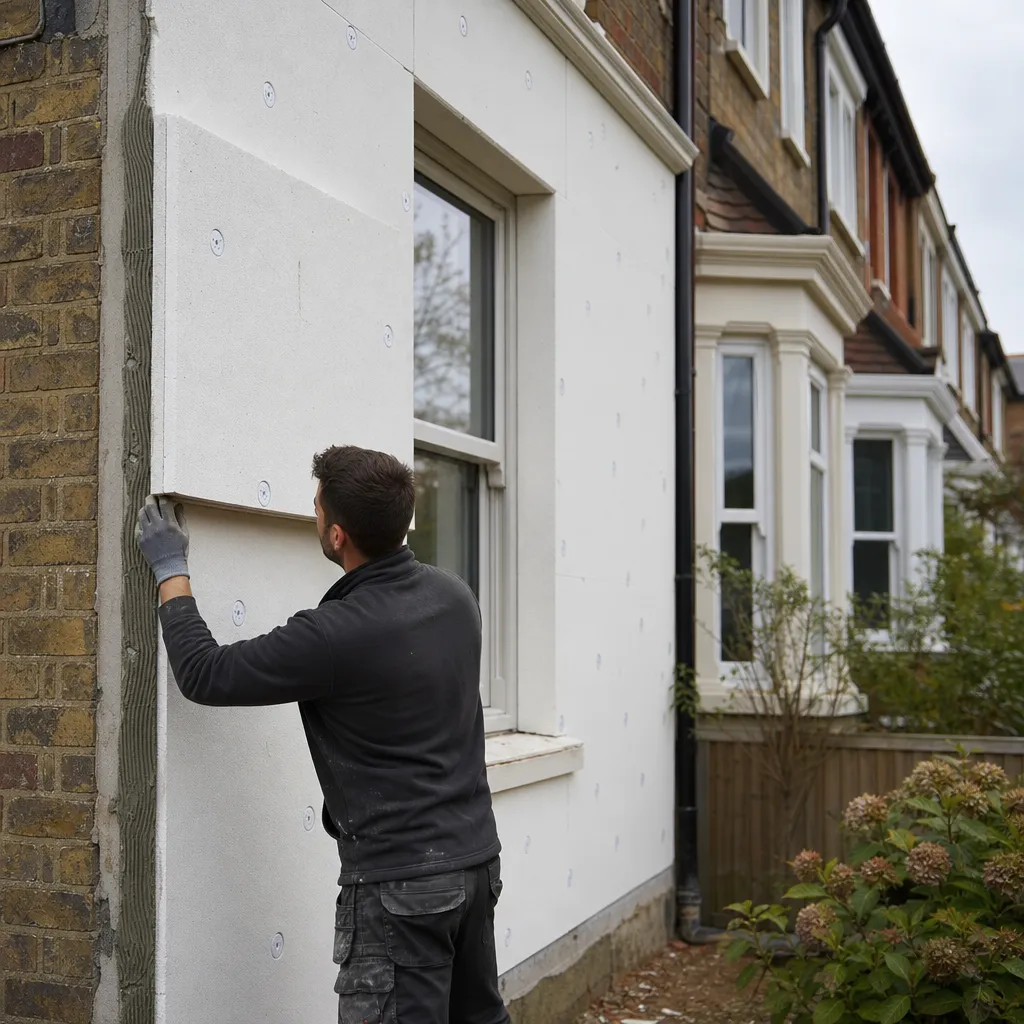
High-Performance Wall Insulation Systems for UK Homes
Insulating the walls of a UK home addresses the single largest source of fabric heat loss in most property types — responsible for up to 35% of heating energy escaping in solid-walled Victorian and Edwardian homes. The choice of insulation system typically arises when a homeowner is pursuing energy bill reductions, preparing for an EPC improvement, or accessing funded retrofit schemes such as ECO4 or the Great British Insulation Scheme (GBIS). Getting the specification wrong — particularly in relation to moisture management — can lead to damp, mould, and structural damage that is expensive to reverse.
Key points
- Building Regulations Approved Document L1B (England) requires retrofitted external walls to achieve a U-value of 0.30 W/m²K or better, where technically and practically feasible.
- PAS 2035:2023 governs all funded retrofit work; a whole-house Retrofit Assessment is required before insulation is specified under ECO4 or GBIS.
- Cavity wall insulation is only appropriate where the cavity is at least 50 mm wide, in good condition, and not in a Zone 3 severe driving-rain exposure area without a suitably rated system.
- Internal wall insulation (IWI) must include a continuous vapour control layer on the warm side of the insulation to prevent interstitial condensation.
- TrustMark registration is required for all installers carrying out funded retrofit work; CIGA membership applies specifically to cavity fill contractors.
Which wall insulation system suits your home?
The right system depends primarily on your wall construction type — cavity or solid — and practical constraints including planning restrictions, tenure, and existing condition.
Cavity wall insulation (CWI)
Most homes built between approximately 1920 and 1995 have a cavity of 50–100 mm between two masonry leaves. Injecting insulation — blown mineral fibre, expanded polystyrene (EPS) beads, or polyurethane foam — is usually the least disruptive and least expensive approach. Indicative installed costs run from £400 to £1,200 for a typical semi-detached house (indicative UK costs, last reviewed 2026-05-25; see CIGA for current benchmarks).
A pre-installation survey must confirm:
- The cavity is at least 50 mm wide and free from rubble, mortar bridging, or prior fill.
- External masonry is in good condition with no defective pointing or cracked render.
- The exposure zone classification does not require a specialist system.
- No existing damp or water ingress is present.
External wall insulation (EWI)
EWI is the primary approach for solid walls — Victorian and Edwardian terraces, stone-built cottages, and pre-1920 brick construction. An insulation board (mineral wool, EPS, or phenolic) is fixed to the outer face and finished with render or cladding, significantly reducing the wall's U-value. Indicative whole-house installed costs typically range from £8,000 to £22,000 for a semi-detached home (indicative, last reviewed 2026-05-25; costs vary by system, wall area, and region; source: Energy Saving Trust).
In conservation areas or on listed buildings, planning consent or listed building consent is very likely required before EWI is installed. Always check with your local planning authority.
Internal wall insulation (IWI)
Where external works are impractical — leasehold flats, planning-restricted terraces, listed buildings — insulation can be applied from inside. Common approaches include:
- A timber studwork frame filled with mineral wool, lined with plasterboard.
- Rigid PIR or phenolic boards fixed directly to the wall (dry-lining).
- Insulated plasterboard composite panels.
All IWI approaches reduce usable floor area and require careful detailing at reveals, skirting boards, and service penetrations. Poorly executed IWI is a leading cause of interstitial condensation failures in retrofitted UK homes.
Comparison of UK wall insulation systems
System | Best for | Typical U-value achievable | Main moisture risk | Typical professional |
|---|---|---|---|---|
Cavity wall insulation | 1920–1995 cavity-wall homes in good condition | 0.50 → 0.28–0.35 W/m²K | Driving rain penetration if cavity defective | CIGA-registered installer |
External wall insulation (EWI) | Solid walls; homes needing external refresh | 2.10 → 0.18–0.30 W/m²K | Render cracking allowing water ingress | BBA/ETA-certified EWI contractor |
Internal wall insulation (IWI) | Flats; listed properties; planning-restricted terraces | 2.10 → 0.30–0.45 W/m²K | Interstitial condensation if vapour control omitted | Retrofit Coordinator; specialist dry-liner |
Hybrid (CWI + IWI or EWI) | High-performance targets; near-Passivhaus retrofits | 0.15 W/m²K or better | Complex detailing if not fully coordinated | Retrofit Coordinator and energy modeller |
What not to assume about wall insulation
"Any cavity wall can be filled." Cavity fill is unsuitable for walls in severe driving-rain zones, for cavities narrower than 50 mm, or for walls with existing damp or defective masonry. A pre-installation survey is a regulatory requirement under BS 8208, not an optional extra.
"Insulation pays for itself quickly." Payback periods for solid wall insulation are typically 20–40 years on energy savings alone. ECO4 or GBIS grant funding, improved thermal comfort, and an EPC uplift can make the investment worthwhile, but the energy-saving case alone is rarely straightforward for solid-wall homes.
"EWI always needs planning permission." In England, EWI is generally permitted development for houses — not flats, not listed buildings, not conservation area properties — provided the finished material does not differ materially in appearance from the existing wall. Confirm with your local planning authority before proceeding.
"Any builder can install EWI." EWI requires a contractor trained and certified under the specific product system being installed. Using an uncertified contractor may void the manufacturer's warranty, invalidate the insurance-backed guarantee, and disqualify the work from funded schemes.
Homeowner checklist before instructing an insulation installer
Important limitations
This article provides general information only. The appropriate insulation system for your home depends on your wall construction, property condition, exposure zone, planning status, and tenure. Incorrect specification can cause damp, structural damage, and health risks. A qualified Retrofit Coordinator (required for PAS 2035-funded work) or an independent energy assessor should assess your property before any system is specified. Grant scheme eligibility, regulations, and available products change; always verify current information with GOV.UK and the Energy Saving Trust.
When this becomes urgent
Seek professional assessment without delay if:
- You notice new or worsening damp, staining, or mould after any insulation work has been completed.
- An installer proposes filling your cavity without conducting a pre-installation survey.
- You have been offered free insulation and cannot confirm the installer holds TrustMark registration.
- Existing EWI or IWI is visibly cracking, delaminating, or appears to be trapping moisture against the wall.
What to ask a qualified professional
- What wall construction type and exposure zone does my property fall into?
- Is my cavity in suitable condition for filling, based on the pre-installation survey?
- Do you hold TrustMark registration and CIGA membership (cavity) or BBA/ETA system approval (EWI)?
- Will you provide a whole-house Retrofit Assessment under PAS 2035 before specifying the system?
- What U-value will the installed system achieve, and does it meet the Part L1B guideline?
- What insurance-backed guarantee is provided with the installation?
- What ventilation measures are included in the specification?
When to get professional help
A qualified professional should be involved before insulation is specified — not just at installation stage. If there are existing signs of damp, cracked render, or defective pointing, a chartered surveyor or building pathologist should identify the cause before insulation is added. Never allow cavity fill to proceed without a pre-installation survey; this is a requirement under BS 8208 and standard industry practice.
How Housey can help
Housey connects homeowners with vetted insulation installers and energy-efficiency consultants across the UK. If you are considering a whole-house retrofit pathway, our retrofit assessments service can match you with a PAS 2035-qualified Retrofit Coordinator to guide specification and funding options.
Frequently asked questions
Does cavity wall insulation require planning permission?
No, for most houses in England, cavity wall insulation does not require planning permission. Exceptions include listed buildings, properties on Article 2(3) land such as conservation areas, and some flats. Always confirm with your local planning authority before proceeding.
What U-value should my wall achieve after insulation?
Under Building Regulations Part L1B (England), the guideline U-value for retrofitted existing walls is 0.30 W/m²K, subject to technical and practical feasibility. For funded retrofit work, your Retrofit Coordinator will set the target based on a whole-house energy model under PAS 2035.
Can I insulate a solid wall without changing the external appearance of my home?
Yes, using internal wall insulation (IWI). This involves lining walls from inside with insulation boards or a studwork system, leaving the external appearance unchanged. However, IWI reduces usable floor area and must be carefully detailed with vapour control to prevent interstitial condensation.
What funding is available for wall insulation in the UK?
The ECO4 scheme provides funding for eligible low-income and vulnerable households through energy suppliers. The Great British Insulation Scheme (GBIS) also targets solid-walled and under-insulated homes. Eligibility and availability change frequently; check the current position on GOV.UK or with the Energy Saving Trust.
Sources and further reading
- Building Regulations Approved Document L — GOV.UK
- PAS 2035:2023 Retrofitting dwellings — BSI / TrustMark
- Cavity insulation standards and guidance — CIGA
- Solid wall insulation — Energy Saving Trust
- Energy grants and funding checker — GOV.UK
Useful next reads
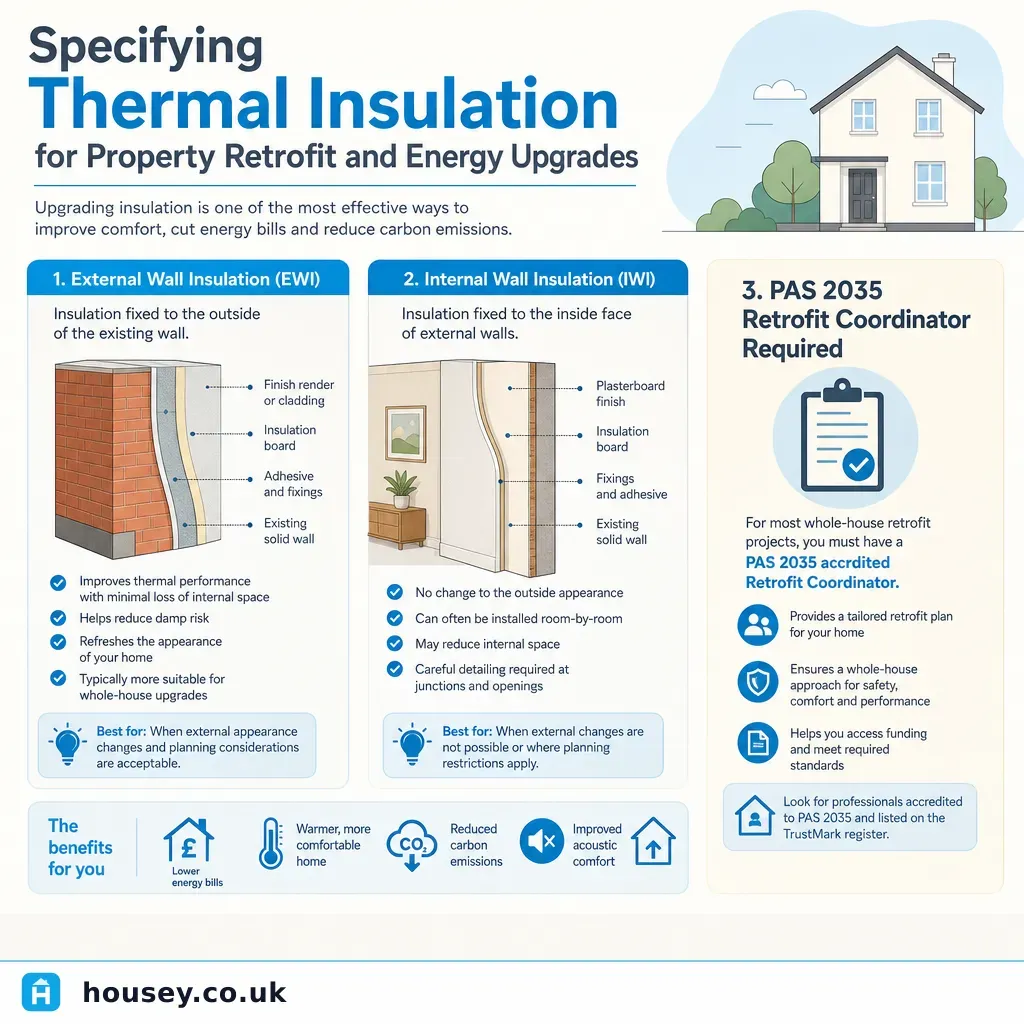 Energy & Retrofit
Specifying Thermal Insulation for Property Retrofit and Energy Upgrades
Specifying thermal insulation for UK retrofit requires matching the product to your property's construction, moisture conditions, and heating system.
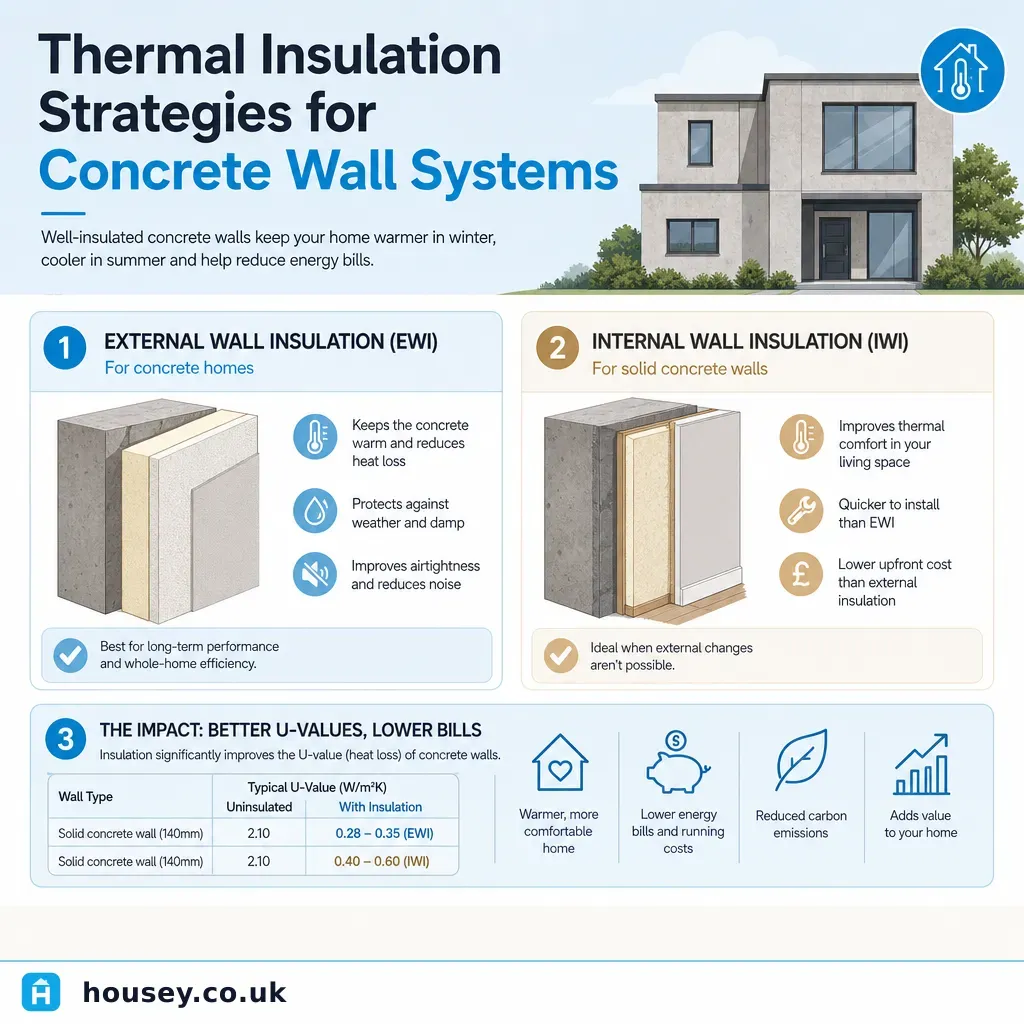 Energy & Retrofit
Thermal Insulation Strategies for Concrete Wall Systems
Concrete walls can be insulated using three main approaches: external wall insulation (EWI), internal wall insulation (IWI), or — where a cavity exists — cavity fill.
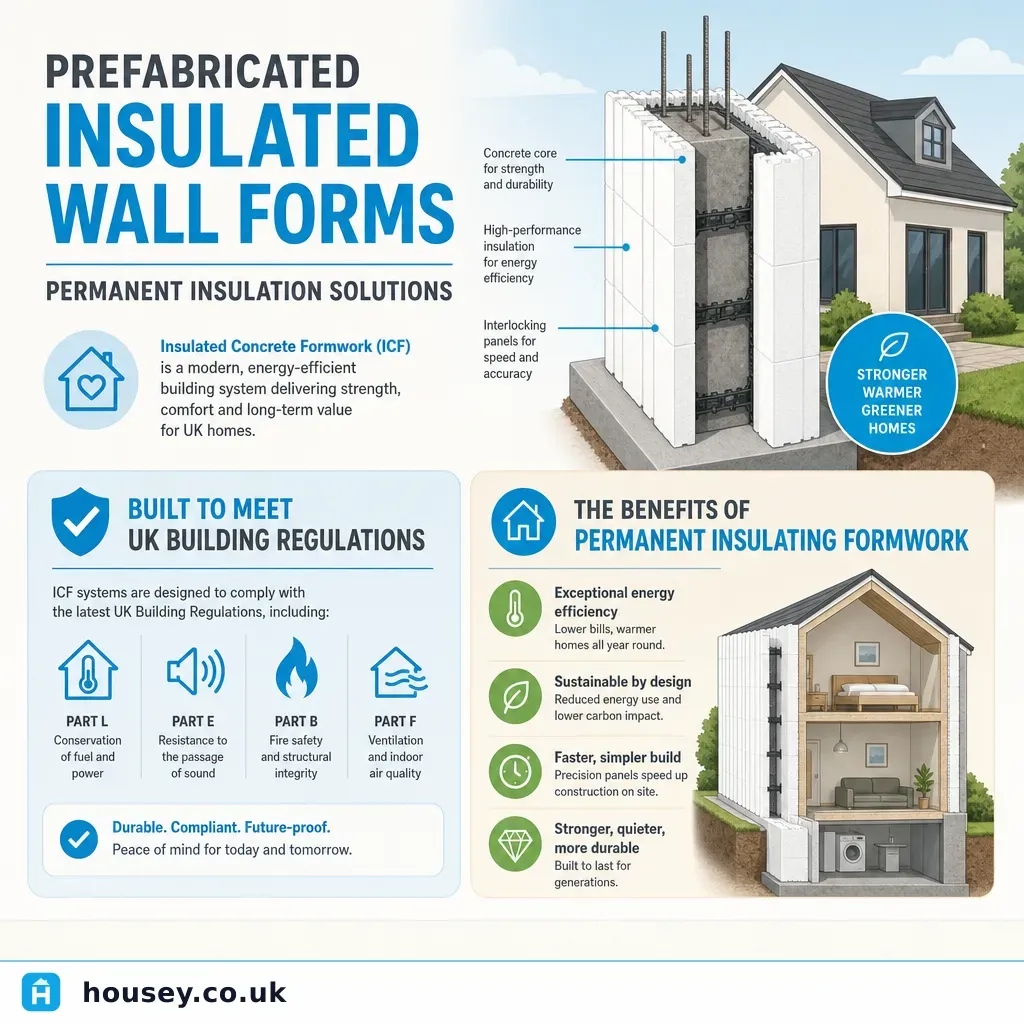 Energy & Retrofit
Prefabricated Insulated Wall Forms: Permanent Insulation Solutions
Prefabricated insulated wall forms — including ICF and SIPs systems — deliver high thermal performance by combining permanent insulation with structural concrete or timber in a single wall assembly.
 Energy & Retrofit
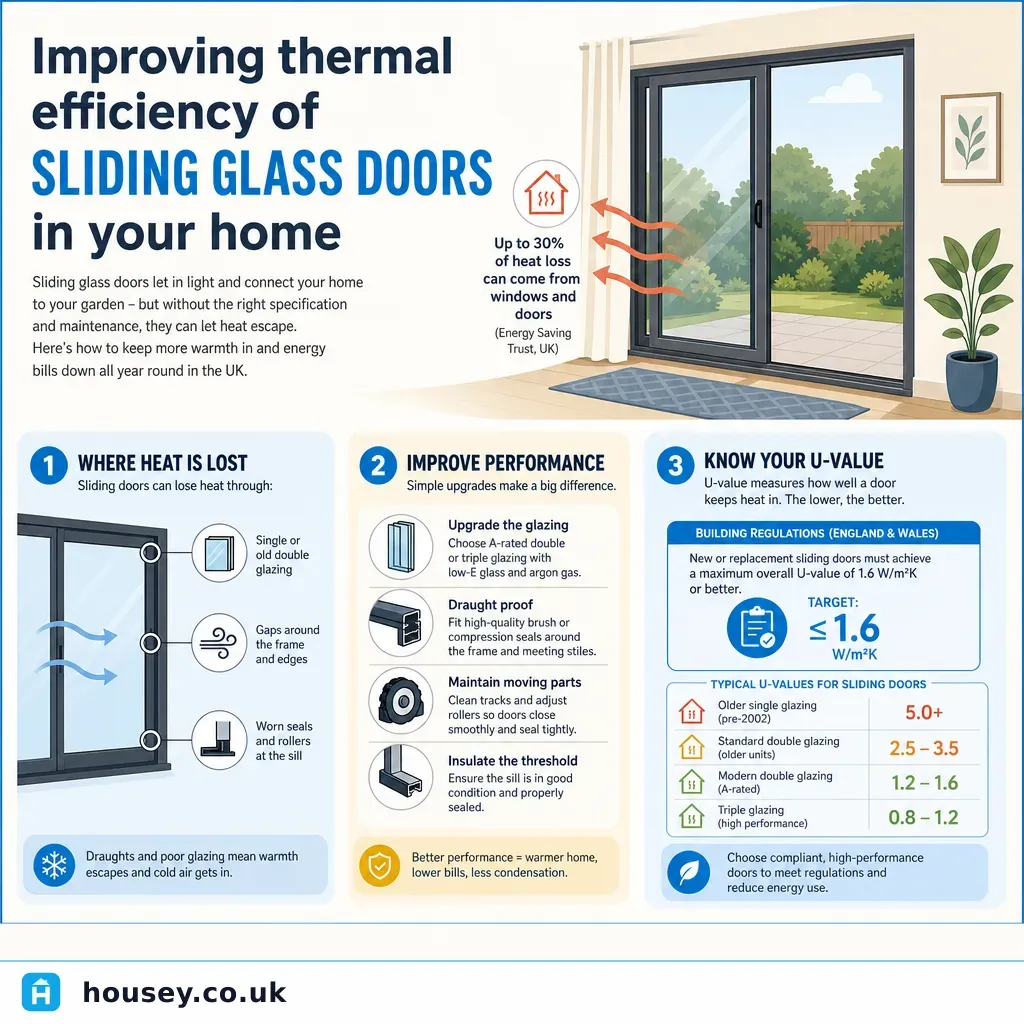
Improving thermal efficiency of sliding glass doors in your home
Sliding glass doors lose heat through the glazing unit, the frame, and air gaps in worn seals.
 Energy & Retrofit
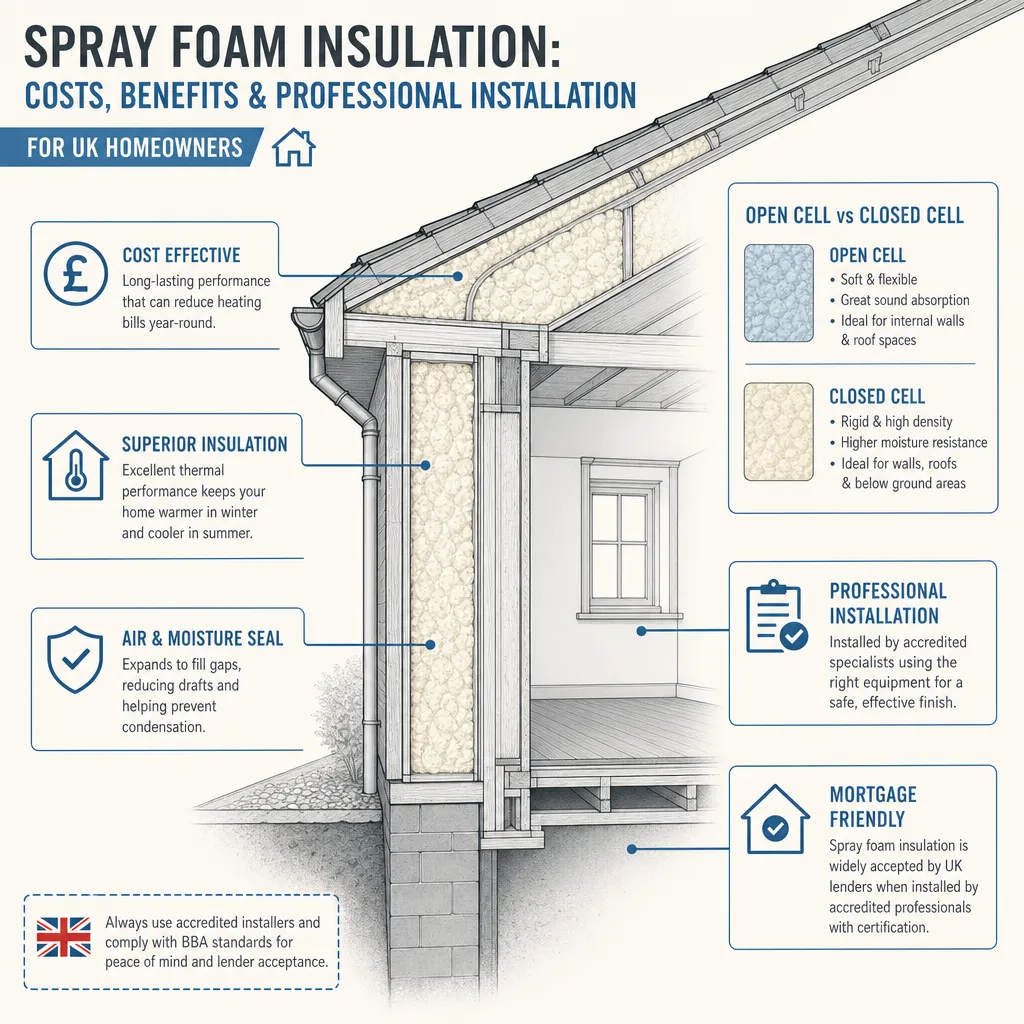
Spray foam insulation: costs, benefits and professional installation
Spray foam insulation costs between £15 and £60 per square metre installed in the UK, depending on whether open-cell or closed-cell foam is used.