Hiring a Tree Surgery Specialist: Key Questions and Expectations
By Housey · Last reviewed 7th of May 2026
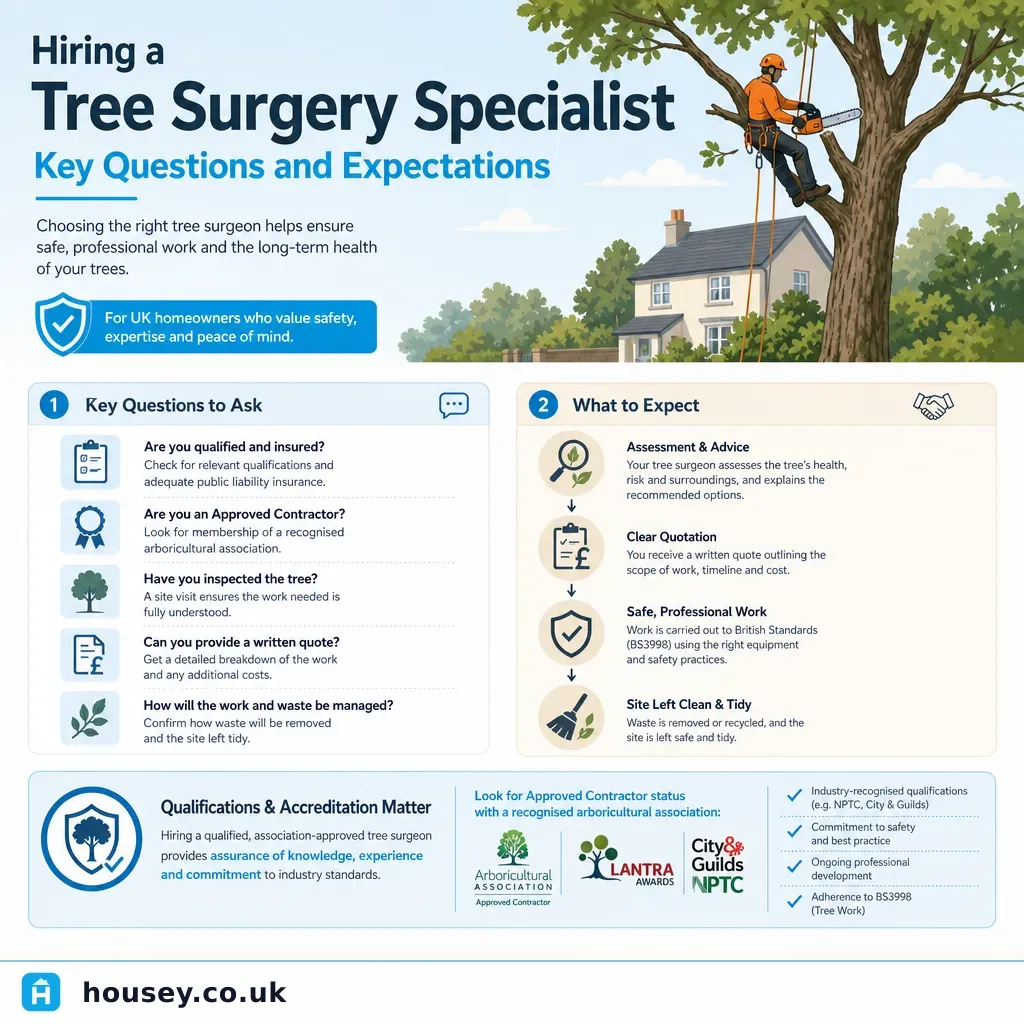
Hiring a Tree Surgery Specialist: Key Questions and Expectations
Tree work often becomes urgent — a storm-damaged limb, an overgrown boundary tree, or a removal needed before a planned extension. Knowing what to look for in a tree surgeon before you call anyone out can be the difference between a safe, well-executed job and a costly dispute. In the UK, tree surgery is an unregulated trade in name, but professional standards, qualifications, and legal obligations around protected trees create clear markers of competence.
Key points
- Trees subject to a Tree Preservation Order (TPO) require written consent from your local planning authority (LPA) before any pruning or removal; work without consent can result in a fine of up to £20,000 in a magistrates' court or an unlimited fine in a Crown Court.
- Trees in a Conservation Area with a trunk diameter of 75mm or more at 1.5m height require six weeks' prior notification to the LPA before most works, under the Town and Country Planning (Tree Preservation) (England) Regulations 2012.
- Competent tree surgeons hold NPTC (Lantra Awards) chainsaw certificates — at minimum CS30 (safe use of a chainsaw) and CS31 (felling trees up to 380mm) — under a nationally recognised qualification framework.
- The Arboricultural Association (AA) maintains a directory of independently assessed approved contractors; search at trees.org.uk before making any approach.
- Any contractor working near overhead power lines must follow the Electricity at Work Regulations 1989 and demonstrate awareness of safe working distances from conductors.
Does your tree need a survey or just surgery?
A tree surgeon carries out physical work — pruning, crown reduction, deadwooding, felling. An arboricultural consultant produces written reports: TPO applications, BS 5837 tree surveys required by most LPAs before planning decisions near existing trees, and formal tree risk assessments. If you are planning an extension or loft conversion near trees, you will almost certainly need an arboricultural survey before applying for planning permission, separate from any surgery work.
Check before booking whether:
- Any trees on or adjacent to your plot carry a TPO (searchable via your LPA's online planning portal).
- Your property sits within a Conservation Area (check your council website or the Historic England National Heritage List for England).
- A planning application is anticipated in the near future — in which case a formal tree survey may be required before surgery proceeds.
What qualifications should a tree surgeon hold?
Tree surgery involves working at height with chainsaws, operating chippers, and rigging loads — all activities with genuine risk. Qualifications and memberships to look for:
Qualification or membership | What it confirms | Where to verify |
|---|---|---|
NPTC CS30 & CS31 (Lantra Awards) | Safe chainsaw operation at ground level | Ask to see certificates; note expiry dates |
NPTC CS38 or CS39 | Aerial chainsaw work when climbing | Essential for any powered work at height |
City & Guilds 0660 or equivalent | Broader arboricultural competence | Relevant for complex crown or structural work |
Arboricultural Association Approved Contractor | Independent business-level assessment | Search the AA directory at trees.org.uk |
ISA Certified Arborist | International Society of Arboriculture credential | Relevant for consultancy or written report work |
Membership of a professional body does not guarantee quality, but it confirms the contractor has been vetted and is required to hold adequate insurance as a condition of membership.
What insurance must a tree surgeon carry?
Request written evidence of:
- Public liability insurance — a minimum of £5 million is standard; larger firms working close to occupied buildings often carry £10 million.
- Employers' liability insurance — legally required for any business with employees under the Employers' Liability (Compulsory Insurance) Act 1969; minimum cover is £5 million.
- Professional indemnity — relevant if the contractor also provides written reports, TPO applications, or formal arboricultural assessments.
Ask to see current certificates, not photocopies of historic documents.
What to ask before accepting a quote
Put these questions to every tree surgeon you are seriously considering:
- Are you able to provide your NPTC chainsaw certificates for the type of work involved?
- Are you a member of the Arboricultural Association or another recognised professional body?
- What public liability cover do you carry, and can you provide a current certificate?
- Will you check whether the tree has a TPO or is within a Conservation Area before work starts?
- Who will carry out the work on the day — your own staff, or subcontractors? Are subcontractors covered under your insurance policy?
- What happens to the timber and arisings — is removal included in the quote or charged separately?
- Will you provide a written specification referencing BS 3998:2010 before any work begins?
- Will you notify relevant utility companies if overhead lines are nearby?
- What is your procedure if unexpected defects or hazards are discovered during the work?
Red flags to watch for
- No written quote. Reputable tree surgeons provide a written specification before work begins — without one, scope disputes are very difficult to resolve.
- Unsolicited doorstep approaches. Legitimate contractors rarely cold-call; if someone knocks claiming your tree needs urgent work, seek an independent second opinion before committing.
- No evidence of insurance. Verbal assurances are not sufficient. Uninsured tree work creates significant liability if a branch damages property or injures a bystander.
- Pressure to start immediately. Even genuinely urgent situations allow time for a brief credentials check.
- Large cash deposit demanded upfront. A modest deposit is reasonable on substantial jobs; demands for more than 25–30% upfront are a warning sign.
- No mention of TPOs or Conservation Area rules. A competent contractor should routinely ask about protected status before quoting.
- Crown topping proposed as standard. Cutting all leaders to a uniform height is widely considered harmful to tree health and is contrary to BS 3998:2010 guidance.
Comparing quotes for tree surgery
When gathering multiple quotes — three is a reasonable minimum — ensure each covers an identical scope:
Item to compare | Why it matters |
|---|---|
Exact scope of work (crown reduction percentage, specific limbs) | Prevents scope disputes on the day |
Stump grinding included or charged separately | Often a significant additional cost |
Arisings removal versus left on site | Material difference in time and overall price |
Access arrangements and any specialist equipment | Mobile elevated work platforms add cost |
BS 3998:2010 compliance noted in the quote | Confirms professional standards will be applied |
Projected start date and working duration | Helps with garden access and neighbour communication |
When to get professional help
Call a qualified arboricultural consultant rather than a tree surgeon if:
- You are unsure whether a tree has a TPO — carrying out work without consent is a criminal offence.
- A neighbouring tree is damaging your property and you anticipate a legal or insurance dispute.
- A developer's BS 5837 tree survey has identified trees on your plot requiring protection during construction.
- A tree appears structurally unsafe and you need a formal written risk assessment for insurers or your LPA.
- You need a TPO application or Conservation Area exemption justification submitted to your council.
For physical surgery work only, an AA Approved Contractor with the correct NPTC certificates and current insurance is the appropriate starting point.
How Housey can help
Housey connects UK homeowners with vetted tree surgeons and arboricultural survey providers, allowing you to request quotes, compare credentials, and review profiles in one place. If your project also involves garden landscaping once tree work is complete, landscapers are available through the platform.
Frequently asked questions
Do I need planning permission to cut down a tree in my garden?
Not in most cases, but important exceptions apply. If the tree has a Tree Preservation Order, you must apply to your local planning authority before any work. In a Conservation Area, trees with a trunk diameter over 75mm at 1.5m height require six weeks' prior notice to the LPA. Check your council's planning portal or contact your LPA directly to confirm protected status before commissioning any tree surgery.
How much does tree surgery cost in the UK?
Costs vary considerably based on tree size, species, access, scope, and location. Indicative UK costs, last reviewed 2026-05-07: a straightforward small-to-medium tree removal might range from £200 to £1,000+; large or complex removals near structures can exceed £3,000. Stump grinding is usually charged separately. Always obtain at least three written quotes on an identical specification before committing.
Can I cut branches from my neighbour's tree that overhang my garden?
You are generally entitled to cut back overhanging branches to the boundary line, but the cut timber legally belongs to your neighbour and must be offered back to them. You have no right to enter their property without permission. If roots are causing structural damage, the legal position is more nuanced — take advice from a solicitor familiar with property law before taking any action.
What is BS 3998:2010 and why does it matter?
BS 3998:2010 is the British Standard for tree work recommendations, published by the British Standards Institution. It defines best practice for pruning techniques, surgery operations, and reporting. Reputable tree surgeons and local planning authorities routinely reference it. Specifying BS 3998:2010 compliance in your written quote helps ensure proper pruning cuts, appropriate crown management, and professional standards throughout.
Sources and further reading
- Tree Preservation Orders and trees in conservation areas — GOV.UK
- Find an Arboricultural Association Approved Contractor — Arboricultural Association
- BS 3998:2010 Tree work recommendations — British Standards Institution
- Town and Country Planning (Tree Preservation) (England) Regulations 2012 — legislation.gov.uk
- Working safely near overhead electricity lines — HSE
Useful next reads
 Improvement & Build
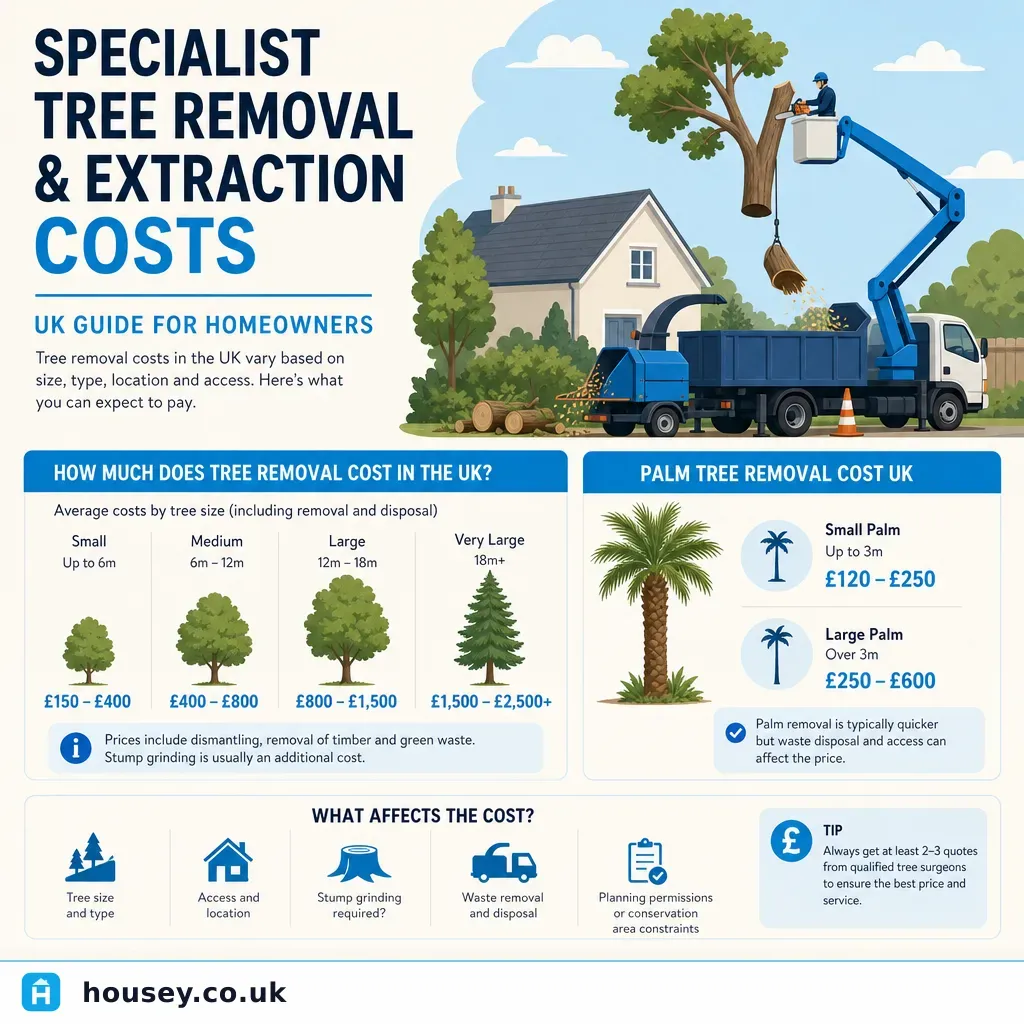
Specialist Tree Removal and Extraction Costs
Specialist tree removal costs in the UK range from around £150 for small trees to £3,000 or more for large mature specimens, with palm trees typically costing more due to specialist technique.
 Improvement & Build
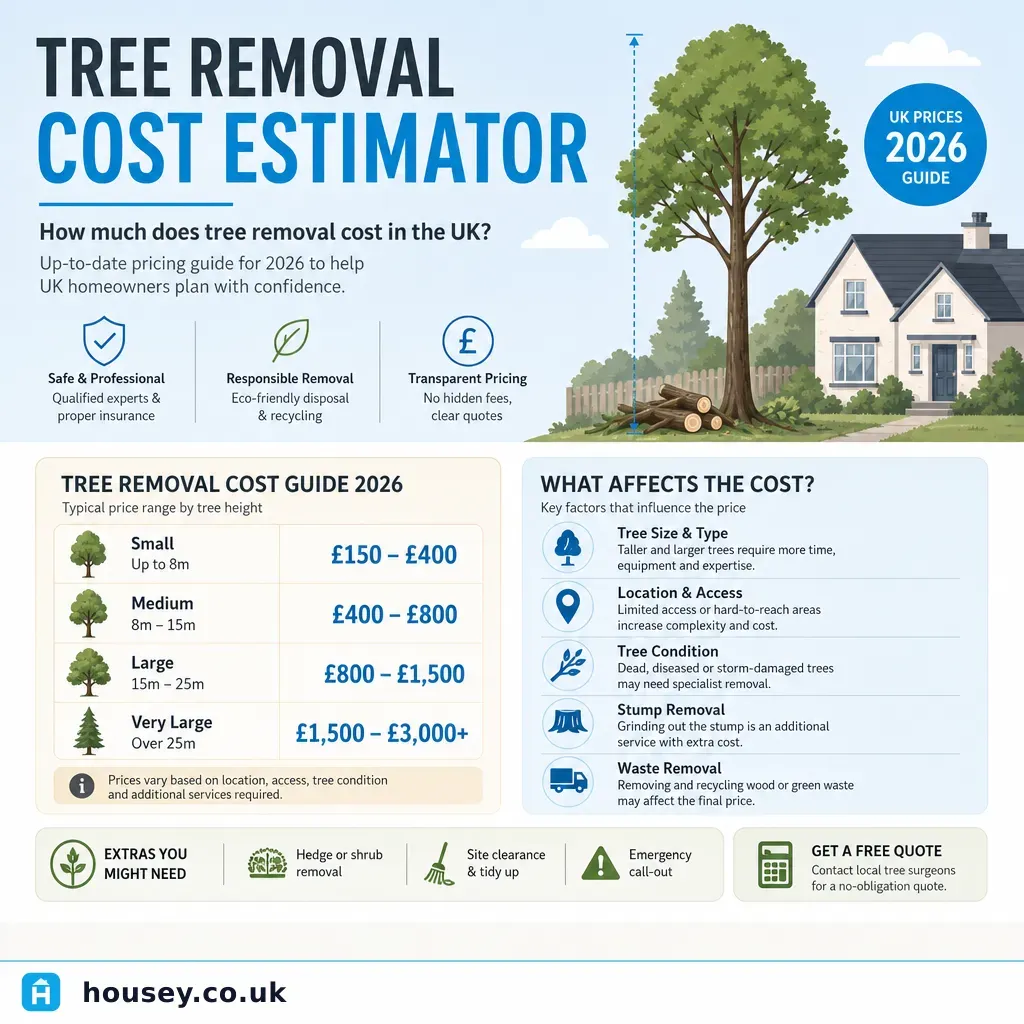
Tree Removal Cost Estimator
Tree removal in the UK costs roughly £150 to £5,000 or more, depending on the tree's height, species, access conditions, and whether stump removal is needed.
 Improvement & Build
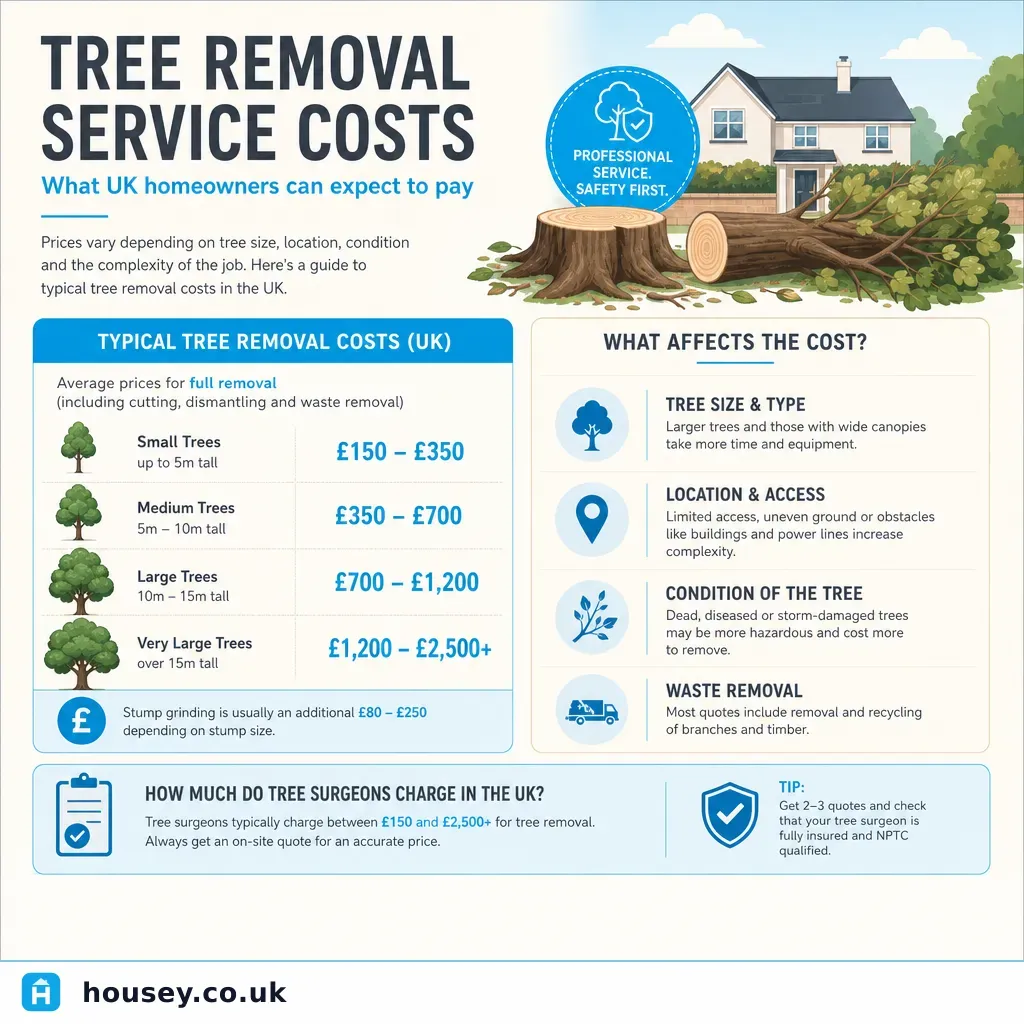
Tree Removal Service Costs
Professional tree removal costs in the UK depend on tree height, access, species, and the scope of work included.
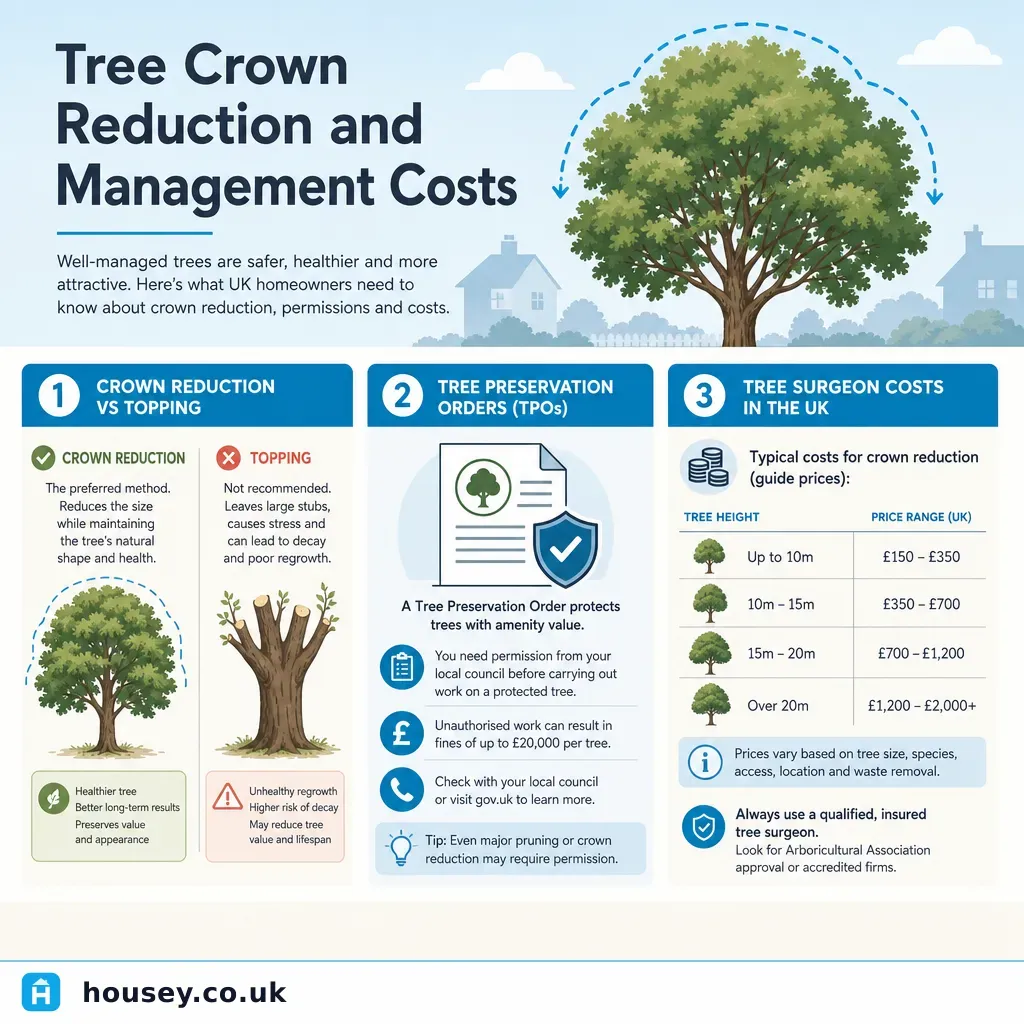 Improvement & Build
Tree Crown Reduction and Management Costs
Crown reduction reduces a tree's overall size by 15–30% while preserving its natural shape, and must follow BS 3998:2010.
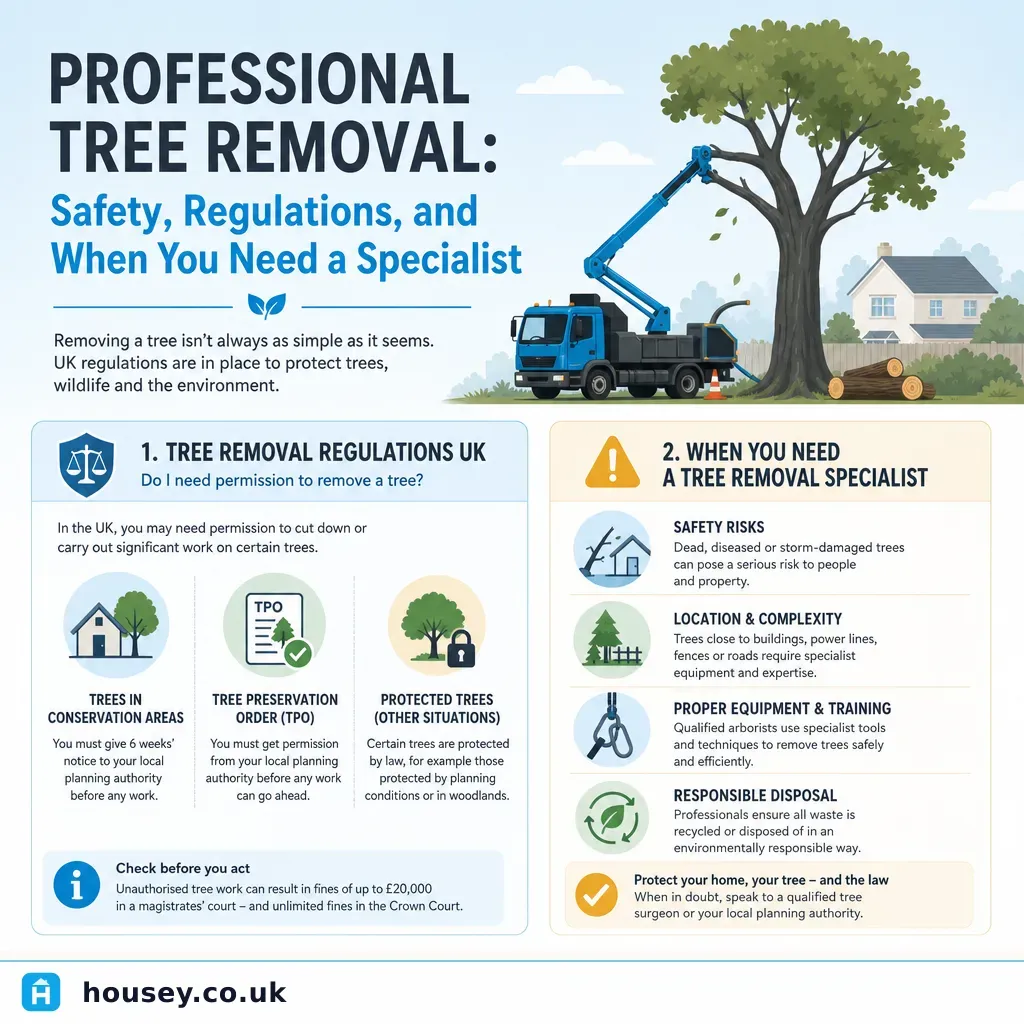 Improvement & Build
Professional Tree Removal: Safety, Regulations, and When You Need a Specialist
Professional tree removal in the UK often requires checking for Tree Preservation Orders or conservation area protections before any work begins.