Specialist Tree Removal and Extraction Costs
By Housey · Last reviewed 7th of May 2026
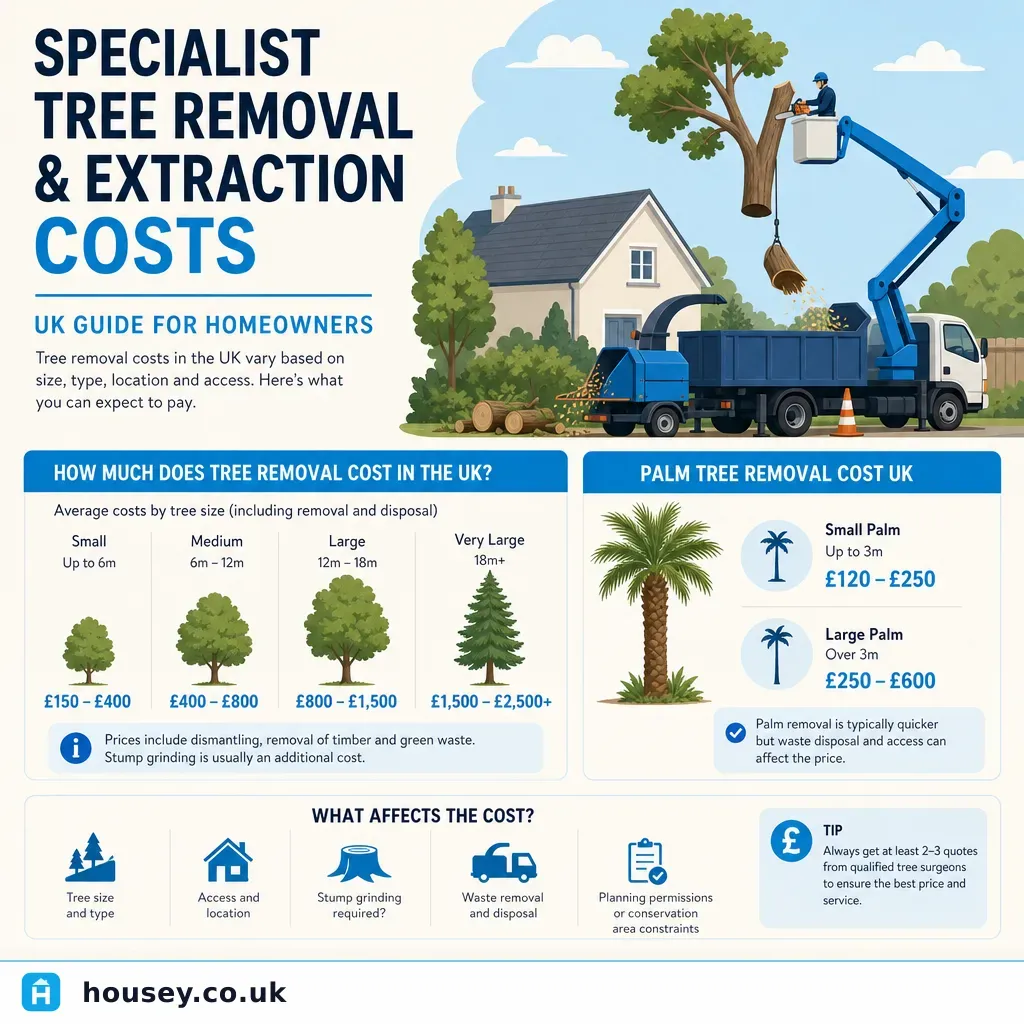
Specialist Tree Removal and Extraction Costs
Tree removal becomes necessary for many UK homeowners when a tree is diseased, structurally unsafe, blocking light, or interfering with foundations or drainage. The cost depends on tree size, species, site access, and whether any legal protections apply — understanding these factors before approaching contractors avoids surprises and helps you compare quotes fairly.
Key points
- Small tree removal (up to 5m) typically costs £150–£400; large mature trees can reach £2,000–£3,500 or more — indicative UK costs, last reviewed 2026-05-07.
- Check for a Tree Preservation Order (TPO) or Conservation Area designation before any work — felling without consent is a criminal offence under the Town and Country Planning Act 1990.
- Stump grinding is usually priced separately, adding £60–£250 depending on stump diameter.
- Palm tree removal requires specialist blades and often rope access; costs typically exceed those for a comparable-sized broadleaf or conifer.
- Verify any arborist carries public liability insurance (minimum £5 million standard in the sector) and holds NPTC or City & Guilds chainsaw qualifications — check via the Arboricultural Association's approved contractor register.
What affects tree removal costs?
Tree size and crown diameter drive labour and equipment requirements most directly. Site access is the next biggest variable — a tree requiring sectional dismantling over a roof or near overhead cables involves more risk and time than one in open garden. Waste disposal (chipping, log removal, or skip hire) is usually quoted separately. Palm trees carry a cost premium because their fibrous, non-laminar trunks require specialist blades rather than standard chainsaw methods, and debris is denser and slower to process.
Additional services commonly quoted separately:
- Stump grinding: reduces the stump below ground level. Recommended before replanting or hard landscaping.
- Stump removal: full extraction including root ball — more disruptive and more expensive.
- Crown reduction or pollarding: if full removal is not needed, this is usually cheaper and preserves the tree.
Indicative UK tree removal costs
Indicative UK costs, last reviewed 2026-05-07. Costs vary by region, access, species, and disposal requirements. Always obtain at least three quotes.
Tree height | Typical cost range | Notes |
|---|---|---|
Small (up to 5m) | £150–£400 | Garden trees, small conifers, young specimens |
Medium (5–10m) | £400–£900 | Established garden trees, standard conifers |
Large (10–20m) | £900–£2,000 | Mature hardwoods, section felling required |
Very large (over 20m) | £2,000–£3,500+ | Specialist equipment and access required |
Palm tree (any size) | £300–£1,500+ | Specialist technique; varies with height and trunk diameter |
Stump grinding (add-on) | £60–£250 | Depends on stump diameter |
Stump removal (add-on) | £200–£600+ | Full extraction including root ball |
Sources: Arboricultural Association contractor guidance; Checkatrade and Rated People indicative market data, 2025–2026. Prices are estimates — actual quotes will vary.
Tree Preservation Orders and Conservation Areas
A Tree Preservation Order (TPO) is made by a local planning authority (LPA) and protects specific trees. Any work on a TPO tree requires LPA consent — felling without it carries an unlimited fine. Check your LPA's planning portal or contact the tree officer to confirm status.
In England, trees in Conservation Areas with a trunk diameter of 75mm or more at 1.5m above ground are automatically protected. You must give the LPA six weeks' written notice before felling or significant pruning. The GOV.UK guidance on Tree Preservation Orders covers the full process for England.
If a neighbour's tree overhangs your property, you may cut it back to the boundary — but the severed material remains the neighbour's property. Always confirm TPO status before trimming.
What to ask before accepting a quote
- What is included — felling, sectioning, chipping, and waste removal?
- What qualifications does the operative hold (NPTC or City & Guilds chainsaw units)?
- Can I see your public liability insurance certificate?
- Have you checked for a TPO on this tree, and will you handle any consent application needed?
- Is VAT included in the quoted price?
- Who is responsible for disposing of all arising material?
- What could change the price or timeline once work begins?
Red flags when hiring a tree surgeon
- Verbal quote with no written breakdown of costs and scope.
- Cannot produce proof of public liability insurance.
- Holds no relevant qualification and cannot name their chainsaw certification.
- Does not ask about TPO status or Conservation Area designation before starting.
- Offers to fell a large tree in a single operation where sectional dismantling is clearly required.
- Requests full payment upfront before work is completed.
Which approach do you need?
- Full removal: tree is dead, diseased beyond recovery, structurally unsafe, or cannot remain in its location safely.
- Crown reduction or pollarding: tree is healthy but overgrown — usually cheaper, preserves the tree.
- Crown lifting: concern is low-level light or clearance rather than overall height.
- Consult a qualified arborist: fungal growth, significant dead wood, root damage, or any structural concern.
- Contact your LPA first: potential TPO, Conservation Area designation, or planning condition involved.
When to get professional help
Tree removal and significant pruning above 2m must always be carried out by a qualified, insured arborist. The HSE's guidance on working at height is clear that chainsaw work at height carries serious injury risk without proper training and equipment. Do not proceed without a professional if the tree is near structures, overhead cables, or shows signs of instability such as root plate lift, a basal cavity, or fungal brackets.
How Housey can help
Housey connects you with vetted tree surgeons who are accredited, insured, and familiar with local TPO requirements. Submit one request and receive comparable quotes from qualified local arborists.
Frequently asked questions
Do I need planning permission to cut down a tree in my garden?
You do not need planning permission for most trees unless a Tree Preservation Order (TPO) applies or the tree sits in a Conservation Area. In England, Conservation Area trees with a trunk diameter of 75mm or more at 1.5m height require six weeks' notice to the local planning authority before felling. Failing to give notice is a criminal offence carrying an unlimited fine.
Why is palm tree removal more expensive than other species?
Palm trunks are fibrous and non-laminar, requiring specialist blades rather than standard chainsaw equipment. Operatives often need rope access or elevated work platforms, and the dense fibrous sections are heavier to handle and dispose of than equivalent broadleaf or conifer timber. These factors combine to push costs above those for comparably sized conventional trees.
How long does tree removal typically take?
A small garden tree can usually be removed in two to four hours. A large mature tree requiring sectional dismantling, specialist access equipment, and full stump grinding may take a full day or more. Restricted access or proximity to structures extends the programme further and will be reflected in the contractor's quote.
Is stump grinding always necessary?
Stump grinding is not legally required but is generally recommended if you plan to replant, lay hard landscaping, or restore a lawn. Untreated stumps from vigorous species such as cherry or hornbeam can regrow, attract fungal decay, and become trip hazards over time. Discuss the options and costs with your arborist when obtaining quotes.
Can my neighbour object to me removing a tree in my own garden?
Your neighbour cannot prevent you removing a tree on your own land, provided no Tree Preservation Order applies and the tree is not in a Conservation Area requiring notice. If a tree sits on a boundary or is subject to a planning condition, check your title deeds first. Severed branches from a neighbour's overhanging tree legally remain the neighbour's property.
Sources and further reading
- Tree Preservation Orders and trees in conservation areas — GOV.UK
- Find an Arborist — Arboricultural Association
- Working at height: a brief guide — Health and Safety Executive
- Town and Country Planning Act 1990, Part VIII — legislation.gov.uk
Useful next reads
 Improvement & Build
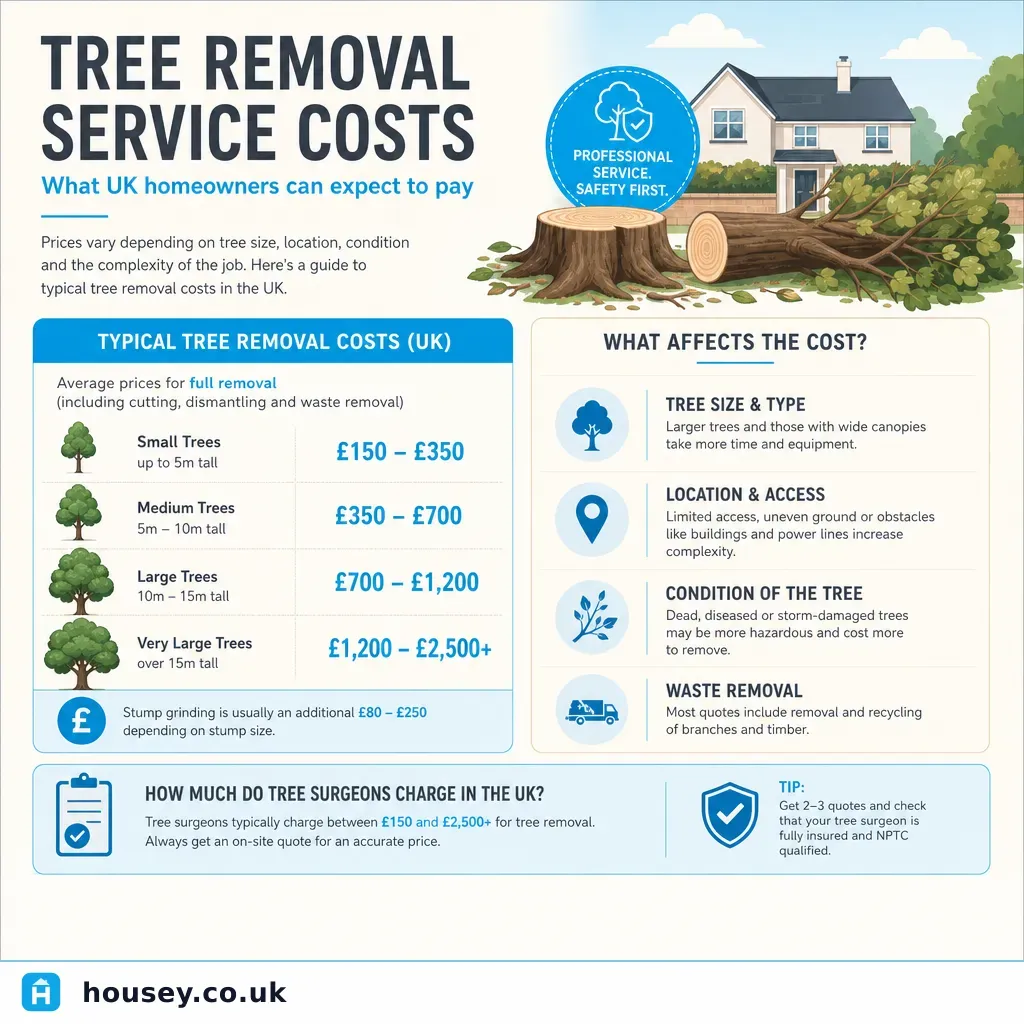
Tree Removal Service Costs
Professional tree removal costs in the UK depend on tree height, access, species, and the scope of work included.
 Improvement & Build
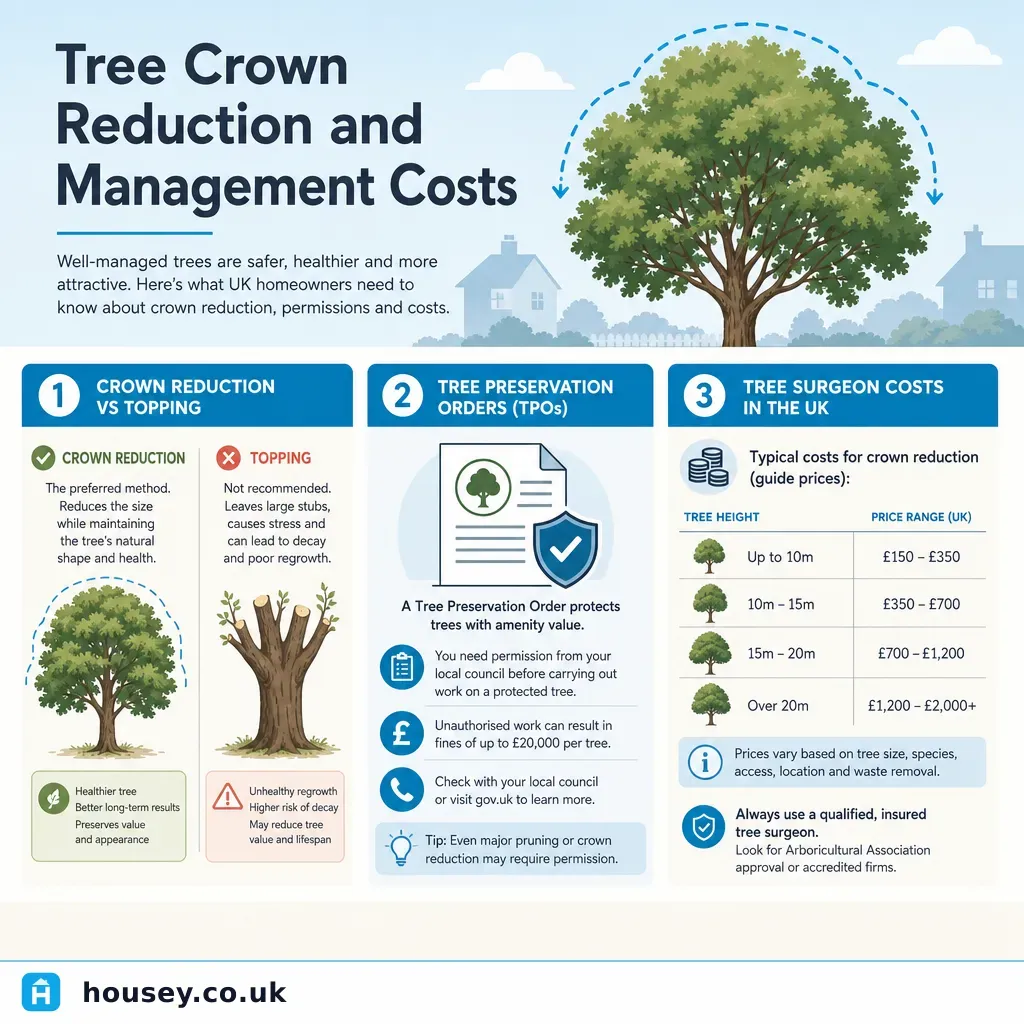
Tree Crown Reduction and Management Costs
Crown reduction reduces a tree's overall size by 15–30% while preserving its natural shape, and must follow BS 3998:2010.
 Improvement & Build
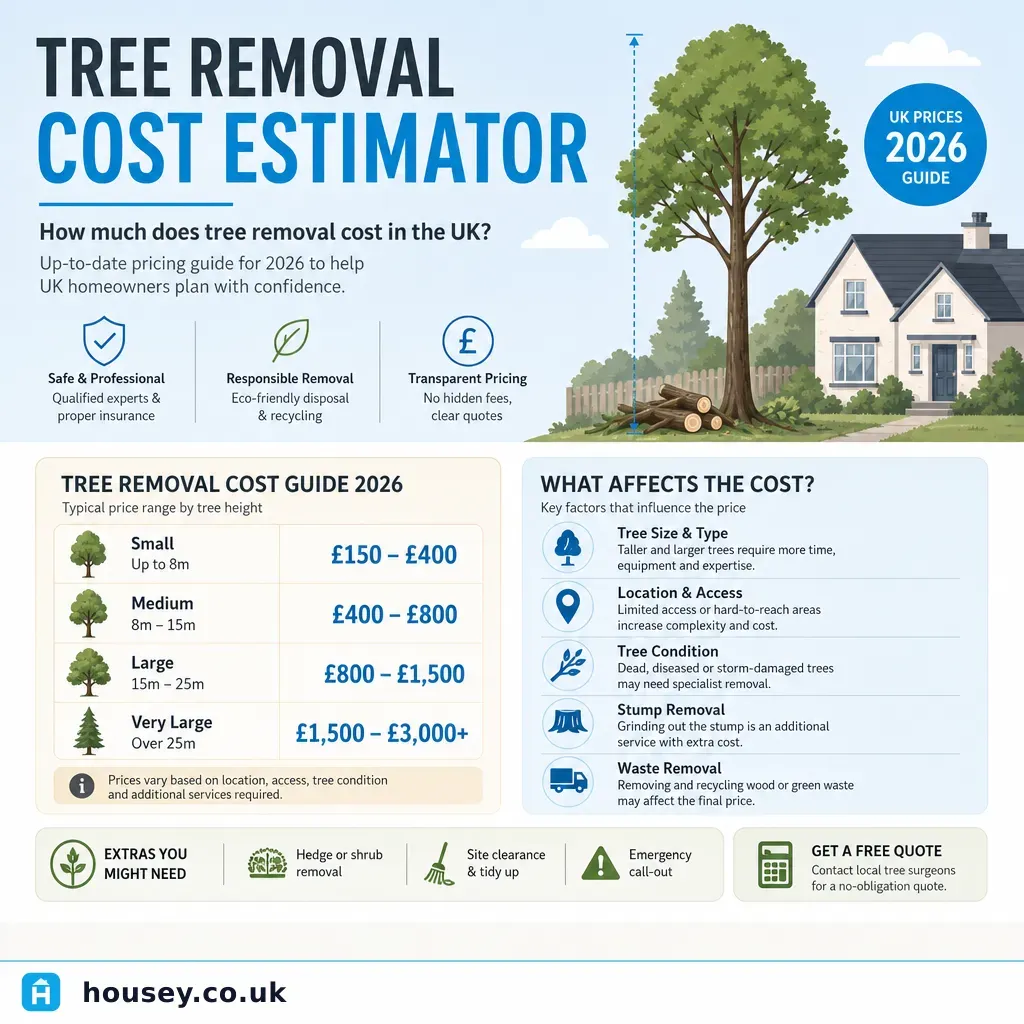
Tree Removal Cost Estimator
Tree removal in the UK costs roughly £150 to £5,000 or more, depending on the tree's height, species, access conditions, and whether stump removal is needed.
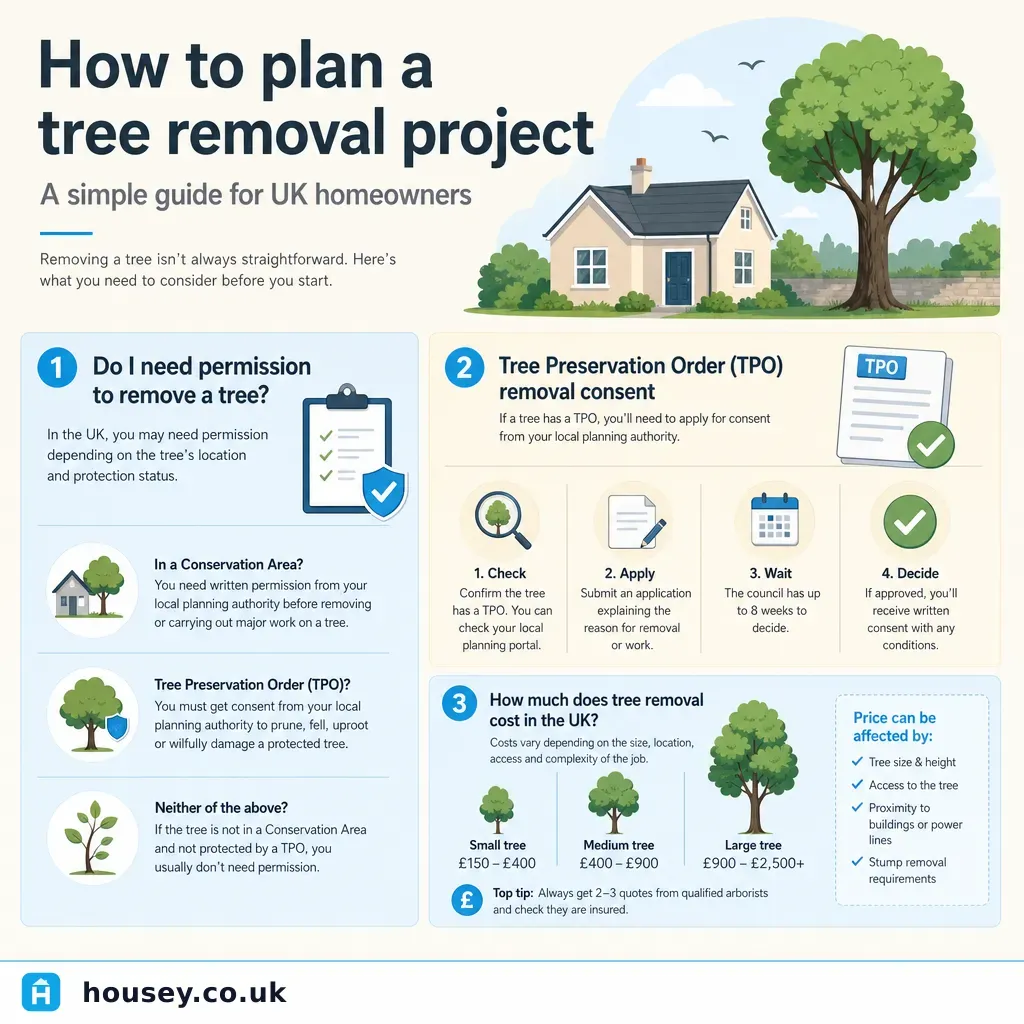 Improvement & Build
How to plan a tree removal project
Planning a tree removal project starts with checking whether the tree is protected by a Tree Preservation Order or sits in a conservation area, as both require council consent before any work begins.
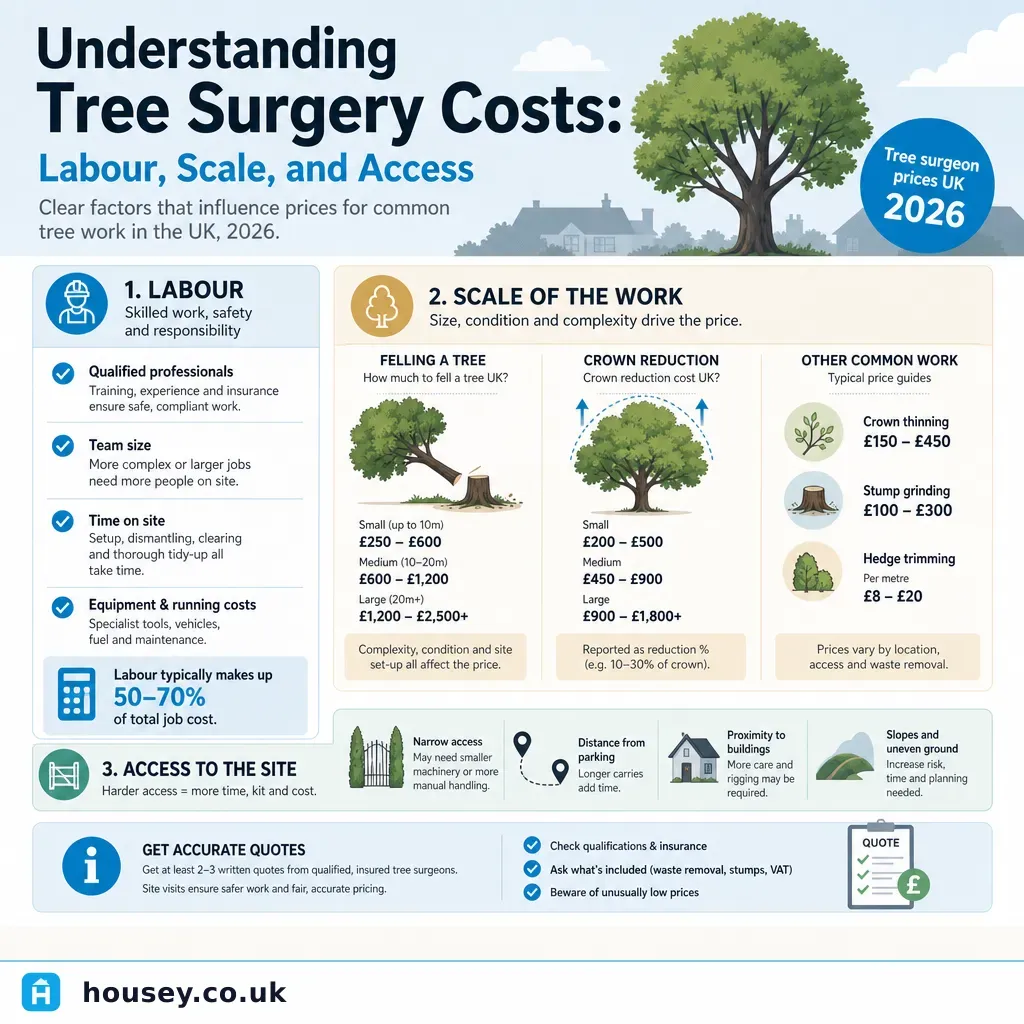 Improvement & Build
Understanding Tree Surgery Costs: Labour, Scale, and Access
Tree surgery costs in the UK depend on tree height, species, condition, and site access.