Professional Tree Removal: Safety, Regulations, and When You Need a Specialist
By Housey · Last reviewed 18th of May 2026
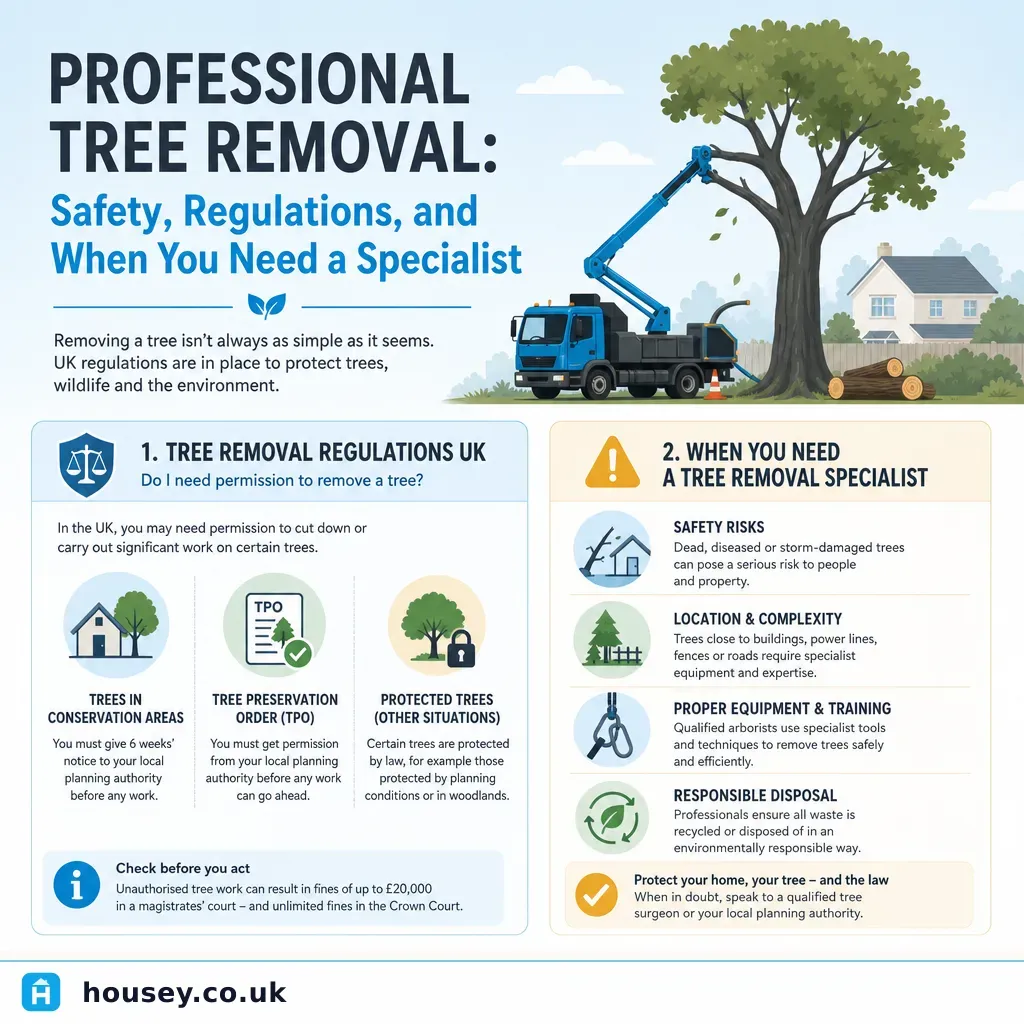
Professional Tree Removal: Safety, Regulations, and When You Need a Specialist
When a tree in a UK garden or on a residential property becomes dangerous, diseased, or falls in the path of planned building work, removal is often the practical solution. But tree removal in the UK is more tightly regulated — and considerably more hazardous — than many homeowners expect. Understanding the legal requirements and safety considerations before instructing any contractor helps you avoid enforcement action, neighbour disputes, and serious injury.
Key points
- Removing a tree subject to a Tree Preservation Order (TPO) without local planning authority consent is a criminal offence under the Town and Country Planning Act 1990, carrying a potential unlimited fine.
- Trees in conservation areas with a trunk diameter exceeding 75 mm (measured at 1.5 m height) require at least six weeks' written notice to the local planning authority before felling — even if the tree appears dead or diseased.
- Felling trees with a trunk over 8 cm in diameter (10 cm in thinning operations) generally requires a Forestry Commission felling licence unless the site qualifies for an exemption, such as a private garden.
- Professional tree surgeons should hold current Lantra Awards chainsaw certificates — as a minimum CS30 (chainsaw maintenance and cross-cutting) and CS31 (felling and processing small trees) — alongside appropriate public liability insurance.
- Under the Electricity at Work Regulations 1989, a minimum safe approach distance of 6 metres applies to standard 11 kV overhead distribution lines; only suitably trained operatives should work near electricity infrastructure.
Do you need permission to remove a tree?
Tree removal in England is governed by three overlapping regulatory regimes. Checking all three before instructing work is essential.
Decision tree — do you need permission?
- Is the tree covered by a TPO? Check with your local planning authority (LPA). If yes → apply for TPO consent and wait for written approval before any work begins.
- Is the property in a conservation area? If yes, and the trunk exceeds 75 mm in diameter at 1.5 m height → submit a section 211 notice to the LPA and wait at least six weeks. Emergency exemptions apply where a tree poses an immediate safety risk, but you must notify the LPA as soon as practicable.
- Is the tree in woodland and the trunk over 8 cm in diameter? A Forestry Commission felling licence may be required. Check the GOV.UK guidance on tree felling permissions.
- None of the above apply? Work can generally proceed without consent, but seek written confirmation from the LPA if uncertain and retain records of your check.
Scenario | Permission needed? | Route |
|---|---|---|
TPO-protected tree, any size | Yes | Written consent from local planning authority |
Conservation area tree (trunk >75 mm diameter) | Yes — six weeks' notice minimum | Section 211 notice to LPA |
Woodland tree (trunk >8 cm diameter) | Possibly | Forestry Commission felling licence |
Garden tree, no TPO, not in conservation area | Usually no | Confirm with LPA; retain records |
Dead or dangerous tree subject to a TPO | Yes, in most cases | Emergency TPO consent; provide photographic and written evidence of risk |
Why professional arborists are essential for tree removal
Felling a tree of any significant size carries hazards that go well beyond ordinary garden work. Principal risks include:
- Falling timber — a felled tree or cut limb can travel unpredictably on impact. Professional arborists use rigging equipment, lowering lines, and sectional dismantling to control the descent of each piece.
- Working at height — crown reduction and staged dismantling often involve working several metres above the ground. Fall arrest equipment and the continuous presence of a second operative are standard professional requirements.
- Proximity to structures — trees near buildings, conservatories, fences, or boundary walls require careful planning and, in confined spaces, specialist rigging to prevent structural impact.
- Overhead power lines — HSE guidance sets minimum safe approach distances; work near lines typically requires advance coordination with the relevant Distribution Network Operator.
- Underground services — roots can wrap around or press against buried drain runs; disturbing them during felling or stump extraction can crack or displace underground pipes.
A qualified tree surgeon should hold current Lantra Awards chainsaw certificates (CS30 and CS31 as a minimum; CS38 for aerial tree work) and carry adequate public liability insurance — typically a minimum of £5 million for residential work. Check membership of the Arboricultural Association Approved Contractor scheme, which requires evidence of qualifications, insurance, and safety management systems.
Important limitations
This article provides general information about tree removal regulations and safety in England. Rules vary by location, property history, tree species, and local planning authority policy. In Wales, Scotland, and Northern Ireland, separate but broadly similar regimes apply. You should not rely on this guidance as a substitute for a site-specific assessment by a qualified arborist or advice from a planning consultant. Regulatory requirements around TPOs and conservation areas are complex, and the consequences of non-compliance are serious.
When this becomes urgent
Contact a qualified arborist immediately if:
- The tree is leaning towards a building, public footpath, or road — particularly after high winds or storm damage.
- You notice significant crown dieback, fungal brackets at the base, split or lifting bark, or hollowing of the trunk, any of which may indicate imminent structural failure.
- Roots are visibly lifting paving, cracking boundary walls, or blocking drains.
- A structural surveyor or building surveyor has flagged the tree as a risk in a written report.
Do not attempt any work on a structurally compromised tree yourself.
What to ask a qualified professional
Before instructing tree removal, ask the arborist or contractor:
- Have you checked for TPOs or conservation area status for this tree, and can you confirm the regulatory position in writing?
- What qualifications do you hold (CS30, CS31, CS38 or equivalent) and are they current?
- What is your public liability insurance cover, and can I see the certificate before work begins?
- How will the tree be dismantled — sectionally from the top down, or as a directional fell?
- Is a second operative present throughout all aerial work?
- How will adjacent structures, planted areas, and boundary features be protected during the work?
- Is disposal of all timber and brash included in the quoted price?
- Will stump treatment or grinding be carried out after felling, and is this included in the quote?
When to get professional help
Tree removal of any tree over approximately 5 metres in height, or any tree of any size located within falling distance of a building, boundary, overhead cable, or public area, should always be carried out by a qualified arborist. Do not attempt to fell a tree yourself if:
- The tree is over approximately 5 m tall.
- Any part of the canopy or trunk could reach a structure, fence, or public area if it falls.
- You are uncertain about the regulatory status of the tree.
- The tree shows signs of structural instability — cracks, hollowing, fungal growth, a pronounced one-sided lean, or roots that are lifting from the ground.
How Housey can help
Housey connects UK homeowners with qualified, vetted tree surgeons who can check TPO status, submit required notifications, and carry out safe, compliant tree removal. Request and compare quotes from local arborists before any work begins.
Frequently asked questions
What happens if I remove a protected tree without permission?
Removing or carrying out unauthorised work on a TPO-protected tree is a criminal offence under section 210 of the Town and Country Planning Act 1990, carrying a potential unlimited fine. The same principle applies to qualifying trees in conservation areas under section 211. Local planning authorities actively investigate complaints, and acting without consent carries serious legal and financial consequences.
Can a dead tree be removed without permission?
Not automatically. TPO protection can apply to dead trees — the local planning authority must decide whether the order still serves its purpose. Always notify the LPA and provide supporting evidence such as photographs and an arborist's written assessment confirming the tree is dead or poses an immediate risk before proceeding with any removal works.
How much does professional tree removal cost in the UK?
Indicative UK costs, last reviewed 2026-05-18: small trees up to approximately 5 m typically range from £150 to £400; medium trees (5–15 m) from £350 to £1,000 or more; large or complex trees from £800 upwards. Costs vary significantly by species, access, location, and whether waste disposal and stump treatment are included. Obtain at least three quotes from qualified arborists.
Do I need to tell my neighbours before removing a tree?
There is no statutory obligation to notify neighbours before removing a tree from your own property, provided no TPO consent or conservation area notice applies. However, if roots or branches extend across the boundary, it is sensible to discuss the work in advance to avoid disputes. Neighbours have the right to cut overhanging branches back to the boundary line.
Sources and further reading
- Tree preservation orders and trees in conservation areas — GOV.UK
- Tree felling: getting the permissions you need — Forestry Commission / GOV.UK
- Find an Arboricultural Association Approved Contractor — Arboricultural Association
- Working at height — Health and Safety Executive (HSE)
Useful next reads
 Improvement & Build
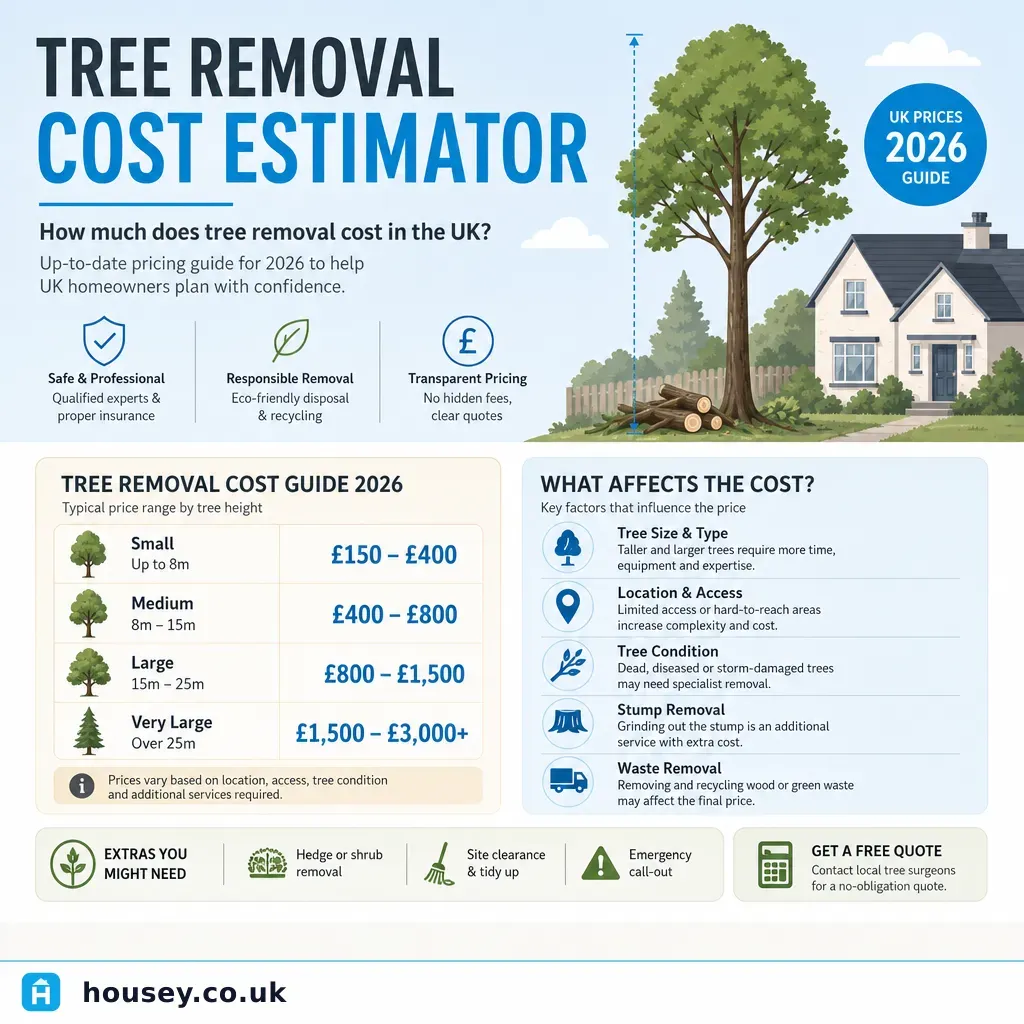
Tree Removal Cost Estimator
Tree removal in the UK costs roughly £150 to £5,000 or more, depending on the tree's height, species, access conditions, and whether stump removal is needed.
 Improvement & Build
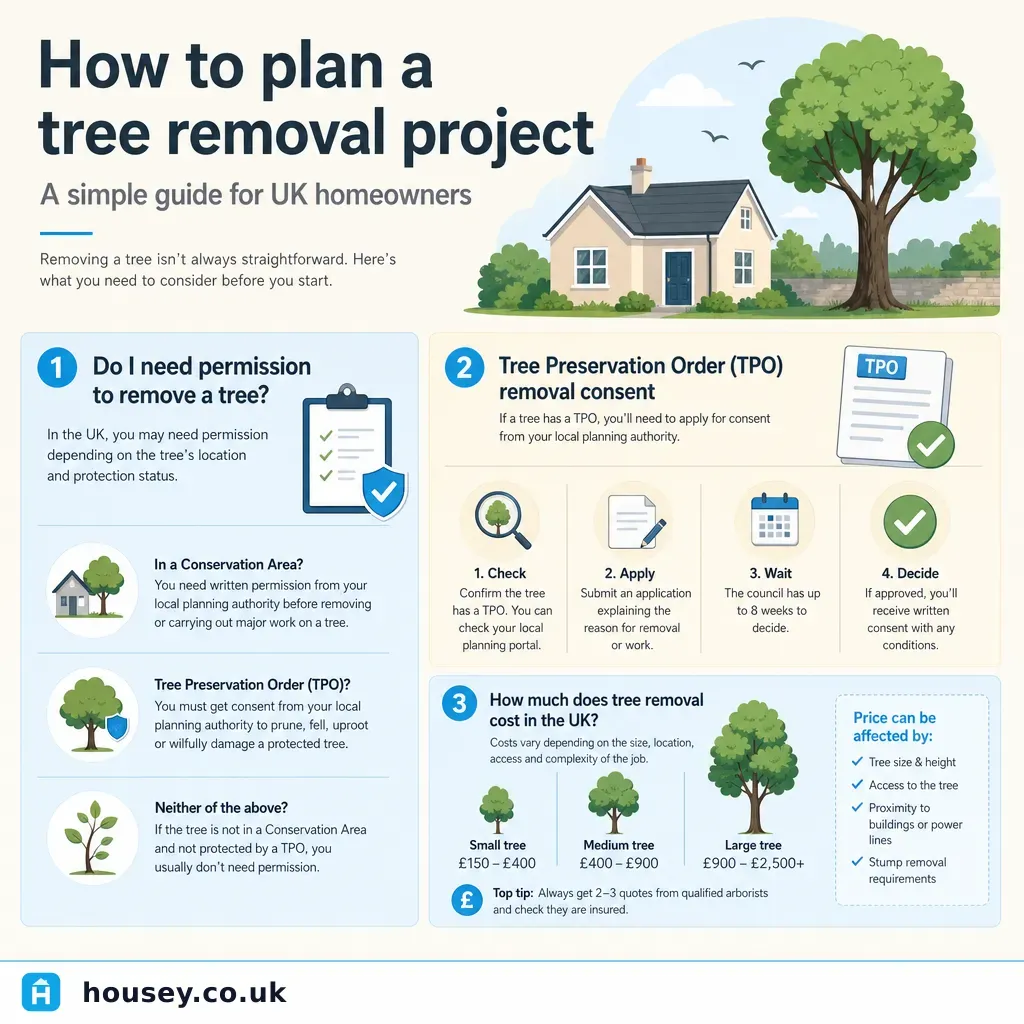
How to plan a tree removal project
Planning a tree removal project starts with checking whether the tree is protected by a Tree Preservation Order or sits in a conservation area, as both require council consent before any work begins.
 Improvement & Build
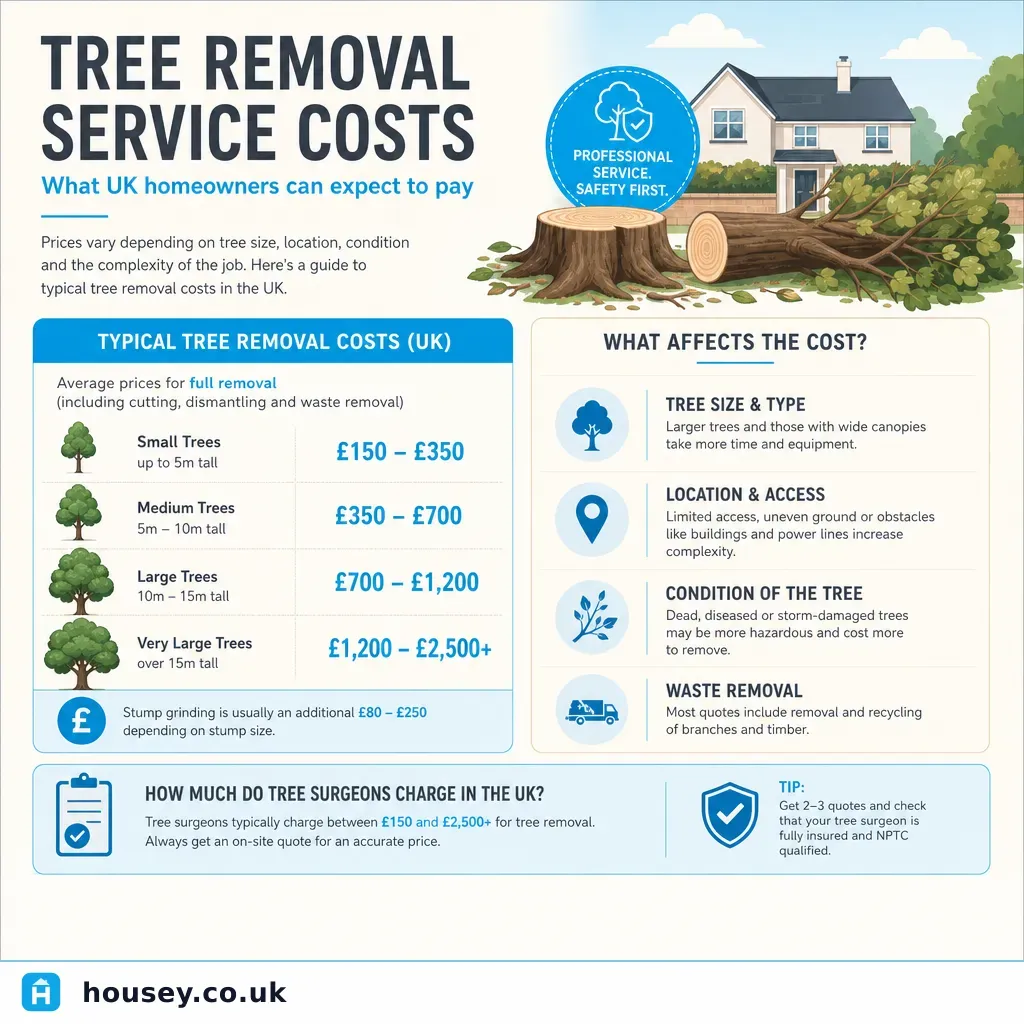
Tree Removal Service Costs
Professional tree removal costs in the UK depend on tree height, access, species, and the scope of work included.
 Improvement & Build
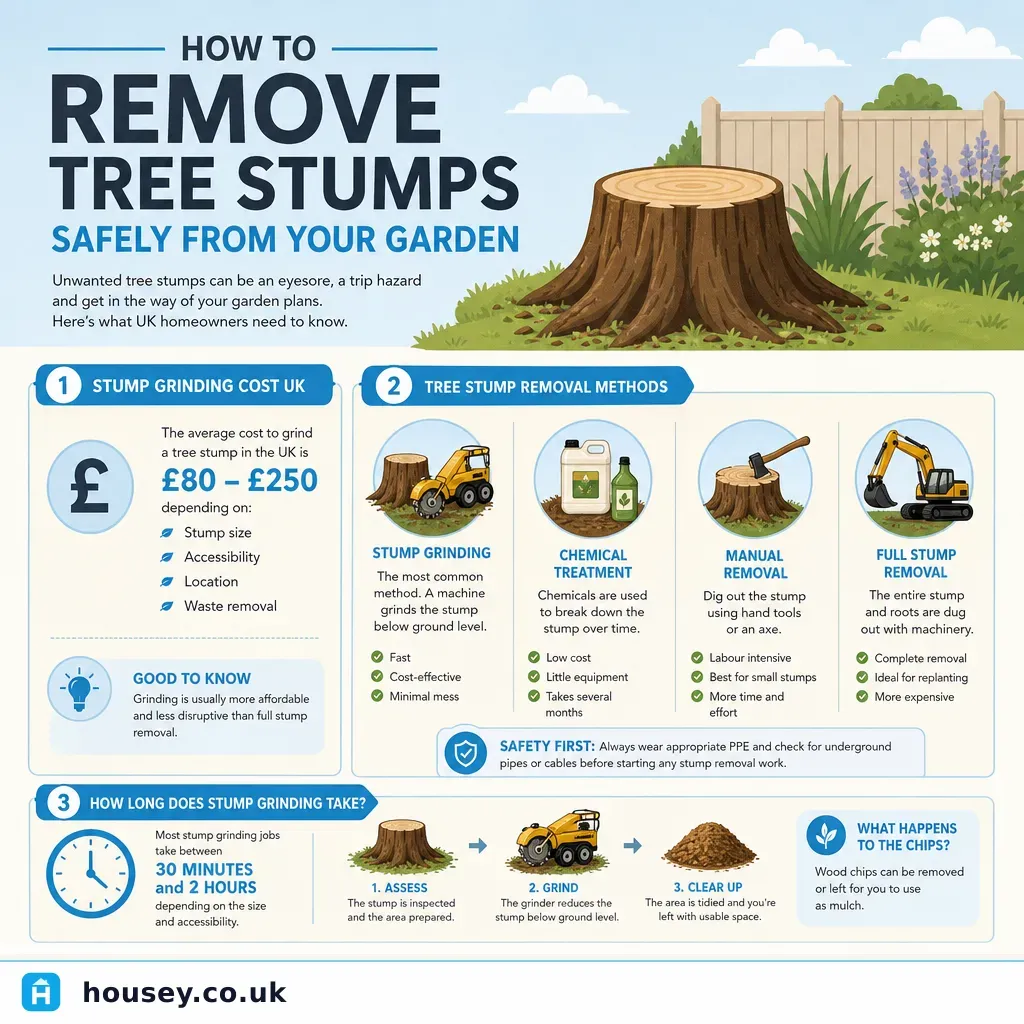
How to Remove Tree Stumps Safely from Your Garden
Tree stump removal in the UK typically involves stump grinding, chemical treatment, or manual excavation.
 Improvement & Build
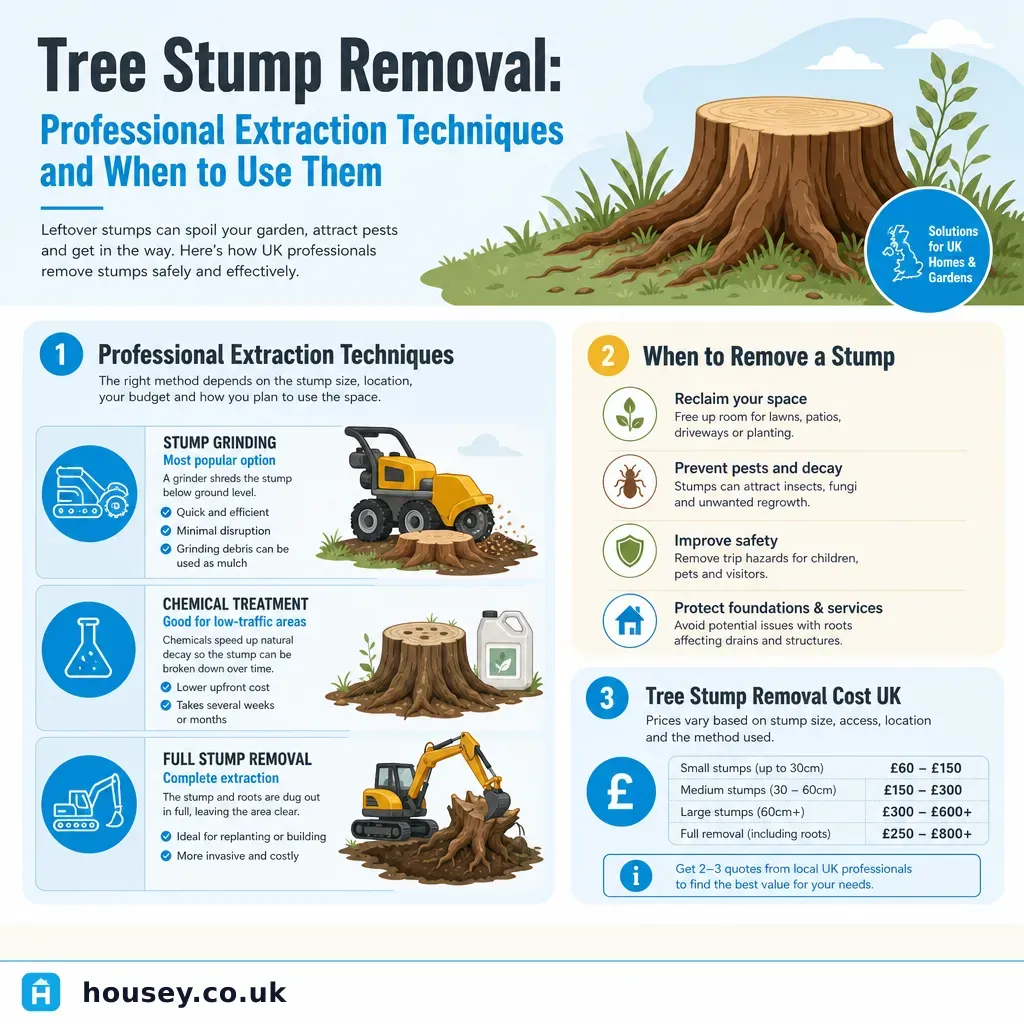
Tree Stump Removal: Professional Extraction Techniques and When to Use Them
Tree stumps in UK gardens can be removed by grinding, mechanical extraction, or chemical treatment.