Hiring Contractors for Home Renovation: Selection Guide
By Housey · Last reviewed 11th of May 2026

Hiring Contractors for Home Renovation: Selection Guide
Renovation projects — from a loft conversion to a kitchen extension — succeed or fail largely on the quality of the contractor you appoint. The selection process matters as much as the design itself, yet many homeowners begin it under time pressure, relying on a single referral or the lowest quote. In a UK market where disputes over building work are among the most common consumer complaints, understanding how to vet, compare, and appoint a contractor is one of the most practical skills a homeowner can develop.
Key points
- Under the Consumer Rights Act 2015, any contractor you hire must carry out work with reasonable care and skill, within a reasonable time, and at a reasonable price where no fixed price was agreed upfront.
- Electrical work notifiable under Part P of the Building Regulations must be carried out by a registered electrician (NICEIC, NAPIT, or a similar Competent Person Scheme) or formally notified to your local building control authority before work begins.
- Always obtain a minimum of three written quotes — verbal agreements offer limited legal protection and make disputes significantly harder to resolve.
- Public liability insurance (typically £1m–£5m cover) is the baseline requirement for any contractor working in your home; employers' liability insurance is a legal requirement where the contractor employs anyone.
- Verify registration with a relevant trade body or Competent Person Scheme before any regulated work begins: Gas Safe Register for gas, NICEIC or NAPIT for electrical, FENSA or Certass for windows and doors, TrustMark for general building work.
How to find and shortlist contractors
A reliable shortlist usually comes from:
- Personal referrals: neighbours, friends, or local community groups who have seen comparable finished work in person.
- Trade directories: TrustMark-registered businesses have met government-endorsed quality standards; Checkatrade and Which? Trusted Traders carry independently verified reviews.
- Architect or project manager recommendations: professionals who oversee building work routinely develop relationships with contractors whose quality and reliability they can vouch for.
Aim for three to five contractors on your shortlist. For projects involving structural alterations, extensions, or multiple trades, invite each contractor to visit the property before they quote. A quote produced from photographs or floor plans alone carries hidden assumptions that typically result in cost variations once work is underway.
What to check before inviting quotes
Contractor verification checklist
How to compare quotes fairly
Factor | What to look for | Red flag |
|---|---|---|
Price | Broken down by labour, materials, and VAT | Single lump sum with no line-item detail |
Scope | Explicitly states what is and is not included | Vague description such as 'all works as discussed' |
Materials | Specifies brands, grades, or standards (e.g., British Standard, CE marked) | 'Materials to be agreed' with no cap or specification |
Timeframe | Start date, key milestone dates, and completion date | 'Approximately X weeks' with no firm commitment |
Payment schedule | Stage payments tied to verified progress milestones | Upfront payment exceeding 25–30% of the total contract value |
Guarantees | Workmanship warranty period clearly stated | No warranty mentioned, or 'satisfaction guaranteed' only |
VAT | VAT registration number shown if the contractor is VAT-registered | No VAT number shown for a contractor billing significant sums |
Where quotes differ substantially in price, ask each contractor to explain their assumptions. A significantly lower quote usually reflects a thinner specification, excluded preliminaries, or favourable assumptions about access and groundwork — not necessarily better value or greater efficiency.
Red flags when hiring a contractor
Stop and investigate before proceeding if a contractor:
- Requests cash-only payment and does not provide a formal invoice or receipt
- Cannot supply a current insurance certificate within 24 hours of being asked
- Is unable to name the trade body or Competent Person Scheme they belong to for regulated work
- Pressures you to sign a contract or make a payment before you have had adequate time to read and understand it
- Has no fixed business address and communicates only via a mobile number
- Refuses to provide references from recent, comparable projects you can independently contact
- Quotes materially below every other contractor without a credible explanation for the difference
- Arrives unsolicited and offers to carry out urgent or discounted work on the spot
Written contracts and payment terms
A written contract protects both parties. It should cover:
- Full scope of works with materials specification
- Start date, key milestones, and practical completion date
- Stage payment schedule linked to verified progress
- Variation procedure — how changes to scope are agreed in writing and priced before work proceeds
- Retention (typically 2.5–5% held for a defined snagging period after practical completion)
- Dispute resolution process
For projects above roughly £5,000, consider using a recognised standard-form contract such as the JCT Minor Works Building Contract or the Federation of Master Builders' standard form. A project manager or architect can advise on the appropriate form and administer it on your behalf throughout the project.
Avoid paying more than 25–30% upfront. Stage payments tied to verified progress give you leverage if work stalls, quality falls short, or the contractor becomes insolvent before completion.
When to get professional help
For straightforward single-trade jobs — a new bathroom suite, garden landscaping, or internal decoration — direct contractor engagement is manageable with the checks above. For anything involving structural alterations, extensions, multiple trades, or budgets above approximately £30,000–£50,000, consider appointing a project manager or contract administrator to oversee the programme and certify stage payments independently.
Seek professional guidance promptly if:
- Work has started but stopped without explanation or an agreed written variation order
- The contractor is claiming extra costs you have not authorised in writing
- Defects are appearing during or after works and the contractor is unresponsive
- You are unsure whether building regulations approval or planning permission is required for the works planned
How Housey can help
Housey connects homeowners with vetted extension builders and experienced project managers who can manage complex renovation programmes from design through to completion. Submit your project details to receive up to four competitive quotes from local professionals.
Frequently asked questions
Do I need a written contract for small renovation jobs?
Even for small jobs, a written quote accepted by email creates a basic contract. For jobs above a few thousand pounds, a formal written contract covering scope, price, and timeline gives stronger protection under the Consumer Rights Act 2015 if disputes arise. Verbal agreements are legally valid but much harder to enforce in practice.
Can I withhold payment if renovation work is substandard?
Under the Consumer Rights Act 2015, if a contractor has not carried out work with reasonable care and skill, you may ask them to rectify it at no extra cost, or negotiate a price reduction. Withholding the final stage payment while you raise a formal snag list in writing is common practice — document all defects with photographs and dated correspondence.
What happens if a contractor disappears mid-project?
If a contractor abandons a project, you may recover costs through their public liability insurer, via the county court small claims track (up to £10,000), or through a trade body dispute resolution scheme. Whether the contractor was registered with a recognised scheme before you started significantly affects your available options.
Is VAT always charged on home renovation work?
New residential builds are zero-rated for VAT. Most renovation and repair work on existing homes is standard-rated at 20%, though some energy-saving materials and certain conversion works may qualify for a reduced rate of 5%. Ask your contractor to confirm the applicable rate in writing before work begins.
Sources and further reading
- Consumer Rights Act 2015 — legislation.gov.uk
- TrustMark: government-endorsed quality scheme for tradespeople — TrustMark
- Gas Safe Register: find a registered engineer — Gas Safe Register
- Building regulations approval — GOV.UK
- Find a registered electrician — NICEIC
Useful next reads
 Improvement & Build
Fixing Leaking Back Doors and Water Ingress
Most leaking back doors in UK homes fail at one of three points: the threshold or door sill joint, the frame-to-masonry mastic seal, or the door weatherstrip.
 Improvement & Build
Who Provides House Demolition Services
House demolition in the UK is carried out by specialist demolition contractors, often members of the National Federation of Demolition Contractors (NFDC).
 Improvement & Build
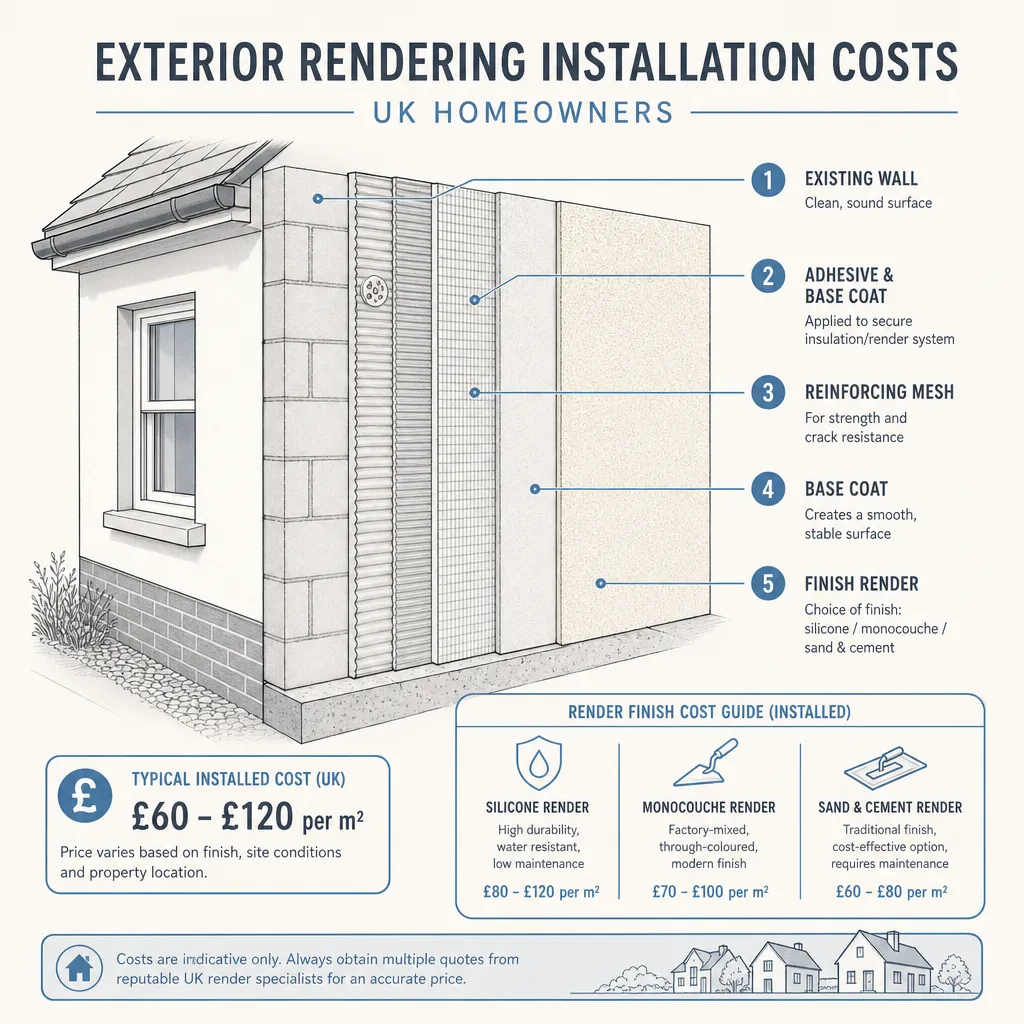
Exterior Rendering Installation Costs
Exterior rendering in the UK typically costs £20–£60 per square metre for standard render systems, or £80–£150 per square metre for External Wall Insulation with a render finish.
 Improvement & Build
Designing an outdoor kitchen for entertaining and garden living
An outdoor kitchen in a UK garden needs a stable, level base — typically a concrete slab or quality paving — with weather-rated materials such as stainless steel grade 316 or frost-rated porcelain.
 Improvement & Build
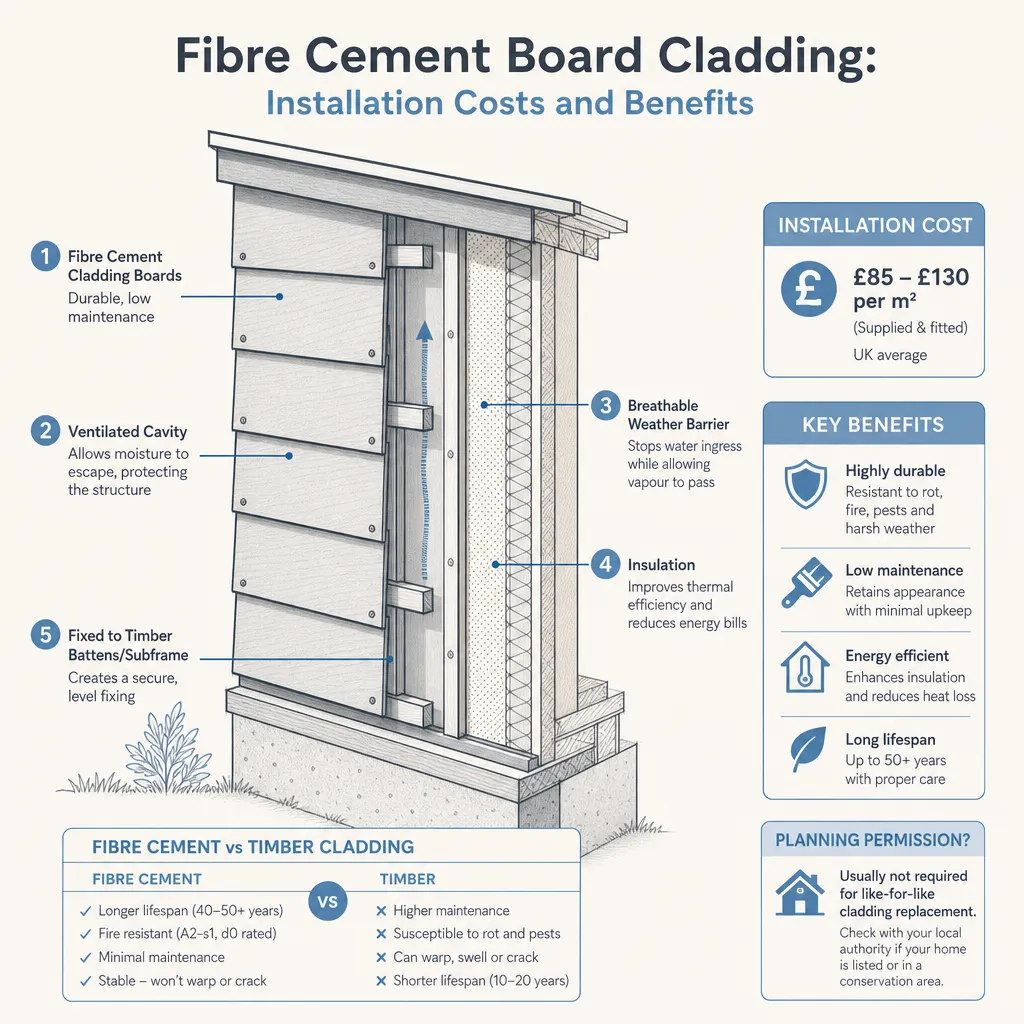
Fibre Cement Board Cladding: Installation Costs and Benefits
Fibre cement board cladding typically costs £80–£180 per m² installed in the UK, including boards, battens, breather membrane, and labour.