Home Automation Wiring: Planning and Installation Considerations
By Housey · Last reviewed 10th of May 2026
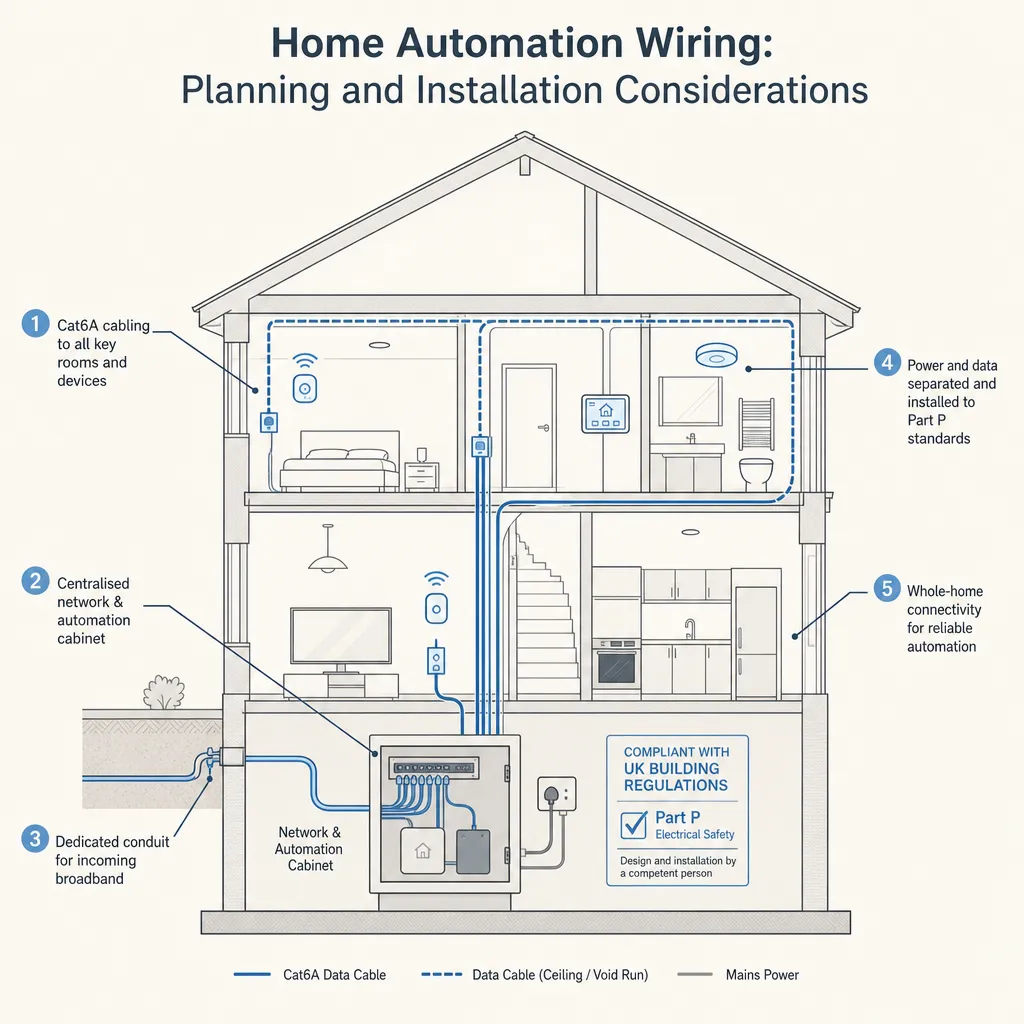
Home Automation Wiring: Planning and Installation Considerations
Planning the wiring for a smart or automated home is ideally done before walls are plastered and floors are laid — but the decisions made at this stage affect what the system can do for years to come. Whether you are specifying a new build, planning a loft conversion, or undertaking a full house renovation, the structured cabling infrastructure underpins everything from lighting control and AV distribution to security, broadband, and future-proofing. Mistakes at this stage are expensive to correct later, and some elements of the electrical installation are regulated under Building Regulations.
Key points
- New electrical circuits and consumer-unit work in England and Wales fall under Building Regulations Part P (Electrical Safety in Dwellings) and must be notified to building control or carried out by a Part P-registered competent person (NICEIC, NAPIT, or equivalent scheme member).
- Structured cabling installations in buildings follow BS EN 50174 (planning and installation) and BS EN 50173 (design standards) — the recognised UK and European series for communications cabling in buildings.
- For wired home automation (KNX, Crestron, Control4), cabling is typically installed during first-fix electrical, before plasterboard goes up — retrofitting wired systems in a completed property is disruptive and costly.
- Running Cat6A cabling to all rooms — plus empty conduit for future cables — is the most widely recommended approach for new builds and major renovations as of 2025.
- CEDIA (Custom Electronic Design and Installation Association) publishes installation standards for residential home technology systems; using a CEDIA-registered installer provides access to a recognised quality framework and complaints process.
What wiring does a smart home typically require?
A modern smart home installation usually involves several different cabling types running in parallel:
Data cabling (Cat6 or Cat6A): Ethernet to every room future-proofs the property for wired broadband connections, IP cameras, smart TVs, and network switches. Cat6A (Augmented Category 6) supports 10 Gigabit Ethernet up to 100 metres and is increasingly specified in UK new builds.
Power circuits: Dedicated circuits may be needed for AV equipment racks, network switches, electric vehicle chargers, and smart heating systems. Additional ring or radial circuits require notification under Part P.
Speaker cable: In-wall or in-ceiling speaker cable — typically 2-core CCA or OFC at 16 AWG or heavier for longer runs — supports whole-home audio distribution.
HDMI and AV distribution cabling: HDMI 2.1 cable or HDBaseT cabling for video distribution between a central AV rack and TV locations throughout the property.
Control wiring: For KNX or other wired bus systems, dedicated 2-core screened cable (YCYM or similar) is run between sensors, actuators, and the bus coupler.
Conduit: Empty conduit (25 mm or 32 mm corrugated or rigid plastic) allows future cable upgrades without breaking into walls — highly recommended in new builds and any first-fix situation where the full cable schedule is uncertain.
Planning your cabling installation: a homeowner checklist
Before first-fix electrical begins, confirm the following:
Wired vs wireless: comparing the approaches
Factor | Wired (KNX / Cat6A backbone) | Wireless (Zigbee / Z-Wave / Matter) |
|---|---|---|
Reliability | Very high — no radio interference | Good, but mesh coverage varies by property |
Installation timing | First-fix only (new build / renovation) | Retrofit-friendly at any stage |
Upfront cost | Higher; lower long-term maintenance | Lower; hub and firmware updates ongoing |
Range | Unlimited via cable runs | Typically 10–30 m per node; extended by mesh |
Future-proofing | High — passive infrastructure lasts decades | Moderate — protocols evolve; obsolescence risk |
Professional requirement | Always recommended | DIY possible for basic setups |
Building Regulations impact | Part P applies to all new mains circuits | Part P applies only to new mains circuits |
Building Regulations: what applies to home automation wiring?
Part P (Electrical Safety in Dwellings) applies in England and Wales to any work on a domestic electrical installation. Work that must be notified to building control or carried out by a Part P-registered competent person includes: new circuits from the consumer unit, consumer unit replacement, and any work in a special location (bathroom, shower room, swimming pool). Low-voltage data and AV cabling — Cat6, HDMI, speaker cable — does not itself require Part P notification, but the power circuits feeding the equipment do.
Building control will want evidence that electrical work has been carried out by a Part P-registered competent person or notified and inspected. If your home automation project forms part of a larger renovation with a full plans application, the electrical installation should be included in the relevant submissions.
In Scotland, electrical work is regulated under the Building (Scotland) Regulations 2004 and associated technical standards — rules differ from England and Wales, so check with your local verifier before proceeding.
Listed buildings and conservation areas: Penetrations through walls, new cable routes visible on external elevations, or equipment affecting the fabric of a listed building may require Listed Building Consent in addition to building control approval.
Important limitations
This article provides general information for planning purposes only. Electrical installation rules vary by property type, construction method, location, and the scope of works. Nothing here constitutes professional electrical, legal, or building control advice. A qualified professional should assess your specific situation before any electrical work begins.
When this becomes urgent
Seek professional advice immediately if:
- An electrician discovers that existing wiring does not meet current standards during your project — do not proceed until a competent person has assessed the risk.
- You are planning to work near or in a consumer unit, main fuse, or service intake — this must only be carried out by a qualified and registered electrician.
- Your project involves a loft conversion, extension, or new structure that requires a full plans building control application — cabling routes and electrical specifications should be included in the submission.
- You suspect existing aluminium wiring, damaged insulation, or non-standard installation — these require expert assessment before any new work is added.
What to ask a qualified professional
Before appointing an electrician or structured cabling installer:
- Are you registered with a Part P-competent person scheme (NICEIC, NAPIT, ELECSA, or equivalent)?
- Will you provide an Electrical Installation Certificate (EIC) on completion?
- Are you familiar with CEDIA residential installation standards for home technology cabling?
- What cabling specification do you recommend and why?
- How will cable runs be routed to avoid interference with mains wiring?
- What labelling and documentation will be provided at handover?
- How will the installation be notified to building control?
- What testing and commissioning will be carried out before walls are closed?
When to get professional help
Home automation wiring is a stage where professional involvement is not just advisable but legally required in many cases. Contact a qualified professional when:
- Any new electrical circuits are required — Part P registration is a legal requirement in England and Wales, not a recommendation.
- The installation forms part of a building control application — our building control consultants can advise on what documentation is needed at each stage.
- You want a building regulations drawings package that incorporates electrical and data cabling specifications into your wider build submission.
- The property is listed, in a conservation area, or has existing non-standard wiring that needs assessing before new work proceeds.
How Housey can help
If your home automation wiring is part of a renovation or new build, it needs to sit within a coherent building control strategy. Our building regulations drawings service helps ensure your electrical and cabling specifications are properly documented for Part P compliance and building control sign-off. For projects involving more complex compliance questions, our building control consultants can advise on notification requirements and inspection stages.
Frequently asked questions
Do I need building regulations approval for home automation wiring?
Low-voltage data cabling — Cat6, HDMI, speaker cable — does not itself require building regulations notification in England and Wales. However, any new mains electrical circuits, consumer-unit work, or work in special locations such as bathrooms must be notified under Part P or carried out by a Part P-registered competent person. If your project has a full plans application for other reasons, include the electrical specification in the submission.
What is the best cable to run for future-proofing a UK home?
Cat6A (Augmented Category 6) is widely recommended for data cabling in UK new builds and major renovations as of 2025 — it supports 10 Gigabit Ethernet and PoE++ applications. Run it to every room, plus at least two drops per TV location and one to any planned external camera position. Supplement with empty conduit (25 mm or 32 mm) wherever future cable requirements are uncertain.
Can I do home automation wiring myself in the UK?
Low-voltage cabling — Cat6, speaker cable, HDMI, and control wiring — can generally be installed by a competent DIYer. However, connecting equipment to mains power, installing new circuits, or working on or near the consumer unit requires a Part P-registered electrician in England and Wales. Do not attempt mains electrical work without the relevant qualifications and registrations — this is a legal requirement, not simply a recommendation.
How far in advance should I plan home automation wiring?
Wiring decisions should be made before first-fix electrical — typically when walls are open and before plasterboard is fixed. In a new build this is usually several months before occupation. In a renovation, the window is during structural and first-fix works. Retrofitting wired infrastructure after walls are closed is significantly more disruptive and costly, often requiring chasing, re-plastering, and redecoration.
Sources and further reading
- Building Regulations Approved Document P — Electrical safety in dwellings — GOV.UK
- NICEIC — Part P competent person scheme — NICEIC
- NAPIT — competent person scheme for electrical work — NAPIT
- CEDIA — residential technology installation standards — CEDIA
- Building (Scotland) Regulations 2004 — legislation.gov.uk
- BS EN 50174 — Installation of cabling infrastructure in buildings — BSI
Useful next reads
 Planning & Pre-Build
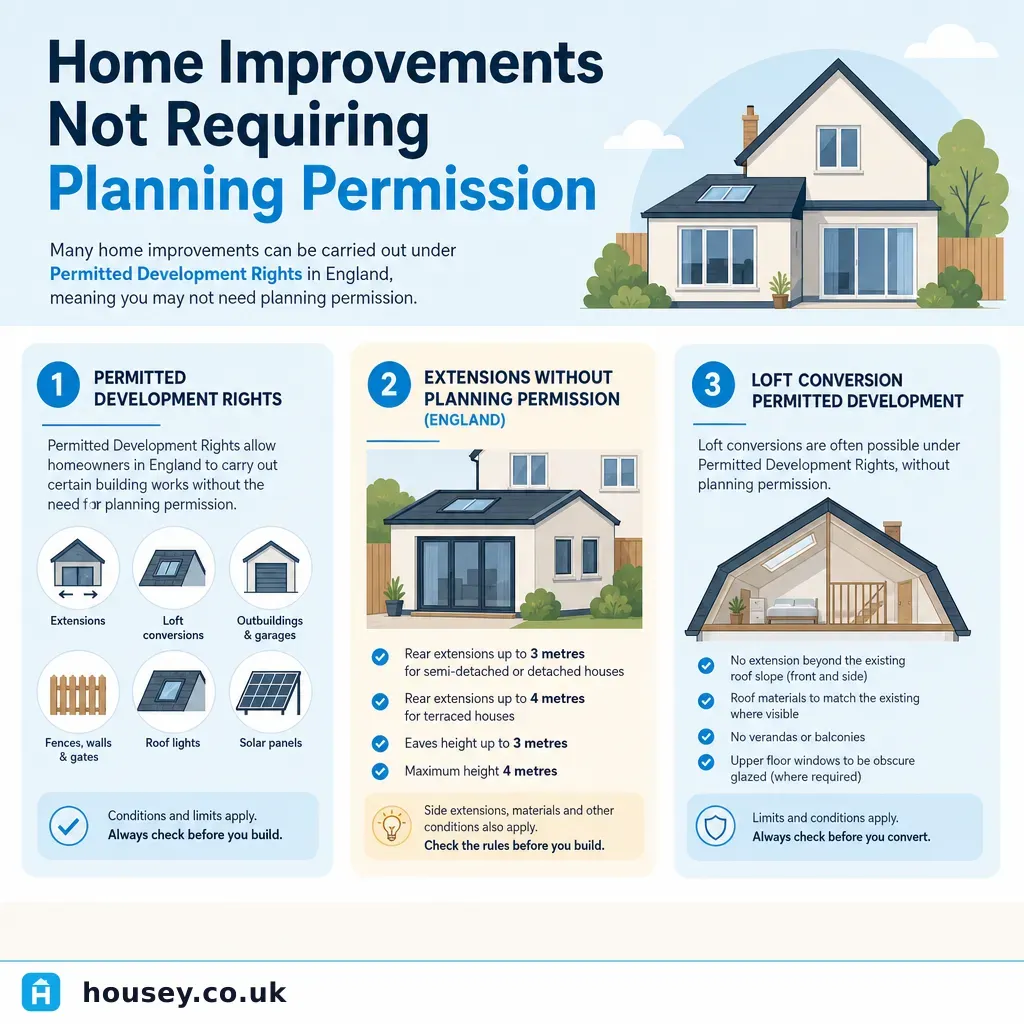
Home Improvements Not Requiring Planning Permission
Many common home improvements in England fall under Permitted Development Rights and do not require a planning application.
 Planning & Pre-Build
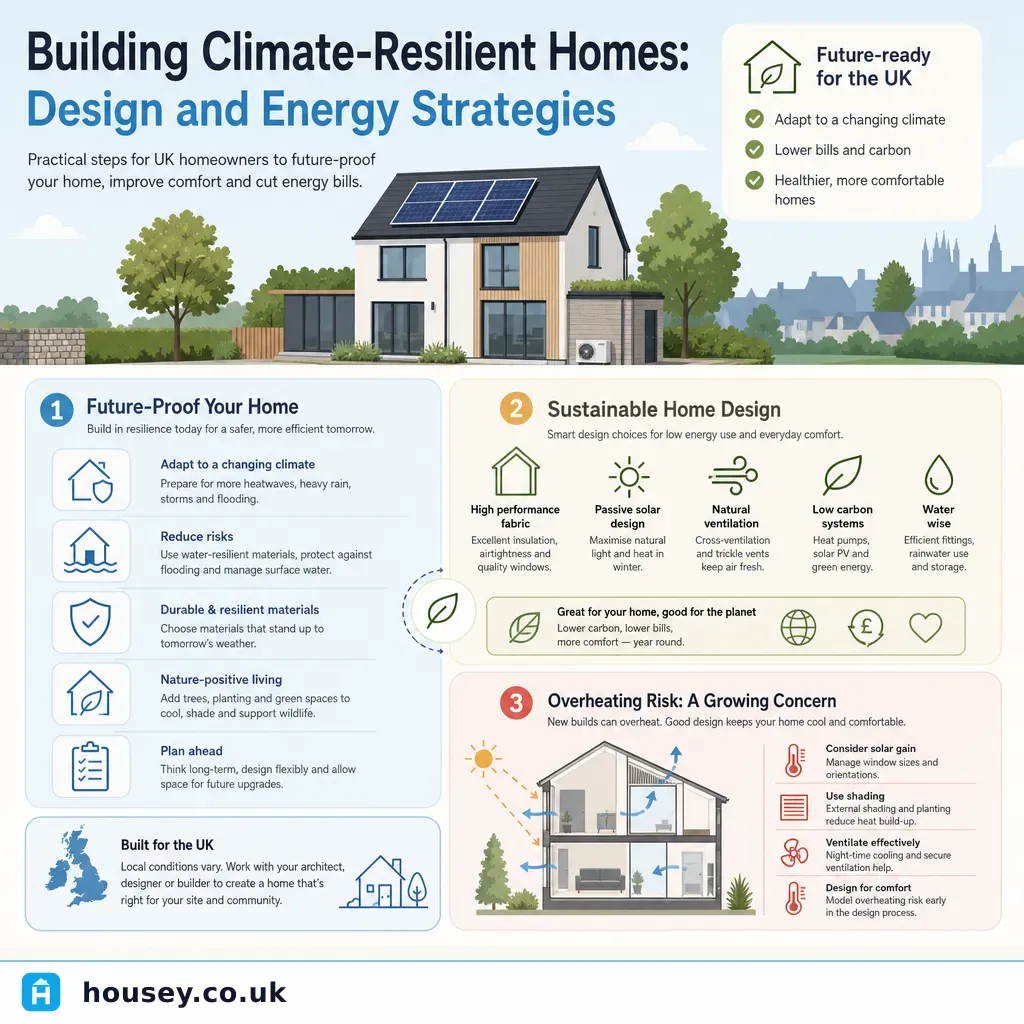
Building Climate-Resilient Homes: Design and Energy Strategies
A climate-resilient UK home handles hotter summers, wetter winters, and rising energy costs through high-performance insulation, overheating mitigation, flood-resilient construction, low-carbon heating, and good water management.
 Planning & Pre-Build
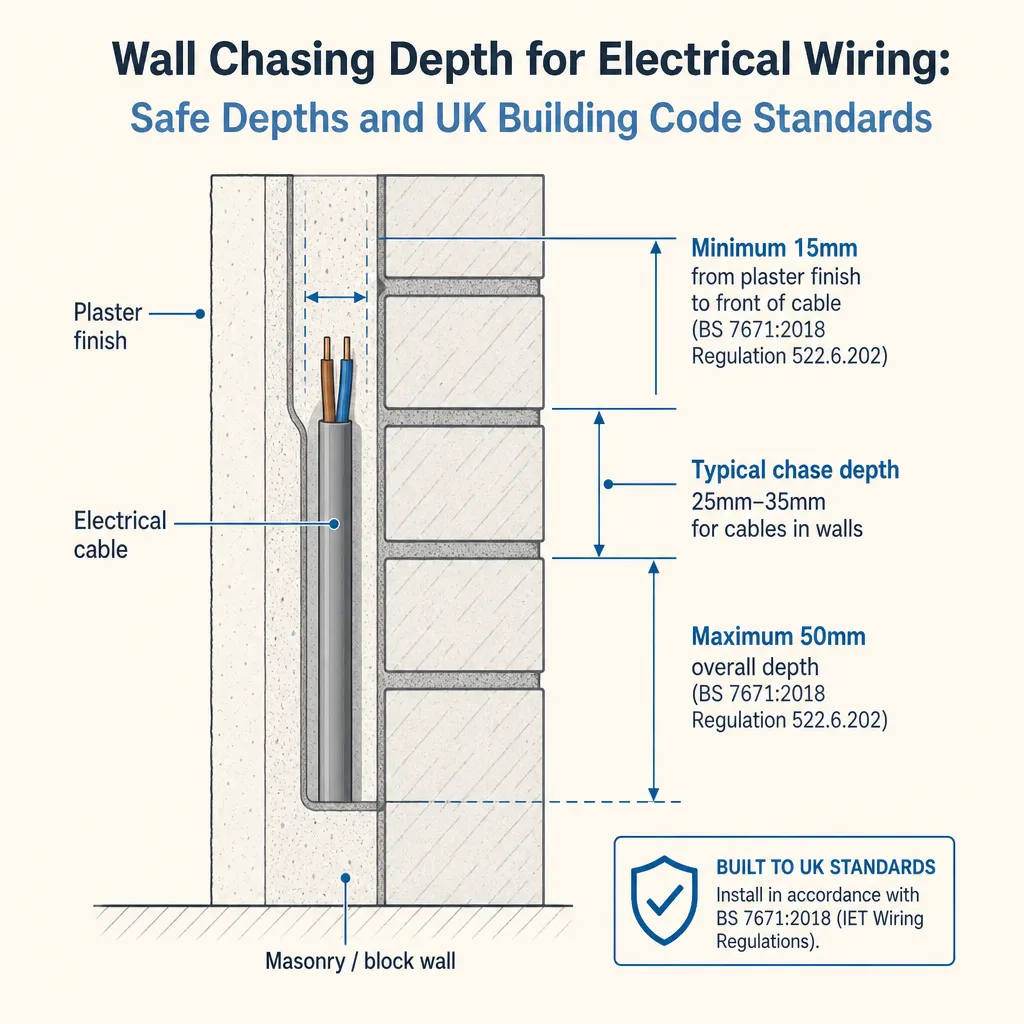
Wall Chasing Depth for Electrical Wiring: Safe Depths and UK Building Code Standards
Cables chased into walls must be within BS 7671 safe zones — within 150 mm of a ceiling, floor, or corner junction — or enclosed in rigid conduit for mechanical protection.
 Planning & Pre-Build
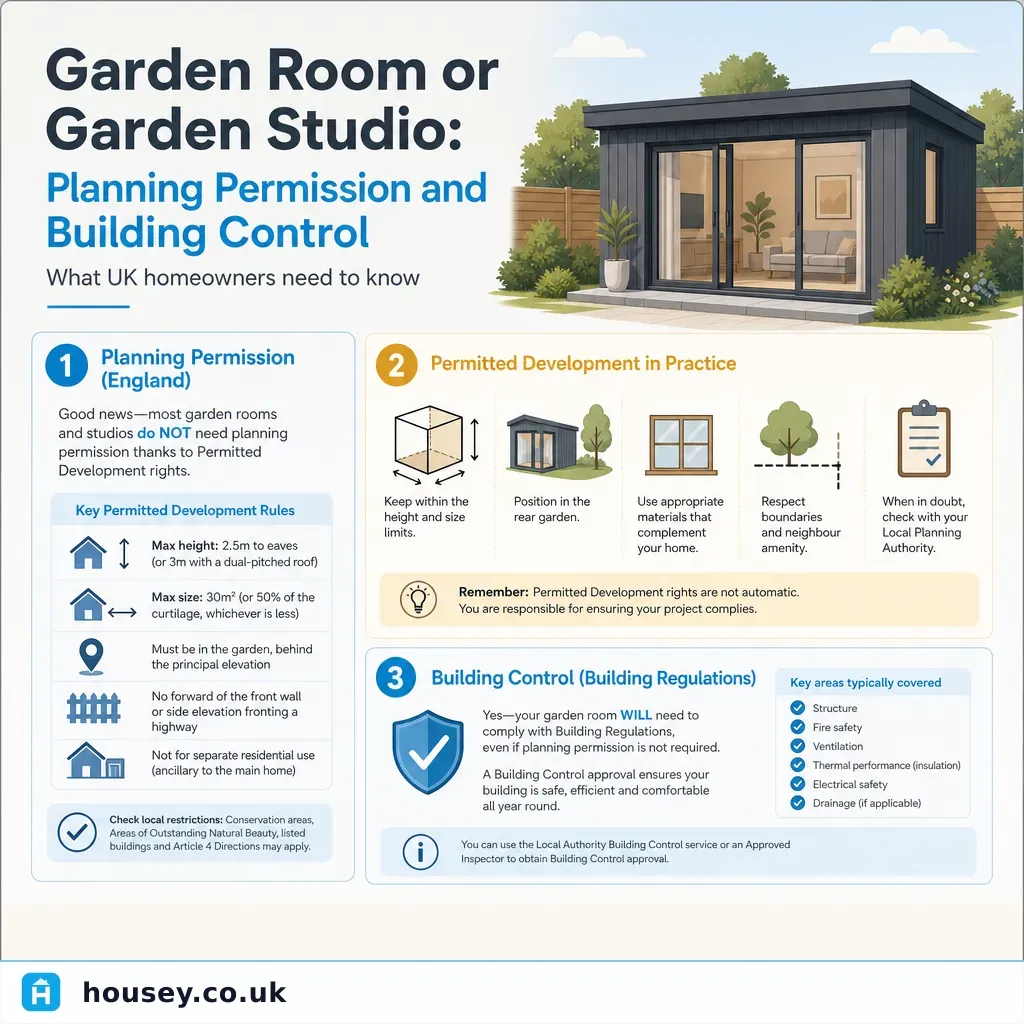
Garden Room or Garden Studio: Planning Permission and Building Control
A garden room or studio often qualifies as permitted development in England, meaning no planning application is needed — provided it occupies no more than 50% of the total curtilage, sits within height limits, and is not used as a separate dwelling.
 Planning & Pre-Build
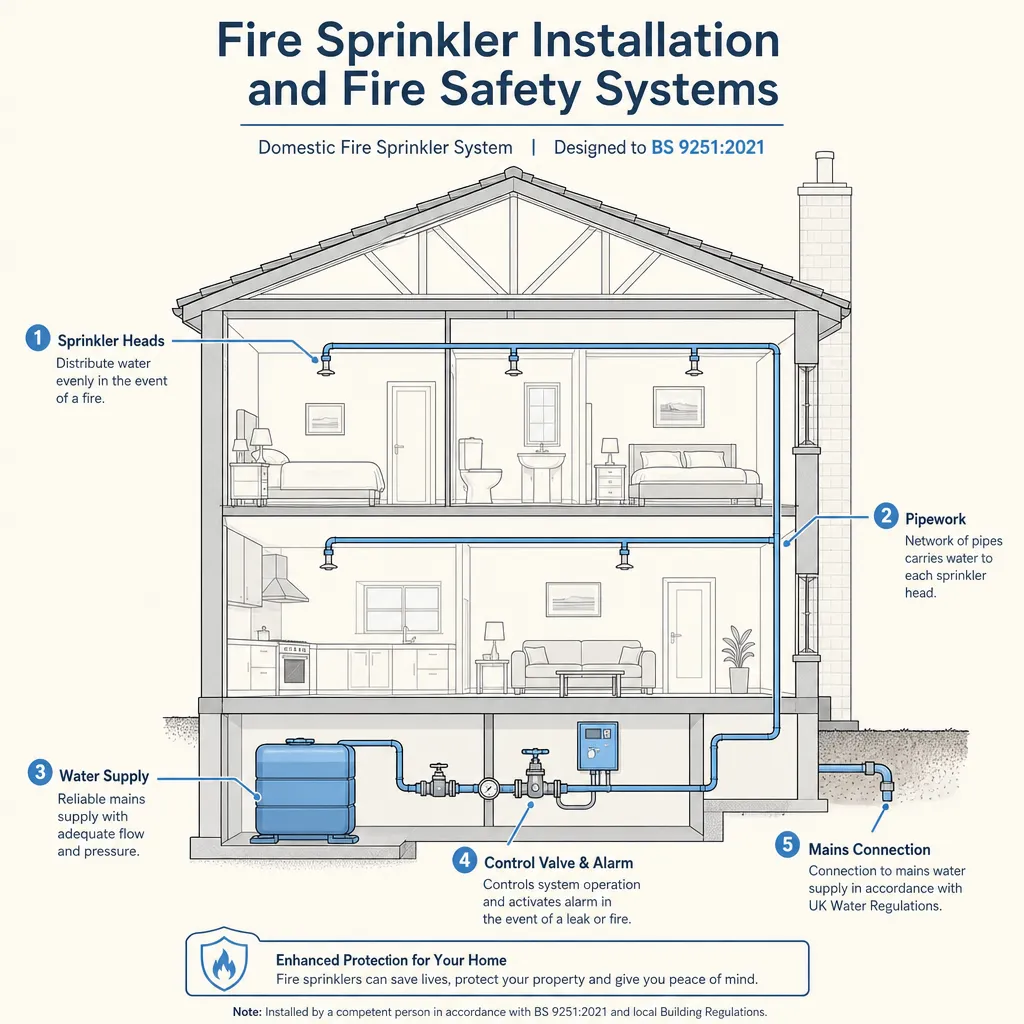
Fire Sprinkler Installation and Fire Safety Systems
Residential fire sprinkler systems in the UK must comply with BS 9251:2021.