Home Battery Storage Systems: Powering Your Property
By Housey · Last reviewed 9th of May 2026
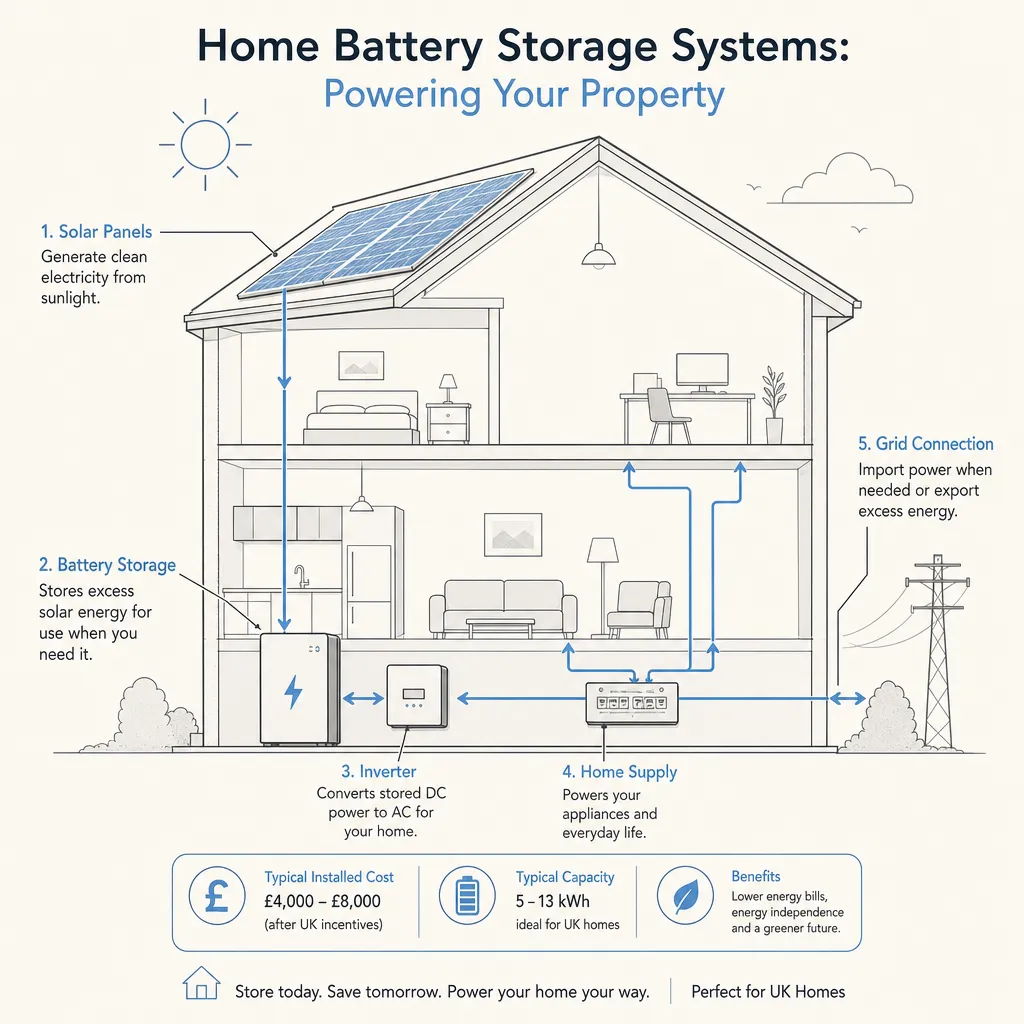
Home Battery Storage Systems: Powering Your Property
Home battery storage has moved from early-adopter territory to a mainstream energy decision for UK homeowners, particularly as electricity tariffs have risen and time-of-use rates have become more widely available. If you have solar panels — or are considering them — a battery system lets you use more of what you generate rather than exporting it at a low Smart Export Guarantee rate. Even without solar, some battery owners charge from the grid on cheap overnight tariffs and discharge during expensive peak hours. Understanding the options, costs, and requirements before approaching an installer helps you make a well-informed decision.
Key points
- Home battery storage systems in the UK typically range from 5 kWh to 15 kWh usable capacity; most average households see practical benefit from 10 kWh or more depending on consumption patterns.
- From February 2024, both standalone battery storage and batteries installed alongside solar panels in residential properties in Great Britain qualify for 0% VAT under HMRC rules.
- The Smart Export Guarantee (SEG), administered by Ofgem, pays homeowners for surplus electricity exported to the grid from eligible generation — but most SEG contracts prohibit exporting grid-charged electricity.
- MCS (Microgeneration Certification Scheme) certification of the installer and product is usually required to access SEG payments and certain energy efficiency funding routes.
- Battery storage installation involves connection to the household consumer unit and must be carried out by a qualified electrician; Building Regulations notification may also be required depending on the scope of work.
How home battery storage works
A home battery system stores electrical energy in lithium chemistry cells and releases it on demand. A battery management system (BMS) controls charging and discharging, protects the cells from overcharge or deep discharge, and communicates with an inverter that converts stored DC power to the AC electricity your home uses.
In a solar-paired installation, the battery charges during periods of strong generation and only exports electricity once the battery is full. In a grid-only installation, the battery charges at times of low tariff — typically overnight on time-of-use products such as Octopus Go or equivalent — and discharges during expensive peak-price periods.
Most systems sold in the UK since 2022 are either AC-coupled (the battery connects via its own inverter to the AC household circuit) or DC-coupled (the battery connects directly to the solar inverter's DC bus). AC-coupled systems are more flexible and can be retrofitted to existing solar installations; DC-coupled systems are slightly more efficient but require a compatible hybrid inverter.
Battery system types compared
System type | How it connects | Best suited for | Key consideration |
|---|---|---|---|
AC-coupled battery | Via its own inverter to the AC circuit | Retrofitting to existing solar; grid-only charging | Slightly lower round-trip efficiency than DC-coupled |
DC-coupled battery | Directly to the solar inverter's DC bus | New solar-plus-storage installations | Requires a compatible hybrid inverter |
All-in-one hybrid inverter and battery | Single integrated unit | New installations with no existing inverter | Replacing one component may require replacing both |
Virtual power plant (VPP) enrolment | Battery partly managed by a grid operator | Homeowners willing to share control for grid-service revenue | Some loss of autonomous control over charge and discharge |
Typical installed costs in the UK
Indicative UK costs, last reviewed 2026-05-09. Costs vary by battery capacity, brand, installation complexity, and region. Always obtain at least three quotes from MCS-certified installers.
Usable capacity | Indicative installed cost | Approximate daily coverage |
|---|---|---|
5 kWh | £2,000 – £3,500 | Partial coverage (roughly 50% of typical daily use) |
10 kWh | £3,500 – £5,500 | Close to full coverage on moderate-consumption days |
15 kWh or more | £5,500 – £8,000+ | Full daily coverage plus a resilience buffer |
Sources: Energy Saving Trust indicative cost guidance; installer market data 2025–2026. Prices exclude any scaffolding, structural work, or consumer unit upgrades that may be required.
As of February 2024, battery storage systems installed in residential properties in Great Britain attract 0% VAT. Confirm current HMRC rules at the time of your installation, as the position can change.
The Smart Export Guarantee
The Smart Export Guarantee (SEG) requires larger energy suppliers — those with more than 150,000 domestic customers — to offer a tariff for electricity exported to the grid from eligible small-scale renewable generation. For solar panels installed since 1 January 2020, SEG registration replaces the Feed-in Tariff (FiT) scheme, which closed to new applicants in 2019.
Key points for battery owners:
- You can receive SEG payments with a battery installed, but only for electricity generated by your solar panels — not for grid-charged electricity subsequently exported.
- Most SEG suppliers require that your battery cannot export grid-charged electricity; some use smart meter data to verify compliance.
- Your installation must hold an MCS certificate (or equivalent approved standard) to be eligible for SEG.
- SEG export tariff rates vary between suppliers; compare current offers on the Ofgem SEG supplier list before signing a contract.
What to ask a battery storage installer
Before accepting a quote, use this list to ensure you can compare proposals fairly and identify any gaps.
- Is the installer MCS-certified, and what MCS certificate numbers will apply to this installation?
- Which battery product is being quoted, what is its usable (not nominal) capacity, and what is the manufacturer's warranty period and cycle count?
- Is this an AC-coupled or DC-coupled system, and why is that configuration recommended for my property?
- Will the installation require any upgrades to the existing consumer unit, and are those costs included in the quote?
- Does the quote include all materials, labour, commissioning, and Building Regulations notification if required?
- Is VAT included at 0%, and can you confirm this treatment in writing?
- Will the system be configured to comply with Smart Export Guarantee requirements — specifically, can it be prevented from exporting grid-charged electricity?
- What monitoring app or system is provided, and does it require an ongoing subscription fee?
- What is your process if the battery manufacturer ceases to support the product in the UK?
- Based on my current tariff and estimated consumption, what payback period would you estimate, and on what assumptions is that figure based?
Payback and financial considerations
Battery storage payback periods in the UK typically range from around 8 to 15 years, depending on tariff structure, export rate, system cost, and consumption pattern. The financial case is usually strongest when:
- You have an existing solar system generating more electricity than your household uses during the day and currently exporting at a low SEG rate.
- You are on, or can switch to, a time-of-use tariff offering cheap overnight charging.
- Your household uses significant electricity during morning and evening peak periods.
If none of these conditions apply, a professional energy audit may help clarify whether battery storage is the right investment before you commit to installation costs.
When to get professional help
Battery storage installation always requires a qualified electrician. The work involves connection to your property's consumer unit, installation of isolation switches, cable runs, and in many cases meter reconfiguration. This is not suitable as a DIY project under any circumstances.
Arrange a consultation with an MCS-certified installer if:
- You are considering any battery storage installation, including adding storage to an existing solar system.
- Your current solar inverter is approaching end of life or is incompatible with modern battery systems.
- You are unsure whether switching to a time-of-use tariff is financially beneficial for your usage pattern.
- Your consumer unit is more than 20 years old or has not had a recent EICR — a battery installation may prompt an upgrade requirement.
How Housey can help
Housey can connect you with MCS-certified battery storage installers in your area. Submit a quote request, compare responses from local professionals, and check their credentials before making a decision.
Frequently asked questions
Do I need solar panels to get a home battery storage system in the UK?
No. Battery storage can be installed without solar panels and charged from the grid, typically overnight on a time-of-use tariff. However, the financial case is usually stronger when paired with solar, as the battery stores surplus generation rather than relying entirely on tariff price differentials. Standalone battery payback periods are generally longer than solar-plus-storage combined systems.
Is VAT charged on home battery storage installation?
As of February 2024, battery storage systems installed in residential properties in Great Britain attract 0% VAT, whether fitted alongside solar panels or as a standalone unit. Always confirm the VAT treatment in writing with your installer at quotation stage, as HMRC rules can change and individual contractors should be current with the latest guidance.
How long do home battery storage systems last?
Most lithium-based home battery systems are warranted by manufacturers for 10 years or a set number of charge cycles — often 3,000 to 6,000. Battery chemistry degrades gradually; a well-maintained lithium iron phosphate (LiFePO4) battery may retain around 70–80% of its original capacity after a decade. Many manufacturers offer take-back or recycling schemes at end of life.
What is the Smart Export Guarantee and how does battery storage affect it?
The SEG requires larger energy suppliers to pay homeowners for surplus electricity exported to the grid from eligible solar generation. Battery owners can still receive SEG payments, but most SEG contracts prohibit exporting grid-charged electricity. Your installation should carry an MCS certificate, and your installer should configure the system to comply with your chosen supplier's export requirements.
Sources and further reading
- Smart Export Guarantee (SEG) — Ofgem
- Battery storage for your home — Energy Saving Trust
- VAT on energy-saving materials and heating equipment (Notice 708/6) — GOV.UK / HMRC
- Find an MCS-certified installer — Microgeneration Certification Scheme
Useful next reads
 Energy & Retrofit
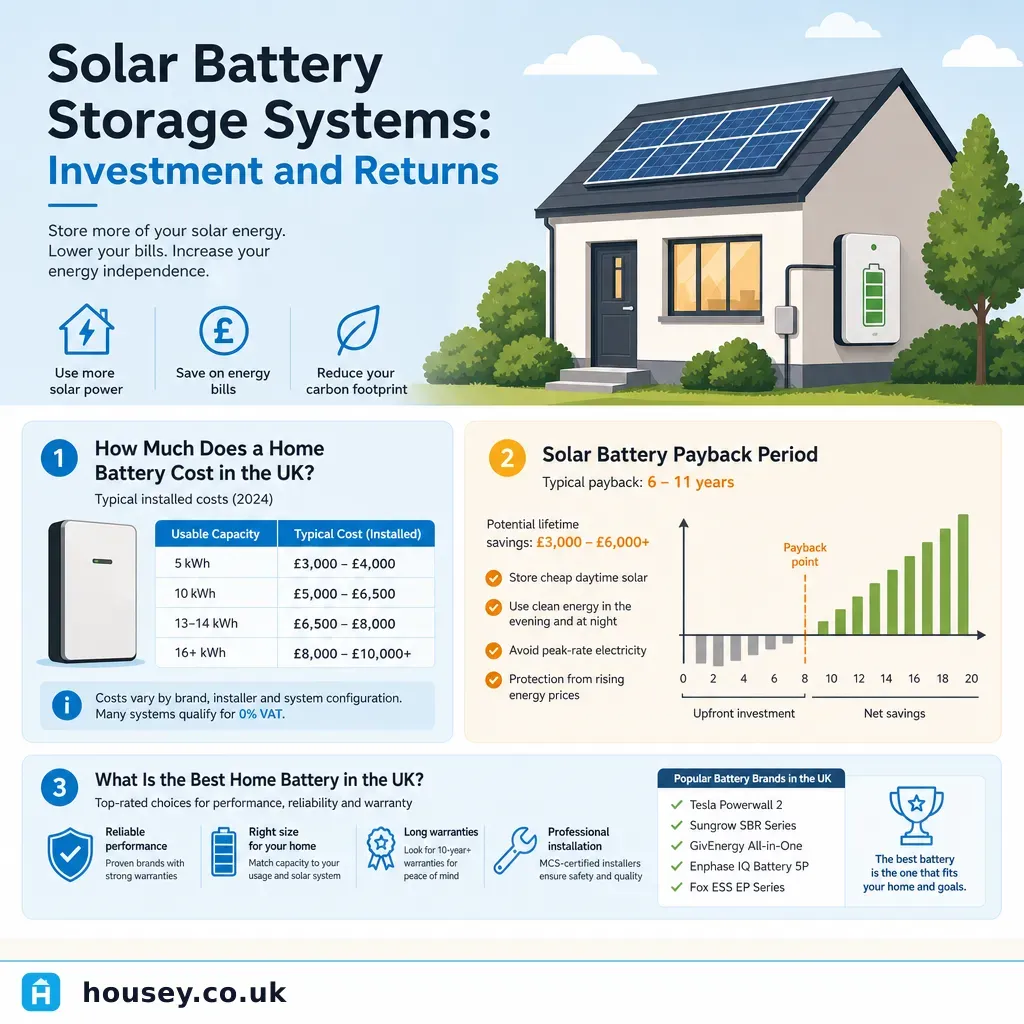
Solar Battery Storage Systems: Investment and Returns
A home battery storage system stores surplus solar energy for use in the evening, reducing grid electricity imports.
 Energy & Retrofit
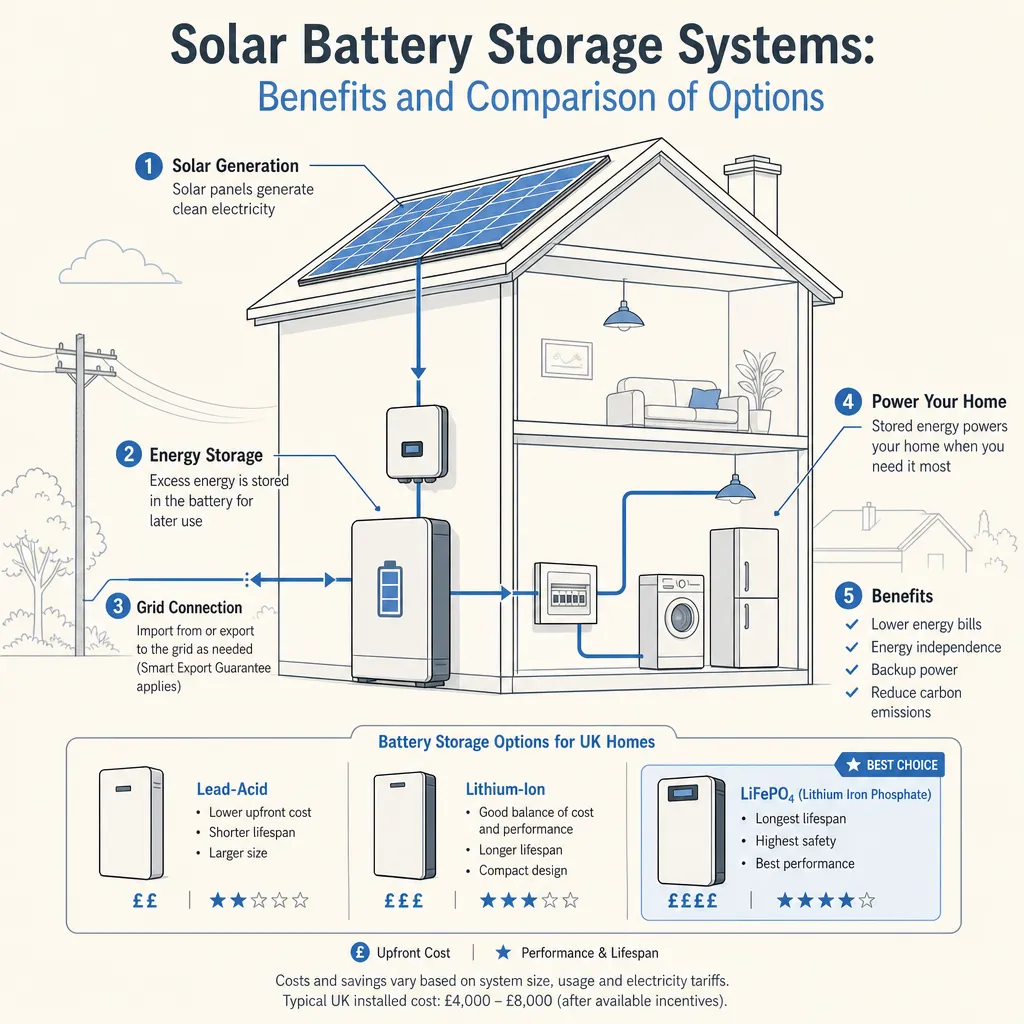
Solar Battery Storage Systems: Benefits and Comparison of Options
A solar battery storage system captures surplus electricity from your solar panels and stores it for use in the evenings, overnight, or on cloudy days.
 Energy & Retrofit
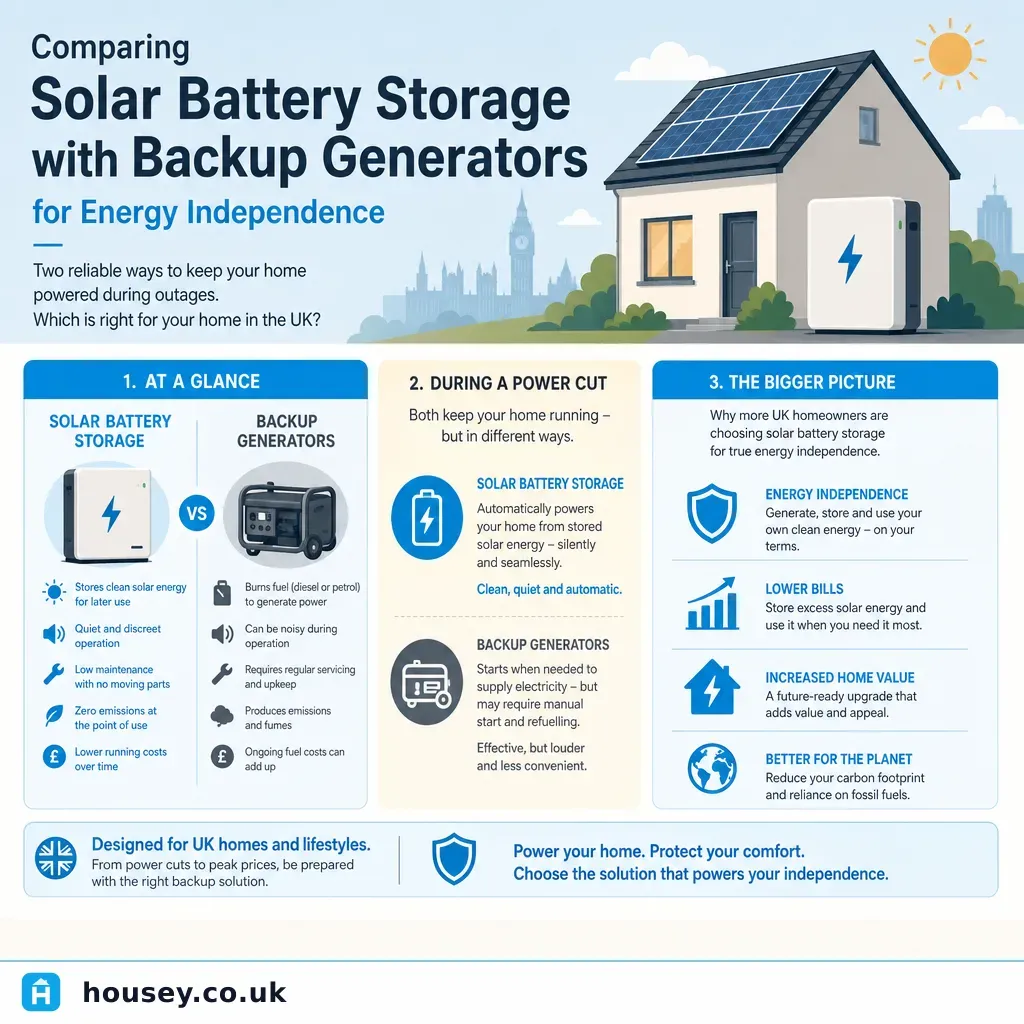
Comparing Solar Battery Storage with Backup Generators for Energy Independence
Solar battery storage and backup generators both offer energy resilience but work very differently.
 Energy & Retrofit
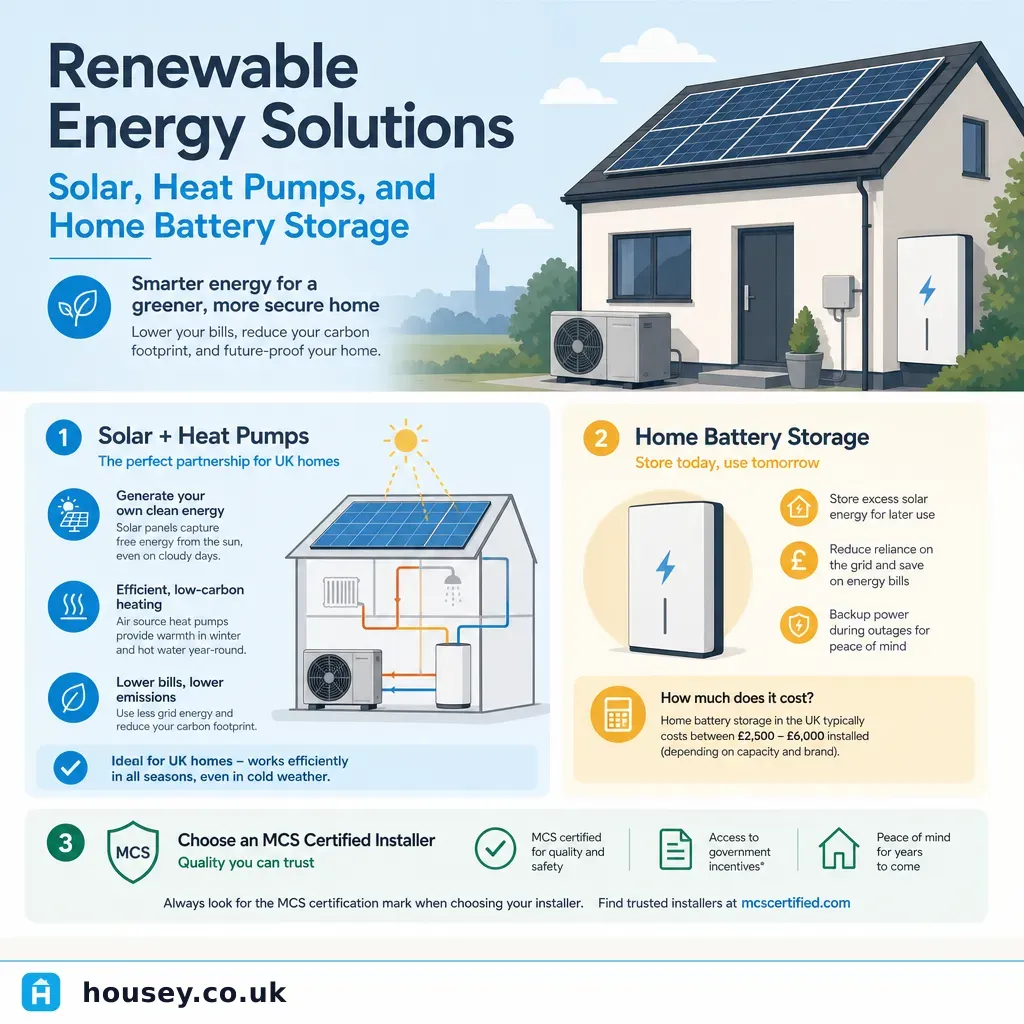
Renewable Energy Solutions: Solar, Heat Pumps, and Home Battery Storage
UK homeowners can reduce energy bills and carbon emissions by combining solar PV panels, air source heat pumps, and home battery storage.
 Energy & Retrofit
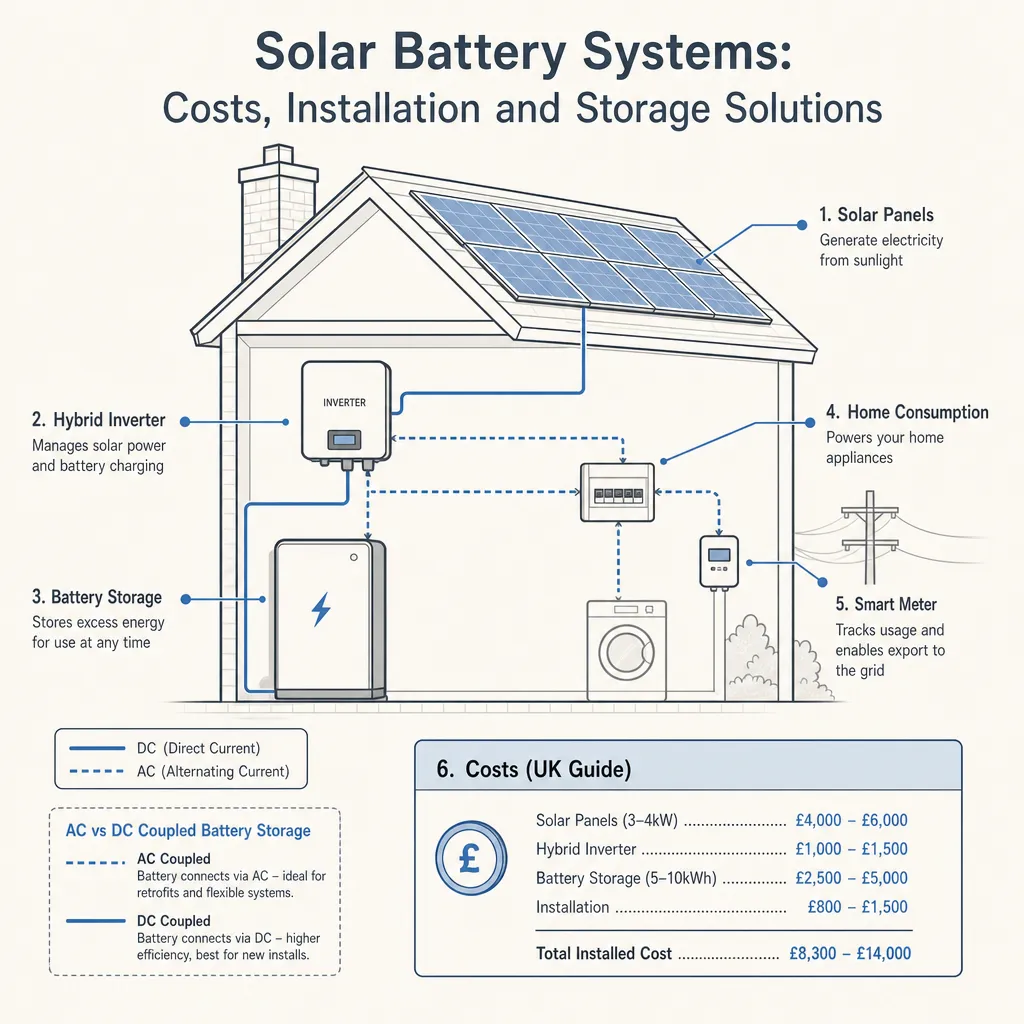
Solar Battery Systems: Costs, Installation and Storage Solutions
Solar battery systems in the UK typically cost £3,000–£8,000 installed for a 5–10 kWh system, though prices vary by brand, capacity, and coupling method.