Solar Battery Storage Systems: Benefits and Comparison of Options
By Housey · Last reviewed 7th of May 2026
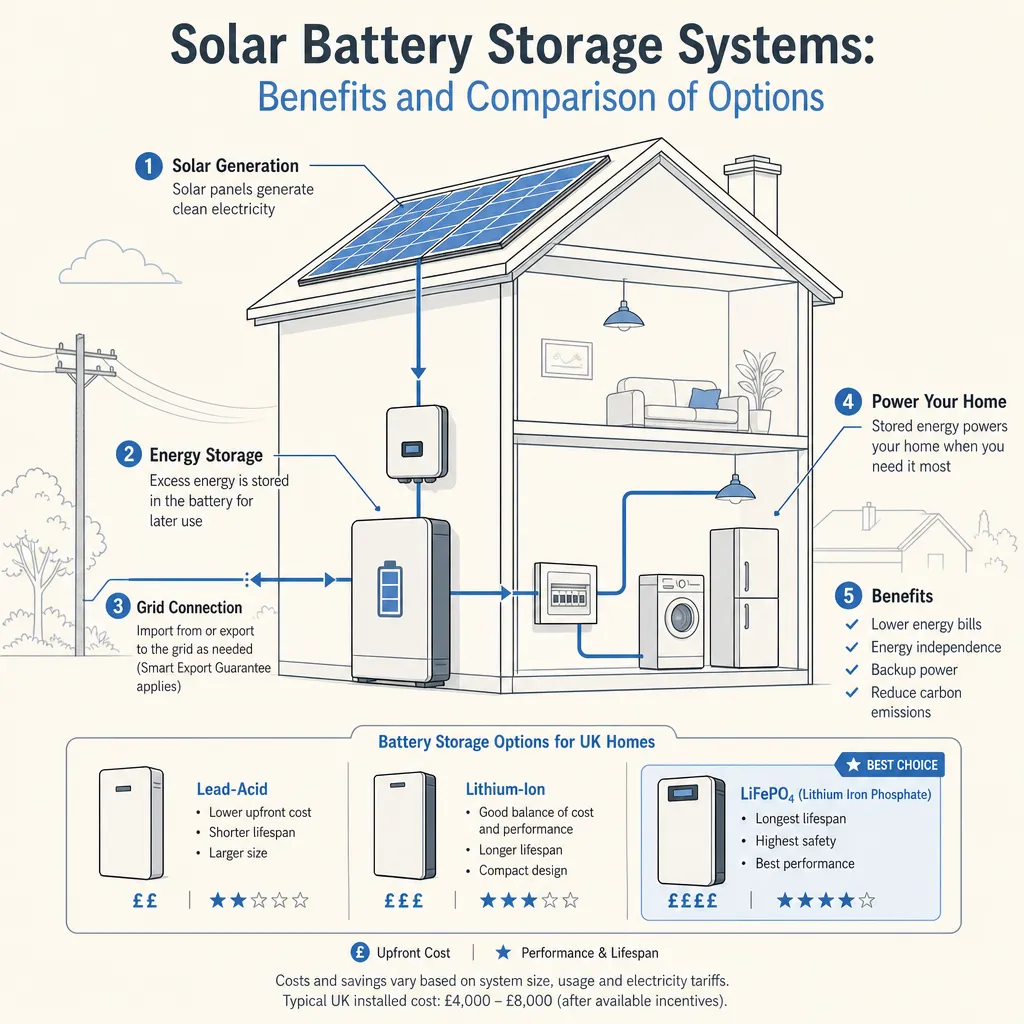
Solar Battery Storage Systems: Benefits and Comparison of Options
Questions about battery storage tend to arise once homeowners have already installed solar panels and want to capture more of what they generate, or when planning a combined solar and storage system from the outset. With UK electricity prices remaining volatile and grid export rates modest, storing surplus energy rather than selling it back at low SEG rates can make a meaningful financial difference — but the right system depends on your household's energy profile, roof output, and budget.
Key points
- Most UK home battery systems offer usable storage of between 5 kWh and 15 kWh — enough to cover typical evening household demand after a good solar generation day.
- MCS (Microgeneration Certification Scheme) accreditation is required for installers connecting battery systems to solar PV if you want to qualify for Smart Export Guarantee (SEG) payments.
- Lithium iron phosphate (LFP) chemistry dominates new UK residential installations due to its longer cycle life (typically 4,000–6,000 cycles) and better thermal stability compared with older NMC chemistries.
- The Smart Export Guarantee requires electricity suppliers with 150,000 or more domestic customers to pay for surplus electricity exported to the grid; battery storage helps maximise self-consumption rather than low-rate export.
- Indicative installed costs for a standalone home battery range from approximately £2,000 to £6,000 depending on capacity, brand, and labour; combined solar-plus-storage packages vary considerably more.
What does a solar battery storage system actually do?
A battery storage system — sometimes called a home energy storage system (HESS) — stores electrical energy generated by your solar panels during daylight hours and releases it when your panels are not generating: typically in the evenings, overnight, or on overcast days. Without storage, unused solar electricity is either exported to the grid at the relatively low SEG rate, or effectively wasted. With storage, more of the energy you generate is consumed within your home, reducing the amount you buy from your supplier at full retail rates.
Battery systems can also be configured to charge from the grid during cheap overnight tariff periods — such as time-of-use tariffs that offer off-peak rates as low as 7p/kWh — providing additional flexibility even for households without solar panels, though the financial case is strongest when combined with generation.
Comparing the main battery storage options
The UK residential market is dominated by a small number of battery technologies. The table below covers the main chemistry types and key practical considerations:
Feature | Lithium iron phosphate (LFP) | Lithium NMC (older systems) | Lead-acid (legacy) |
|---|---|---|---|
Typical cycle life | 4,000–6,000+ cycles | 2,000–4,000 cycles | 500–1,500 cycles |
Depth of discharge | 90–100% | 80–90% | 50–70% |
Thermal stability | High — safer chemistry | Moderate | High |
Typical warranty | 10 years | 5–10 years | 2–5 years |
Best for | New installations, long-term use | Existing compatible systems | Off-grid or specific legacy retrofit |
Main limitation | Higher upfront unit cost | Shorter lifespan than LFP | Heavy; poor depth of discharge |
LFP is now the default chemistry for new UK residential installations. Lead-acid systems are rarely recommended for new installs due to short cycle life and limited depth of discharge.
Which battery size do you need?
Battery sizing should be matched to your solar array's daily surplus output and your household's evening and overnight demand. A system that is too small leaves surplus solar exported at low rates; one that is too large will rarely charge fully, offering a poor return on investment. Sizing calculations should always be carried out by an MCS-accredited installer using actual consumption data and solar generation estimates for your location.
Decision tree — choosing a battery capacity:
- Choose 5–7 kWh if your solar array is 3 kWp or smaller, or your household uses fewer than 10 kWh per day on average.
- Choose 8–12 kWh if your array is 3.5–6 kWp, your household uses 10–20 kWh per day, or you plan to charge an electric vehicle from stored solar overnight.
- Choose 12 kWh or more if you have a large array (6 kWp+), high evening demand, an EV, or want substantial grid independence.
- Ask a qualified installer if your home has a three-phase electricity supply, a legacy Feed-in Tariff system, or a complex hybrid generation setup.
- Check with your Distribution Network Operator (DNO) if your planned battery exceeds 3.68 kW single-phase export capacity — a G98 notification or G99 application may be required under Engineering Recommendation G98/G99.
Key benefits of battery storage for UK homeowners
Self-consumption: The primary benefit. Instead of exporting surplus solar at SEG rates (which vary by supplier and tariff), you use it at home — avoiding buying the equivalent units from your supplier at full retail rates, which as of 2026 often exceed 24p/kWh.
Tariff optimisation: When paired with a time-of-use electricity tariff, batteries can charge cheaply during off-peak overnight periods and discharge during higher-rate hours, reducing bills even without solar.
Grid outage resilience: Some battery systems include a backup or islanding mode that can power critical circuits during a grid outage. This feature is not standard on all systems — confirm availability before purchasing.
Carbon reduction: Using stored solar energy rather than grid electricity reduces your household's carbon intensity, particularly at peak demand times when the UK grid relies more heavily on fossil fuel generation.
What to check before installation
Use this checklist before instructing a battery storage installer:
When to get professional help
Battery storage installation involves work on your home's electrical system and, in most cases, your solar inverter. This work must be carried out by a qualified electrician holding MCS accreditation for battery storage. Do not attempt to install or modify battery systems yourself.
Seek professional assessment if:
- Your solar panels are more than 10 years old and have not been recently inspected — a condition check is advisable before adding storage.
- You are unsure whether your inverter is hybrid-ready or whether a replacement is needed.
- Your home has a three-phase electricity supply — sizing and connection requirements differ from standard single-phase properties.
- You experience recurring faults or unexplained output drops from your existing solar system.
- You want to maintain eligibility for the Smart Export Guarantee after adding storage — your installer must certify the combined system under MCS.
How Housey can help
Housey can connect you with MCS-accredited battery storage installers who can assess your property, confirm compatibility with your existing solar array, and provide competitive quotes. If you want to check the condition and output of your solar panels before investing in additional equipment, a solar survey is a practical first step.
Frequently asked questions
Can I add battery storage to an existing solar PV system?
In most cases, yes — but compatibility depends on your existing inverter. AC-coupled batteries can work with virtually any inverter, while DC-coupled systems require a hybrid inverter. An MCS-accredited installer will assess your existing equipment and recommend the most cost-effective approach for your property.
Does battery storage qualify for any UK government grants?
As of 2026, there is no dedicated standalone grant for home battery storage in Great Britain. Battery storage installed as part of a qualifying retrofit programme may attract support under schemes such as ECO4 — check GOV.UK for current eligibility. Scotland, Wales, and Northern Ireland operate separate energy efficiency schemes with their own criteria.
How long does a home battery system last?
Most modern lithium iron phosphate (LFP) batteries are warranted for 10 years or a minimum number of cycles — often 4,000 or more — retaining at least 70–80% of original capacity at end of warranty. Physical lifespan can extend to 15 years or beyond with correct use, though capacity gradually declines over time.
Will battery storage earn money from the Smart Export Guarantee?
Battery storage is primarily designed to increase self-consumption rather than export, so it may reduce your SEG earnings if you currently export significant amounts. The main financial benefit comes from avoiding high electricity import costs — typically 24–30p/kWh — rather than from increased export payments at lower SEG rates.
Do I need planning permission for a home battery storage system?
Battery storage systems installed inside the property or in an attached garage generally do not require planning permission under permitted development rules. If your property is listed or in a conservation area, check with your local planning authority before installation, as permitted development rights may be restricted.
Sources and further reading
- Smart Export Guarantee (SEG) — Ofgem
- Microgeneration Certification Scheme: find an accredited installer — MCS
- Battery storage for homes — Energy Saving Trust
- Engineering Recommendation G98 and G99 — Energy Networks Association
- Energy efficiency schemes and grants — GOV.UK
Useful next reads
 Energy & Retrofit
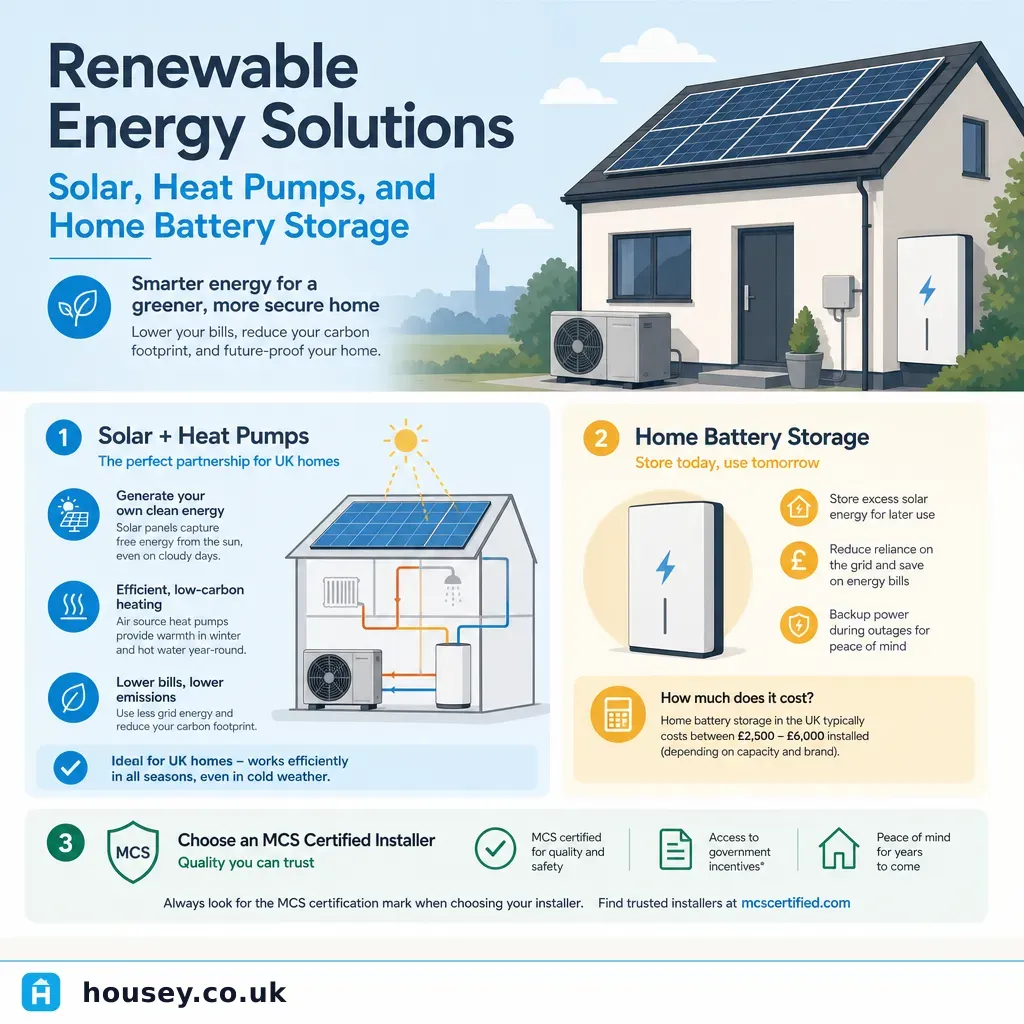
Renewable Energy Solutions: Solar, Heat Pumps, and Home Battery Storage
UK homeowners can reduce energy bills and carbon emissions by combining solar PV panels, air source heat pumps, and home battery storage.
 Energy & Retrofit
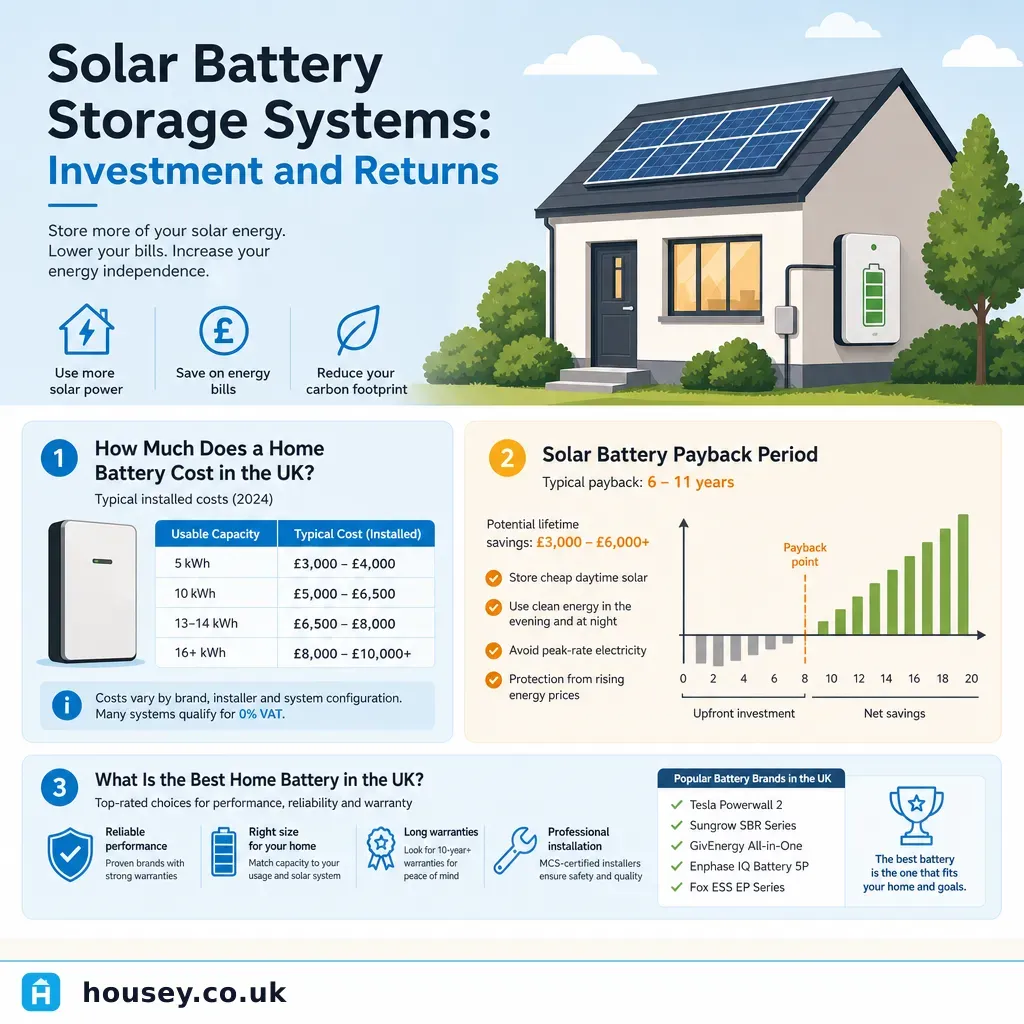
Solar Battery Storage Systems: Investment and Returns
A home battery storage system stores surplus solar energy for use in the evening, reducing grid electricity imports.
 Energy & Retrofit
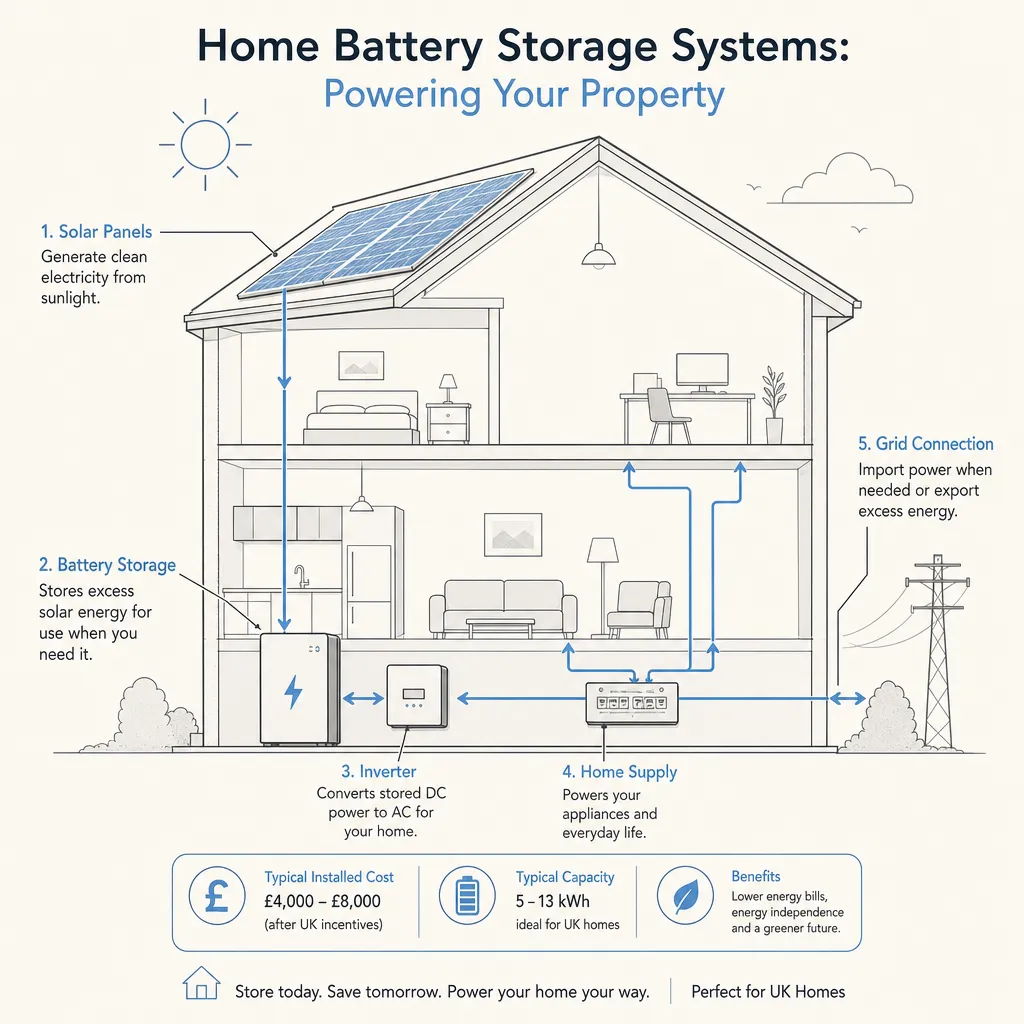
Home Battery Storage Systems: Powering Your Property
Home battery storage systems store electricity from solar panels or the grid — typically 5 to 15 kWh capacity — for use when generation is low or tariffs are high.
 Energy & Retrofit
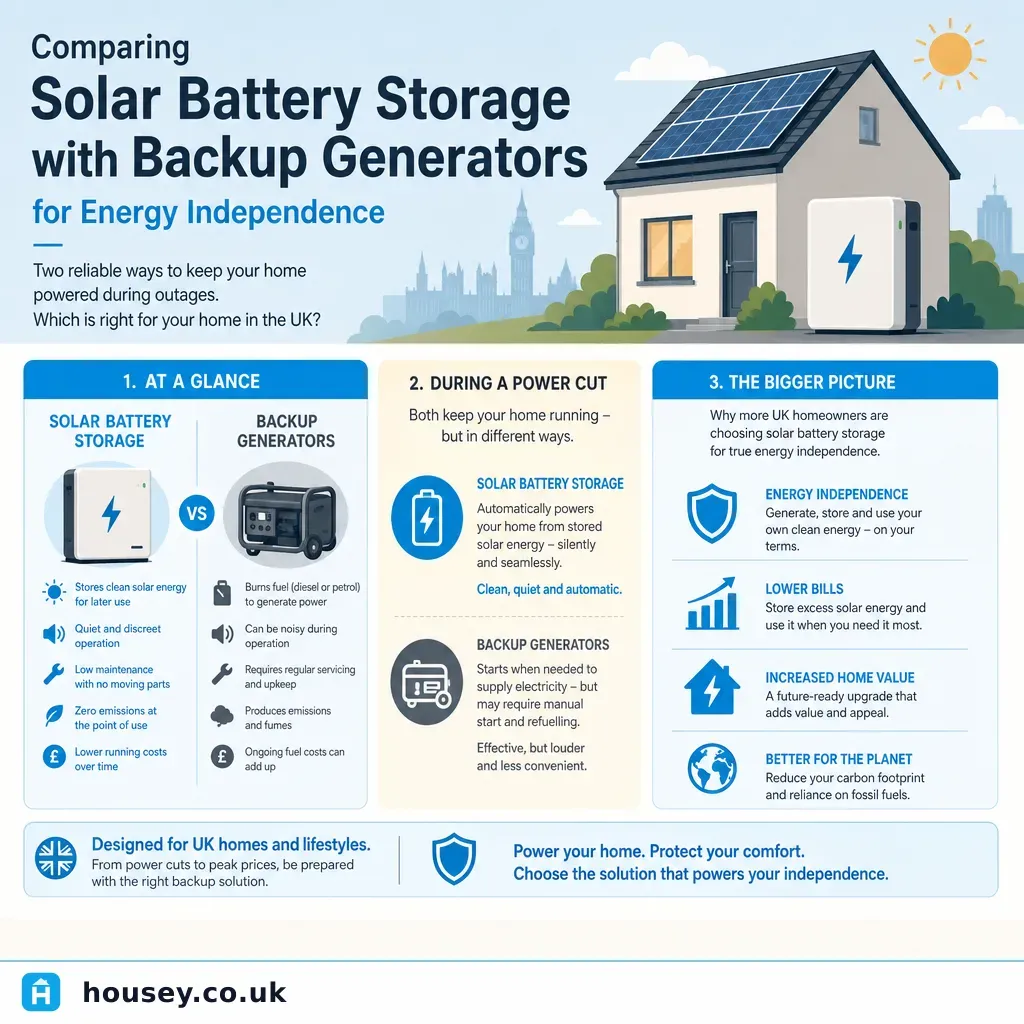
Comparing Solar Battery Storage with Backup Generators for Energy Independence
Solar battery storage and backup generators both offer energy resilience but work very differently.
 Energy & Retrofit
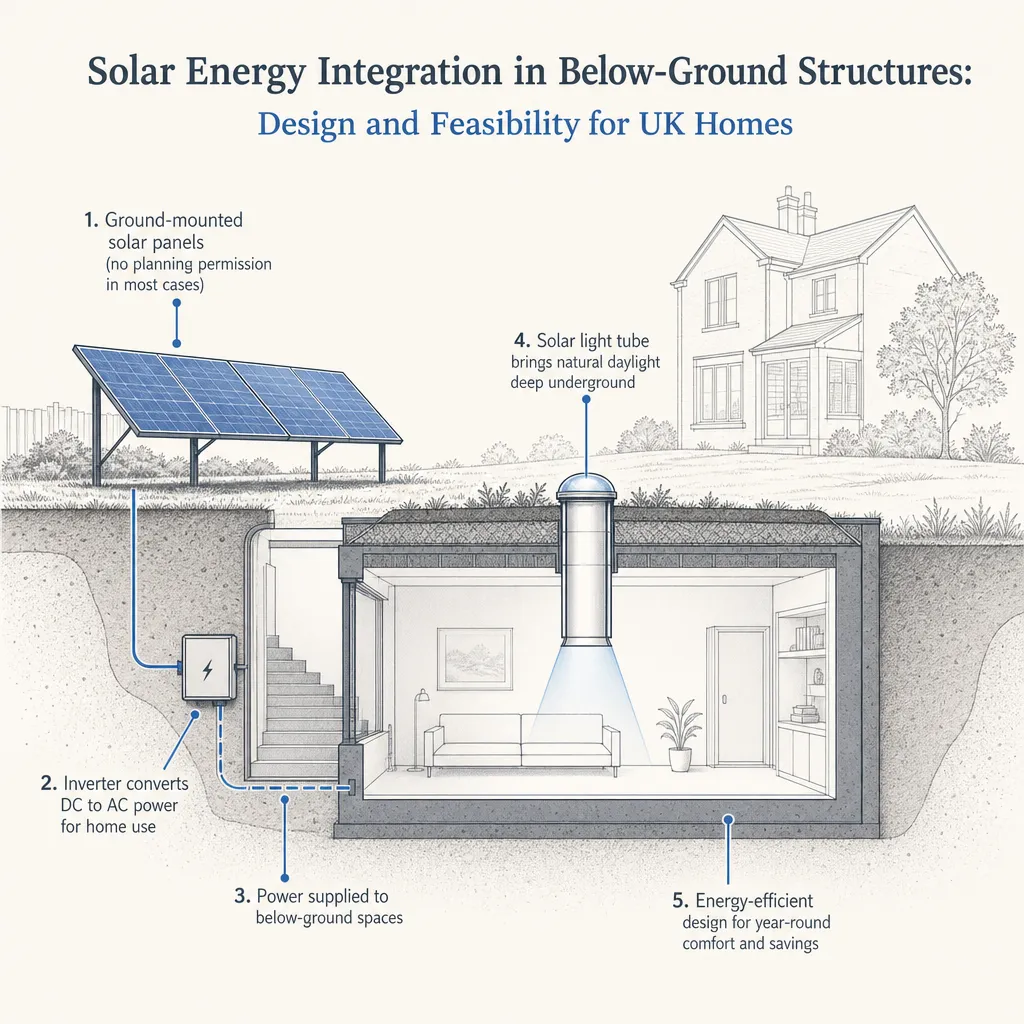
Solar Energy Integration in Below-Ground Structures: Design and Feasibility
Below-ground structures cannot host solar panels on their own roofs but can use surface-mounted panels connected via cable runs, solar light tubes for daylighting, and battery storage.