Stress-Free Home Renovation: Project Planning and Contractor Management Tips
By Housey · Last reviewed 24th of May 2026
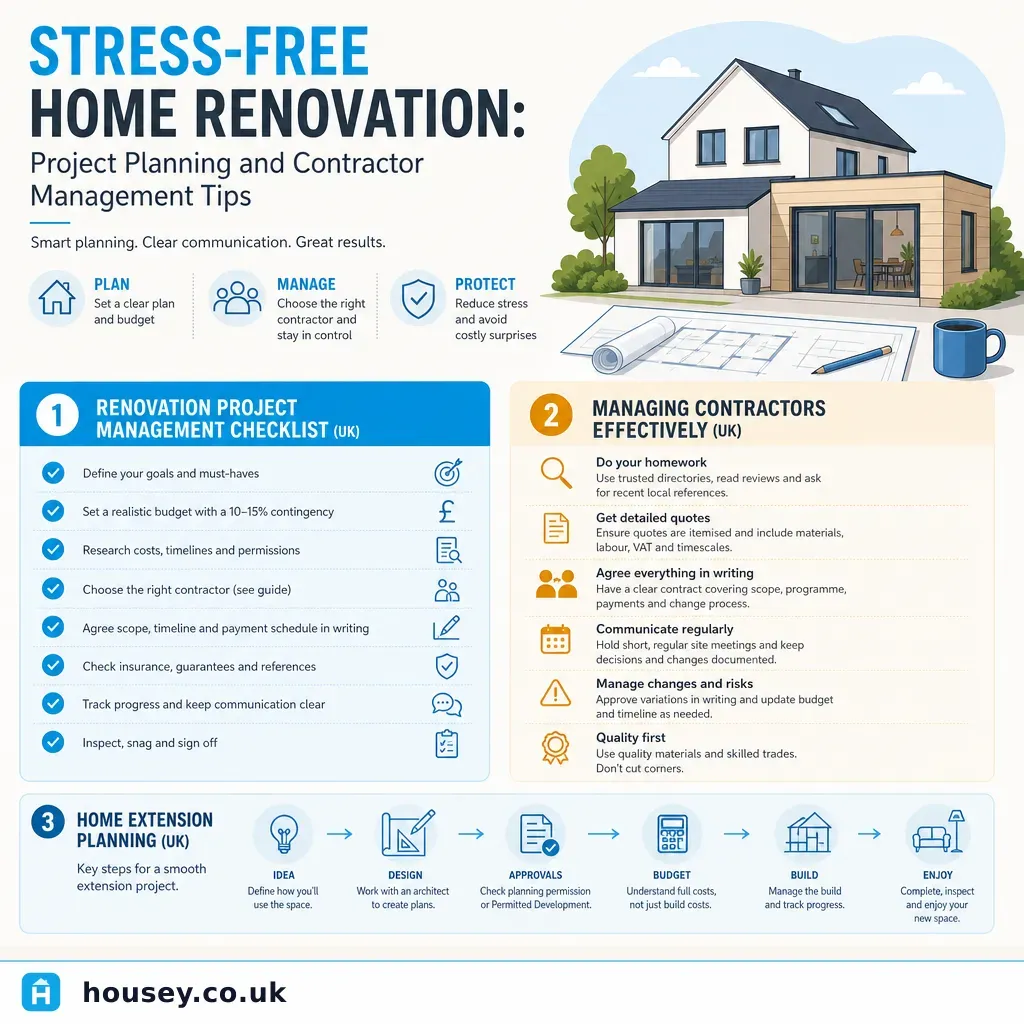
Stress-Free Home Renovation: Project Planning and Contractor Management Tips
A home renovation — whether a rear extension, loft conversion, or room-by-room overhaul of a 1930s semi — is one of the largest financial and logistical undertakings most UK homeowners will face. Projects that run smoothly almost always share one trait: thorough preparation before anyone breaks ground. Those that derail into cost overruns, contractor disputes, and half-finished rooms typically reflect decisions made too quickly — no detailed specification, vague payment terms, or contractors appointed before designs were finalised.
Key points
- Most structural extensions require Building Regulations approval; work affecting a shared or boundary wall triggers the Party Wall etc. Act 1996, requiring a surveyor-agreed award before work begins
- Permitted development rights allow certain extensions without full planning permission, but thresholds vary by property type, location, and previous extensions — verify with your local planning authority before starting
- Obtaining at least three itemised quotes against a common specification exposes pricing discrepancies and protects against scope gaps before work begins
- A formal contract — the JCT Minor Works Building Contract is widely used for domestic projects — with a clear scope, payment schedule tied to milestones, and a variation procedure is the single most effective safeguard against disputes
- Retaining at least 5% of the contract value as a final payment held for four weeks after practical completion covers snagging and incentivises the contractor to return promptly
The right sequence before appointing anyone
Many renovation problems stem from appointing a contractor before the design is resolved. The correct sequence for most significant UK projects is:
- Define scope and budget — what you want, what you can afford including a 15–20% contingency, and what level of disruption you will tolerate
- Appoint a designer — for extensions, loft conversions, or structural alterations, a RIBA-registered architect or CIAT-accredited architectural technologist prepares drawings and a specification
- Confirm planning status — obtain planning permission or formally confirm permitted development applies before spending money on detailed construction drawings
- Prepare a detailed specification — a written document describing every element of the works: materials, dimensions, finishes, brands, and required warranties
- Tender to at least three contractors — send the specification to all three so quotes are directly comparable
- Agree a written contract — not just an email accepting a quote
- Notify under the Party Wall etc. Act 1996 — if applicable, start this process at least two months before work is due to begin, as the Act has fixed notice periods
- Submit for Building Regulations approval — a full plans application (preferred for larger works) or a building notice before work starts
Choosing and vetting contractors
What to look for
- Membership of a recognised trade body: the Federation of Master Builders (FMB) for general builders, NICEIC or NAPIT for electrical work, Gas Safe Register for gas installations, NHBC for new-build elements
- Evidence of comparable projects: ask to visit completed work and speak to previous clients directly
- Public liability insurance of at least £2 million — ask for the certificate, not just a verbal assurance
- A fixed business address and, for larger firms, a VAT registration number
What to ask before appointing a contractor
- Can you provide references from comparable projects completed in the last two years?
- Who will be the site supervisor on a day-to-day basis — the person I met, or someone else?
- What trade body memberships do you hold, and what does membership require in practice?
- Can I see your current public liability insurance certificate?
- What is your proposed programme, and what milestones will trigger each stage payment?
- How do you handle variations to the agreed specification — in writing before the work is done, or afterwards?
- Will you submit the Building Regulations application, or is that my responsibility?
- What warranties or guarantees do you provide on completed work, and are they backed by an insurance product?
Quote comparison template
When comparing quotes, confirm that each contractor has quoted against the same specification. Ask for a breakdown across the following categories:
Work element | Contractor A (£) | Contractor B (£) | Contractor C (£) |
|---|---|---|---|
Groundworks and foundations |
|
|
|
Structural walls and frame |
|
|
|
Roof structure and coverings |
|
|
|
Windows and external doors |
|
|
|
First fix (electrics, plumbing) |
|
|
|
Plastering and dry lining |
|
|
|
Second fix (electrics, plumbing, joinery) |
|
|
|
Floor finishes |
|
|
|
Contingency (state %) |
|
|
|
VAT at 20% |
|
|
|
Total |
|
|
|
If one quote is dramatically lower than the others, ask specifically what it excludes. A low quote often means items are missing from the scope, cheaper materials are assumed, or the programme is unrealistic.
Contracts and payment terms
Avoid paying large sums upfront. A typical payment structure for a medium-sized UK renovation might be:
- No deposit for established contractors (a materials deposit of 10–15% for specialist or long-lead items is reasonable if supported by receipts)
- Stage payments tied to measurable milestones: completion of groundworks, completion of structure, first fix, second fix, and practical completion
- Final retention of at least 5% of the contract value, held for a minimum of four weeks after practical completion to cover snagging
The JCT Minor Works Building Contract provides a standard framework for variations, extensions of time, and disputes, and is appropriate for domestic projects up to around £500,000. Even for smaller projects, a written agreement detailing scope, programme, payment terms, and the variation procedure is strongly advisable.
Managing the project day to day
Once work begins, maintain regular but not intrusive oversight.
- Programme: Ask for a simple milestone list or Gantt chart at the outset. Review progress weekly and raise slippage in writing early.
- Variations: Any change to the agreed scope must be agreed in writing — including the price — before it is actioned. Verbal variations are a common source of end-of-project disputes.
- Building control inspections: Ensure the contractor gives notice to the building control body at the required stages — foundations, damp proof course, pre-plaster, completion. Missed inspections can result in the building control body requiring opening-up works.
- Materials: Check that materials delivered to site match the specification. Substitutions happen, and some cheaper alternatives are not performance-equivalent.
- If things go wrong: Raise concerns in writing. Allow a reasonable remedy period. If unresolved, invoke the contract dispute procedure. FMB members have access to a dispute resolution service.
Planning permission and Building Regulations: a decision tree
- Rear extension, single storey, under 4 m deep (detached) or 3 m (semi or terrace)? → Likely permitted development, but verify with your local planning authority and check for Article 4 directions
- Two-storey extension, side return, or extension that takes the property beyond 50% of the original footprint? → Likely requires full planning permission
- Loft conversion within volume limits, no front dormer? → Likely permitted development; Building Regulations approval always required
- Any structural alteration, new beam, electrical rewire, or drainage alteration? → Building Regulations notification required regardless of planning status
- Property in a conservation area, AONB, National Park, or listed building? → Permitted development rights may be significantly restricted; check with the local planning authority before any work
When to get professional help
Professional oversight pays for itself most clearly in these scenarios:
- Party wall matters: if work affects a shared or boundary wall, a party wall surveyor is often legally required under the Party Wall etc. Act 1996
- Structural alterations: beam installations, load-bearing wall removals, and underpinning must be specified and signed off by a structural engineer
- Listed buildings: listed building consent is required; a heritage architect familiar with your local authority's conservation team is usually advisable
- No one managing the inspection sequence: if neither you nor the contractor is actively managing the building control stages, an independent project manager or clerk of works adds clear value
Red flags during a renovation that warrant immediate attention:
- Contractor requests more than 25–30% of the contract value before work begins
- No formal written contract is offered despite your request
- Building Regulations application has not been submitted when structural work has already started
- Structural work proceeds without engineer's drawings or building control sign-off
How Housey can help
Whether you need a design-and-build firm to take your project from initial drawings through to completion, a specialist extension builder for a rear or side addition, or an independent project manager to oversee contractors and building control on your behalf, Housey can connect you with vetted professionals who cover your area.
Frequently asked questions
Do I need planning permission for a loft conversion?
Many loft conversions fall within permitted development rights, meaning no formal planning application is required. However, Building Regulations approval is always required regardless of planning status. Permitted development conditions include volume limits, restrictions on roof alterations visible from a highway, and exclusions for listed buildings, conservation areas, and properties with prior PD rights removed by an Article 4 direction. Confirm with your local planning authority before starting.
How much contingency should I allow for a renovation?
A widely recommended contingency for UK renovation and extension work is 15–20% of the construction budget. Older properties — particularly Victorian or Edwardian terraces with solid walls — frequently reveal unexpected conditions once work starts, including hidden damp, buried drainage runs, or poorly executed previous alterations. The older and more complex the property, the higher the contingency should be.
What is a JCT contract and do I need one?
The JCT Minor Works Building Contract is a standard-form building contract widely used for domestic renovation projects in the UK. It sets out the contractor's obligations, payment schedule, how variations are priced, and what happens if either party defaults. You are not legally required to use it, but having some form of written contract is strongly advisable for any project above approximately £5,000.
How do I find a reliable builder in the UK?
Seek recommendations from local homeowners who have had comparable work done recently. Check trade body membership — the Federation of Master Builders (FMB) and NHBC are two widely recognised bodies. Ask to see the contractor's public liability insurance certificate, request references from projects completed in the last two years, and always meet the person who will actually manage the work on site before signing anything.
Sources and further reading
- Planning Portal: permitted development interactive guide — Planning Portal
- Party Wall etc. Act 1996: explanatory booklet — GOV.UK
- Building Regulations approval: when you need it — GOV.UK
- Federation of Master Builders: find a member — Federation of Master Builders
- JCT Minor Works Building Contract — JCT
Useful next reads
 Improvement & Build
Home Renovation: Contractor Advice and Professional Tips for Property Owners
Successful renovations depend on preparation, clear contracts, and vetted contractors.
 Improvement & Build
Living Through Major Renovation: Stay or Relocate During Building Work
Whether to stay in your home or relocate during major building work depends on the project scope, programme, and your household's circumstances.
 Improvement & Build
Evaluating And Planning Renovations For Properties Requiring Modernisation
Start by commissioning a condition survey — RICS Level 3 for pre-1919 properties — to identify structural defects, damp, and services issues before finalising a budget.
 Improvement & Build
Small kitchen renovation: budgeting for costs and planning your project
A small kitchen renovation in the UK typically costs £5,000–£15,000 for a full refresh including new units, worktops, tiling, and appliances, though costs vary widely by specification, region, and whether structural changes or rewiring are involved.
 Improvement & Build
Conservatories and Garden Extensions: Design and Building Guide
Most conservatories qualify as permitted development in England if they are single-storey, within 50% of original curtilage, and meet dimensional limits.