Roof Retiling and Planning Permission: When Consent is Required
By Housey · Last reviewed 4th of May 2026
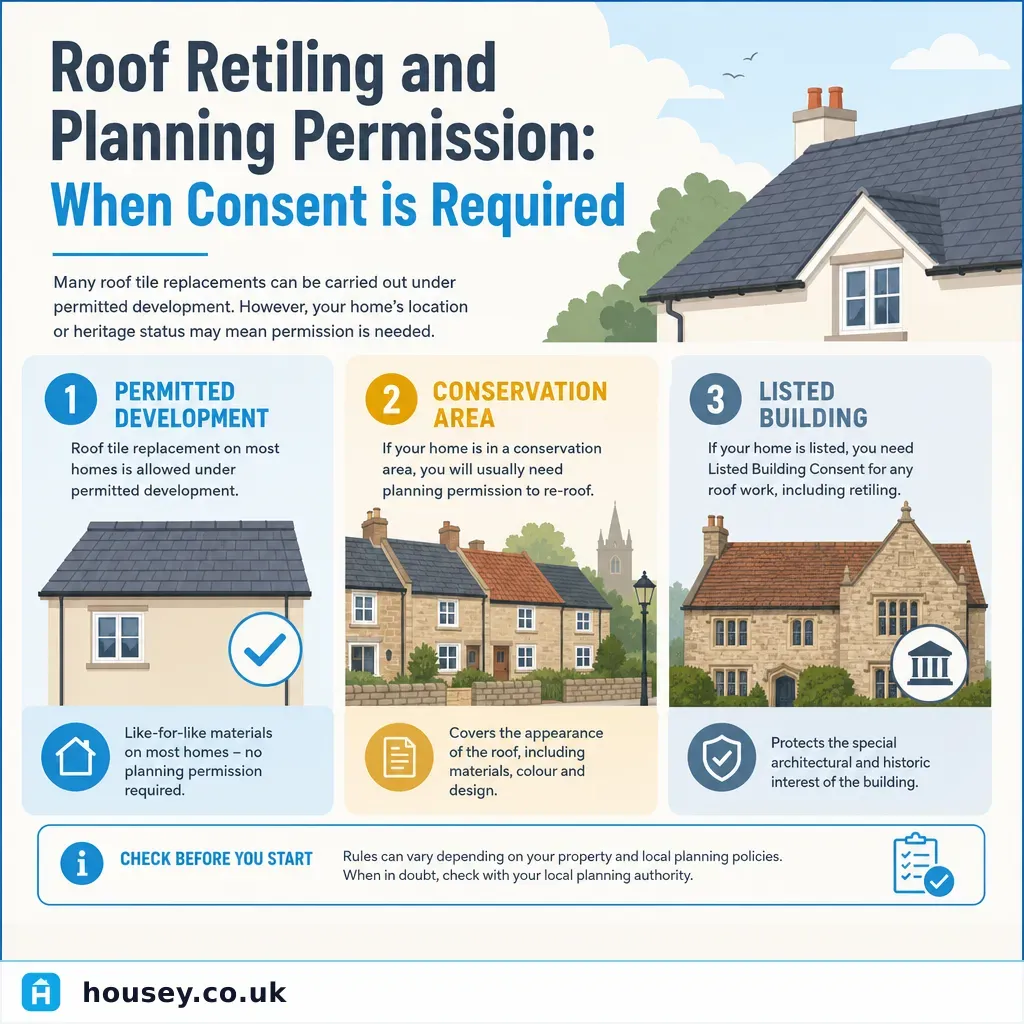
Roof Retiling and Planning Permission: When Consent is Required
Most homeowners replacing worn or damaged roof tiles expect it to be a straightforward practical job — agree a specification with a roofer, arrange scaffolding, and get it done. But depending on where you live, the material you choose, and the status of your property, roof retiling can require planning permission or listed building consent before a single tile is lifted. Understanding the rules in advance can prevent enforcement action, protect the property's planning history, and avoid complications at the point of sale.
Key points
- Replacing roof tiles with materials of a similar appearance to existing tiles is generally permitted development in England under Schedule 2, Part 1 of the Town and Country Planning (General Permitted Development) (England) Order 2015, and does not require planning permission.
- Any re-roofing works on a listed building require listed building consent under the Planning (Listed Buildings and Conservation Areas) Act 1990, even if the replacement tiles appear identical to the originals.
- In a conservation area, changing to a noticeably different tile material — for example replacing plain clay tiles with profiled concrete interlocking tiles — may require planning permission because it could affect the character or appearance of the area.
- A Certificate of Lawful Development (CLD) is not mandatory but provides written legal confirmation that works are permitted development; it is useful when selling or remortgaging.
- Article 4 Directions, which remove permitted development rights in certain designated areas, can apply to roof works — check with your local planning authority if you are unsure whether one is in force.
When is planning permission not needed for roof retiling?
For most straightforward re-roofing jobs on standard residential properties in England, planning permission is not required. Maintenance and repair of a dwelling — including like-for-like tile replacement — is generally permitted development.
Roof retiling is likely to be permitted development if:
- You are replacing tiles on a like-for-like basis (same material, similar colour and profile)
- The property is not listed and not in a conservation area
- No Article 4 Direction has removed permitted development rights for the area
- The works do not alter the shape, pitch, or form of the roof in any way
- The works are to a dwelling (not a flat above commercial premises or a building with a different use class)
When planning permission or consent is required
Situation | Consent likely required | Notes |
|---|---|---|
Like-for-like tile replacement, standard property outside conservation area | No | Standard permitted development |
Re-roofing with a noticeably different tile material, standard property | Check with LPA | Depends on the degree of visual difference and local policy |
Any re-roofing on a listed building | Yes — listed building consent | Criminal offence to proceed without consent |
Re-roofing in a conservation area using a materially different tile | Possibly — check with LPA | May affect character of conservation area |
Changing roof form, pitch, or adding a raised parapet or dormer | Yes — planning permission | Roof shape change is not permitted development |
Flat-to-pitched or pitched-to-flat conversion | Yes — planning permission | Material alteration to roof form |
Property subject to an Article 4 Direction | Check with LPA | Permitted development rights may be removed |
Decision guide: do you need planning permission for roof retiling?
- Is your property listed (Grade I, Grade II*, or Grade II)? Yes — listed building consent is required before any re-roofing work. Contact your local authority conservation officer before instructing a roofer.
- Is the replacement tile the same material, colour, and profile as the existing tile? Yes — likely permitted development. No — continue to the next question.
- Is your property in a conservation area? Yes — check with your local planning authority. If the change in tile is visible and could affect the character of the area, consent may be needed.
- Does an Article 4 Direction apply to your property or street? Check with your local planning authority — your permitted development rights may have been removed.
- Are you changing the roof form, pitch, or adding any new element beyond tile replacement? Yes — planning permission is likely required.
- Still uncertain? Apply for a Certificate of Lawful Development for written certainty, or request pre-application planning advice from your local planning authority.
Conservation areas: what the rules mean in practice
If your property is in a conservation area, permitted development rights for roof alterations are more restricted. The key test is whether the works would affect the character or appearance of the conservation area.
Replacing clay plain tiles with matching clay plain tiles is very unlikely to require consent. Replacing them with modern profiled concrete interlocking tiles — which have a noticeably different texture, profile, and reflectivity — may require planning permission, because conservation areas are often characterised by uniform, traditional roofing materials.
Before starting:
- Check the conservation area appraisal published by your local planning authority to understand which materials are historically valued in the area.
- Contact your local planning authority's development management or conservation team for pre-application advice — many offer this free of charge.
- Consider applying for a Certificate of Lawful Development if you want written confirmation that your proposed works are permitted development. This is not mandatory but provides legal certainty and can be helpful when selling or remortgaging.
Listed buildings: a separate legal regime
If your property is listed, the permitted development framework for maintenance does not override the listed building consent requirement. Re-roofing a listed building without consent is a criminal offence under the Planning (Listed Buildings and Conservation Areas) Act 1990, even if the proposed tiles appear identical to the originals.
Listed building consent applications for re-roofing typically consider:
- Whether the existing tile material is original or historically significant
- Whether the proposed material matches or is sympathetic in appearance, profile, and colour
- Whether mortar bedding methods, ridge details, and hip treatments are being changed
- Any guidance from Historic England and the local authority's conservation officer
Apply for listed building consent through the Planning Portal. The statutory target is 8 weeks for a decision. Work with a roofer who has direct experience of listed building re-roofing, and consider engaging a planning consultant or heritage consultant to prepare the application.
What counts as a similar appearance in practice?
The phrase similar appearance is not precisely defined in planning legislation — it is a judgement made by the local planning authority. As a working guide:
- Plain clay tiles replaced with plain clay tiles of the same profile: almost certainly similar appearance.
- Plain clay tiles replaced with concrete plain tiles: may be considered similar by some local planning authorities; can be contentious in conservation areas.
- Plain clay tiles replaced with profiled concrete interlocking tiles: generally not similar appearance due to profile and texture differences.
- Natural slate replaced with natural slate of the same origin and colour: similar appearance.
- Natural slate replaced with fibre cement or synthetic slate: not usually considered similar appearance — check with your local planning authority.
- Concrete tiles replaced with concrete tiles of the same profile and colour: generally similar appearance.
If uncertain, ask your roofer to obtain manufacturer data sheets and tile samples before work starts, and seek pre-application advice from the planning department.
Important limitations
This article provides general guidance on planning permission for roof retiling in England. The rules governing permitted development, conservation area controls, and listed building consent vary by local planning authority, property history, and the specific nature of the works. The framework in Scotland, Wales, and Northern Ireland differs from the English system described here.
Nothing in this article constitutes planning or legal advice. If your property is listed, in a conservation area, or subject to an Article 4 Direction, always obtain professional advice before starting any roof works.
What to ask a qualified professional
If you are unsure whether your roof retiling project needs consent, a planning consultant can advise. Before instructing one, consider asking:
- Does my property have any planning history or conditions that might affect permitted development rights?
- Is an Article 4 Direction in force for my area, and does it cover roof works?
- Would the tile I am proposing be considered similar in appearance to the existing tiles under local policy?
- Should I apply for a Certificate of Lawful Development, or is pre-application advice with the LPA more appropriate?
- If planning permission is needed, what is the likely determination period and application fee?
- For a listed building: which tile specifications have previously been accepted by this local authority for similar properties?
When to get professional help
Consider contacting a planning consultant or your local planning authority before work starts if:
- Your property is listed or in a conservation area
- You want legal certainty before spending money on materials, scaffolding, or labour
- Your roofer is uncertain whether the replacement tile is sufficiently similar in appearance
- The re-roofing is part of a wider project involving changes to the roof form or structure
- You have received a planning enforcement enquiry or notice
- The property is leasehold and your lease may require external consent for changes to the building fabric
How Housey can help
If you need guidance before your roof retiling project, Housey can connect you with qualified professionals. Get advice from a planning consultant on whether consent is needed, find experienced roofers with knowledge of conservation area and listed building requirements, or arrange a roof survey to understand the full condition of your roof before committing to a specification.
Frequently asked questions
Can I retile my roof without notifying anyone if it is like-for-like?
In most cases yes — like-for-like re-roofing on a standard property outside a conservation area is permitted development and does not require you to notify the planning authority. However, if your property is listed, any works require listed building consent regardless of how similar the tiles appear. If in doubt, apply for a Certificate of Lawful Development for written certainty before work starts.
How long does planning permission take for roof works?
If a full planning application is required, the statutory target is 8 weeks for a decision on a householder application. Listed building consent applications also target 8 weeks. Pre-application advice, where offered by your local planning authority, typically takes 4–8 weeks. Factor these timescales into your project programme, particularly if scaffolding hire costs are running.
What happens if I retile without consent in a conservation area?
If planning permission was required and you did not obtain it, the local planning authority can issue an enforcement notice requiring you to restore the roof to its previous condition. For listed building works carried out without consent, enforcement can include criminal prosecution. Acting without consent can also complicate a future property sale, as solicitors will ask for planning history documentation.
Does changing from slate to tiles count as a material change in appearance?
Replacing natural slate with clay or concrete tiles is generally considered a material change in appearance, particularly in conservation areas. Outside conservation areas on standard properties, it may still be permitted development — but check with your local planning authority if the visual difference is significant. Your roofer should be able to provide samples to assist a pre-application discussion.
Sources and further reading
- Town and Country Planning (GPDO) 2015 — Schedule 2 — legislation.gov.uk
- Planning (Listed Buildings and Conservation Areas) Act 1990 — legislation.gov.uk
- Historic England: Repair and maintenance of listed buildings — Historic England
- GOV.UK: Planning permission overview — GOV.UK
- Planning Portal: Permitted development rights for householders — Planning Portal
Useful next reads
 Planning & Pre-Build
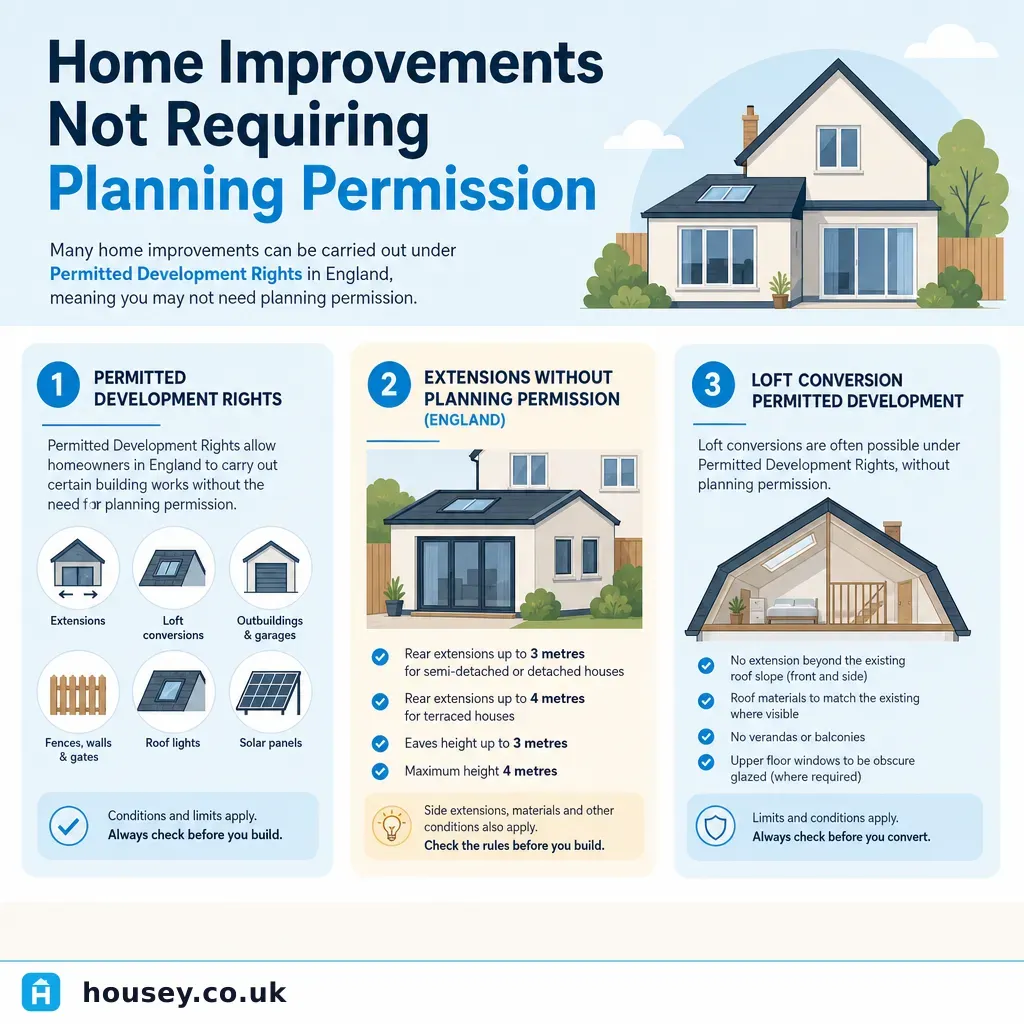
Home Improvements Not Requiring Planning Permission
Many common home improvements in England fall under Permitted Development Rights and do not require a planning application.
 Planning & Pre-Build
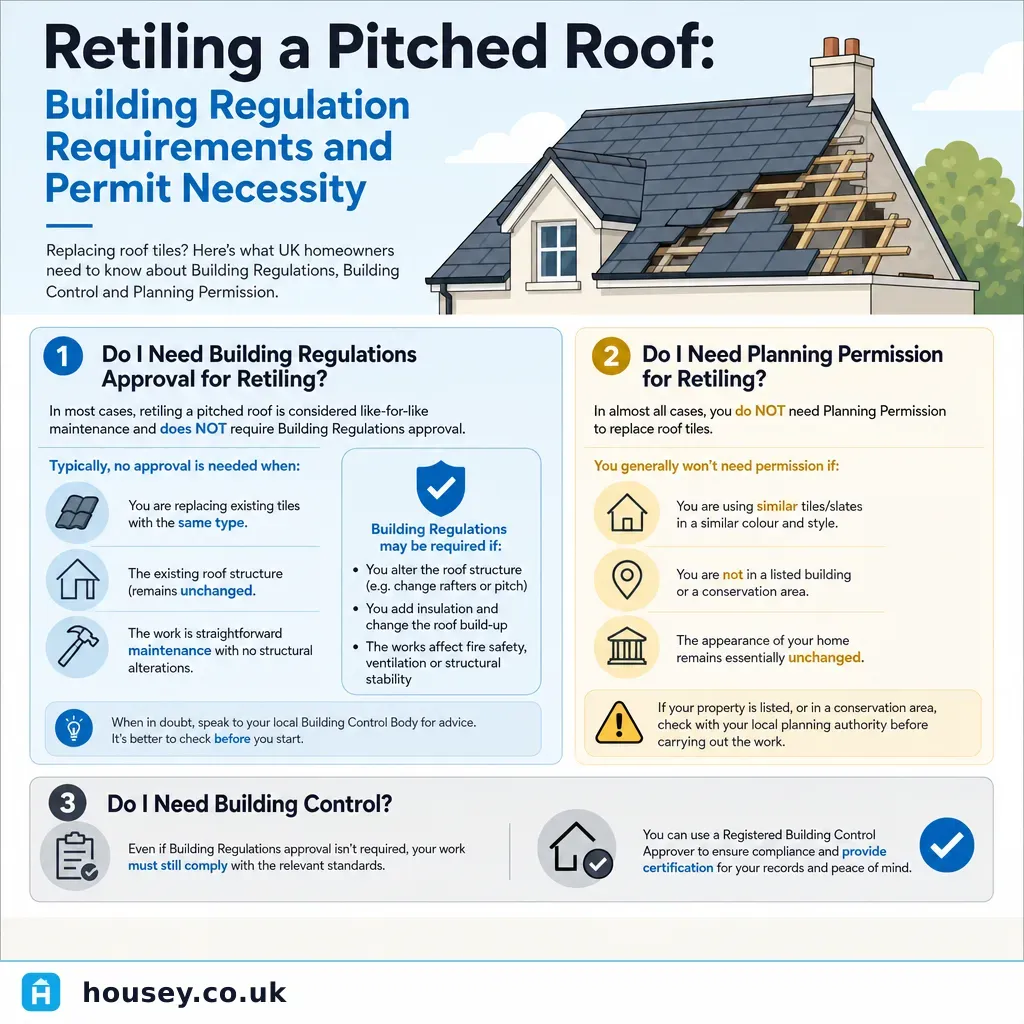
Retiling a Pitched Roof: Building Regulation Requirements and Permit Necessity
Like-for-like retiling of a pitched roof in England does not usually require planning permission or a building control application.
 Planning & Pre-Build
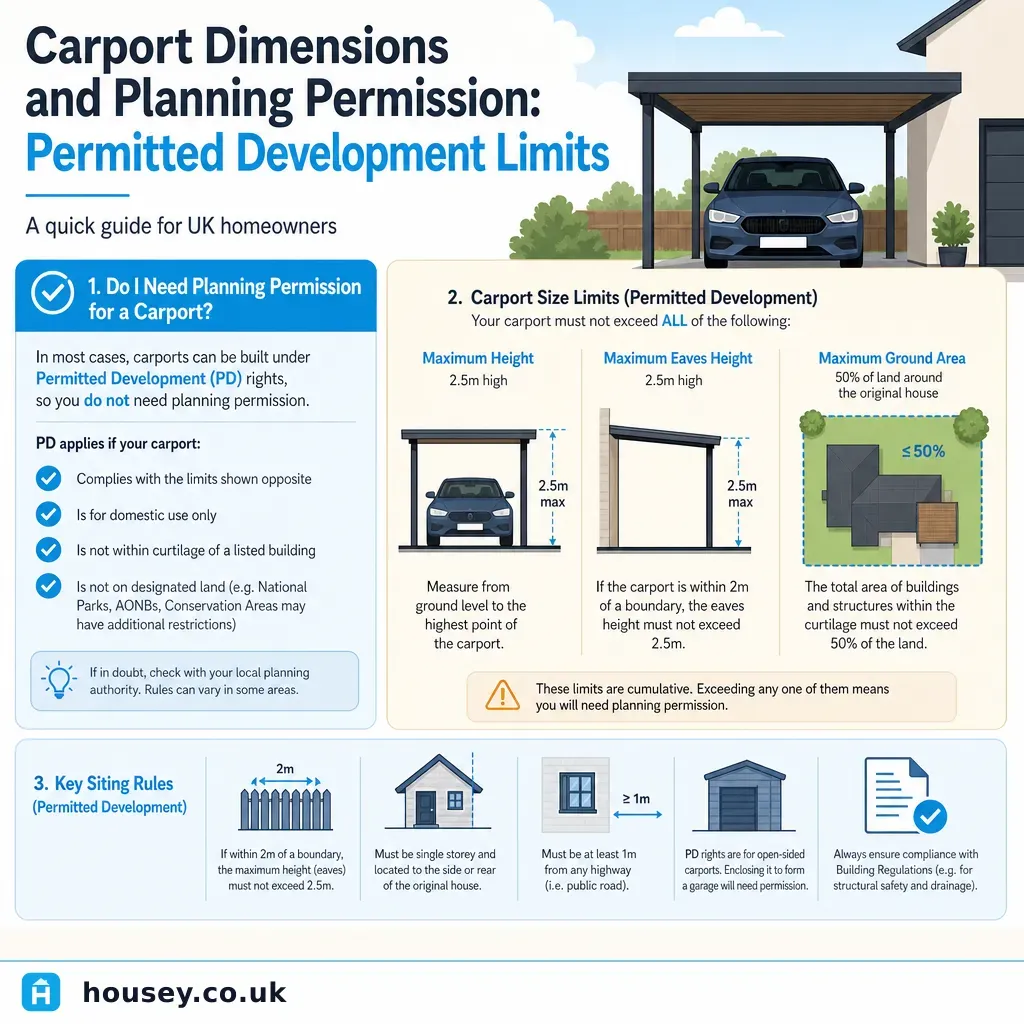
Carport Dimensions and Planning Permission: Permitted Development Limits
A carport may be built under permitted development (Class E, GPDO 2015) if it stays within 50% of the curtilage, does not exceed 2.
 Planning & Pre-Build
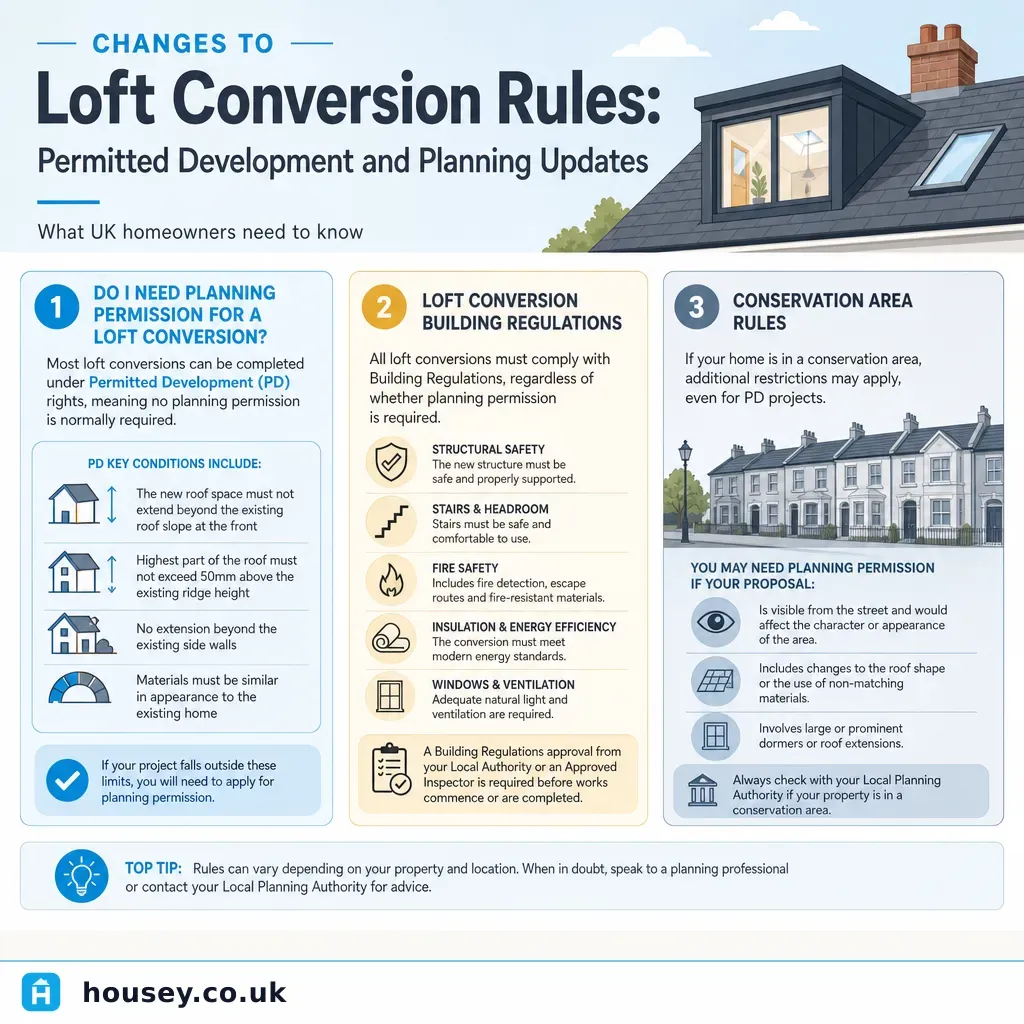
Changes to Loft Conversion Rules: Permitted Development and Planning Updates
In England, most loft conversions on standard houses qualify as Permitted Development under Class B of the GPDO 2015, allowing up to 40 cubic metres (terraced) or 50 cubic metres (detached or semi-detached) without a planning application — if conditions are met.
 Planning & Pre-Build
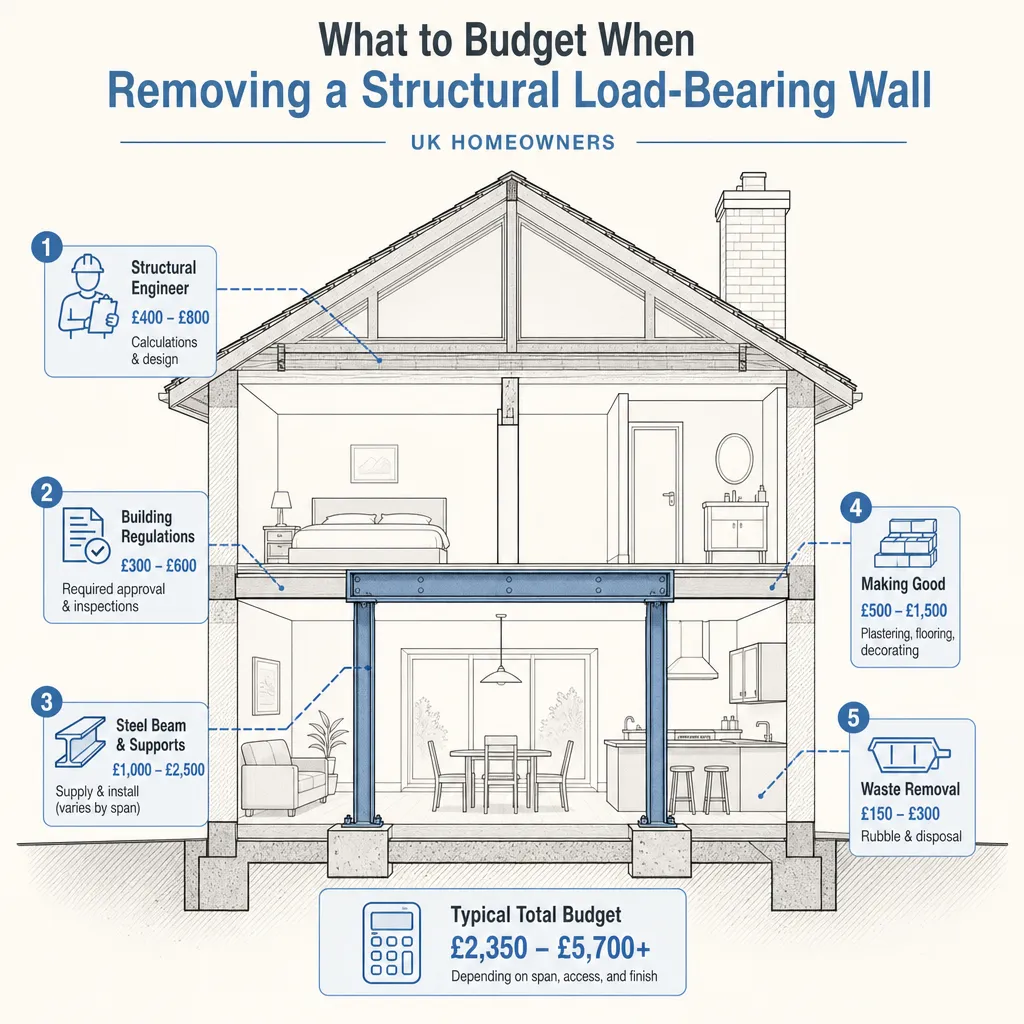
What to Budget When Removing a Structural Load-Bearing Wall
Removing a load-bearing wall in a typical UK home costs £2,500–£8,000 or more in total, covering a structural engineer's calculations, Building Regulations approval, the steel beam, builder's labour, and replastering.