Home Improvements That Add Value to Your Property
By Housey · Last reviewed 18th of May 2026
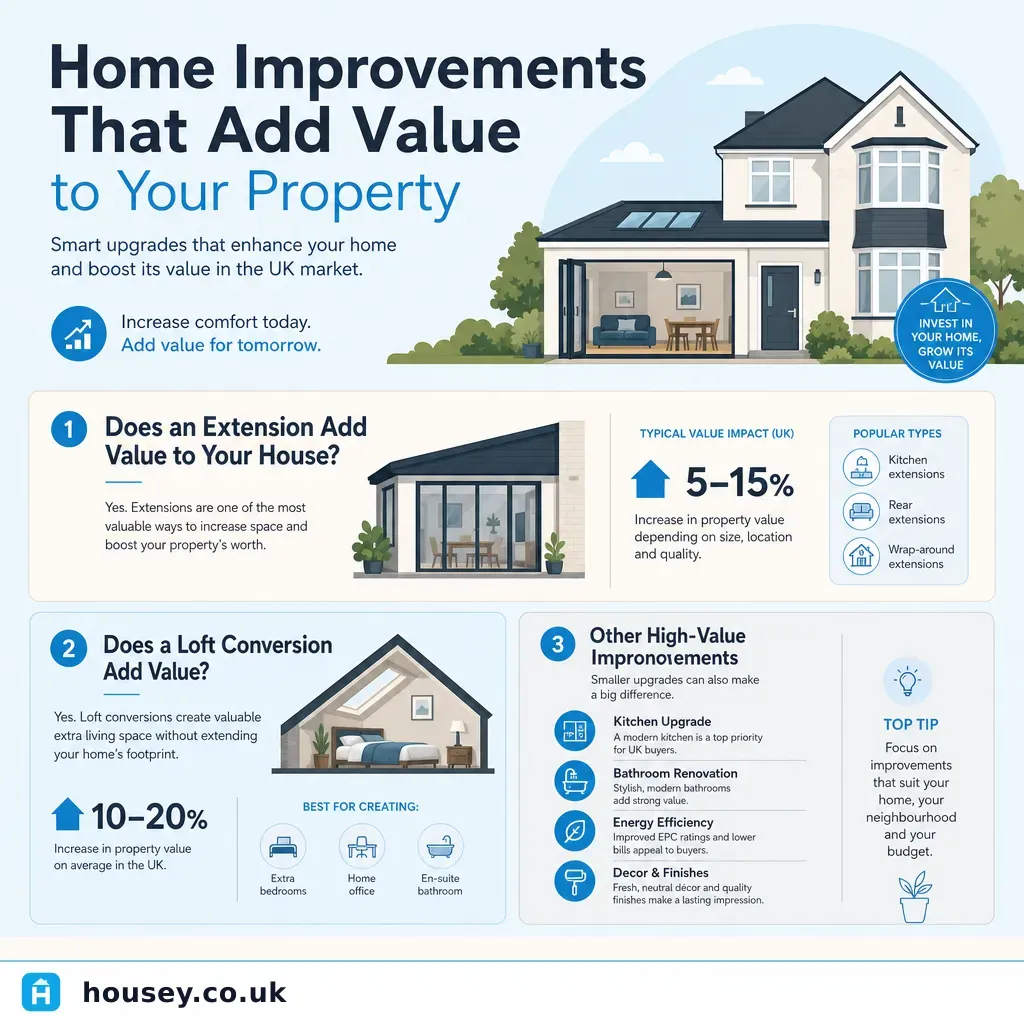
Home Improvements That Add Value to Your Property
When homeowners in the UK consider renovating, the question of return on investment almost always surfaces alongside budget. Some projects can add significantly more than they cost; others absorb money without a proportionate lift in market value. Understanding which improvements are genuinely value-adding — and under what conditions — helps you plan strategically rather than speculatively, particularly in a market where local ceiling values and planning constraints vary considerably between streets and property types.
Key points
- Loft conversions are consistently cited among the highest-return improvements in the UK, with some valuers estimating they can add 10–20% to a property's value depending on type and location.
- Single-storey rear extensions cost roughly £1,500–£2,500 per sq m to build (indicative UK costs, last reviewed 2026-05-18; quotes vary by region and specification) but typically recover 50–70% of that cost in added value for standard properties.
- Replacing a poor-quality kitchen or bathroom usually delivers a better return than upgrading an already-functional one; condition, not specification, drives the improvement value.
- An EPC rating improvement from D or E to C or B can affect mortgage eligibility, rental compliance, and buyer pool — particularly as 2028 minimum EPC targets for the private rented sector approach.
- Planning permission adds value independently of any build: a property with approved consent for an extension or conversion is worth more to buyers than an identical property without it.
How to decide which improvements to prioritise
Not all homes benefit equally from the same improvements. A three-bedroom end-of-terrace in Leeds responds differently to a rear extension than an identical mid-terrace in a conservation area. The key questions are: what is the ceiling value for your street or area; does the improvement bring you closer to that ceiling without exceeding it; and will the cost of works be recovered in full or in part at sale?
Decision tree — which improvement suits your situation:
- Choose a loft conversion if your property has two or fewer bedrooms, the loft has adequate head height (minimum 2.2–2.4 m at ridge), and neighbouring extended properties command a clear premium nearby.
- Choose a rear extension if you have a small kitchen-diner that limits family use, the garden can accommodate the loss of outdoor floor area, and similar extended properties sell for noticeably more on your street.
- Choose a kitchen renovation if the existing kitchen is functional but dated, and comparable properties show buyers paying more for modern kitchens in your area.
- Choose energy improvements (insulation, windows, low-carbon heating) if your EPC is D or below, energy bills are high, or you are a landlord preparing for incoming minimum EPC legislation.
- Ask a RICS-registered valuer first if you are unsure whether the improvement headroom exists in your area before committing to a large spend.
Comparison: high-impact UK home improvements
Improvement | Typical cost (indicative, 2026-05-18) | Estimated value added | Planning required? | Best for |
|---|---|---|---|---|
Loft conversion (dormer) | £40,000–£65,000 | 10–20% of property value | Usually permitted development (check) | 2–3 bed semis and terraces |
Single-storey rear extension | £25,000–£50,000 | 5–12% of property value | Usually permitted development (check) | Families needing open-plan space |
Full kitchen renovation | £10,000–£25,000 | 3–7% of property value | None for like-for-like | Dated kitchens in good-condition homes |
Bathroom addition or renovation | £5,000–£15,000 | 3–5% of property value | None for internal works | Homes with a single bathroom |
Double glazing (full replacement) | £5,000–£15,000 | EPC uplift and buyer appeal | None for replacement | Pre-2000 homes with single or poor glazing |
EV charging point | £800–£1,500 | Growing buyer expectation | None for most installations | Properties with off-road parking |
Indicative UK costs and value estimates; last reviewed 2026-05-18. Costs vary by region, specification, and contractor. Always obtain at least three quotes.
Worked example: a 1930s semi in the East Midlands
A three-bedroom 1930s semi-detached house has a current market value of approximately £240,000. The top of its street typically sees properties sell for £290,000 when extended and modernised.
A rear kitchen extension (single-storey, 20 sq m) costs around £38,000 all-in with building control approval. A comparable extended property nearby recently sold for £275,000 — roughly £35,000 more than the unextended value. Net position before selling costs: broadly cost-neutral or slight gain, while the homeowner gains a usable kitchen-diner for the years until sale.
Adding a loft conversion on top would approach the ceiling for the street, making recovery of the full cost less likely — the diminishing-returns principle applies once you are close to the local ceiling value.
Improvements that rarely recover their full cost
Some projects absorb significant budget without delivering proportionate value at resale:
- Swimming pools: expensive to install and maintain, and they appeal to a narrow buyer profile in the UK climate
- Highly personalised finishes: taste-specific features often require buyers to budget for replacement
- Poorly specified conservatories: a lean-to without proper insulation or heating adds limited value compared to a fully approved extension
- Permanent bedroom-to-office conversions: in most markets, bedroom count drives value, and losing a bedroom usually reduces it
What not to assume
Adding square footage always adds value. It does only up to the ceiling for that street. Over-improving relative to neighbours is a common and costly mistake.
Planning is never needed for a loft conversion. Permitted development rights depend on the cumulative volume of permitted development already used, whether the property is in a conservation area, and whether it is listed. Always check with your local planning authority before starting.
A new kitchen always returns its cost. Returns depend on condition, not specification. Replacing a functional but dated kitchen yields better returns than upgrading an already-modern one.
Green improvements do not add value. EPC-rated improvements are increasingly priced into the market, particularly as landlords face regulatory pressure and buyers factor running costs into affordability decisions.
Homeowner checklist before committing to an improvement
When to get professional help
- Consult a local estate agent or RICS-registered valuer before spending significantly on improvements if you are unsure whether the local ceiling supports the investment.
- Use an architect or CIAT-qualified architectural technologist for any extension or loft conversion — permitted development rules are more nuanced than they appear and non-compliant work can cause problems at sale.
- Always use a building control-approved contractor or submit your own building notice before structural or significant building work begins.
How Housey can help
Housey connects you with trusted local specialists for the improvements most likely to add genuine value. Whether you are exploring a rear or side extension, want to compare quotes from window and door installers, or are planning a loft conversion, you can request quotes from up to four local specialists through a single submission.
Frequently asked questions
Does a loft conversion add value?
A properly completed loft conversion that adds usable bedroom and bathroom space typically adds 10–20% to a property's value in the UK, though this depends heavily on location, property type, and whether the local market ceiling supports the improvement. A dormer loft conversion on a two-bedroom semi in a popular area usually shows the strongest returns.
Do I always need planning permission for a home extension?
Not always. Many single-storey rear extensions fall within permitted development rights for detached and semi-detached houses, subject to size limits — typically up to 4 m deep for a detached property and 3 m for a semi or terraced house under standard permitted development. Conservation areas, listed buildings, flats, and some estates with Article 4 Directions are excluded. Always confirm with your local planning authority before starting.
What is the best home improvement for adding value in the UK?
This varies by property type, location, and local market conditions, but adding habitable floor space through a loft conversion or extension consistently ranks highly. Improving EPC ratings is increasingly relevant as energy costs and regulatory requirements make efficiency a buying criterion. The best improvement is usually the one that takes your property towards the ceiling for its street without exceeding it.
Does double glazing add value?
Replacing single glazing or poor-quality double glazing improves energy efficiency, noise reduction, and security, and tends to improve EPC ratings. Its direct value impact is modest — typically 1–3% — but it supports broader buyer confidence and is increasingly a baseline expectation. Use a FENSA or CERTASS-registered installer to receive a compliance certificate, which is required at sale.
Sources and further reading
Useful next reads
 Improvement & Build
Maximising Value Through Strategic Home Improvement Projects
In the UK, loft conversions and kitchen extensions tend to deliver the strongest return on investment, with loft conversions potentially adding around 20% to property value according to Nationwide data.
 Improvement & Build
Home improvements for selling: investments that increase your property value
Not all home improvements deliver equal return when selling.
 Improvement & Build
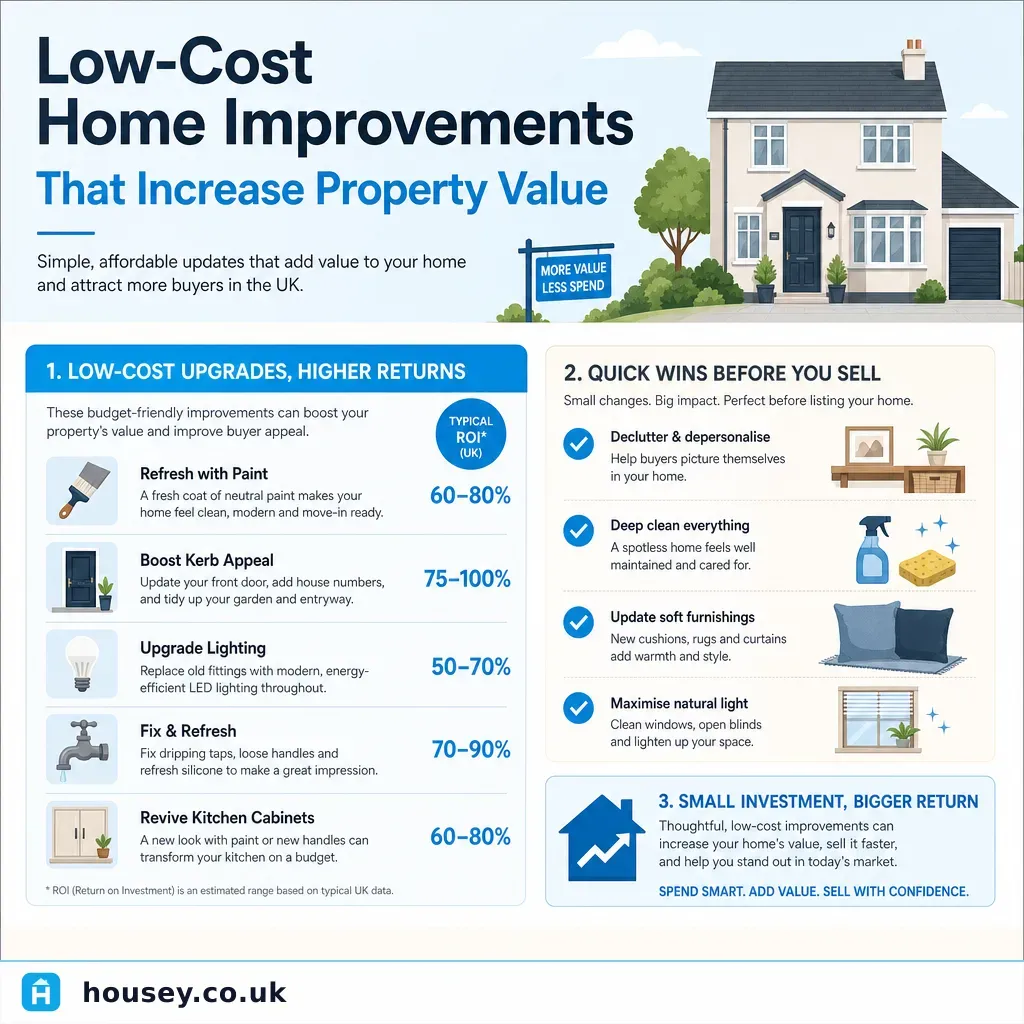
Low-Cost Home Improvements That Increase Property Value
Cosmetic upgrades such as fresh neutral paint, improved kerb appeal, tidied gardens, and refreshed kitchens and bathrooms can meaningfully improve a property's saleability and perceived value at relatively low cost.
 Improvement & Build
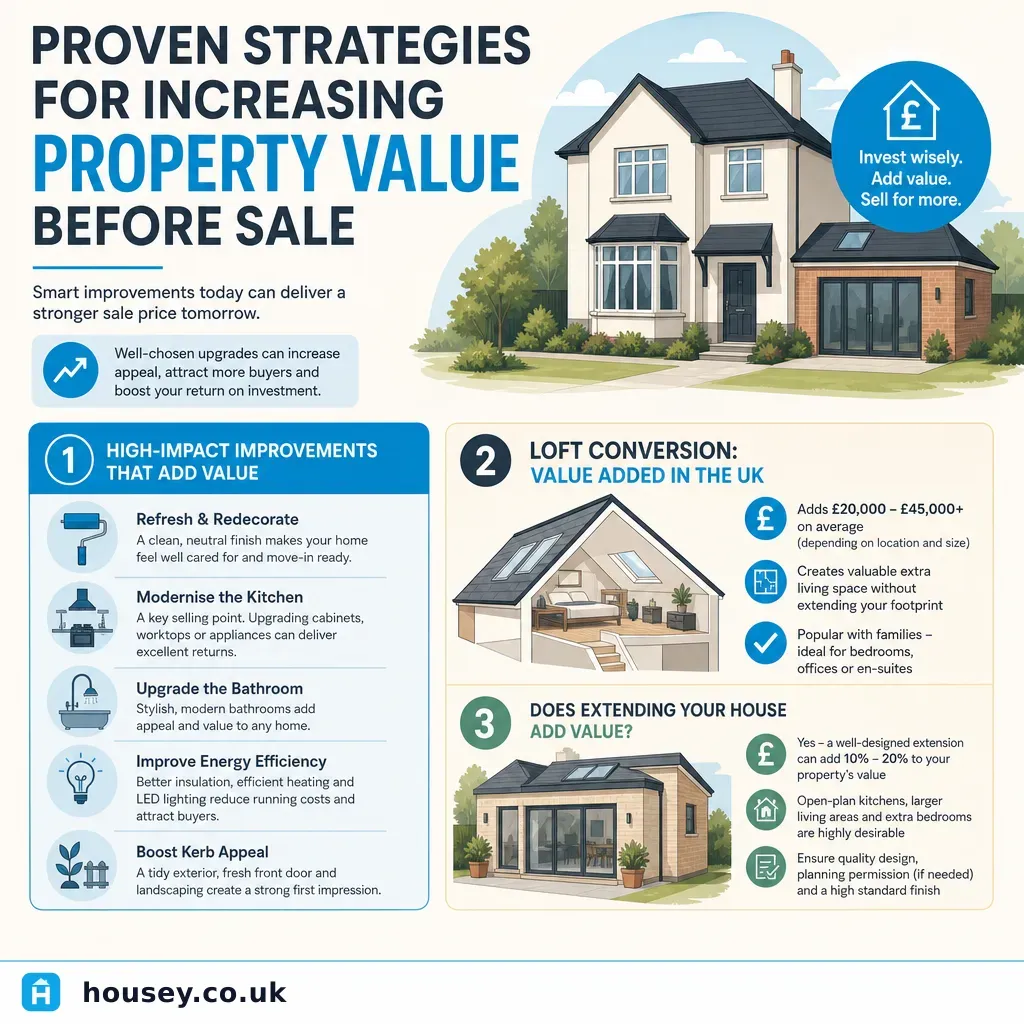
Proven Strategies for Increasing Property Value Before Sale
The improvements most consistently linked to value uplift in UK property are loft conversions (15–20%), rear extensions (5–15%), and EPC improvements.
 Improvement & Build
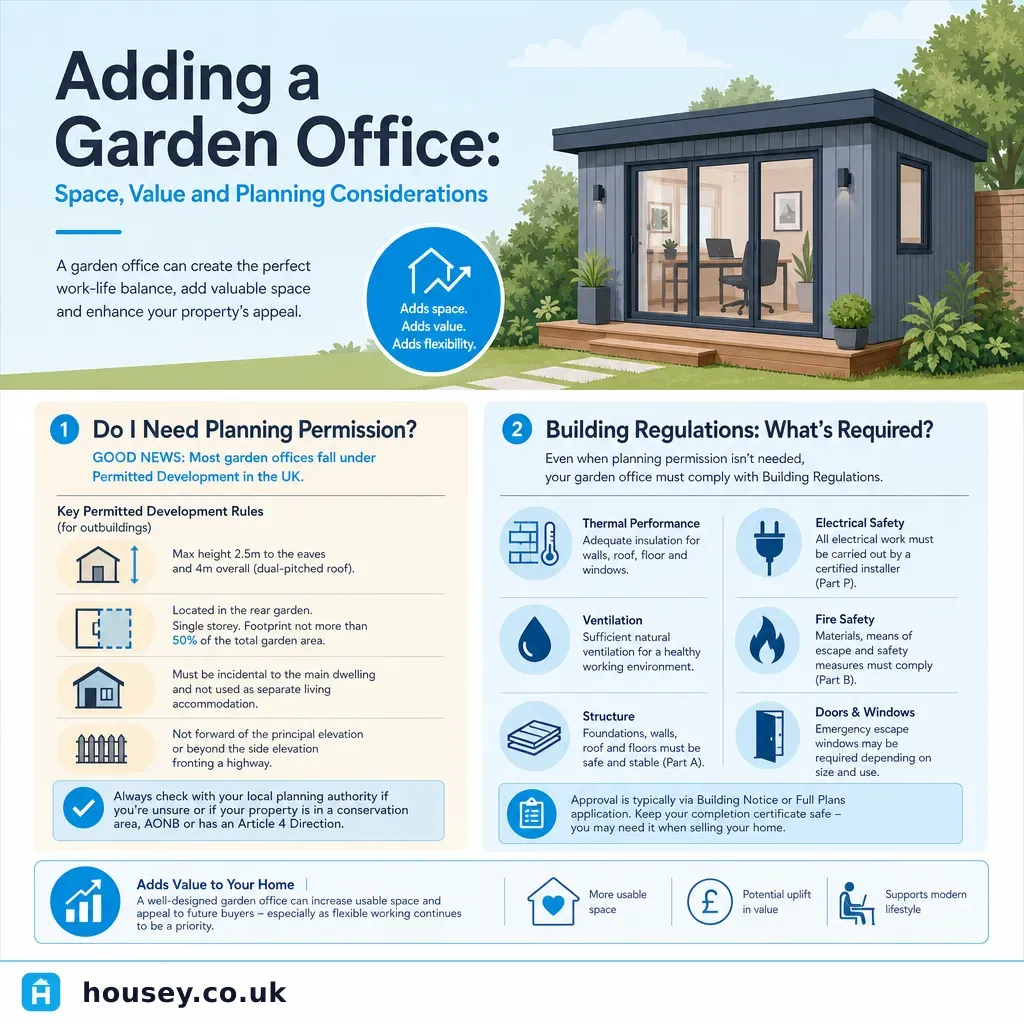
Adding a Garden Office: Space, Value and Planning Considerations
Most garden offices qualify as permitted development and do not need planning permission, provided they stay within specific size and height limits and are not used as separate sleeping accommodation.