Proven Strategies for Increasing Property Value Before Sale
By Housey · Last reviewed 9th of May 2026
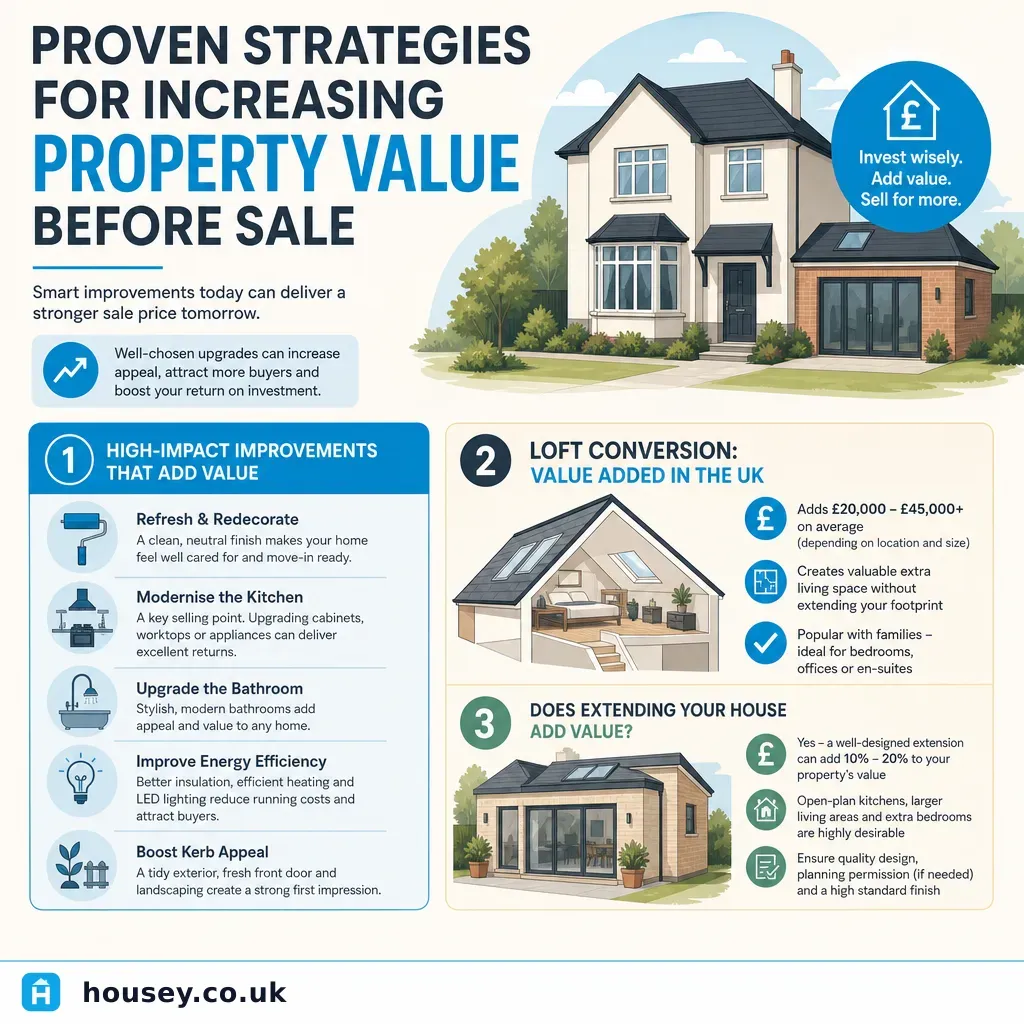
Proven Strategies for Increasing Property Value Before Sale
Whether you are preparing to list in six months or simply thinking about your home as a long-term investment, the improvements most likely to increase value at sale are often misunderstood. Some homeowners overspend on projects that buyers discount or already expect; others miss low-cost changes with a disproportionate impact on first impressions and surveyor findings. This guide covers what the evidence suggests about value-add improvements in the UK market, grounded in the practical constraints of planning, building regulations, and buyer behaviour.
Key points
- A loft conversion with a dormer window can add around 15–20% to a home's value in many UK locations, according to Nationwide Building Society research — one of the highest-return structural improvements available to most homeowners.
- Properties rated EPC band C or above attract a measurable price premium over equivalent D-rated homes; buyer awareness of energy bills is driving this gap wider as of 2025–2026.
- A single-storey rear extension may fall under permitted development (up to 4m for detached houses, 3m for semi-detached and terraced), but building regulations approval is always required regardless of permitted development status.
- A FENSA certificate is required for replacement windows and doors; its absence can delay conveyancing and reduce buyer confidence when you come to sell.
- Resolving existing defects — damp, roof condition, missing certificates — typically recovers more per pound spent than adding luxury finishes to a property with outstanding issues.
Which improvements add the most value?
The return on any improvement depends on your property type, location, current condition, and price band. That said, certain categories consistently appear in UK estate agent research and homeowner surveys as delivering measurable uplift.
Value-add improvements: a comparison
Improvement | Typical value uplift | Approx. cost range | Permits/approval needed | Best for |
|---|---|---|---|---|
Loft conversion (dormer) | 15–20% | £30,000–£60,000+ | Building regulations; planning if roofline altered | 3-bed houses where an extra bedroom adds a price band uplift |
Single-storey rear extension | 5–15% | £20,000–£50,000+ | Building regulations; permitted development for qualifying cases | Houses where the kitchen or living space limits buyer appeal |
New kitchen (mid-range) | 3–8% | £8,000–£25,000 | None for like-for-like refit | Properties with a dated or poorly laid-out kitchen |
New bathroom | 2–6% | £4,000–£12,000 | None; building regs if drainage is moved | Properties with one bathroom or a very dated suite |
EPC improvement (insulation, heating) | 2–7% | Varies; some grant-funded via ECO4 | None for insulation; building regs for heating systems | Pre-2000 homes in EPC band D or below |
New windows and doors (FENSA certified) | 2–5% | £5,000–£15,000+ | FENSA certification or building control approval | Properties with ageing single-glazing or non-compliant windows |
New driveway (block paving or resin-bound) | 1–4% | £3,000–£10,000+ | Permeable surface required in most cases | Properties without off-street parking where demand is high |
Garden landscaping (basic tidying and planting) | 1–3% | £1,500–£8,000 | None for most work | Properties with overgrown or unmaintained outdoor space |
Indicative UK costs and uplift ranges, last reviewed 2026-05-09. Figures vary by location, property type, and specification. Obtain multiple quotes before committing.
A worked UK property scenario
Consider a 1970s three-bedroom semi-detached house in a commuter town, currently valued at approximately £320,000 with an EPC rating of D. The property has original single-glazed windows at the rear, a dated kitchen, a small main bedroom, and an unfinished loft with good head height.
Selective pre-sale improvement plan:
- Loft conversion (dormer, creating a fourth bedroom): estimated cost £38,000; potential uplift of roughly £48,000–£64,000, moving the property into the four-bedroom bracket.
- Rear windows replaced (FENSA certified, double-glazed): estimated cost £2,800; removes a buyer objection and improves the EPC band.
- Kitchen refresh (new doors, worktops, and splashback — not a full refit): estimated cost £3,500; substantial visual improvement for modest spend.
- New resin-bound driveway (permeable surface): estimated cost £5,500; improved kerb appeal and off-street parking.
Total estimated spend: approximately £49,800. Estimated post-improvement value: £375,000–£395,000.
This is an illustrative scenario only. Values depend on the local market, surveyor assessment, and quality of execution. Obtain professional valuations before and after any significant work.
What buyers and surveyors actually look for
Estate agents consistently report that buyers notice condition before specification. A well-maintained property with modest finishes often performs better at valuation than a heavily upgraded one with unresolved defects.
RICS surveyors will flag the following as issues that affect value:
- Roof in poor condition — missing tiles, a sagging ridge, or blocked gutters.
- Evidence of damp — rising damp, penetrating damp, or condensation damage.
- Single-glazed windows where the rest of the street has been double-glazed.
- An electrical installation without a current EICR, especially for leasehold properties.
- Extensions built without a building regulations completion certificate.
- An outdated or inefficient heating system with no recent gas safety certificate.
Addressing these defects before sale typically recovers more per pound spent than adding luxury finishes to a property with outstanding structural or compliance issues.
Pre-sale improvement checklist
Use this list to prioritise before instructing an estate agent:
What to ask before commissioning improvement work
Before instructing a contractor on a significant pre-sale improvement, ask these questions:
- What is the likely return in my specific postcode and price band? (Ask your estate agent first — not every improvement makes sense in every market.)
- Will the work require building regulations approval, and who will submit the application?
- What certificates or documentation will I receive on completion?
- Will the work be finished within my planned sale timeline?
- Are the materials and finishes appropriate for the likely buyer, rather than over-specified for the area?
- Is VAT included in the quote?
- What happens if unforeseen issues are discovered during the work?
When to get professional help
Some improvements that sound straightforward carry significant risk if done poorly. Get professional input if:
- Your loft conversion involves altering roof trusses or requires structural calculations — a structural engineer's input is needed.
- An extension butts against a party wall — the Party Wall etc. Act 1996 may require surveyor involvement.
- You are dealing with any suspected asbestos, which is common in pre-2000 properties. Do not disturb it.
- Electrical or gas work is required as part of the improvement — both require registered professionals.
- The property is listed or in a conservation area.
- Your estate agent advises the improvement is not warranted for your price band.
How Housey can help
Housey connects you with qualified UK professionals for the improvements most likely to add value before sale. Request quotes from loft conversion specialists, extension builders, window and door installers, or driveway installers — all through one straightforward request process.
Frequently asked questions
Does a loft conversion always add value?
Usually, yes — particularly in areas where four-bedroom houses command a meaningful premium over three-bedroom ones. The uplift is less pronounced where the price gap between bedroom counts is small. Ask a local estate agent to assess the likely uplift before committing, as costs range from £30,000 to over £60,000 depending on specification and access constraints.
Is it worth extending before selling?
It depends on your local market, the cost of the extension, and your sale timeline. A single-storey rear extension can add 5–15% to value but typically takes 3–6 months to complete and requires building regulations sign-off. If your timeline is short, a kitchen refresh or kerb appeal improvements may offer better return per pound and can be completed faster.
Does improving the EPC rating help with the sale price?
Evidence increasingly suggests yes. Properties rated C or above attract a premium over equivalent D-rated homes, and buyer awareness of energy costs is growing. The cheapest measures — loft insulation, draught-proofing, LED lighting — can often improve a band without significant expenditure. Some measures such as cavity wall insulation may be grant-funded through the ECO4 scheme.
Do I need planning permission to replace my windows before selling?
Most window replacements do not need planning permission (they fall within permitted development for houses), but they do require FENSA certification or a building control completion certificate. In conservation areas and for listed buildings, planning consent is usually required even for like-for-like replacements — check with your local planning authority before instructing a contractor.
Can I sell a property where an extension has no building regulations certificate?
Yes, but you should disclose this to your solicitor. Buyers' solicitors will raise it as a legal query. The usual resolution is an indemnity insurance policy, which protects the buyer and lender against enforcement action. The cost is typically modest, but its absence can affect buyer confidence and occasionally the price achieved.
Sources and further reading
- Nationwide: house price index and value research — Nationwide Building Society
- Energy Saving Trust: home energy improvements — Energy Saving Trust
- Planning Portal: permitted development for householders — Planning Portal
- Building regulations: overview — GOV.UK
- FENSA: replacement windows and doors certification — FENSA
- ECO4 scheme: energy efficiency grants — GOV.UK
Useful next reads
 Improvement & Build
Home improvements for selling: investments that increase your property value
Not all home improvements deliver equal return when selling.
 Improvement & Build
Maximising Value Through Strategic Home Improvement Projects
In the UK, loft conversions and kitchen extensions tend to deliver the strongest return on investment, with loft conversions potentially adding around 20% to property value according to Nationwide data.
 Improvement & Build
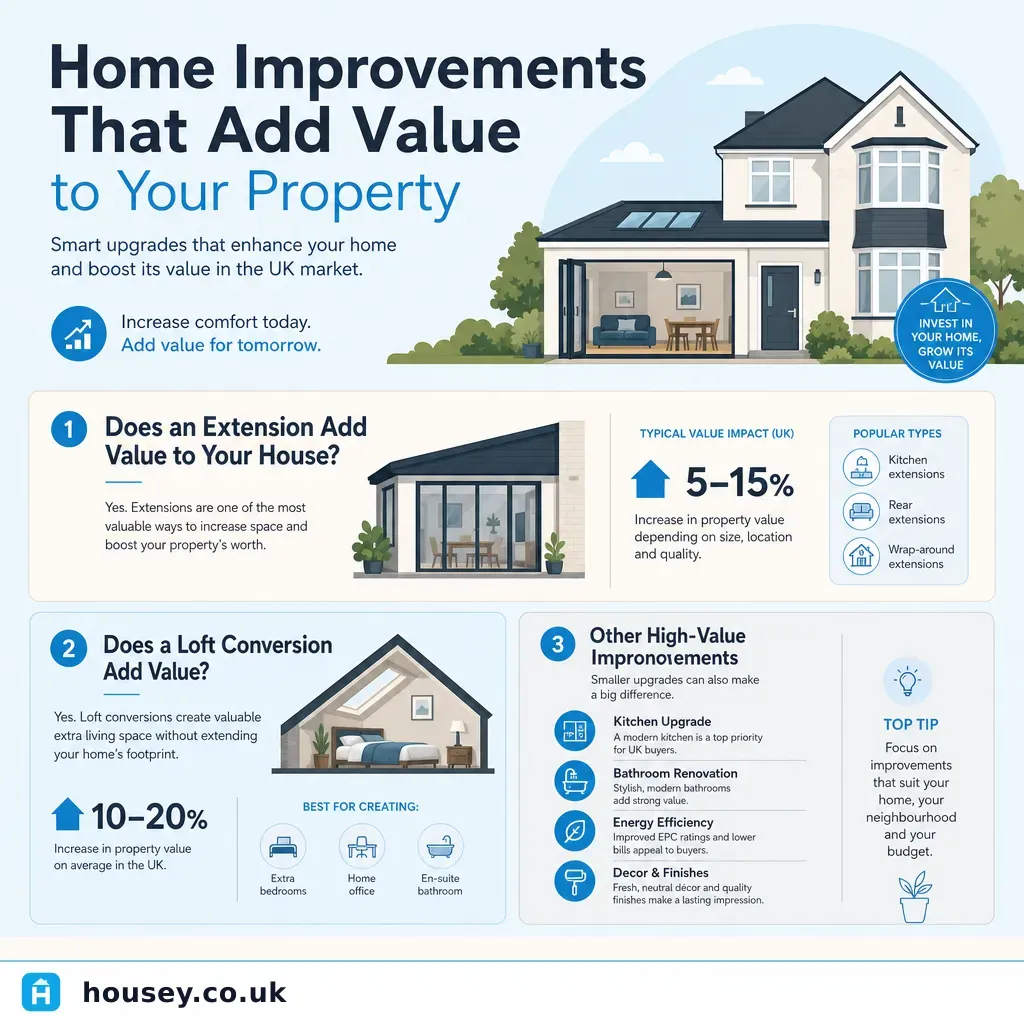
Home Improvements That Add Value to Your Property
The home improvements most likely to add value in the UK are those that add usable floor space — loft conversions and extensions — or improve EPC ratings.
 Improvement & Build
Home Improvement Projects That Add Value to Your Property
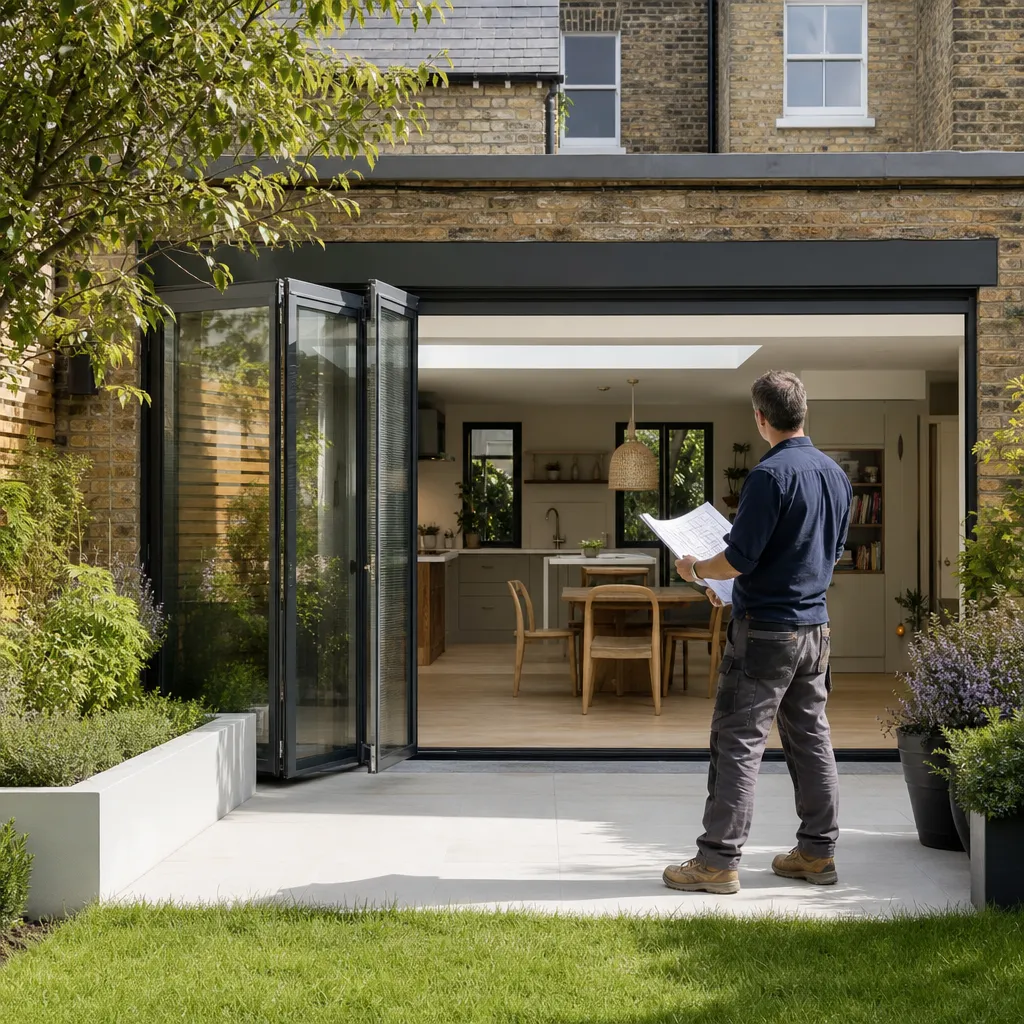
Loft conversions, rear extensions, and kitchen refurbishments typically offer the strongest return on investment for UK homeowners.
 Improvement & Build
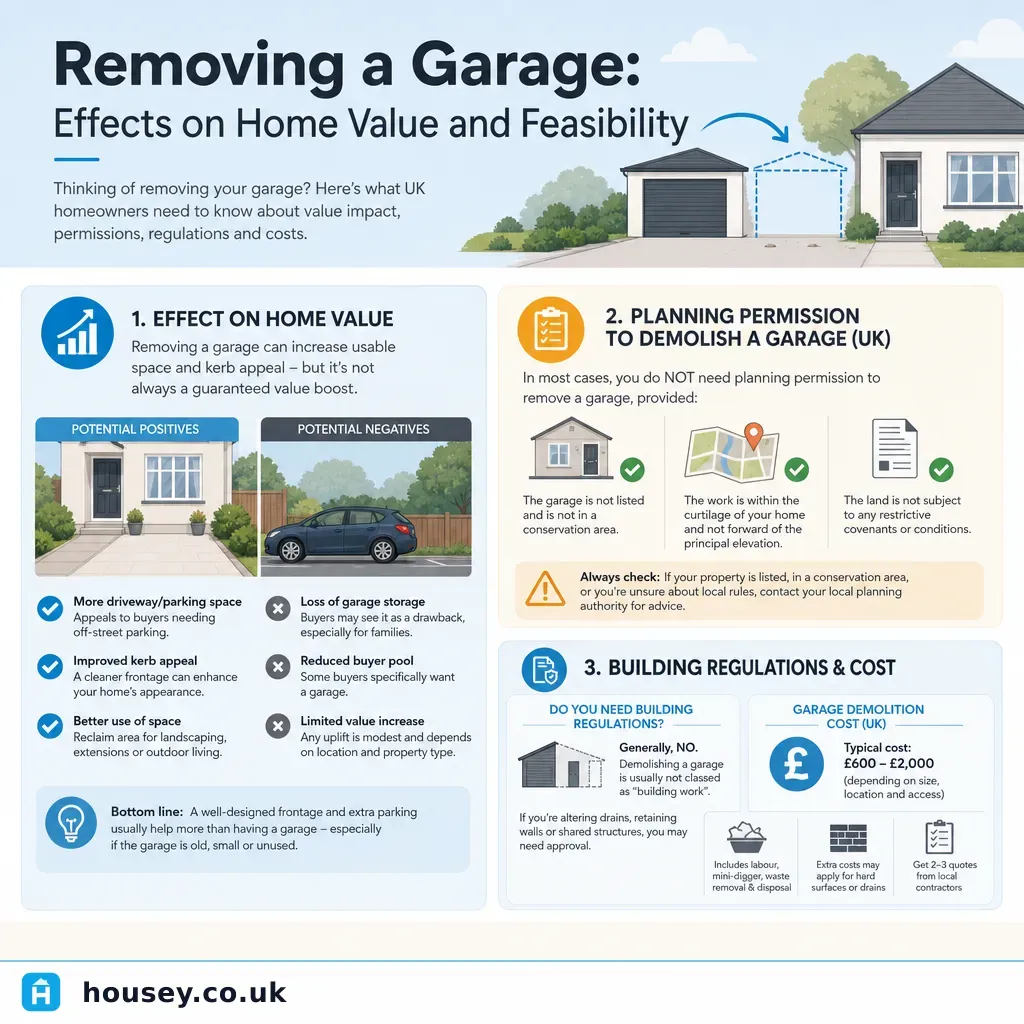
Removing a Garage: Effects on Home Value and Feasibility
Demolishing a garage in England may require prior notification to the local planning authority, and structural or building regulations assessments are often needed if the garage is attached to or integral with the house.