Home Redesign Essentials: Balancing Function and Style in Property Improvements
By Housey · Last reviewed 19th of May 2026
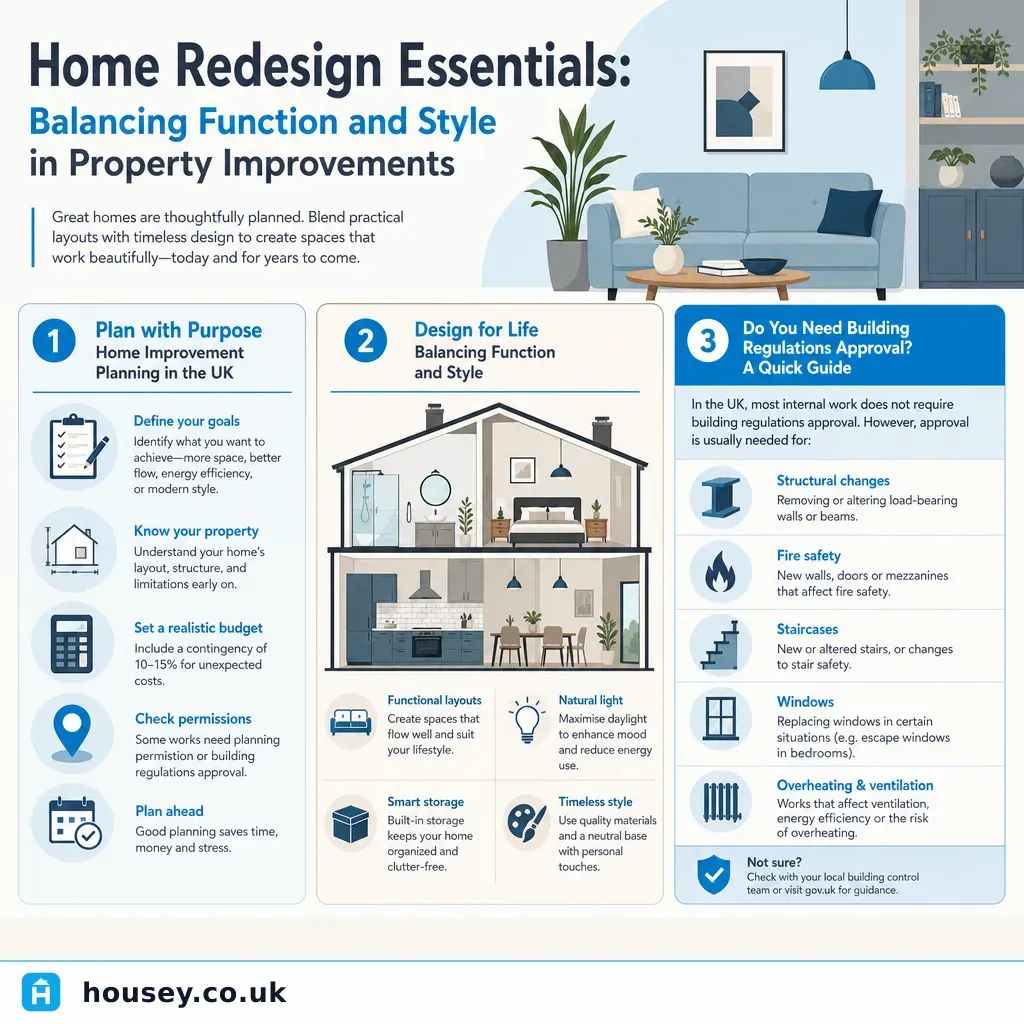
Home Redesign Essentials: Balancing Function and Style in Property Improvements
Many UK homeowners begin a redesign with a clear aesthetic vision — a knocked-through kitchen-diner, a new bathroom layout, or an updated 1930s semi with modernised proportions — only to find mid-project that the functional reality has been underestimated. Whether you are working on a Victorian terrace that has grown awkwardly over decades or a post-war semi that feels compartmentalised and dark, good redesign starts with understanding how a space is actually used before deciding how it should look.
Key points
- Structural changes such as removing walls or creating new openings require Building Regulations approval under Approved Document A — planning permission may also be needed if the building's external appearance changes.
- An architectural technologist can produce Building Regulations drawings and a specification for most residential redesigns at a lower fee than a full architect service.
- Permitted development rights allow many internal reconfigurations without planning permission, but flats, listed buildings, and conservation area properties almost always face additional restrictions.
- Kitchen and bathroom relocations affect drainage falls, waste run distances, and ventilation — all governed by Building Regulations.
- Adding 15–20% contingency to any redesign budget is standard practice; hidden services, damp, or non-standard construction are common surprises in pre-1980s UK housing stock.
Function before aesthetics: why the order matters
A redesign that looks good in a mood board but ignores how a household moves through its home tends to frustrate occupants within months. Before committing to a layout, map how you use the space on a typical day:
- Where do people gather in the morning and evening?
- What storage are you consistently short of?
- Which rooms feel dark, cramped, or poorly connected to the rest of the house?
- Where do deliveries, coats, school bags, or tools land when people arrive home?
Answering these questions shapes design decisions far more usefully than a colour palette. It also helps any professional you engage — from a kitchen designer to an architectural technologist — to propose a layout that works for your household rather than for a generic show home.
Which professional do you need?
Project type | Suitable professional | Why |
|---|---|---|
Internal wall removal or new openings | Architectural technologist and structural engineer | Building Regulations drawings and structural specification required |
Full extension or external appearance change | Architect or architectural technologist | Planning drawings and Building Regulations pack needed |
Kitchen or bathroom redesign (no structural changes) | Kitchen or bathroom designer | No Regs required unless drainage, electrics, or ventilation change |
Listed building or conservation area works | Architect with heritage experience | Listed Building Consent or planning approval likely needed |
Internal cosmetic redesign (decoration, flooring, fixtures) | No professional legally required | Competent tradespersons are sufficient |
An architectural technologist is often the most cost-effective choice for projects that require formal drawings and Building Regulations sign-off without involving complex planning applications.
Planning permission and permitted development: what applies to redesigns?
Internal changes to a house — wall removal, new doorways, repositioning a staircase — generally do not require planning permission. They do require Building Regulations approval where they affect structural elements, means of escape, drainage, or the thermal envelope.
External changes — altering windows, adding a porch or extension — may fall under permitted development rights. Check with your local planning authority before starting, particularly if:
- Your property is in a conservation area
- It is a listed building of any grade
- It is a flat or maisonette (permitted development rights do not apply to flats in England)
- Previous extensions may have used up your permitted development allowances
The Planning Portal provides interactive guidance on what does and does not need a planning application.
How to decide on your redesign scope
- Choose a cosmetic redesign if your layout fundamentally works but feels dated — new flooring, decoration, lighting, and joinery can transform a space without regulatory complexity.
- Choose a structural redesign if walls are blocking natural light, flow, or usable space — but budget for Building Regulations costs (fees, drawings, inspections) and a longer programme, typically three to six months.
- Choose incremental improvements if budget is limited — kitchens and bathrooms can often be refreshed with new units and finishes without moving drainage or electrics.
- Get professional advice first if you are unsure whether a wall is load-bearing, your drainage layout is unusual, or your property has listed or conservation area status.
Homeowner checklist: before you start any redesign
Common redesign mistakes and what not to assume
Do not assume trends equal longevity. All-white kitchens and open-plan layouts have both had moments of ubiquity; many homeowners have found them impractical within a few years. Invest in durable, flexible materials and proportions that suit the property's era.
Do not underestimate storage. Almost every redesign project underestimates how much built-in storage is needed. Purpose-built joinery costs more but delivers significantly more usable storage per square metre than freestanding furniture.
Do not ignore acoustics. Removing walls to create open-plan spaces can worsen noise transmission between floors and rooms. Acoustic matting, insulated partitions, and solid-core doors address this — but they need to be planned before builders arrive, not retrofitted.
Do not skip a lighting plan. Fixed ceiling pendants alone rarely serve a room well. Plan layered lighting — ambient, task, and accent — before chasing cables into plaster. Changing lighting positions afterwards is expensive.
Do not assume all internal walls are non-structural. In many UK house types — including 1930s semis, post-war terraces, and cross-wall constructed flats — partitions and chimney breasts can be load-bearing. Always confirm before removing.
When to get professional help
Even apparently straightforward projects benefit from professional input if:
- You are unsure whether a partition or chimney breast is load-bearing
- Your drainage is on a shared or complex route through another part of the building
- The project involves a leasehold flat requiring freeholder or landlord consent
- The property may contain asbestos-containing materials — common in homes built before 2000; do not disturb suspected materials; commission an asbestos survey first
- You are spending more than approximately £20,000 — at this scale, a formal Building Regulations sign-off provides important legal protection if you later sell
How Housey can help
If your redesign involves structural changes, new openings, or works that need Building Regulations sign-off, Housey can match you with a qualified architectural technologist who can produce the drawings, specifications, and compliance documentation your project requires — helping you avoid costly changes mid-build.
Frequently asked questions
Do I need Building Regulations approval to remove an internal wall?
Usually yes — if the wall is load-bearing or if the opening affects a means of escape such as a corridor serving bedrooms. Contact your local Building Control department or a registered building inspector before starting. Removing a non-load-bearing partition that does not affect escape routes may not require approval, but it is worth confirming before work begins.
How long does a home redesign typically take in the UK?
Timescales vary considerably. A cosmetic kitchen refresh can take two to four weeks. A structural reconfiguration requiring Building Regulations approval typically runs three to six months from initial design to completion. Projects involving planning permission add a further eight to ten weeks minimum for the statutory determination period.
Does a home redesign add value to my property?
Well-executed improvements to kitchens, bathrooms, and living spaces generally improve saleability, though the return on investment varies by location and market conditions. Projects that resolve clear functional problems — dark hallways, cramped kitchens, poor storage — tend to add the most durable value. Speak to a local estate agent before committing to a major spend.
Can I carry out internal alterations on a leasehold flat?
Usually you need the written consent of the freeholder or management company before altering the structure or layout of a leasehold flat. Check your lease carefully and obtain consent in writing before instructing any contractors. Failure to do so can create legal complications, particularly when you come to sell.
Sources and further reading
- Planning Portal: do I need permission? — Planning Portal
- Building Regulations approval — GOV.UK
- Approved Document A: structure — GOV.UK / MHCLG
- What is an architectural technologist? — CIAT
- Leaseholders' rights and responsibilities — Citizens Advice
Useful next reads
 Improvement & Build
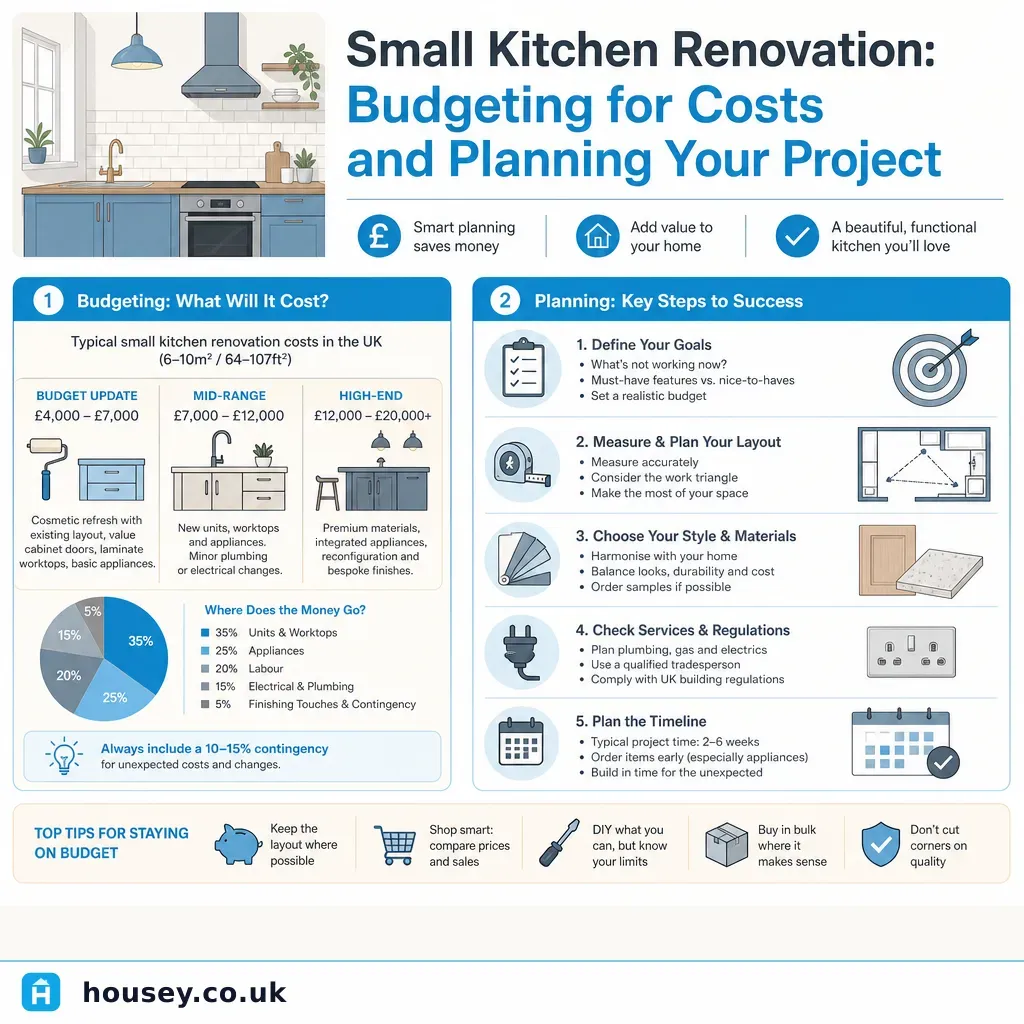
Small kitchen renovation: budgeting for costs and planning your project
A small kitchen renovation in the UK typically costs £5,000–£15,000 for a full refresh including new units, worktops, tiling, and appliances, though costs vary widely by specification, region, and whether structural changes or rewiring are involved.
 Improvement & Build
Conservatories and Garden Extensions: Design and Building Guide
Most conservatories qualify as permitted development in England if they are single-storey, within 50% of original curtilage, and meet dimensional limits.
 Improvement & Build
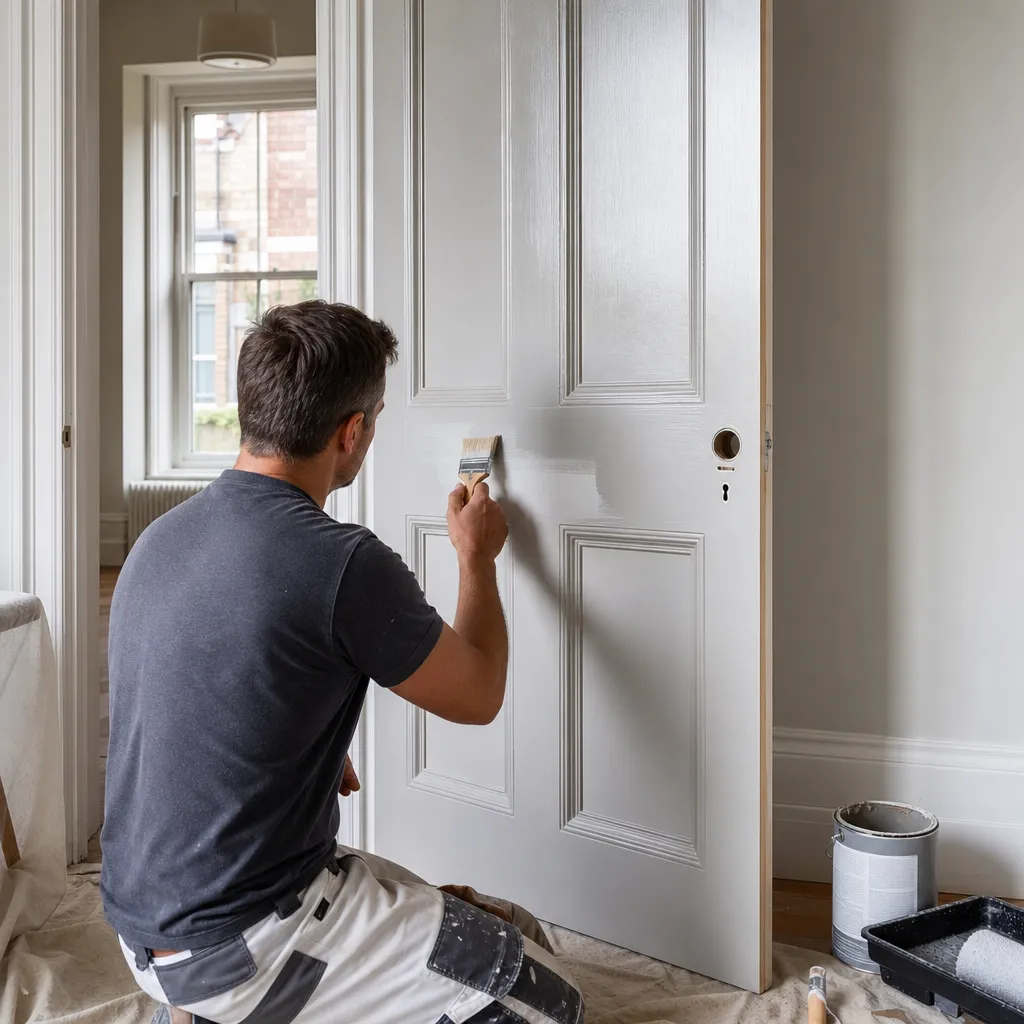
Painting Interior Doors: Preparation and Technique
Painting interior doors well depends on preparation rather than paint choice.
 Improvement & Build
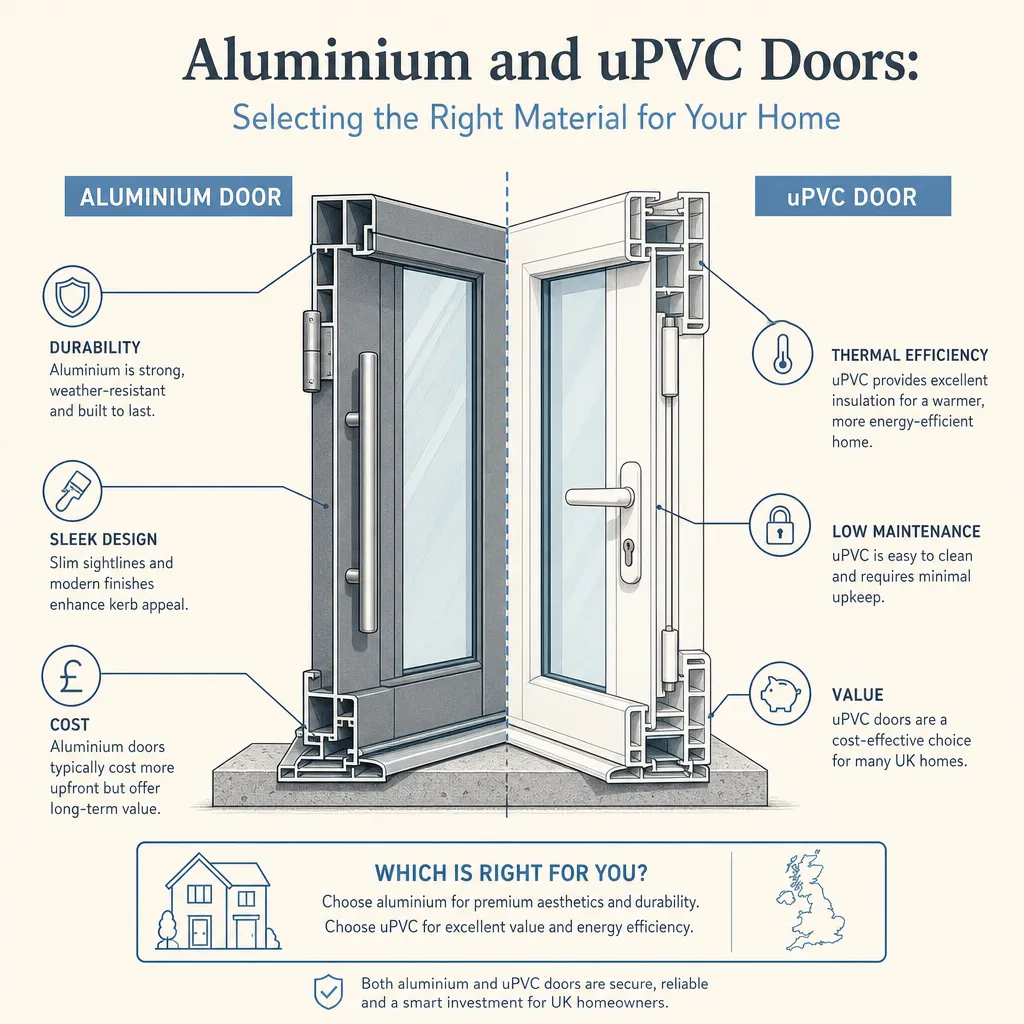
Aluminium and uPVC Doors: Selecting the Right Material for Your Home
uPVC doors are lower-cost and low-maintenance, making them a practical choice for most UK homes.
 Improvement & Build
Maximising Value Through Strategic Home Improvement Projects
In the UK, loft conversions and kitchen extensions tend to deliver the strongest return on investment, with loft conversions potentially adding around 20% to property value according to Nationwide data.