Home Renovation: Contractor Advice and Professional Tips for Property Owners
By Housey · Last reviewed 25th of May 2026

Home Renovation: Contractor Advice and Professional Tips for Property Owners
Taking on a home renovation — whether extending a Victorian terrace, converting a loft in a 1930s semi, or refurbishing a leasehold flat — involves managing contractors, making decisions under time pressure, and navigating regulations that most homeowners encounter only once. The difference between a project that completes on budget and one that runs into disputes and delays almost always comes down to preparation and the quality of the contractual relationship before work begins.
Key points
- At least three written, itemised quotes should be obtained before appointing a contractor; verbal estimates are not a basis for a binding agreement.
- Contractors should hold public liability insurance (minimum £2m; preferably £5m for larger works) and, if they employ staff, employers' liability insurance — ask to see current certificates before signing any contract.
- Building Regulations approval is required for most structural works, extensions, loft conversions, electrical work, plumbing alterations, and changes to heating systems — not only projects that also need planning permission.
- Payment schedules should be tied to defined milestones, not calendar dates or large upfront sums; retaining 5–10% until practical completion is standard practice for larger contracts.
- The JCT Minor Works Building Contract provides a recognised framework for domestic projects and is appropriate for any contract over approximately £5,000.
Choosing the right type of professional
Not every renovation requires the same team. Understanding who does what prevents gaps in responsibility and reduces the risk of disputes over liability.
Project type | Professionals typically needed | Key consideration |
|---|---|---|
Single-room refurbishment | Specialist trades (plasterer, tiler, electrician) | Coordinate trades sequentially; one delay cascades to the next |
Kitchen or bathroom fit-out | Specialist installer or general builder plus trades | Confirm Gas Safe and Part P registered subcontractors are being used |
Single-storey house extension | Architect or architectural technologist, structural engineer, main contractor | Building Regs and usually planning permission required |
Loft conversion | Architectural designer, structural engineer, contractor | Building Regs always required; planning often within permitted development |
Full house renovation | Project manager or design-and-build firm | Consider appointing before purchase if the property condition is uncertain |
Listed building alteration | Architect experienced in heritage work, conservation officer input | Listed Building Consent is likely required for most internal and external works |
Getting and comparing quotes
Getting three or more quotes is not just about finding the cheapest price — it reveals the spread of interpretation, assumptions, and quality within your local market.
What to ask for in a quote:
- Full itemisation of labour and materials, or at minimum a breakdown by trade and phase.
- Names and accreditations of any subcontractors (Gas Safe registration number, NICEIC membership, FENSA number for window replacements).
- VAT status: is the contractor VAT-registered, and is VAT included in the quoted figure?
- Programme: proposed start date, estimated duration, and key stage milestones.
- What allowances are built in for unknowns such as hidden structural condition, existing drainage runs, or the possible presence of asbestos in older properties.
- Whether a formal contract (such as JCT Minor Works) will be used, or what written agreement the contractor proposes.
A large discrepancy between quotes usually signals that either the cheapest contractor has missed something in the scope, or the most expensive has over-specified. Understand the reason for the difference before deciding — the cheapest price at tender can become the most expensive project at handover.
Worked example: single-storey rear extension on a 1930s semi
A homeowner in a typical 1930s semi-detached property in the East Midlands wishes to extend the rear by 4m × 5m, removing the existing external rear wall to open up the ground floor. The following professionals and approvals are typically needed for a project of this type:
- Architectural designer — draws plans for any planning submission (often permitted development under Schedule 2, Part 1, Class A of the GPDO 2015 for single-storey rear extensions) and for the Building Regulations application, which is always required regardless of whether planning is needed.
- Structural engineer — specifies the steel or concrete beam to carry the load of the removed wall, the new foundation design, and advises on any party wall implications.
- Party Wall Surveyor — if the proposed foundations are within 3m of a neighbour's structure, a Party Wall etc. Act 1996 Notice is required. The neighbour can consent in writing or require a formal party wall award prepared by agreed surveyors.
- Extension builder or main contractor — carries out groundworks, brickwork, roofing, plastering, and coordinates first-fix electrical and plumbing subcontractors.
- Building Control — local authority Building Control or an Approved Inspector must inspect and sign off the work at key stages: foundations, structural frame, weathertight stage, and practical completion.
Indicative UK costs for a single-storey extension of this type typically range from £1,500 to £2,500 per m² fully fitted (supply and fit, excluding VAT), with London and the South East at the upper end. Indicative UK costs, last reviewed 2026-05-25. These figures vary significantly by specification, market conditions, and contractor availability — obtain current quotes before budgeting.
Managing the project: common pitfalls
Scope creep — additional works requested informally during the project are among the most common causes of budget overruns and disputes. Every change of scope should be agreed in writing with a revised cost before the work is carried out, not after the invoice arrives.
Programme management — trade coordination is demanding. If the plasterer is delayed, the decorator cannot start. Build realistic float into your programme (10–20% of the total duration is not unreasonable) and confirm that your contractor has sequenced the trades explicitly in the programme.
Payment — never pay the full contract sum upfront. A standard milestone payment schedule for a medium-sized project might look like this:
- 10% on contract signing.
- 30% on completion of foundations and ground-floor slab.
- 30% on completion of structure and weathertight stage.
- 20% on second fix and practical completion.
- 10% retained for 6 months as a defects liability period retention.
Regulatory approvals: what homeowners often miss
Many homeowners assume that if planning permission is not needed, no regulatory approvals apply. This is a common and costly misunderstanding.
Building Regulations under the Building Act 1984 and the Building Regulations 2010 (as amended) apply to:
- Structural alterations, including removal of load-bearing walls.
- Extensions of any size.
- Loft conversions.
- New or replacement electrical installations (Part P of the Building Regulations).
- New heating systems, boilers, or gas appliances (Part J, and Gas Safe requirements).
- Alterations to drainage runs.
- New or enlarged windows or rooflights affecting thermal performance (Part L).
Work carried out without Building Regulations sign-off may require a Regularisation Certificate retrospectively, which adds cost and delay. Some works cannot be retrospectively certified, which can block a future sale or require remedial works at significant expense.
When to get professional help
Consider appointing a professional project manager or design-and-build firm if:
- The project involves structural alterations, extensions, or loft conversions beyond your confidence to coordinate.
- You cannot be on site regularly to monitor progress and manage trade sequencing.
- The property is listed, in a conservation area, or has leasehold restrictions that require freeholder or management company consent before alterations.
- The total contract value exceeds approximately £30,000, at which point the cost of professional oversight is typically offset by savings from better procurement and fewer disputes.
Red flags when dealing with contractors:
- Unwillingness to provide insurance certificates, a company registration number, or trade body accreditation.
- Requesting 50% or more of the contract sum upfront before any work has begun.
- Providing only a verbal estimate with no written specification.
- No mention of Building Regulations, or vagueness about where approval will come from.
- Pressure to start immediately to hold the quoted price, leaving no time for due diligence.
How Housey can help
Whether you need a specialist extension builder, a design-and-build firm to handle everything from drawings to handover, or a dedicated project manager to oversee complex works, Housey connects you with vetted professionals so you can compare, choose, and start with confidence.
Frequently asked questions
Do I always need planning permission for a home extension?
Not always. Many single-storey rear extensions, loft conversions, and outbuildings fall within Permitted Development rights under the Town and Country Planning (General Permitted Development) (England) Order 2015, provided they meet size, position, and material conditions. Properties in conservation areas, Article 4 Direction areas, or that are listed have more restricted rules. Always check with your Local Planning Authority before starting.
What is Building Regulations approval and do I need it?
Building Regulations approval confirms that work meets legal standards for structural safety, fire safety, insulation, drainage, and other technical requirements. It is a separate process from planning permission. Most structural, thermal, or service-related works require approval even when planning permission is not needed. Without it you may struggle to sell the property later.
How do I check if a builder is reputable?
Look for membership of a recognised trade body such as the Federation of Master Builders (FMB), TrustMark registration, or Which? Trusted Traders listing. For specialist trades, check Gas Safe Register (gas), NICEIC or NAPIT (electrical), and FENSA or CERTASS (window replacements). Ask for references from recently completed projects and contact those clients directly.
What contract should I use for a home renovation?
The JCT Minor Works Building Contract is the most widely used standard-form contract for domestic projects. It sets out clear terms for payment, variations, defects liability, and dispute resolution. For smaller jobs, a detailed written specification and payment schedule — even in letter form, signed by both parties — provides important protection if a dispute arises.
Sources and further reading
- Planning Portal — Permitted Development rules — Planning Portal
- GOV.UK — Building Regulations approval — GOV.UK
- Federation of Master Builders — find a builder — Federation of Master Builders
- JCT Minor Works Building Contract — Joint Contracts Tribunal
- TrustMark — find trusted traders — TrustMark
Useful next reads
 Improvement & Build
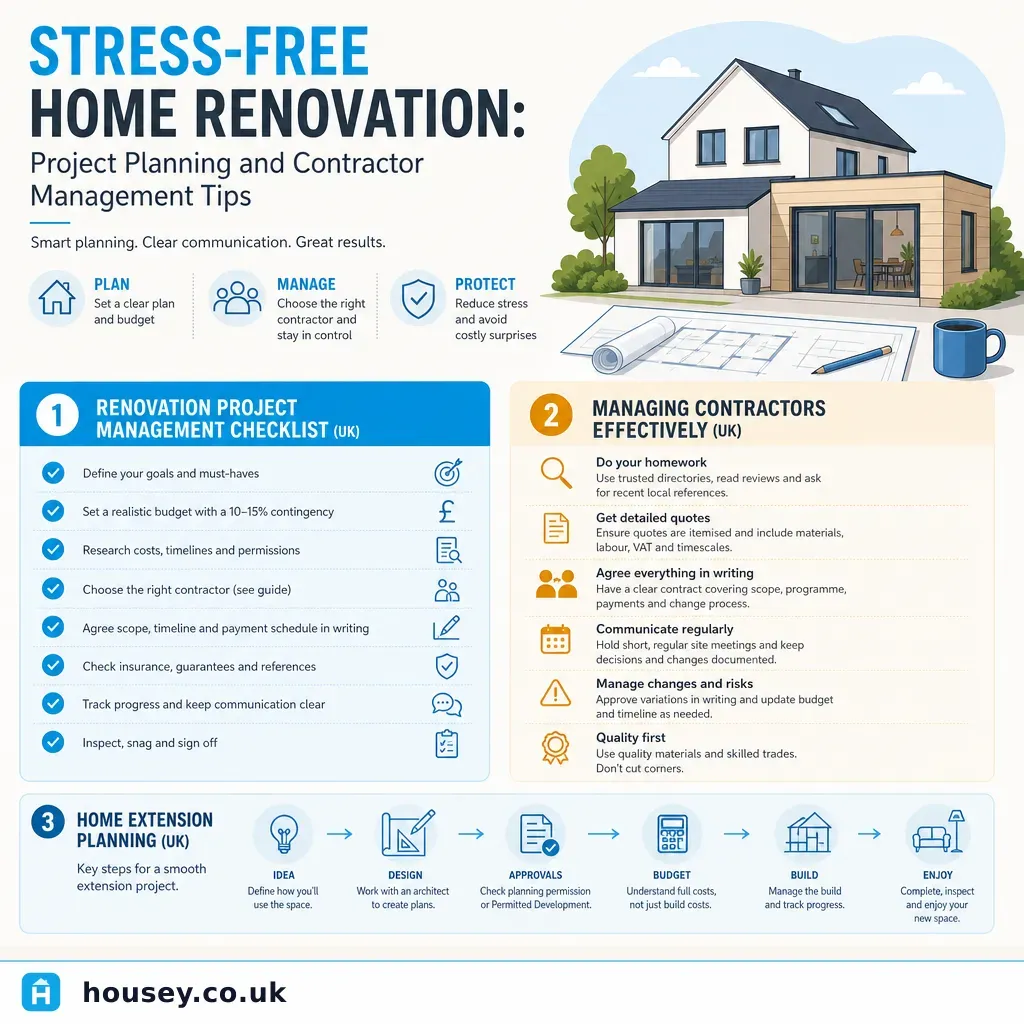
Stress-Free Home Renovation: Project Planning and Contractor Management Tips
The home renovations that stay on budget and on time share one characteristic: clear upfront planning.
 Improvement & Build
Renovation Insights: Tips From Professional Home Renovation Experts
Professional renovation guidance consistently covers three areas: understanding your property's history and construction before work begins, sequencing trades in the correct order, and allowing a realistic contingency of 10–15%.
 Improvement & Build
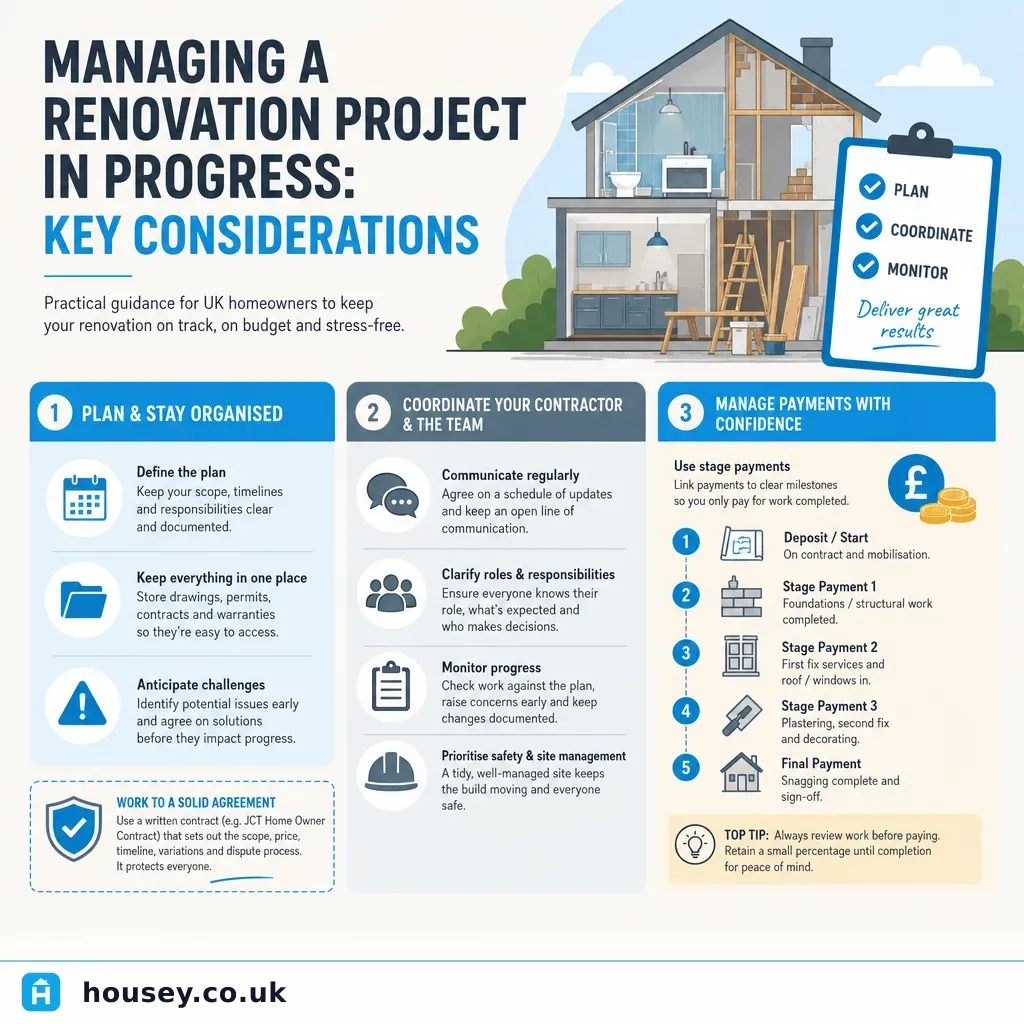
Managing a Renovation Project in Progress: Key Considerations
Keep a written schedule of works, confirm every variation in writing, and check progress at agreed milestones.
 Improvement & Build
Small kitchen renovation: budgeting for costs and planning your project
A small kitchen renovation in the UK typically costs £5,000–£15,000 for a full refresh including new units, worktops, tiling, and appliances, though costs vary widely by specification, region, and whether structural changes or rewiring are involved.
 Improvement & Build
Conservatories and Garden Extensions: Design and Building Guide
Most conservatories qualify as permitted development in England if they are single-storey, within 50% of original curtilage, and meet dimensional limits.