Managing a Renovation Project in Progress: Key Considerations
By Housey · Last reviewed 10th of May 2026
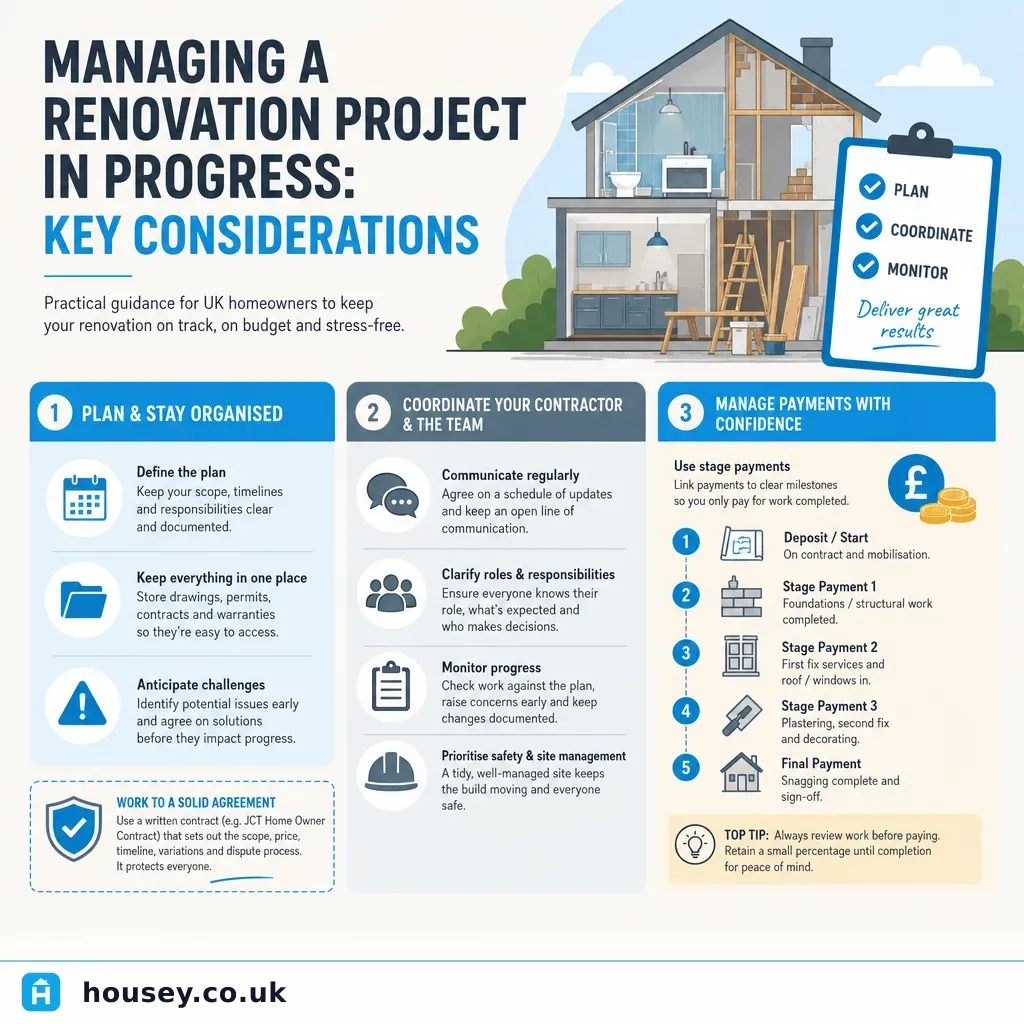
Managing a Renovation Project in Progress: Key Considerations
Once a renovation project is under way, many UK homeowners discover that managing the build is a very different challenge from planning it. Whether you are overseeing a rear extension, a loft conversion, or a full house refurbishment, the decisions you make during construction — how you communicate with contractors, handle changes to the scope, and control payments — often determine whether the final result meets your budget, timeline, and quality expectations. Disputes and cost overruns on domestic projects in the UK rarely emerge from a single catastrophic event; they accumulate through undocumented changes and missed milestones.
Key points
- Any change to the agreed scope of works should be confirmed in a written variation order before the contractor proceeds; verbal agreements are very difficult to enforce if a dispute arises later.
- Payment schedules tied to completed stages, rather than calendar dates, give you practical leverage if quality or progress falls short of what was agreed.
- Building Regulations inspections at key stages — foundations, drainage, structural elements, roof — are a legal requirement for most notifiable works; missing them can complicate a future property sale.
- Under the Construction (Design and Management) Regulations 2015 (CDM 2015), domestic clients have defined duties that transfer automatically to the principal contractor if not actively managed.
- A contingency budget of 10–20% of the total project value is standard practice for most residential renovations, in line with RICS guidance on residential project management.
Setting a clear schedule of works
Before you can manage a project, you need a baseline to measure against. A schedule of works — a written document listing every task, who is responsible, and the expected order and duration — is the single most useful tool a client can have during an active build.
If your contractor has not provided one, ask for it at the earliest opportunity. A responsible contractor should be able to produce a simple programme showing key milestones: structural openings, first fix, plastering, second fix, snagging. It does not need to be a formal Gantt chart for a typical domestic project, but it must be specific enough for you to check progress against it at regular intervals.
What to include in a schedule of works:
- Start date and anticipated practical completion date
- Key stage milestones (for example: steelwork installed, roof tiled, first-fix electrical complete)
- Building control inspection points
- Named subcontractors and when they are expected on site
- Dates by which client decisions — tile selections, sanitaryware choices — must be confirmed to avoid holding up the programme
Managing contractors day-to-day
Effective contractor management is about maintaining a clear professional relationship, not micromanaging. Most disputes on residential sites arise from poor communication rather than deliberate bad practice.
Practical communication rules:
- Agree a single point of contact on each side — typically the site foreman or main contractor on theirs, and you or your project manager on yours.
- Hold a brief weekly site meeting, even if informal. Note what was discussed and confirm it by email the same day.
- Confirm any instruction, change, or concern in writing immediately after it is agreed.
- Do not give instructions directly to subcontractors; always go through the main contractor to preserve the contractual relationship and avoid confusion about responsibility.
When a subcontractor is engaged directly by you — rather than as a domestic subcontractor to the main contractor — you take on additional coordination responsibilities, including under CDM 2015.
Dealing with variations and changes
Almost every renovation involves some departure from the original plan. Variations become expensive not because they happen, but because they go undocumented.
A variation order should record:
- What has changed and a description of the new or revised work
- Why it changed (client request, unforeseen site condition, design revision)
- The agreed cost impact, including any VAT implications
- Any effect on the programme or completion date
Insist on signed variation orders before work proceeds. A sequence of seemingly minor changes can add 20–30% to a project's original cost if not tracked. This is one of the most common causes of end-of-project disputes on domestic renovation contracts in the UK.
Payment stages and financial control
Do not pay in full in advance or in large lump sums. Stage payments tied to completed, inspected work are standard in residential contracting and protect both parties.
A typical stage payment structure for an extension or major renovation:
Stage | Payment trigger | Indicative % of contract sum |
|---|---|---|
Mobilisation | Contract signed, materials ordered | 5–10% |
Foundations complete | Building control approval at foundation stage | 10–15% |
Structure and roof watertight | Structural and roof sign-off | 25–30% |
First fix complete | Electrical and plumbing first fix inspected | 15–20% |
Second fix and plastering | Walls plastered, services connected | 15–20% |
Practical completion | Snagging list agreed and signed off | 5–10% |
Retention release | Defects liability period ended (typically 6 months) | 2–5% |
Indicative UK stage-payment structures, last reviewed 2026-05-10. Actual splits vary by contract type and project value. Seek professional advice for contracts above £50,000.
Keep a retention of 2–5% until the defects liability period has passed and any snagging items have been resolved in writing.
Weekly site checklist for homeowners
Use this checklist at each weekly site visit or scheduled call with your contractor:
Red flags to watch for during a renovation
These signs may indicate a project is heading off track and warrant a direct conversation — or professional intervention — before they escalate:
- Repeated requests for payment ahead of stage completion — legitimate contractors do not typically need significant advance funding once the mobilisation payment has been made.
- Consistent resistance to written variation orders — if your contractor routinely avoids documenting changes, treat this as a warning sign regardless of the reason given.
- Unannounced subcontractors on site — ask who is present and confirm their role through the main contractor.
- Building control inspections missed or delayed — this creates a legal compliance risk and can affect your ability to sell the property in future without retrospective approval.
- Programme slipping without a revised schedule — a delay of a week or two may be unavoidable; ongoing slippage without explanation and a revised completion date is a different matter.
- Materials invoiced but not visibly on site — you may be financing a contractor's cash flow for a separate project.
- Key site staff changing without notice — particularly the site manager or foreman, who hold the knowledge of how the project has been built to date.
When to get professional help
For smaller, clearly scoped projects — a bathroom renovation or a roof replacement — homeowner management is often practical with the right structure in place. For larger or more complex works, professional oversight adds clear value and can reduce the risk of costly disputes.
Consider instructing professional project managers if:
- The project involves multiple contractors working simultaneously.
- A structural element is being altered or added (steel beams, load-bearing wall removal, new foundations).
- You have already encountered disputes or unexpected costs that suggest the project is under financial pressure.
- Building Regulations or planning conditions require formal sign-off at staged intervals you cannot easily attend.
- You are not confident interpreting construction drawings or assessing workmanship quality on site.
A chartered quantity surveyor can independently value works to date before you release a stage payment — a useful safeguard if you have concerns about the accuracy of billing.
How Housey can help
If your renovation is growing in complexity, or you need qualified oversight on site, Housey can help you find the right professional. Compare quotes from vetted project managers who can take day-to-day coordination responsibility, or find experienced extension builders if you need to re-tender a project that has run into difficulty.
Frequently asked questions
Do I need a written contract with my contractor?
Yes, in practice. For any works above a few thousand pounds, a written contract protects both parties. JCT's Homeowner/Occupier Contract is a widely used, plain-English option for domestic works. It sets out payment terms, change procedures, and dispute resolution. Without a written contract, disputes become significantly harder to resolve and costly to pursue.
What is a practical completion certificate?
Practical completion marks the point at which the main works are finished to a standard where you can occupy or use the space, even if minor snagging items remain. It triggers the start of the defects liability period and typically releases the majority of retained payment. It should always be confirmed in writing by the contractor.
Can I withhold payment if I am unhappy with workmanship?
You may withhold any retention element tied to snagging, but withholding payment for completed stages without a clear contractual basis may itself constitute a breach of contract. If you have a genuine quality dispute, document it in writing and seek independent professional assessment before withholding funds. Many JCT contracts include adjudication as a faster alternative to litigation.
What does CDM 2015 mean for a domestic client?
The Construction (Design and Management) Regulations 2015 apply to most domestic building projects. Your duties as a domestic client are limited, but if your project involves more than one contractor working simultaneously, or lasts longer than 30 working days with more than 20 workers, it must be notified to the HSE. Your duties automatically transfer to the principal contractor unless you appoint a principal designer.
Should I be on site every day?
Not necessarily. What matters more is regular structured contact — weekly site meetings or calls, a clear communication channel, and formal checkpoints at building control inspection stages. If you cannot visit site at all, appointing a professional project manager is strongly worth considering, particularly for projects above approximately £50,000 in value.
Sources and further reading
- CDM 2015: guidance for domestic clients — Health and Safety Executive
- Building regulations approval — GOV.UK
- JCT Homeowner and Occupier Contracts — Joint Contracts Tribunal
- RICS guidance on residential projects — Royal Institution of Chartered Surveyors
Useful next reads
 Improvement & Build
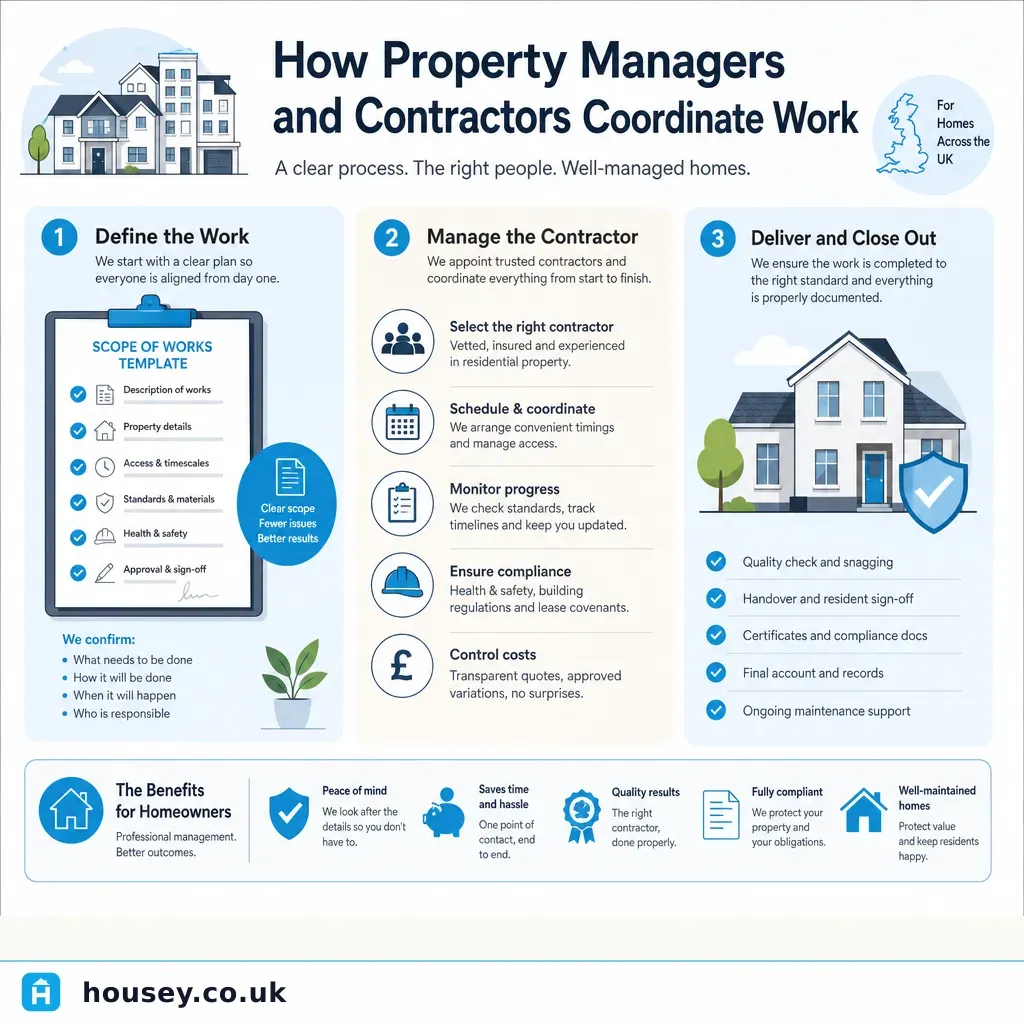
How Property Managers and Contractors Coordinate Work
Property managers coordinate contractors by scoping work clearly, selecting vetted and insured tradespeople, managing schedules and site access, checking progress against the brief, and handling sign-off and payment.
 Improvement & Build
Home Renovation: Contractor Advice and Professional Tips for Property Owners
Successful renovations depend on preparation, clear contracts, and vetted contractors.
 Improvement & Build
How to Find and Hire a Loft Conversion Company
To hire a loft conversion company, get at least three quotes from TrustMark-registered or FMB-member firms.
 Improvement & Build
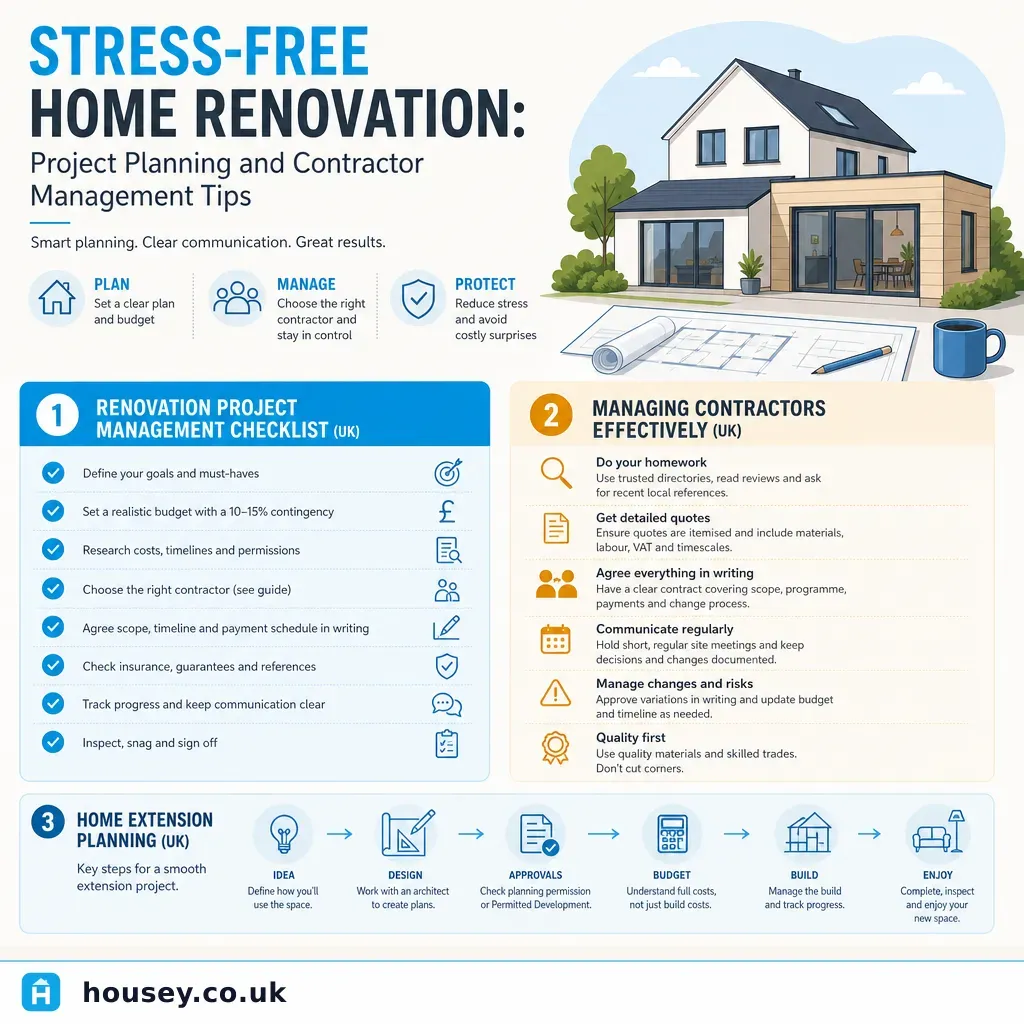
Stress-Free Home Renovation: Project Planning and Contractor Management Tips
The home renovations that stay on budget and on time share one characteristic: clear upfront planning.
 Improvement & Build
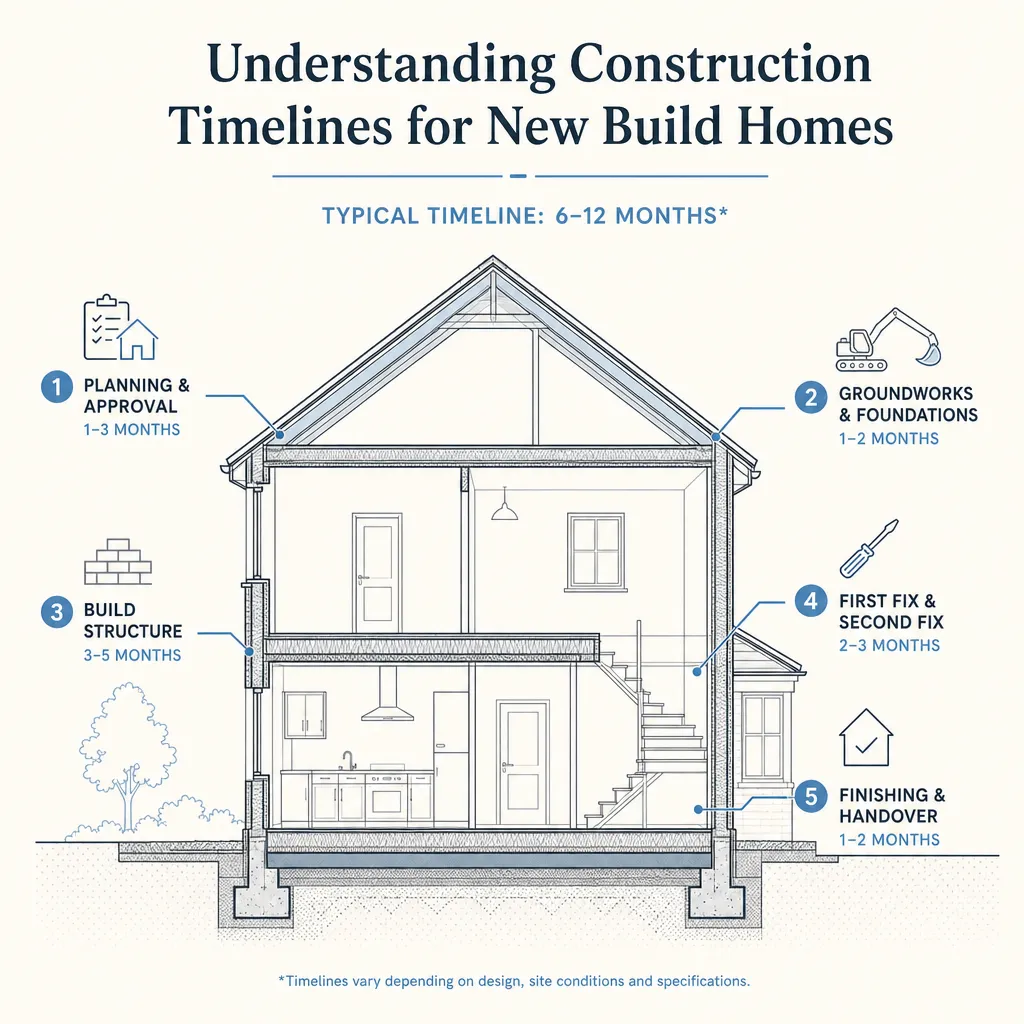
Understanding Construction Timelines for New Build Homes
Building a new home in the UK typically takes 12–24 months from planning approval to practical completion, though smaller projects can complete in 6–12 months.