Renovation Insights: Tips From Professional Home Renovation Experts
By Housey · Last reviewed 10th of May 2026

Renovation Insights: Tips From Professional Home Renovation Experts
UK renovation projects range from straightforward cosmetic refreshes to complex multi-trade programmes lasting many months. Homeowners who approach renovation with a clear process, realistic expectations, and the right professionals in place consistently achieve better results — on budget, on time, and with fewer defects to correct after completion. Understanding what experienced renovation professionals check before they start can prevent the most costly and disruptive surprises a UK renovation typically produces.
Key points
- A pre-renovation condition survey can identify hidden defects — including damp ingress, roof deterioration, and structural movement — that would otherwise surface mid-project and significantly inflate costs.
- Building Regulations Part L (energy efficiency) applies to renovations that alter the thermal envelope, including replacing windows, re-roofing with added insulation, and building extensions — not only to new-build construction.
- In a full renovation, trades follow a defined sequence: structural works first, then watertight envelope, then mechanical and electrical first fix, then insulation and plasterboard, then second fix and finishes.
- Retrospective building control sign-off (regularisation) costs more than applying in advance and cannot be guaranteed for all work types — some non-compliant work must be demolished or exposed for inspection.
- Under the Construction (Design and Management) Regulations 2015, domestic clients who commission work from more than one contractor must appoint a Principal Designer and a Principal Contractor.
What renovation professionals check before they start
Experienced contractors and project managers rarely accept a client brief at face value. Before agreeing a programme or committing to a price, they want to understand the property's history and current condition in detail.
Property history:
- Age and construction type — Victorian solid-wall brick, 1930s cavity masonry, 1960s system build, or modern timber frame each present different challenges
- Prior extensions, loft conversions, or structural alterations, and whether building control completion certificates exist for each
- Any party wall agreements or known boundary disputes affecting the site
- Mortgage lender restrictions that may affect the scope of alterations
Condition of key systems:
- Roof covering age and estimated remaining serviceable life
- State of the electrical installation (Electrical Installation Condition Report)
- Boiler age, service history, and gas safety
- Drainage condition, particularly for older properties or where extensions over drains are planned
Planning history:
- Whether the property or immediate neighbours have already used permitted development allowances
- Whether planning conditions, Article 4 Directions, or listed building constraints apply to the property
Gathering this information before a programme is agreed prevents the most common renovation cost overruns: discovering a failing roof during a kitchen remodel, or finding that a previous owner's extension was built without building regulations approval and requires regularisation before the sale can proceed.
A worked UK renovation scenario
Property: 1930s semi-detached in the East Midlands. Three bedrooms, original steel-framed windows still in place, kitchen at the rear, flat-roof brick garage attached to the side.
Homeowner's brief: Open up the wall between the kitchen and dining room, add a rear extension to enlarge the kitchen, replace the windows and boiler, and modernise the family bathroom.
What the pre-start assessment found:
- The wall between the kitchen and dining room was load-bearing — a structural engineer's beam design was required before any accurate quotes could be obtained for this element
- The flat-roof garage had no building regulations history and was structurally inadequate to support the proposed extension above it
- Two original steel window frames had rusted lintels concealed behind plasterwork, requiring remediation before new windows could be installed
- The boiler flue terminated in a position that would be enclosed by the new extension shell, requiring relocation before the extension could be built out
Revised programme in correct sequence:
- Structural engineer assessment and beam design commissioned
- Party wall notices served on both adjoining neighbours
- Building control application submitted before work started
- Garage structure demolished and rebuilt to engineer's specification
- Extension shell constructed; boiler flue relocated as part of this phase
- Windows replaced by a FENSA-registered installer
- New boiler installed by a Gas Safe registered engineer
- Internal structural opening formed; steel beam installed; building control inspection attended
- Mechanical and electrical first fix
- Insulation and plasterboard
- Kitchen and bathroom fitment
- Decoration, flooring, and external landscaping
Total project duration: 22 weeks. Had the structural and regulatory issues not been identified before work began, disruption at stages 4, 6, and 8 would have added an estimated 6–10 weeks and significant unplanned cost to the programme.
Decision tree: which renovation approach do you need?
- Choose a single-trade specialist if the project is a straightforward replacement — roof covering, boiler, or windows. Use a scheme-registered contractor (Gas Safe, FENSA or CERTASS, or a vetted roofers firm). Building control may apply depending on scope.
- Instruct an architect or architectural technologist if the project involves structural changes, an extension, or a loft or garage conversion. Planning checks and a building regulations application are both essential before design is finalised.
- Appoint a project manager if the programme involves more than two trades working in sequence, if you cannot be present on site regularly, or if the overall project is a whole-house renovation of significant complexity.
- Commission a pre-renovation condition survey if the property is over 50 years old, has not had a professional survey in recent years, or shows any signs of damp, cracking, or roof deterioration before you commit to a budget.
- Seek specialist advice immediately if you discover or suspect asbestos-containing materials, or if the property is listed or in a conservation area — both situations require qualified professionals before any works can proceed.
What renovation professionals wish homeowners knew
Contingency is not optional
Experienced contractors build a contingency of 10–15% of build cost into programmes for moderate-complexity projects, and 15–20% for older properties or those with an unknown structural or regulatory history. Homeowners who allocate no contingency frequently exhaust funds before completion. A partially renovated property can be harder to insure, difficult to sell, and more expensive to finish later than it would have been to complete in one programme.
Specification changes mid-project carry a premium
Changing tile choices, repositioning bathroom fittings, or adding electrical sockets after first fix is always more expensive than making those decisions before work begins. Every variation instruction issued to a contractor mid-build carries a cost premium — sometimes double or triple the equivalent unit cost of the same decision made at design stage, because trades must return to work already completed.
Sequencing determines quality and cost
The correct sequence for a renovation involving multiple trades is:
- Strip out and structural works
- Roof and external envelope — achieve watertight condition before internal works begin
- First fix: plumbing, heating pipework, electrical cabling
- Insulation and plasterboard
- Plastering
- Second fix: sockets, switches, sanitaryware, radiators, and boiler connections
- Kitchen and bathroom fitment
- Flooring
- Decoration
- External works and landscaping
Deviation from this sequence — for example, laying finished flooring before plumbing is complete, or decorating before electrical second fix — almost always results in avoidable rework costs and programme delays.
What to ask before instructing a renovation contractor
- What similar projects have you completed in the past 12 months, and can I contact those homeowners directly?
- Who will be present on site day to day — you personally, your employees, or subcontractors?
- How do you manage the programme if one trade overruns and affects the next?
- How are variation instructions and additional costs agreed and confirmed — in writing, before work proceeds?
- What trade body memberships or scheme registrations do you hold (FMB, TrustMark, NICEIC, Gas Safe)?
- What warranties or guarantees apply to the completed work, and are they transferable if the property is sold?
- Who is responsible for submitting building control applications and attending inspections?
- Is VAT included in your quote, and what assumptions is the quote based on?
When to get professional help
Renovation projects of any significant scale benefit from professional input at the design and specification stage, before costs are committed and trades are booked. Seek professional guidance when:
- The project involves structural alterations of any kind, including wall removals or new openings
- You are unsure of the property's construction type, age, or regulatory history
- Quotes from different contractors vary by more than 20–30% and you cannot identify why
- The project involves multiple trades working in a defined sequence over more than a few weeks
- More than one contractor will be on site simultaneously or consecutively — CDM duties apply in this case
For larger or more complex programmes, a qualified project manager can coordinate trades, manage procurement, and ensure building control obligations are met from start to completion.
How Housey can help
Housey helps UK homeowners find and compare qualified professionals for renovation and build projects of all scales. Request quotes from vetted extension builders for structural and thermal works, experienced roofers for envelope repairs and full replacements, or project managers to coordinate a larger programme from inception to sign-off.
Frequently asked questions
Do I need a project manager for a home renovation?
Not always, but for multi-trade projects lasting more than a few weeks, coordinating sequencing, procurement, and quality control yourself is time-consuming and error-prone. An experienced project manager typically costs 10–15% of the build cost and often saves more than that through avoided mistakes, better procurement, fewer programme delays, and ensuring building control obligations are properly met throughout.
What are my CDM Regulations duties as a domestic client?
Under the Construction (Design and Management) Regulations 2015, when more than one contractor works on a project you must appoint a Principal Designer and a Principal Contractor. For small single-trade jobs, the contractor typically fulfils these roles automatically. For larger multi-trade programmes, explicit written appointments are required before work begins on site.
How do I check a contractor's references properly?
Ask for at least two references from similar, recently completed projects. Contact the homeowners directly — not via the contractor — and ask specifically: Did the project finish on time and on budget? Were there problems, and how were they resolved? Would you use this contractor again? References without direct contact details are difficult to verify and carry less weight.
What does building control sign-off actually mean?
Building control is the process by which a local authority or approved inspector checks that construction work complies with the Building Regulations. A completion certificate confirms the work met the required standards at inspection. Without it, work may need to be exposed for retrospective assessment, and missing certificates commonly delay or collapse property sales at conveyancing stage.
How long does a full house renovation typically take in the UK?
Duration varies considerably. A boiler or roof covering replacement may take days to weeks. A kitchen extension with structural work typically takes 12–20 weeks. A whole-house renovation of a Victorian terrace can take 6–18 months depending on scope, contractor availability, and unforeseen conditions. Add a 20–30% time buffer to any contractor's programme estimate for realistic planning.
Sources and further reading
- Building regulations approval — GOV.UK
- Construction (Design and Management) Regulations 2015 — legislation.gov.uk
- Party Wall etc. Act 1996 — legislation.gov.uk
- TrustMark — government-endorsed quality mark — TrustMark
- Federation of Master Builders — find a builder — Federation of Master Builders
- Gas Safe Register — Gas Safe Register
Useful next reads
 Improvement & Build
Home Renovation: Contractor Advice and Professional Tips for Property Owners
Successful renovations depend on preparation, clear contracts, and vetted contractors.
 Improvement & Build
Ensuring Your Home Locks Are Secure Enough
For most UK homes, external door locks should meet British Standard BS 3621 or be part of a PAS 24-certified door set.
 Improvement & Build
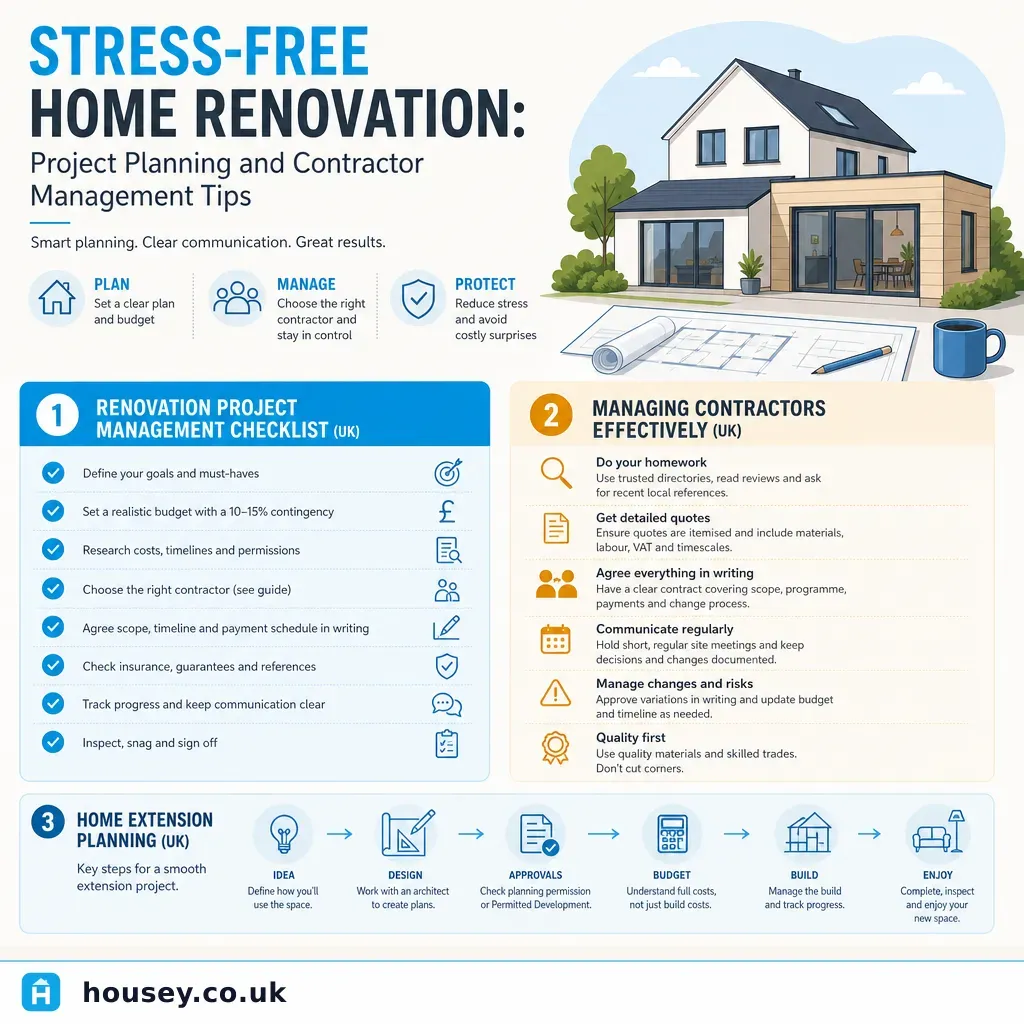
Stress-Free Home Renovation: Project Planning and Contractor Management Tips
The home renovations that stay on budget and on time share one characteristic: clear upfront planning.
 Improvement & Build
Renovation Tips From Experienced Homeowners: Practical Advice
Experienced UK homeowners consistently identify the same lessons: set a contingency of 10–20%, obtain at least three written itemised quotes, confirm whether planning permission and Building Regulations approval are both needed, and always sign a contract with a written scope of works before work starts.
 Improvement & Build
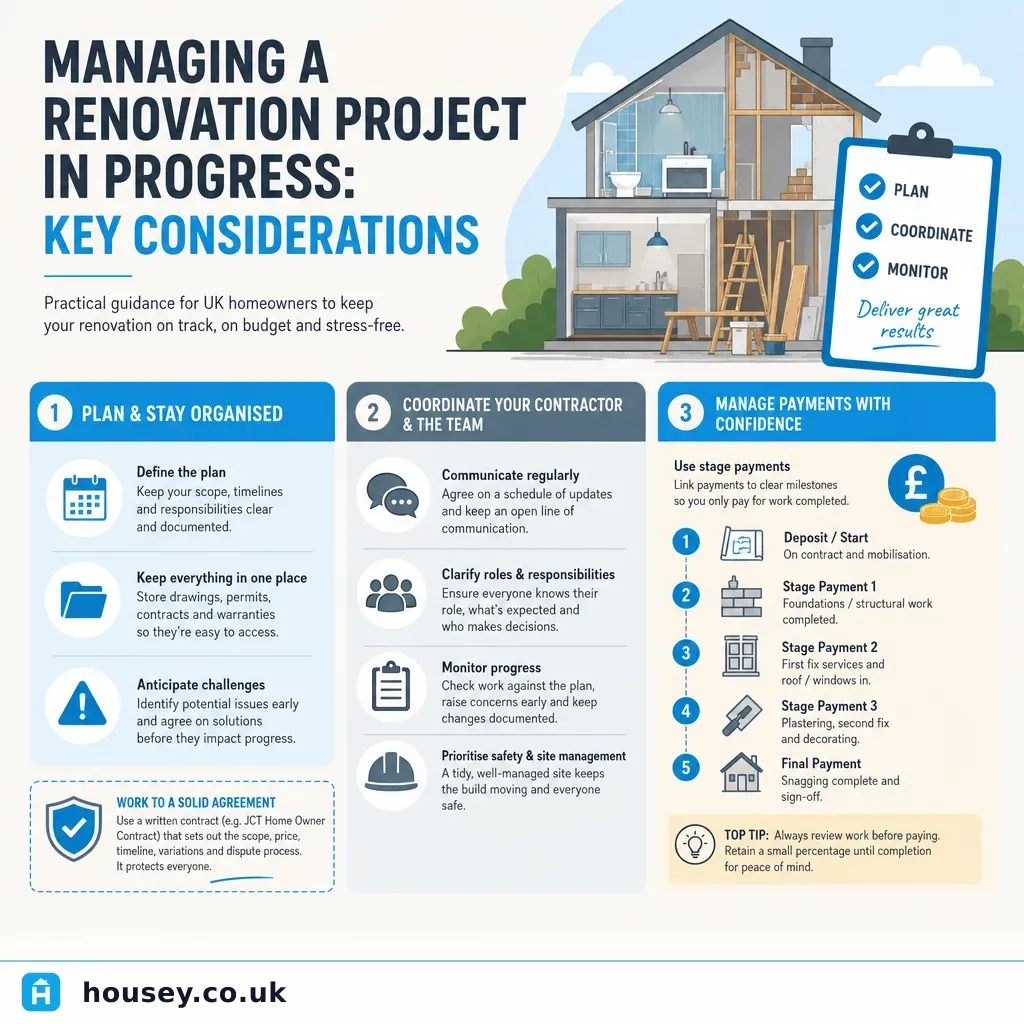
Managing a Renovation Project in Progress: Key Considerations
Keep a written schedule of works, confirm every variation in writing, and check progress at agreed milestones.