Home Retrofit Upgrade Costs and Investment Planning
By Housey · Last reviewed 6th of May 2026
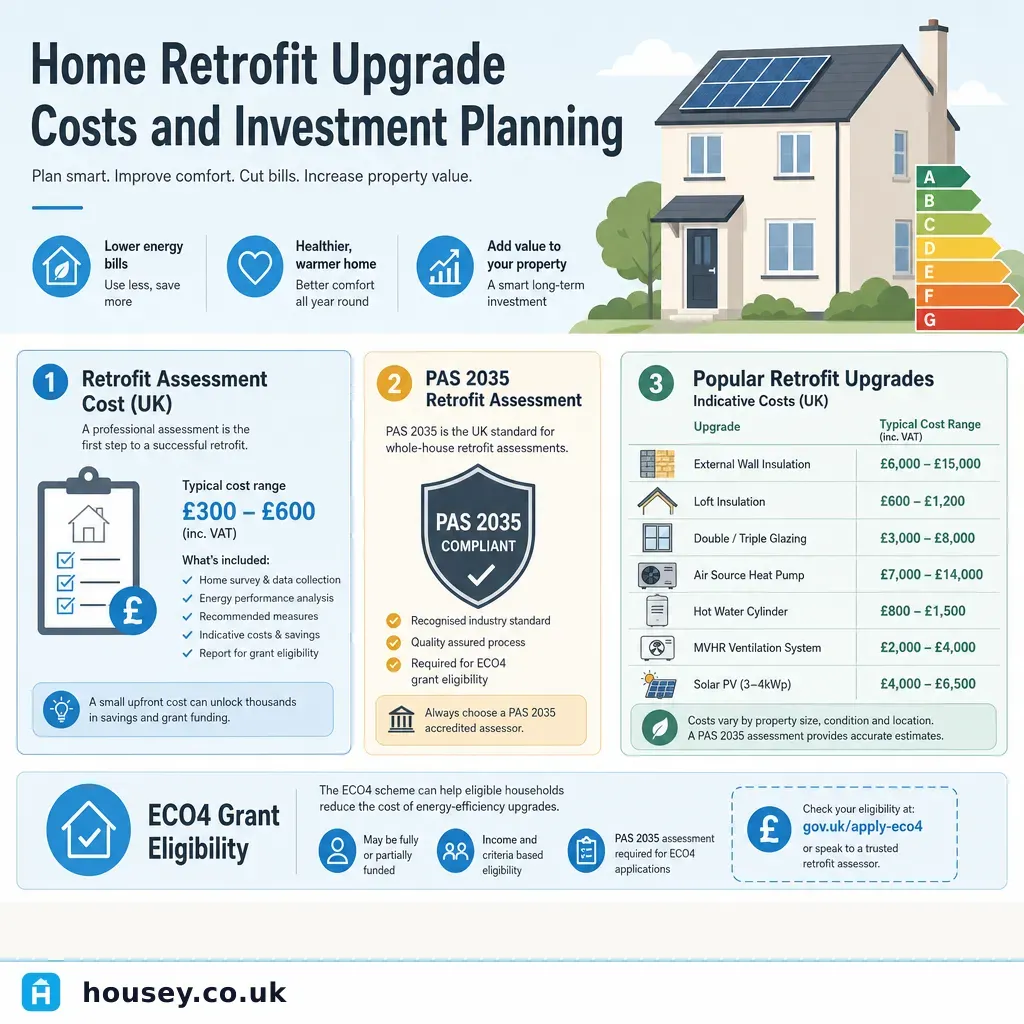
Home Retrofit Upgrade Costs and Investment Planning
Retrofitting a UK home is one of the most consequential financial decisions a homeowner can make — both in terms of upfront cost and long-term energy savings. Questions about budget typically arise when energy bills spike, when a property changes hands, or when a household begins exploring grant funding. Getting the numbers right from the start prevents expensive mistakes, particularly in older properties where poorly sequenced upgrades can cause condensation, damp, or structural deterioration.
Key points
- A PAS 2035 retrofit assessment is required before energy measures can be installed under most government-funded schemes, including ECO4 and the Great British Insulation Scheme (GBIS).
- The Boiler Upgrade Scheme (BUS) currently offers £7,500 towards an air source or ground source heat pump, paid directly to your MCS-certified installer.
- Solid wall insulation — internal or external — is typically the most expensive single retrofit measure, with indicative costs of £8,000–£22,000 depending on property size and method.
- ECO4 can fully or partially fund insulation for eligible households; eligibility is primarily income-based or linked to an EPC rating of D–G.
- Retrofit work in pre-1919 solid-wall properties carries a specific moisture risk — incorrectly specified insulation in breathable lime-mortar construction can trap moisture and cause serious damage if the wrong products are used.
What does a home retrofit typically cost in the UK?
Retrofit costs vary enormously based on the measures chosen, the property's size, age, and construction type, and whether grant funding is available. The table below gives indicative ranges based on publicly available data and industry guidance.
Measure | Indicative cost (self-funded) | Potential grant or scheme | Notes |
|---|---|---|---|
Loft insulation (topping up to 270mm) | £300–£600 | GBIS / ECO4 | Very cost-effective; typical payback 2–4 years |
Cavity wall insulation | £400–£1,500 | GBIS / ECO4 | Only suitable where the cavity is clear and dry |
Solid wall insulation (internal) | £8,000–£14,000 | ECO4 if eligible | Reduces room dimensions; requires careful moisture detailing |
Solid wall insulation (external) | £10,000–£22,000 | ECO4 if eligible | Alters external appearance; may require planning consent |
Floor insulation (suspended timber) | £1,000–£4,000 | ECO4 in some cases | Effectiveness varies by existing draught levels |
Air source heat pump | £10,000–£18,000 | BUS: £7,500 off | Requires good fabric insulation to operate efficiently |
Ground source heat pump | £20,000–£40,000 | BUS: £7,500 off | Higher upfront cost; typically higher seasonal efficiency |
Solar PV (3–4 kWp system) | £5,000–£9,000 | Smart Export Guarantee (export payments) | Payback varies by self-consumption rate |
MVHR ventilation system | £2,000–£6,000 | Sometimes bundled in whole-house retrofit | Essential in airtight retrofits to prevent condensation |
Whole-house deep retrofit | £25,000–£60,000+ | Various, if eligible | Costs vary hugely by property type and existing condition |
Indicative UK costs, last reviewed 2026-05-06. Actual quotes will vary. Obtain at least three written quotes from TrustMark-registered or MCS-certified installers.
How to plan your retrofit investment
A piecemeal approach to retrofit — fitting measures one by one without a coordinated plan — is one of the most common and costly mistakes UK homeowners make. Installing a heat pump in a poorly insulated home, for example, results in high running costs and potential occupant discomfort.
The recognised approach under PAS 2035, the UK standard for domestic retrofit, sequences work as follows:
- Commission a retrofit assessment from a qualified Retrofit Assessor to establish the home's current energy performance and construction type.
- Receive a medium-term improvement plan (MTIP) that sequences measures correctly — fabric first, then low-carbon heating.
- Appoint a Retrofit Coordinator (required for most publicly funded work) to oversee design and installation.
- Install measures in the planned order, starting with the building fabric (insulation, draught-proofing, windows) before upgrading the heating system.
- Verify outcomes via post-installation checks and, where required, an air-pressure test.
This structured approach is mandatory for work funded through ECO4, GBIS, and most other government schemes, and is strongly recommended even for self-funded projects in older properties.
Worked example: 1930s semi-detached in the Midlands
A 1930s semi-detached with cavity walls, an ageing gas boiler, and 100mm of existing loft insulation might plan the following phased retrofit:
- Year 1: Cavity wall insulation top-up to 270mm plus draught-proofing — estimated £600–£1,000, potentially grant-funded under GBIS
- Year 2–3: Air source heat pump after fabric improvement — estimated £10,000–£14,000 after the £7,500 BUS grant, plus smart controls
- Year 3–4: Solar PV (3 kWp) — estimated £5,500–£7,500 to offset electricity costs from the heat pump
Total estimated self-funded outlay over four years: £16,100–£22,500. Savings on energy bills depend on prevailing tariff rates, usage patterns, and the property's final EPC performance.
Grant funding available in 2026
Several government-backed schemes can significantly reduce the cost of retrofit measures. Scheme rules change — always verify the current position on GOV.UK before committing expenditure.
ECO4 (Energy Company Obligation 4)
ECO4 funds insulation and heating measures for households in energy-inefficient homes (EPC D–G) who receive qualifying benefits or have a low income. In many cases it covers 100% of the cost of eligible measures. Apply via your energy supplier or an approved TrustMark-registered installer.
Great British Insulation Scheme (GBIS)
GBIS targets homes with an EPC rating of D–G and is available to a wider group than ECO4, including some households not on benefits. It primarily covers loft and cavity wall insulation. Check eligibility on GOV.UK.
Boiler Upgrade Scheme (BUS)
The BUS offers £7,500 towards an air source or ground source heat pump, paid directly to the MCS-certified installer who deducts it from your invoice. No means-testing applies, but the installation must meet MCS standards.
Smart Export Guarantee (SEG)
For solar PV, the SEG requires licensed electricity suppliers with 150,000 or more customers to pay you for electricity exported to the grid. Rates vary by supplier — compare on Ofgem's guidance pages.
Homeowner checklist: before you start a retrofit project
Red flags: warning signs of a poorly planned retrofit
Watch for these warning signs when speaking to installers or reviewing quotes:
- An installer recommends measures without first visiting the property or reviewing the EPC
- No discussion of ventilation when proposing high levels of insulation or airtightness improvement
- Solid wall insulation proposed without any assessment of moisture movement or the wall's breathability
- Grant-funded work proposed without a clear explanation of eligibility criteria or whether you qualify
- No mention of PAS 2035 for publicly funded retrofit projects
- Pressure to sign a contract before obtaining multiple quotes or a written improvement plan
- Quotes that bundle measures without itemising individual costs or explaining the sequencing rationale
Important limitations
This article provides general information about retrofit costs and planning in the UK. Actual costs, grant eligibility, and the suitability of specific measures depend on your property's construction type, condition, tenure, and location. Government schemes including ECO4 and the BUS have been amended multiple times — always verify the current position on GOV.UK before making financial decisions.
Retrofit work, particularly in pre-1919 solid-wall properties, carries specific risks including moisture damage if measures are incorrectly specified. This article does not constitute technical, legal, or professional advice. A qualified Retrofit Assessor or Coordinator should assess your property before any work begins.
What to ask a qualified professional
Before instructing a Retrofit Assessor or Retrofit Coordinator, ask:
- Are you accredited under PAS 2035 as a Retrofit Assessor or Retrofit Coordinator, and can I verify your registration number?
- Will you produce a medium-term improvement plan, not just a list of measures?
- How will you assess moisture risk, particularly if the property has solid walls or lime mortar construction?
- What ventilation strategy do you recommend alongside the proposed insulation measures?
- Are you TrustMark-registered, and will the installers you recommend also be registered?
- What happens if grant funding is unavailable — will the specification or cost change significantly?
- Will you coordinate or oversee the installation, or are you providing a report only?
When to get professional help
A qualified professional should always be involved in retrofit work. Specifically, contact a Retrofit Assessor or Retrofit Coordinator if:
- Your property was built before 1919 (solid walls, lime mortar, and breathable construction require careful moisture management)
- You are planning to install a heat pump or solar PV alongside insulation measures
- Your EPC rating is E, F, or G and you are a landlord subject to Minimum Energy Efficiency Standards (MEES)
- You are applying for ECO4, GBIS, or BUS funding — a qualifying assessment is required
- You have noticed damp, condensation, or mould following previous insulation work, which may indicate a moisture or ventilation problem
How Housey can help
Housey connects homeowners with qualified retrofit professionals across the UK. Whether you need a retrofit assessment to map your upgrade options, insulation installers to carry out fabric improvements, an energy-efficiency consultant to help you plan a phased programme, or a heat pump survey to assess your property's readiness, you can request and compare quotes from accredited professionals in one place.
Frequently asked questions
How much does a retrofit assessment cost in the UK?
A PAS 2035 retrofit assessment typically costs £300–£600 for a standard home, though prices vary by property size, location, and the assessor's scope of work. Some assessments are bundled with grant-funded schemes at no direct cost to the homeowner. Always confirm what the assessment report will include — a full medium-term improvement plan is more valuable than a simple measure list.
Do I need planning permission for external wall insulation?
External wall insulation usually falls under permitted development for standard homes, but listed buildings always require listed building consent. Homes in conservation areas, national parks, or Areas of Outstanding Natural Beauty may also need planning permission. Check with your local planning authority before specifying external insulation — enforcement action can require costly removal of completed work.
Is a heat pump suitable for my home before I improve the insulation?
Most Retrofit Coordinators and heat pump engineers recommend addressing the building fabric — loft insulation, wall insulation, and draught-proofing — before installing a heat pump. A heat pump in a poorly insulated home runs more frequently to maintain temperature, increasing running costs. Your retrofit assessment should confirm whether your home is heat-pump-ready before you commit.
Can a landlord be required to fund retrofit improvements?
Yes. Under the Minimum Energy Efficiency Standards (MEES) regulations, landlords in England and Wales must ensure privately rented properties have an EPC rating of at least E before letting. Proposed future requirements may raise this threshold. Landlords should check current requirements on GOV.UK and seek professional advice on compliance and available grant funding.
What is TrustMark and why does it matter for retrofit?
TrustMark is a government-endorsed quality scheme for tradespeople working in and around UK homes. For retrofit, TrustMark registration is required for work carried out under ECO4 and GBIS. It provides consumer protection by ensuring installers have been vetted against defined quality and competence standards, and gives you a route for complaints if something goes wrong.
Sources and further reading
- PAS 2035: Retrofitting dwellings for improved energy efficiency — BSI Group
- Boiler Upgrade Scheme guidance — GOV.UK
- ECO4: Energy Company Obligation — GOV.UK
- Great British Insulation Scheme — GOV.UK
- Smart Export Guarantee guidance — Ofgem
- TrustMark: find registered retrofit installers — TrustMark
- EPC Register — Ministry of Housing, Communities and Local Government
Useful next reads
 Energy & Retrofit
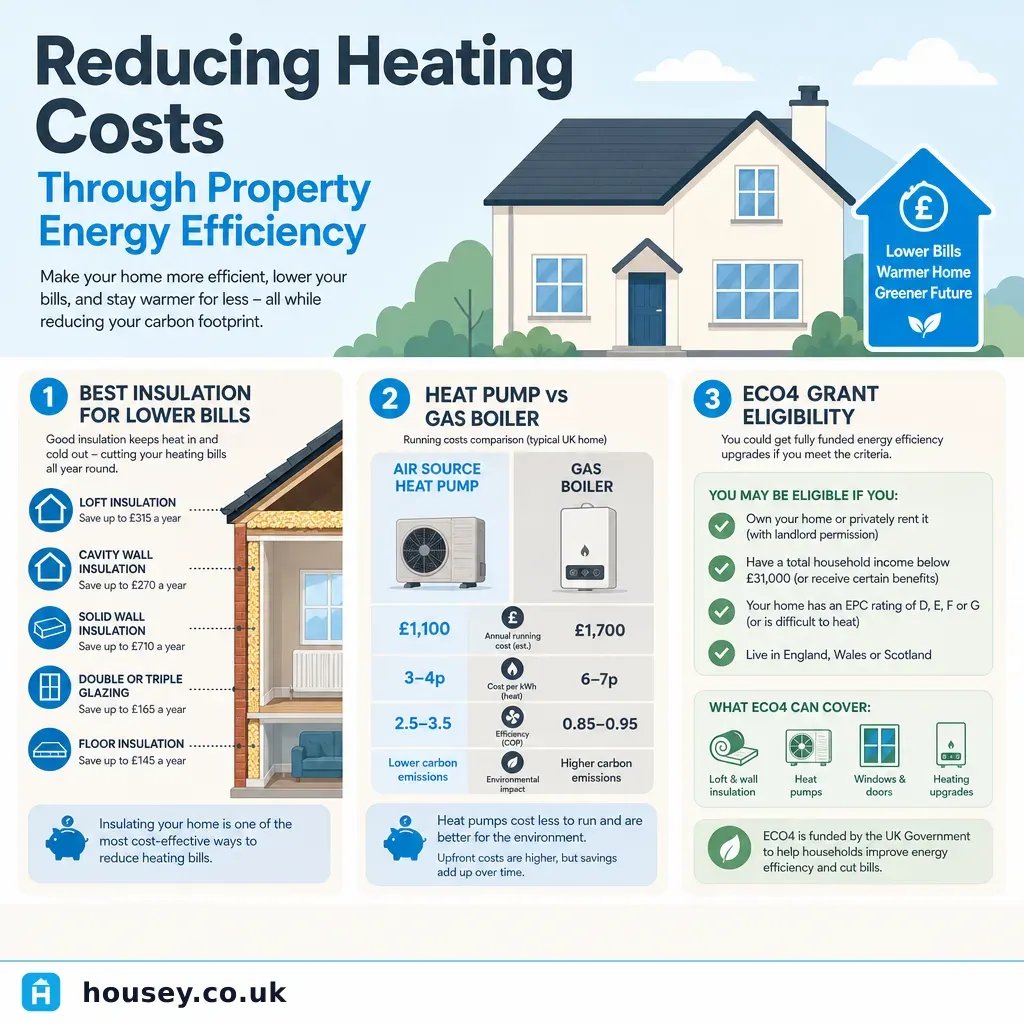
Reducing Heating Costs Through Property Energy Efficiency
Reducing heating costs starts with identifying where heat is lost — typically walls (30–35%), roof (20–25%), and windows.
 Energy & Retrofit
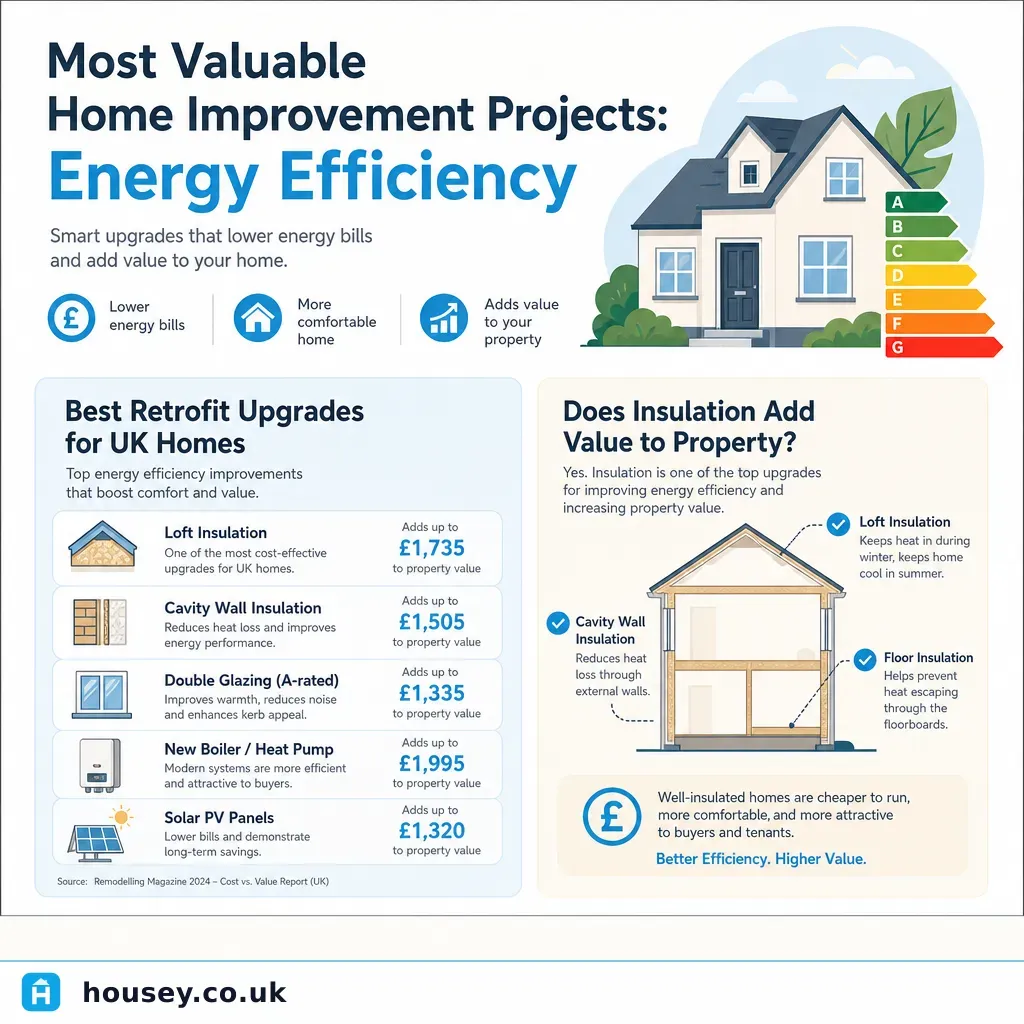
Most Valuable Home Improvement Projects: Energy Efficiency
Energy efficiency improvements with the strongest value case for UK homes include loft insulation, cavity wall insulation, double glazing, and air source heat pumps in well-insulated properties.
 Energy & Retrofit
The Rise of Green-Rated Homes: Energy Efficiency, Sustainability, and Long-Term Property Value
Homes with higher EPC ratings typically sell faster and can command a premium of up to 10% over equivalent lower-rated properties.
 Energy & Retrofit
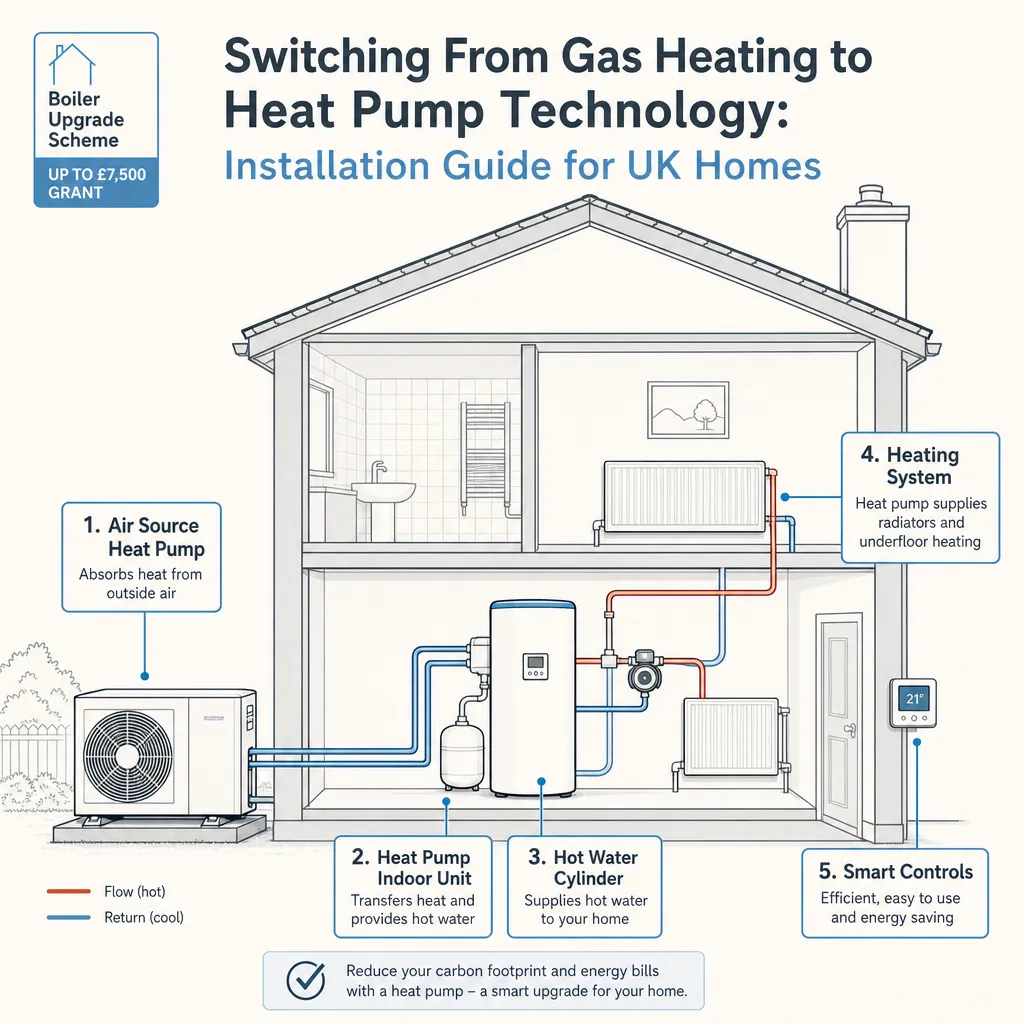
Switching From Gas Heating to Heat Pump Technology: Installation Guide
Switching from gas to a heat pump requires a heat loss calculation, correctly sized equipment, and often radiator upgrades before installation.
 Energy & Retrofit
Making your home resilient to climate change: practical strategies
UK homeowners can improve climate resilience by addressing flood risk, overheating, and energy efficiency together.