Home Survey Process: Step-by-Step Guide Through a Property Inspection
By Housey · Last reviewed 31st of May 2026
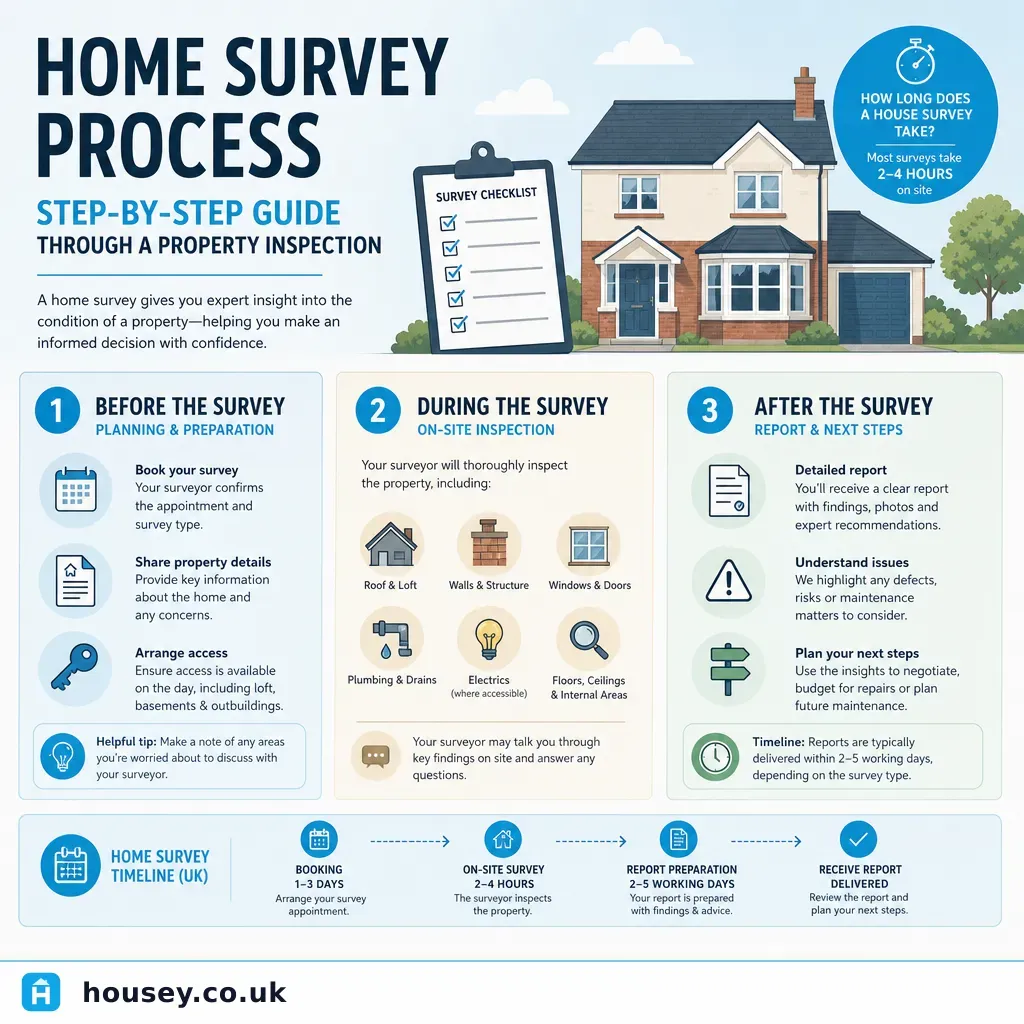
Home Survey Process: Step-by-Step Guide Through a Property Inspection
Most buyers commission a survey after their offer is accepted but before exchange of contracts — a window that can feel pressured and unfamiliar. In England and Wales, you are not legally required to have a survey, but without one you take on the full risk of undiscovered defects after exchange. The decision about which level to instruct, and how to act on the findings, is often made with limited time and guidance.
Key points
- RICS Home Surveys follow the RICS Home Survey Standard (2019), which defines inspection scope, condition ratings, and report format across Level 1, 2, and 3 surveys.
- The condition rating system uses three categories: 1 (no repair needed now), 2 (defects needing attention), and 3 (serious or urgent — obtain specialist advice before exchange).
- Surveyors inspect accessible areas only; they do not lift fitted carpets, move furniture, open up walls, or lift drain covers unless a specific scope is agreed in advance.
- A Level 2 inspection typically takes 2–3 hours; a Level 3 Building Survey on a large or complex property can take 4–8 hours.
- Reports are usually delivered within 3–5 working days of the inspection; expedited turnaround may be available at extra cost.
How to book a survey: timing and lead times
Instruct a surveyor once your offer is accepted in principle — not after you receive a mortgage valuation. A mortgage valuation is carried out for the lender's benefit and does not substitute for a buyer's survey.
Typical timeline from offer to report:
Stage | Approximate timing |
|---|---|
Offer accepted | Day 0 |
Survey instructed | Days 1–3 |
Inspection booked | Days 5–14 |
Inspection visit | Days 7–21 |
Report delivered | 3–5 working days after visit |
Follow-up queries resolved | 1–3 days |
To instruct a surveyor, you will usually provide the property address, your preferred survey level, the estate agent's contact details for access, and any known concerns worth flagging in advance. Most RICS surveyors are booked 1–2 weeks ahead; in rural areas or busy markets, allow 3–4 weeks.
Which survey level is right for you?
- Choose a RICS Level 1 Condition Report if the property is a post-2000 new-build in good condition and you need a basic health check only.
- Choose a RICS Level 2 Home Survey if the property is conventional construction (1930s semi, 1990s estate house, modern flat), appears in reasonable condition, and you want condition ratings with maintenance advice.
- Choose a RICS Level 3 Building Survey if the property is pre-1919, has been extended or altered, shows visible defects (cracks, damp, sagging roof), or is made from non-standard materials such as timber frame, cob, or concrete panel.
- Ask a chartered surveyor to advise if you are unsure — many offer a free pre-instruction call.
What happens during the inspection visit
The surveyor attends the property when the estate agent or vendor has arranged access. You are usually welcome to attend, though most surveyors prefer to work without interruption and then answer questions at the end.
A typical inspection involves:
- External inspection: roof covering (viewed from ground level or via binoculars), gutters, downpipes, external walls, windows, doors, boundaries, outbuildings, and drainage where visible.
- Internal inspection: all habitable rooms, loft space (if accessible and safe), cellar (if present and accessible), and service installations noted but not tested.
- Key checks: damp at skirting boards and reveals, wall and ceiling cracking, floor condition, roof void structure, timber for rot or beetle damage, and window and door operation.
- Photography: defects are photographed to support report findings.
Surveyors do not test gas or electrical installations — these require a separate Gas Safety Certificate or Electrical Installation Condition Report (EICR). The report will note where specialist investigation is recommended.
What surveyors do not inspect
A standard RICS survey does not include:
- Areas behind fitted furniture, under floor coverings, above sealed ceilings, or inside cavity walls
- Testing of gas, oil, or electrical installations
- CCTV drain surveys (a separate instruction)
- Japanese knotweed or tree root surveys
- Asbestos sampling — presence may be noted; testing is a specialist service
- Structural calculations or engineering assessments
If the report recommends specialist investigation, obtain that report before exchange wherever possible.
Understanding your survey report
Condition ratings explained
Rating | Meaning | Recommended action |
|---|---|---|
1 — No repair currently needed | Satisfactory; normal maintenance only | None urgent |
2 — Defects needing attention | Repairs required; not yet urgent | Plan and budget |
3 — Serious or urgent defects | Could worsen rapidly or affect safety or value | Get specialist advice before exchange |
NI — Not inspected | Area not accessible; surveyor cannot comment | Consider further investigation |
A property with several Condition 2 ratings and no Condition 3 items is generally in reasonable repair. One or more Condition 3 ratings warrants specialist reports before exchange.
What to do after reading the report
- Read the whole report, not just the summary page.
- List all Condition 3 items and all recommended specialist investigations.
- Ask the surveyor to clarify anything unclear — most include a free follow-up call.
- Obtain contractor quotes for Condition 3 repairs and use these to renegotiate the purchase price if significant.
- Decide whether to proceed, renegotiate, or withdraw.
Red flags in a survey report
The following findings usually warrant pausing before exchange:
- Any Condition 3 rating for structural movement, roof structure, or drainage
- Recommendation for intrusive damp investigation (suggests potential timber decay)
- Reference to non-standard construction — concrete panels or prefabricated systems may affect mortgageability
- Mention of possible asbestos-containing materials (ACMs) requiring testing
- Active subsidence indicators: diagonal cracking above openings, stepped brickwork cracking, or distorted door and window frames
- Note of Japanese knotweed on or near the boundary
- Recommendation for specialist electrical or gas inspection
None of these is automatically a reason to withdraw — they are a signal to investigate further before committing.
Preparing your property for a survey (sellers)
If you are the vendor and a buyer has instructed a survey, this checklist helps the inspection proceed smoothly:
When to get professional help
A survey report is the beginning of decision-making, not the end. Seek specialist help when:
- A Condition 3 item involves structural, drainage, or damp issues
- The surveyor recommends a structural engineer, specialist damp surveyor, or arboriculturist
- You cannot confidently interpret a rating or recommendation
- Findings suggest Japanese knotweed, past underpinning, or non-standard construction that may affect lending
Do not rely on builder quotes alone for structural concerns — commission an independent chartered engineer where structural movement is suspected.
How Housey can help
Housey connects you with RICS-regulated surveyors across all levels. Whether you need a RICS Level 2 survey for a 1960s semi or a RICS Level 3 survey for an older property with visible defects, you can request quotes from local surveyors and compare them in one place. Browse all RICS Home Surveys to get started.
Frequently asked questions
Can I attend the survey inspection?
Yes — you are usually welcome to attend, though most surveyors prefer to complete the inspection without interruption and answer questions at the end or by phone afterwards. Attending can help you understand the property's condition first-hand, but it is not a requirement and some surveyors prefer to work alone.
How long does a home survey take?
A RICS Level 1 Condition Report typically takes 1–2 hours. A Level 2 Home Survey takes 2–3 hours for an average home. A Level 3 Building Survey on a larger or more complex property can take 4–8 hours. The time depends on property size, age, access, and the number of issues found.
What if the surveyor cannot access part of the property?
The surveyor marks that area as NI (Not Inspected) and explains why — usually inaccessibility such as a sealed loft hatch, locked outbuilding, or furniture blocking access. Where significant areas are not inspected, consider whether further investigation is warranted before exchange. You can ask the surveyor what a more complete inspection would require.
Should I use the surveyor recommended by my estate agent?
You are not obliged to. Instructing your own RICS-regulated surveyor ensures they work in your interest, not the agent's or lender's. Recommended surveyors may be perfectly competent, but compare at least two or three quotes and check the surveyor's local experience with similar property types before making your choice.
Can I use the survey to renegotiate the purchase price?
Yes — survey findings are commonly used to renegotiate. A Condition 3 finding accompanied by a contractor's repair estimate gives a reasonable basis for a price reduction. The vendor is not obliged to agree, but many do to preserve the sale. Any renegotiation should happen before exchange of contracts.
Sources and further reading
- RICS Home Survey Standard (2019) — RICS
- Buying or selling a home — GOV.UK
- Getting a property survey — Citizens Advice
Useful next reads
 Surveys & Inspections
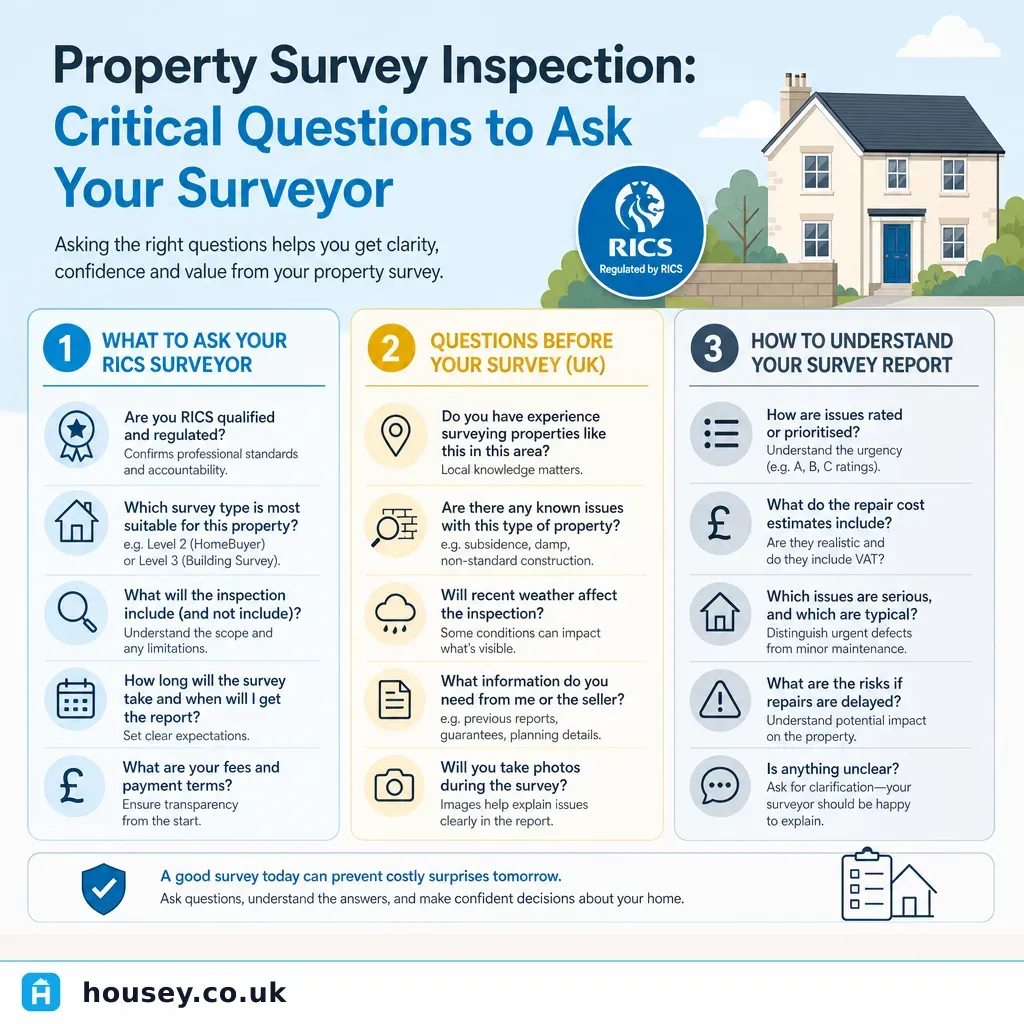
Property Survey Inspection: Critical Questions to Ask Your Surveyor
Before instructing a surveyor, ask which RICS level suits your property and what the report will and will not cover.
 Surveys & Inspections
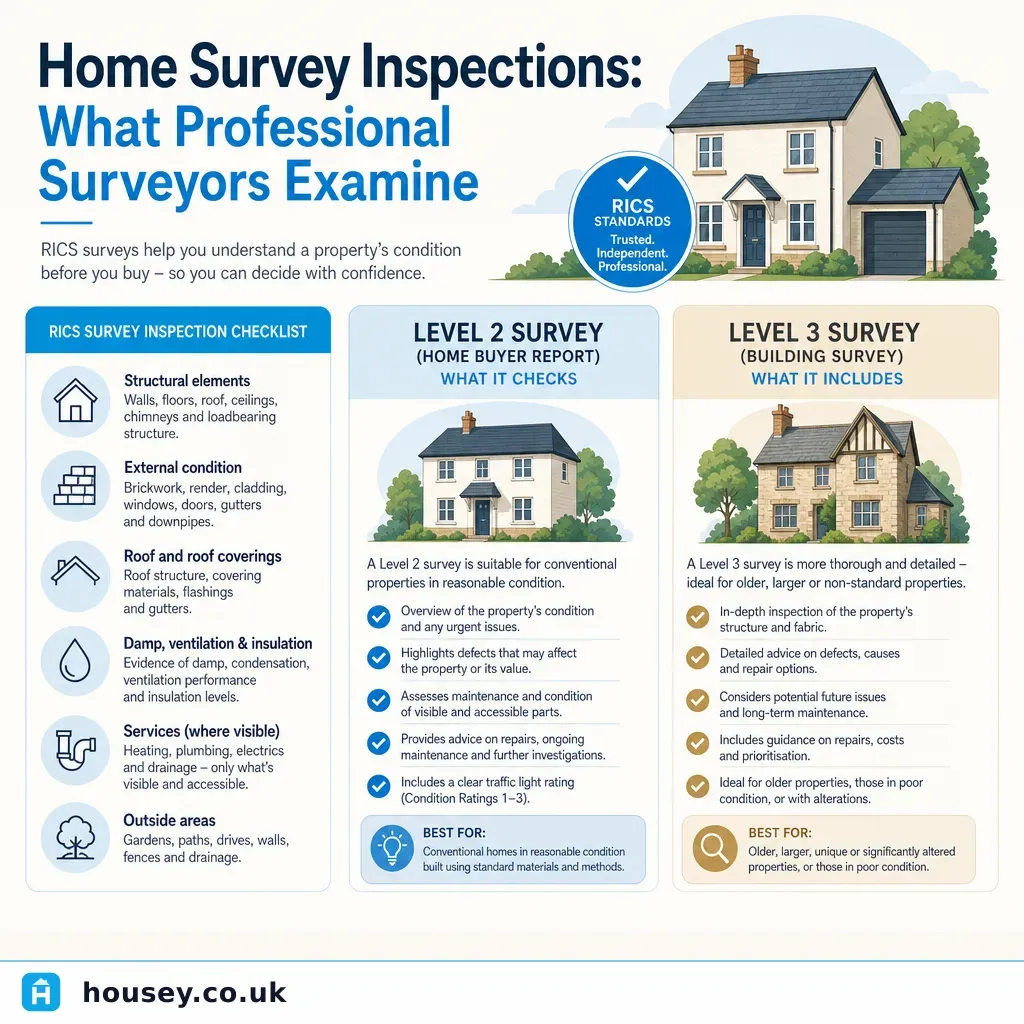
Home Survey Inspections: What Professional Surveyors Examine
A RICS home survey involves a visual inspection of a property's structure, roof, walls, floors, and services.
 Surveys & Inspections
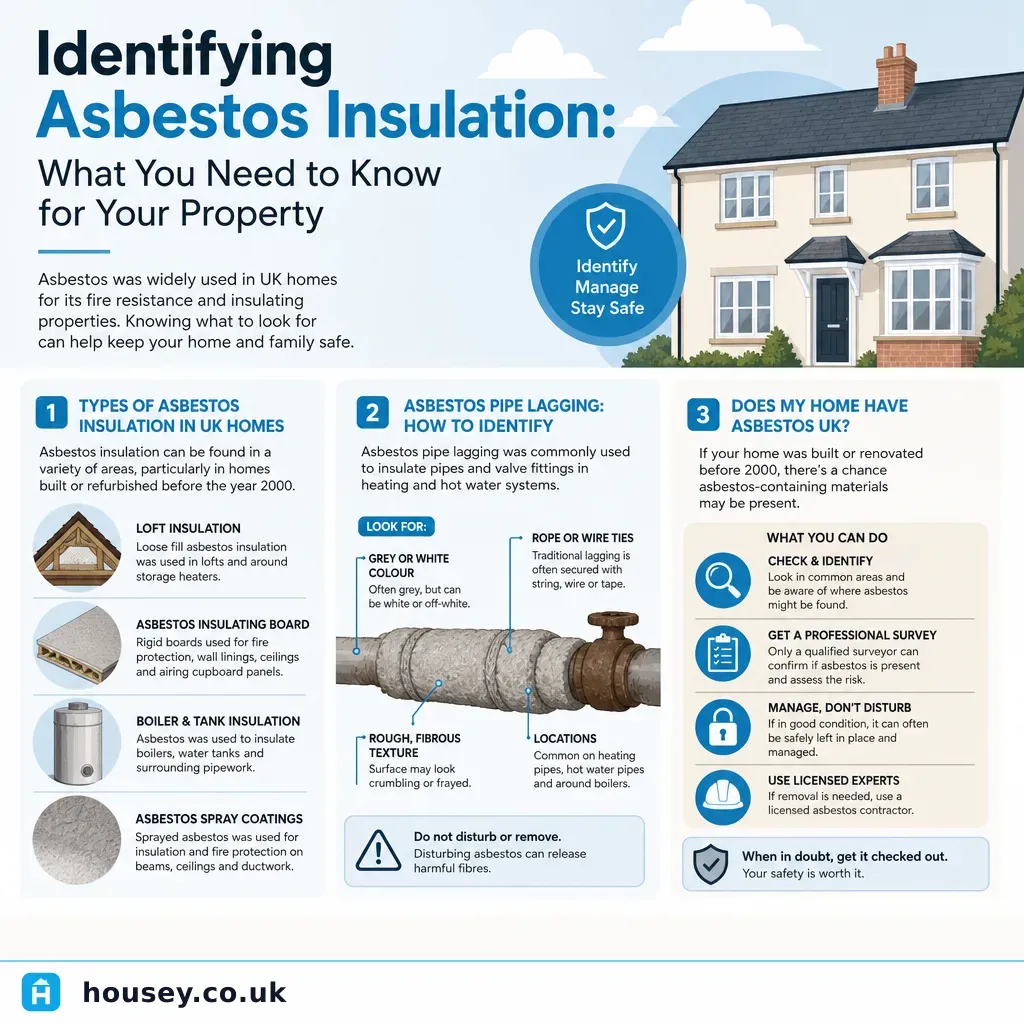
Identifying Asbestos Insulation: What You Need to Know for Your Property
Asbestos insulation was widely used in UK properties built before 2000, commonly found in pipe lagging, ceiling tiles, loose-fill loft insulation, and around boilers.
 Surveys & Inspections
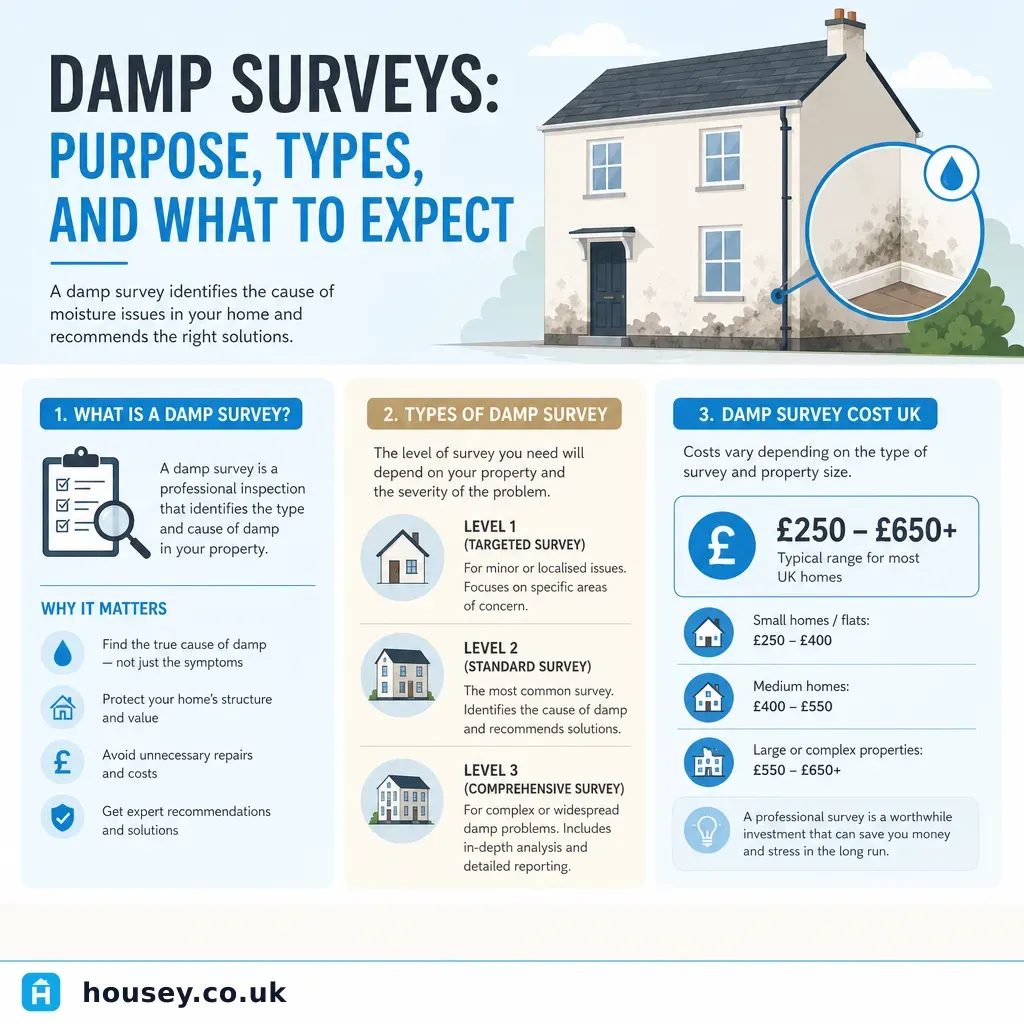
Damp Surveys: Purpose, Types, and What to Expect
A damp survey is a specialist inspection to identify the source, type, and extent of moisture in a property.
 Surveys & Inspections
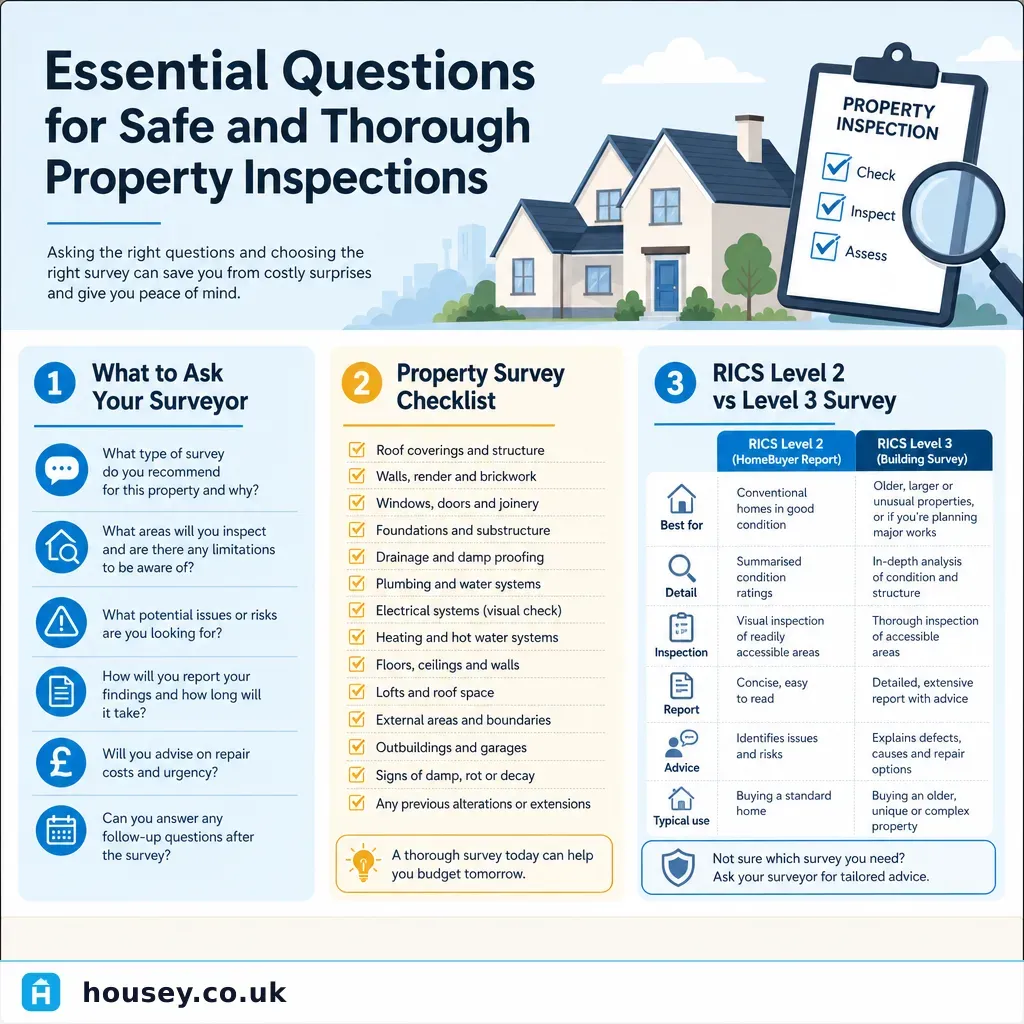
Essential Questions for Safe and Thorough Property Inspections
Before commissioning a property survey, confirm what type of inspection suits your property's age and condition, ask the surveyor what defects they will and will not assess, and understand what the report will recommend.