Home Surveys and Inspections: Understanding Your Options
By Housey · Last reviewed 26th of May 2026
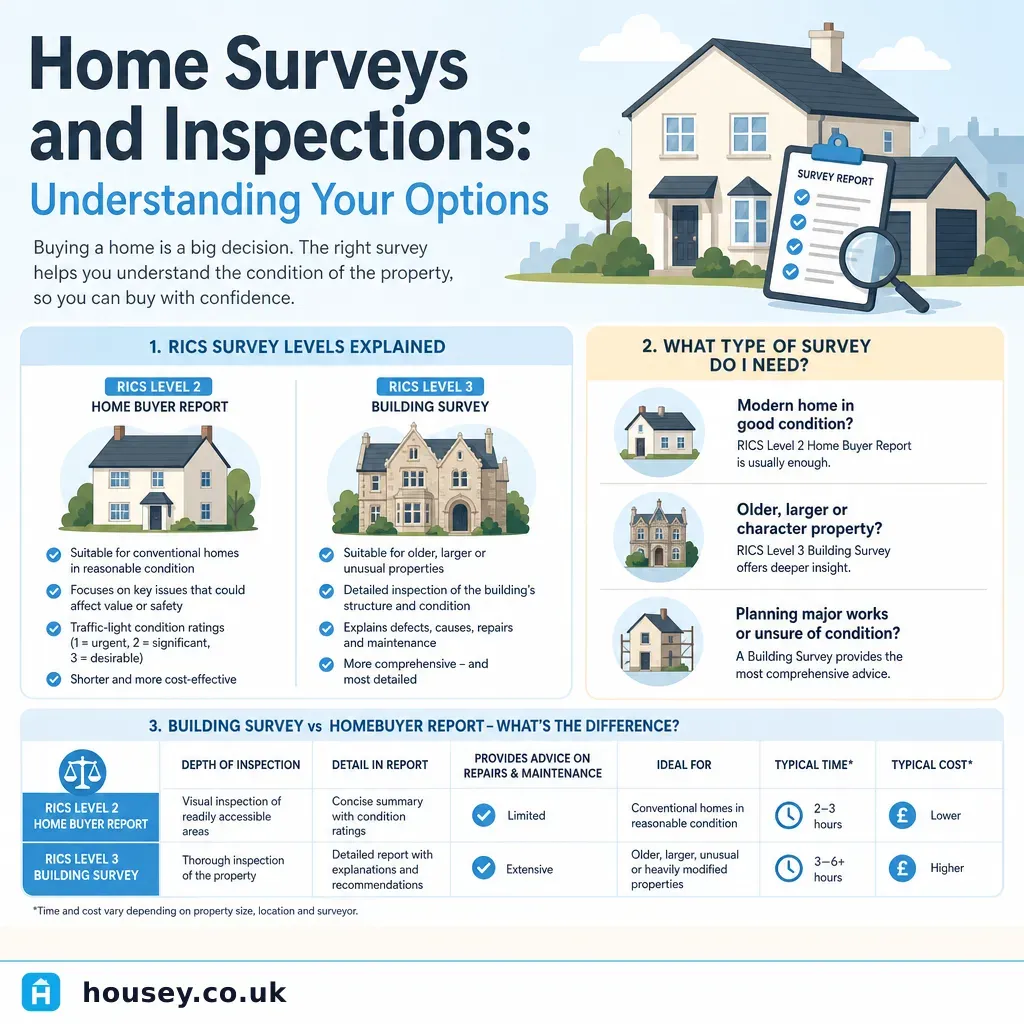
Home Surveys and Inspections: Understanding Your Options
Choosing a property survey typically becomes a priority once your offer is accepted and you are moving towards exchange of contracts — the point at which you are most exposed if hidden defects are missed. The decision carries real weight: commissioning a survey at the wrong level for the property type can leave a buyer with unexpected repair bills running to tens of thousands of pounds after completion. In England, Wales, and Scotland, the RICS Home Survey Standard (2021 edition) provides three standardised inspection levels designed to help buyers match the depth of inspection to the property in front of them.
Key points
- RICS Level 3 (Building Survey) is the appropriate choice for properties built before approximately 1900, those showing visible defects, non-standard construction, or significant past alterations.
- A mortgage valuation is not a survey — it is carried out solely for your lender and provides no duty of care to you as the buyer.
- RICS condition ratings apply across all three survey levels: Condition Rating 1 (no repair needed), Rating 2 (defects present but not urgent), Rating 3 (urgent repair required).
- Surveyor fees are not regulated; obtain at least two comparable quotes before instructing.
- Specific defect surveys — damp investigations, structural crack assessments, drainage CCTV — are specialist products entirely separate from the three standardised RICS Home Survey levels.
What the three RICS survey levels cover
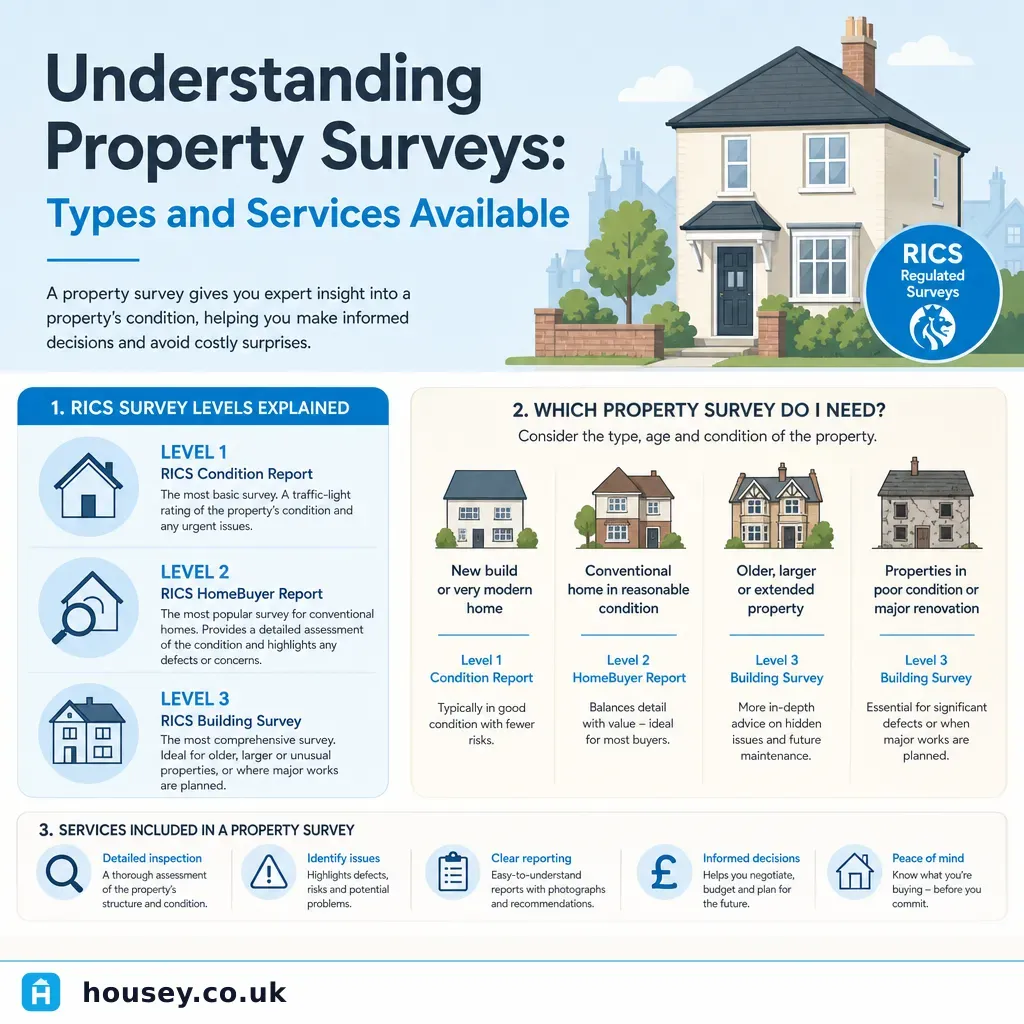
Since the RICS Home Survey Standard came into effect in 2021, all RICS members offering residential surveys must use one of three standardised products. The previous Homebuyer Report format has been updated and rebranded, and all three levels share a common condition rating system.
RICS Level 1 — Condition Report
A visual inspection that assigns condition ratings to key building elements. No repair advice, no maintenance recommendations, and no market or reinstatement valuation. It suits modern properties in clearly good condition where a buyer needs simple confirmation of state, not detailed diagnosis.
RICS Level 2 — Home Survey
The most widely commissioned residential survey. The surveyor inspects all accessible areas, provides condition ratings, comments on significant defects, flags legal issues to raise with your solicitor, and may include a reinstatement cost assessment for insurance purposes. It does not involve lifting carpets, opening up structures, or investigating behind wall finishes. A RICS Level 2 home survey is a reasonable starting point for a 1990s estate house with no obvious concerns.
RICS Level 3 — Building Survey
The most thorough residential inspection under the RICS standard. The surveyor assesses construction methods, identifies visible and potentially hidden defects, and provides repair options with indicative cost ranges. A RICS Level 3 building survey is appropriate for a Victorian terrace, an interwar semi with visible extensions, any non-standard construction, or any property where you want the fullest pre-exchange picture.
Which survey level do you need?
- Choose Level 1 if the property is a modern new-build or near-new flat in visibly good condition and you want basic condition confirmation only.
- Choose Level 2 if the property is a conventional post-1930 home in reasonable condition with no obvious structural concerns or unusual construction.
- Choose Level 3 if the property is pre-1900 or pre-1930, shows visible cracks, damp, past alterations, or non-standard construction (timber frame, stone, thatched roof), or is significantly larger than average.
- Consider specific defect surveys if you already have a general survey and need specialist opinion on a single identified issue — suspected subsidence, chimney stack condition, or a flat roof.
- Ask a chartered structural engineer if you observe widening cracks, stepped cracking through brickwork, or any sign of ongoing structural movement that a general survey may not fully diagnose.
- Check with the surveyor directly if you are uncertain whether your property falls into an edge case — unusual construction eras, conversions, or listed buildings may need bespoke guidance.
Survey types compared
Survey | Best for | What it covers | Repair guidance | Indicative cost* |
|---|---|---|---|---|
RICS Level 1 | Modern homes, good condition | Visual inspection, condition ratings | None | £250–£500 |
RICS Level 2 | Conventional post-1930 homes | Accessible areas, defect flags | Limited | £400–£900 |
RICS Level 3 | Older, unusual, or defective properties | Thorough inspection, hidden risks | Yes, with cost ranges | £600–£1,500+ |
Specific defect survey | Single identified concern | Focused specialist inspection | Yes | £200–£600+ |
*Indicative UK costs, last reviewed 2026-05-26. Figures vary significantly by property size, location, and surveyor experience. Always obtain at least two comparable quotes.
What a mortgage valuation does not do
A mortgage valuation is instructed by your lender to confirm the property provides adequate security for the loan amount. You may not receive a copy, and even if you do, the surveyor's duty of care runs to the lender rather than to you. It is not uncommon for a lender's valuation to raise no concerns on the same property on which a Level 3 survey subsequently identifies significant structural movement, concealed damp, or major roof defects. A mortgage valuation is not a substitute for commissioning your own inspection.
New build snagging inspections
For newly completed properties, a RICS Level 1 or Level 2 survey is rarely necessary, but a snagging inspection can identify cosmetic defects, incomplete work, and deviations from specification before legal completion. The NHBC Buildmark warranty covers structural defects for ten years but snagging items must be reported to the developer directly and within the agreed defects liability period. Snagging is not a standardised RICS product; use an inspector registered with the New Homes Quality Board or a similarly recognised body.
Important limitations
This article reflects the RICS Home Survey Standard (2021 edition) and general practice in England, Wales, and Scotland as of 2026-05-26. Survey scope depends on access conditions, the property's state on the day of inspection, and the individual surveyor's professional judgement. No survey can guarantee identification of all defects, particularly those concealed behind finishes, below ground level, or within building services. This article does not constitute legal or professional advice. Always read your surveyor's terms of engagement carefully and raise any questions about scope before instructing.
What to ask a qualified professional
Before instructing a surveyor, ask:
- Which RICS Home Survey level is this, and does it comply with the current RICS Home Survey Standard (2021 edition)?
- Which areas of the property will be excluded from the inspection, and on what basis?
- Will you contact me directly before issuing the written report if you identify a Condition Rating 3 defect?
- Does the fee include a reinstatement cost assessment for buildings insurance purposes?
- What professional indemnity insurance cover do you hold, and with which body are you registered?
- What is the estimated turnaround time for the written report?
- If specialist follow-up is needed after the survey, can you recommend appropriate professionals?
When to get professional help
If your survey returns Condition Rating 3 on any element, arrange specialist follow-up before exchange of contracts. A general building survey does not replace:
- A chartered structural engineer for suspected subsidence, significant structural movement, or any proposed alteration to load-bearing elements.
- A licensed asbestos surveyor for properties built or refurbished before 2000 where materials may have been disturbed or where works are planned.
- A Gas Safe registered engineer for assessment of gas installations identified as a concern.
- A NICEIC or NAPIT-registered electrician for an Electrical Installation Condition Report (EICR).
How Housey can help
Housey connects you with RICS-qualified surveyors across the UK for RICS Level 2 home surveys, RICS Level 3 building surveys, and specific defect surveys. Compare quotes, check credentials, and read verified reviews before instructing. Browse all RICS home survey options to find the right inspection level for your property.
Frequently asked questions
Can I use survey findings to reduce the purchase price?
Survey findings can provide substantiated grounds for renegotiation before exchange of contracts. A Condition Rating 3 defect with an estimated repair cost gives you a documented basis for discussion. There is no obligation on the seller to agree, but many buyers succeed in securing a price reduction or requesting that repairs be carried out before completion.
What is the difference between a building survey and a structural survey?
The term structural survey is an older, informal description broadly equivalent to the current RICS Level 3 Building Survey. A structural survey carried out by a chartered structural engineer is a different and more technically focused product — assessing load-bearing elements, movement, and stability in greater depth — and is typically commissioned after a general survey identifies a specific concern.
How long does a RICS Level 3 survey take?
On site, a Level 3 survey on a typical three- to four-bedroom period house usually takes between four and eight hours. Written reports are generally delivered within three to seven working days, though turnaround times vary by surveyor. Confirm timescales when obtaining quotes.
Is a survey legally required when buying a house in the UK?
No — a survey is not a legal requirement in England, Wales, or Scotland. Purchasing without one means you take the property as found. Most mortgage lenders require a valuation, but this is entirely separate from a survey commissioned for your own benefit and provides no duty of care to you as buyer.
Sources and further reading
- RICS Home Survey Standard — RICS
- Surveys and valuations when buying or selling a home — GOV.UK
- NHBC Buildmark warranty guidance — NHBC
- Types of house survey explained — Which?
- Electrical Installation Condition Reports (EICR) — Electrical Safety First
Useful next reads
 Surveys & Inspections
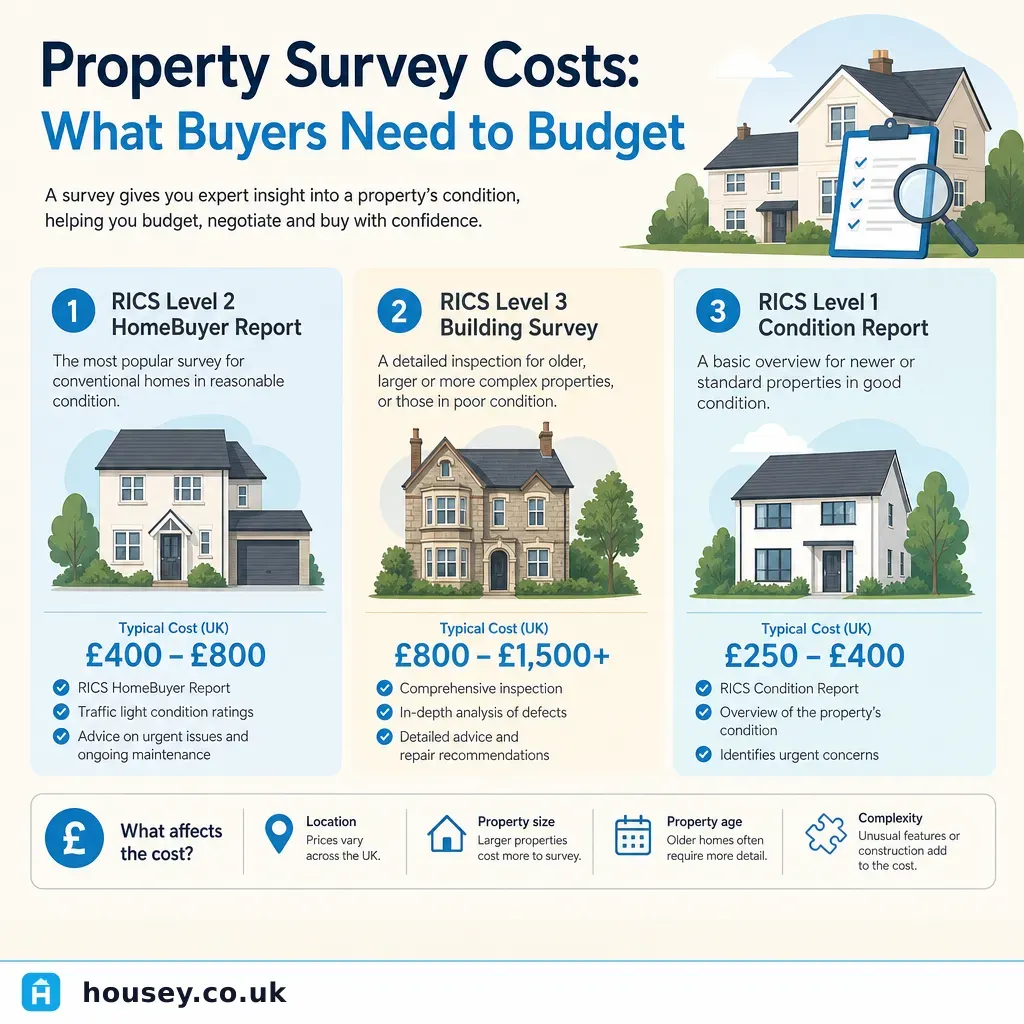
Property Survey Costs: What Buyers Need to Budget
A RICS Level 1 survey typically costs £300–£500, a Level 2 Home Survey £400–£900, and a Level 3 Building Survey £600–£1,500 or more.
 Surveys & Inspections
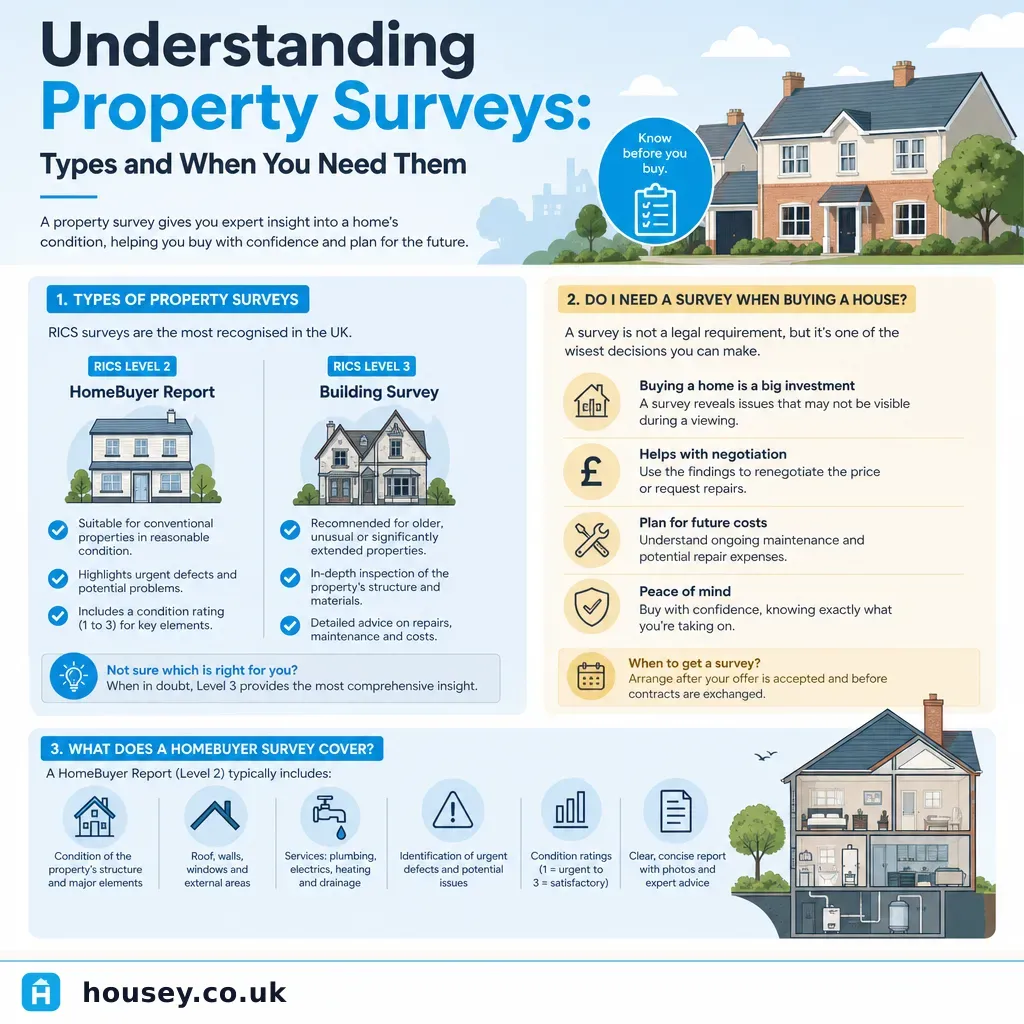
Understanding Property Surveys: Types and When You Need Them
The three main RICS survey types are the Level 1 Condition Report (for standard properties in good condition), the Level 2 Home Survey (conventional homes in reasonable condition), and the Level 3 Building Survey (older, unusual, or defective properties).
 Surveys & Inspections
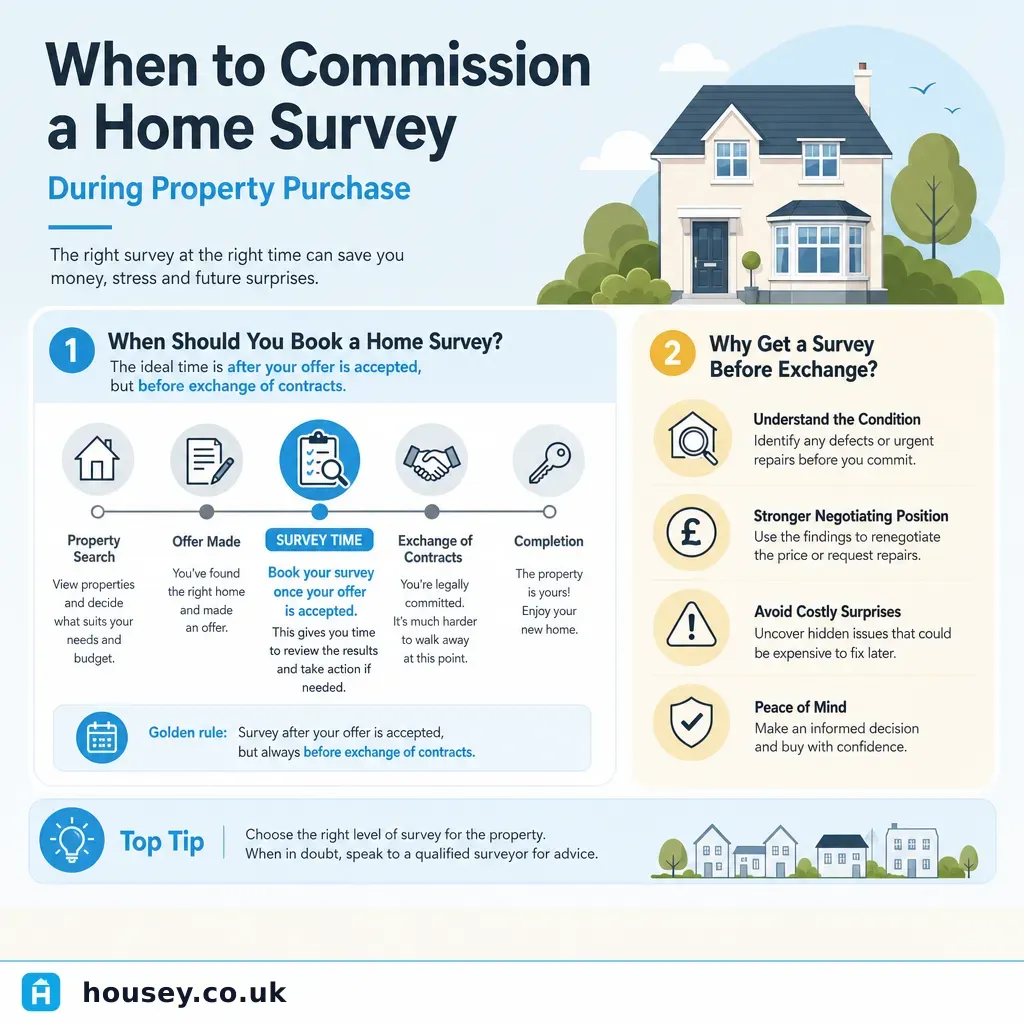
When to Commission a Home Survey During Property Purchase
Commission a home survey after your offer is accepted and before exchange of contracts.
 Surveys & Inspections
Understanding Property Surveys: Types and Services Available
UK property surveys follow three RICS-defined levels: Level 1 (Condition Report), Level 2 (Home Survey), and Level 3 (Building Survey).
 Surveys & Inspections
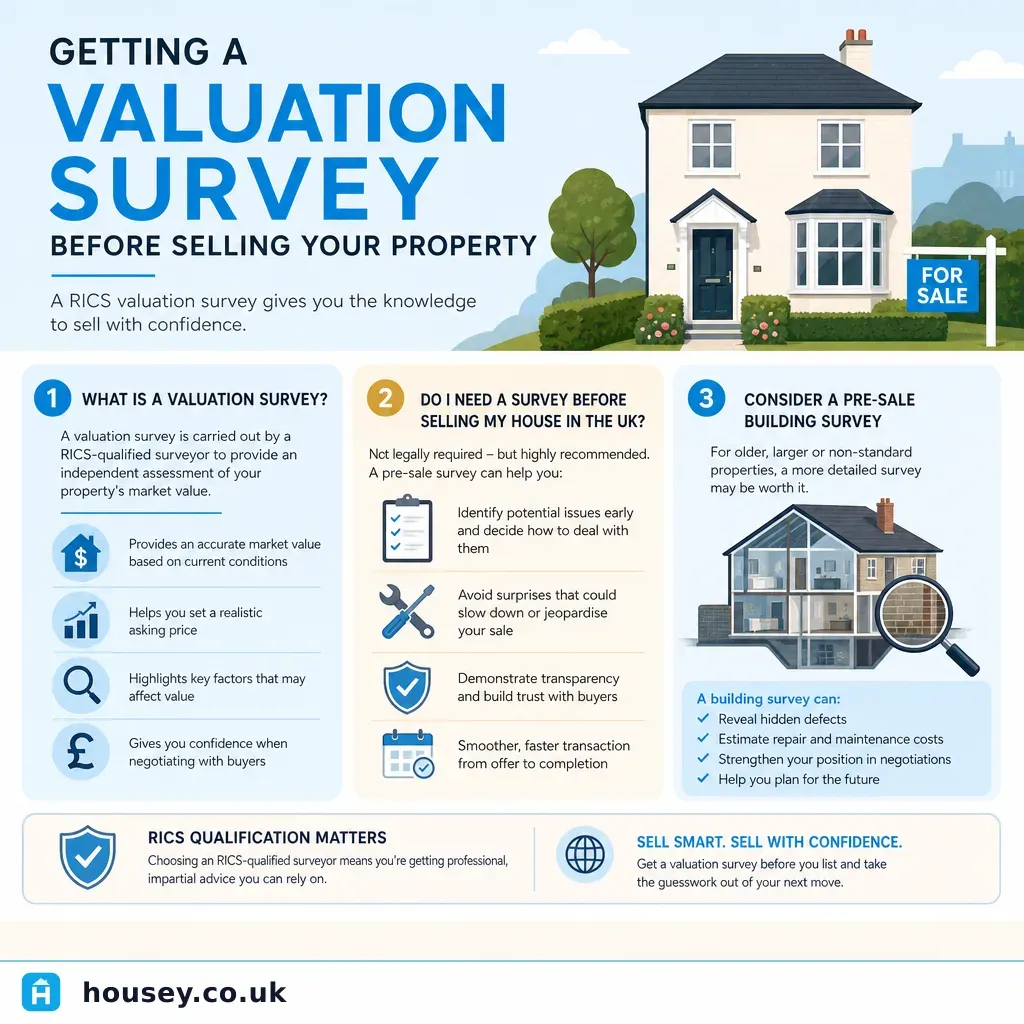
Getting a Valuation Survey Before Selling Your Property
Before selling, a free estate agent appraisal gives a market price guide, but only a RICS Red Book valuation carries formal professional standards and legal weight.