When to Commission a Home Survey During Property Purchase
By Housey · Last reviewed 12th of May 2026
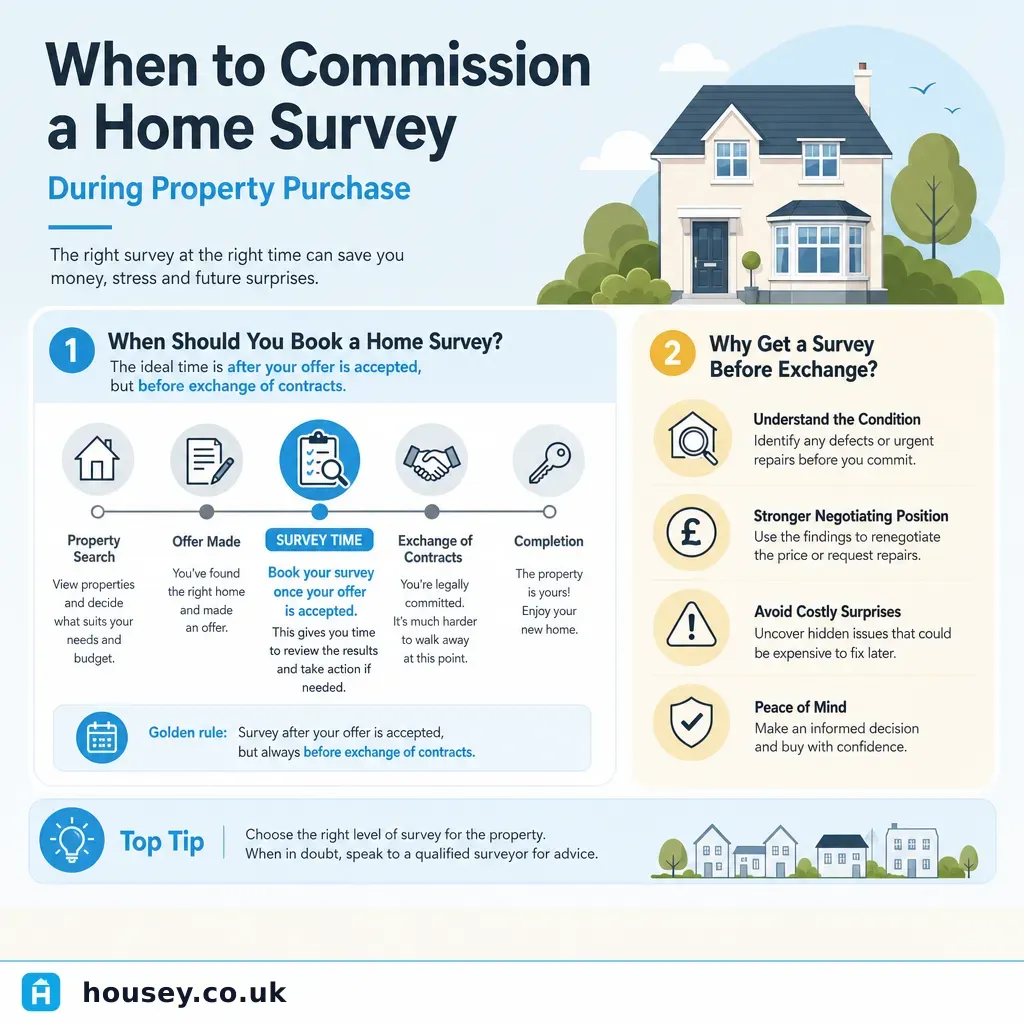
When to Commission a Home Survey During Property Purchase
The period between an accepted offer and exchange of contracts is one of the most consequential — and time-pressured — phases of buying a home in England or Wales. Commissioning a home survey at the right moment gives you the information needed to proceed with confidence, renegotiate on findings, or walk away before you are legally committed. Getting the timing wrong, or skipping a survey altogether, can mean inheriting serious defects with no recourse after completion.
Key points
- Commission a RICS home survey after your offer is accepted and before exchange of contracts — this is the only window where findings can still influence the purchase price or terms.
- A mortgage lender's valuation is not a structural survey; it assesses whether the property is adequate security for the loan, not whether it is free of defects.
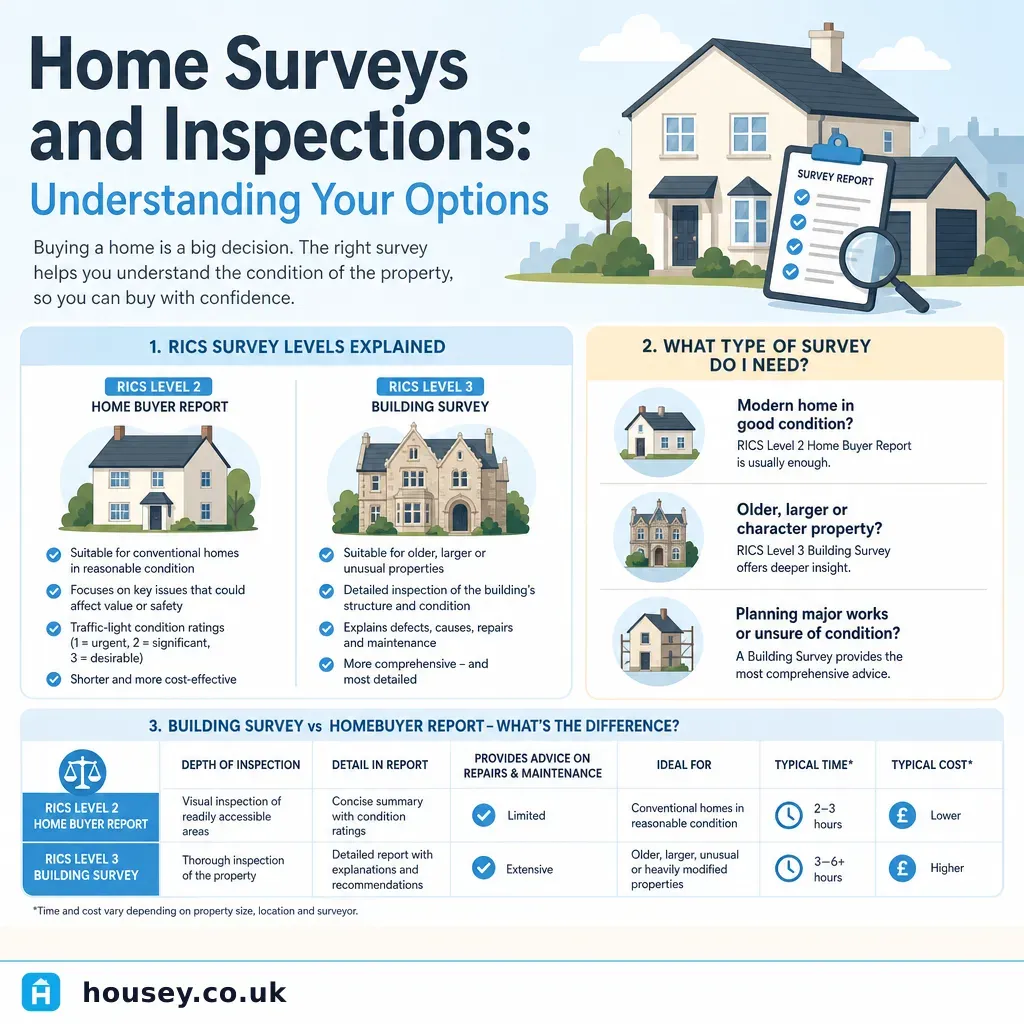
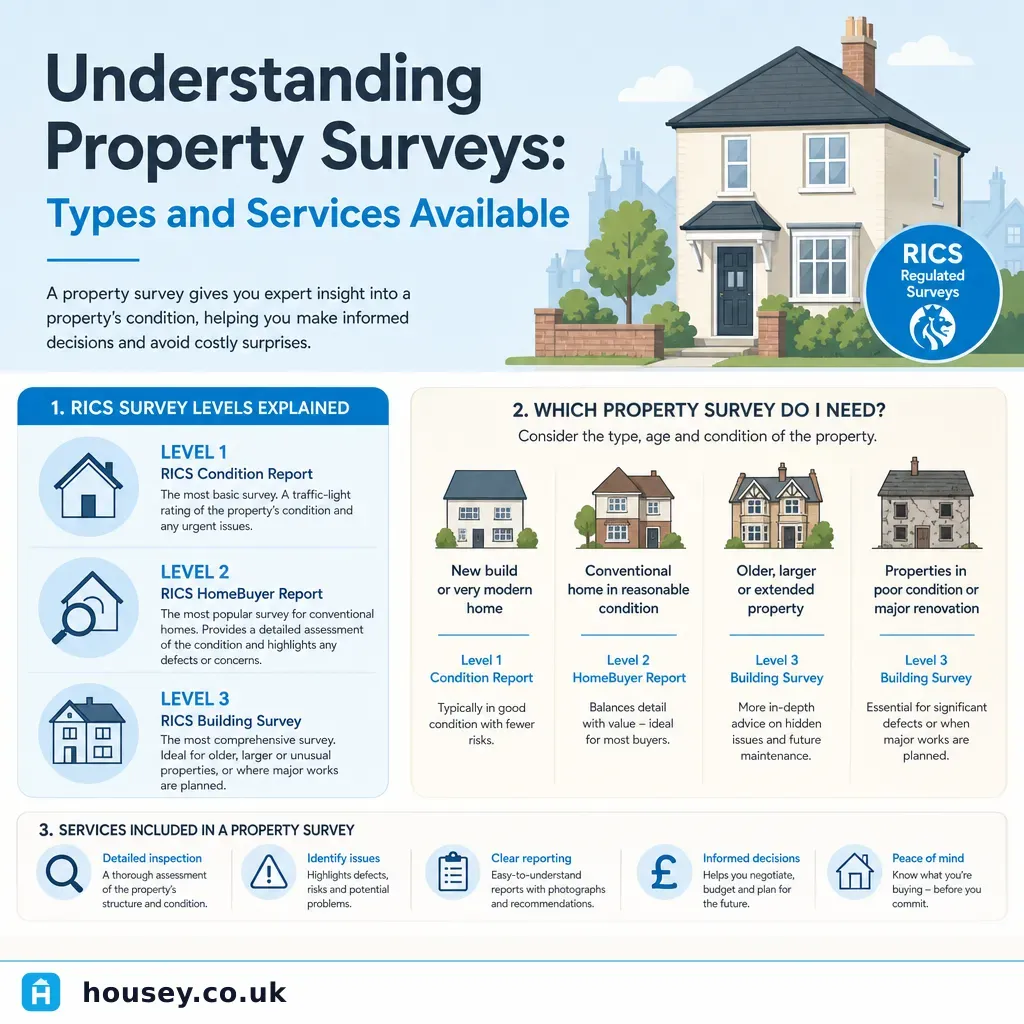
- RICS Level 2 Home Surveys suit most conventional properties in reasonable condition; RICS Level 3 Building Surveys are recommended for older, larger, altered, unusual, or visibly defective properties.
- Most RICS surveyors deliver a written report within 3–5 working days of the inspection; allow 1–2 weeks from instruction to report receipt.
- Condition rating 3 items in a survey report (defects requiring urgent attention) should trigger specialist follow-up reports before you proceed toward exchange.
When in the buying process should you book?
The standard advice from RICS and conveyancing solicitors is to instruct a survey as soon as your offer is accepted in writing. In a typical English or Welsh purchase, the conveyancing process runs for 8–12 weeks between offer and exchange, so there is usually adequate time — but delays are common and the window can close faster than buyers expect.
Do not wait until:
- Your solicitor has completed all searches.
- The mortgage offer is formally issued.
- You feel "more certain" the sale will proceed.
Each of those milestones typically arrives later in the process and narrows the time available to act on survey findings. Book within the first two weeks of acceptance wherever possible. This gives you the report before your solicitor is pushing toward exchange, and time to commission specialist follow-up reports — structural engineer, asbestos consultant, drainage CCTV — if the survey flags concerns.
In Scotland, the legal process differs: a Home Report (including a single survey and energy report) is provided by the seller before offers are invited. Buyers in Scotland should still read the Home Report carefully and may commission an independent survey for higher-risk properties.
Which survey level should you choose?
Decision tree
- Choose a RICS Level 2 Home Survey if the property is a conventional home — a 1990s estate house, modern flat, or recently renovated terrace — in broadly reasonable visible condition, and you want a clear condition assessment with cost guidance for identified defects.
- Choose a RICS Level 3 Building Survey if the property is older than approximately 1900, substantially altered or extended, of unusual construction (timber frame, thatched, converted), or if you have already noticed signs of damp, movement, or significant defects.
- Commission a specialist defect report or structural engineer's assessment if the RICS survey recommends it, or if you have already identified a specific concern such as a crack in an external wall, suspected subsidence, or active damp ingress.
- Ask your solicitor about leasehold-specific checks if buying a leasehold flat — building surveys assess the structure, but lease terms, service charge reserves, and major works liability require separate legal review.
- Consider a new-build snagging survey if purchasing a recently completed property before legal completion, in preference to a standard RICS survey.
Comparison: RICS survey levels at a glance
Survey type | Best for | Not ideal for | Typical output | Main risk if wrong choice |
|---|---|---|---|---|
RICS Level 2 Home Survey | Conventional homes post-1900 in reasonable condition | Older, unusual, or visibly defective properties | Condition ratings 1–3, cost guidance, key risks | Missing hidden defects in older or complex fabric |
RICS Level 3 Building Survey | Older, larger, altered, unusual, or defective properties | Brand-new homes (snagging survey more appropriate) | Detailed diagnosis, maintenance priorities, repair options | Rarely a reason to downgrade; overpaying for unnecessary detail is a minor risk |
Specific defect or structural report | One identified concern — crack, damp, roof failure | Whole-property due diligence | Diagnosis of the specific issue | Not a substitute for a full-property assessment |
New-build snagging survey | New-build properties before legal completion | Older or second-hand homes | Punch-list of incomplete or defective items | Missing building control or warranty issues |
Why the mortgage valuation is not enough
Many buyers — particularly first-time purchasers — assume that because their mortgage lender has carried out a valuation, the property has been professionally assessed for defects. This is a significant and costly misunderstanding.
A mortgage valuation is instructed by the lender to confirm the property represents adequate security for the loan amount. It is typically a desk-based assessment or a brief external inspection and will not identify damp, roof defects, subsidence, or the range of structural and maintenance issues commonly found in older UK homes.
RICS guidance on home surveys and GOV.UK guidance on buying a home both advise buyers to commission their own independent survey. The cost of a RICS Level 2 or Level 3 survey — typically £400–£1,500 depending on property size, type, and location — is modest relative to the potential cost of undetected defects.
Indicative UK costs, last reviewed 2026-05-12. Fees vary by surveyor, property size, and location.
What to do with survey findings
A survey report does not need to be alarming to be useful. Even a Level 2 report with amber (condition rating 2) items gives you:
- A basis for renegotiation. If the report documents significant remedial work, you may ask the seller to reduce the price or contribute to remediation costs before exchange.
- A maintenance roadmap. The report identifies items requiring attention in the short and medium term — useful for budgeting after completion.
- A trigger for specialist reports. Where the surveyor recommends a structural engineer, damp specialist, or Electrical Installation Condition Report (EICR), instruct these promptly.
- Grounds to withdraw. If findings reveal defects you cannot accept or afford to remedy, you may withdraw before exchange without financial penalty beyond costs already incurred.
When to get professional help
If the survey returns condition rating 3 items (urgent or serious defects), do not attempt to assess the severity yourself. Instruct the specialist reports your surveyor recommends before proceeding toward exchange.
Red flags that warrant immediate action:
- Any mention of suspected or confirmed structural movement, subsidence, or heave.
- Active or historic damp ingress, particularly in older solid-wall properties.
- Identification of hazardous materials including asbestos-containing materials.
- Flat or pitched roof described as at or near the end of its serviceable life.
- Electrical installation described as potentially unsafe or requiring an EICR.
- A recommendation for specialist drainage or CCTV drainage survey.
How Housey can help
Housey connects buyers with RICS-qualified surveyors across the UK. Whether you need a RICS Level 2 survey for a modern property or a more detailed RICS Level 3 survey for an older or more complex home, you can compare quotes from local surveyors through our RICS home surveys service.
Frequently asked questions
Can I get a home survey before my offer is accepted?
You can, but most buyers do not — it creates cost and logistical risk if the offer fails. Some buyers commission a pre-offer survey on competitive properties where they plan to bid without further negotiation. In Scotland, sellers must provide a Home Report before marketing, which includes a single survey and valuation.
What if the survey finds problems?
You have several options: renegotiate the price based on estimated remediation costs, ask the seller to carry out works before exchange, proceed as agreed, or withdraw your offer. Any renegotiation must happen before exchange of contracts — once you exchange, you are legally committed to the purchase.
Do I need a survey if I am a cash buyer?
You are not required to commission a survey as a cash buyer, but it is strongly advisable. Without a mortgage lender requiring a valuation, there is no independent check on the property's condition at all unless you arrange one yourself.
How long does a home survey take?
The physical inspection typically takes 2–4 hours for a RICS Level 2 survey on an average-sized property and 4–8 hours for a Level 3 on a larger or more complex home. Written reports are usually delivered within 3–5 working days of the inspection date.
Can I use the survey report to reduce the purchase price?
Survey reports are not a guaranteed basis for price reduction — sellers can decline. However, findings that document significant remedial costs give buyers a legitimate and commonly accepted basis to renegotiate before exchange of contracts.
Sources and further reading
- Buying or selling your home — GOV.UK
- RICS Home Survey Standard — RICS
- Homebuyer surveys and valuations — Citizens Advice
Useful next reads
 Surveys & Inspections
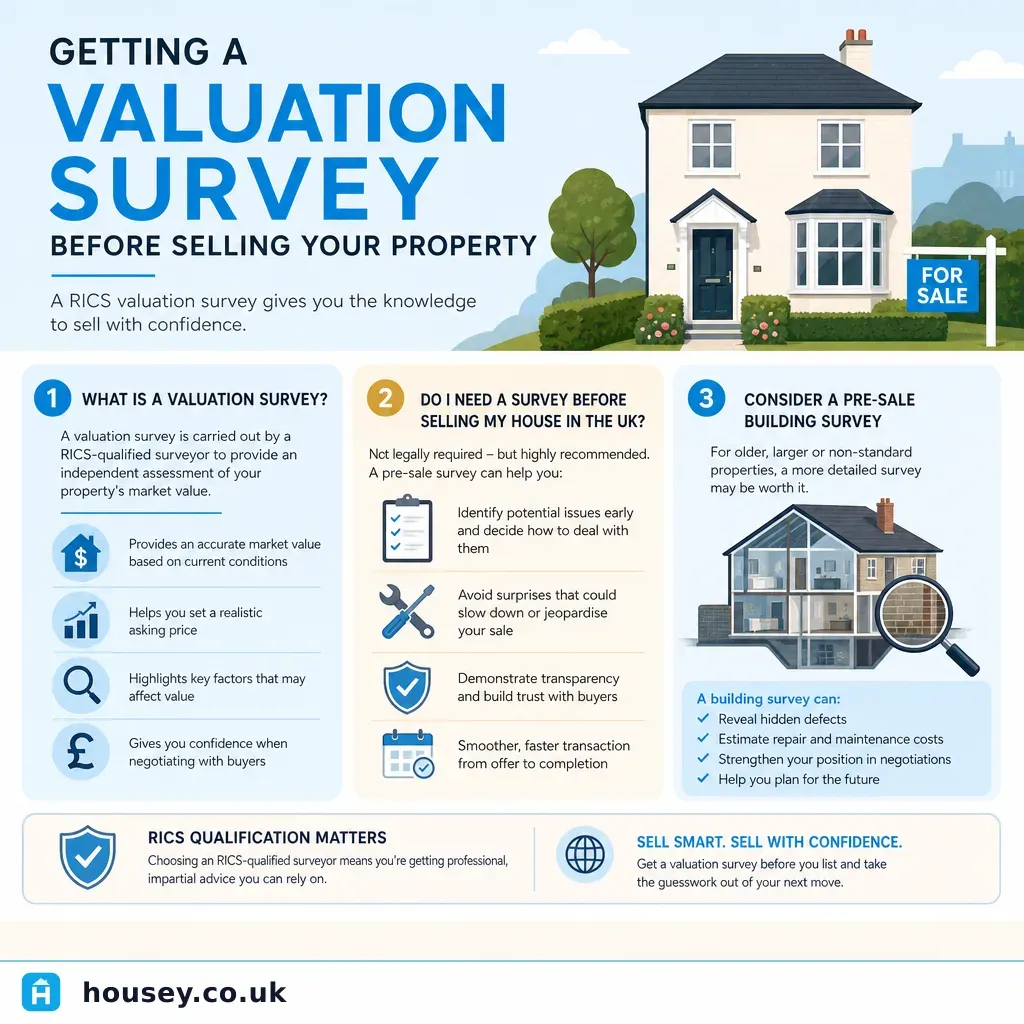
Getting a Valuation Survey Before Selling Your Property
Before selling, a free estate agent appraisal gives a market price guide, but only a RICS Red Book valuation carries formal professional standards and legal weight.
 Surveys & Inspections
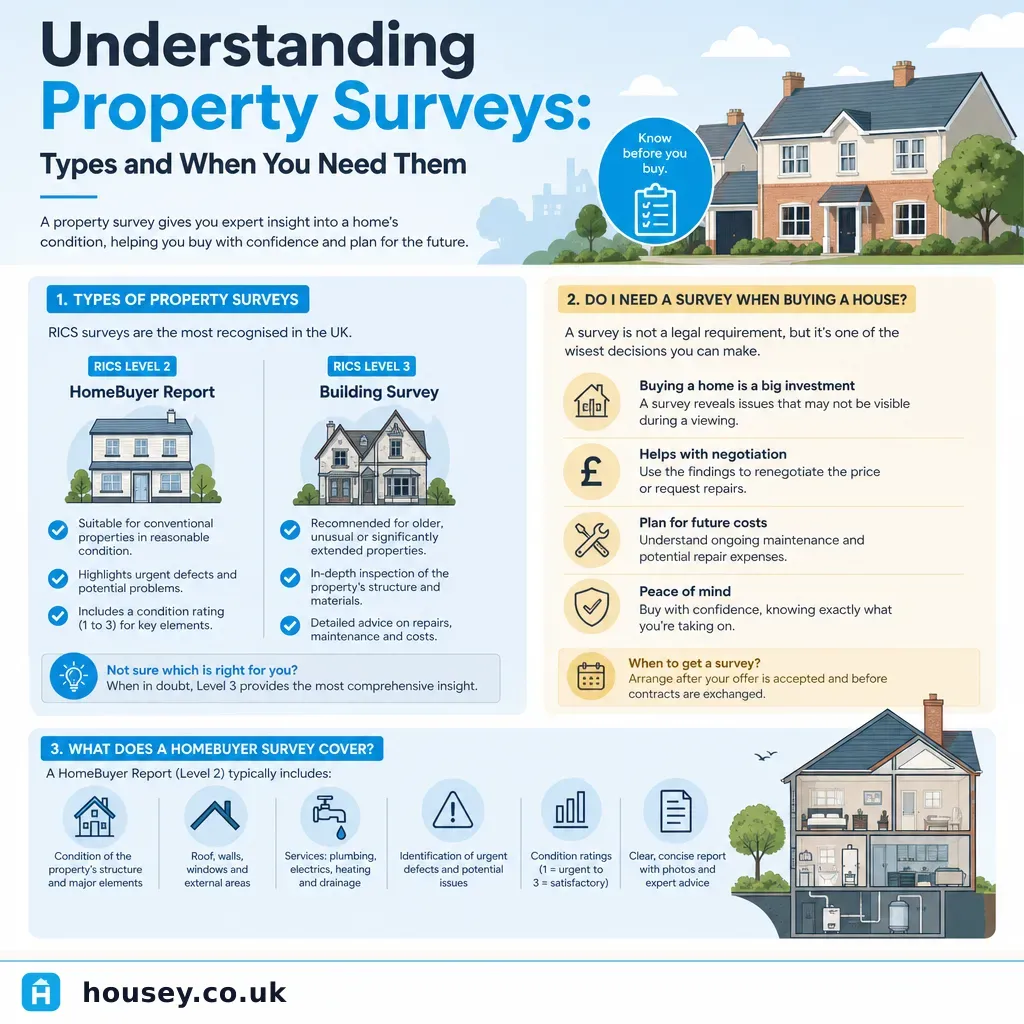
Understanding Property Surveys: Types and When You Need Them
The three main RICS survey types are the Level 1 Condition Report (for standard properties in good condition), the Level 2 Home Survey (conventional homes in reasonable condition), and the Level 3 Building Survey (older, unusual, or defective properties).
 Surveys & Inspections
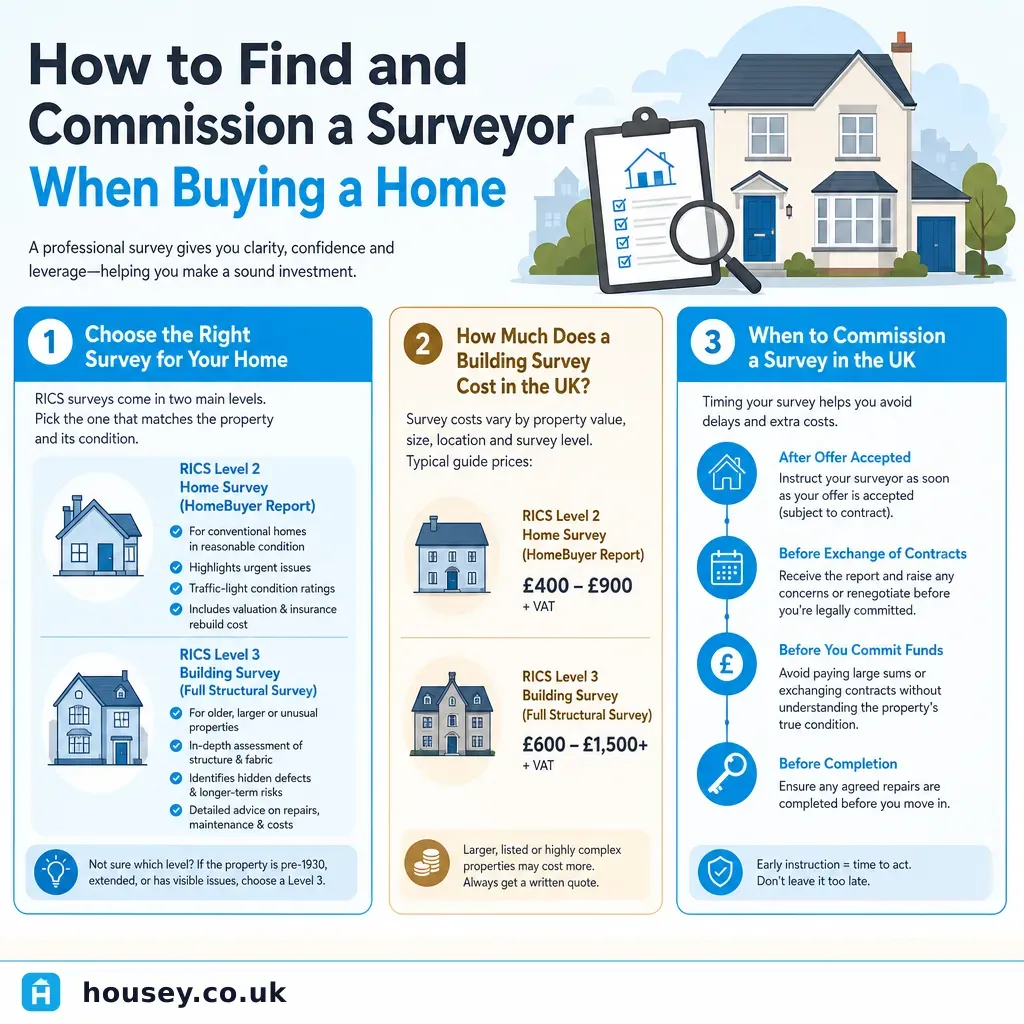
How to Find and Commission a Surveyor When Buying a Home
To commission a surveyor when buying a home, use the RICS Find a Surveyor tool to identify a regulated professional, choose between a RICS Level 2 Home Survey or Level 3 Building Survey based on the property's age and condition, and book as soon as your offer is accepted.
 Surveys & Inspections
Home Surveys and Inspections: Understanding Your Options
The three RICS home survey levels — Condition Report (Level 1), Home Survey (Level 2), and Building Survey (Level 3) — differ in depth, cost, and the properties they suit.
 Surveys & Inspections
Understanding Property Surveys: Types and Services Available
UK property surveys follow three RICS-defined levels: Level 1 (Condition Report), Level 2 (Home Survey), and Level 3 (Building Survey).