Property Survey Costs: What Buyers Need to Budget
By Housey · Last reviewed 7th of May 2026
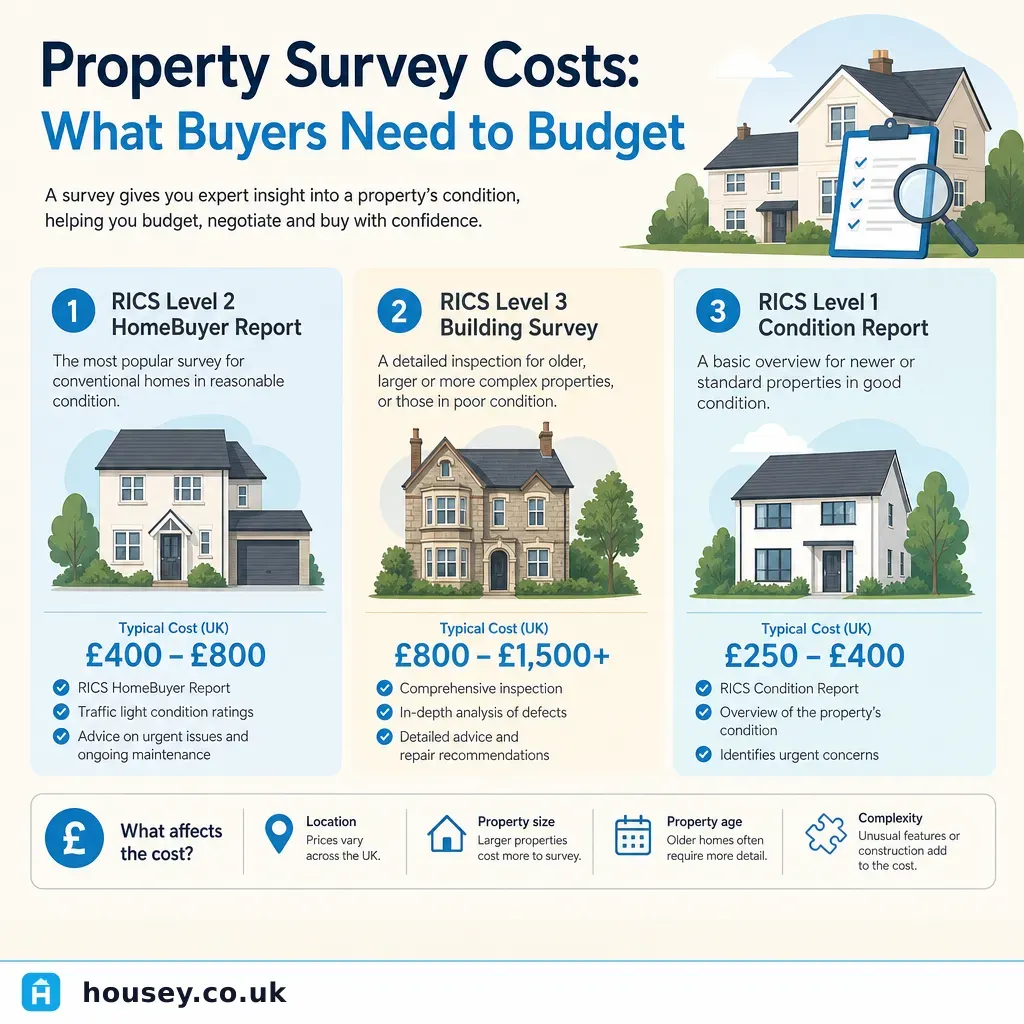
Property Survey Costs: What Buyers Need to Budget
Knowing what to budget for a property survey is one of the first financial questions many buyers face after agreeing a purchase price. The choice of survey affects not just the immediate cost but the level of detail you receive about the property's condition — and the leverage you may have to renegotiate if problems are found. Survey costs vary by inspection type, property size, age, location, and the individual surveyor's fees.
Key points
- RICS Level 1 (Condition Report) typically costs £300–£500; Level 2 (Home Survey) £400–£900; Level 3 (Building Survey) £600–£1,500 or more. Indicative UK costs, last reviewed 2026-05-07.
- A mortgage lender's valuation is not a structural survey — it confirms adequate security for the loan, not the property's condition for the buyer.
- All RICS-qualified surveyors must be registered with the Royal Institution of Chartered Surveyors; verify via the RICS Find a Surveyor directory before instructing.
- Survey fees are normally payable upfront and are non-refundable if you withdraw before completion.
- Listed buildings, pre-1919 construction, and any property with visible damp, cracks, or past alterations generally warrant a Level 3 survey regardless of price.
What affects property survey costs?
Survey fees vary considerably across the UK. The main drivers are:
- Property size: Surveyors price partly by floor area — a two-bedroom flat costs less than a five-bedroom detached house.
- Property age and construction: Older, non-standard, or unusual builds (timber-framed, thatched, concrete panel) require more inspection time and specialist knowledge.
- Location: Surveyors in London and the South East typically charge more than those in the North of England, Wales, or Scotland.
- Survey level: A Level 3 Building Survey is considerably more time-intensive than a Level 1 Condition Report.
- Additional services: Market valuations, insurance reinstatement assessments, and post-report calls are sometimes charged separately.
Always request a fixed-price quote and confirm what is — and is not — included before instructing.
RICS Level 1, 2, and 3: a cost and scope comparison
Since January 2022 RICS has operated a standardised three-tier Home Survey Standard. The table below compares levels on cost, suitability, and output.
Survey level | RICS name | Best for | Not ideal for | Indicative cost* | Key output |
|---|---|---|---|---|---|
Level 1 | Condition Report | New builds, modern conventional flats, recently renovated homes | Pre-1919 properties, visible defects, unusual construction | £300–£500 | Traffic-light condition ratings; no advice or valuation |
Level 2 | Home Survey (formerly Homebuyer Report) | Post-war conventional homes in reasonable condition | Properties with damp, cracks, or structural alterations | £400–£900 | Condition ratings, advice, optional market valuation |
Level 3 | Building Survey | Older, larger, or unusual properties; any with suspected defects | Buyers needing only a basic check on a straightforward modern home | £600–£1,500+ | Detailed defect analysis, repair cost guidance, construction advice |
*Indicative UK costs, last reviewed 2026-05-07. Quotes vary by surveyor, region, and property.
A structural engineer's report — separate from a RICS survey — may be appropriate where cracking, subsidence, or significant alterations are present. Typical cost: £400–£1,000+ depending on scope.
Is a lender's valuation enough?
A mortgage valuation is carried out for the lender's benefit. It confirms the property is worth broadly what you are paying — it does not tell you whether the roof needs replacing, whether subsidence is active, or whether damp in a corner is structural. Buyers who rely solely on a mortgage valuation risk discovering significant defects after completion, with no negotiating position and no recourse.
Some lenders offer a combined valuation and Level 2 survey. This can reduce costs slightly, but confirm the surveyor is acting in your interest, not only the lender's.
Worked example: choosing the right survey for three UK properties
Scenario A — 2010 new-build detached, South East England. Standard brick-and-block construction, no visible defects, partial NHBC warranty remaining. A Level 2 Home Survey (approx. £550–£750 in this region) is likely appropriate. Most buyers still benefit from an independent inspection even with a builder warranty in place.
Scenario B — 1930s semi-detached, East Midlands. Partially converted loft, pebble-dash render, dampness noted in the estate agent's particulars. A Level 3 (approx. £700–£950 in this region) is warranted given the age, the conversion, and the damp concern — a Level 2 may not provide sufficient detail.
Scenario C — Victorian end-of-terrace, North West England. 1890 construction, chimney stacks, hairline cracks to the front elevation, no central heating. A Level 3 (approx. £700–£1,100 in this region) is strongly warranted. Ask the surveyor specifically about chimney condition and whether there is evidence of structural movement.
These are illustrative scenarios; survey costs and appropriate level should be confirmed with a qualified RICS surveyor for your specific property.
What to ask before accepting a surveyor's quote
- What RICS survey level is included, and does it comply with the RICS Home Survey Standard?
- Is a market valuation included, or charged separately?
- Will you inspect the roof space and under-floor areas where safely accessible?
- How long will the on-site inspection take?
- When will I receive the written report?
- Are drainage, heating, or electrical systems covered, or would those require separate specialist surveys?
- What happens if you identify something requiring specialist investigation?
- Is VAT included in the quoted fee?
Red flags that may increase survey costs or scope
Some property features prompt surveyors to recommend additional specialist investigations at extra cost:
- Cracks wider than approximately 5mm, or stepped cracks through brickwork (may require a structural engineer)
- Visible damp staining or tide marks (may require a specialist damp and timber survey)
- Flat roofs or complex pitched roof structures (may require a roofer's report)
- Extensions, loft conversions, or garage conversions without visible evidence of building regulations approval
- Properties within 3 metres of a mature tree (subsidence and root damage risk)
- Suspected asbestos-containing materials in artex ceilings, floor tiles, or pipe lagging — do not disturb; arrange a licensed asbestos survey conducted by a qualified professional
Allow approximately £200–£600 per additional specialist report where required.
When to get professional help
A RICS surveyor is already the qualified professional in this context. Escalate to specialist advice if:
- The survey identifies structural movement and recommends an engineer's assessment
- The report mentions possible asbestos — do not disturb suspect materials; engage a licensed asbestos surveyor
- You are buying a listed building or property in a conservation area, where heritage specialist input may also be needed
- The surveyor recommends a CCTV drain survey — particularly relevant for older terraced houses sharing drainage runs
Do not attempt to assess structural cracks, roof conditions, or electrical installations on the basis of a general guide.
How Housey can help
Housey connects buyers with RICS-qualified surveyors across the UK. Request quotes for a RICS Level 2 survey, a RICS Level 3 survey, or browse all RICS Home Survey options. If a structural concern has been flagged, structural survey specialists are also available through the platform.
Frequently asked questions
How much does a property survey cost in the UK?
A RICS Level 1 Condition Report typically costs £300–£500, a Level 2 Home Survey £400–£900, and a Level 3 Building Survey £600–£1,500 or more. Costs vary by property size, age, location, and surveyor. Always get at least three quotes and confirm whether VAT and a market valuation are included. Indicative UK costs, last reviewed 2026-05-07.
Is a survey compulsory when buying a house?
No. Buyers in England, Wales, and Northern Ireland are not legally required to commission a survey. However, skipping one means no independent professional assessment of the property's condition before exchange. Most solicitors and mortgage brokers recommend at minimum a Level 2 survey for conventional homes.
Can I negotiate the house price after a survey?
Yes. If a survey identifies material defects, buyers commonly use the findings to renegotiate the purchase price or ask the seller to remedy issues before exchange. The written report provides documented evidence to support any renegotiation.
What is the difference between a survey and a valuation?
A mortgage valuation confirms market value for the lender — it does not inspect physical condition in detail. A survey identifies defects, risks, and repair needs for the buyer. A lender's valuation does not substitute for a buyer's survey.
Do I need a survey for a new-build property?
New builds benefit from an independent snagging inspection or a RICS Level 1 or Level 2 survey. NHBC Buildmark warranties cover structural defects for 10 years, but an independent inspection at handover documents snagging issues before you take possession.
Sources and further reading
- RICS Home Survey Standard — Royal Institution of Chartered Surveyors
- RICS Find a Surveyor directory — RICS
- Buying or selling your home — GOV.UK
- Before you buy a home — Citizens Advice
Useful next reads
 Surveys & Inspections
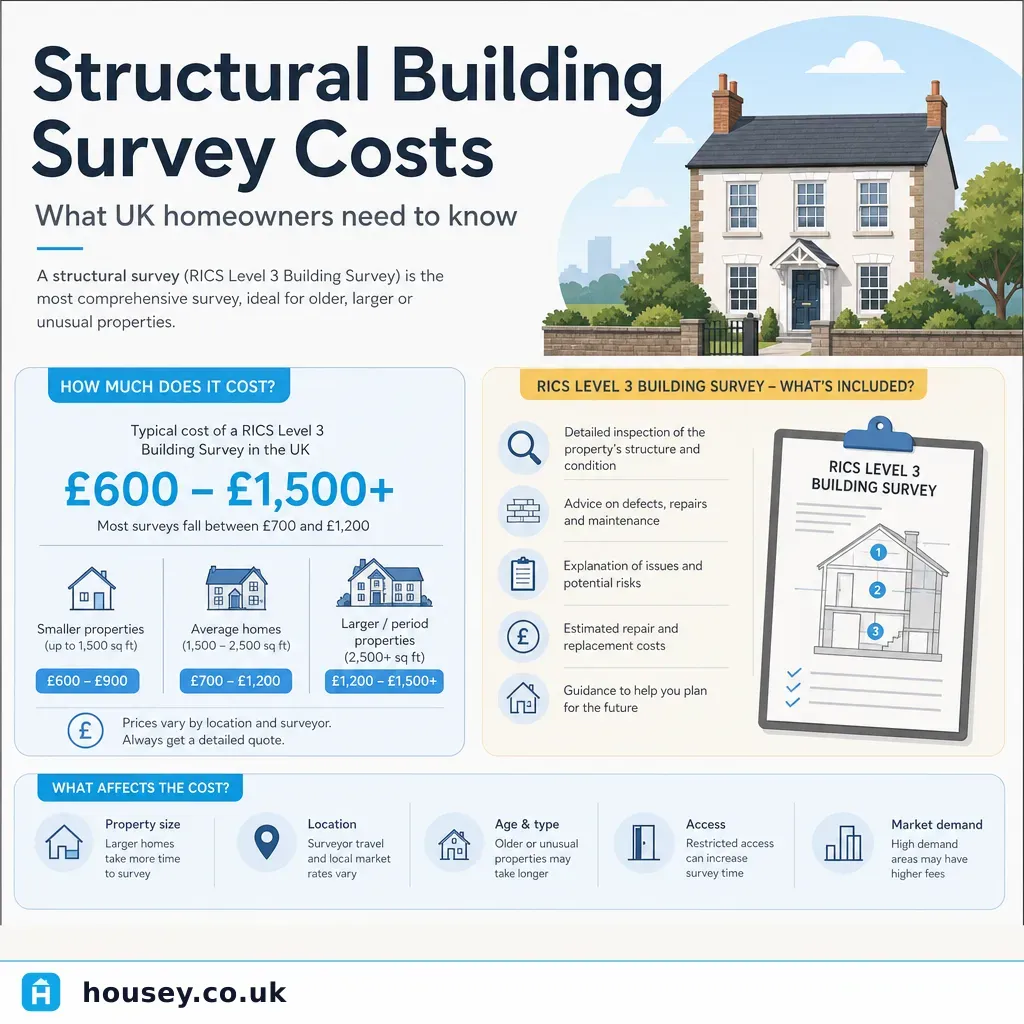
Structural Building Survey Costs
A RICS Level 3 Building Survey typically costs £500–£1,500 in the UK, depending on property size, age, and location.
 Surveys & Inspections
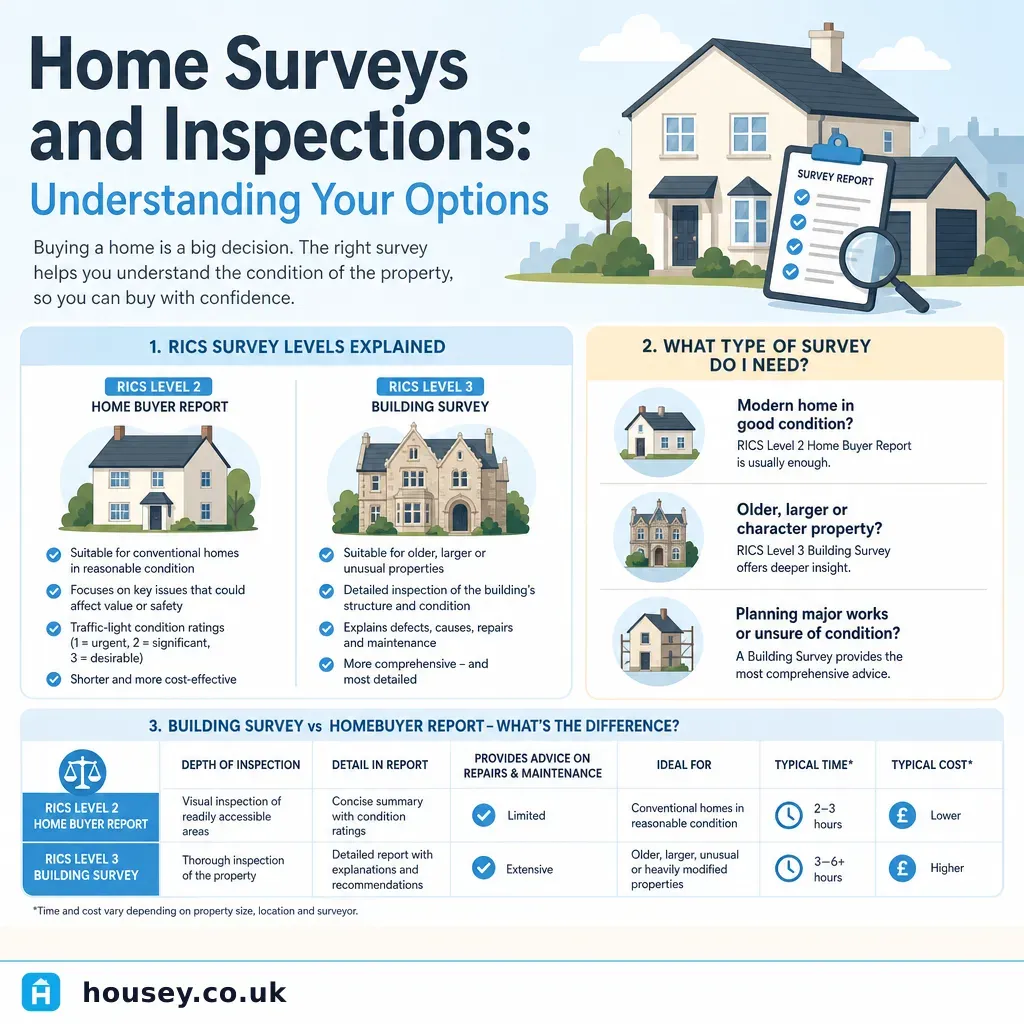
Home Surveys and Inspections: Understanding Your Options
The three RICS home survey levels — Condition Report (Level 1), Home Survey (Level 2), and Building Survey (Level 3) — differ in depth, cost, and the properties they suit.
 Surveys & Inspections
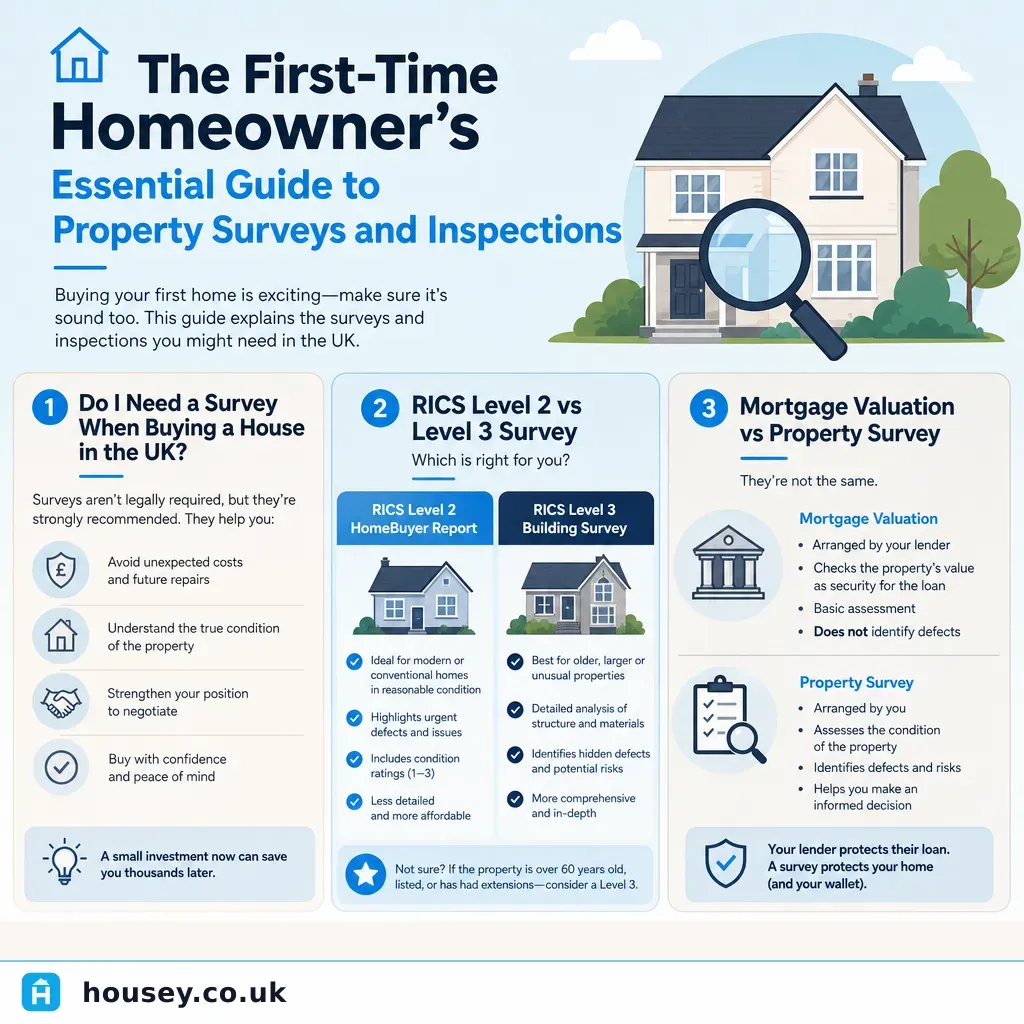
The First-Time Homeowner's Essential Guide to Property Surveys and Inspections
First-time buyers in the UK need more than the mortgage valuation — that report protects the lender, not you.
 Surveys & Inspections
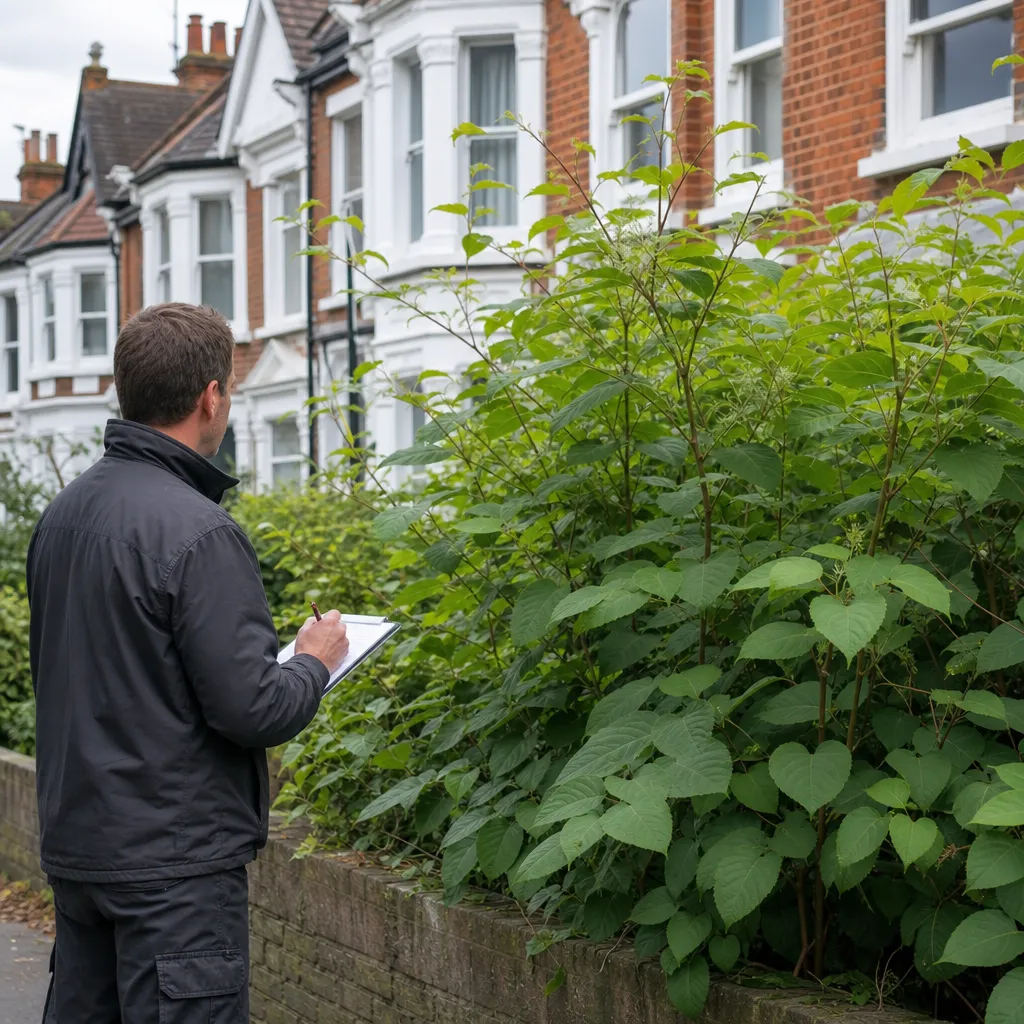
Japanese Knotweed and Property Purchase: Impact on Mortgages and Valuations
Japanese knotweed can prevent mortgage approval and reduce a property's value, especially if it is within 7 metres of a habitable structure.
 Surveys & Inspections
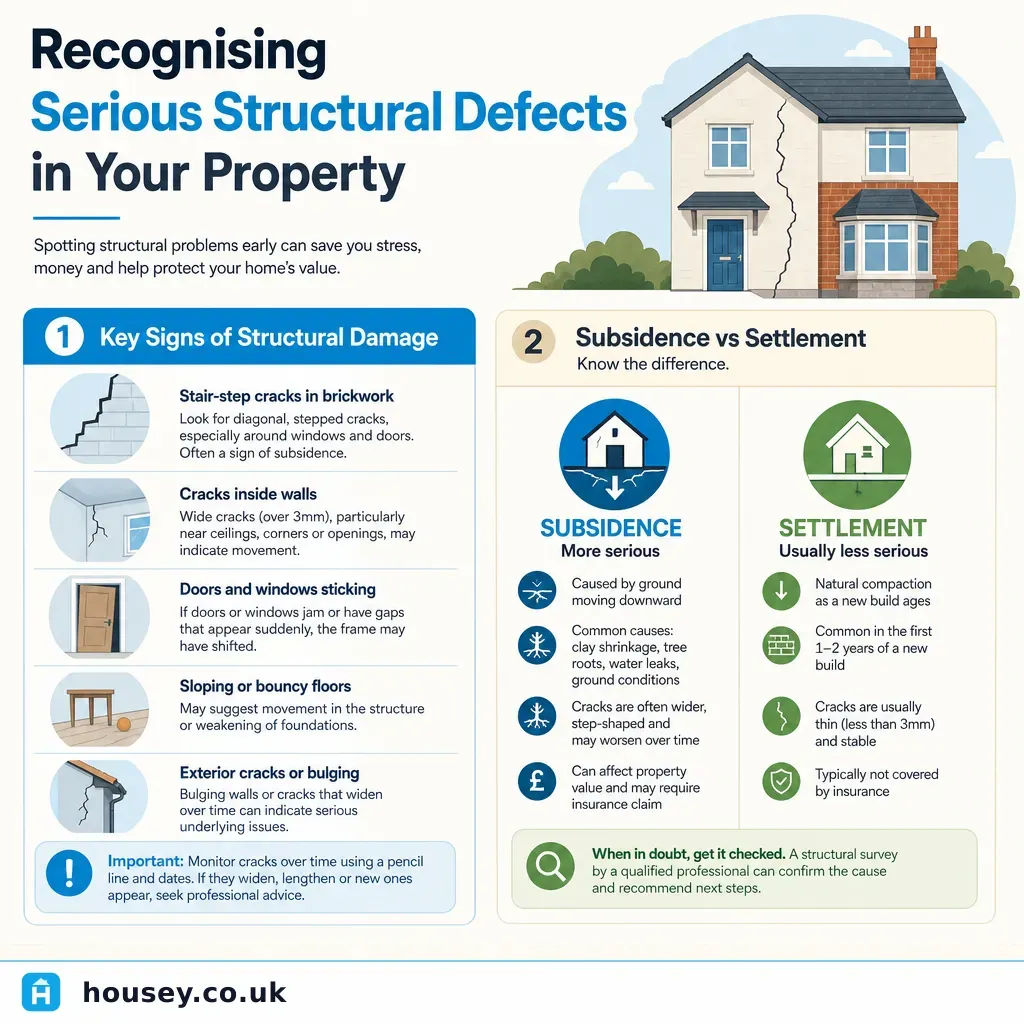
Recognising Serious Structural Defects in Your Property
Serious structural defects in UK homes include wide or diagonal cracks through brickwork, bowing or leaning walls, a sagging roof ridge, and floors or door frames notably out of level.