Home Surveys and Valuations: Who Pays?
By Housey · Last reviewed 31st of May 2026
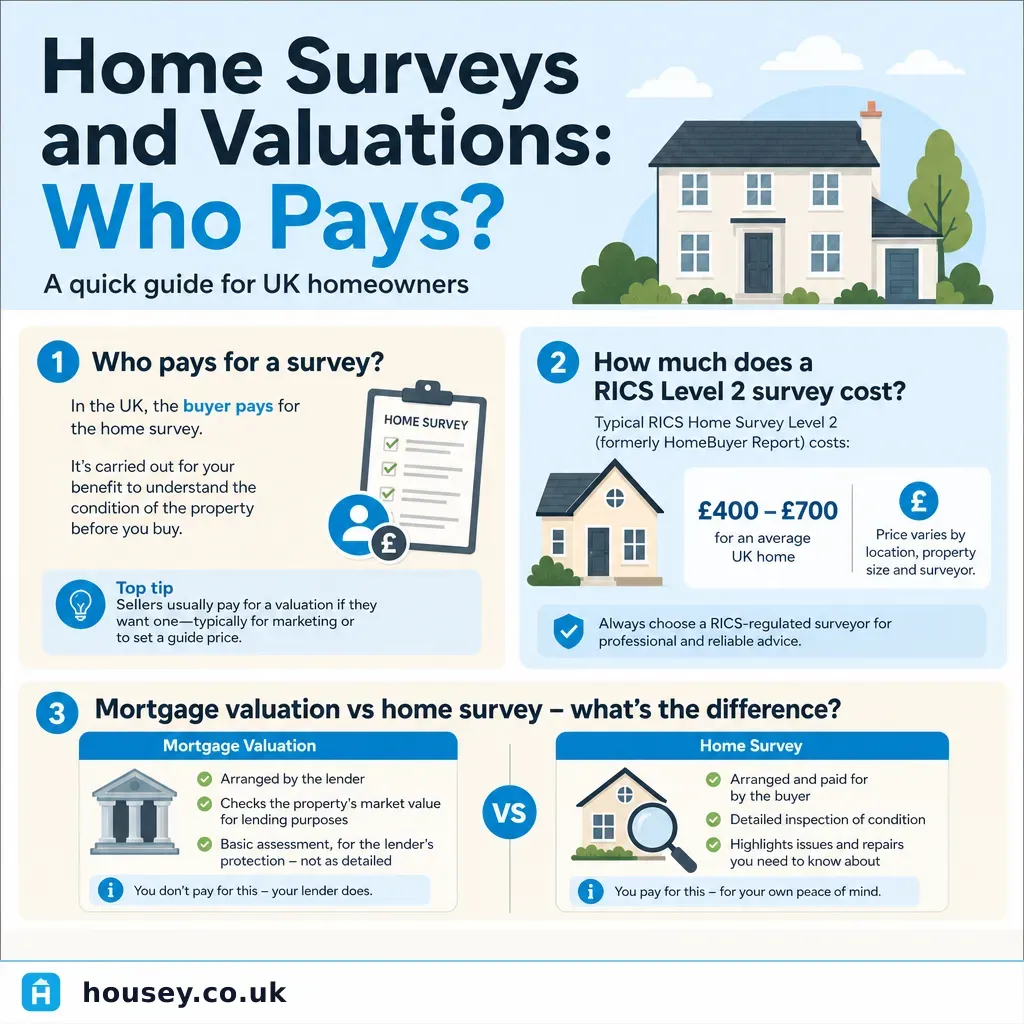
Home Surveys and Valuations: Who Pays?
Arranging a home survey is one of the most important steps a buyer can take before exchanging contracts on a property in England, Wales, or Scotland — yet confusion about who is responsible for the cost, and which type of survey to choose, is surprisingly common. Whether you are a first-time buyer weighing up survey types, or a seller considering a pre-sale report to help your transaction proceed smoothly, understanding who pays helps you budget realistically and avoids relying on an assessment that was never designed to protect your interests.
Key points
- In the UK, the buyer almost always commissions and pays for their own independent survey — the seller has no legal obligation to pay for the buyer's survey in England and Wales.
- A mortgage lender's valuation is separate from a homebuyer's survey: it protects the lender's loan, not the buyer, and does not assess the condition of the property in any meaningful detail.
- RICS surveys are classified as Level 1, Level 2, and Level 3 — the right choice depends on property age, construction type, condition, and your tolerance for risk.
- Indicative fees: RICS Level 1 £300–£500, Level 2 £400–£900, Level 3 £600–£1,500+ — costs vary by property size, location, and surveyor. (Indicative UK costs, last reviewed 2026-05-31.)
- In Scotland, sellers must commission a Home Report including a single survey and valuation before marketing under the Housing (Scotland) Act 2006 — making Scotland the main UK jurisdiction where the seller pays for a survey upfront.
Does the buyer or the seller pay for a home survey?
In England and Wales, the buyer pays. There is no legal obligation on the seller to commission a survey, and it is standard practice for buyers to arrange their own independent inspection after an offer is accepted and before exchange of contracts.
Sellers occasionally commission a pre-sale survey voluntarily — to identify defects before marketing, price the property accurately, or reduce the risk of a price renegotiation after the buyer's own survey. This is paid for by the seller but does not remove the buyer's need for independent professional assessment.
Scotland is different. Under the Housing (Scotland) Act 2006, sellers must provide a Home Report before marketing a residential property. The Home Report includes a single survey (condition inspection), an energy report, and a property questionnaire. The seller commissions and pays for it; prospective buyers receive a copy on request. Buyers in Scotland may still arrange their own additional survey if they want a more detailed assessment of condition.
What is the difference between a mortgage valuation and a survey?
Type | Who commissions it | Who pays | Purpose | Protects |
|---|---|---|---|---|
Mortgage valuation | The lender | Usually the buyer as a product or completion fee; sometimes waived | Confirms the property is adequate security for the loan amount | The lender |
RICS Level 1 survey | The buyer | The buyer | Basic condition overview for modern properties in apparent good condition | The buyer |
RICS Level 2 survey | The buyer | The buyer | Condition ratings for all accessible elements; most widely used survey | The buyer |
RICS Level 3 survey | The buyer | The buyer | Detailed inspection with defect analysis and repair advice; for older or complex properties | The buyer |
A mortgage valuation is not a survey. It typically involves a brief visit — sometimes only a desktop check using comparable sales data — to confirm the property broadly justifies the loan amount. It will not identify roof defects, concealed damp, subsidence, or structural problems in any useful detail. Relying solely on a lender's valuation has historically left buyers with significant undisclosed repair costs after completion.
Which RICS survey level should you choose?
- Choose RICS Level 1 if the property is a recently built or modern home in apparent good condition and you want a basic condition overview. This is the lightest-touch option and is most appropriate for new builds where a developer's warranty already covers workmanship.
- Choose RICS Level 2 if the property is a conventional home — typically post-1930s construction — in reasonable condition with no obvious major defects. This is the most widely used survey for standard purchases and covers condition ratings for all accessible elements.
- Choose RICS Level 3 if the property is Victorian, Edwardian, pre-1919 construction, has visible defects (cracks, damp staining, or past extensions), uses unusual or traditional construction (solid wall, stone, timber frame, thatched roof), or if you plan significant renovation or structural alterations.
- Ask a structural engineer if there is visible cracking, suspected subsidence, or specific structural concerns. A RICS Level 3 survey may flag these, but a structural engineer provides the engineering diagnosis and remediation advice needed to make an informed decision.
How much does a home survey cost?
Fees are set by individual RICS-registered surveyors and vary by location, property size, complexity, and the surveyor's experience.
Indicative UK costs, last reviewed 2026-05-31. Obtain two or three written quotes before instructing.
Survey type | Typical range | Key cost drivers |
|---|---|---|
RICS Level 1 | £300–£500 | Floor area, location |
RICS Level 2 | £400–£900 | Floor area, property age, location |
RICS Level 3 | £600–£1,500+ | Floor area, age, construction type, access requirements |
Mortgage valuation | £0–£500 (or waived) | Lender; sometimes included in product fee |
A Level 3 survey on a large Victorian property in London will typically sit toward the top of the range; a smaller 1970s semi-detached in the East Midlands will often come in considerably lower. Always confirm what is included — some surveyors include a verbal debrief as standard, others charge for it separately.
What to ask before commissioning a survey
- Is the surveyor registered with RICS? Verify via RICS Find a Surveyor.
- Will they physically inspect the roof space, subfloor void, and outbuildings?
- How long will the written report take to arrive after the inspection date?
- Does the fee include thermal imaging, damp meter readings, or a drainage check?
- If serious defects are identified, will the surveyor discuss findings by telephone before the written report is issued?
- What is explicitly excluded from the inspection — concealed services, areas behind fixed furniture, surfaces not safely accessible?
- Is VAT included in the quoted fee?
Important limitations
This article provides general information about survey types and indicative costs in England, Wales, and Scotland. Survey fees vary by surveyor, region, property type, and market conditions. The cost ranges given are indicative and based on publicly available market data; actual quotes will differ. This article does not constitute professional advice. Always commission a survey from a RICS-registered surveyor and read the scope of service carefully before instructing.
When this becomes urgent
Seek advice before proceeding if:
- You have received a mortgage valuation that flags concerns about value or property condition.
- A survey has identified structural movement, invasive plants such as Japanese knotweed, or the possible presence of asbestos-containing materials.
- You are buying a property with undisclosed alterations or extensions that lack building regulations documentation.
- The seller is unwilling to permit access for an independent survey — this is a significant red flag.
What to ask a qualified professional
Ask your RICS-registered surveyor:
- Based on this property's age, type, and what you can see from the listing, which survey level do you recommend?
- Are there specific concerns I should flag to you before the inspection — for example, a damp patch or a crack visible during viewings?
- If defects are found, what is the typical next step — a specialist report, price renegotiation, or withdrawal from the purchase?
- Can you confirm in writing what is and is not included within your scope of inspection?
When to get professional help
Always commission an independent survey before exchanging contracts on a second-hand residential property. If the survey identifies serious defects — particularly structural movement, drainage failure, invasive plants, or significant damp — instruct a relevant specialist (structural engineer, drainage surveyor, arboriculturalist, or damp specialist) for a detailed assessment before committing to proceed.
A solicitor or licensed conveyancer should handle the legal aspects of your purchase alongside — not instead of — an independent survey.
How Housey can help
Housey connects buyers with RICS-registered surveyors for RICS Home Surveys, including Level 1, Level 2, and Level 3 surveys. Compare written quotes from qualified surveyors in your area before booking your inspection.
Frequently asked questions
Can I use the lender's mortgage valuation instead of a survey?
A mortgage valuation is designed to protect the lender, not the buyer. It does not assess the condition of the property in any meaningful detail. You should always commission your own RICS survey before exchange, particularly for older, larger, or visibly defective properties. The cost of a survey is small relative to the cost of undiscovered defects after completion.
Is a RICS Level 2 survey enough for a Victorian terrace?
A Level 2 can be used for Victorian properties, but many surveyors recommend Level 3 for pre-1919 construction given the greater risk of hidden defects, original building materials, and subsequent alterations. Discuss the specific property — its age, visible condition, and any concerns you noted during viewings — with your surveyor before deciding.
Do I need a survey on a new-build property?
New-build properties come with a developer's warranty (typically NHBC Buildmark or equivalent), but this does not replace independent inspection. A snagging survey — a detailed check of workmanship and finishes — is often commissioned before legal completion or during the initial warranty period to identify items the developer must rectify.
How long does a home survey take?
A RICS Level 2 survey of a typical three-bedroom semi-detached home usually takes two to four hours on site. A Level 3 survey of a larger or more complex property may take a full day. Written reports are typically delivered within two to five working days of the inspection date.
Sources and further reading
- RICS Home Surveys — RICS
- Buying or selling a home — GOV.UK
- Housing (Scotland) Act 2006 — legislation.gov.uk
- Getting a survey when buying a home — Citizens Advice
Useful next reads
 Surveys & Inspections
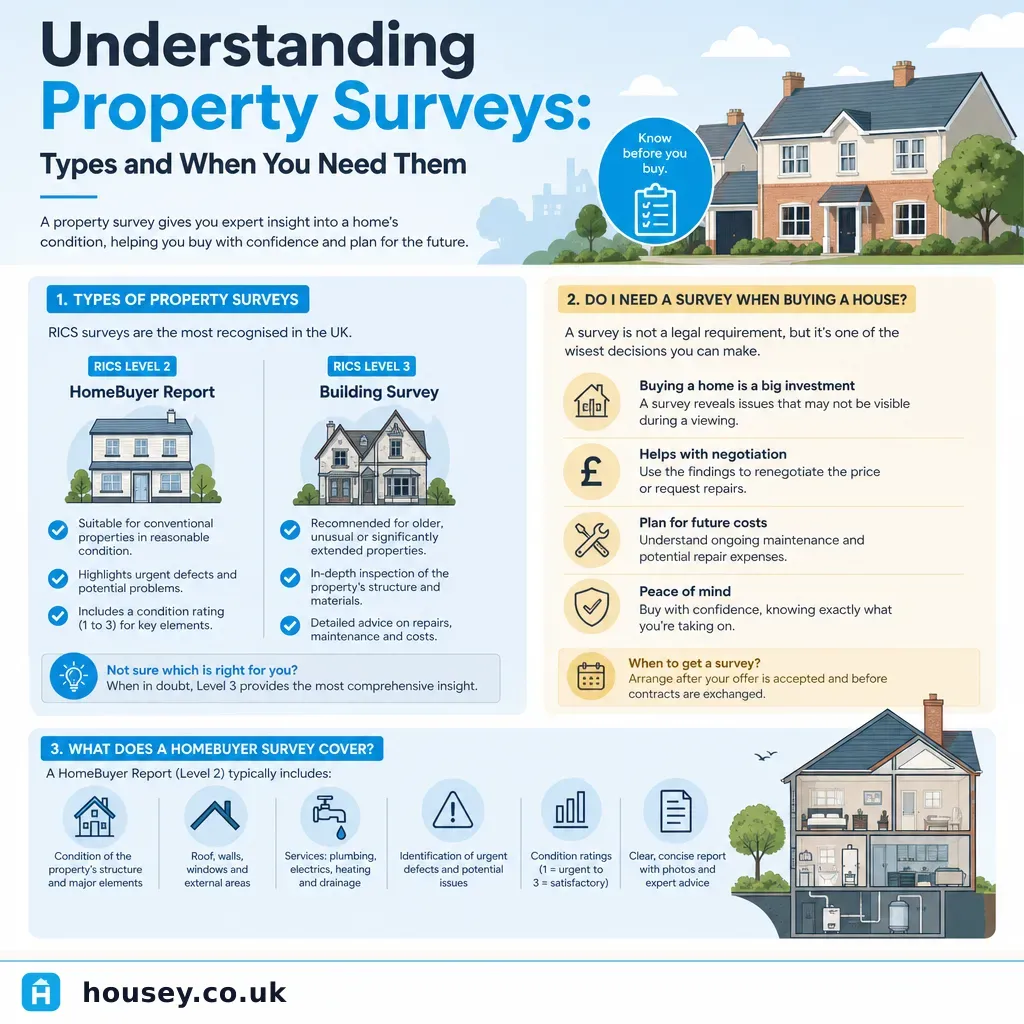
Understanding Property Surveys: Types and When You Need Them
The three main RICS survey types are the Level 1 Condition Report (for standard properties in good condition), the Level 2 Home Survey (conventional homes in reasonable condition), and the Level 3 Building Survey (older, unusual, or defective properties).
 Surveys & Inspections
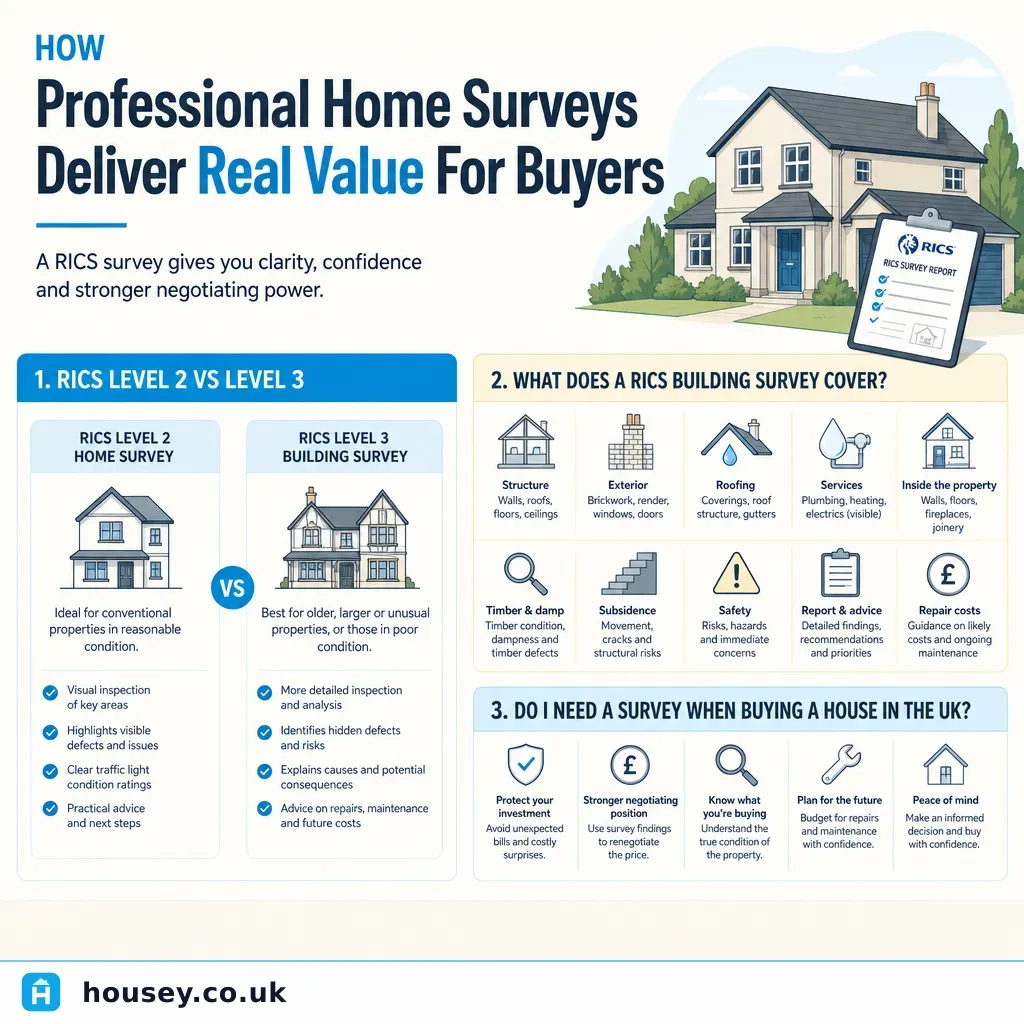
How Professional Home Surveys Deliver Real Value For Buyers
A professional home survey by a RICS-registered surveyor can identify defects, legal compliance gaps, and cost liabilities before exchange of contracts, giving buyers an evidence base for negotiation or withdrawal.
 Surveys & Inspections
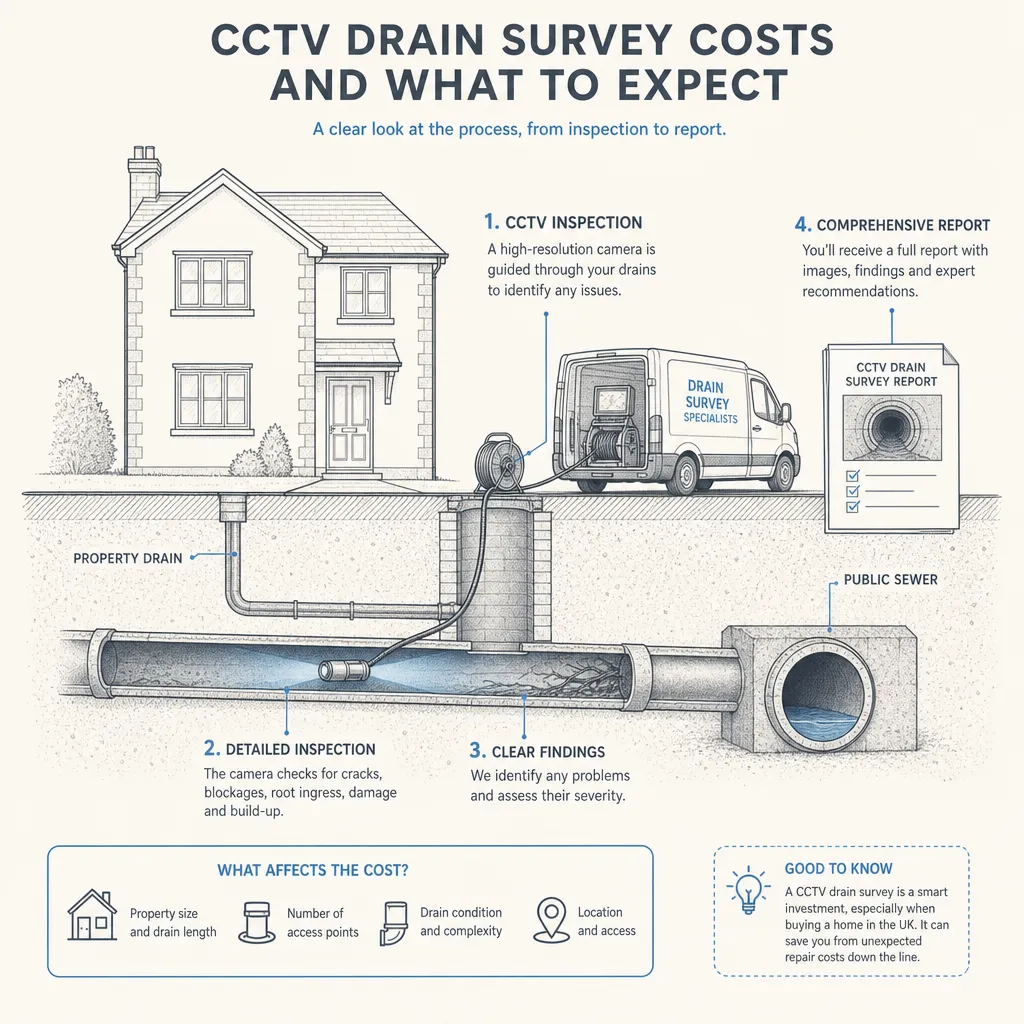
CCTV Drain Survey Costs and What to Expect
A CCTV drain survey in the UK typically costs between £150 and £400 for a standard residential survey covering one or two drainage runs.
 Surveys & Inspections
Structural Building Survey Costs
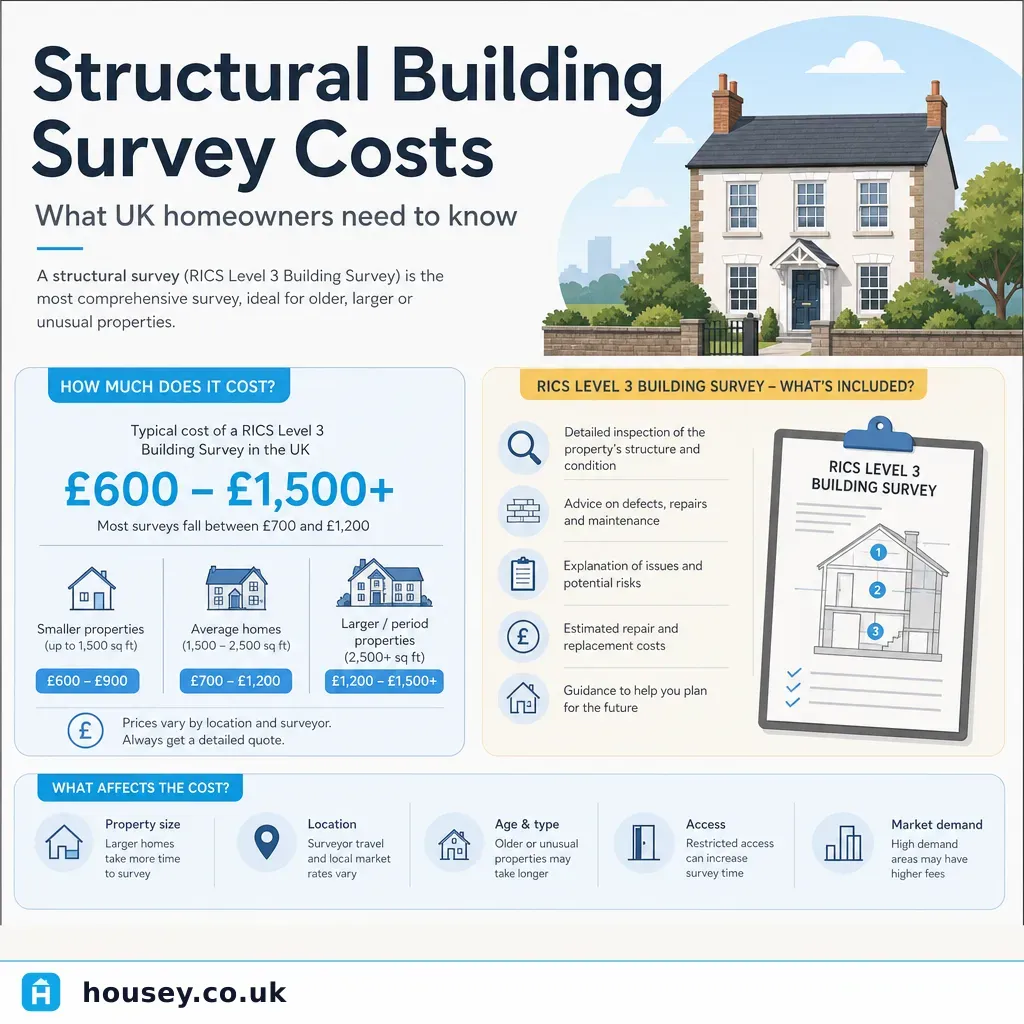
A RICS Level 3 Building Survey typically costs £500–£1,500 in the UK, depending on property size, age, and location.
 Surveys & Inspections
Land Surveys and Boundary Measurement: Who Pays
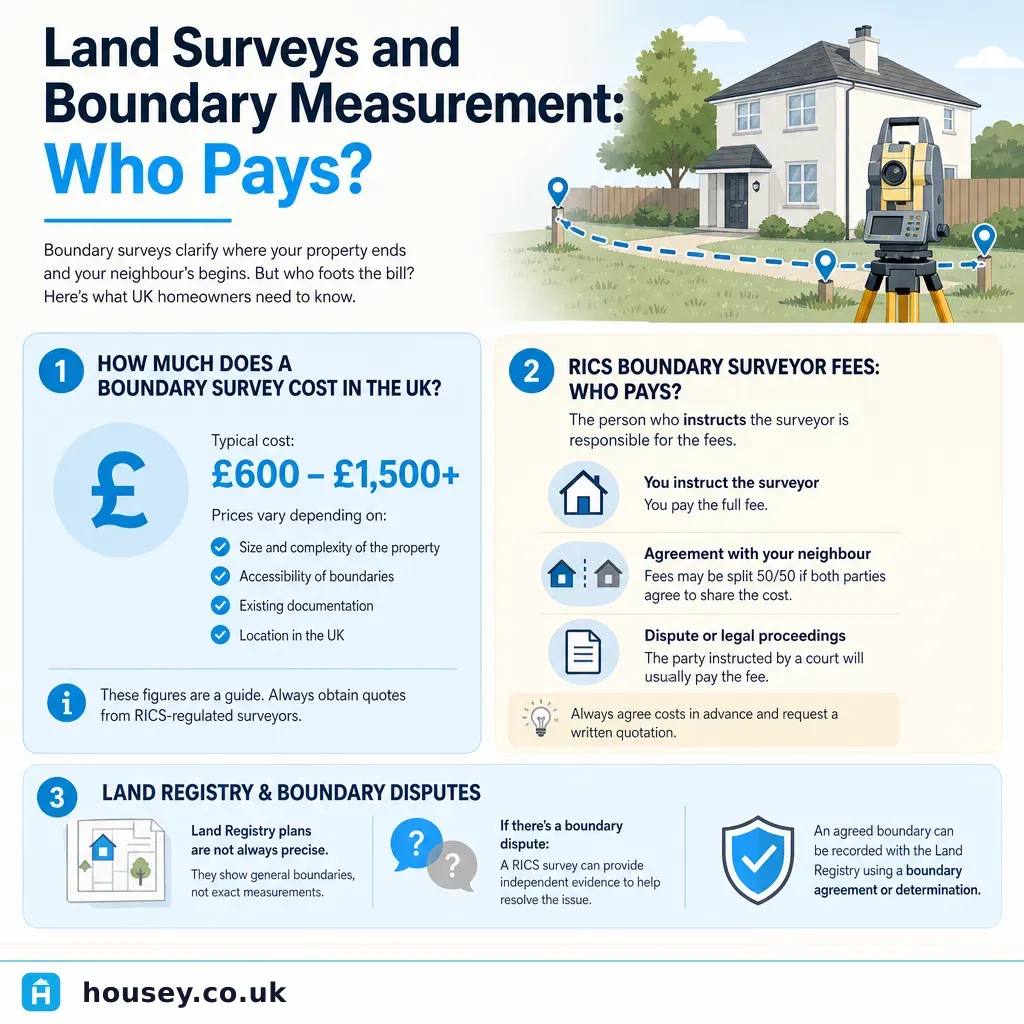
There is no statutory rule in England and Wales that determines who pays for a boundary or land survey.