Home Wind Turbine Installation: Costs and Feasibility
By Housey · Last reviewed 30th of May 2026
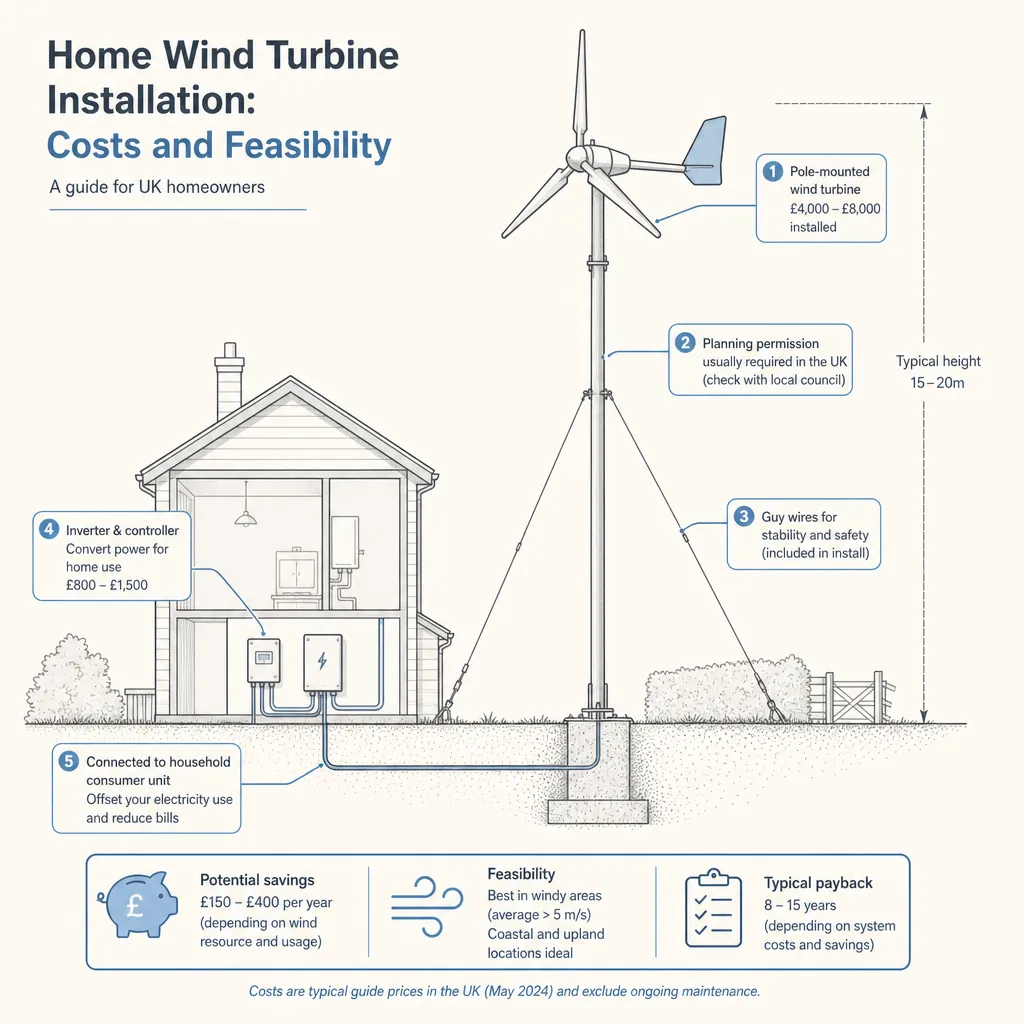
Home Wind Turbine Installation: Costs and Feasibility
Interest in domestic wind turbines has grown alongside broader awareness of renewable energy options, but home wind generation remains far more site-dependent than solar PV. The output of a domestic wind turbine is determined almost entirely by average wind speed at the installation point — and many UK properties, particularly those in urban or suburban settings, do not receive enough consistent wind to make the investment financially viable. A proper site assessment should precede any purchase decision.
Key points
- The Energy Saving Trust recommends a minimum average wind speed of 5–6 metres per second at the turbine's hub height for a domestic installation to be cost-effective.
- A pole-mounted domestic wind turbine (2.5–6kW) typically costs £15,000–£25,000 installed; roof-mounted micro-turbines (0.5–2kW) cost approximately £2,000–£5,000 but generate significantly less electricity (Indicative UK costs, last reviewed 2026-05-30).
- Most domestic wind turbines in England can proceed under Permitted Development Rights under the Town and Country Planning (General Permitted Development) (England) Order 2015, but prior approval from the local planning authority is still required; listed buildings, conservation areas, and AONBs are excluded.
- The Smart Export Guarantee (SEG), administered by Ofgem, allows homeowners with MCS-certified installations to be paid for surplus electricity exported to the grid.
- Distribution Network Operators (DNOs) must be notified for any generation system above 3.68kW on a single-phase connection; this process can take several months and may add substantial cost.
Pole-mounted vs roof-mounted turbines
The two main configurations differ substantially in output, cost, planning implications, and suitability for most UK properties.
Feature | Pole-mounted turbine | Roof-mounted (building-integrated) turbine |
|---|---|---|
Typical capacity | 2.5–6kW | 0.5–2kW |
Typical installed cost | £15,000–£25,000 | £2,000–£5,000 |
Wind resource quality | Better — positioned above building-induced turbulence | Poorer — buildings create turbulence that reduces output |
Structural requirements | Deep foundation and adequate land area required | May cause vibration and structural loading on the roof |
Planning (typical) | Usually Permitted Development with prior approval | More complex; often requires full planning application |
Best for | Rural properties with open land and consistent wind | Rarely cost-effective for most UK properties |
MCS certification | Widely available for this class | Fewer accredited products available |
Indicative UK costs, last reviewed 2026-05-30.
Is your site suitable? A feasibility checklist
Wind resource is the single biggest determinant of financial viability. Before requesting quotes:
Planning permission and Permitted Development
In England, domestic wind turbines may proceed under Permitted Development Rights as set out in the Town and Country Planning (General Permitted Development) (England) Order 2015, Schedule 2, Part 14. Key conditions include:
- Only one wind turbine may be installed per property.
- The turbine must generally be freestanding (pole-mounted) to benefit from the householder Permitted Development route.
- Prior approval from the local planning authority (LPA) must be obtained before installation — this involves submitting details for the LPA to assess, even though it is not a full planning application.
- Mast height limits apply and vary by situation; always confirm the specific conditions with your LPA.
- Listed buildings, properties in conservation areas, AONBs, Sites of Special Scientific Interest, and National Parks are excluded from Permitted Development for wind turbines and require a full planning application.
Scotland, Wales, and Northern Ireland each operate their own planning systems with different rules. Even within England, requirements can vary between local planning authorities — always confirm your specific position with your own LPA before committing.
Smart Export Guarantee and financial returns
The Smart Export Guarantee (SEG), administered by Ofgem, requires licensed energy suppliers with 150,000 or more domestic customers to offer an export tariff to eligible small-scale generators. Key points:
- Installations must be MCS-certified (both installer and equipment) to qualify for SEG payments.
- SEG tariff rates are set individually by each supplier and vary considerably — compare current tariffs via the Ofgem SEG register or the Energy Saving Trust.
- There are no dedicated UK government grant schemes specifically for domestic wind turbines as of 2026-05-30; however, some green finance products may be accessible for MCS-certified installations. Check with your lender and the Energy Saving Trust for the current position.
Important limitations
This article provides general information only. The financial viability of a domestic wind turbine is highly site-specific and cannot be determined without a proper wind resource assessment at your property. Planning requirements vary by local planning authority, property type, and designation. Financial returns depend on actual wind speeds, electricity prices, SEG tariff rates, and ongoing maintenance costs — all of which change over time. A qualified MCS-certified installer, and where planning is uncertain a planning consultant, should assess your specific situation before any expenditure is committed.
What to ask a qualified professional
Before instructing an MCS-certified installer, ask:
- What is the estimated annual energy yield (kWh) for my specific site, and what wind speed data and methodology underpin that estimate?
- What is the realistic payback period based on current electricity prices and available SEG tariff rates?
- What planning process applies to my property, and will you manage the prior approval or full planning application as part of the contract?
- What foundation or groundwork is required, and is this included in your quoted price?
- What DNO connection notification or application is required, what does this cost, and how long does it typically take?
- What maintenance schedule does this turbine require, and what are the typical annual maintenance costs over its design life?
- Does the 0% VAT rate on energy-saving materials apply to this installation, or is standard-rate VAT charged?
When to get professional help
Seek professional advice before proceeding if any of the following apply:
- You are unsure about average wind speeds at your site — a professional wind resource assessment is significantly more reliable than postcode-level online tools.
- The property is listed or in a designated area (conservation area, AONB, National Park) — planning refusal after paying for a site assessment would represent significant wasted expenditure.
- A grid connection upgrade may be needed — DNO assessments can take months and add substantial cost that should be modelled before any purchase decision.
- You are considering a roof-mounted turbine — vibration and structural loading should be assessed by a structural engineer before any installation proceeds.
- You are weighing wind generation against additional solar PV — an independent energy assessor can model both scenarios and provide an objective comparison for your property.
Pairing a wind turbine with battery storage can improve self-consumption of generated electricity. Housey's battery storage installers can advise on compatible systems and help model whole-system returns for your property.
How Housey can help
Housey can connect you with MCS-certified renewable energy installers who provide site-specific feasibility assessments and transparent, comparable quotes. For homeowners wanting to maximise self-consumption of any wind-generated electricity, our battery storage installers can advise on pairing a wind turbine with appropriate battery storage as part of a whole-home energy strategy.
Frequently asked questions
Do I need planning permission for a home wind turbine in the UK?
Most pole-mounted domestic wind turbines in England can proceed under Permitted Development Rights, but prior approval from the local planning authority is still required before installation. Properties in conservation areas, AONBs, or those that are listed require full planning permission. Scotland, Wales, and Northern Ireland have separate planning frameworks. Always confirm the position with your local planning authority before beginning any work.
How much electricity can a home wind turbine generate?
A well-sited 6kW pole-mounted turbine at a rural location with average wind speeds of around 6 m/s might generate 10,000–15,000 kWh per year — a significant share of average UK household consumption of roughly 2,700 kWh per year. Output at poorly sited or urban locations may be a fraction of this. Always obtain a site-specific yield estimate from an MCS-certified installer before making financial projections.
Are there grants for home wind turbines in the UK?
There are no dedicated UK government grant schemes for domestic wind turbines as of 2026-05-30. MCS-certified installations do qualify for the Smart Export Guarantee, allowing payment for surplus electricity exported to the grid. Some green finance products may also be accessible. Check the Energy Saving Trust and Ofgem websites for the most current information on available support.
How long does a domestic wind turbine last?
Most pole-mounted wind turbines have a design life of 20–25 years. Key components such as the main bearing and rotor blades typically require inspection and may need replacement around the 10-year mark. Maintenance costs should be included in any financial model alongside the installation cost and expected annual energy yield.
Sources and further reading
- Wind turbines — costs, savings and planning — Energy Saving Trust
- Smart Export Guarantee (SEG) — Ofgem
- Planning permission for wind turbines — GOV.UK
- Town and Country Planning (General Permitted Development) (England) Order 2015 — legislation.gov.uk
- Find an MCS certified installer — Microgeneration Certification Scheme
- Working at height regulations — Health and Safety Executive
Useful next reads
 Energy & Retrofit
Understanding the costs of installing wind turbines on residential property
A roof-mounted domestic wind turbine in the UK costs around £2,000–£4,000 installed; a free-standing pole-mounted turbine suitable for a rural residential plot typically costs £15,000–£30,000 or more.
 Energy & Retrofit
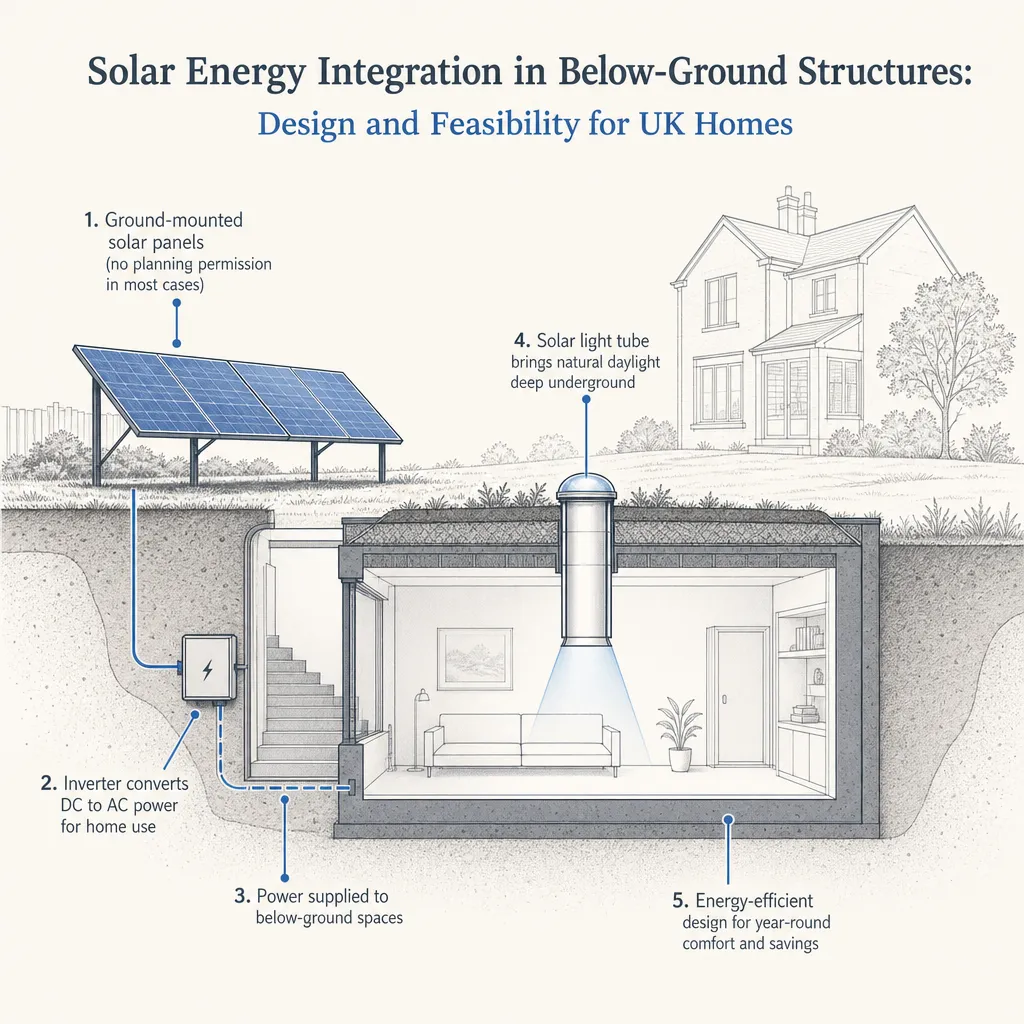
Solar Energy Integration in Below-Ground Structures: Design and Feasibility
Below-ground structures cannot host solar panels on their own roofs but can use surface-mounted panels connected via cable runs, solar light tubes for daylighting, and battery storage.
 Energy & Retrofit
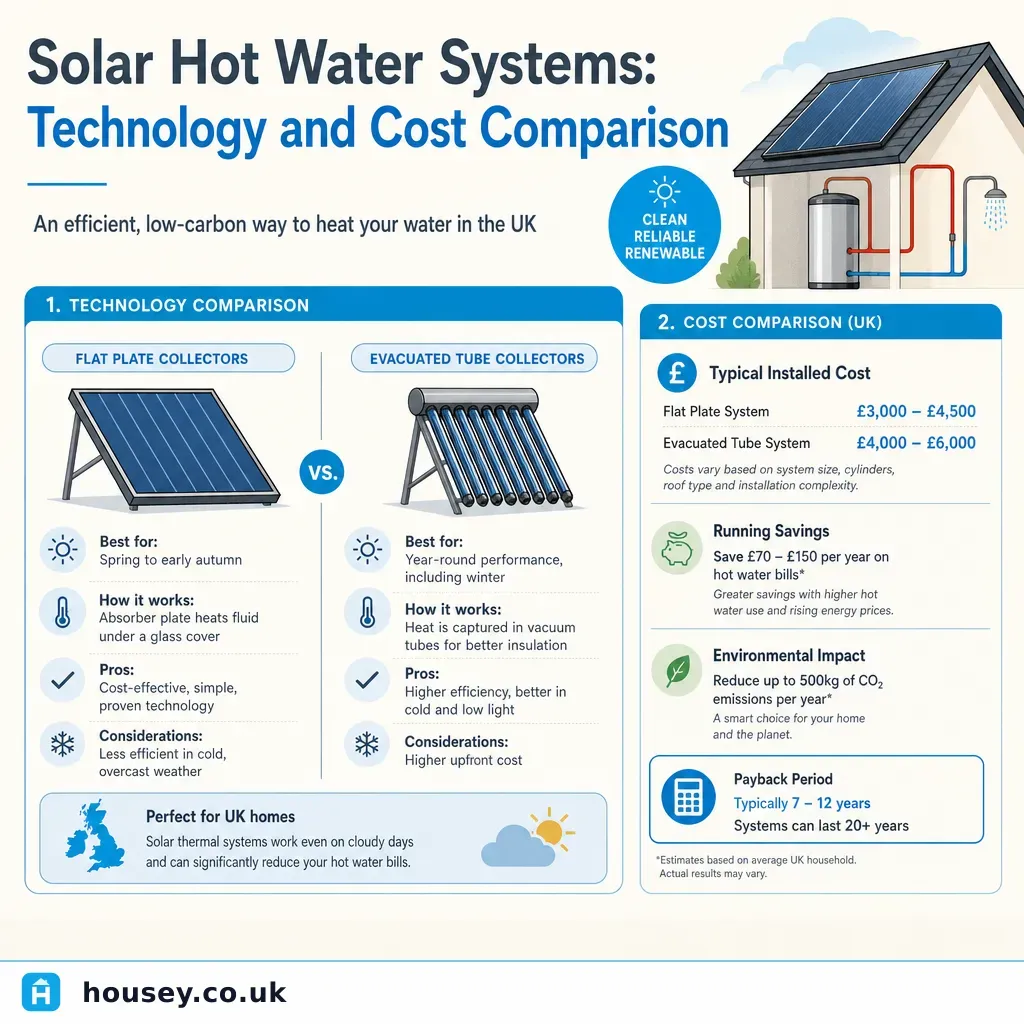
Solar Hot Water Systems: Technology and Cost Comparison
Solar thermal systems use roof-mounted collectors to heat domestic hot water via a glycol circuit and twin-coil cylinder.
 Energy & Retrofit
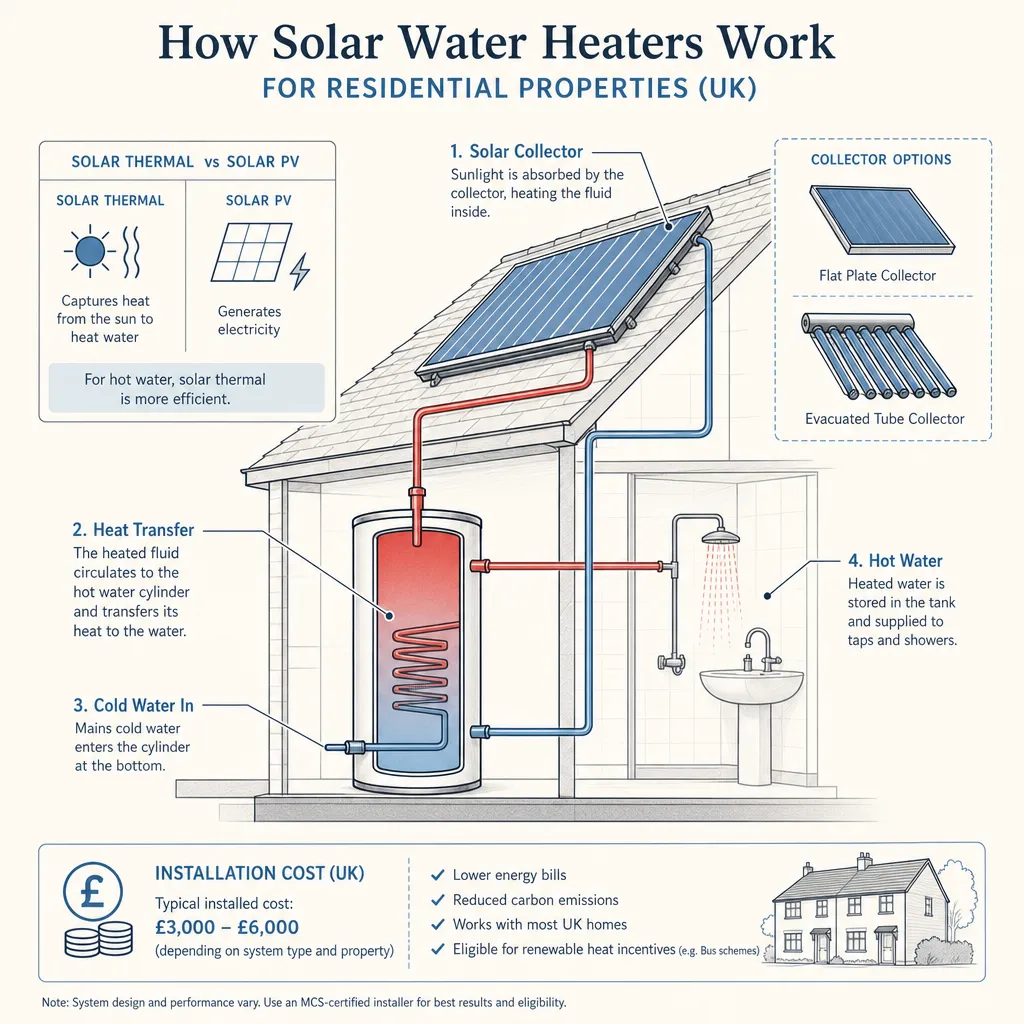
How Solar Water Heaters Work for Residential Properties
Solar water heaters use roof-mounted collectors to capture heat from sunlight and transfer it to a hot water cylinder via a fluid circuit.
 Energy & Retrofit
Renewable Energy Technologies for Homes
UK homes can choose from solar photovoltaic panels, air source heat pumps, ground source heat pumps, and battery storage as the main residential renewable technologies.