Understanding the costs of installing wind turbines on residential property
By Housey · Last reviewed 11th of May 2026

Understanding the costs of installing wind turbines on residential property
Wind turbines represent one of the more technically demanding renewable energy options available to UK homeowners. Unlike solar panels, which can be fitted to a wide range of properties with minimal site-specific constraints, small wind turbines are suited to a narrow set of locations — primarily rural and semi-rural plots with consistent, unobstructed exposure to the prevailing wind. The decision to install involves planning requirements, grid connection approvals, structural considerations, and a site-specific wind assessment, making cost estimation more complex than for most domestic energy improvements.
Key points
- Roof-mounted domestic wind turbines typically cost £2,000–£4,000 installed; free-standing pole-mounted turbines suitable for residential plots cost £15,000–£30,000 or more (indicative UK costs, last reviewed 2026-05-11).
- MCS (Microgeneration Certification Scheme) certification is required for both the turbine and the installer if the system is to qualify for the Smart Export Guarantee (SEG), which allows homeowners to sell surplus electricity to the grid.
- Under Schedule 2, Part 14 of the Town and Country Planning (General Permitted Development) (England) Order 2015, a single free-standing wind turbine may be installed without planning permission, subject to strict conditions on hub height and distance from site boundaries; conservation areas and protected designations almost always require full planning permission.
- The Energy Saving Trust advises that a turbine requires a mean annual wind speed of at least 5–6 m/s at hub height to generate electricity cost-effectively; most urban and suburban UK sites fall below this threshold.
- Electrical connection to the grid must be approved by the Distribution Network Operator (DNO) and, for notifiable electrical work in dwellings, must comply with Part P of the Building Regulations.
How much does a residential wind turbine cost in the UK?
Costs depend substantially on turbine type, size, site conditions, and grid connection requirements.
Turbine type | Typical installed cost | Typical capacity | Best for | Main limitations |
|---|---|---|---|---|
Roof-mounted (building-mounted) | £2,000–£4,000 | 0.5–2 kW | Urban trials; very constrained budgets | Low output due to roof turbulence; structural load on roof; rarely cost-effective |
Free-standing pole-mounted (small, up to 6 kW) | £15,000–£22,000 | 2.5–6 kW | Rural plots with open, unobstructed exposure | Permitted development conditions apply; requires clear land away from buildings and boundaries |
Free-standing pole-mounted (larger, 6+ kW) | £25,000–£50,000+ | 6–15 kW | Farms, large rural properties | Full planning permission almost always required; higher grid connection costs |
Indicative UK costs, last reviewed 2026-05-11. Quotes vary significantly by region, installer, and site-specific factors. Always obtain at least three quotes.
Additional costs to budget for:
- Wind site assessment: £300–£800 for a professional assessment; many MCS installers include a desktop assessment in their survey fee.
- Grid connection: a single-phase connection for export may cost £500–£2,000; complex grid reinforcement for larger systems can run to £5,000 or more.
- Planning application fee: £258 in England (as of May 2026) for a householder application; specialist planning consultants may charge £1,000–£3,000 if the application is contested or complex.
- Ongoing maintenance: annual service contracts typically cost £150–£400 for small systems; turbines have moving parts and require significantly more regular maintenance than solar panels.
Planning permission for residential wind turbines
Planning requirements depend on turbine type, size, property location, and local planning history.
Which route applies to your project?
- Choose permitted development if the turbine is a single free-standing unit, complies with the hub height limits set out in Part 14 of the GPDO 2015, is positioned at an appropriate distance from your site boundaries and neighbouring properties as specified in the Order, no other turbine is already installed at the site, and the property is not in a conservation area, World Heritage Site, Area of Outstanding Natural Beauty (AONB), or National Park.
- Apply for full planning permission if any of the permitted development conditions cannot be met, or if the property is in a protected area or subject to an Article 4 Direction that removes relevant permitted development rights.
- Expect a more difficult process if the property is listed or within a heritage setting — local planning authorities have significant discretion to refuse on landscape and visual impact grounds.
- Check with your local planning authority (LPA) before purchasing any turbine — permitted development rules are subject to amendment and some LPAs have additional local restrictions in place.
Roof-mounted turbines are subject to different and more restrictive rules. Building-mounted turbines are generally not permitted development on flats or HMOs.
What not to assume about home wind turbines
Several common misunderstandings lead homeowners to overestimate site suitability or likely return on investment.
"My roof is a good location" Building-mounted turbines are subject to significant turbulence from the structure itself and from nearby buildings. The Energy Saving Trust notes that roof-mounted turbines rarely deliver the output of well-sited free-standing units, and ongoing vibration can stress the roof structure over time.
"My area is windy enough" UK wind resource data shows that most urban and suburban sites have mean annual wind speeds below the 5–6 m/s threshold needed for cost-effective generation. A desktop check using the NOABL (Numerical Objective Analysis of Boundary Layer) wind speed database is a starting point; an on-site anemometer survey provides more reliable data.
"The payback will be quick" Unlike solar PV, which can achieve payback periods of 7–12 years on suitable roofs, domestic wind turbines on marginal sites may never recover their capital cost from generation income alone. SEG export tariffs from major suppliers typically range from 3–15p/kWh, meaning substantial annual generation is needed to make a meaningful return on a £15,000–£30,000 installation.
"I can handle the electrical connection myself" Electrical installation work in dwellings is notifiable under Part P of the Building Regulations in England. Grid export connections must be notified to and approved by the Distribution Network Operator (DNO) before commissioning. This work must be carried out by a competent electrician.
Important limitations
This article provides general guidance only. Wind turbine suitability, planning requirements, and financial returns depend on site-specific factors including wind resource, property type, local planning policy, and grid connection capacity. Planning legislation differs in Scotland, Wales, and Northern Ireland, each of which has its own version of permitted development rules. A qualified assessor should evaluate your specific site before any purchase or planning decision is made. Nothing in this article constitutes planning, legal, structural, or electrical advice.
When to get professional help
Seek specialist advice before purchasing any wind turbine system if:
- You have not had a site wind assessment carried out — even a desktop NOABL check
- Your property is in or near a conservation area, AONB, National Park, or World Heritage Site
- A neighbouring property is within the distance thresholds set by the GPDO 2015 permitted development conditions
- Your property is listed or subject to an Article 4 Direction
- You are unsure whether your roof structure can carry the load and vibration of a building-mounted turbine
- You want to connect to the grid or register for the Smart Export Guarantee and need DNO approval
What to ask a qualified professional
Before instructing a wind turbine assessor or MCS-certified installer:
- What MCS certifications do you hold, and do they cover both this turbine model and the installation work?
- What site wind assessment methodology will you use — desktop NOABL data, or on-site anemometry?
- What is the realistic annual generation estimate for my specific site and proposed hub height?
- What planning permission will be required, and will you manage the application process?
- What is the estimated simple payback period based on current SEG tariffs and your generation estimate?
- What are the grid connection requirements, and will you liaise directly with the DNO?
- What does the annual maintenance contract include, and what is the expected turbine lifespan?
How Housey can help
Housey helps homeowners find vetted renewable energy specialists across the UK who can carry out site assessments, advise on planning requirements, and install MCS-certified systems. Submit a request through Housey to compare quotes from qualified installers in your area.
Frequently asked questions
Do I need planning permission for a home wind turbine in the UK?
It depends on turbine type, size, and location. Free-standing turbines may qualify for permitted development under Schedule 2, Part 14 of the GPDO 2015 (England), but the conditions are strict and cover hub height, distance from site boundaries, and protected designations. Conservation areas, National Parks, and AONBs typically require full planning permission. Always check with your local planning authority before purchasing — rules differ in Scotland, Wales, and Northern Ireland.
How much electricity can a domestic wind turbine generate?
A well-sited 6 kW pole-mounted turbine in a rural location with mean wind speeds above 6 m/s may generate 8,000–10,000 kWh per year, roughly equivalent to the annual electricity consumption of a typical UK household. A small roof-mounted turbine in a suburban setting may generate only 200–500 kWh per year. Generation is highly site-dependent and should always be based on a professional site assessment, not manufacturer headline figures.
Are there grants for domestic wind turbines in the UK?
As of May 2026, there is no specific UK government grant for residential wind turbines equivalent to the Boiler Upgrade Scheme for heat pumps. Systems installed by MCS-certified contractors are eligible for the Smart Export Guarantee (SEG), which allows homeowners to sell surplus electricity to the grid at a market rate. Check Ofgem's SEG guidance for current participating suppliers and available tariffs.
What wind speed do I need for a home turbine to be worthwhile?
The Energy Saving Trust recommends a mean annual wind speed of at least 5–6 m/s at hub height. You can check indicative speeds using the NOABL wind speed database, but this provides modelled estimates rather than measured site data. A professional on-site anemometer assessment provides more reliable figures on which to base a purchasing decision.
Can I sell electricity from a wind turbine back to the grid?
Yes, via the Smart Export Guarantee (SEG). Energy suppliers with 150,000 or more domestic customers are required by Ofgem to offer an SEG tariff. To qualify, the turbine must be installed by an MCS-certified installer and the system must hold MCS certification. SEG rates are market-set and vary by supplier — compare available tariffs on the Ofgem website.
Sources and further reading
- Small-scale wind energy — Energy Saving Trust
- Smart Export Guarantee — Ofgem
- MCS: Microgeneration Certification Scheme — MCS
- Town and Country Planning (General Permitted Development) (England) Order 2015, Schedule 2, Part 14 — legislation.gov.uk
- Planning permission: England — GOV.UK
Useful next reads
 Energy & Retrofit
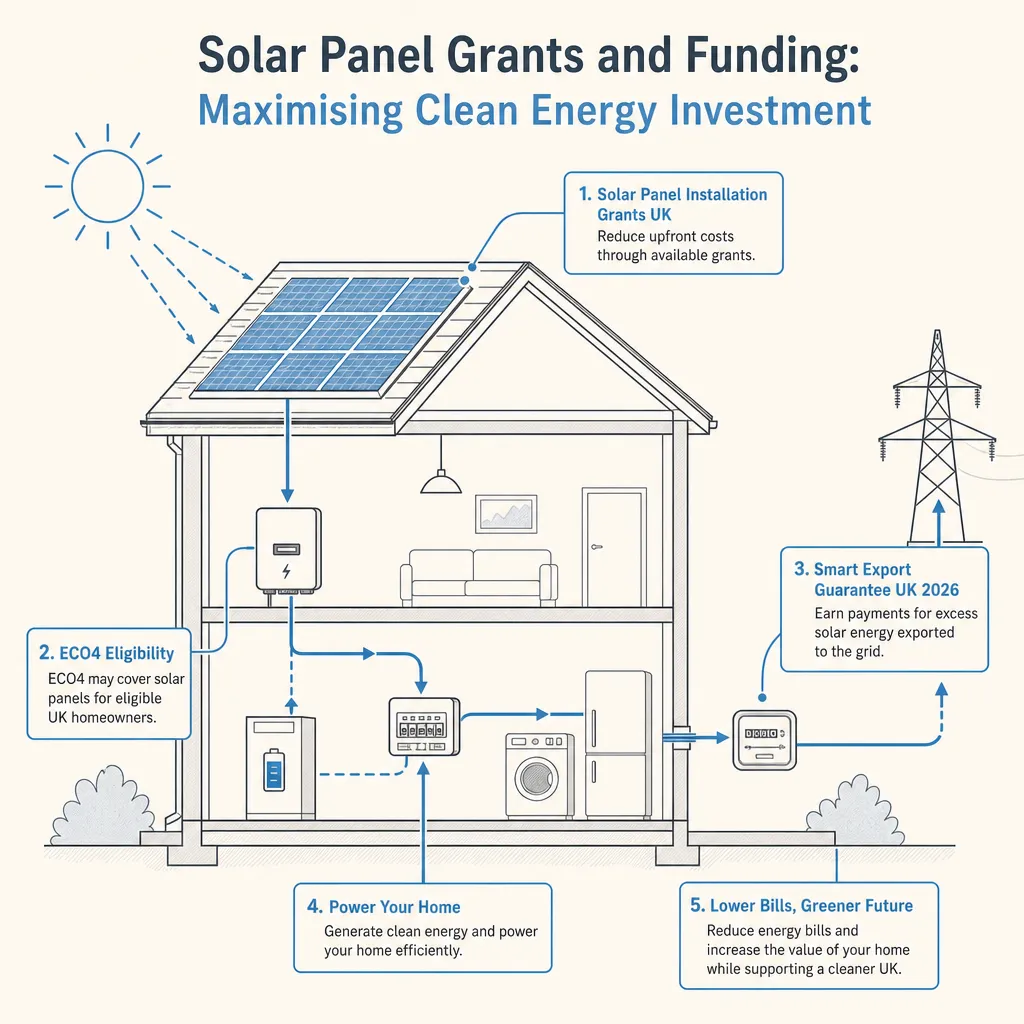
Solar Panel Grants and Funding: Maximising Clean Energy Investment
Several UK solar funding schemes are currently open: the Smart Export Guarantee pays homeowners for surplus electricity exported to the grid, ECO4 can fund free or subsidised panels for eligible low-income households, and 0% VAT on installation applies until at least March 2027.
 Energy & Retrofit
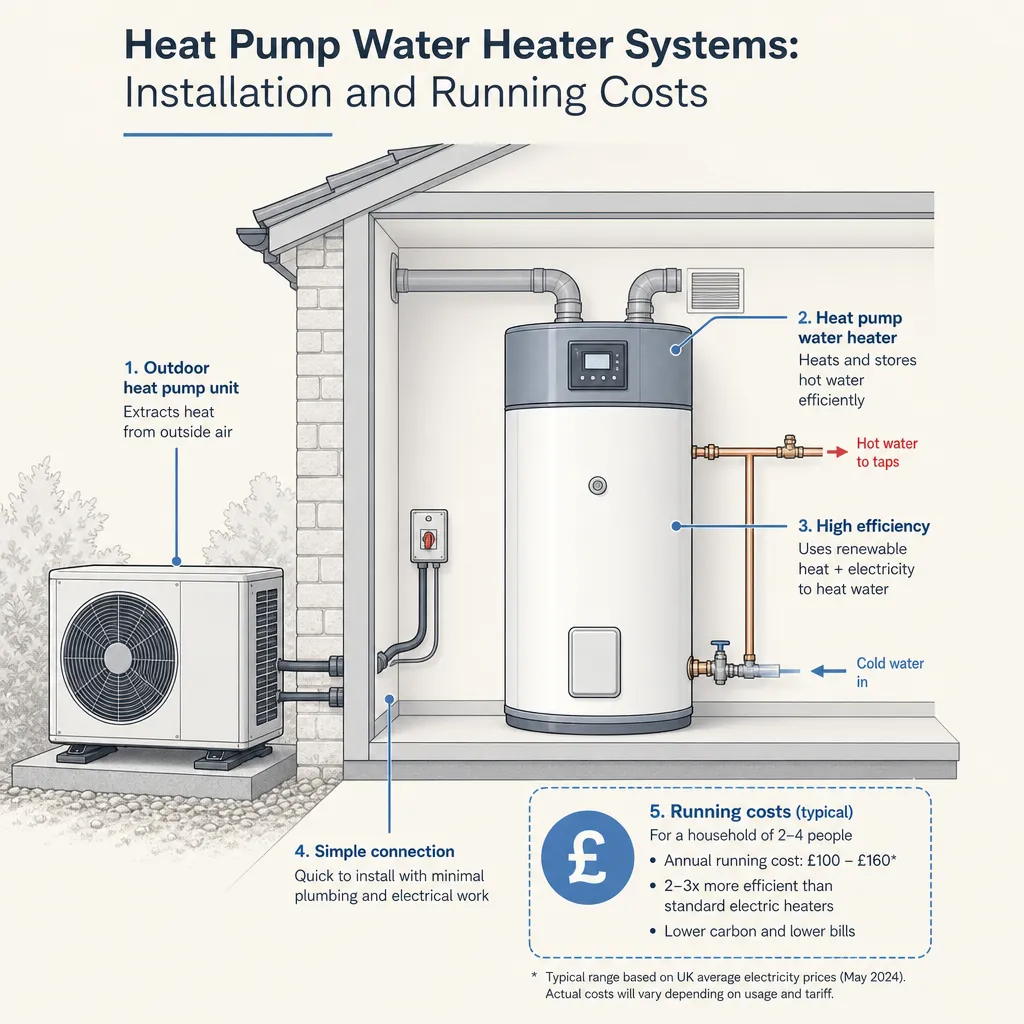
Heat Pump Water Heater Systems: Installation and Running Costs
A heat pump water heater extracts heat from surrounding air to warm your domestic hot water cylinder, achieving a Coefficient of Performance of 2.
 Energy & Retrofit
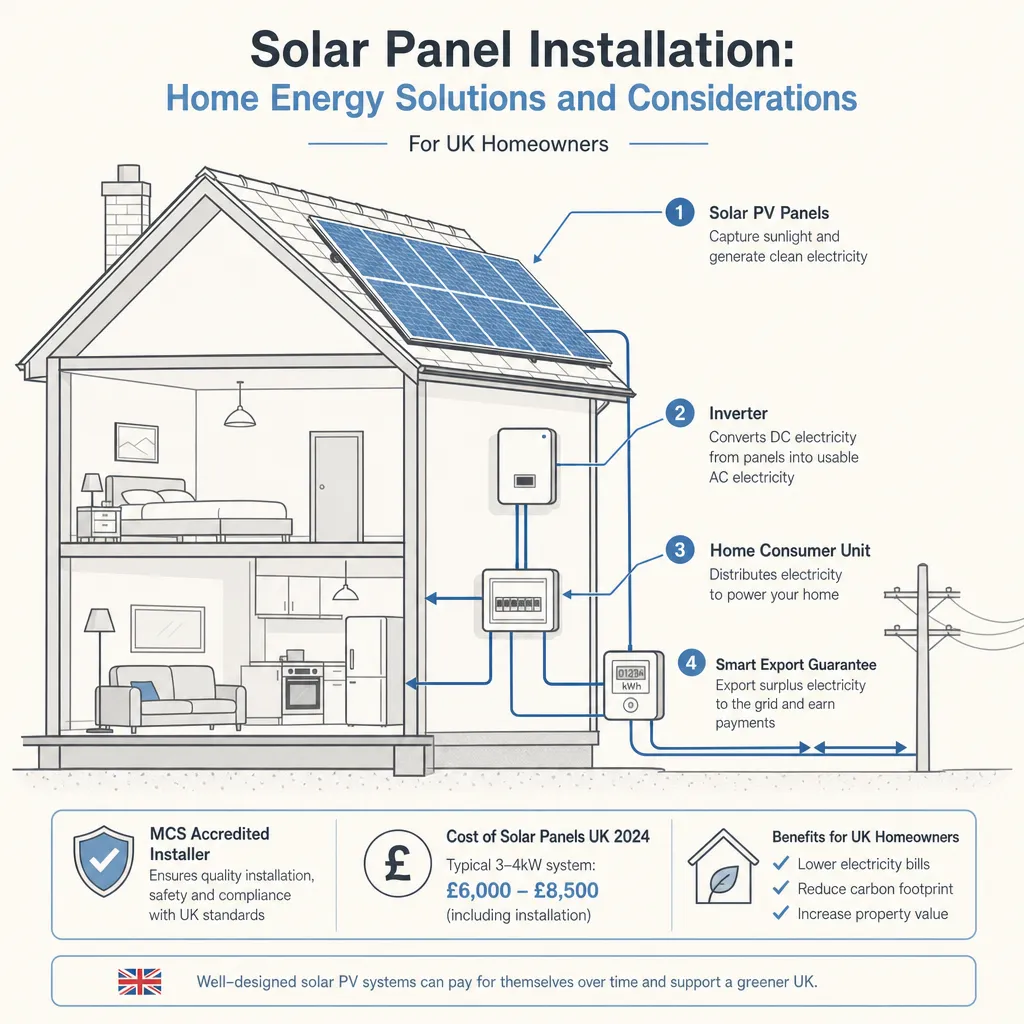
Solar Panel Installation: Home Energy Solutions and Considerations
A typical 4 kWp solar PV system costs £6,000–£9,000 installed and generates around 3,400–3,800 kWh per year on a south-facing roof in southern England.
 Energy & Retrofit
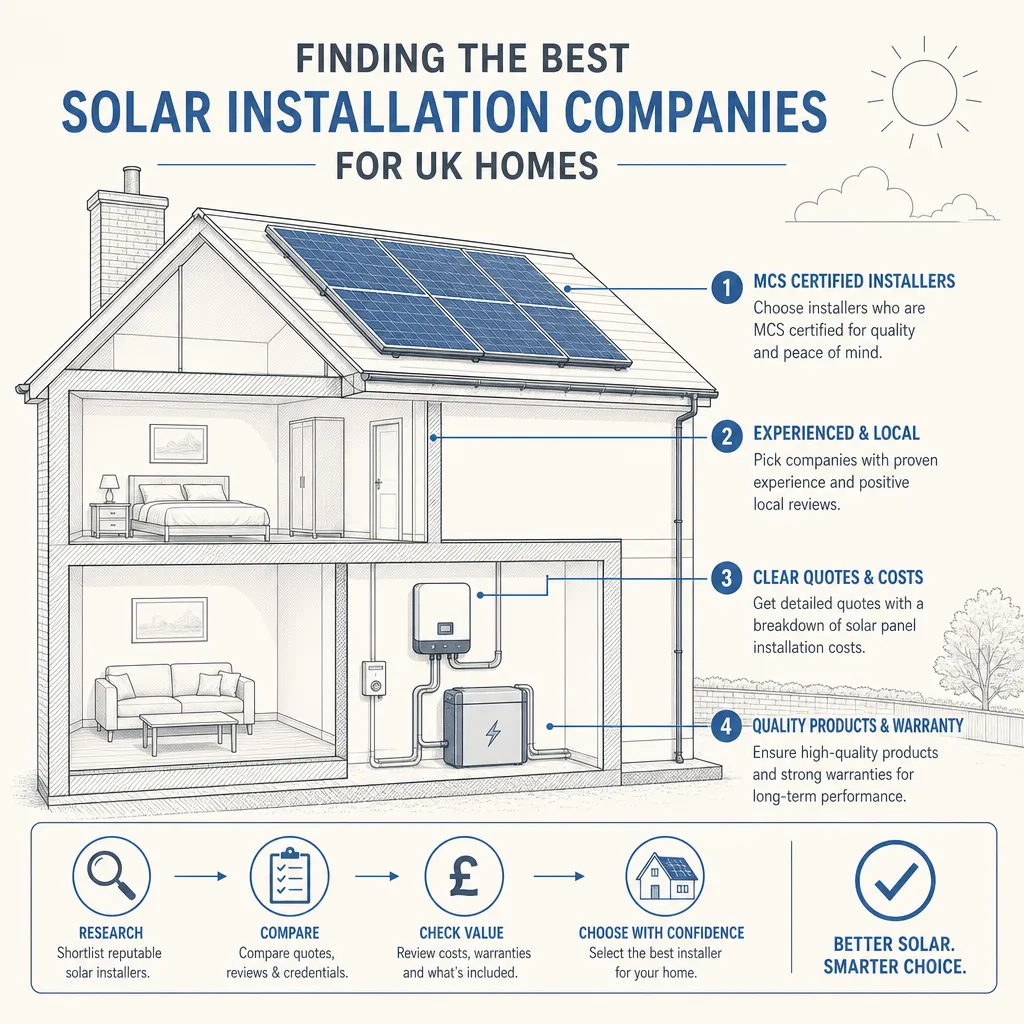
Finding the Best Solar Installation Companies for UK Homes
To find a reliable solar installation company in the UK, look for MCS (Microgeneration Certification Scheme) certification — required for Smart Export Guarantee eligibility — plus NICEIC or NAPIT electrical registration.
 Energy & Retrofit
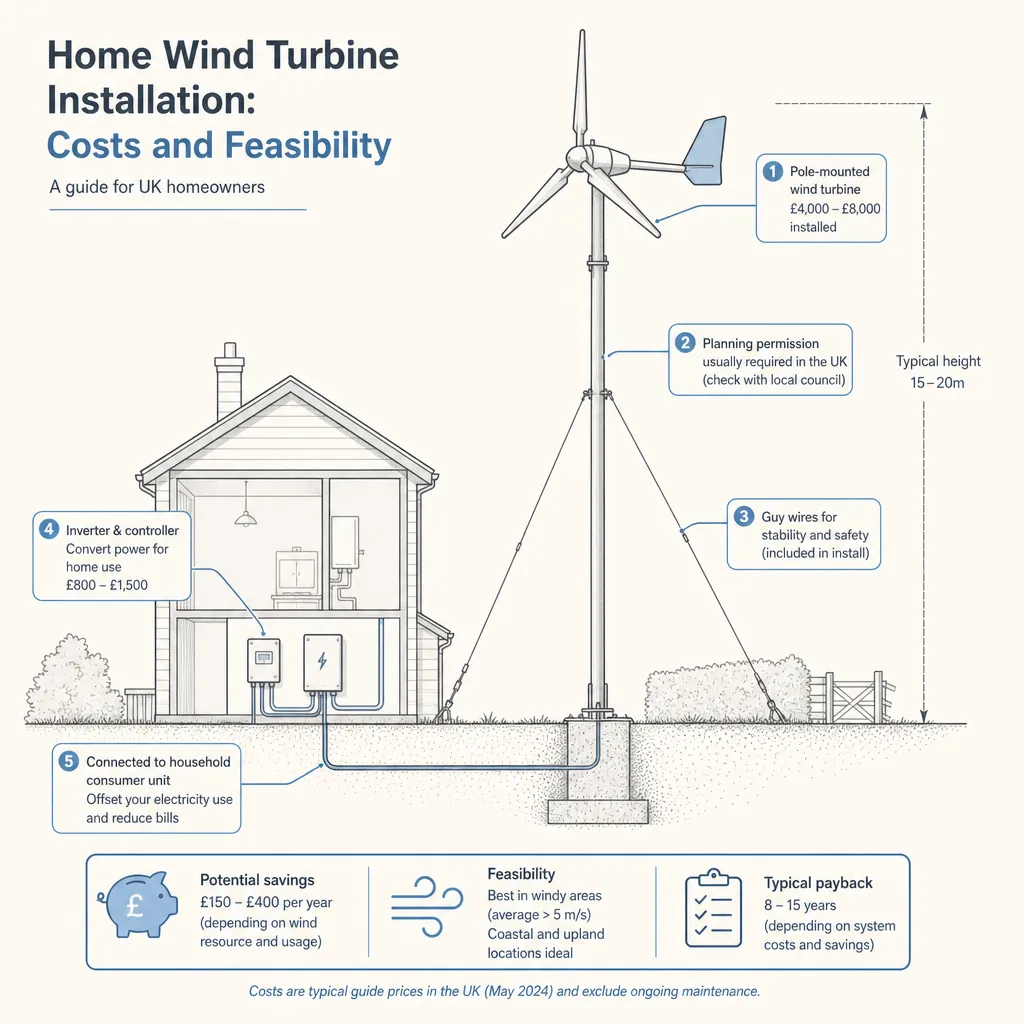
Home Wind Turbine Installation: Costs and Feasibility
A domestic wind turbine is only cost-effective if your site averages 5–6 metres per second or more in wind speed.