Homeowner's Guide to Concrete Construction and Maintenance
By Housey · Last reviewed 25th of May 2026
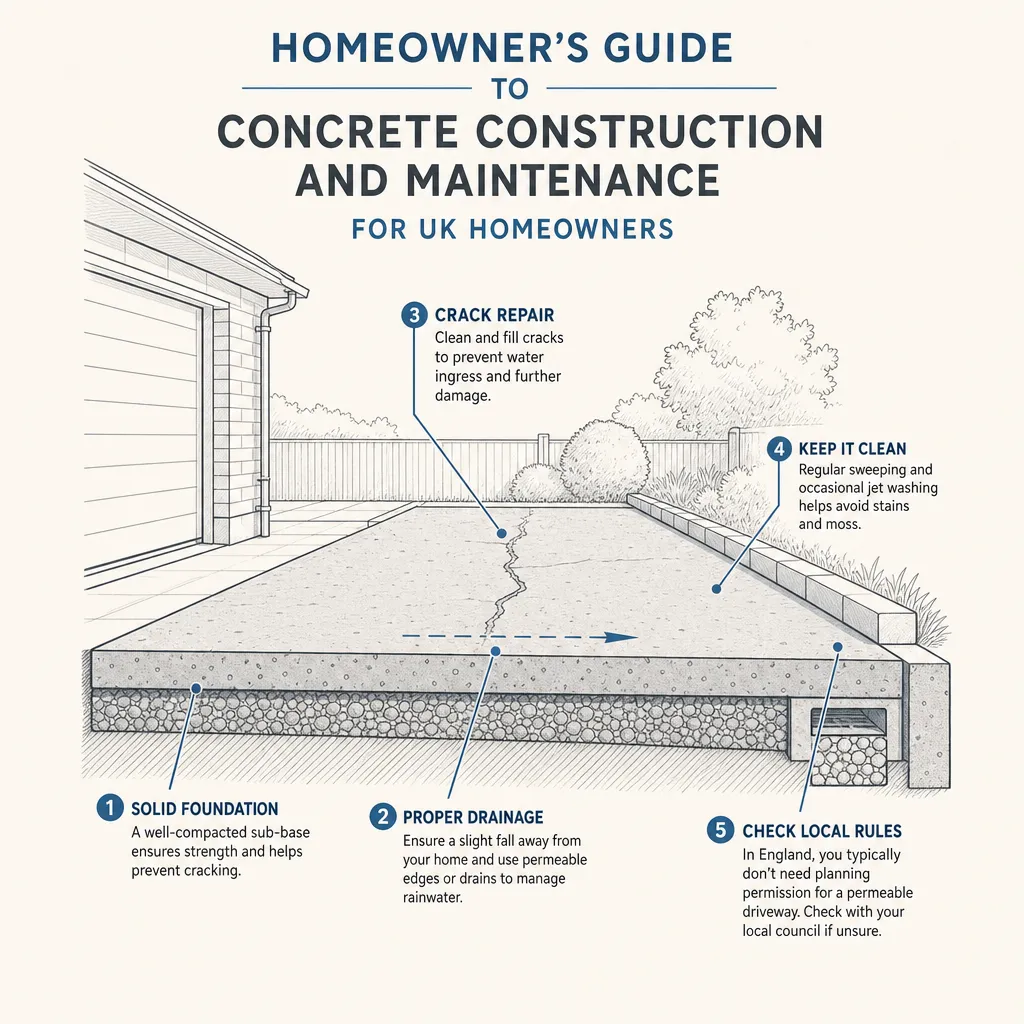
Homeowner's Guide to Concrete Construction and Maintenance
Concrete is one of the most widely used materials in UK residential properties — from driveways, paths, and garage floors to outbuilding bases, steps, and retaining kerbs. Despite its reputation for toughness, concrete does require periodic attention, and neglected maintenance can lead to progressive deterioration that becomes expensive to reverse. Understanding how concrete is specified, what causes it to deteriorate, and how to respond to early warning signs puts you in a much stronger position when commissioning new work or deciding whether to repair or replace an existing slab.
Key points
- Concrete driveways serving the highway in England do not require planning permission if they are permeable or drain to a lawn or soakaway; impermeable driveways over 5 m² require permission under the Town and Country Planning (Permitted Development) (England) Order 2008.
- Residential driveways and external slabs should be specified to at least C25/30 (GEN 3 under the BS 8500 designation system); lower grades such as GEN 0 or GEN 1 are not appropriate for vehicle loading.
- A correctly laid concrete driveway — adequate sub-base, minimum 100–150 mm slab thickness, and proper curing — can last 25–40 years; premature failure almost always traces back to an insufficient sub-base, inadequate concrete thickness, or poor curing immediately after the pour.
- Surface sealers applied every 3–5 years significantly reduce water ingress, freeze-thaw damage, and oil staining — the three most common causes of surface deterioration in the UK climate.
- Hairline cracks under 0.3 mm wide are generally cosmetic in non-structural slabs; cracks wider than 1 mm, stepped cracks, or cracks accompanied by differential movement between adjacent slab sections may indicate a sub-base or ground stability problem requiring professional assessment.
How concrete works in a residential setting
Concrete is a composite material — cement, aggregate (sand and gravel), and water — mixed in proportions that govern its strength, workability, and durability. Once the cement hydrates and the concrete sets, it gains most of its strength within 28 days and continues to strengthen slowly beyond that. This long-term durability makes it an excellent material for residential use, but it also means that construction errors are effectively locked in — there is no correcting a poorly compacted or under-specified slab after it has cured.
For homeowners, the most common concrete applications are:
- Driveways and paths: external slabs subject to vehicle and foot loading, freeze-thaw cycles, de-icing salt exposure, and oil spills.
- Garage floors: typically lightly reinforced internal slabs subject to vehicle loading and concentrated point loads from jacks or storage racking.
- Steps and kerbs: elements with high weather exposure and frequent foot traffic at edges and nosings.
- Outbuilding bases: non-structural or lightly reinforced slabs for garden buildings, workshops, and car ports.
- Extension foundations and structural floor slabs: elements forming part of the main dwelling — these require building control approval and are outside the scope of DIY maintenance guidance.
Do you need planning permission for concrete work?
This depends on what the concrete is for and where the property is located.
Decision tree: does my concrete project need permission?
- Is it a foundation or structural floor slab for a house extension or new building? → Building Regulations approval required — contact building control before starting any work.
- Is it a new driveway serving the road, is the surface impermeable (such as brushed concrete with no drainage channel), and is it larger than 5 m²? → Planning permission required in England under TCPA permitted development rules.
- Is the driveway permeable, or does it drain via channels to a lawn or a soakaway? → Planning permission not usually required — but confirm with your local planning authority if the property is in a conservation area.
- Is the concrete a garden path, patio, outbuilding base, or step not serving the highway? → Planning permission not usually required — but check if the property is listed or within a conservation area.
- Is the concrete within the curtilage of a listed building? → Listed building consent may be required — contact your local planning authority before starting.
If in doubt, the Planning Portal's driveway guidance sets out the current rules clearly and is the authoritative starting point.
How long should concrete last, and what causes early failure?
Well-specified and correctly laid residential concrete typically lasts 25–40 years before requiring major remediation. The most common causes of premature failure in UK residential settings are:
Failure type | Typical cause | Visible symptom | Recommended action |
|---|---|---|---|
Surface scaling | Freeze-thaw damage; de-icing salt use on inadequately specified concrete | Flaking, pitting, rough surface texture | Sealer at early stage; resurfacing or replacement if advanced |
Cracking | Normal shrinkage; sub-base settlement; tree root intrusion; overloading | Hairline to wide cracks | Monitor narrow cracks; fill stable cracks; investigate if wider than 1 mm or moving |
Heaving | Root intrusion; frost heave; clay ground expansion | A section of slab raised above its neighbours | Remove root cause; relay the affected section |
Oil staining | Lack of surface sealer | Dark spreading stains | Degrease and reseal; cosmetic only if the concrete is otherwise sound |
Honeycombing | Poor compaction during original pour | Visible aggregate pockets, rough patches on the surface | Minor: cementitious patch repair; extensive: seek professional assessment |
Edge spalling | Inadequate edge reinforcement; vehicles overrunning the slab edge | Chipping and breaking at corners and edges | Cut back to sound concrete, patch, and install edging restraint |
Maintaining concrete: a practical homeowner checklist
Carry out this inspection annually and after any period of severe weather:
When to repair and when to replace
Not all concrete problems require full replacement. As a guide:
- Surface sealing: apply a penetrating silane-siloxane sealer when the concrete is structurally sound, clean, and dry. This is effective at preventing water and oil ingress and can extend the slab's useful life by 5–10 years. Apply in dry weather above 5 °C.
- Crack filling: appropriate for stable cracks under 5 mm wide. Use a flexible polyurethane or epoxy crack filler. Clean and dry the crack before application. Ordinary cement mortar is not suitable as it cracks again with any thermal or ground movement.
- Patching: suited to localised honeycombing, spalling, or edge damage. Use a proprietary cementitious repair mortar bonded to a prepared surface. The existing concrete must be cleaned of all contamination, and the patch should be feathered to a minimum 20 mm depth.
- Full resurfacing or replacement: appropriate when more than 30–40% of the surface is scaling, when cracks are active and widespread, when the sub-base has failed, or when drainage cannot be corrected by repair alone.
Indicative UK costs, last reviewed 2026-05-25: a full concrete driveway replacement typically ranges from £60–£120 per m² fully installed, depending on slab thickness, finish, sub-base preparation required, and location. Always obtain at least three written quotes from experienced contractors.
When to get professional help
Contact a professional if:
- Cracks are wider than 5 mm, stepped, or accompanied by differential movement between adjacent slab sections.
- The concrete is lifting or heaving significantly, particularly near trees or in areas of known clay shrinkage.
- Surface water is draining toward the house rather than away from it.
- The slab forms part of a structural foundation or is the floor of a habitable room.
- You are considering overlaying new concrete on an existing slab — the existing surface's condition and bond adhesion must be professionally assessed first.
- The driveway or path is within a listed building's curtilage or a conservation area.
How Housey can help
If your concrete driveway or external slab needs replacement, full reinstatement, or a new installation, Housey can connect you with local driveway installation specialists who can assess your existing surface, recommend the right specification and finish for your site, and provide competitive quotes.
Frequently asked questions
How thick should a concrete driveway be in the UK?
A residential concrete driveway for private car use should be a minimum of 100 mm thick, with most contractors recommending 125–150 mm where heavier vehicles are expected or the sub-base is variable. The compacted sub-base — typically MOT Type 1 granular material — should be at least 150 mm deep. Thinner slabs on an inadequate sub-base are the most common reason UK driveways fail within 5–10 years of installation.
Can I seal an old concrete driveway myself?
Yes, applying a penetrating concrete sealer to a sound, clean, dry surface is a manageable DIY task. The surface must be free of oil, algae, and loose material, and the sealer applied in dry conditions above 5 °C. Penetrating silane-siloxane sealers are generally preferred over film-forming coatings for driveways because they do not peel or significantly alter the surface appearance over time.
What is the difference between concrete and tarmac for a driveway?
Concrete driveways are generally more durable and lower-maintenance over the long term but carry a higher initial cost — typically 20–40% more than tarmac. Tarmac is quicker to install and cheaper upfront but is more susceptible to softening in hot weather and to damage from petrol and oil spills. Both are appropriate for residential use; the choice usually depends on budget, aesthetic preference, and planned maintenance commitment.
How do I stop moss and algae growing on my concrete?
Moss and algae grow readily on concrete that retains moisture. Regular cleaning with a pressure washer or a proprietary patio cleaner removes existing growth. Applying a concrete biocide solution followed by a penetrating surface sealer reduces the rate of re-growth. The most effective long-term prevention is improving drainage so that water does not pool on the surface between rain events.
Sources and further reading
- GOV.UK guidance: paving your front garden — GOV.UK
- Planning Portal: driveways and hardstanding — Planning Portal
- The Concrete Society: guidance for homeowners — The Concrete Society
- BS 8500-1:2023 Concrete — Complementary British Standard to BS EN 206 — BSI Group
- Energy Saving Trust: home materials and maintenance — Energy Saving Trust
Useful next reads
 Improvement & Build
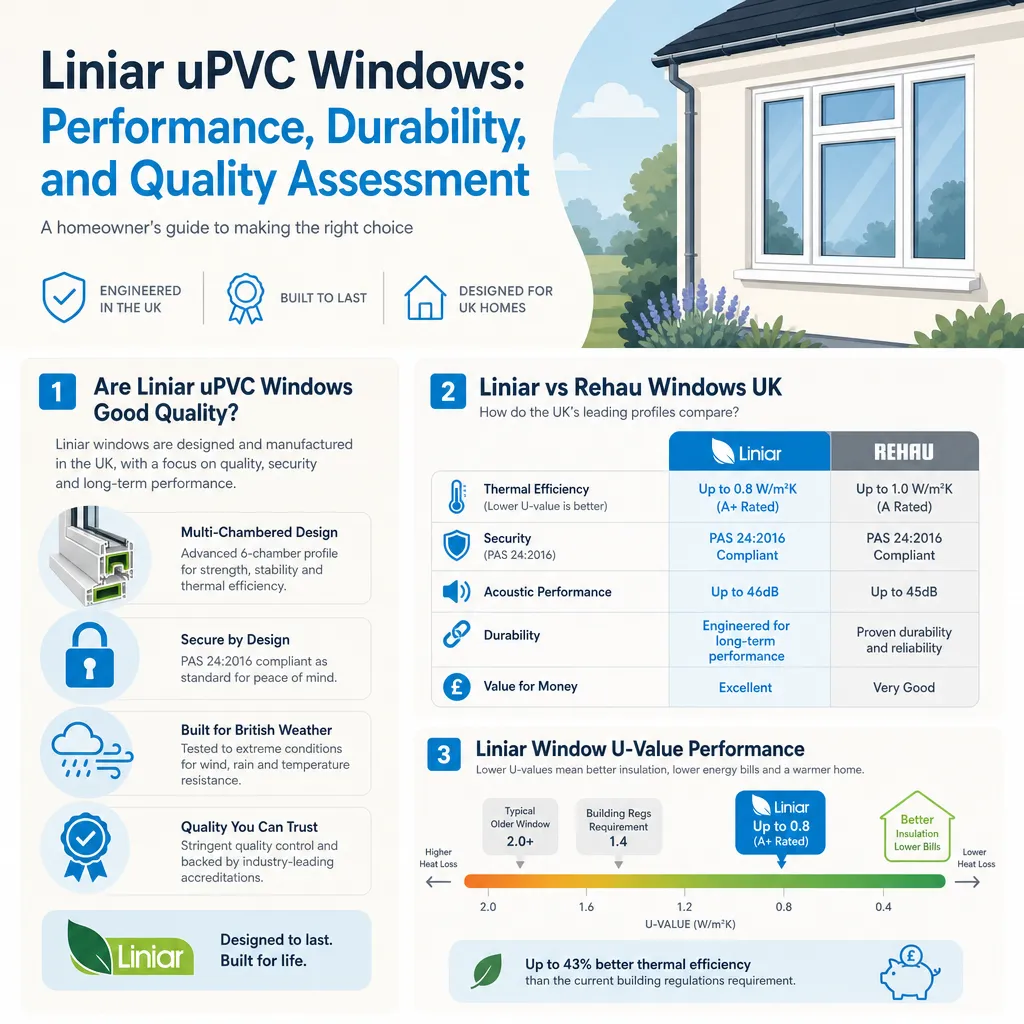
Liniar uPVC Windows: Performance, Durability, and Quality Assessment
Liniar uPVC window profiles are manufactured in the UK using multi-chambered, foamed frames.
 Improvement & Build
Aluminium Windows: Benefits, Specifications, and Installation Costs
Aluminium windows typically cost £600–£1,800 per window installed in the UK, depending on size and specification.
 Improvement & Build
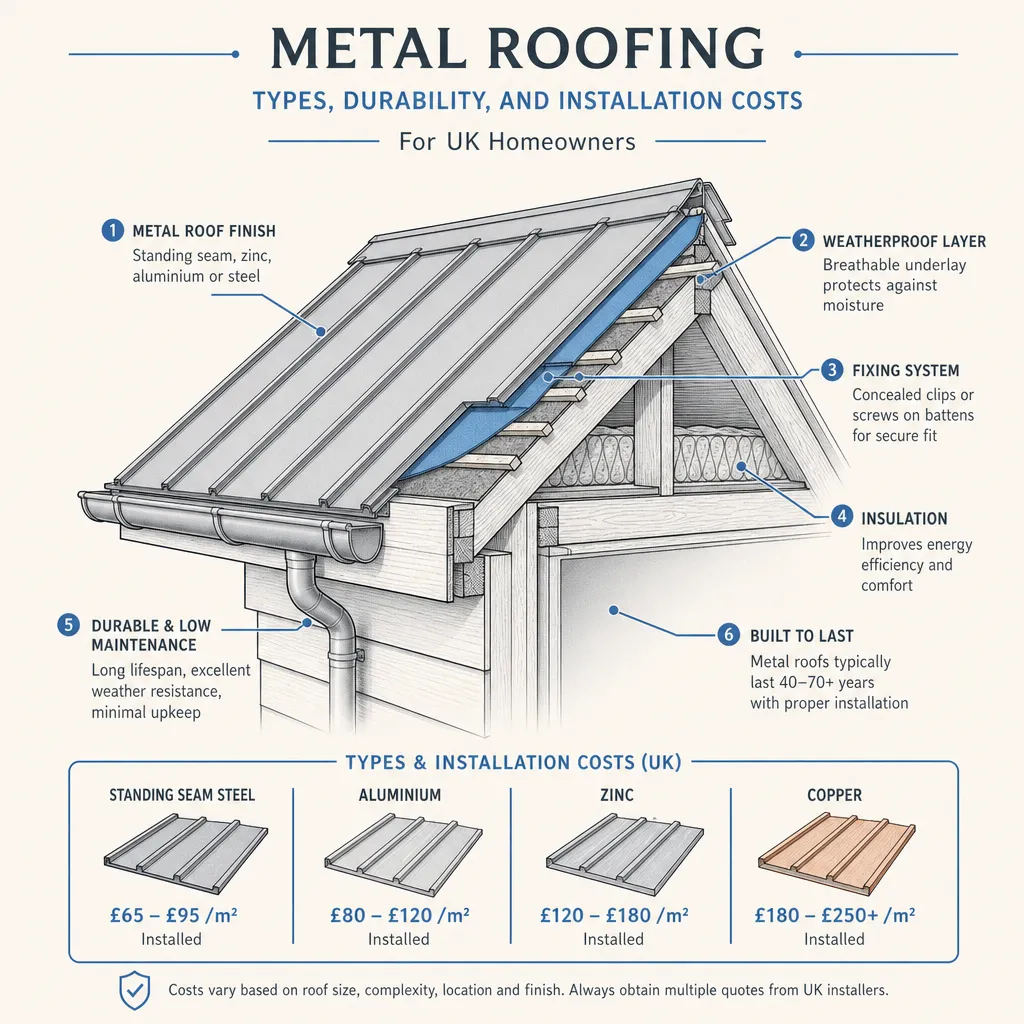
Metal Roofing: Types, Durability, and Installation Costs
Metal roofing in the UK includes standing seam, corrugated sheet, and metal tile systems in steel, aluminium, zinc, or copper.
 Improvement & Build
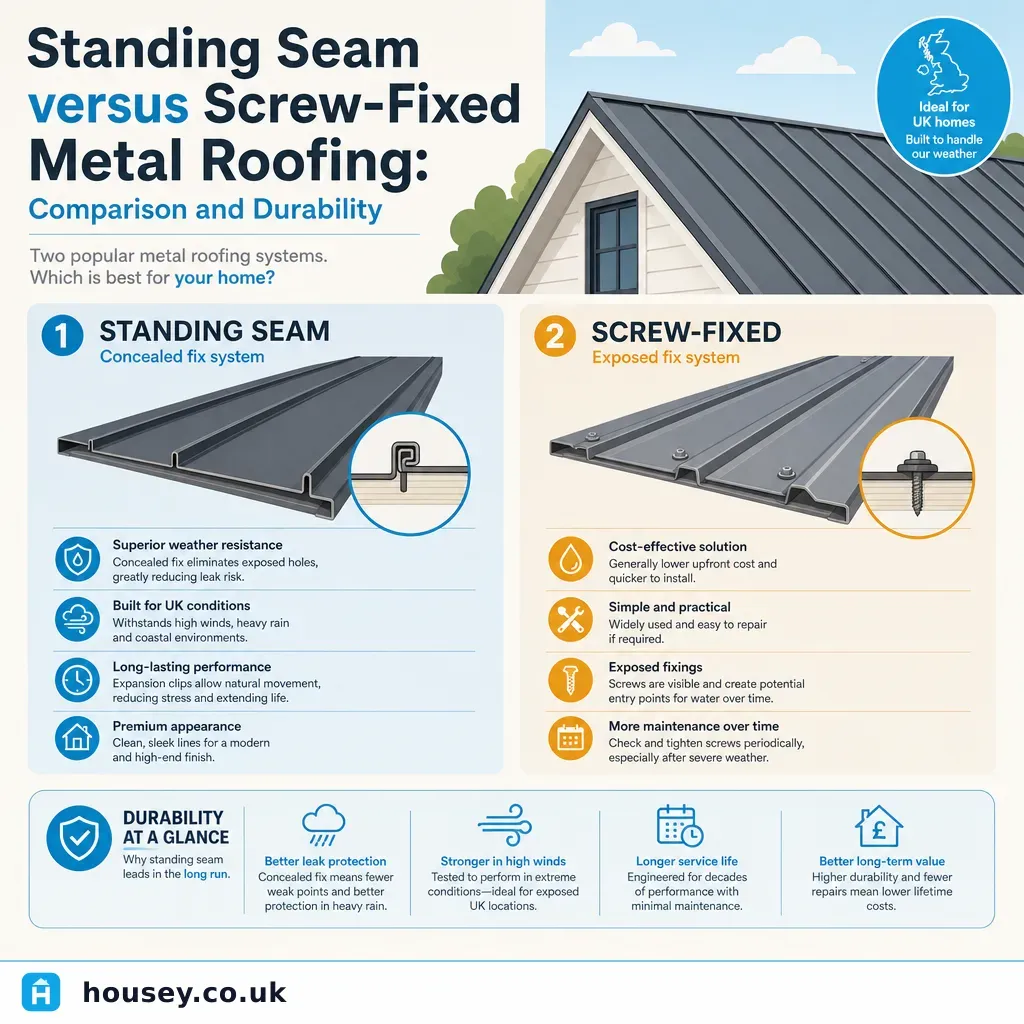
Standing Seam versus Screw-Fixed Metal Roofing: Comparison and Durability
Standing seam uses concealed clips to hold panels, keeping all fasteners out of the weatherline and giving a design life of 40–60 years or more.
 Improvement & Build
Synthetic Cedar Shake Roofing: Installation Costs and Material Performance
Synthetic cedar shake roofing uses polymer composite, rubber, or fibre-cement tiles to replicate the look of natural cedar wood shingles.