House Extensions: Design, Planning, and Professional Build Services
By Housey · Last reviewed 19th of May 2026
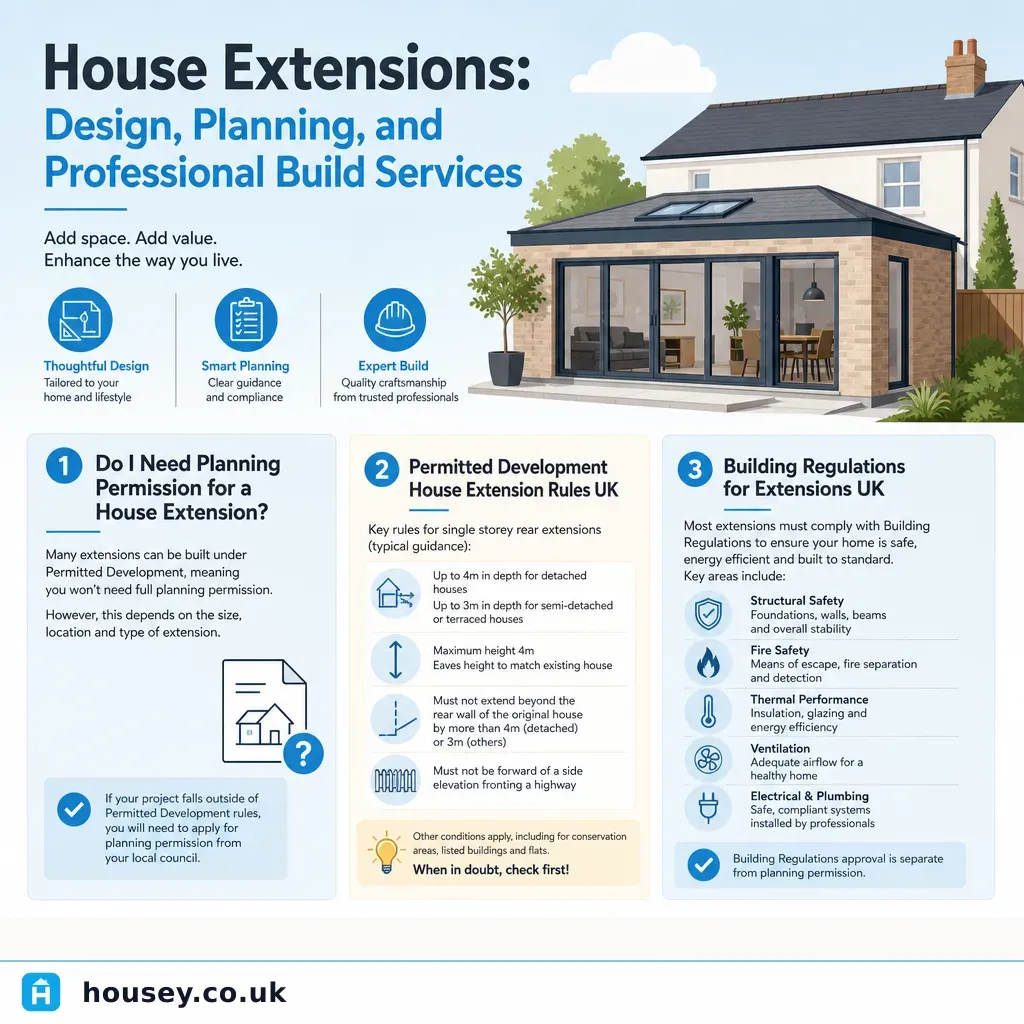
House Extensions: Design, Planning, and Professional Build Services
A house extension is one of the most transformative improvements a UK homeowner can make — adding space, value, and functionality without the upheaval and cost of moving. But an extension touches architecture, structural engineering, planning law, and building control simultaneously, and decisions made early have consequences that are expensive to reverse once work is underway.
Key points
- Most single-storey rear extensions up to 4 m deep (detached houses) or 3 m deep (semi-detached and terraced) can be built under Permitted Development (PD) rights, but larger extensions up to 8 m / 6 m require Prior Approval under the Neighbour Consultation Scheme.
- Building Regulations approval is required for virtually all extensions regardless of planning status, covering structure (Part A), fire safety (Part B), insulation (Part L), ventilation (Part F), and drainage (Part H).
- The Party Wall etc. Act 1996 applies if your extension is within 3 m of a neighbour's foundation, involves a shared wall, or involves excavation close to the boundary — a Party Wall Award may be needed before works begin.
- A chartered structural engineer must provide calculations for any new opening in a load-bearing wall, new steel beams, or foundations in challenging ground conditions.
- A Completion Certificate issued by building control is a key document when selling — missing certificates can delay or block a sale and are costly to obtain retrospectively.
Planning permission or permitted development?
Understanding whether your extension needs a full planning application or falls within Permitted Development (PD) rights is the first critical decision. PD rights can be removed by an Article 4 Direction — common in conservation areas, many London boroughs, and some new-build estates — so always confirm with your Local Planning Authority (LPA) before starting any design work.
Decision tree: do you need planning permission?
- Use Permitted Development (check Prior Approval threshold) if: the extension is single-storey, at the rear, within the PD size limits (3 m / 4 m standard, up to 6 m / 8 m under Prior Approval), the property is not listed, not in a conservation area or AONB, and PD rights have not been removed or used up by earlier extensions.
- Apply for Prior Approval if: the extension exceeds the standard PD limit but is within 6 m (semi-detached or terraced) or 8 m (detached) of the original rear wall — the LPA must be notified and neighbours consulted, but this is not a full planning application.
- Apply for full planning permission if: the extension is two-storey; a side extension exceeds half the original dwelling width; the property is listed (Listed Building Consent also required); the property is in a conservation area or AONB; or PD rights have been removed by an Article 4 Direction.
- Consult an architect or planning consultant if: you are unsure about the property's PD history, whether an Article 4 Direction applies, or whether the proposed design meets all PD conditions.
Always request a Lawful Development Certificate (LDC) from the LPA to confirm PD status in writing — this provides legal certainty at sale.
Extension types: a comparison
Extension type | Planning route (typical) | Structural complexity | Indicative cost range | Best for |
|---|---|---|---|---|
Single-storey rear | PD or Prior Approval (under 8 m) | Low to medium | £25,000–£60,000+ | Kitchen-diner, family room |
Two-storey rear | Full planning usually required | Medium to high | £45,000–£100,000+ | Extra bedroom plus ground-floor space |
Side return infill | Usually PD (terraces and semis) | Medium | £20,000–£45,000+ | Wider kitchen on a terraced house |
Wrap-around | Full planning likely | High | £60,000–£150,000+ | Large open-plan kitchen-living area |
Over-garage | Often full planning | Medium to high | £30,000–£70,000+ | Home office or additional bedroom |
Indicative UK costs, last reviewed 2026-05-19. Costs vary significantly by region, specification, and site conditions. Always obtain itemised quotes from at least three contractors.
The professional team you need
An extension rarely requires just one professional. The table below explains who does what and when to appoint them.
Professional | Role | When to appoint |
|---|---|---|
Architect or architectural designer | Design, planning drawings, specification, contract administration | Before any planning application or builder conversations |
Structural engineer | Structural calculations, beam and foundation design | Once design is developed; before building control application |
Building control body | Approval and inspection of Building Regulations compliance | Before work starts on site |
Party wall surveyor | Serving notices and preparing Party Wall Awards where the Act applies | As soon as notices need to be served — typically 2 months before works |
Extension builder / main contractor | Construction management and build | After design is complete and approvals are in place |
Quantity surveyor | Cost planning and contract oversight on larger projects | Early in design stage for projects over approximately £100,000 |
What building control checks
Building Regulations approval — separate from and in addition to planning permission — ensures your extension is structurally safe and energy-efficient. For a typical single-storey extension, the building control body will check:
- Part A (Structure): foundations, masonry, structural steelwork, and roof structure.
- Part B (Fire safety): escape routes, fire-resisting elements, and smoke alarm provision.
- Part C (Damp): continuity of the damp-proof course and membrane.
- Part F (Ventilation): adequate ventilation in new habitable rooms.
- Part L (Energy efficiency): insulation U-values, thermal bridging details, and airtightness.
- Part P (Electrical safety): new electrical circuits within the extension.
A Completion Certificate is issued once work passes final inspection. Keep this document — buyers' solicitors will ask for it, and missing certificates can delay or jeopardise a sale.
Important limitations
This article is general guidance only. Planning rules, Permitted Development thresholds, Building Regulations requirements, and Party Wall obligations vary depending on your property's location, planning history, tenure, listing status, and structural conditions. You must verify requirements with your Local Planning Authority and consult qualified professionals before starting any work. Nothing in this article constitutes planning, legal, or structural engineering advice.
When this becomes urgent
Stop and seek professional advice immediately if:
- Excavations uncover unexpected ground conditions, buried services, or contamination.
- Cracks appear in existing walls during or after works.
- A neighbour serves a counter-notice or dissent under the Party Wall etc. Act 1996.
- A building control inspector raises a structural concern during an inspection visit.
- Works have started without Building Regulations approval — the LPA may require opening up or demolition of non-compliant elements.
What to ask a qualified professional
Before appointing an architect, structural engineer, or extension builder:
- Are you RIBA-registered (architects), a member of IStructE or ICE (structural engineers), or registered with the Federation of Master Builders (contractors)?
- Have you worked on extensions of this type and size on properties of similar age and construction?
- Will you manage the building control application and attend site inspections?
- What professional indemnity and public liability insurance do you hold?
- How will unexpected structural or ground conditions be handled and communicated?
- Will a Party Wall Agreement be needed, and can you advise on the process and associated costs?
When to get professional help
Appoint an architect at the earliest possible stage — before finalising room sizes, approaching builders, or making any planning enquiry. Key red flags that require immediate professional advice:
- A contractor who claims you definitely do not need planning permission without checking with the LPA or obtaining an LDC.
- A quote that makes no mention of Building Regulations or structural calculations.
- A proposed extension within 3 m of a neighbouring property's foundations with no mention of the Party Wall Act.
- Any proposal to remove or alter an internal wall without first confirming whether it is load-bearing.
How Housey can help
Housey connects UK homeowners with vetted extension builders, structural engineering services, and building control consultants who work on domestic projects of all scales. Compare quotes from qualified professionals and start your extension on the right footing.
Frequently asked questions
Do I need planning permission for a single-storey rear extension?
Not always. Single-storey rear extensions can often be built under Permitted Development rights, provided they stay within size limits (up to 4 m deep for detached houses, 3 m for others) and meet all PD conditions. Extensions between these limits and 8 m / 6 m need Prior Approval under the Neighbour Consultation Scheme. Always confirm with your Local Planning Authority and consider obtaining a Lawful Development Certificate.
How long does a house extension take to build?
A typical single-storey extension takes 10–16 weeks on site once approvals are in place. Two-storey or more complex projects may take 20–30 weeks. Design, planning, and building regulation approvals add further time — allow 3–6 months from first instruction of an architect to works starting on site, longer if full planning permission is required.
What is building control and do I need it for an extension?
Building Regulations approval is required for nearly all extensions, regardless of planning status. You apply to your local authority building control team or an approved private inspector. They check structural, fire, energy, drainage, and ventilation standards during construction and issue a Completion Certificate at the end. This certificate is essential when selling the property.
How much does a house extension cost in the UK?
Costs vary widely by size, specification, location, and site conditions. A modest single-storey rear extension may start around £25,000–£35,000; a large two-storey extension can exceed £100,000. Professional fees typically add 10–15% on top of build costs. Always obtain at least three detailed, itemised quotes. Indicative UK costs, last reviewed 2026-05-19.
Sources and further reading
- When is permission required? — HM Government
- Extensions — Planning Portal — Planning Portal
- Building regulations approval — HM Government
- Party Wall etc. Act 1996 guidance — HM Government
- Party wall guidance — RICS
- Find an architect — RIBA
Useful next reads
 Improvement & Build
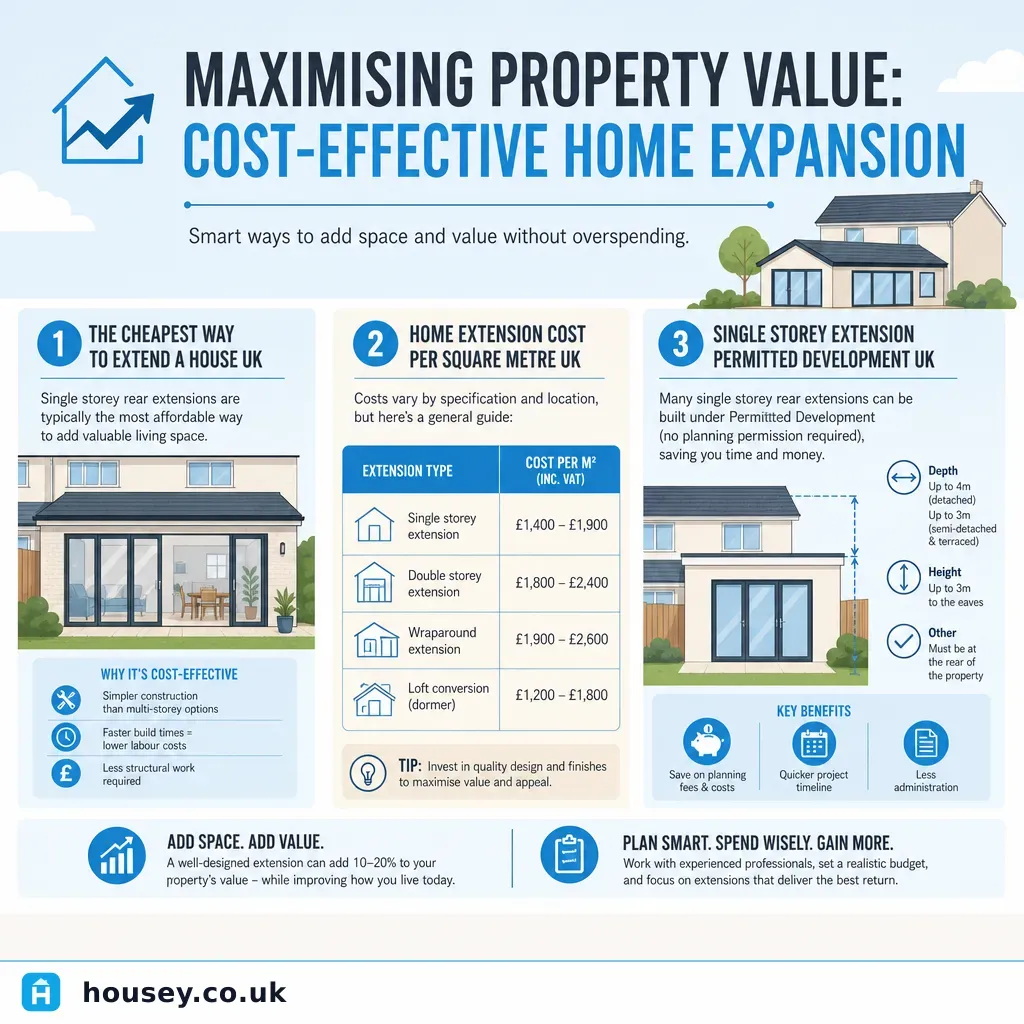
Maximising Property Value: Cost-Effective Home Expansion
A cost-effective home extension in the UK typically starts with a single-storey rear extension under permitted development, using an extension builder or design-and-build firm to control costs.
 Improvement & Build
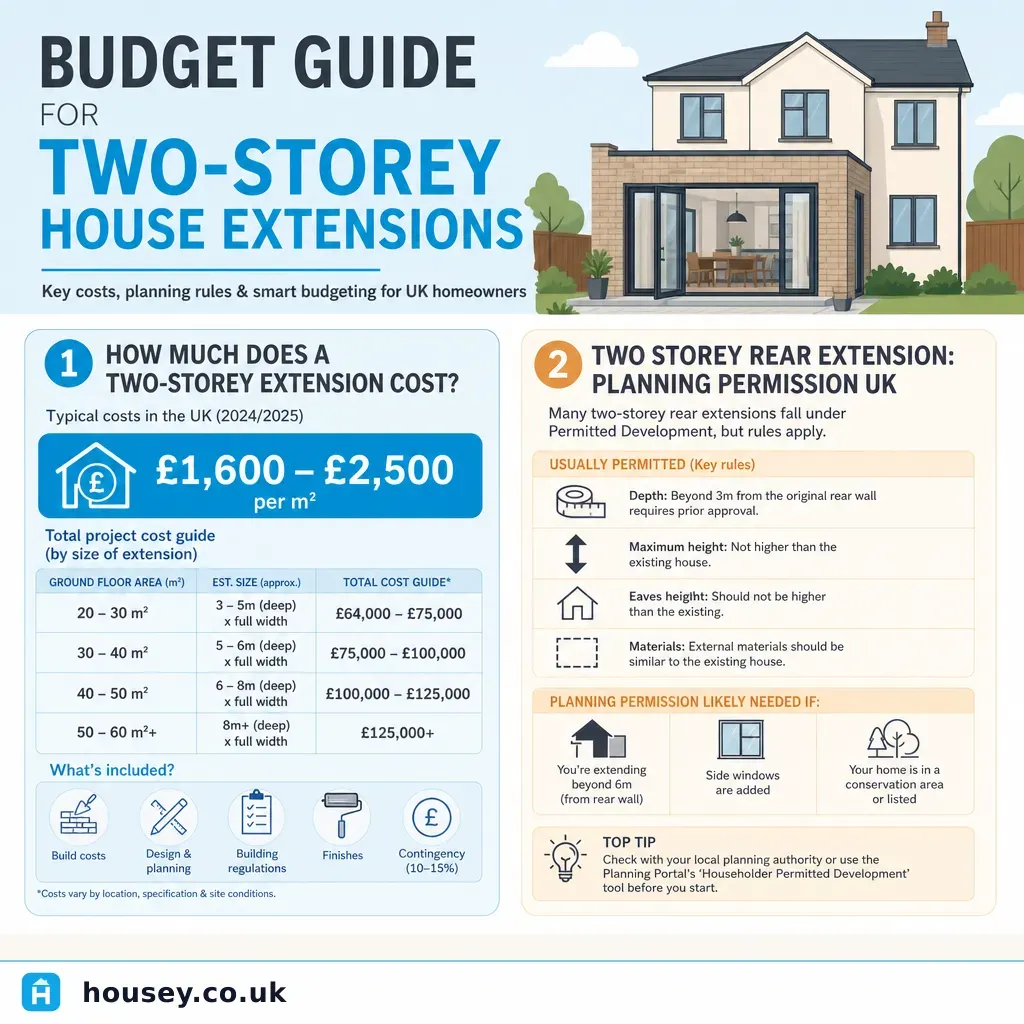
Budget Guide for Two-Storey House Extensions
A two-storey house extension in the UK typically costs £1,800–£3,000+ per square metre for the build alone.
 Improvement & Build
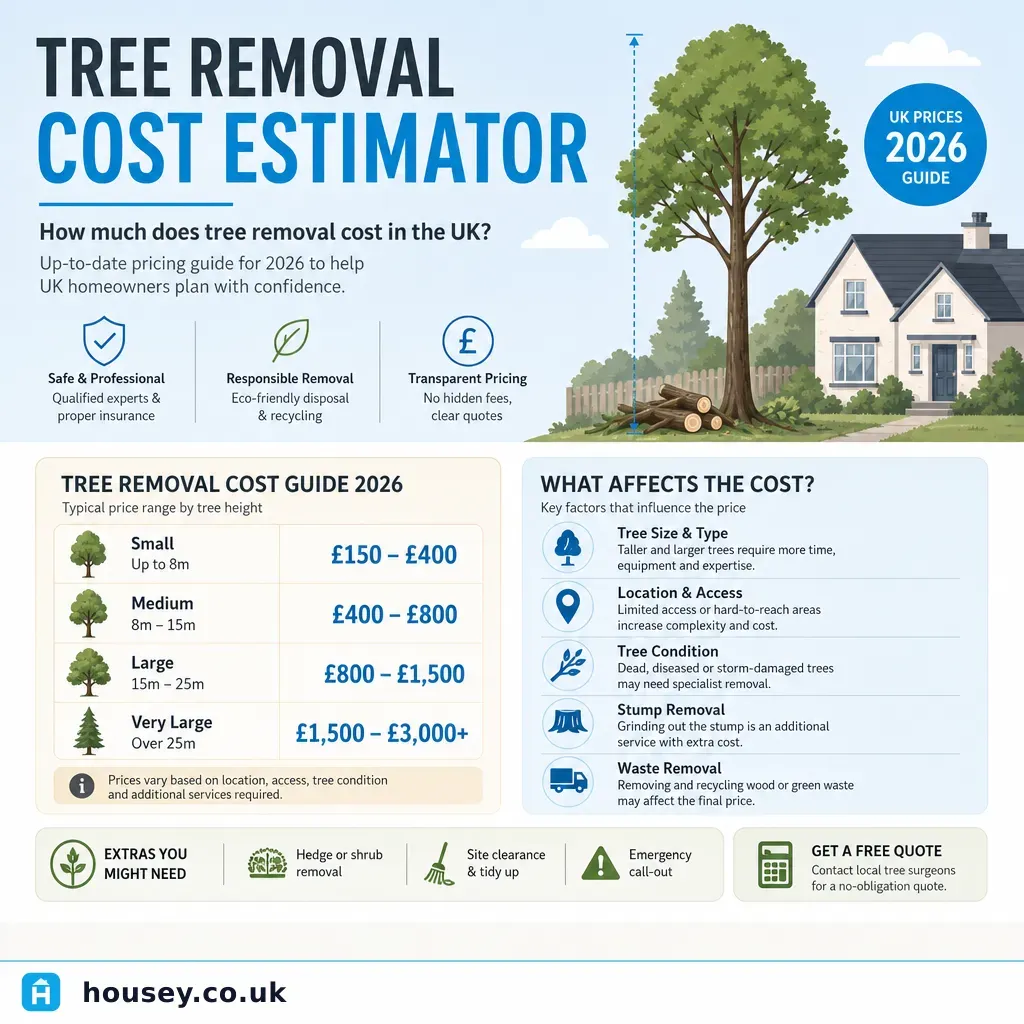
Tree Removal Cost Estimator
Tree removal in the UK costs roughly £150 to £5,000 or more, depending on the tree's height, species, access conditions, and whether stump removal is needed.
 Improvement & Build
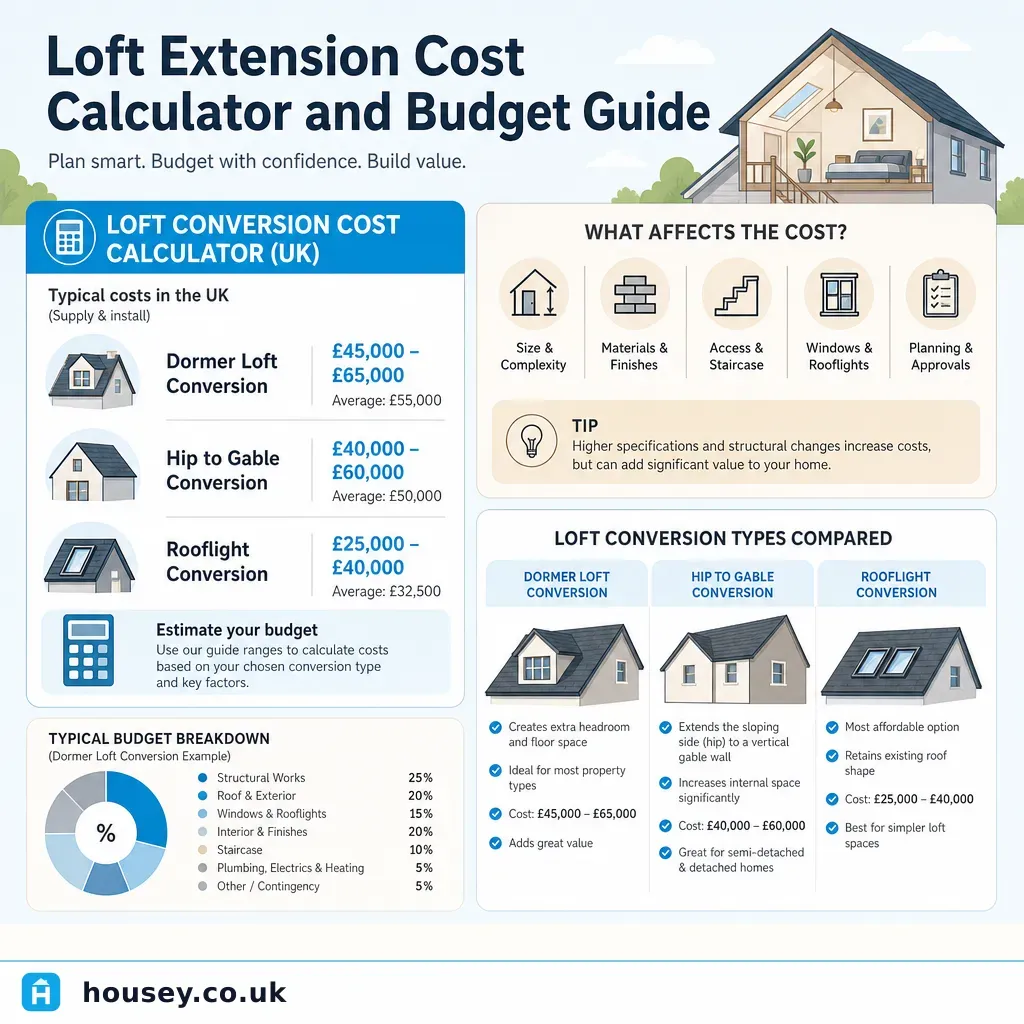
Loft Extension Cost Calculator and Budget Guide
Loft extension costs in the UK typically range from £15,000 for a basic Velux conversion to £75,000 or more for a mansard or L-shaped dormer.
 Improvement & Build
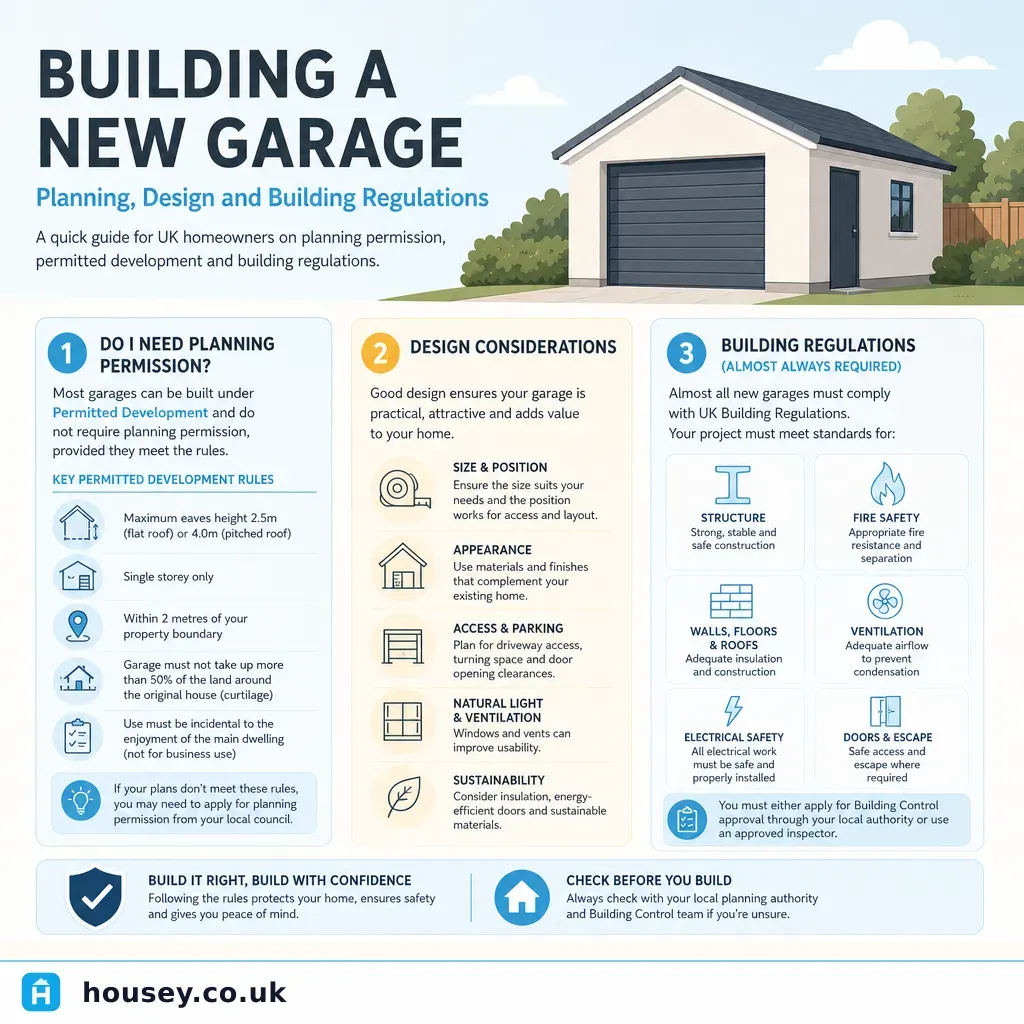
Building a New Garage: Planning, Design and Building Regulations
Most new detached garages in England qualify as permitted development and do not need planning permission, provided they stay within size, height, and coverage limits and are not within 5m of the dwelling.