Roof Truss Systems and Structural Design in Modern Construction
By Housey · Last reviewed 26th of May 2026
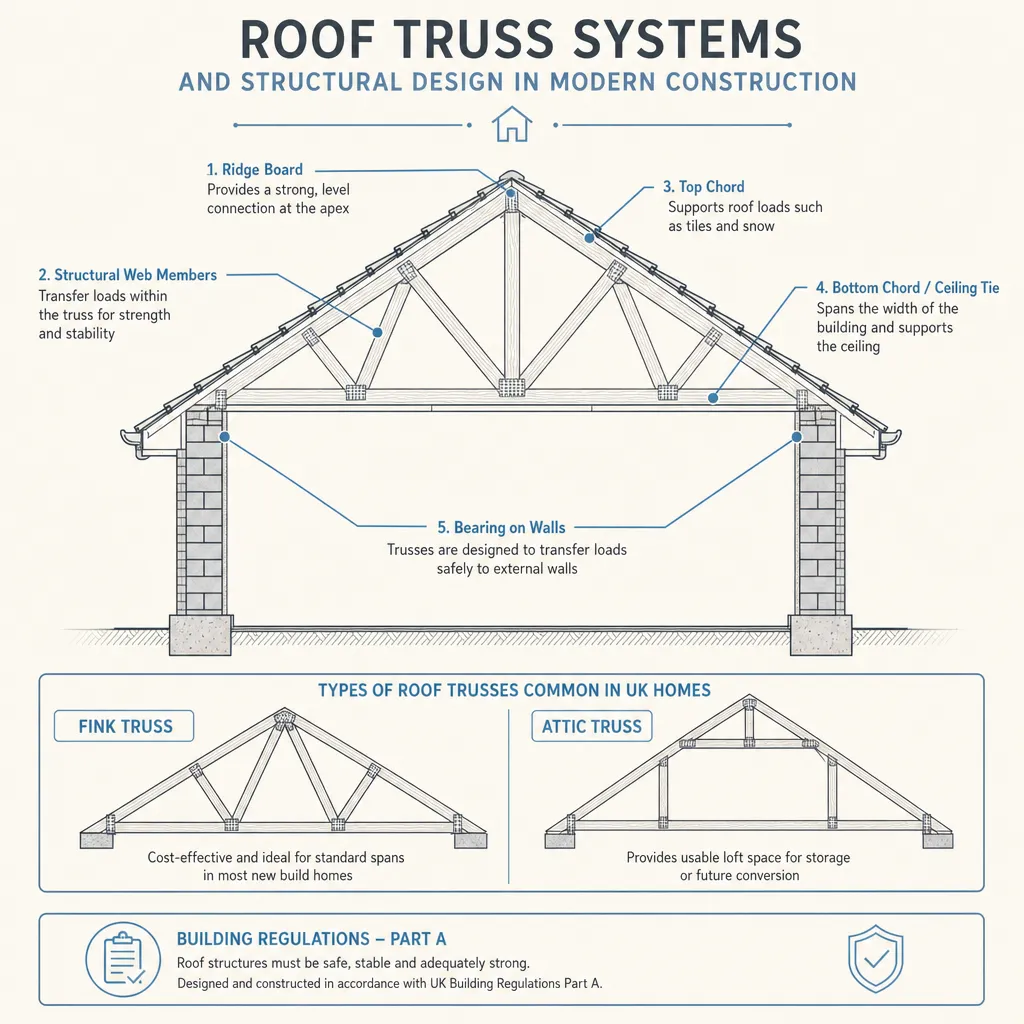
Roof Truss Systems and Structural Design in Modern Construction
Most UK homes built since the 1960s use factory-manufactured timber trusses to form the roof structure, yet these engineered components are rarely discussed until something goes wrong or a loft conversion is planned. Whether you are commissioning a new extension, investigating a structural concern flagged in a building survey, or considering converting your loft into habitable space, understanding how roof trusses are specified, designed, and installed can save significant cost and delay. Building Regulations Part A (Structure) governs all roof structural work, and unauthorised alterations to trusses remain one of the most frequently discovered defects when conveyancing solicitors request building control certificates.
Key points
- Factory-made timber roof trusses must be designed to BS EN 1995-1-1 (Eurocode 5) and BS EN 14250; each truss package is supplied with manufacturer engineering drawings specifying bracing, fixing, and loading requirements.
- Building Regulations Part A requires roof structures to carry dead loads — tiles, insulation, boarding — and imposed loads; snow loading for most of England is typically 0.75 kN/m² at ground level.
- Cutting or notching a manufactured roof truss — even for plumbing or electrical routes — can compromise structural integrity and must not be done without a structural engineer's written approval.
- A loft conversion in a trussed roof almost always requires the internal web members to be removed and replaced with structural steel or engineered timber beams; Building Regulations approval and a structural engineer's design are mandatory.
- Permanent longitudinal bracing is a non-negotiable part of every trussed roof installation; the manufacturer's drawings specify the exact layout, and omitting it constitutes a structural defect.
Types of roof truss and when each is used
Truss type | Configuration | Typical use | Internal loft space |
|---|---|---|---|
Fink (W-truss) | W-shaped internal web bracing | Standard residential pitched roofs — by far the most common type | None — all space occupied by web members |
Attic truss | A-frame with central habitable opening | When a usable loft room is needed from the outset of construction | Habitable room in centre section |
Mono-pitch (lean-to) | Single slope | Garages, single-storey extensions, outbuildings | Minimal |
Hip truss | Stepped end framing | Hipped roof ends on detached and semi-detached homes | None at hipped ends |
Room-in-roof truss | Raised tie configuration with larger central void | Larger budgets requiring habitable loft without full structural alteration | Full habitable loft room |
Scissor truss | Raised bottom chord creating vaulted ceiling | Open-plan areas where a cathedral ceiling effect is wanted | Vaulted ceiling void only |
Parallel chord (flat roof) | Horizontal top and bottom chords with internal web | Very low-pitch or flat roofs, some commercial applications | Ceiling void only |
How roof trusses are designed and specified
The design process for a trussed roof involves several parties whose roles are often misunderstood on residential projects:
- Architect or designer sets out the roof geometry — span, pitch, ridge height, overhang, and any dormers or structural openings required.
- Truss manufacturer's engineer uses the geometry to design individual trusses using proprietary software, calculating member sizes, connector plate specifications, bracing requirements, and bearing details to Eurocode 5 and BS EN 14250.
- Structural engineer (appointed separately where spans are large, openings penetrate the roof plane, or loft conversion is planned) reviews loading assumptions, interfaces with other structural elements, and signs off on any deviation from standard truss design.
- Building control body — either a local authority building control inspector or an approved inspector — checks that the design satisfies Part A before structural work begins.
- Installer erects trusses strictly to the manufacturer's installation drawings, including all temporary propping and permanent bracing at every stage.
For standard residential spans of up to approximately 11–12 metres, most truss manufacturers carry out their own structural design as part of the supply package. For larger spans, complex hip geometry, or where openings are required in the roof plane, an independent structural engineer's input before the truss order is placed is strongly advisable.
Bracing — the most commonly missed installation step
Permanent longitudinal bracing — typically 25×100 mm or 38×89 mm treated softwood fixed diagonally across top chord, bottom chord, and web members at intervals specified in the manufacturer's drawings — is essential for the roof to function as a three-dimensional structural system. Individual trusses are two-dimensional frames; bracing ties them together so the assembly can resist racking, wind loads, and member buckling.
Building control inspectors check bracing at the frame stage before tiles or insulation are installed. If a building control certificate was not obtained for a previous roof installation — common on extensions built before the mid-1980s — there may be no record of whether bracing was correctly fitted. A RICS Level 3 building survey or a structural engineer's inspection can assess visible bracing in an accessible loft void.
Loft conversions in trussed roofs
Converting a trussed roof loft into habitable space is one of the most common structural interventions in UK housing and also one of the most frequently under-specified. Standard fink trusses cannot simply be cut away — they carry load in multiple directions, and removing web members without a replacement load path causes the roof to spread at eaves level and can crack internal walls.
The typical structural approach involves:
- A structural engineer designing a new support system using steel beams (universal column or universal beam sections) or engineered timber (laminated veneer lumber or glulam) to carry loads previously carried by the truss web members.
- New floor joists or a structural floor deck designed to the imposed floor load for habitable use — typically 1.5 kN/m² for a bedroom.
- Building Regulations applications covering Part A (structure), Part B (fire resistance and means of escape), Part K (stairs and balustrades), Part L (thermal envelope), and Part F (ventilation).
Carrying out a loft conversion without Building Regulations approval creates a serious legal liability at point of sale and may make the property unmortgageable until regularisation is obtained.
Important limitations
This article provides general educational information about roof truss systems and the structural principles involved. Roof structures vary significantly depending on span, pitch, geometry, loading, timber specification, and the property's age and condition. Nothing here constitutes structural engineering advice for any specific property. A chartered structural engineer must assess your individual situation before any alteration, removal, or addition to trussed roof members is carried out.
When this becomes urgent
Seek immediate professional advice if:
- Any roof truss member has been cut, notched, or partially removed — even if the roof appears stable in the short term.
- Cracking or movement is visible at eaves level, at wallplates, or in load-bearing walls directly below the roof structure.
- The ridge line is visibly curved, sagging, or the roof plane is no longer flat when viewed from the outside.
- Water damage, rot, or fungal staining is visible on truss members, connector plates, or wallplates.
- You are purchasing a property where a loft conversion was carried out and building control completion was not obtained.
- A RICS surveyor has flagged truss bracing, spreading, or structural concerns in a building survey report.
What to ask a qualified professional
Before instructing a structural engineer or truss specialist, ask:
- Are you a Chartered Member of the Institution of Structural Engineers (MIStructE) or the Institution of Civil Engineers (MICE)?
- Will you produce stamped engineering drawings suitable for submission to building control?
- What loading assumptions will you apply — snow zone, wind exposure category, tile dead load?
- Will you carry out a site visit to inspect the existing structure before designing any alteration?
- If the scope involves a loft conversion, will your design include the floor structure and staircase opening as well as the roof?
- What are your professional indemnity insurance limits and the policy excess?
When to get professional help
Beyond the urgent scenarios listed above, professional input is advisable whenever:
- You are planning any roof extension, dormer, or structural alteration, even one that appears minor from the outside.
- You have purchased a property built before building control computerised records (roughly pre-1985) and want confidence that the roof structure is correctly braced and bears correctly on the wallplates.
- A contractor has quoted for a loft conversion without mentioning structural engineering input — this is a significant red flag.
- You are procuring a new extension with an unusual or large roof span and the builder has not included a structural engineer in the design team.
How Housey can help
Housey connects homeowners with structural engineers who can assess existing roof structures, specify alterations, and produce the engineering drawings building control requires. Once the structural design is confirmed, our qualified roofers can advise on practical installation, tile choice, and compliance with Part L thermal requirements.
Frequently asked questions
Do I need a structural engineer for roof trusses on a new extension?
In most cases, the truss manufacturer produces engineering drawings as part of the supply package for standard residential spans. However, if the extension has an unusual span — typically over 10–12 metres — complex geometry, or interfaces with a load-bearing wall opening, an independent structural engineer should review the design. Building control requires evidence that the structure meets Part A regardless of who carried out the design.
Can I use my loft space for storage if I have a trussed roof?
Light storage is generally possible on boarded sections between truss bottom chords, but you should not overload the area. The bottom chord of a standard fink truss is sized for ceiling loads, not floor-level imposed loads. If in doubt, a structural engineer can assess whether additional boarding and loading is safe for your specific truss design.
How long do timber roof trusses last?
Timber roof trusses in a dry, well-ventilated loft can last the full life of the building — 60 years or more. The main risks are moisture ingress causing rot, insect attack in older unventilated roofs, and damage from subsequent unauthorised alterations. A structural engineer or chartered surveyor can assess truss condition as part of a property inspection.
What is the difference between a cut roof and a trussed roof?
A cut (traditional) roof is built on site from individual rafter, purlin, ridge board, and collar tie members cut and fixed by a carpenter. A trussed roof uses factory-manufactured frames lifted into place on site. Cut roofs are more common in pre-1960s properties and offer more inherent loft space; trussed roofs are faster to erect and more structurally consistent for standard residential spans.
Sources and further reading
Useful next reads
 Planning & Pre-Build
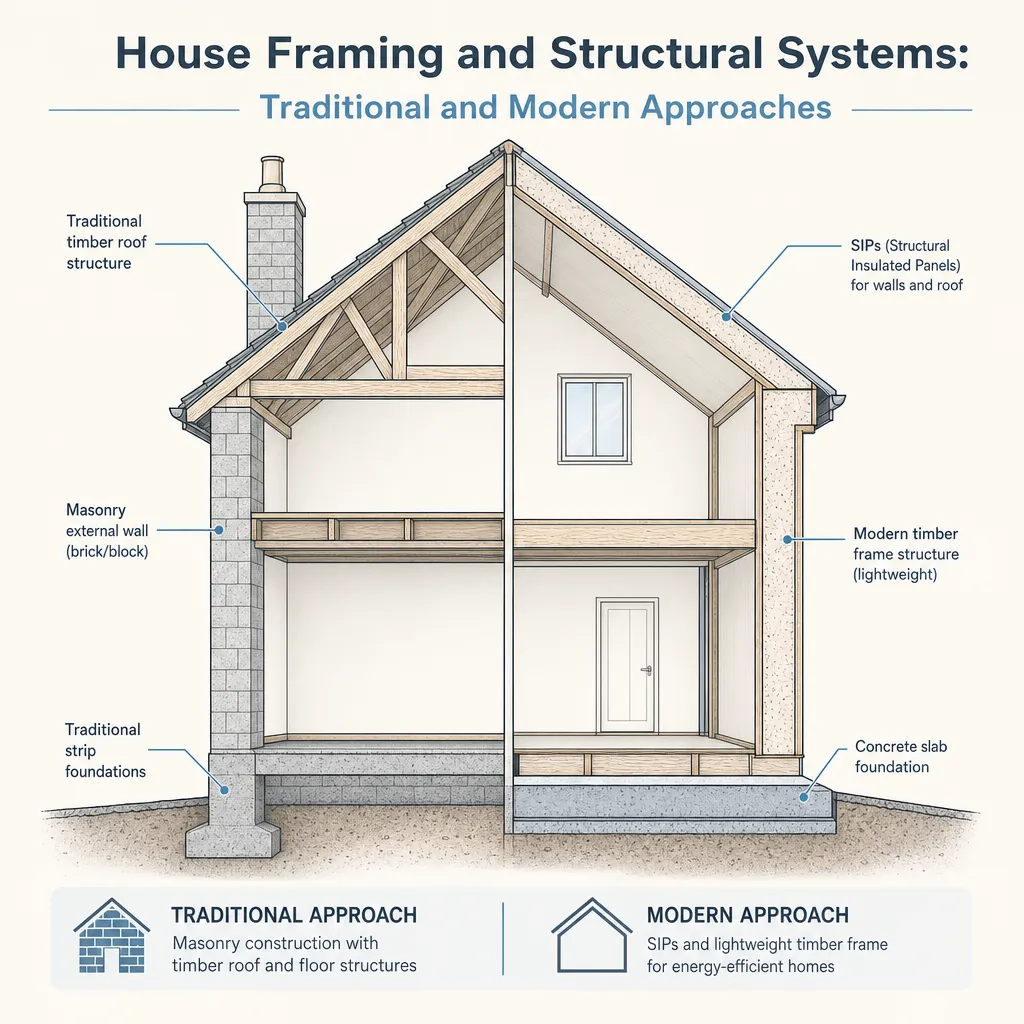
House Framing and Structural Systems: Traditional and Modern Approaches
UK homes are built using four main structural systems: traditional masonry (brick and block), timber frame, structural insulated panels (SIPs), and insulated concrete formwork (ICF).
 Planning & Pre-Build
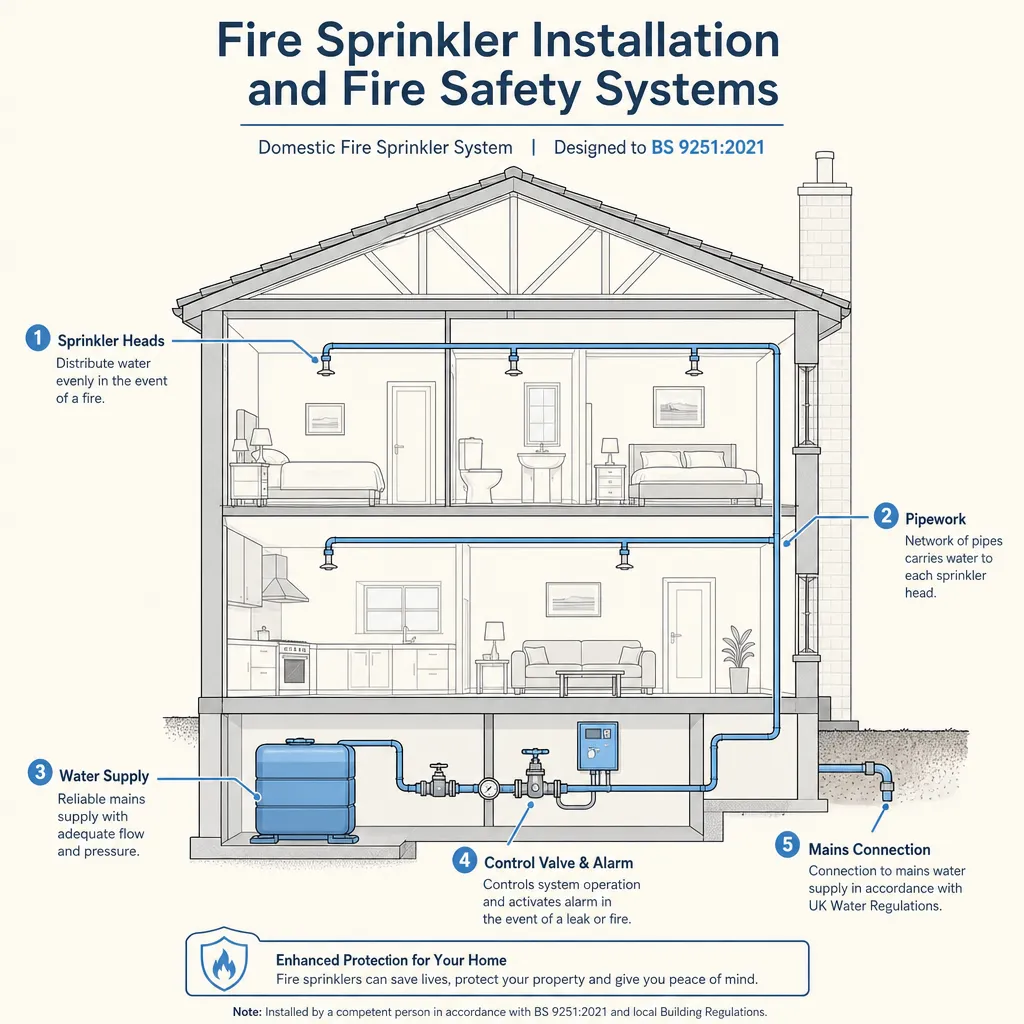
Fire Sprinkler Installation and Fire Safety Systems
Residential fire sprinkler systems in the UK must comply with BS 9251:2021.
 Planning & Pre-Build
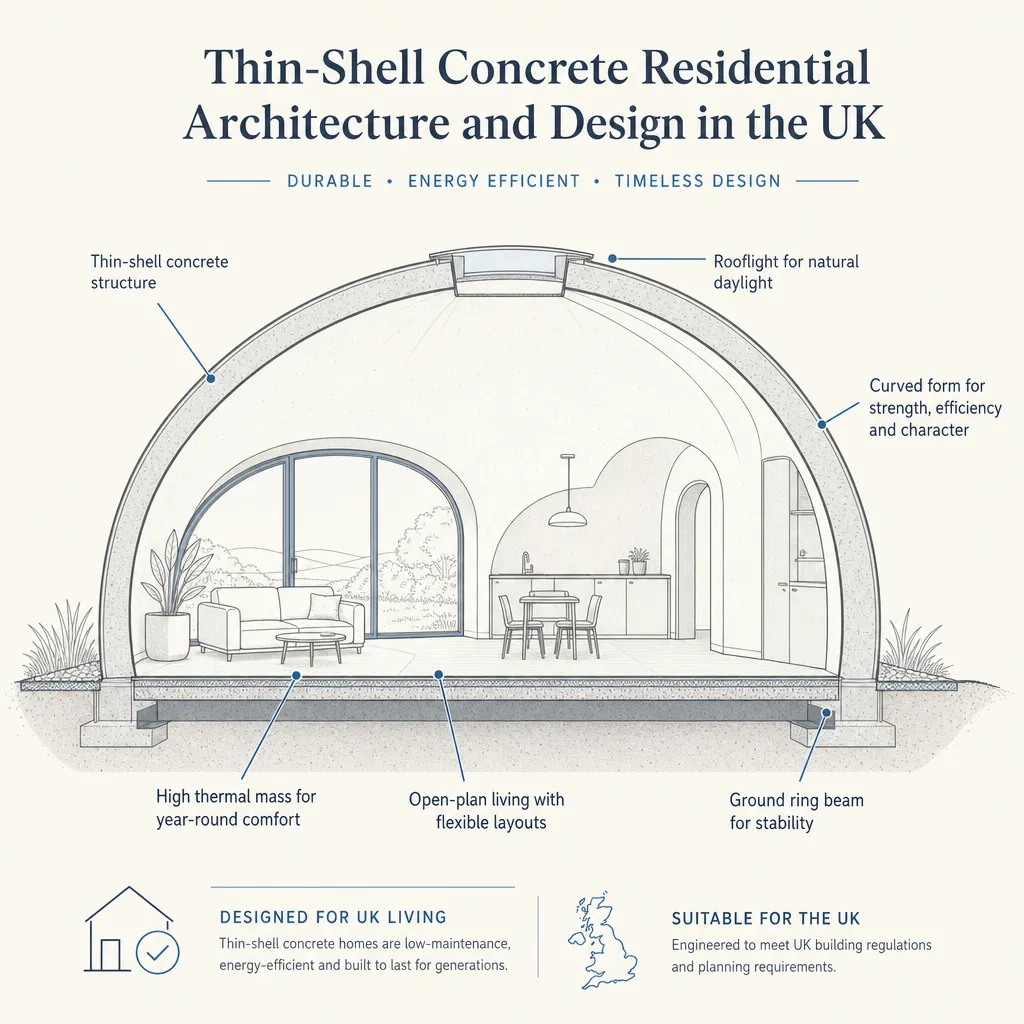
Thin-Shell Concrete Residential Architecture and Design in the UK
Thin-shell concrete construction uses curved or folded concrete forms — including domes, vaults, and hyperbolic paraboloids — to achieve structural efficiency through shape rather than mass.
 Planning & Pre-Build
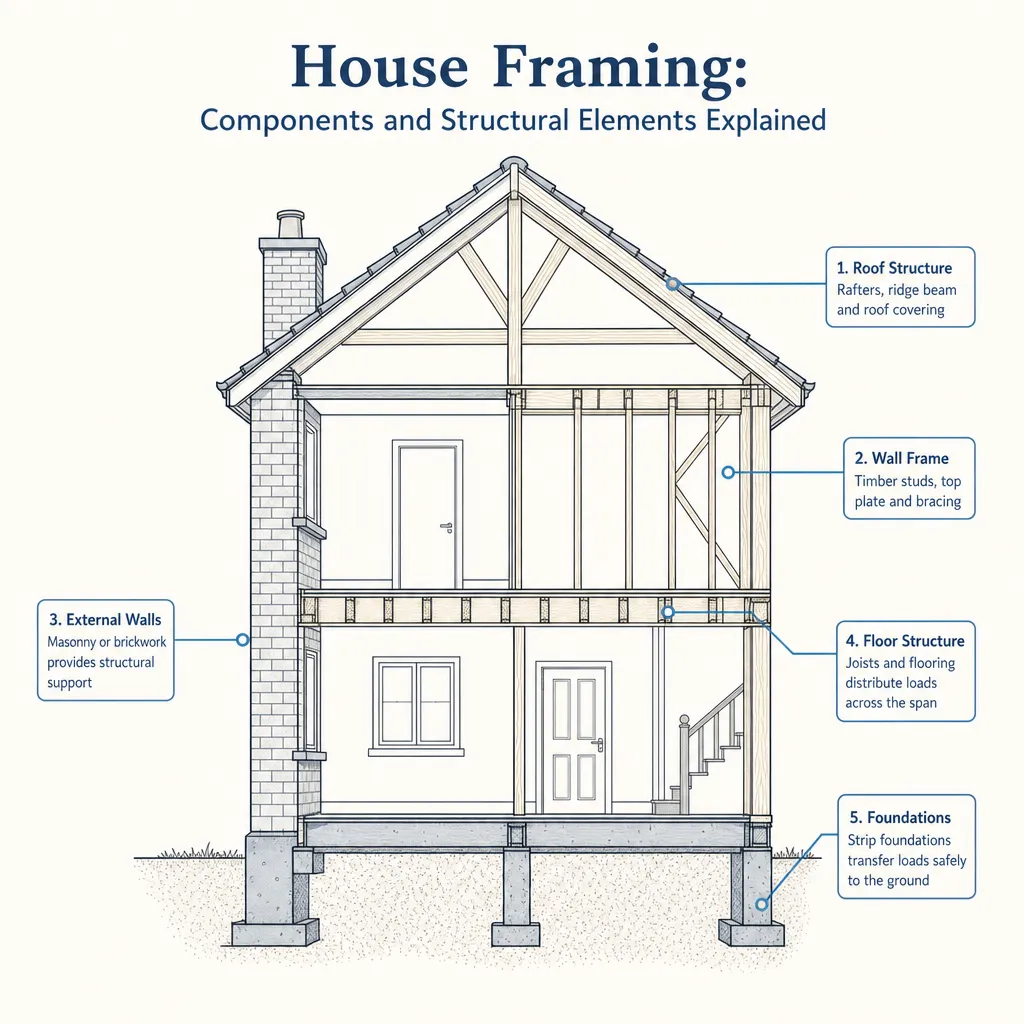
House Framing: Components and Structural Elements Explained
Most UK homes are built from load-bearing masonry — brick and block cavity walls — or, increasingly, from factory-engineered timber frames where the masonry outer leaf is non-structural cladding.
 Planning & Pre-Build
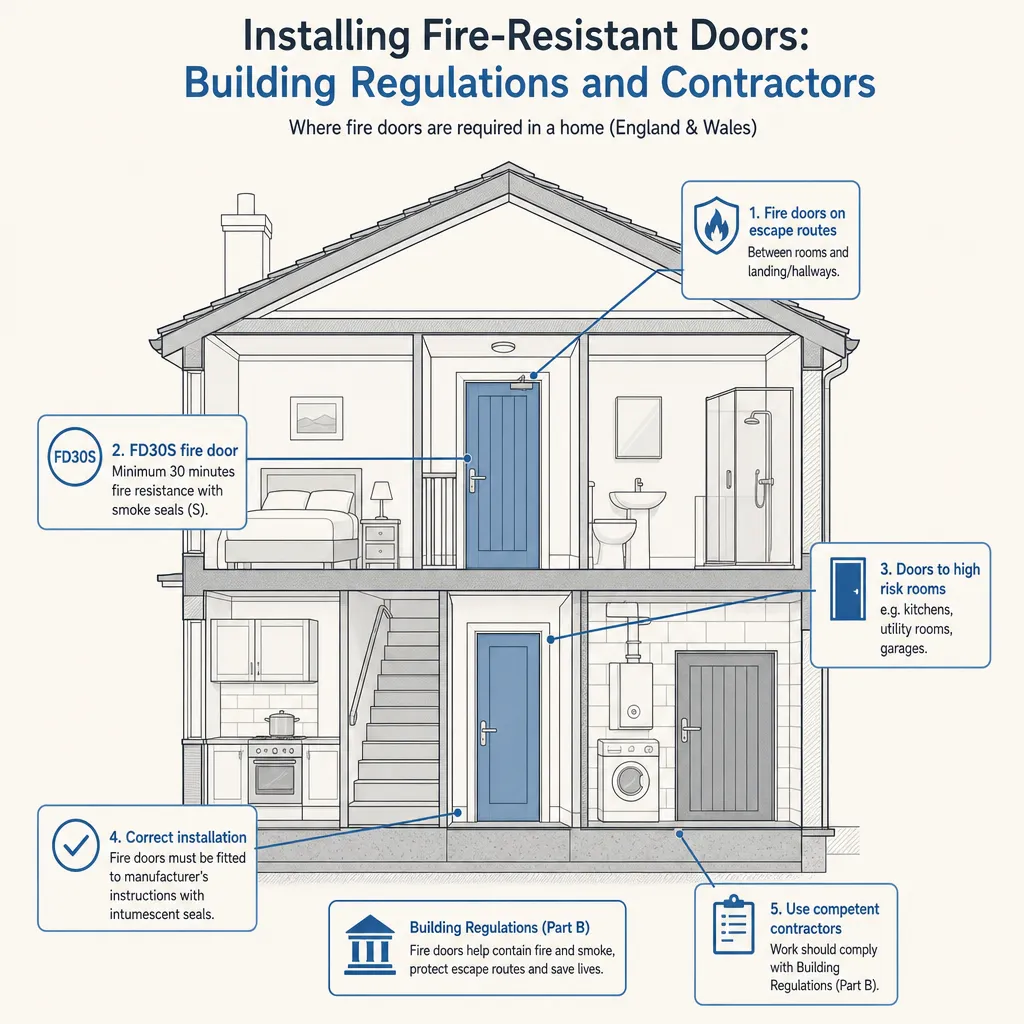
Installing Fire-Resistant Doors: Building Regulations and Contractors
Fire doors are required by Building Regulations in specific locations — including integral garages, properties of three or more storeys, loft conversions, and HMOs.