Stone Wall Cavities: Design, Function, and Maintenance
By Housey · Last reviewed 11th of May 2026
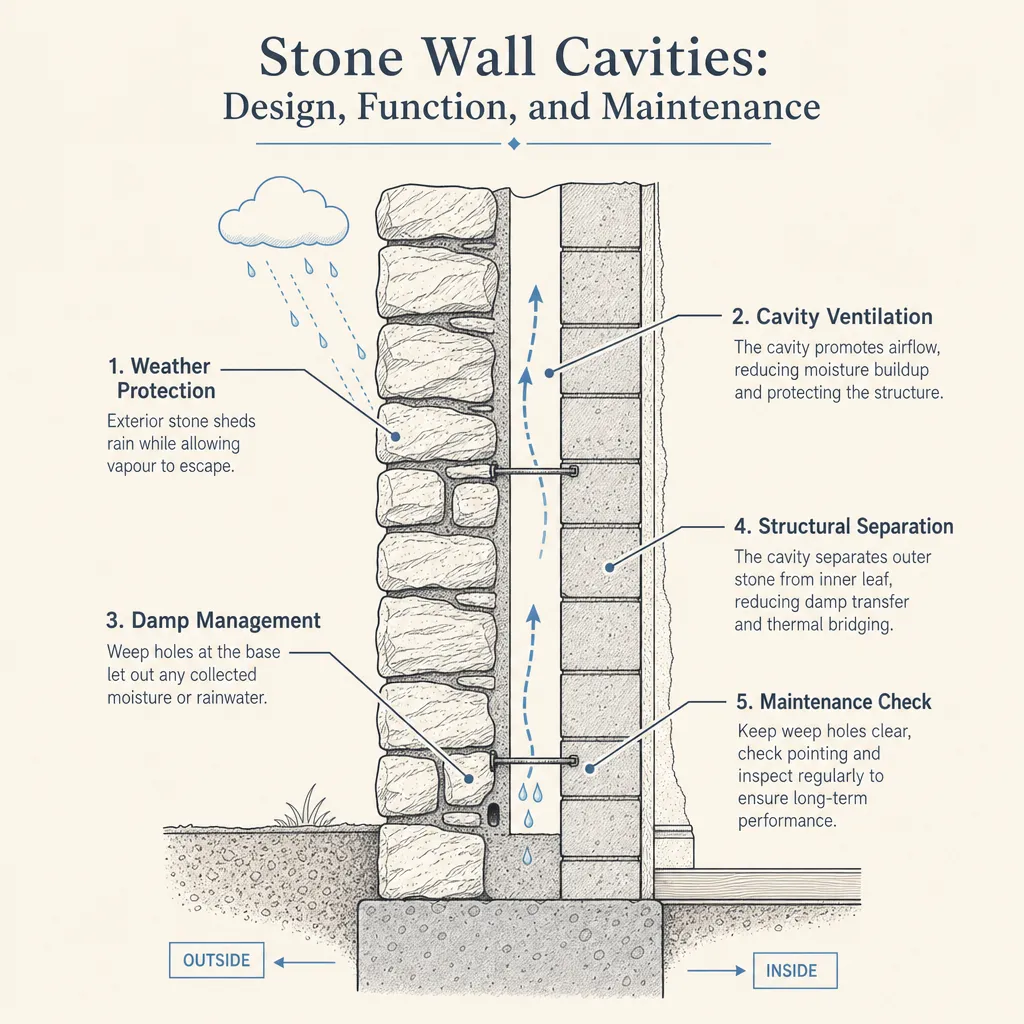
Stone Wall Cavities: Design, Function, and Maintenance
Most UK homes built before 1920 — particularly in stone-building regions such as the Yorkshire Dales, the Cotswolds, Scotland, and Wales — were constructed with solid stone walls several hundred millimetres thick. Cavity construction arrived later, initially in brick and only gradually in stone, and today the term 'stone wall cavity' covers two quite different things: a traditional thick stone wall designed to manage moisture through mass, and a modern or late-20th-century cavity wall with a stone facing on its outer leaf. Knowing which type you have determines how it should be designed, maintained, and repaired.
Key points
- Traditional solid stone walls in UK vernacular construction typically measure 450–750 mm thick; moisture resistance comes from the wall's mass and drainage capacity, not from an air gap.
- Rubble-core stone walls — two stone skins bonded with internal rubble fill — are not true cavity walls; they have no drainage cavity and behave structurally differently from both solid stone and modern cavity construction.
- Modern stone-faced cavity walls follow standard cavity-wall construction principles, with a 50–100 mm cavity, wall ties, insulation, and a facing-stone outer leaf; BS EN 1996-1-1 (Eurocode 6) governs structural masonry design.
- Repointing stone walls on listed buildings or in conservation areas must typically use a lime-based mortar compatible with the original; ordinary Portland cement can trap moisture and cause spalling damage in softer stone types.
- Historic England guidance emphasises that traditional stone buildings should be maintained using breathable, compatible materials to preserve their moisture-regulating properties and prevent accelerated decay.
Three types of stone wall construction in UK homes
Understanding the wall type is fundamental before specifying any maintenance or repair.
Solid stone walls
The most common form in pre-1920 vernacular construction. Thickness varies from approximately 350 mm in Cotswold limestone cottages to over 750 mm in Scottish granite farmhouses. Moisture management relies on:
- Wall mass absorbing driving rain, then drying out between weather events.
- Dense outer faces shedding the majority of water.
- Breathable lime mortar that allows moisture vapour to pass through the wall rather than becoming trapped.
These walls rarely include a horizontal DPC; in traditional practice, the mass of a well-built stone wall was considered sufficient to manage moisture from damp subsoil.
Rubble-core stone walls
Common in parts of Scotland and in vernacular cottage construction throughout northern England and Wales. Two roughly dressed stone faces with a rubble-and-mortar core fill. This is a solid wall variant — not a cavity — and has no structural air gap. Moisture management is similar to solid stone construction. Repointing and occasional core consolidation are the principal maintenance tasks.
Modern stone-faced cavity walls
From the 1970s onwards, stone became widely used as a facing material on standard cavity walls. The structural logic is identical to brick-leaf cavity construction: inner skin of blockwork or brick, 50–100 mm cavity, outer skin of facing stone. Wall ties, cavity insulation, cavity trays above openings, and weep holes all apply as they would in any cavity wall.
Comparison: traditional solid stone vs. modern stone-faced cavity
Feature | Traditional solid stone | Modern stone-faced cavity |
|---|---|---|
Typical construction era | Pre-1920 | Post-1970 |
Moisture management | Mass and breathability | Cavity drainage, DPC, cavity trays |
Typical wall thickness | 350–750 mm | 270–350 mm (including cavity) |
Insulation approach | External wall insulation or internal dry-lining | Cavity fill or partial-fill batts |
Common maintenance issue | Mortar erosion, spalling, missing pointing | Cavity tray failure, tie corrosion, mortar decay in stone joints |
Listed building considerations | High — frequently applies | Lower — depends on property age |
Mortar specification | Hydraulic lime, NHL 2–5 per BS EN 459-1 | General-purpose mortar for inner skin; lime-compatible mix for stone joints |
Which option should you choose?
If you are specifying new stone wall construction or advising on a proposed extension or repair:
- Choose solid stone construction if the project is in a conservation area or involves a listed building and the local planning authority or conservation officer requires traditional methods.
- Choose modern stone-faced cavity construction if you need the thermal performance required by Building Regulations Part L and the planning context permits modern construction methods.
- Ask a structural engineer or chartered building surveyor if the existing stone wall shows signs of delamination, bulging, or settlement before undertaking any extension or repair.
- Check with your local planning authority before any repointing, repair, or alteration to stone walls on a listed building or within a conservation area — some works require listed building consent or planning permission even where they appear minor.
Maintenance priorities for stone walls
Repointing
Mortar joints erode faster than the stone itself, particularly in exposed upland or coastal locations. Key maintenance rules:
- Inspect mortar joints every 5–10 years; repoint when joints show erosion of more than 20–25 mm depth.
- Match mortar strength and composition to the existing wall and stone type. Harder stone such as granite or gritstone can tolerate a slightly stronger mix; softer stone such as sandstone or limestone requires a weaker hydraulic lime mix to avoid moisture trapping.
- Avoid ordinary Portland cement in the joints of traditional stone walls — it is harder than most stone and causes spalling as moisture cycles through the wall.
- For listed buildings, the SPAB (Society for the Protection of Ancient Buildings) and Historic England both publish detailed guidance on appropriate lime mortar formulations.
Drainage and water management
Stone walls — particularly solid walls — depend on adequate drainage at their base. Ensure:
- Ground levels are not raised against the wall base; maintain a minimum 150 mm clearance below any DPC, or below the lowest stone course for walls without a DPC.
- Guttering and downpipes discharge clear of the wall base.
- Earth or vegetation is not banked against the wall face.
- Weep holes are clear in any modern stone-faced cavity wall.
Cavity maintenance in modern stone-faced walls
For modern cavity construction with a stone outer leaf, standard cavity wall maintenance applies: check cavity trays above windows and lintels periodically, ensure weep holes remain unblocked, and monitor wall tie condition — particularly in coastal environments where salt accelerates corrosion.
When to get professional help
Stone walls — particularly traditional ones — reward early professional advice. Consult a qualified professional if:
- You notice bulging, delamination, or leaning sections of stonework.
- Damp patches appear on internal faces despite apparently intact mortar joints.
- You are planning any alteration, extension, or repair on a listed building or within a conservation area.
- You are uncertain which type of stone wall construction your property has before commissioning insulation or other retrofit work.
A RICS-qualified chartered surveyor or building surveyor experienced in traditional construction can carry out a damp and timber survey to assess moisture conditions and recommend appropriate remediation. For design and specification of new stone wall elements, an architectural technologist with traditional build experience can advise on both technical performance and planning requirements.
How Housey can help
Housey connects homeowners with specialists in traditional building surveying and design. Whether you need a damp and timber survey to investigate moisture in a stone-built property, or an architectural technologist to specify a stone wall extension or repair that meets planning and building regulation requirements, Housey's network includes professionals with experience in stone construction across England, Scotland, and Wales.
Frequently asked questions
Do traditional stone walls have cavities?
Genuine traditional stone walls — particularly those built before 1920 in vernacular regional styles — are almost always solid construction, ranging from roughly 350 mm to 750 mm thick. They do not have an air cavity. Moisture resistance comes from wall mass, breathable lime mortar, and the natural density of the stone. Some rubble-core walls have an internal fill layer, but this is not a drainage cavity and functions differently from a modern cavity wall.
What mortar should be used to repoint a stone wall?
The correct mortar depends on the stone type, exposure level, and original construction. For most traditional stone walls, a hydraulic lime mortar (NHL 2, NHL 3.5, or NHL 5 per BS EN 459-1) mixed with appropriate aggregate is recommended. Ordinary Portland cement should generally be avoided as it is harder than most stone and can trap moisture, causing spalling. The SPAB can advise on mix specification for specific stone types.
Do I need planning permission to repair a stone wall?
For like-for-like repairs using matching materials on an unlisted property, planning permission is usually not required. However, listed building consent is needed for most alterations to listed buildings including repointing and stone replacement. Works in conservation areas may also be subject to additional controls. Always check with your local planning authority before starting, as unauthorised works to a listed building can be a criminal offence.
How do I know if my stone wall has moisture problems?
Common signs include damp patches or tide marks on interior faces of external walls, efflorescence (white salts) on internal plasterwork, persistent mould on external walls, soft or swelling plaster, and eroded or missing mortar joints. A specialist surveyor using calibrated moisture meters and thermal imaging can distinguish between condensation, penetrating damp, and rising damp — all of which can present similarly in stone buildings.
Sources and further reading
- Repairing historic buildings: guidance on building materials and methods — Historic England
- Listed buildings: consent for alterations — GOV.UK
- SPAB: guidance on repointing historic masonry — Society for the Protection of Ancient Buildings
- BS EN 459-1: Building limes — BSI
- Approved Document L: Conservation of fuel and power — GOV.UK
Useful next reads
 Planning & Pre-Build
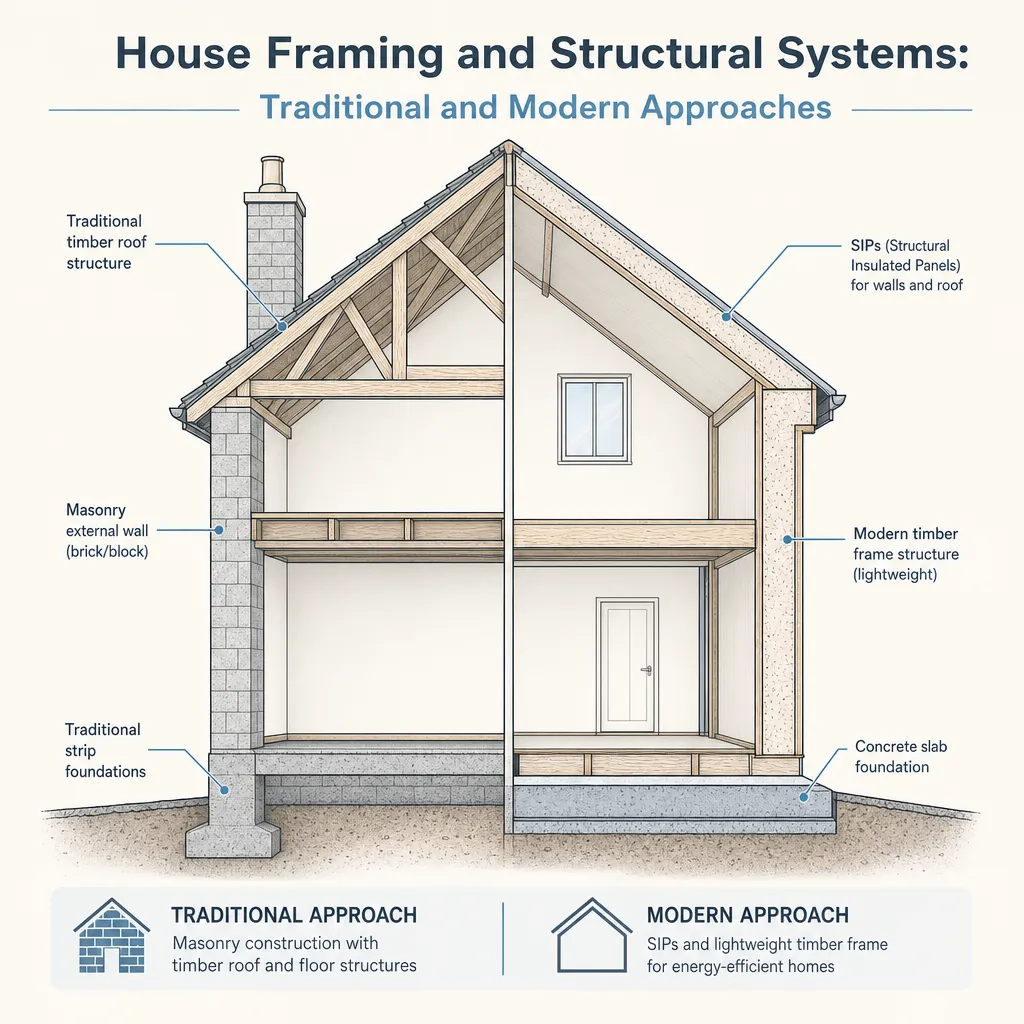
House Framing and Structural Systems: Traditional and Modern Approaches
UK homes are built using four main structural systems: traditional masonry (brick and block), timber frame, structural insulated panels (SIPs), and insulated concrete formwork (ICF).
 Planning & Pre-Build
Changes to Loft Conversion Rules: Permitted Development and Planning Updates
In England, most loft conversions on standard houses qualify as Permitted Development under Class B of the GPDO 2015, allowing up to 40 cubic metres (terraced) or 50 cubic metres (detached or semi-detached) without a planning application — if conditions are met.
 Planning & Pre-Build
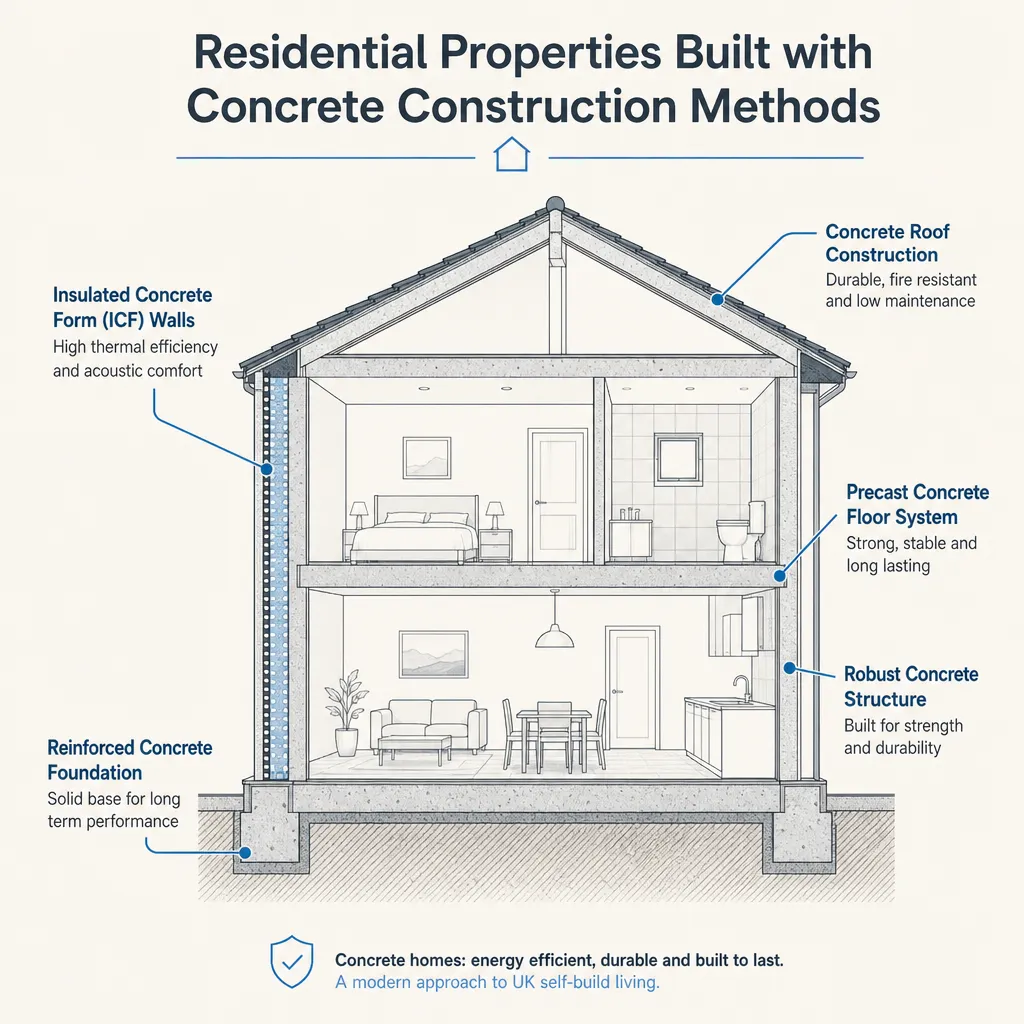
Residential Properties Built with Concrete Construction Methods
UK homes are built using several concrete methods: in-situ cast concrete, precast panel systems, insulating concrete formwork (ICF), and older non-traditional types such as Wimpey No-Fines and Laing Easiform.
 Planning & Pre-Build
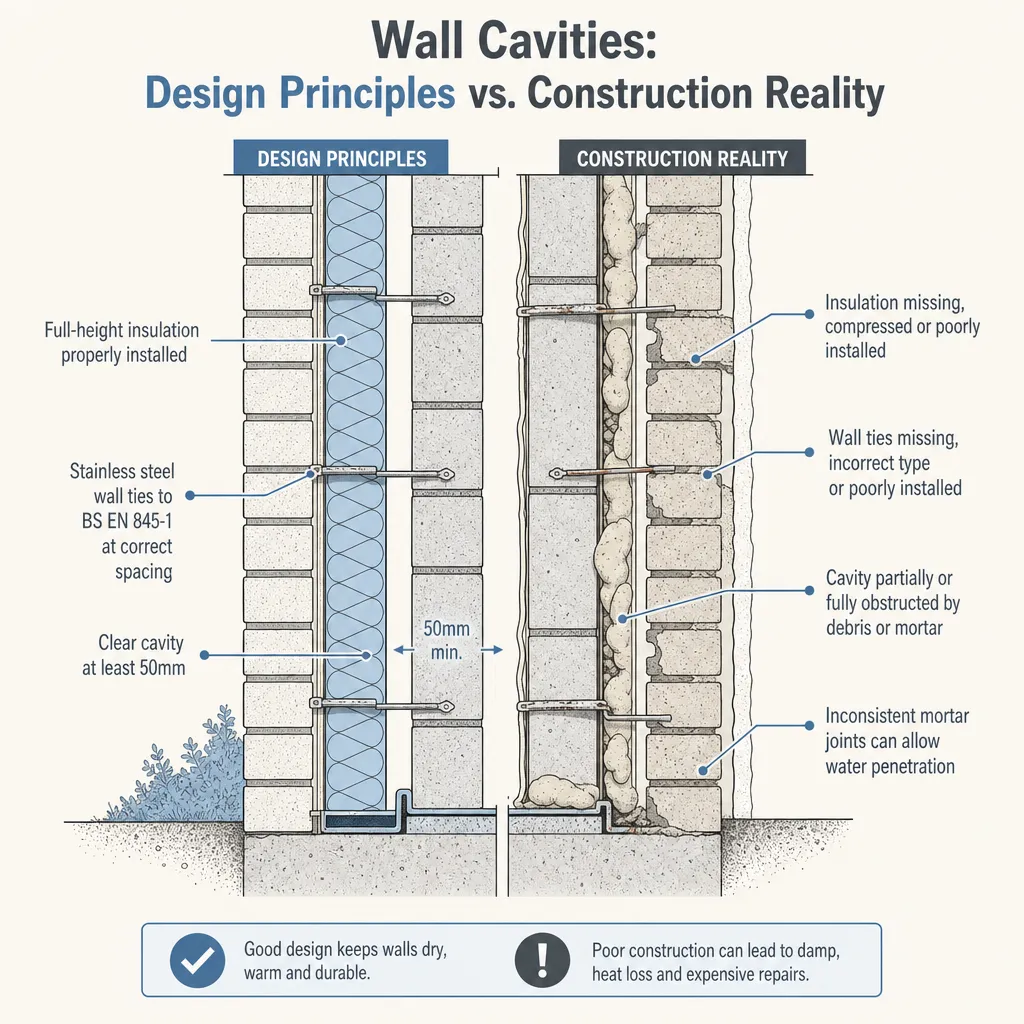
Wall Cavities: Design Principles vs. Construction Reality
A UK cavity wall is designed to resist weather, control heat loss, and structurally link two masonry leaves.
 Planning & Pre-Build
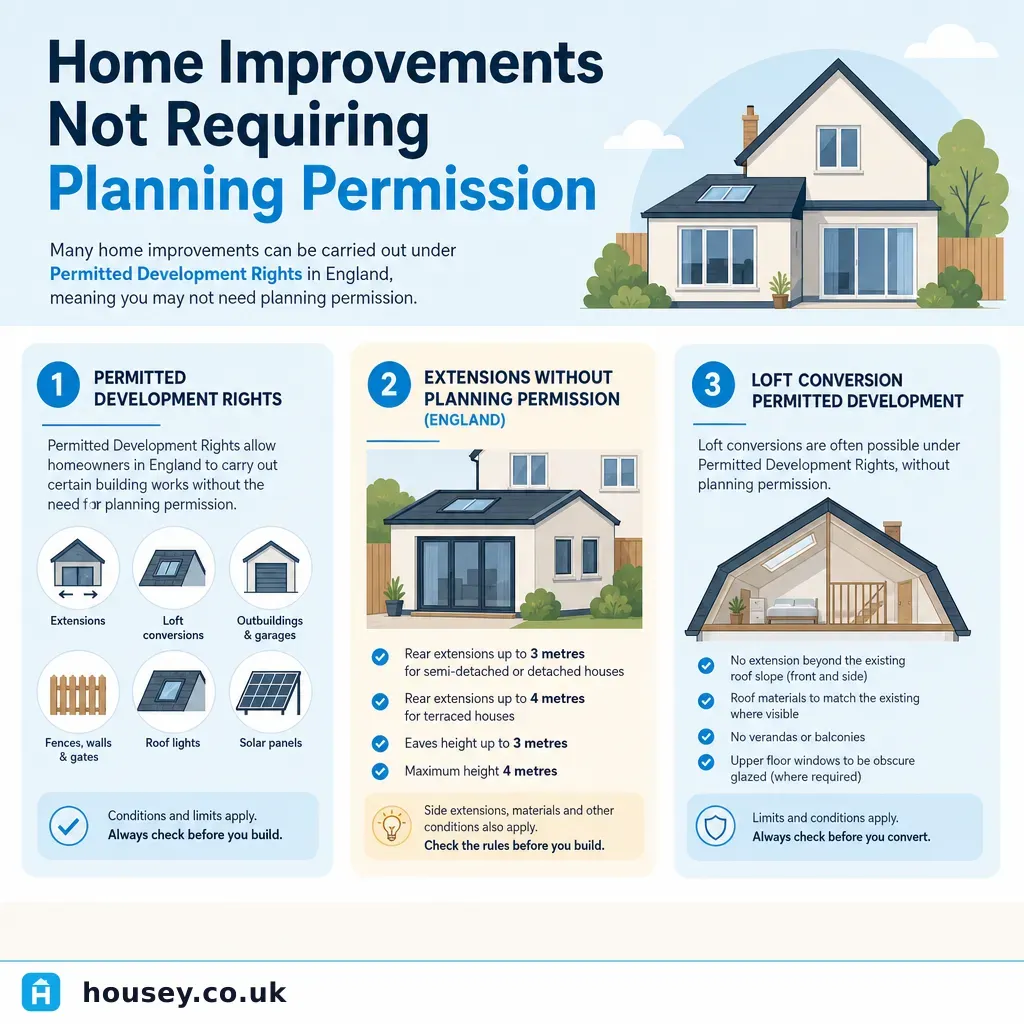
Home Improvements Not Requiring Planning Permission
Many common home improvements in England fall under Permitted Development Rights and do not require a planning application.