How Energy Audits Can Lower Your Heating and Running Costs
By Housey · Last reviewed 19th of May 2026
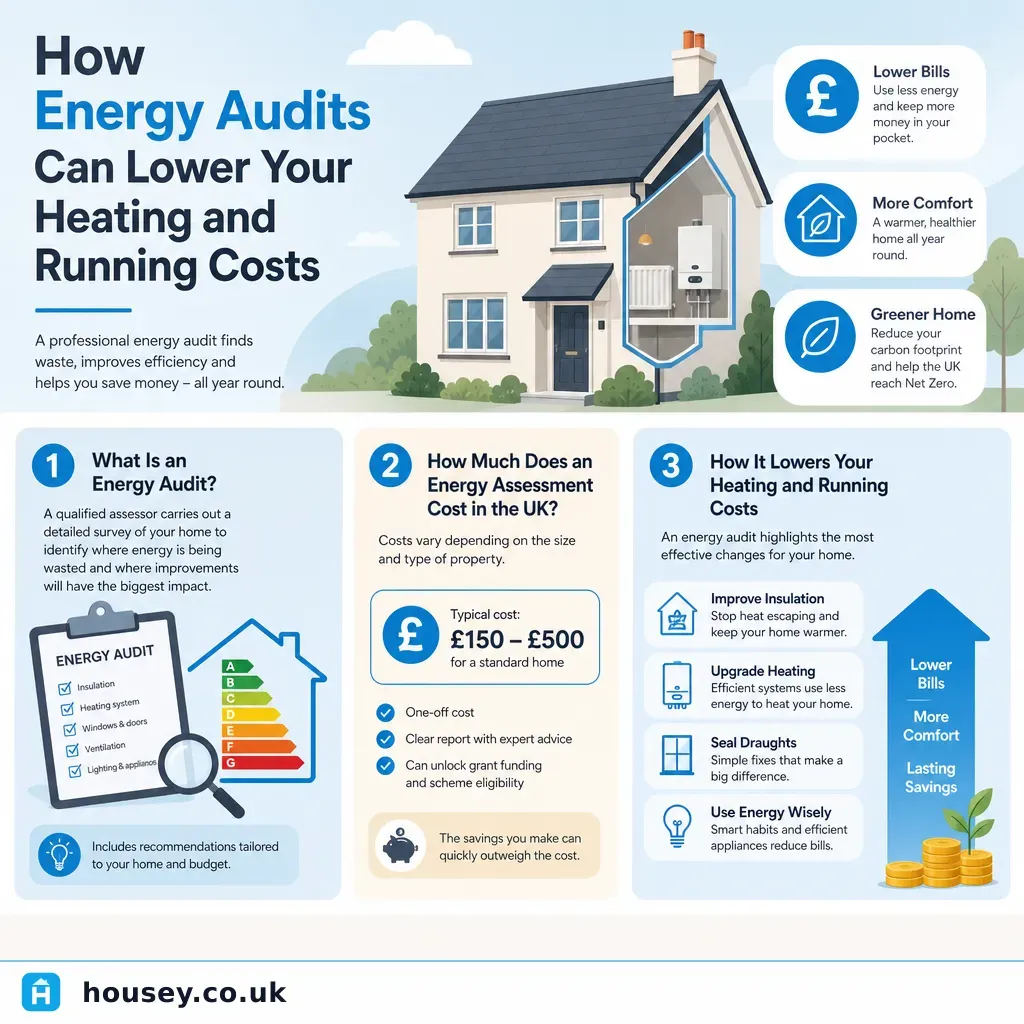
How Energy Audits Can Lower Your Heating and Running Costs
Many UK households are paying more than necessary to heat their homes because fixable heat loss points — poorly topped-up loft insulation, uninsulated cavity walls, draughty suspended timber floors, or ageing boiler controls — have never been systematically identified. An energy audit gives you a structured, property-specific view of where energy is being wasted, rather than relying on generic advice or guesswork about where to spend your improvement budget.
Key points
- For whole-house retrofit planning, look for a PAS 2035-qualified Retrofit Assessor or Retrofit Coordinator, accredited under TrustMark; this qualification is required for any work funded through ECO4 or the Home Upgrade Grant.
- An Energy Performance Certificate (EPC) is a mandatory transactional document using standardised modelled data — it is not the same as a home energy audit, which uses observed conditions at your specific property.
- Current Building Regulations recommend 270 mm of mineral wool insulation in accessible loft spaces; many UK homes built before 1995 have less than this, or none at all.
- ECO4 (Energy Company Obligation 4) and the Great British Insulation Scheme (GBIS) may fund insulation measures at no cost for eligible households, based on EPC rating and income.
- The Boiler Upgrade Scheme (BUS) offers grants of £7,500 toward an air source or ground source heat pump, but a heat pump survey is required first to confirm suitability and correct sizing.
What is a home energy audit?
A home energy audit is a detailed inspection of your property's energy performance — covering building fabric, heating system, hot water, ventilation, and sometimes appliances — to identify where energy is lost and how efficiently it is being used. Unlike an EPC, which applies a standardised calculation to produce a band rating, an energy audit observes your actual property and produces actionable, prioritised recommendations specific to your home.
Types of energy assessment compared
Assessment type | What it covers | Best for | Typical cost (indicative, 2026) |
|---|---|---|---|
Energy Performance Certificate (EPC) | Standardised fabric and heating assessment; produces A–G band rating | Buying, selling, letting; grant eligibility check | £60–£120 |
Home energy audit / survey | Observed fabric, heating, hot water, ventilation; prioritised recommendations | Homeowners planning improvements | £150–£500 |
PAS 2035 Retrofit Assessment | Whole-house condition survey feeding a Whole House Plan; required for publicly funded retrofit | ECO4, HUG2, or grant-funded works | Often funded via scheme |
Thermal imaging survey | Infrared camera identifies heat loss through walls, roof, windows, and floors | Confirming suspected cold spots or insulation gaps | £200–£500 |
Air pressure (blower door) test | Measures airtightness; quantifies draughts and infiltration | Post-retrofit verification; new builds; Passivhaus | £200–£600 |
Indicative UK costs, last reviewed 2026-05-19. Costs vary by property size, location, and scope. Thermal imaging is most effective in cold weather.
What an energy auditor assesses
A qualified auditor will typically inspect and record:
- Loft and roof insulation: depth, condition, continuity, and whether current levels meet the recommended 270 mm for mineral wool.
- Wall type and insulation: solid wall (typically pre-1920s construction) or cavity wall (usually post-1920s), and whether fill is present, absent, or partially installed.
- Floors: suspended timber floors with potential draughty gaps versus solid concrete; ground floor insulation provision.
- Windows and doors: glazing type (single, double, or triple), frame condition, and the integrity of draught seals.
- Heating system: boiler age and ErP efficiency rating, controls (room thermostat, programmer, thermostatic radiator valves, weather compensation), and hot water cylinder insulation.
- Ventilation: background ventilation provision, mechanical extract fans, and the risk of condensation or mould if the building envelope is tightened without adequate ventilation.
- Renewable energy: any existing solar PV, solar thermal, or heat pump; or a preliminary view on suitability for installation.
Preparing for your energy audit
Homeowner checklist — before the assessor visits
Gathering this information in advance will help your assessor give more accurate and useful recommendations:
Prioritising improvements: a typical sequence for UK homes
A good auditor will rank improvements by expected energy saving, upfront cost, disruption, and payback period. A broadly typical priority order for UK residential properties is:
- Loft insulation to 270 mm — low cost, low disruption, fast payback; often under three years for an uninsulated loft.
- Cavity wall insulation — effective where walls are uninsulated and the cavity is sound; a cavity wall survey is needed to confirm suitability first.
- Draughtproofing — windows, external doors, letterboxes, and loft hatches. Very low cost, high return.
- Heating controls upgrade — room thermostat, programmer, and thermostatic radiator valves (TRVs). Often under £200 installed.
- Boiler replacement — if your boiler is more than 15 years old and G-rated, a modern A-rated condensing boiler may reduce gas consumption by 15–20%.
- Solid wall or floor insulation — higher cost and disruption; worth considering when combining with other works or planning an extension.
- Low-carbon heating — an air source or ground source heat pump requires a dedicated heat pump survey to confirm suitability and correct sizing before installation.
- Solar PV — reduces electricity costs; payback typically 8–12 years depending on tariff, self-consumption, and any export payments.
Grant funding and schemes to ask about
- ECO4 (Energy Company Obligation 4): funds insulation and low-carbon heating for households on certain benefits or with a low EPC rating, delivered through energy suppliers.
- Great British Insulation Scheme (GBIS): targets homes at EPC D or below and provides a single insulation measure.
- Boiler Upgrade Scheme (BUS): grants of £7,500 toward an air source or ground source heat pump for eligible properties in England and Wales.
- Home Upgrade Grant (HUG2): for off-gas-grid homes in England with low EPC ratings; funded through local authorities.
Eligibility criteria and funding levels change periodically — check GOV.UK's energy grants guidance for current details before assuming you qualify.
What to ask before booking an energy audit
- What accreditations do you hold, and are you registered with TrustMark or an approved EPC scheme?
- Will the audit produce a written report with prioritised recommendations, or a verbal debrief only?
- Does the assessment include thermal imaging or airtightness testing, or are these separate?
- Can the report be used to support a grant application or a PAS 2035 Whole House Plan?
- What assumptions will the assessment be based on — will you measure existing insulation or estimate from property age?
- Is VAT included in the quoted fee?
- What follow-up support do you offer after the report is delivered?
When to get professional help
An energy audit is itself a professional service — do not attempt to self-assess elements such as cavity wall condition, ventilation adequacy, or heat pump suitability. Seek qualified advice if:
- Your home has solid walls, non-standard construction (timber frame, prefabricated concrete, stone), or a thatched roof, as standard measures may not apply
- You have existing damp, mould, or condensation problems — these should be investigated before any airtightening measures are installed
- You want to access grant funding, which usually requires a formal PAS 2035 Retrofit Assessment from an accredited assessor
- You are considering a heat pump, which requires a specific heat pump survey to size the system correctly for your property
How Housey can help
Housey connects you with local energy-efficiency consultants and specialists who carry out retrofit assessments, insulation assessments, and heat pump surveys — giving you the right professional for your property type and improvement goals.
Frequently asked questions
How much does a home energy audit cost in the UK?
A basic home energy survey typically costs £150–£500, depending on property size, location, and scope. Thermal imaging or airtightness testing costs extra. If you qualify for ECO4 or another funded scheme, a PAS 2035 Retrofit Assessment may be carried out at no direct cost to you. Indicative UK costs, last reviewed 2026-05-19.
How is a home energy audit different from an EPC?
An EPC uses standardised modelled data and is mainly a transactional document for buying, selling, or letting. A home energy audit observes your actual property conditions, identifies specific heat loss points, and produces detailed, prioritised recommendations. An EPC tells you what band your home is in; an audit tells you what to do about it.
Can an energy audit help me access government grants?
Indirectly, yes. An EPC rating often determines eligibility for schemes such as ECO4 or GBIS. For fully funded retrofit works, a PAS 2035 Retrofit Assessment carried out by an accredited Retrofit Assessor is usually required before any measures are installed. A home energy audit helps you understand your options and identify relevant schemes.
What qualifications should an energy assessor hold?
For EPCs, assessors must be accredited with an approved scheme such as Elmhurst Energy or Quidos. For PAS 2035 retrofit work, look for an accredited Retrofit Assessor or Coordinator registered with TrustMark. For general energy audits, CIBSE or NAPIT membership and accreditation under a recognised scheme are good indicators of competence.
How much could I save on my heating bills after an energy audit?
Savings depend on your current energy use, the measures installed, and energy prices. The Energy Saving Trust estimates loft insulation can save a typical semi-detached household £150–£250 per year. Cavity wall insulation offers similar savings. Combined fabric improvements and upgraded controls can reduce bills by 20–40% in many cases.
Sources and further reading
- Energy grants calculator — GOV.UK
- Boiler Upgrade Scheme — GOV.UK
- PAS 2035:2023 Specification for the energy retrofit of domestic buildings — BSI
- Energy Saving Trust — Insulation and heating guidance — Energy Saving Trust
- TrustMark — Find a Retrofit Coordinator — TrustMark
Useful next reads
 Energy & Retrofit
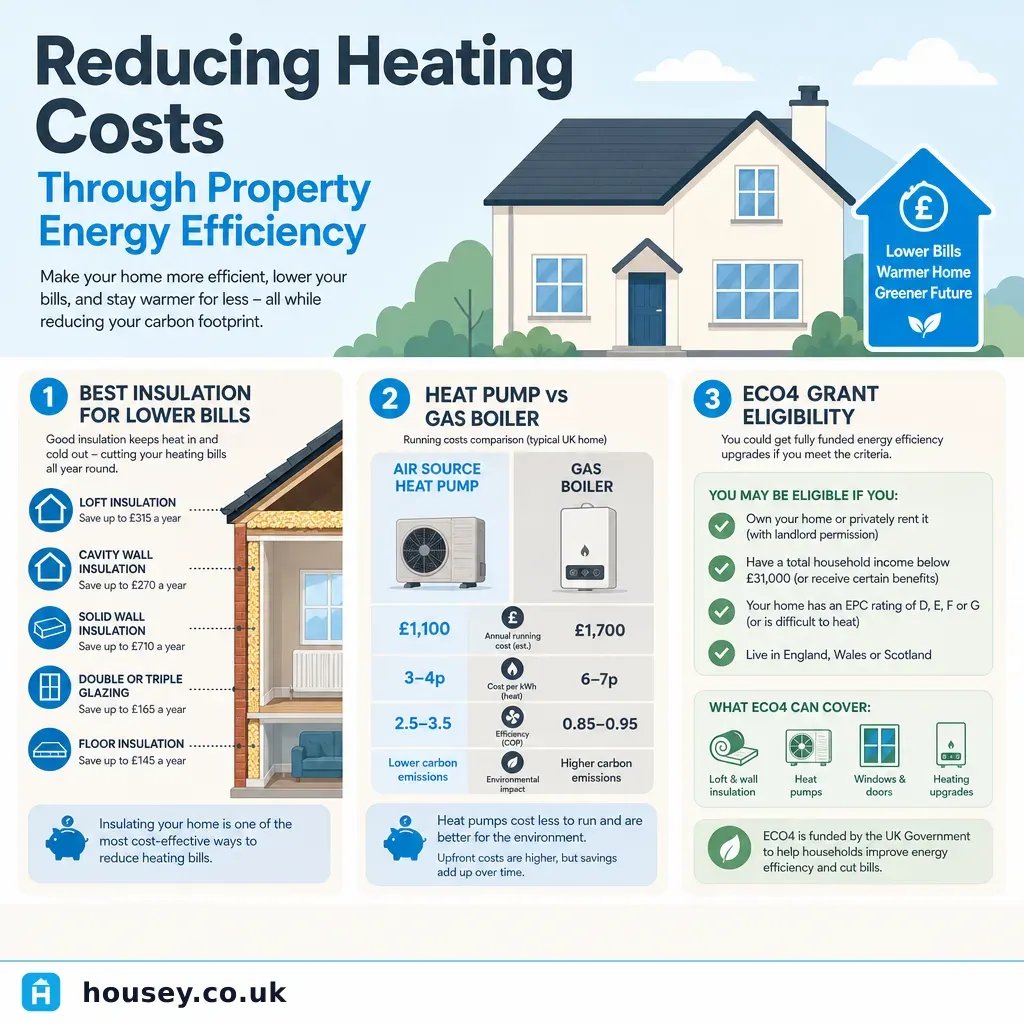
Reducing Heating Costs Through Property Energy Efficiency
Reducing heating costs starts with identifying where heat is lost — typically walls (30–35%), roof (20–25%), and windows.
 Energy & Retrofit
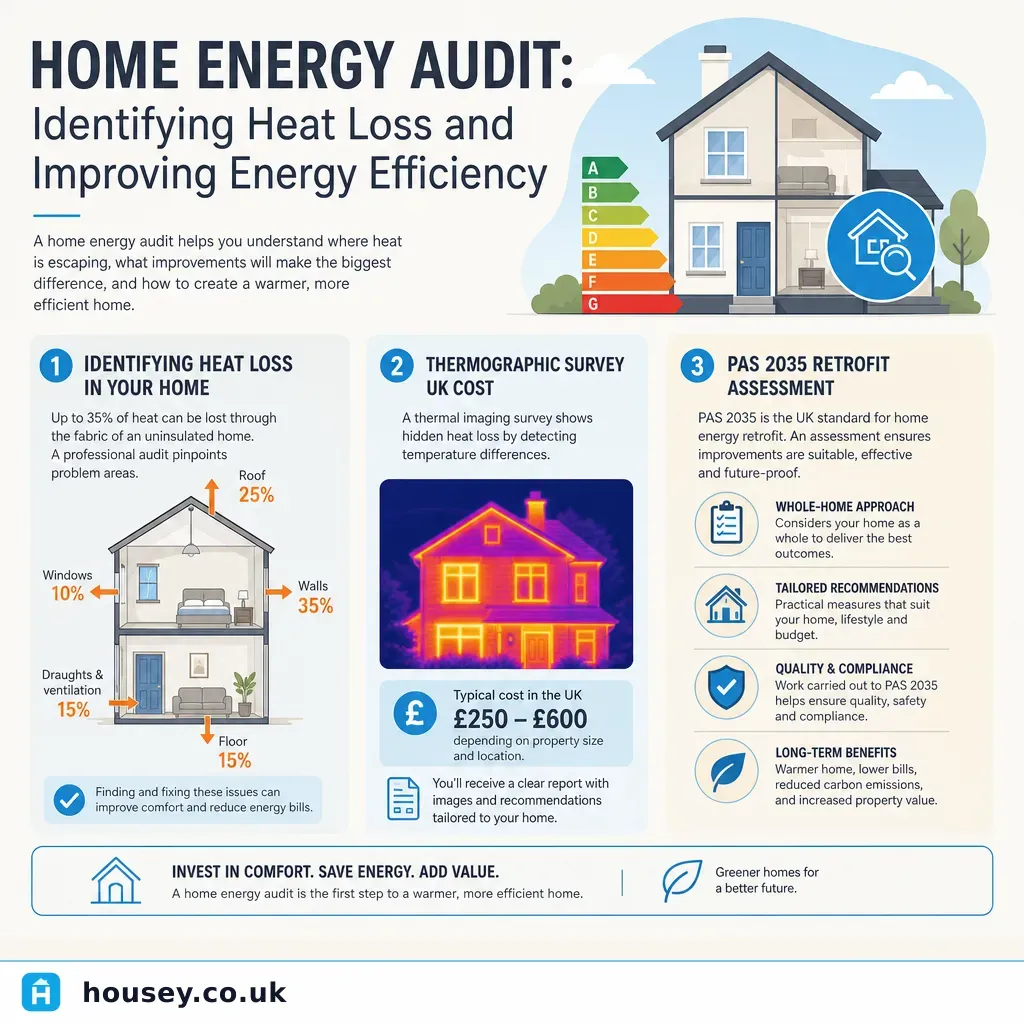
Home Energy Audit: Identifying Heat Loss and Improving Energy Efficiency
A home energy audit is a structured assessment of where your property loses heat and how efficiently it uses energy.
 Energy & Retrofit
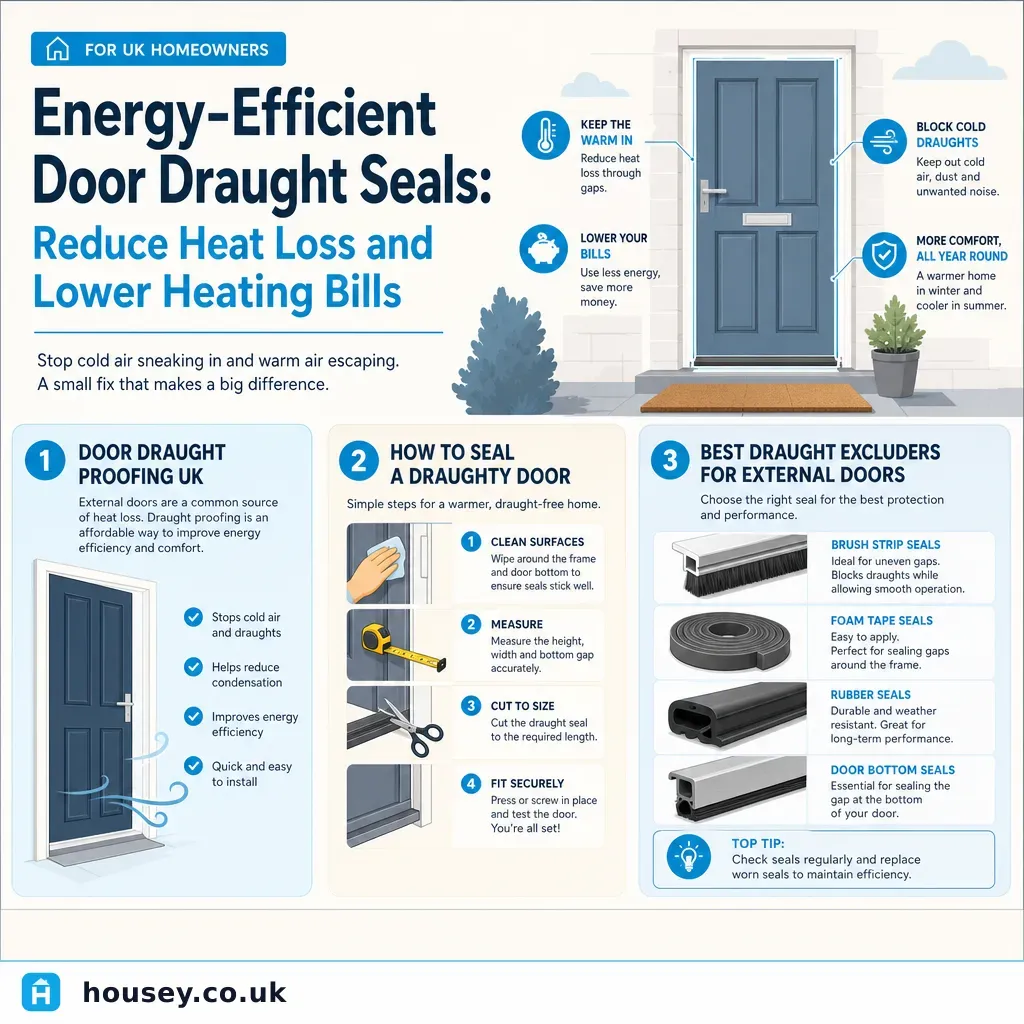
Energy-Efficient Door Draught Seals: Reduce Heat Loss and Lower Heating Bills
Door draught seals — brush strips, compression seals, threshold strips, and letterbox excluders — reduce heat loss through gaps in door frames.
 Energy & Retrofit
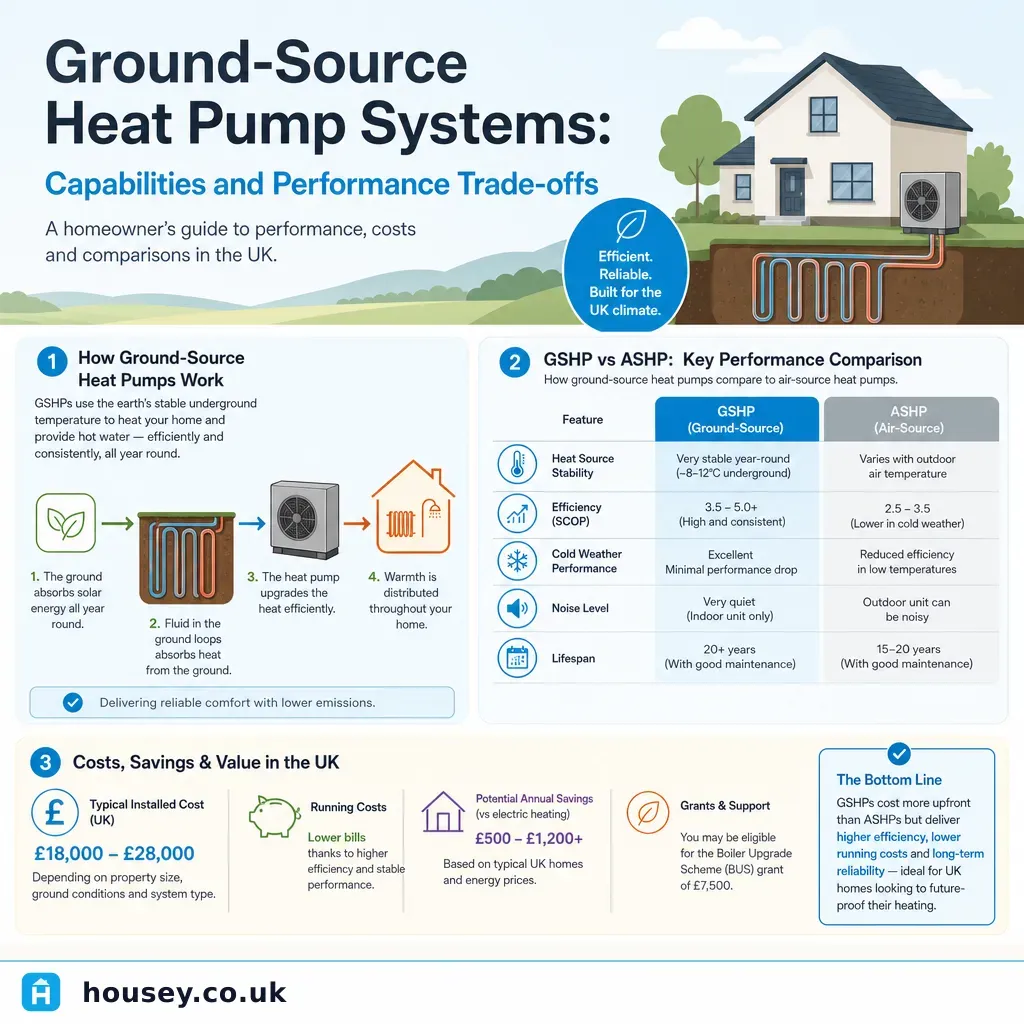
Ground-Source Heat Pump Systems: Capabilities and Performance Trade-offs
A ground-source heat pump extracts heat from the ground via buried loops, typically achieving a COP of 3.
 Energy & Retrofit
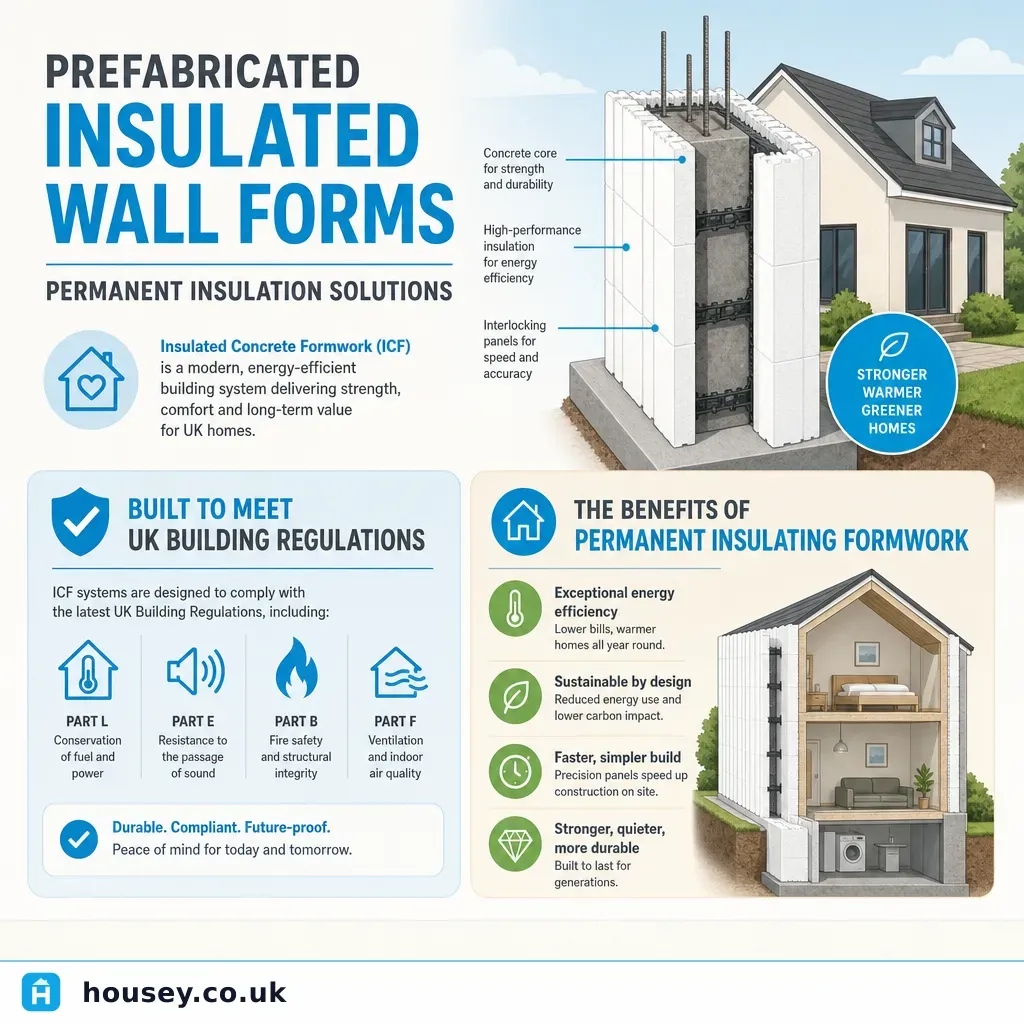
Prefabricated Insulated Wall Forms: Permanent Insulation Solutions
Prefabricated insulated wall forms — including ICF and SIPs systems — deliver high thermal performance by combining permanent insulation with structural concrete or timber in a single wall assembly.