How Energy Performance Certificates Impact Property Value
By Housey · Last reviewed 18th of May 2026
How Energy Performance Certificates Impact Property Value
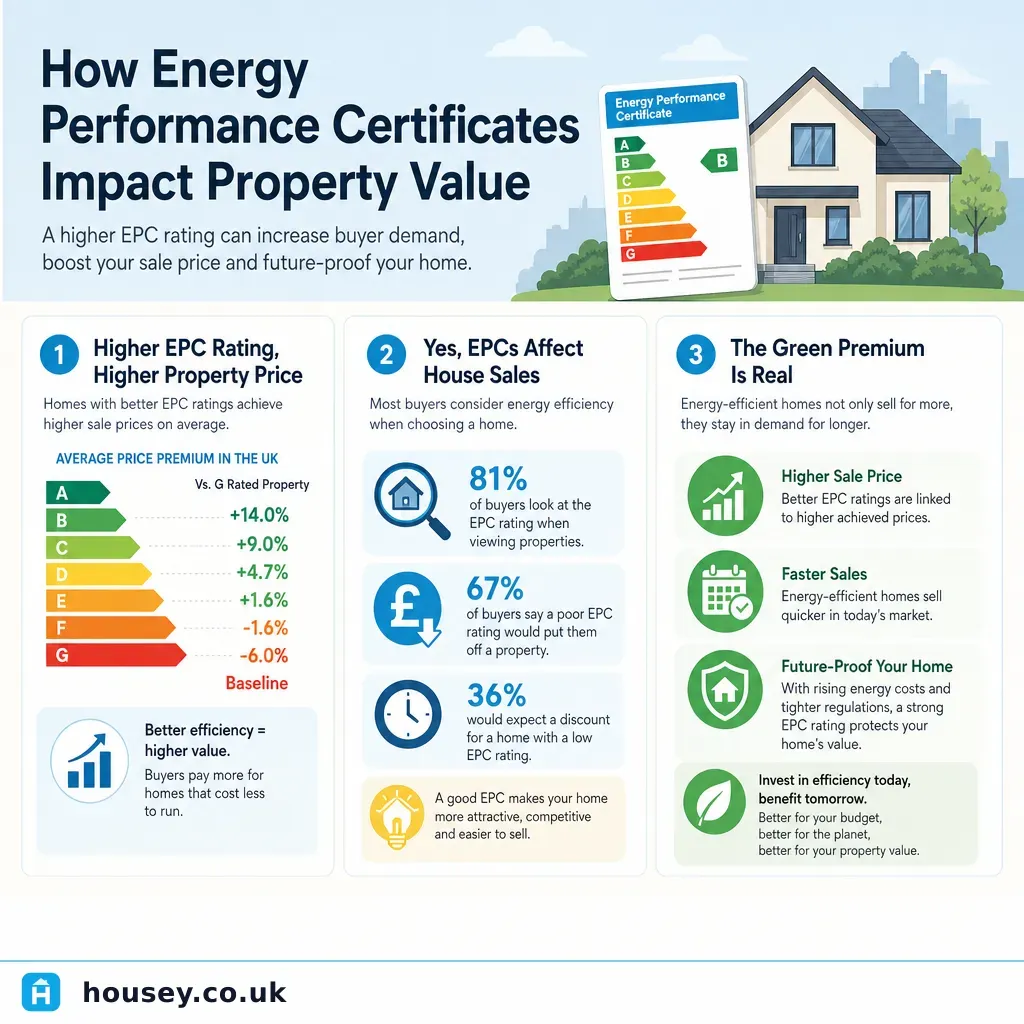
When a property is listed for sale or let, its Energy Performance Certificate (EPC) rating appears prominently in listing details — and increasingly in buyers' calculations. Questions about the financial impact of EPC ratings typically arise when buyers compare similar properties in the same street, when landlords face compliance costs under Minimum Energy Efficiency Standards, or when homeowners weigh up the expense of improvement works against a potential sale premium. The relationship between energy efficiency and property value has sharpened as energy bills have risen and UK lenders have introduced mortgage products tied to EPC ratings.
Key points
- EPC ratings run from A (most efficient) to G (least efficient); a valid EPC lodged on the national register is a legal requirement before marketing a property for sale or rent in England, Wales, and Scotland.
- Research from the Department for Energy Security and Net Zero (DESNZ) indicates that A or B rated properties attract a measurable "green premium" over comparable D-rated homes.
- Minimum Energy Efficiency Standards (MEES) already prohibit landlords in England and Wales from letting most residential properties below EPC E without a registered exemption.
- Several major UK mortgage lenders — including Barclays, Halifax, and NatWest — have offered preferential rates on "green mortgage" products for properties rated A or B.
- An EPC is valid for 10 years from the date of lodgement; if significant improvement works have been completed since the last assessment, commissioning a new certificate can capture an upgraded rating.
What the green premium evidence shows
Research drawing on matched HM Land Registry sold prices and EPC register data has consistently found a positive association between higher EPC bands and sale price. A DESNZ-commissioned analysis suggests the premium for an A or B rated property over an equivalent EPC D property ranges from approximately 2% to 5% in England, though the effect varies considerably by:
- Region and market: The premium is more pronounced in markets where comparable stock exists across different EPC bands. In areas dominated by older, uniformly low-rated housing, buyers have fewer energy-efficient alternatives, which can suppress the premium.
- Property type: Detached houses with large plots may see energy rating displaced by other value drivers such as plot size, garage, and garden. Flats and terraced houses in competitive markets show a stronger correlation.
- Buyer profile: Owner-occupiers motivated by running cost savings respond more directly to EPC ratings than cash investors focused on gross yield.
The green premium is also expressed indirectly through buyer negotiation: a low EPC rating is increasingly used as a basis for price reductions at the offer stage, as buyers request costings for improvement works.
How EPC rating affects different property transactions
Transaction type | EPC impact | Key consideration |
|---|---|---|
Open market sale | A/B may attract a green premium; F/G may depress price or justify buyer discounts | Buyers can use improvement costings as negotiation evidence |
Buy-to-let purchase | EPC E is the current legal minimum for lettable residential property in England and Wales | Investors should price in cost to reach E (and consider C as a planning scenario) |
Remortgage or product transfer | Some lenders offer lower rates for A/B rated properties | Worth commissioning a new EPC after retrofit works before remortgaging |
Listed building or exempt property | Some listed buildings are exempt from MEES; EPC may still be advisable for transparency | Exemptions must be registered on the PRS Exemptions Register |
Shared ownership resale | Housing association may impose own energy standards | Check lease terms alongside EPC band |
Which improvements move the EPC rating — and at what cost
The Standard Assessment Procedure (SAP) methodology underlying UK EPCs prioritises fabric improvements and heating efficiency. Measures that typically produce the largest band uplift relative to cost:
- Loft insulation to 270mm — low-cost, high-impact for properties with accessible loft space.
- Cavity wall insulation — where the property has a suitable cavity (post-1920 brick construction typically), this can lift a D-rated 1990s semi by a full band or more.
- Replacing an old G-rated boiler with an A-rated condensing boiler — combined with programmer and TRV controls, this is one of the most impactful single measures for gas-heated properties.
- Solar photovoltaic (PV) panels — adds renewable generation credit to the SAP score, particularly useful where other fabric measures have already been taken.
- Replacing single glazing with double or triple glazing — material improvement in properties retaining original single-glazed windows.
Worked example: A 1970s solid-wall semi-detached house, currently rated EPC E, with electric storage heaters and no loft insulation. After installing 270mm mineral wool loft insulation, room-in-roof insulation, and replacing storage heaters with an MCS-certified heat pump, the property is re-assessed and reaches EPC C. The previous certificate — still technically valid for its 10-year term — will not reflect these improvements; only a new lodgement following re-assessment captures the upgraded rating.
EPC, MEES, and the rental sector
The rental market operates under more immediate EPC obligations than owner-occupied sales. Under the Minimum Energy Efficiency Standards (MEES) Regulations 2015 (as amended), landlords in England and Wales cannot grant a new tenancy — or continue an existing one — for a domestic property below EPC E without a valid registered exemption. The exemptions are narrow:
- All cost-effective improvements have been made subject to a third-party finance or £3,500 cost cap.
- Written consent to works has been withheld by a tenant, superior landlord, or mortgage lender.
- Works would cause a material impact on the structure or fabric of a listed building.
The government has indicated a policy intention to raise the minimum to EPC C for new tenancies, though no confirmed legislative date has been set as of May 2026. Landlords acquiring property should model the cost of reaching EPC C as a scenario in their financial forecasts, even while the legal floor remains EPC E.
What an EPC doesn't capture — and why it matters for buyers
An EPC is a modelled estimate based on the property's physical characteristics at the time of assessment, not on actual measured energy consumption. This means:
- A property with a heat pump and new windows may rate highly on paper but still have draughts, poorly performing insulation, or a poorly maintained system driving actual bills higher.
- Actual energy bills from the vendor over the past two winters are a more reliable guide to running costs than the EPC's indicative annual figures.
- EPC ratings do not capture comfort: a poorly ventilated high-rated property may have condensation or indoor air quality problems that the certificate alone does not reveal.
When to get professional help
Consider instructing an energy specialist or retrofit assessor if:
- You are buying a property rated EPC F or G and want a costed schedule of works before committing to a purchase price.
- You are a landlord with properties that may fall below EPC E and need a compliance review.
- You have completed improvement works and believe a new assessment would reflect a higher rating.
- You are considering a heat pump installation and want to understand whether your property's insulation standard supports an efficient system.
How Housey can help
Housey connects homeowners and landlords with qualified assessors for EPC assessments and energy advice and whole-house improvement planning. If you are planning retrofit works, a retrofit assessment maps out a PAS 2035-compliant improvement sequence, and energy-efficiency consultants can identify the measures that will move your SAP score most cost-effectively.
Frequently asked questions
Does a higher EPC rating guarantee a higher sale price?
No. EPC rating is one of many factors in a property valuation. The green premium is a statistical association across large datasets, not a guarantee for any individual property. Location, condition, size, and local market conditions remain the primary drivers, and a well-priced EPC D property in a desirable area will typically outsell a poorly located EPC B equivalent.
Can I get a new EPC after improvement works?
Yes. You can commission a Domestic Energy Assessor (DEA) at any time to lodge a fresh certificate. The new certificate supersedes the previous one and reflects the property's current characteristics. The typical fee is £60–£120 for a standard residential property — indicative UK costs, last reviewed 2026-05-18 — and there is no mandatory waiting period.
What is the minimum EPC rating for a rented home in England?
Currently EPC E. Landlords in England and Wales cannot grant a new tenancy or continue an existing one for a domestic property rated F or G without a registered exemption. The government has indicated a policy intention to raise this to EPC C for new tenancies, but no confirmed date applies as of May 2026. Always check GOV.UK for the current position.
What if a property doesn't have an EPC?
A valid EPC lodged on the national register is a legal requirement before marketing a property for sale or rent in England, Wales, and Scotland. Failure to provide one can attract a penalty of up to £200 per property in England and Wales. If you cannot locate a certificate on the national EPC register, ask the agent or vendor to arrange a new assessment before exchange.
Sources and further reading
- Valuing energy efficiency improvements in English residential properties — DESNZ / GOV.UK
- Domestic private rented property: minimum energy efficiency standard (landlord guidance) — GOV.UK
- Find an energy certificate — GOV.UK
- RICS guidance on sustainability and valuation — RICS
- Energy Performance Certificates for your home — GOV.UK
Useful next reads
 Buying & Moving
What Do EPC Ratings Tell You? Understanding Energy Performance Certificates When Buying Property
An Energy Performance Certificate (EPC) rates a property from A (most efficient) to G (least efficient) using a score out of 100, based on estimated energy costs, insulation, heating systems, and carbon emissions.
 Buying & Moving
Which Home Improvements Add Real Value to Your Property?
In the UK, loft conversions, single and double-storey extensions, and energy-efficiency upgrades are most reliably linked to added property value.
 Buying & Moving
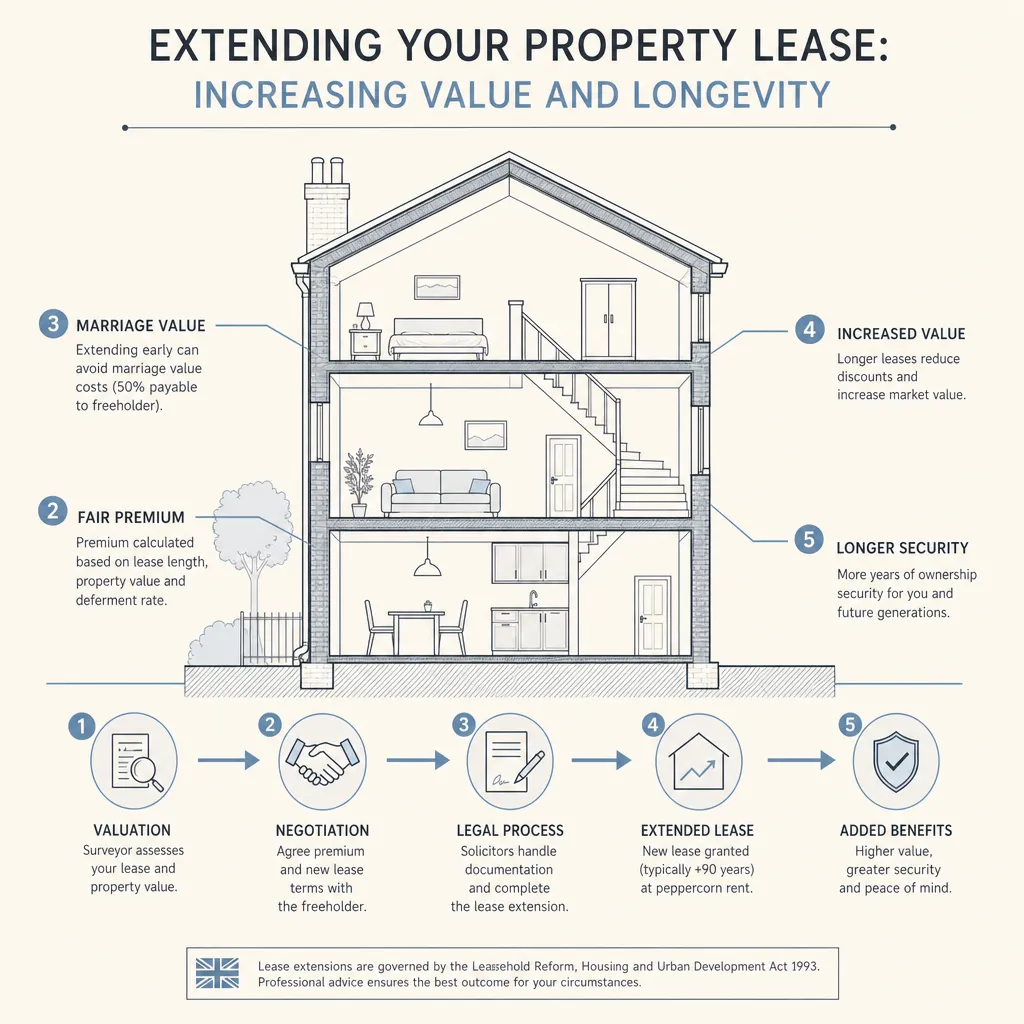
Extending Your Property Lease: Increasing Value and Longevity
Qualifying leaseholders in England and Wales can extend their lease by 90 years at a peppercorn ground rent under the Leasehold Reform, Housing and Urban Development Act 1993.
 Buying & Moving
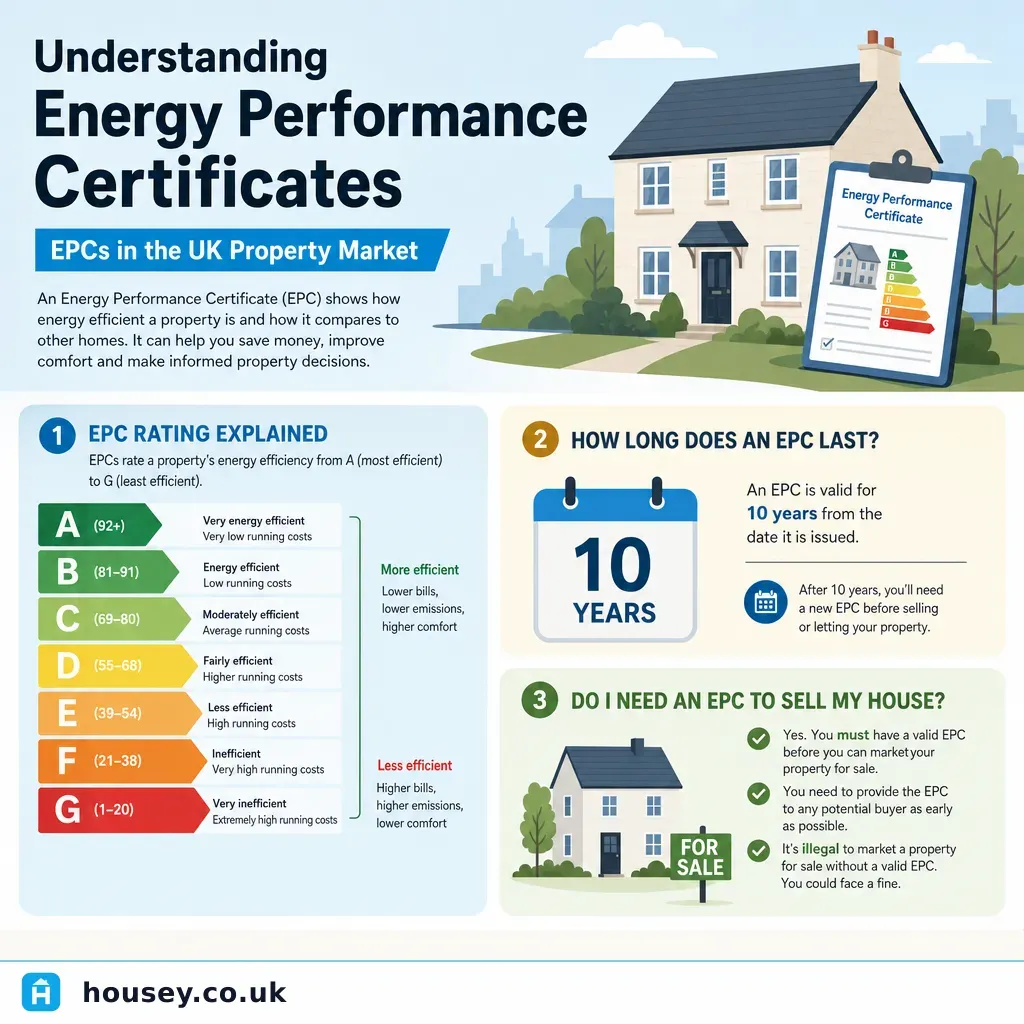
Understanding Energy Performance Certificates: EPCs in the UK Property Market
An Energy Performance Certificate (EPC) rates a property's energy efficiency on a scale from A (most efficient) to G (least efficient).
 Buying & Moving
Adding Value to a New-Build Property
Adding value to a new-build typically means differentiating your home from identical plots, securing a sound baseline through a professional snagging survey, and making targeted improvements — landscaping, EV charging, or structural upgrades chosen at build stage.