Laminate Flooring Installation Costs and Options
By Housey · Last reviewed 7th of May 2026
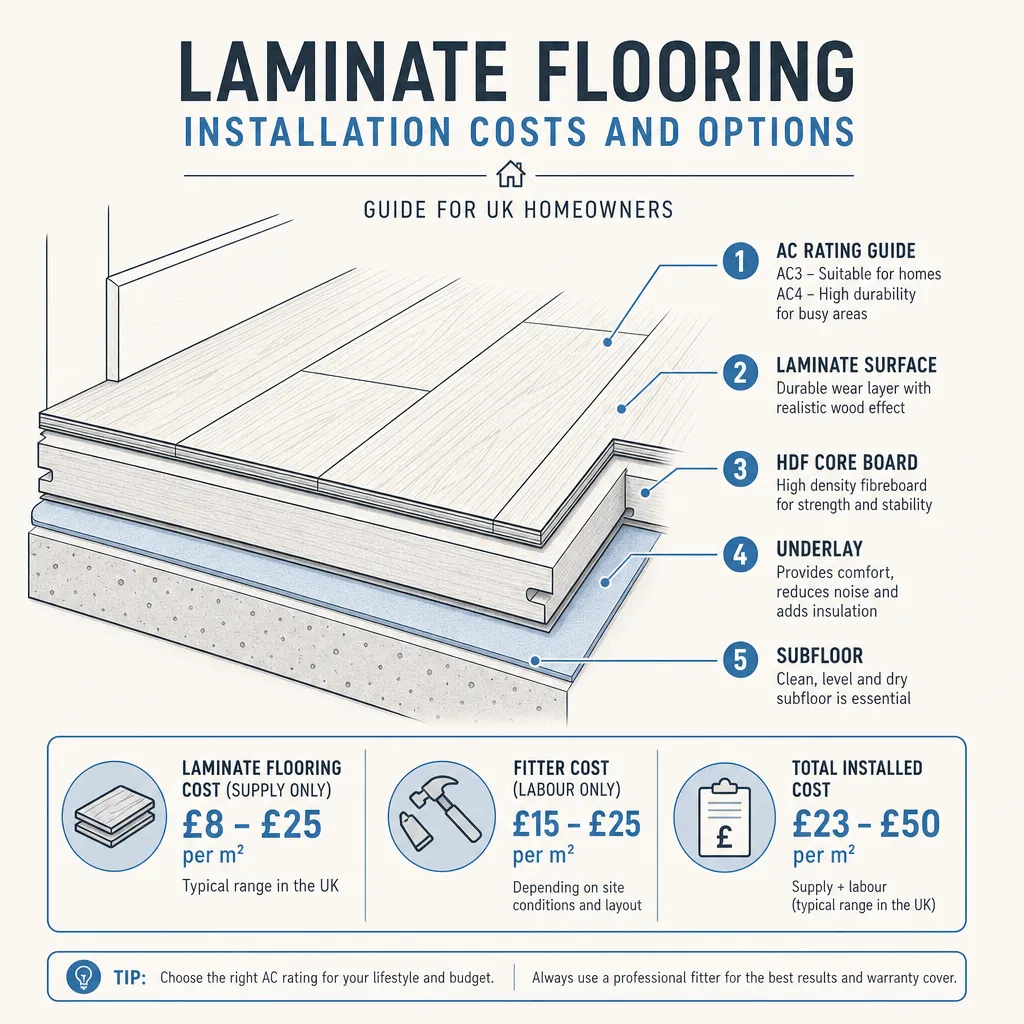
Laminate Flooring Installation Costs and Options
Laminate flooring accounts for a significant share of new floor coverings fitted in UK homes each year, valued for its ease of maintenance, realistic wood and stone effects, and prices that suit most renovation budgets. The category spans everything from thin budget AC1 boards to thick commercial-grade planks with deep embossing and long warranties. The cost difference between a well-specified and a poorly specified installation in the same room can be substantial — and is rarely visible in a headline price per square metre.
Key points
- Laminate flooring is graded AC1–AC6 for abrasion resistance; AC3 (heavy domestic) is the minimum recommended for hallways, kitchens, and open-plan living areas.
- Total installed costs typically range from £20–55 per m² in the UK, covering materials, underlay, and professional fitting.
- Professional fitting is usually charged at £10–20 per m² or a day rate of £150–250 in most UK regions.
- Most standard laminate is not suitable for wet rooms without a waterproof core; look for products labelled as aqua or hydro variants.
- BS EN 13329 requires the subfloor to have no more than 3 mm deviation under a 1.8 m straightedge before laminate can be laid.
What affects laminate flooring costs?
The price you pay depends on several factors beyond the material cost per square metre.
AC rating and thickness Higher AC ratings use more wear-layer material and are priced accordingly. Budget AC3 laminate starts around £8–12/m²; mid-range options run £15–25/m²; premium boards with deep embossing and extended warranties can reach £30–40/m².
Underlay Underlay is not optional — it provides cushioning, acoustic dampening, and moisture protection. Standard foam underlay costs around £1–3/m². Combined underlay with built-in damp-proof membrane (DPM) costs £3–6/m². Products with pre-attached underlay do not require a separate layer.
Subfloor condition Uneven subfloors require levelling compound, typically adding £3–10/m² depending on severity. Older properties with suspended timber floors may need a plywood overlay (£8–15/m²) to achieve a stable surface.
Room shape and waste Alcoves, bay windows, and multiple doorways increase offcuts. A 10–15% waste allowance is standard; irregular layouts may need 20%.
Removal of old flooring If the fitter removes and disposes of existing floor covering, expect this to add £3–8/m².
Laminate grades and options compared
Grade | AC rating | Best for | Not ideal for | Approx. material cost |
|---|---|---|---|---|
Light domestic | AC1–AC2 | Bedrooms with low footfall | Hallways, kitchens, commercial use | £5–10/m² |
General domestic | AC3 | Living rooms, dining rooms, hallways | Wet areas without waterproof core | £8–18/m² |
Heavy domestic | AC4 | Kitchens, busy family homes, home offices | Commercial premises | £15–28/m² |
Commercial / premium | AC5–AC6 | Rental properties, commercial-grade renovations | Budget residential projects | £20–40/m² |
Waterproof core | AC3–AC4 | Kitchens, utility rooms, ground floors | Full wet-room installation | £18–35/m² |
Indicative UK material costs, last reviewed 2026-05-07. Costs vary by retailer and region.
Step-by-step: what laminate installation involves
- Subfloor check — The fitter inspects levelness, checks for damp on ground-floor concrete, and identifies any high or low spots needing correction.
- Subfloor preparation — Levelling compound is applied to low spots; high spots are ground down. Loose timber boards are re-screwed; a plywood overlay may be added.
- Underlay installation — Underlay is laid with taped joints and a 50–100 mm upturn at walls to manage residual moisture vapour.
- Layout planning — Planks typically run parallel to the main light source or the longest wall. Joints are staggered by at least 300 mm between rows.
- Laying — Click-lock planks are installed with a 10–15 mm expansion gap at all perimeter edges, doorframes, and fixed obstacles.
- Trimming and finishing — Planks are cut around pipes, alcoves, and thresholds. Threshold strips connect to adjacent floor types. Skirting board or beading covers the expansion gap.
What to ask before accepting a quote
Use this checklist when comparing quotes from laminate flooring installers:
- What AC rating and thickness is specified, and who is the manufacturer?
- Is underlay included, and what type — foam, combined DPM, or acoustic?
- Is the quote based on a site visit, or estimated remotely from measurements?
- Is subfloor preparation included, and at what point do extra charges apply?
- Who removes and disposes of the existing floor?
- Is a 10–15% waste allowance included in the material calculation?
- Are threshold strips, beading, and adhesives included?
- Is VAT shown separately?
- What warranty does the product carry, and is the fitting warranted separately?
Which professional do you need?
Situation | Recommended professional |
|---|---|
Straight laminate replacement in a single room | Flooring specialist or experienced handyperson |
Multiple rooms including subfloor levelling | Flooring contractor familiar with BS EN 13329 |
Part of a kitchen or bathroom renovation | Main contractor to co-ordinate flooring with tiling and plumbing |
New extension or conversion requiring screed | Discuss screed drying times with your builder before specifying flooring |
Listed building or period property with original boards | Seek conservation officer guidance before laying over original features |
When to get professional help
Laminate installation is widely regarded as DIY-friendly for competent homeowners in straightforward rooms. Professional fitting is advisable when:
- The subfloor requires significant levelling or has suspected damp
- The room is large or has a complex layout with many obstructions
- You are fitting laminate in a kitchen or utility room where moisture management matters
- The project is part of a larger renovation requiring trade co-ordination
- The floor is being laid over recently poured screed — green screed can transfer moisture that causes laminate to lift or buckle
How Housey can help
If your laminate flooring project is part of a wider home improvement such as a kitchen renovation or house extension, Housey connects you with vetted local tradespeople who can manage the full scope of work. Find and compare quotes from extension builders who can co-ordinate subfloor preparation alongside your new laminate installation.
Frequently asked questions
How long does laminate flooring last in a UK home?
Most domestic-grade laminate (AC3) carries a manufacturer warranty of 10–25 years for residential use. Real-world lifespan depends on traffic levels, maintenance, and whether the subfloor and expansion gap were correctly installed. Floors that move, buckle, or delaminate early usually indicate an installation or subfloor preparation issue rather than a product fault.
Can laminate flooring be laid over underfloor heating?
Yes, but check the manufacturer's specification first. Laminate over underfloor heating requires the surface temperature not to exceed 27 °C. Bring the system up to temperature gradually over the first week after installation. Some thicker or denser laminates are not recommended for use over UFH — always confirm compatibility with the specific product datasheet.
Do I need to remove skirting boards before fitting laminate?
Many fitters prefer to remove skirting boards to create a clean finish and conceal the expansion gap beneath them. Alternatively, leave skirting in place and use matching beading or quadrant moulding to cover the gap. Both approaches are acceptable, but removing skirting generally gives a neater result, particularly in living rooms and hallways.
Is laminate flooring suitable for rental properties?
AC4 or AC5 laminate is generally better suited to rental properties due to higher durability under varied use. Waterproof-core laminate is worth considering for kitchens and hallways in rentals, where moisture management may be less consistent. Choosing a product with a longer warranty also gives landlords documented protection in case of disputes with tenants.
Can individual laminate planks be replaced if damaged?
Individual planks can usually be replaced in a click-lock system, provided matching planks are still available. Colour batches can vary between production runs, so keeping one or two spare planks from the original installation is good practice. Deep surface scratches are generally more practical to address by full plank replacement than by filling compounds.
Sources and further reading
- BS EN 13329: Laminate floor coverings — BSI Group
- Technical guidance for flooring installers — Contract Flooring Association
- Flooring buying guide — Which?
- Planning and building work guidance — GOV.UK
Useful next reads
 Improvement & Build
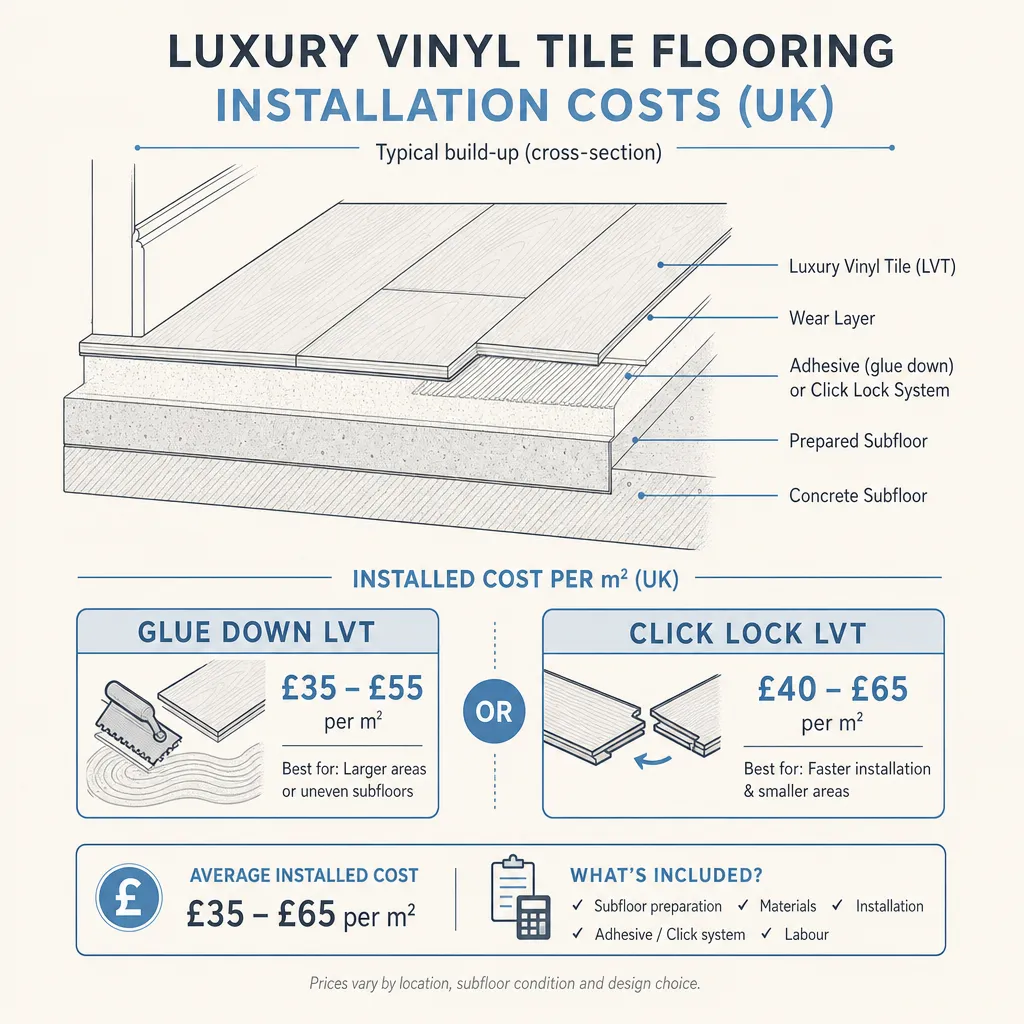
Luxury Vinyl Tile Flooring Installation Costs
Luxury vinyl tile (LVT) flooring typically costs £20–£60 per m² for materials and £10–£25 per m² for professional installation in the UK, giving a total supply-and-fit price of roughly £30–£85 per m².
 Improvement & Build
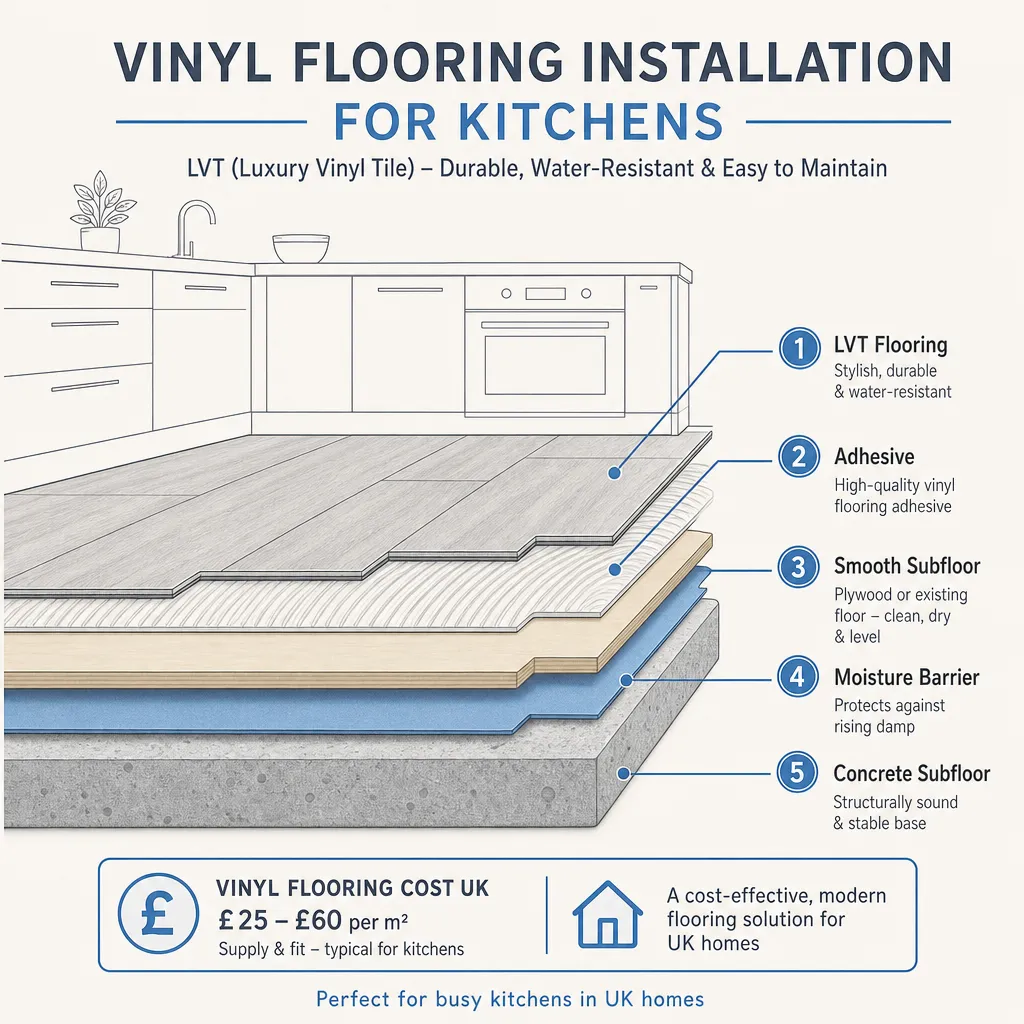
Vinyl Flooring Installation for Kitchens
Luxury vinyl tile (LVT) and sheet vinyl are the most popular choices for UK kitchen floors, offering waterproof performance and competitive costs.
 Improvement & Build
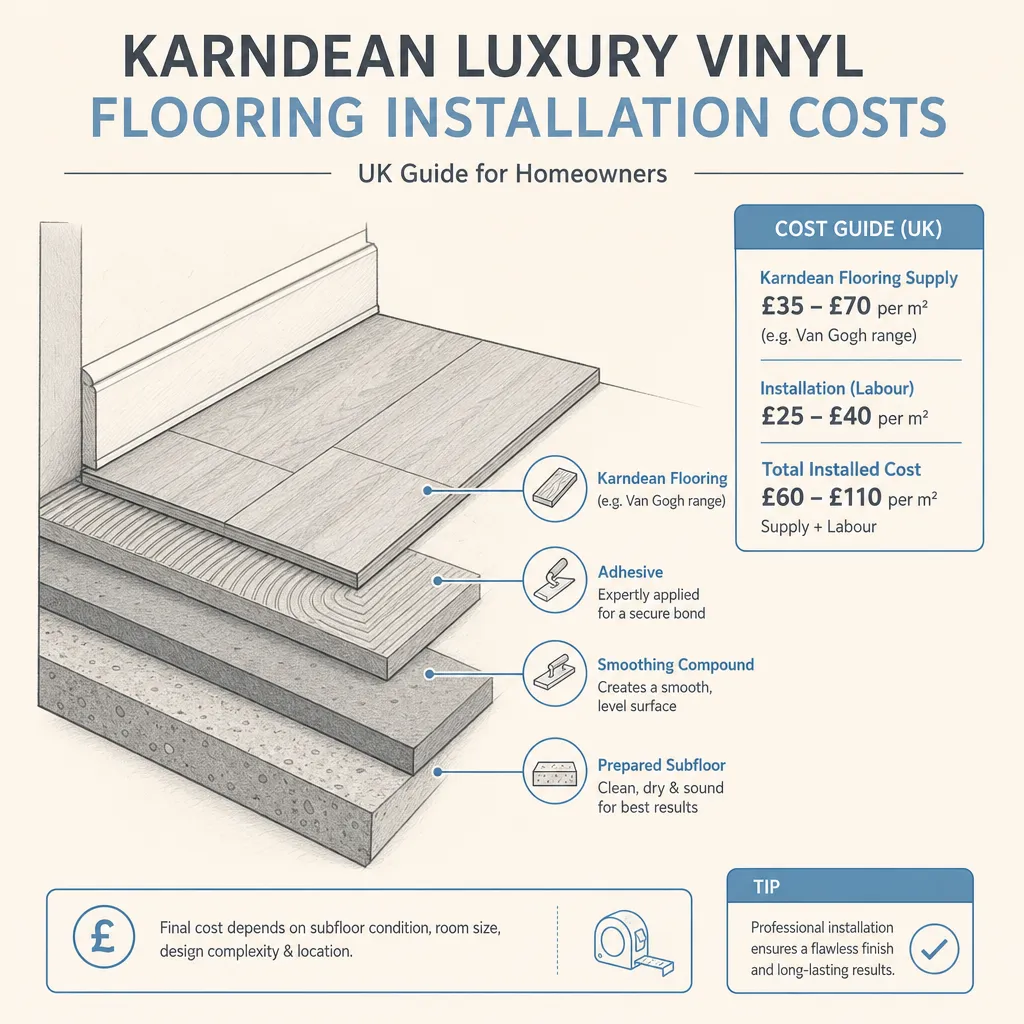
Karndean Luxury Vinyl Flooring Installation Costs
Karndean luxury vinyl flooring costs roughly £30–£75 per m² for materials depending on the range, plus £15–£35 per m² for professional installation.
 Improvement & Build
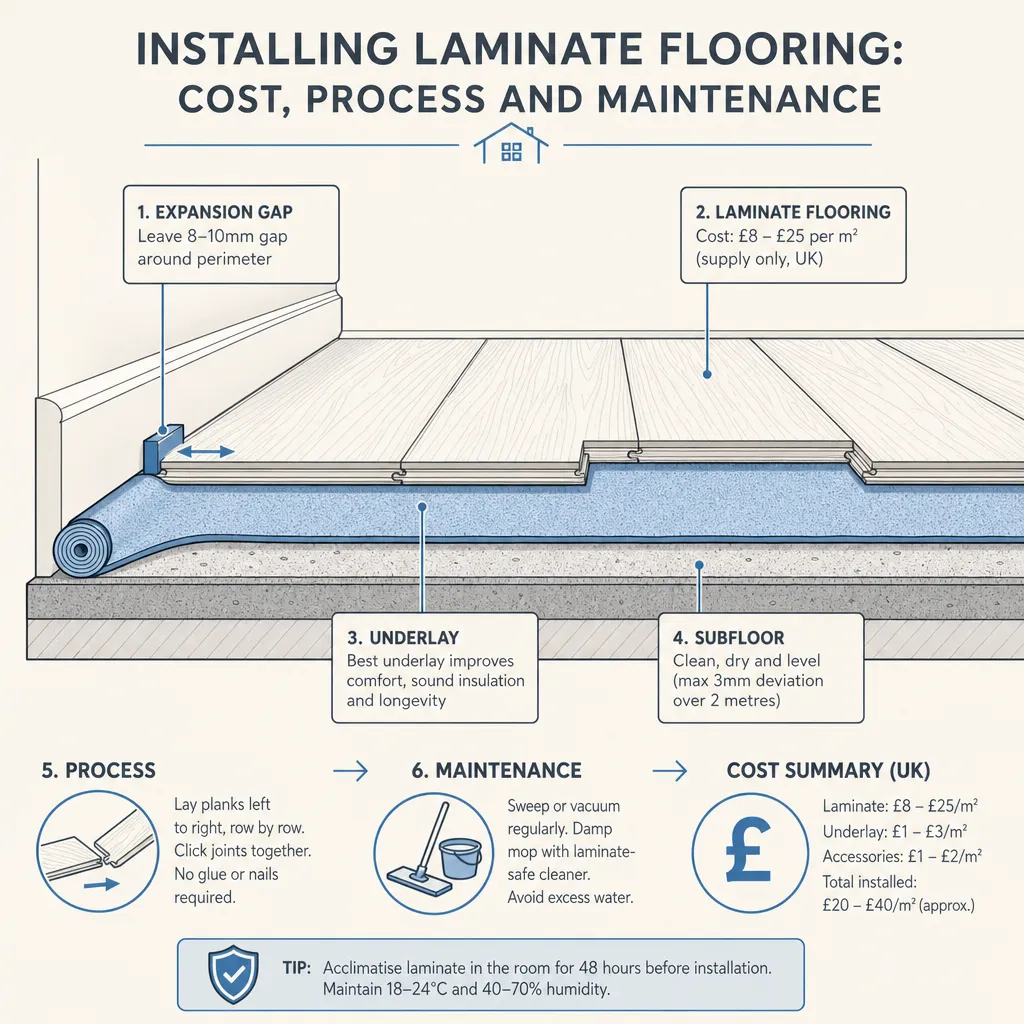
Installing Laminate Flooring: Cost, Process and Maintenance
Laminate flooring in the UK typically costs £15–40 per square metre for materials, plus £8–15 per square metre for professional fitting.
 Improvement & Build
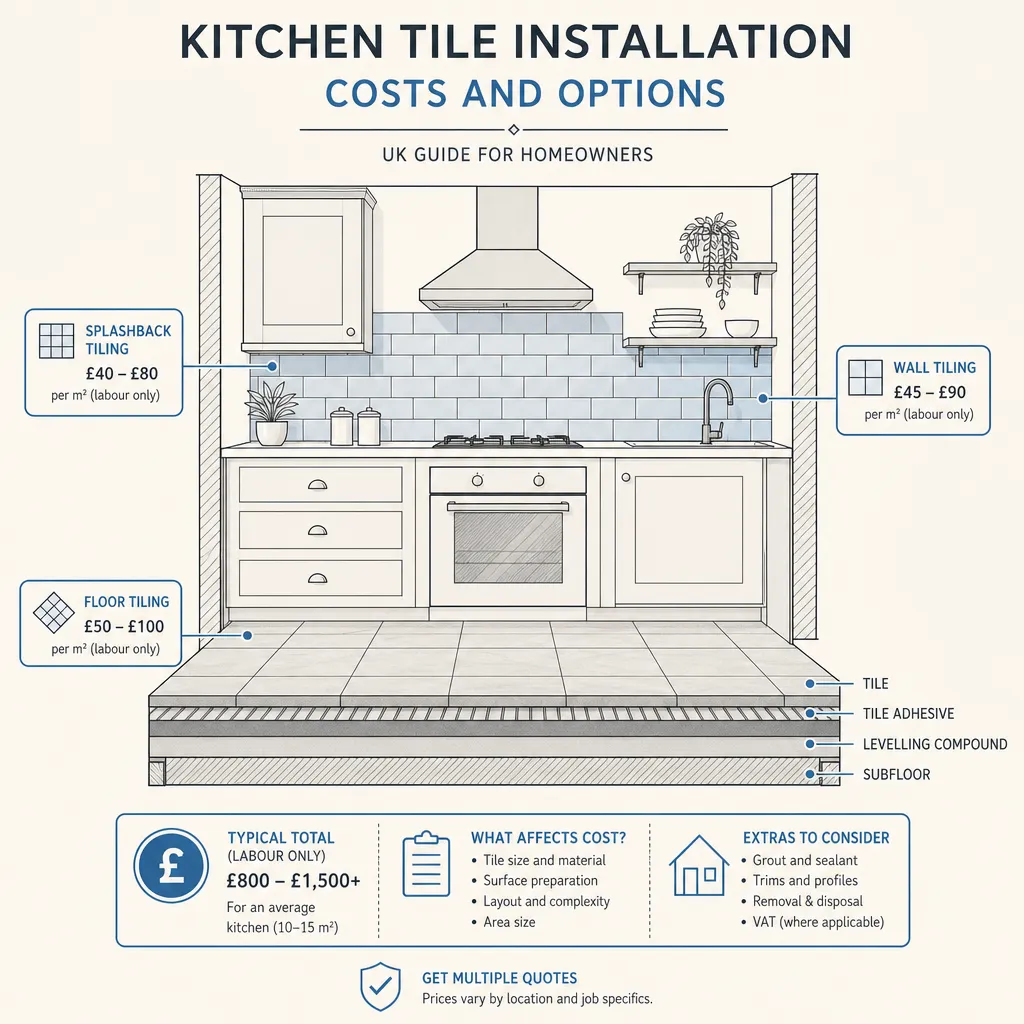
Kitchen Tile Installation Costs and Options
Kitchen tiling in the UK costs roughly £20–£40 per square metre for labour, plus £15–£80 per square metre for materials depending on tile type.