How Property Managers and Contractors Coordinate Work
By Housey · Last reviewed 10th of May 2026
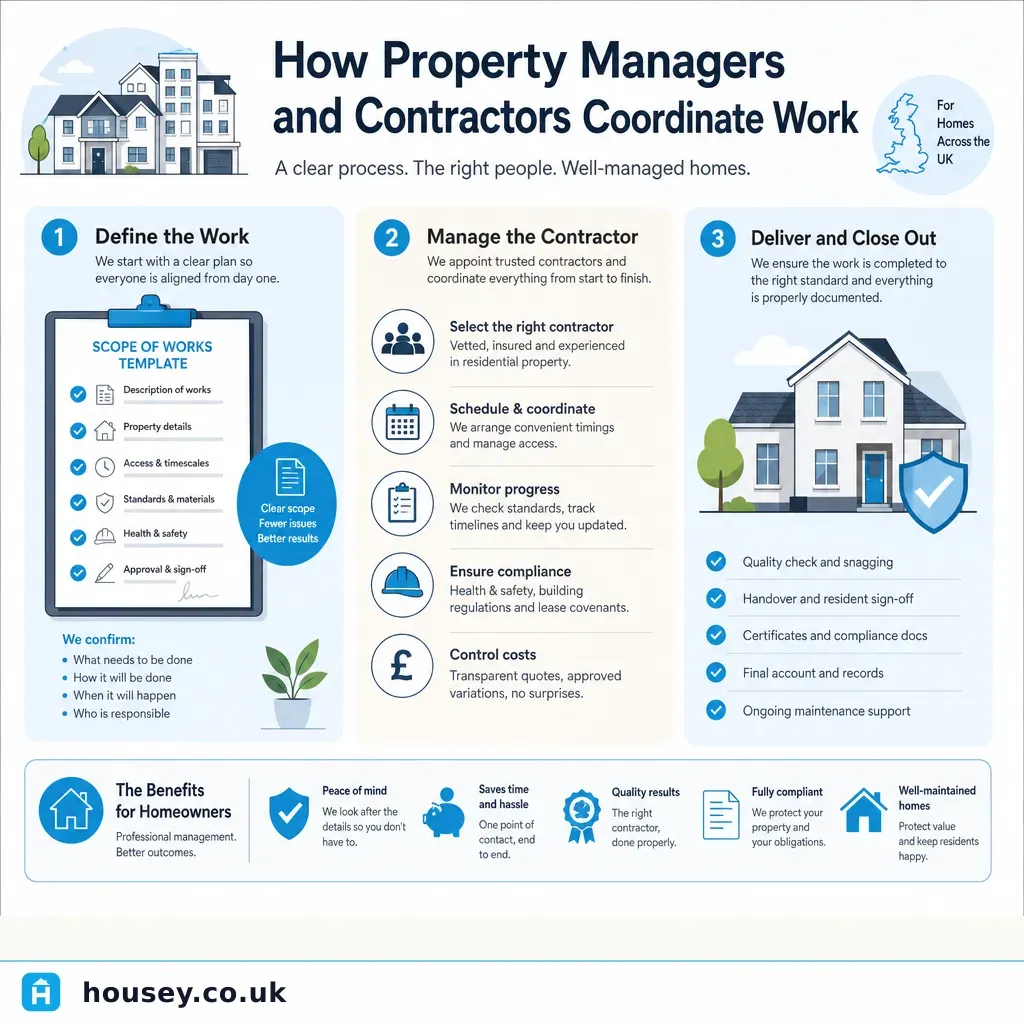
How Property Managers and Contractors Coordinate Work
Coordinating contractors on a residential property — whether a single buy-to-let flat or a larger managed block — involves more process than most homeowners and landlords expect. The point at which things go wrong is rarely the quality of the tradespeople themselves; it is usually a gap in communication, documentation, or scheduling before the first tool is lifted. Understanding how effective coordination works helps anyone overseeing improvement or maintenance work make better decisions about when to handle it personally and when to bring in professional help.
Key points
- A written scope of works sets out exactly what is to be done, by whom, and to what standard — without one, pricing and expectations are easily misunderstood and disputes are harder to resolve.
- The Construction (Design and Management) Regulations 2015 (CDM 2015) impose legal duties on whoever commissions construction work; domestic clients still have limited but real obligations that cannot be ignored.
- Most professional property managers maintain a preferred supplier list (PSL) of contractors whose insurance, qualifications, and references have been pre-checked before any work is awarded.
- Three independent written quotes are a widely used benchmark for works above around £500, particularly where service charge accounting rules or building insurance requirements apply.
- Building insurance policies often require advance notification before structural or major works begin; failing to notify can affect the validity of a subsequent claim.
What coordination actually involves
Property managers act as the link between an owner's wishes and the tradespeople carrying them out. In practice, effective coordination requires six distinct activities:
- Scoping the work — translating a description of a problem into a clear written brief that a contractor can price and act on.
- Tendering — inviting quotes, comparing them on a like-for-like basis, and selecting a contractor based on price, credentials, timeline, and past performance.
- Scheduling and access — liaising with occupants (and, in blocks, neighbours) to agree start dates, working hours, and building-access arrangements.
- Progress monitoring — visiting site or receiving photographic evidence at agreed stages, checking that work matches the scope and the specified quality standard.
- Payment management — releasing staged payments against verified milestones, retaining a proportion until snagging is resolved.
- Sign-off and records — obtaining completion certificates (Gas Safe, FENSA, or building control sign-off where required), updating the property maintenance log, and filing warranties.
The level of oversight required scales with the complexity of the project. A boiler service needs a brief phone call and an invoice; a bathroom refurbishment needs a scope, a programme, stage sign-offs, and a Building Regulations completion certificate if structural or drainage work is involved.
The documents that make coordination work
Document | Purpose | Typically prepared by |
|---|---|---|
Scope or schedule of works | Defines what is to be done, materials, and quality standard | Property manager or appointed architect or PM |
Invitation to tender | Sent to 2–4 contractors with scope attached; requests itemised pricing | Property manager |
Method statement | Written plan for how work will be carried out safely | Contractor |
Risk assessment | Identifies hazards and controls; required under CDM 2015 | Contractor with PM oversight |
Programme of works | Timeline with start date, milestones, and completion date | Contractor, agreed with manager |
Contract | Fixes price, scope, liability, variations, and payment terms | Both parties |
For projects using leaseholder service charge funds above the Section 20 threshold (currently £250 per leaseholder), the Landlord and Tenant Act 1985 requires a formal consultation process before work is awarded. Failing to follow the Section 20 procedure can limit what a landlord can recover through the service charge to £250 per leaseholder, regardless of the actual cost.
How contractors are selected and vetted
A professional property manager's preferred supplier list typically records:
- Public liability insurance — usually a minimum of £2 million cover, often £5 million for larger or multi-occupancy sites
- Employers' liability insurance — a legal requirement if the contractor employs staff
- Trade accreditation — Gas Safe for gas work, NICEIC or NAPIT for electrical work, FENSA or CERTASS for windows and doors
- DBS check status — for contractors entering occupied residential properties
- References — checked from comparable projects, not simply collected and filed
Sole traders are not legally required to carry employers' liability insurance, but should still hold public liability cover. Always verify that a certificate is current — not simply on file from a previous year.
Decision tree: who should coordinate the works?
- Choose DIY coordination if work is routine maintenance under £500, involves a single trade, and you can inspect progress in person.
- Consider a managing agent if the property is let, involves multiple trades, or you cannot reliably oversee access and progress from a distance.
- Appoint a project manager if the project budget exceeds £20,000, involves more than two trades working simultaneously, or requires planning permission or building regulations approval.
- Appoint a RICS-accredited project manager or RIBA architect with contract administration duties if the project is complex, involves listed building consent, or if previous projects on the property have run significantly over time or over budget.
- Check CDM duties with HSE guidance if the project runs more than 30 working days with more than 20 simultaneous workers, or exceeds 500 person-days — a principal designer and principal contractor must be formally appointed in writing before work begins.
Communication structures that prevent delays
The most common causes of delay on residential projects are verbal-only scopes, variations authorised by whoever happened to be available rather than whoever had authority, and access not confirmed with occupants in advance.
A practical approach: agree at the outset that all instructions and variations are confirmed in writing (email is sufficient), that a single named contact authorises changes, and that no variation above a defined threshold — typically £150–£250 — proceeds without prior written approval. This creates a clear audit trail that protects both owner and contractor if a dispute arises later.
When to get professional help
Coordination can be managed by a diligent landlord or homeowner for straightforward maintenance, but professional project management is warranted when:
- The project involves more than two trades working simultaneously or in close sequence
- Listed building consent, planning permission, or building regulations approval is required
- The property is occupied during works and tenant disruption needs active management
- The project budget exceeds £20,000
- Previous projects on the same property have run significantly over time or over budget
- You are not physically close to the property and cannot inspect progress in person
How Housey can help
Finding the right professional to manage contractor coordination can make the difference between a smooth project and a costly dispute. Project managers on Housey are vetted professionals who can scope works, run the tender process, manage contractors on site, and administer contracts — so you have proper oversight without having to manage every detail yourself.
Frequently asked questions
Does a property manager in the UK need to be regulated or licensed?
Property managers are not required to hold a specific national licence, though some local authorities licence managing agents of HMOs. Members of bodies such as the Association of Residential Managing Agents (ARMA) or those registered with the Property Redress Scheme are bound by codes of conduct covering contractor selection, due diligence, and financial management of service charge funds.
What is Section 20 consultation and when does it apply?
Under the Landlord and Tenant Act 1985, Section 20 requires landlords and managing agents to consult leaseholders before qualifying works costing more than £250 per leaseholder are funded from the service charge. The process involves serving notices, inviting contractor nominations, and obtaining at least one nominated contractor's quote before the contract is awarded.
Who is responsible if a contractor causes damage during works?
The contractor's public liability insurance should cover accidental damage to property or third parties. The property manager has a duty to verify adequate cover before instructing any contractor. If a manager fails to check that cover is current and damage occurs, they may share liability alongside the contractor under general agency and negligence principles.
Do CDM Regulations 2015 apply to work on a private home?
Yes, but with reduced duties. Domestic clients have their CDM responsibilities automatically transferred to the principal contractor unless they appoint a principal designer. The contractor then takes on most health and safety planning and coordination obligations. HSE guidance on CDM 2015 sets out the full scope of domestic client duties and the formal notification thresholds.
Sources and further reading
- Construction (Design and Management) Regulations 2015 — Health and Safety Executive
- Section 20 consultation guidance — GOV.UK
- Landlord and Tenant Act 1985, Section 20 — legislation.gov.uk
- ARMA guidance for managing agents — Association of Residential Managing Agents
Useful next reads
 Improvement & Build
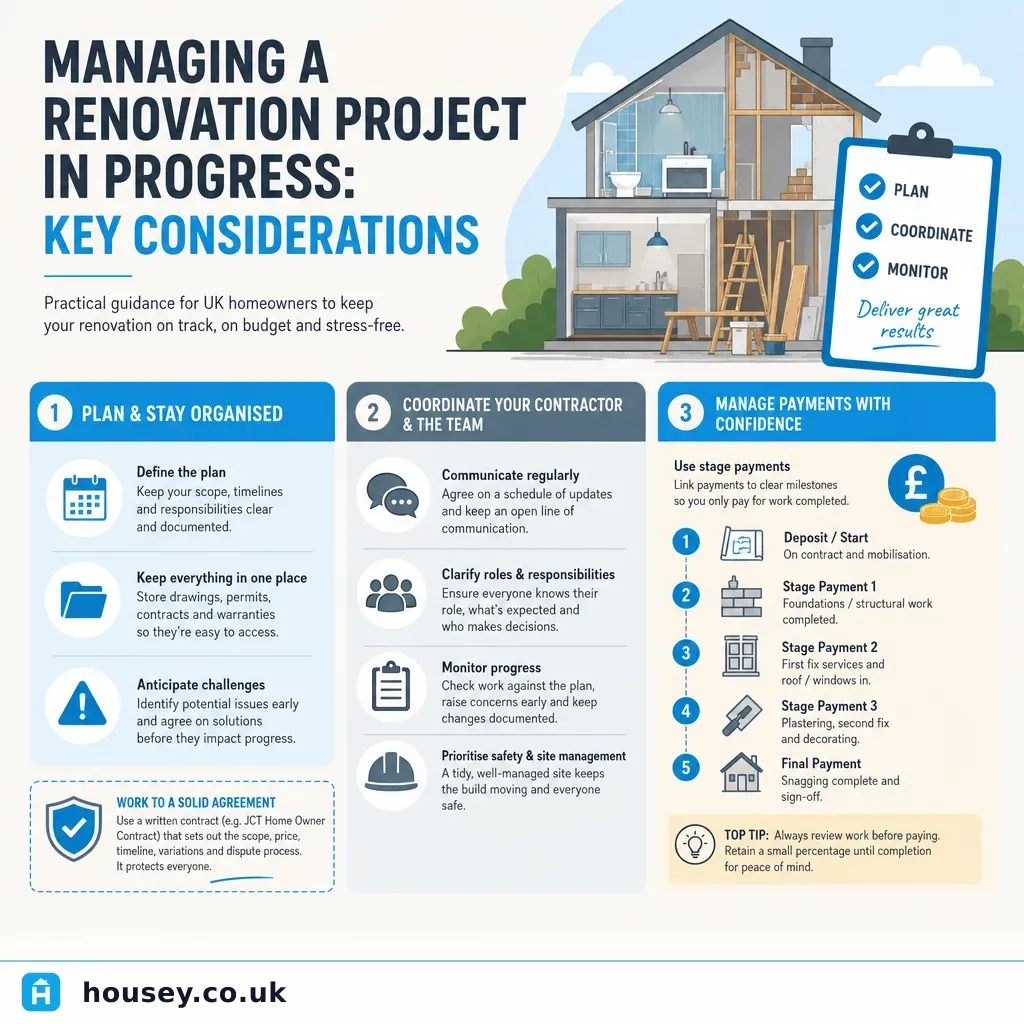
Managing a Renovation Project in Progress: Key Considerations
Keep a written schedule of works, confirm every variation in writing, and check progress at agreed milestones.
 Improvement & Build
How to Find and Hire a Loft Conversion Company
To hire a loft conversion company, get at least three quotes from TrustMark-registered or FMB-member firms.
 Improvement & Build
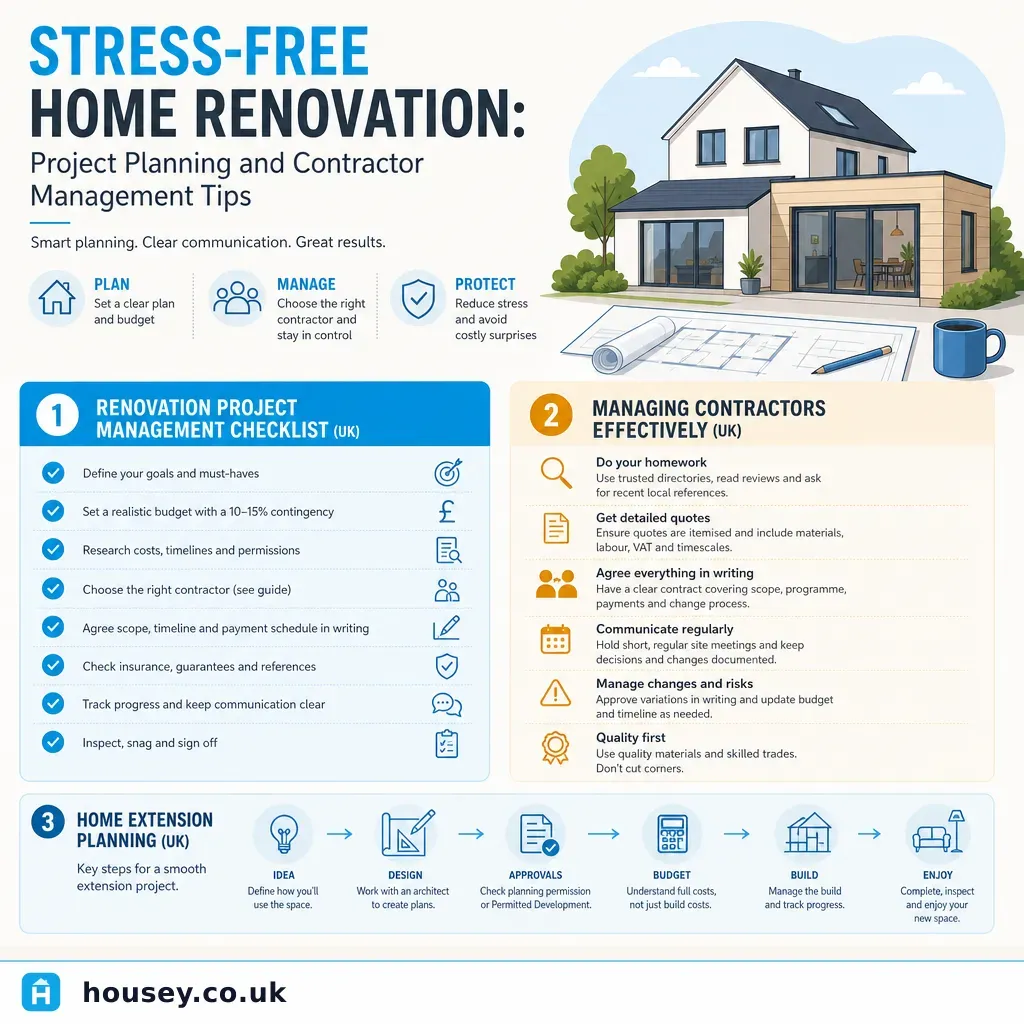
Stress-Free Home Renovation: Project Planning and Contractor Management Tips
The home renovations that stay on budget and on time share one characteristic: clear upfront planning.
 Improvement & Build
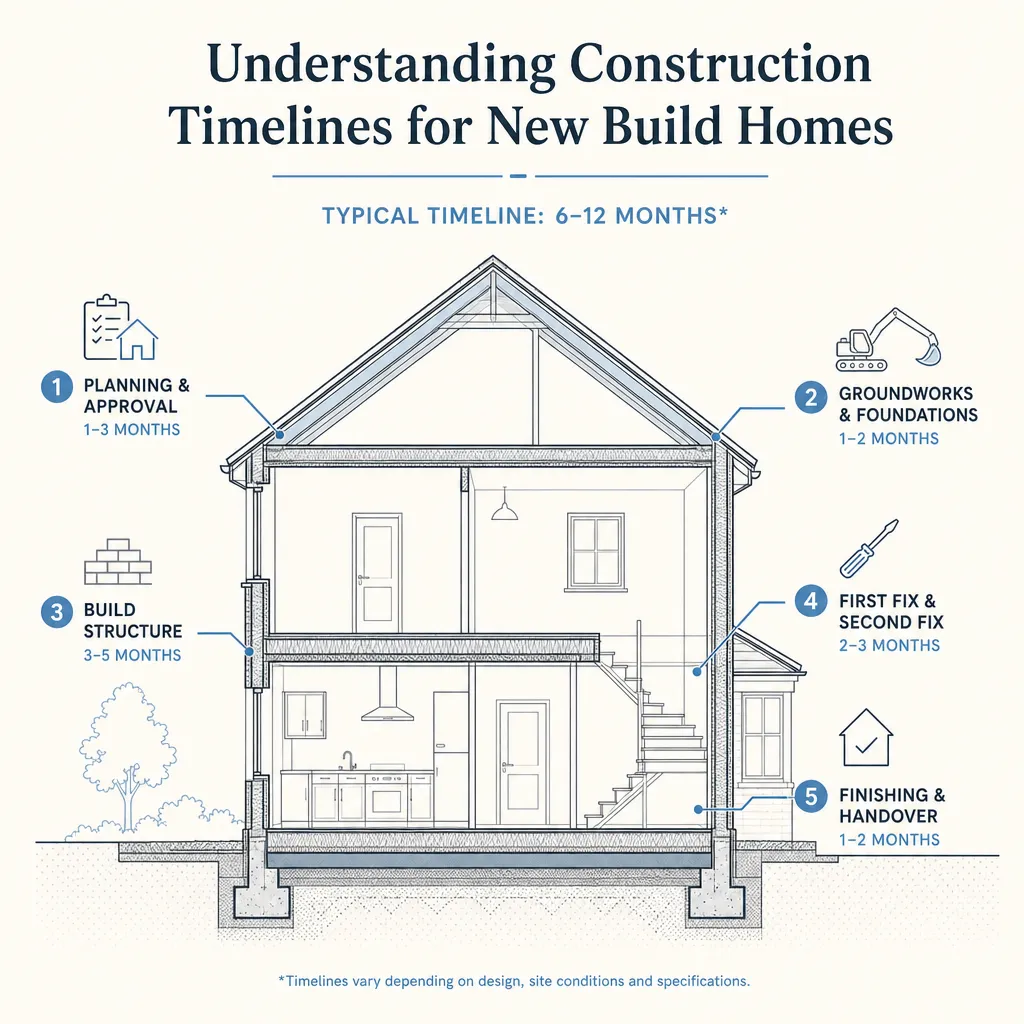
Understanding Construction Timelines for New Build Homes
Building a new home in the UK typically takes 12–24 months from planning approval to practical completion, though smaller projects can complete in 6–12 months.
 Improvement & Build
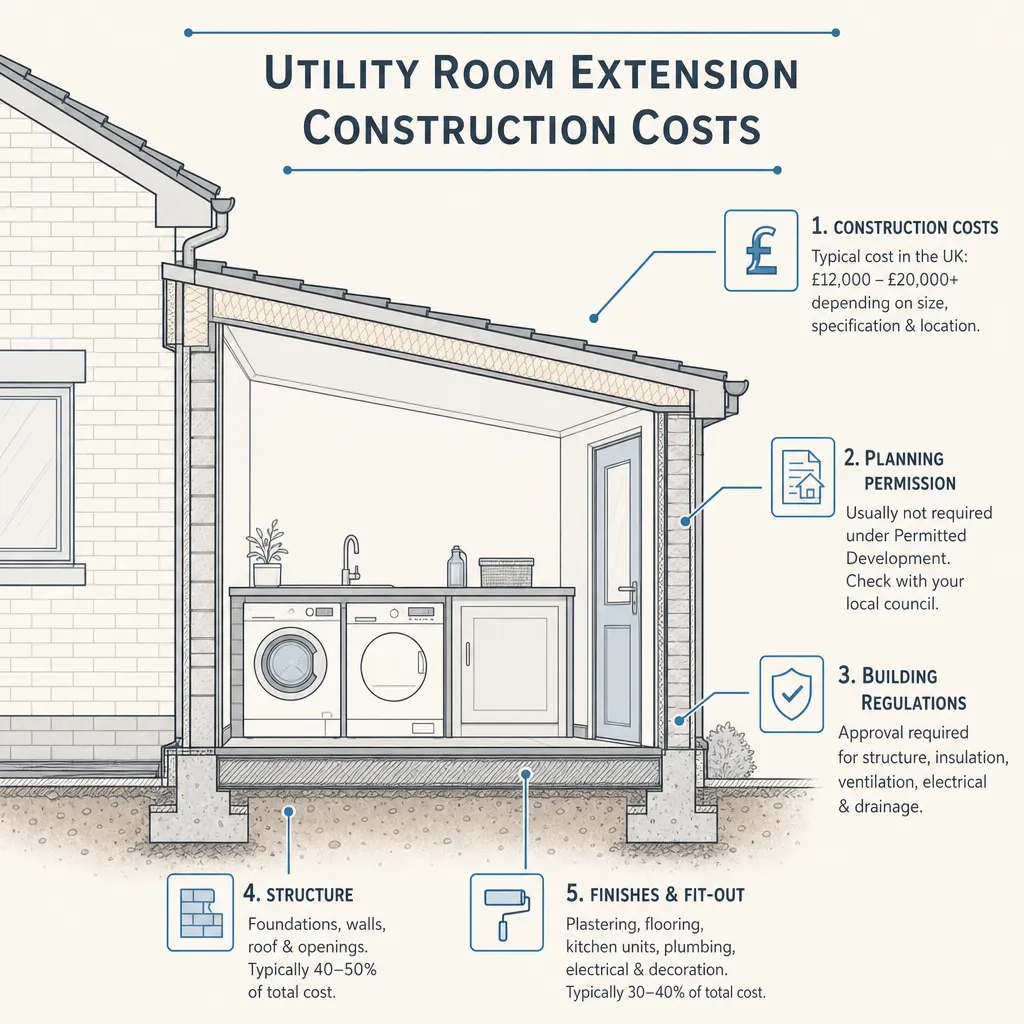
Utility Room Extension Construction Costs
A utility room extension in the UK typically costs £15,000–£40,000, depending on size, specification, and region.