Utility Room Extension Construction Costs
By Housey · Last reviewed 11th of May 2026
Utility Room Extension Construction Costs
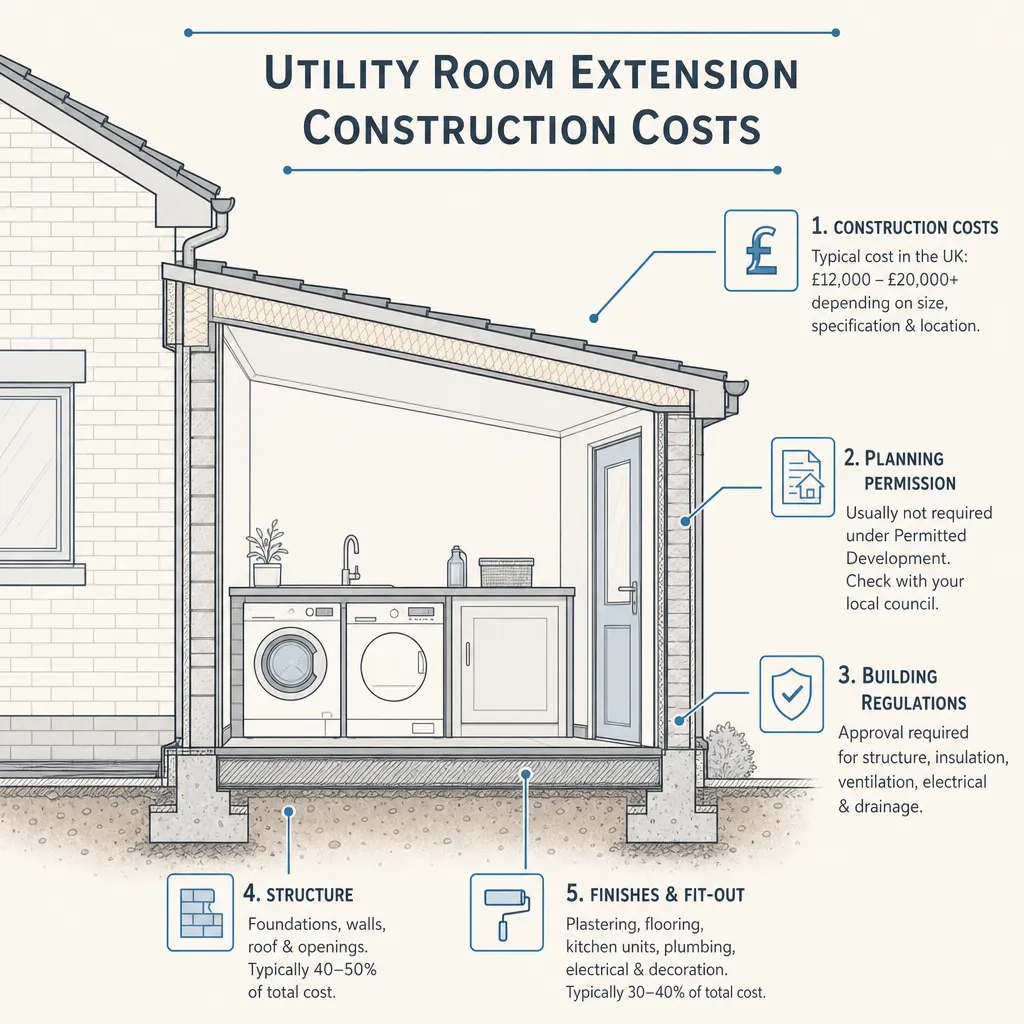
Utility rooms punch well above their weight in practical value — housing washing machines, tumble dryers, boilers, and the muddy aftermath of daily life without cluttering the kitchen. When an internal rearrangement won't do, a rear or side-return extension built specifically for utility purposes is a popular solution, particularly in 1930s semis, Victorian terraces with long side passages, and post-war estates where the original kitchen is simply too small to share. Understanding the cost structure before you approach builders means you can budget realistically and compare quotes on a like-for-like basis.
Key points
- Single-storey rear extensions up to 3m deep (semi-detached or terraced) or 4m deep (detached) commonly qualify as permitted development under the Town and Country Planning (General Permitted Development) (England) Order 2015, provided the prior approval neighbour consultation scheme is followed.
- Building regulations approval is required for all extensions regardless of permitted development status, covering Part A (structure), Part F (ventilation), Part L (thermal performance), and Part P (fixed electrical installations).
- Indicative UK build costs for a single-storey extension run from approximately £1,800 to £3,500 per m² depending on specification and region (Indicative UK costs, last reviewed 2026-05-11), putting a typical 6–9 m² utility extension at roughly £11,000–£32,000 before fittings and appliances.
- Foul drainage connection for a sink and washing machine is almost always required; groundwork costs vary significantly depending on the location of your existing drain run.
- VAT at 20% applies to construction work on existing dwellings and must be included in every quote comparison.
What drives the cost of a utility room extension?
Build costs for extensions vary more than headline per-m² figures suggest. The main cost drivers are:
Size and footprint. A 4 m² lean-to will cost less in total but more per m² than a 10 m² extension, because fixed costs — scaffolding, foundations, roof structure — are spread over a smaller floor area.
Construction method. Traditional cavity-wall brick-and-block is the most common approach and is familiar to most builders. A structural insulated panel (SIP) or timber frame build can be faster but may cost more to source and specify locally.
Roof type. A flat roof (GRP or EPDM rubber membrane) is usually the most affordable option for a single-storey utility extension. A pitched or tiled roof matching the main house costs more in materials and labour but tends to be more durable and visually integrated.
Services and drainage. Plumbing, electrics, and drainage are commonly underestimated. If the extension is far from the existing boiler, soil stack, or consumer unit, extending services adds meaningful cost. A utility room with a sink, washing machine connection, and an outdoor tap carries higher services costs than a basic store room.
Finish and fittings. Structural build costs are separate from internal finishes. Budget separately for plastering, flooring, joinery, appliances, and storage units.
Location. Labour rates in London and the South East are typically 30–50% higher than in the North of England, Wales, or Scotland.
Indicative cost ranges (2026)
Extension size | Typical build-only cost | With basic fittings |
|---|---|---|
4–5 m² (lean-to or porch size) | £8,000–£17,000 | £12,000–£22,000 |
6–9 m² (small utility room) | £11,000–£32,000 | £16,000–£38,000 |
10–15 m² (utility plus lobby) | £18,000–£52,000 | £25,000–£60,000+ |
Indicative UK costs, last reviewed 2026-05-11. Ranges cover budget to mid-range specification. London and South East costs are typically at or above the upper end. Get at least three comparable quotes before committing.
Planning permission and permitted development
Most utility room extensions at the rear of a house qualify as permitted development — meaning formal planning permission is not required — provided they meet the conditions in Schedule 2, Part 1, Class A of the Town and Country Planning (General Permitted Development) (England) Order 2015:
- Rear extension depth: no more than 3m for a semi-detached or terraced house; 4m for a detached house (single storey).
- Height: no more than 4m at the ridge, and eaves no higher than those of the existing house.
- Materials: similar in appearance to the existing house.
- Location restrictions: not available for listed buildings, Article 4 direction areas, or flats.
For extensions between 3–6m deep (semi-detached or terraced) or 4–8m deep (detached), a Prior Approval application under the neighbour consultation scheme is required before work starts, even though full planning permission is not needed. Check with your local planning authority (LPA) before proceeding.
Side extensions are more restricted and often do require full planning permission, particularly in designated areas or where prior extensions have already used up permitted development allowances.
Building regulations and what they cover
Building regulations approval is required for all extensions, including small utility rooms. Notify your local authority building control (LABC) or an approved inspector before work begins. Key parts that apply to a utility extension:
- Part A — structural integrity of foundations, walls, and roof.
- Part F — adequate ventilation for the space use.
- Part L — thermal performance: insulation standards for walls, floor, roof, and any new windows or doors.
- Part P — electrical installation must be completed by a competent person or notified to building control.
- Part H — applies if new drainage connections are being made.
A building regulations completion certificate should be issued once the work passes final inspection. Keep this document — you will need it when selling the property.
A worked example: 1930s semi in the East Midlands
A homeowner on a 1930s semi in Nottingham wanted a 7 m² rear utility room extension with a pitched tiled roof, cavity-wall construction, a utility sink, space for a washing machine and tumble dryer, and a tiled floor.
Approximate costs:
- Main structure (foundations, walls, roof): £14,500
- Plastering and internal finishes: £1,800
- Plumbing (soil drainage, sink, washing machine connection): £1,200
- Electrics (sockets, lighting, consumer unit extension): £900
- Flooring (porcelain tiles): £700
- Joinery (door, window, skirting): £1,100
- Building regulations fee: £450
- Prior approval application (if required): £120
- Total (before fittings and appliances): approximately £20,750
- VAT (20%): approximately £4,150
- Total including VAT: approximately £24,900
Worked scenario for illustration only; actual quotes will vary by region and market conditions. Indicative UK costs, last reviewed 2026-05-11.
Homeowner checklist: what to include in your brief
Use this checklist when approaching builders for quotes to ensure every contractor is pricing the same scope:
What to ask before accepting a quote
- What is specifically included and excluded from the scope?
- Who will be responsible for the building regulations application and inspections?
- What qualifications and accreditations does the electrical subcontractor hold?
- Is the quote based on assumed site conditions that could change the price?
- Is VAT included?
- What is the payment schedule, and what triggers each stage payment?
- How will changes or unexpected groundwork costs be managed and agreed?
- What warranty or guarantee is provided for the completed build?
When to get professional help
A utility room extension is a relatively low-complexity project for an experienced extension builder, but seek professional advice in these situations:
- If your property is listed, in a conservation area, or subject to an Article 4 direction — permitted development rights may be removed or restricted, and listed building consent may also be needed.
- If the extension requires removal of or penetration through a load-bearing wall — a structural engineer must specify the lintel size and temporary support requirements before work proceeds.
- If drainage or groundwork reveals unexpected conditions (high water table, contaminated ground, or tree roots near foundations) — stop work and take advice before continuing.
- If the extension is proposed on a leasehold property — check your lease and obtain freeholder consent before building.
How Housey can help
Housey connects you with vetted extension builders and architects who can help you scope, design, and price your utility room extension — from outline sketch through to building regulations sign-off. Compare quotes from up to four local specialists before committing.
Frequently asked questions
Do I need planning permission for a utility room extension?
Not usually for a rear single-storey extension within permitted development size limits — 3m deep for semi-detached or terraced houses, 4m for detached. You may still need prior approval under the neighbour consultation scheme. Separate rules apply to listed buildings, conservation areas, and flats. Always confirm with your local planning authority before starting work.
Does a utility room extension need building regulations approval?
Yes, always. Building regulations approval is required for all extensions, regardless of whether planning permission is also needed. You must notify building control before work starts. A completion certificate will be issued once the work passes inspection — keep this document, as you will need it when selling the property.
How long does it take to build a utility room extension?
A straightforward 6–9 m² single-storey extension typically takes 8–14 weeks on site, plus 4–8 weeks for prior approval confirmation and design time beforehand. Structural complications or drainage issues can extend the programme. Factor in additional lead time if a structural engineer is needed for lintel specification.
Can I include a toilet in a utility room extension?
Yes, but adding a WC increases cost and complexity. A toilet connection requires foul drainage, and Building Regulations Part H (drainage) and Part G (sanitation) will apply alongside the standard extension parts. Discuss the drainage route with your builder and building control officer early to avoid abortive groundwork.
Will a utility room extension add value to my home?
Utility rooms are widely cited by estate agents as desirable in family homes. The value uplift depends on local market conditions and specification quality. An extension that adds genuinely usable, well-specified space is generally viewed positively. For specific valuation advice, consult a RICS-registered valuer or estate agent familiar with your local market.
Sources and further reading
- Permitted development for householders: extensions — Planning Portal
- Town and Country Planning (General Permitted Development) (England) Order 2015 — legislation.gov.uk
- Building regulations approval — GOV.UK
- Approved Document L: conservation of fuel and power — GOV.UK
- Approved Document P: electrical safety — GOV.UK
Useful next reads
 Improvement & Build
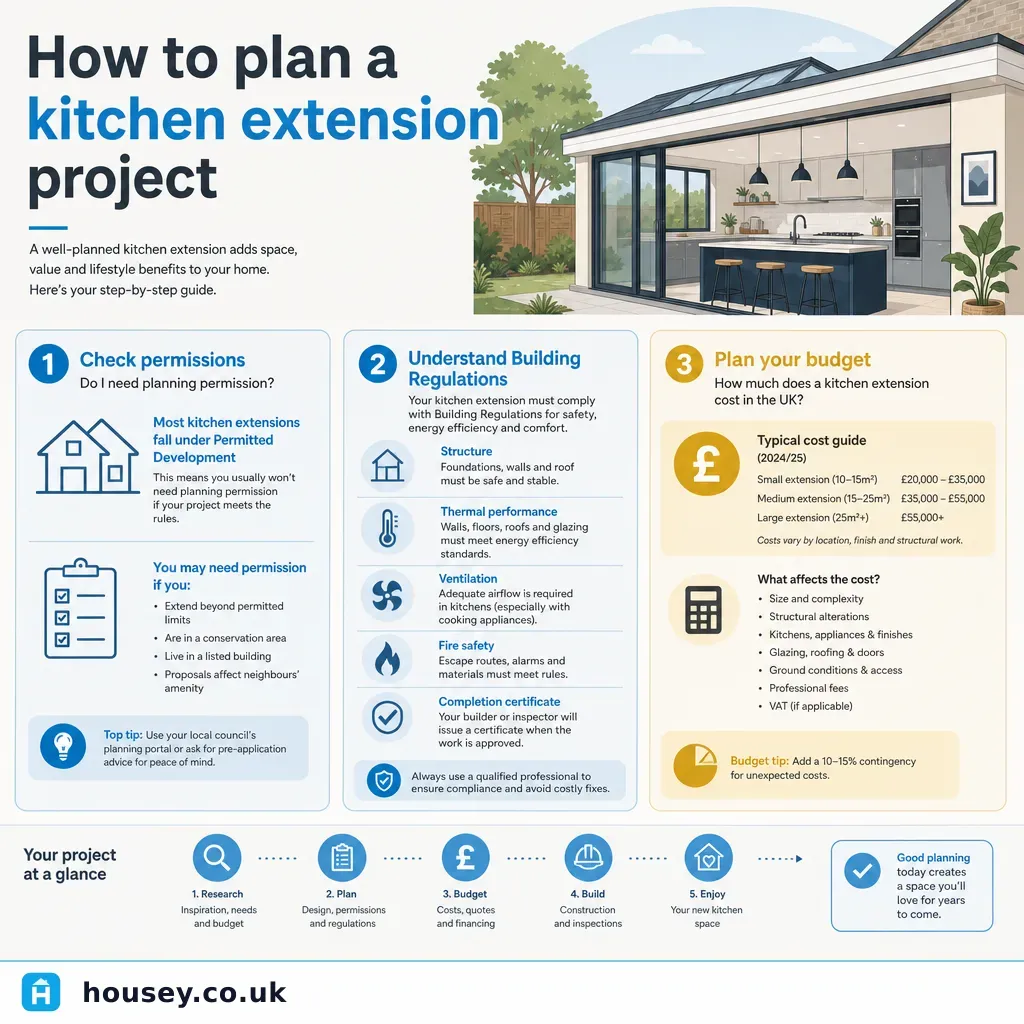
How to plan a kitchen extension project
Planning a kitchen extension means checking whether permitted development or planning permission applies, appointing an architect for drawings, obtaining Building Regulations approval, and commissioning a structural engineer for any wall removals.
 Improvement & Build
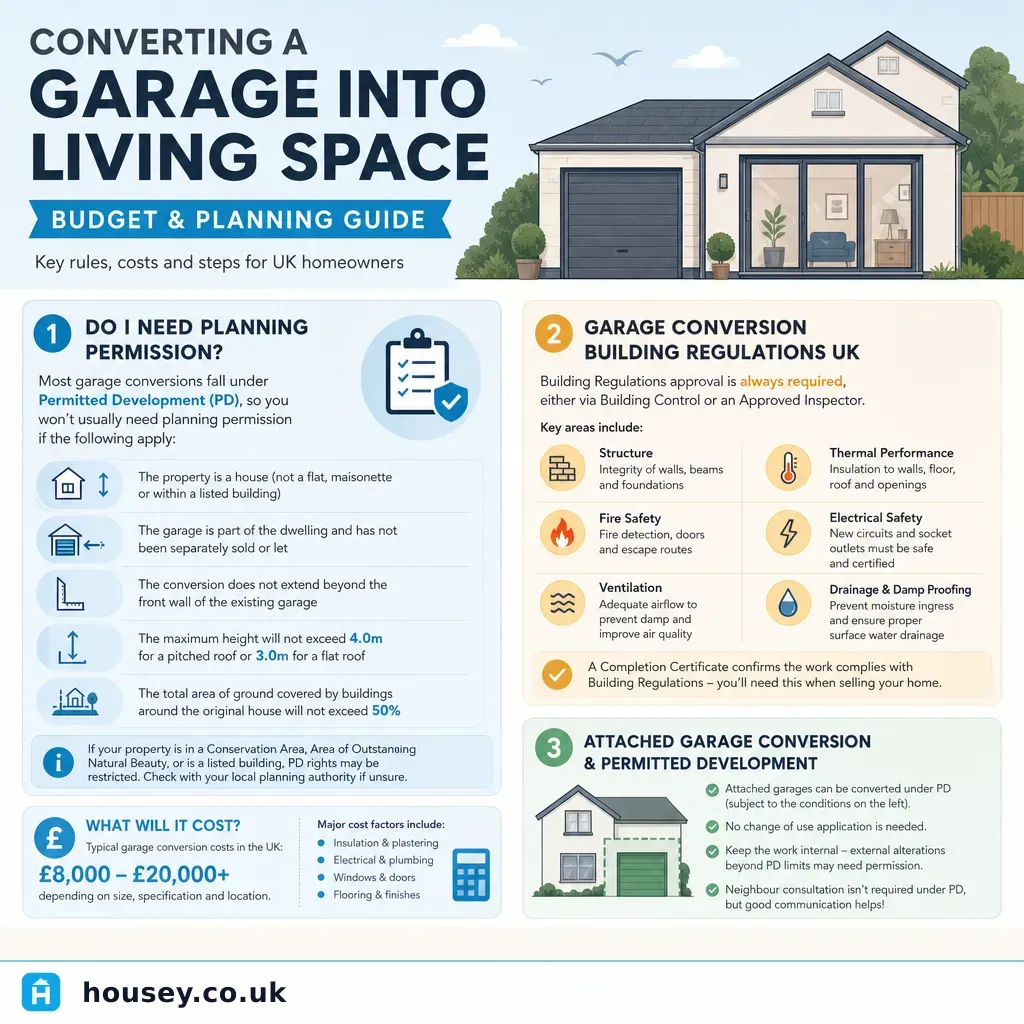
Converting a Garage into Living Space: Budget and Planning Guide
A single-garage conversion typically costs £8,000–£20,000 in the UK.
 Improvement & Build
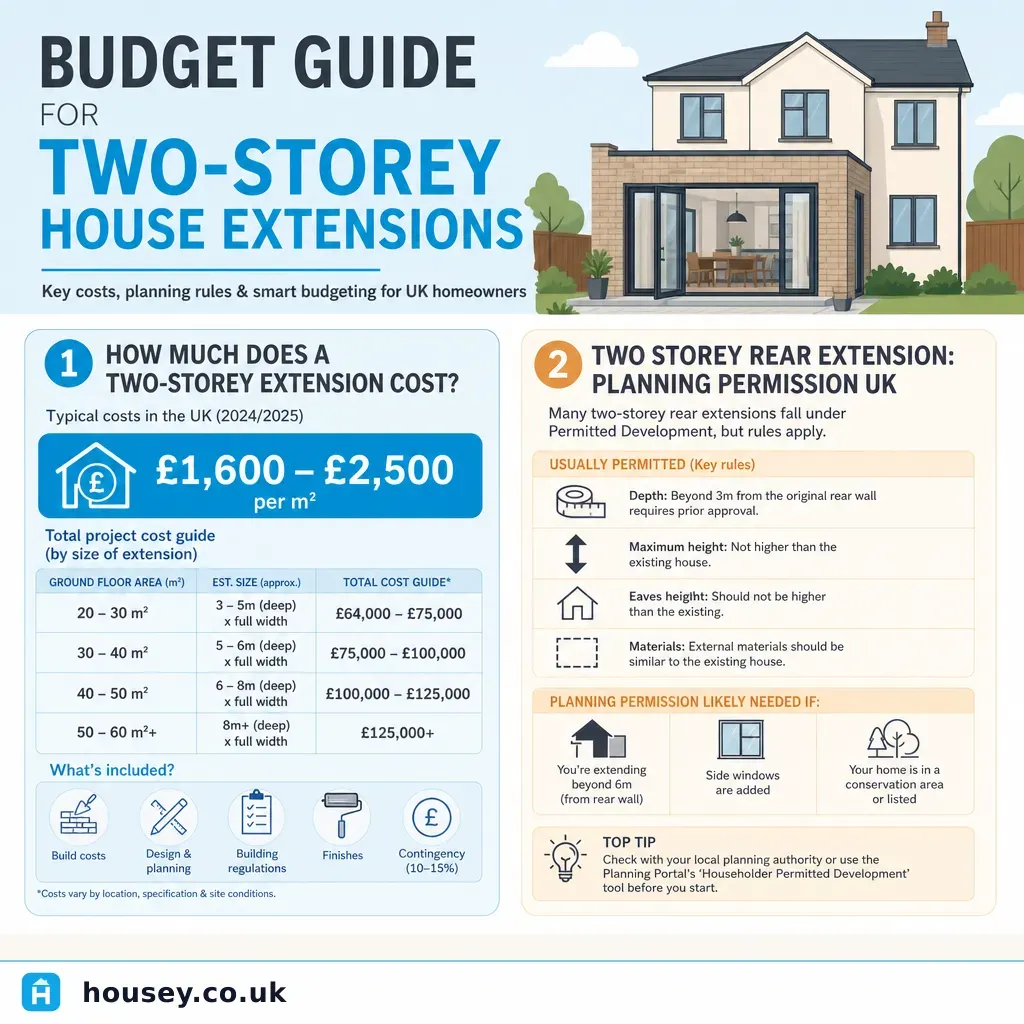
Budget Guide for Two-Storey House Extensions
A two-storey house extension in the UK typically costs £1,800–£3,000+ per square metre for the build alone.
 Improvement & Build
Laundry Room Renovation and Fitting Costs
A basic UK laundry room fit-out typically costs £2,000–£6,000 where plumbing and electrics are already in place, rising to £8,000–£15,000 or more when structural work, new drainage connections, or new electrical circuits are needed.
 Improvement & Build
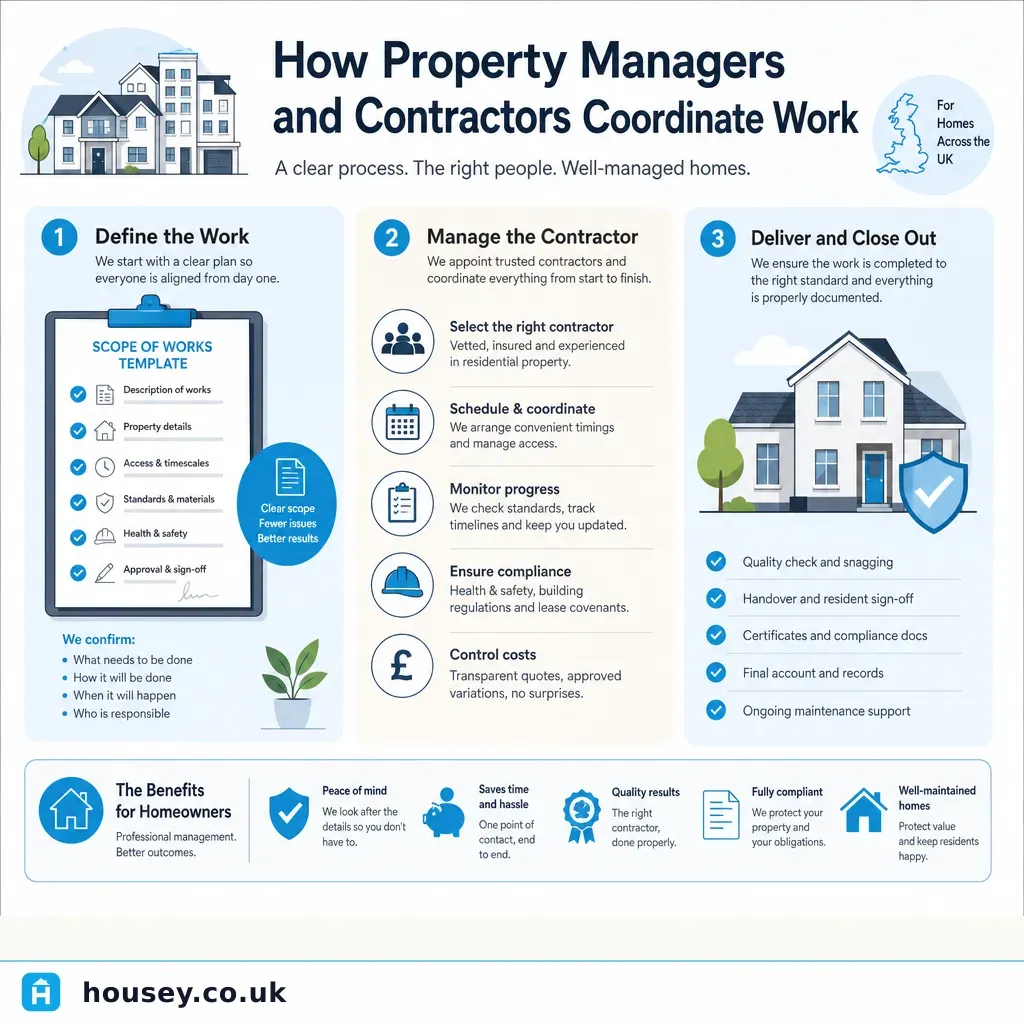
How Property Managers and Contractors Coordinate Work
Property managers coordinate contractors by scoping work clearly, selecting vetted and insured tradespeople, managing schedules and site access, checking progress against the brief, and handling sign-off and payment.