Understanding Construction Timelines for New Build Homes
By Housey · Last reviewed 1st of June 2026
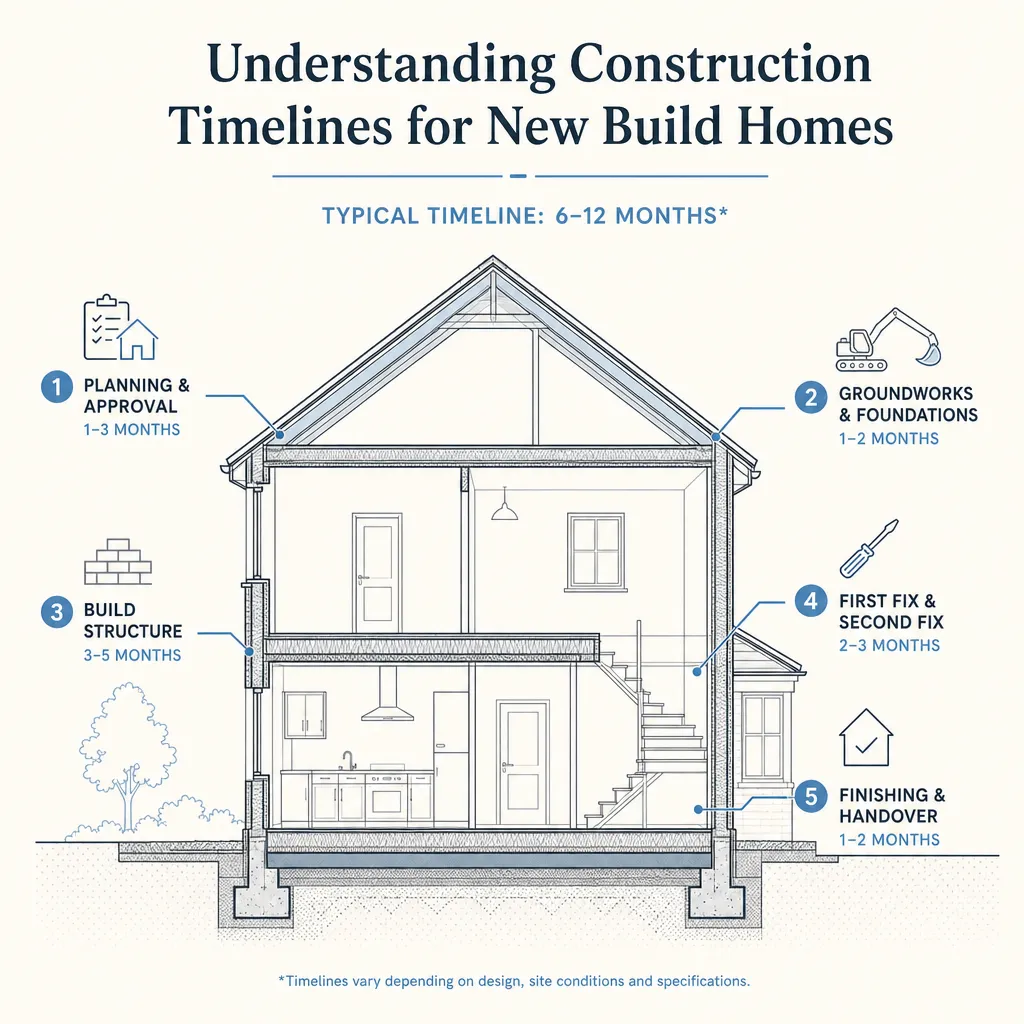
Understanding Construction Timelines for New Build Homes
Building a new home — whether through a self-build, a commission to a main contractor, or a design-and-build package — involves interlocking phases that must be carefully sequenced. Many first-time builders underestimate how long the process takes from site acquisition to moving in, and a delay to one stage can ripple through the entire programme. Understanding realistic timescales at each stage helps you plan procurement, financing, and temporary accommodation far more effectively.
Key points
- A new-build house in the UK typically takes 12–24 months from planning approval to practical completion, though smaller or simpler projects can complete in 6–12 months.
- Local planning authorities have a statutory target of 8 weeks to determine householder planning applications and 13 weeks for major applications — extensions are common, and appeals can add several months.
- The RIBA Plan of Work 2020 divides a construction project into eight stages (0–7), from Strategic Definition through to Use; knowing which stage you are at helps identify required decisions and professional appointments.
- Building control inspections under the Building Act 1984 are mandatory at multiple stages — including foundations, damp-proof course, and before occupation — and missing a statutory notification can delay practical completion.
- A 10–15% time and cost contingency is standard professional advice for new-build and self-build projects to absorb unforeseen ground conditions, material lead times, and weather delays.
The main stages of building a new home
The RIBA Plan of Work 2020 provides the most widely used framework for construction projects in the UK. Understanding these stages helps you anticipate decisions, appointments, and approvals at each phase:
RIBA Stage | Name | What happens | Typical duration |
|---|---|---|---|
0 | Strategic Definition | Establish brief, budget, site viability | 1–4 weeks |
1 | Preparation & Briefing | Appoint design team, initial surveys, feasibility | 4–12 weeks |
2 | Concept Design | Outline design, initial planning discussions | 6–16 weeks |
3 | Spatial Coordination | Developed design, planning application submitted | 8–20 weeks (inc. planning) |
4 | Technical Design | Working drawings, building regulations submission | 8–16 weeks |
5 | Manufacturing & Construction | Site works: foundations through to fit-out | 16–60 weeks |
6 | Handover | Practical completion, defects liability period begins | 2–8 weeks |
7 | Use | Occupation; defects rectified | Ongoing |
The design stages (0–4) are consistently underestimated in self-build planning. Allowing 6–12 months for design, planning, and technical approvals before breaking ground is realistic for most new-build projects.
How long does each on-site construction stage take?
Once groundworks begin, construction proceeds through a recognised sequence:
Groundworks and foundations (4–10 weeks): Site clearance, excavation, foundation construction, and drainage installation. Duration depends heavily on ground conditions — unexpected poor ground requiring piling or a raft foundation will add time and cost.
Superstructure (6–16 weeks): Ground floor slab, walls, and roof structure. Masonry construction (brick and block cavity wall) typically takes longer than timber frame or structural insulated panels (SIPs). A timber frame kit can reach a weather-tight shell in 4–8 weeks from slab level.
Weather-tight shell (1–2 weeks): Roof tiling, external doors, and windows installed. This is a critical milestone — first-fix mechanical and electrical work should not begin until the building is weather-tight.
First-fix mechanical and electrical (4–8 weeks): Plumbing runs, heating flow and return pipework, electrical cabling, and underfloor heating (if applicable) installed before internal linings.
Insulation and plasterboard (2–5 weeks): Insulation fitted to floors, walls, and roof void; plasterboard fixed. A building control inspection is required before boarding up structural elements.
Plastering and screeding (2–6 weeks): Wet trades complete. Adequate drying time before floor coverings and second-fix is critical and often underestimated. Underfloor heating screed typically requires 6–8 weeks to dry naturally, or an accelerated drying programme.
Second-fix and fit-out (6–14 weeks): Kitchen, bathrooms, joinery, decoration, floor finishes, sanitaryware, and electrical and plumbing connections.
External works (2–6 weeks, often concurrent): Paths, driveways, landscaping, and fencing. These frequently proceed in parallel with internal fit-out.
Which factors affect the build schedule?
The most common causes of schedule overrun on UK new-build projects are:
- Planning delays: Even with an 8-week statutory target, many LPAs are working beyond this. A planning application for a new dwelling can take 12–20 weeks in practice; objections or requests for further information add more time still.
- Poor ground conditions: Unexpected fill, contamination, or a high water table found at excavation can require a revised foundation design, adding 4–12 weeks.
- Procurement and material lead times: Structural timber, windows, roof trusses, and specialist mechanical plant can carry lead times of 6–20 weeks. Order well in advance of when items are needed on site.
- Subcontractor availability: In many regions, plastering and electrical subcontractors are booked several months ahead — secure them early.
- Wet weather: Extended rainfall halts groundworks and brickwork; UK winters typically reduce productivity in external trades by 20–40%.
- Design changes mid-construction: Each variation order must be assessed for cost, programme, and building control impact. Variations are the most controllable source of delay and the one most within a client's power to minimise.
Build route comparison
Choosing the right build route at the outset is one of the most consequential early decisions in any new-build programme:
Build route | Typical total programme | Best for | Main risk |
|---|---|---|---|
Self-managed (direct trade contracts) | 20–36 months | Experienced self-builders wanting maximum cost control | Programme management burden falls entirely on the client; delays compound without coordination |
Main contractor (traditional) | 14–24 months | Clients wanting a single point of contractual responsibility | Higher tender cost; quality and speed are relationship-dependent |
Design-and-build | 12–20 months | Clients wanting design and construction from one firm | Less design flexibility; specification must be defined tightly upfront |
Timber frame or SIP package + contractor | 12–18 months | Faster weather-tight shell; well suited to constrained sites | Package quality and specification require careful independent scrutiny |
Worked UK scenario: a 4-bedroom detached house in Surrey
To illustrate realistic timescales, consider a client building a 220m² four-bedroom detached house on a serviced plot in Surrey:
- Months 1–3: Architect appointed; measured survey, ground investigation, and feasibility study completed.
- Months 3–7: Planning application submitted. LPA takes 15 weeks due to pre-application advice process and neighbour consultation period.
- Months 7–11: Technical design and structural engineering completed; building regulations submitted via Full Plans route; main contractor tendering.
- Month 12: Construction starts. Groundworks begin; investigation reveals soft spots requiring deeper strip foundations — a 3-week programme delay.
- Months 13–17: Superstructure (masonry cavity wall construction). Prefabricated roof trusses craned into position.
- Months 17–18: Building weather-tight. Windows and external doors fitted.
- Months 18–22: First-fix trades, insulation, plasterboard, plastering. A full six-week drying period for the underfloor heating screed is observed before second-fix commences.
- Months 22–27: Second-fix, kitchen, bathrooms, decoration, floor finishes, external works, snagging.
- Month 27: Practical completion and building control completion certificate issued. Total programme from project start: 27 months.
The client had engaged a project manager from month 7 onwards, later identified as a key factor in containing variation orders and maintaining the programme through the ground condition delay.
Pre-construction checklist
Before breaking ground, confirm the following are in place:
When to get professional help
A project manager or principal designer is particularly valuable when:
- You are managing multiple subcontractors directly without prior construction management experience.
- The project involves complex groundworks, an unusual structural system, or a site in a conservation area or affecting a listed building.
- You are at risk of missing statutory inspection notifications or building control milestones.
- The programme has already slipped and you need objective diagnosis of the cause.
- Contract disputes have arisen with the main contractor.
For new-build homes, consider engaging a RICS-accredited project manager or an ARB-registered architect to oversee the build stage, even where a design-and-build firm manages day-to-day construction.
How Housey can help
Whether you are at early planning stage or already on site, Housey can connect you with vetted project managers who specialise in new-build and self-build coordination, design-and-build firms that handle both design and construction under a single contract, and extension builders for smaller new-build or ancillary elements. Providing a clear brief — including your programme requirements and site conditions — helps you receive meaningful, comparable quotes.
Frequently asked questions
How long does planning permission take for a new dwelling in the UK?
Local planning authorities have a statutory target of 8 weeks for householder applications and 13 weeks for major applications. In practice, many LPAs are working beyond these targets, and it is common for a new dwelling application to take 12–20 weeks. Pre-application discussions with the LPA can reduce the risk of objections and requests for further information.
What are the most common causes of new-build construction delays?
The most frequent causes are unexpected ground conditions at excavation, late design decisions or variation orders mid-construction, subcontractor availability, material lead times (particularly structural timber, windows, and mechanical plant), and planning conditions that must be discharged before works can proceed. A contingency of 10–15% on both time and budget is standard professional advice.
Do I need a project manager for a self-build in the UK?
Not legally, but it is strongly advisable unless you have direct construction management experience. A project manager coordinates subcontractors, manages the programme, monitors quality, and handles variations — tasks that are time-consuming and technically demanding. RICS-regulated project managers can also provide formal cost reporting and contract administration services.
What is practical completion in a new-build project?
Practical completion is the formal point at which a building is assessed as complete for its intended purpose, even if minor defects (snags) remain. It triggers the defects liability period (typically 12 months for new-build homes), the release of retention monies, and the start of the structural warranty. Building control issues a completion certificate at or around this stage.
Sources and further reading
- RIBA Plan of Work 2020 — Royal Institute of British Architects
- Self Build and Custom Housebuilding Advice — National Custom & Self Build Association
- Building Regulations Approval — GOV.UK
- Planning Permission — GOV.UK
- NHBC Buildmark Warranty — NHBC
Useful next reads
 Improvement & Build
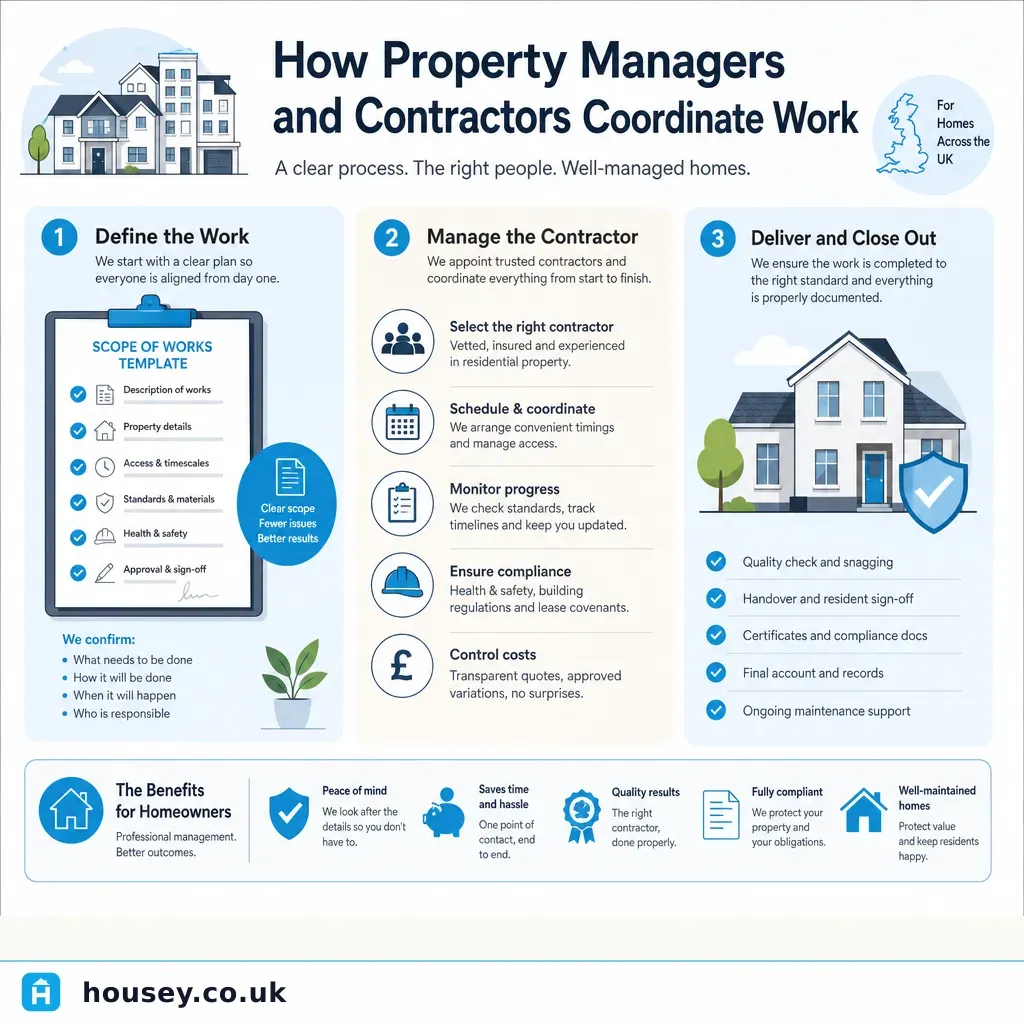
How Property Managers and Contractors Coordinate Work
Property managers coordinate contractors by scoping work clearly, selecting vetted and insured tradespeople, managing schedules and site access, checking progress against the brief, and handling sign-off and payment.
 Improvement & Build
How to Find and Hire a Loft Conversion Company
To hire a loft conversion company, get at least three quotes from TrustMark-registered or FMB-member firms.
 Improvement & Build
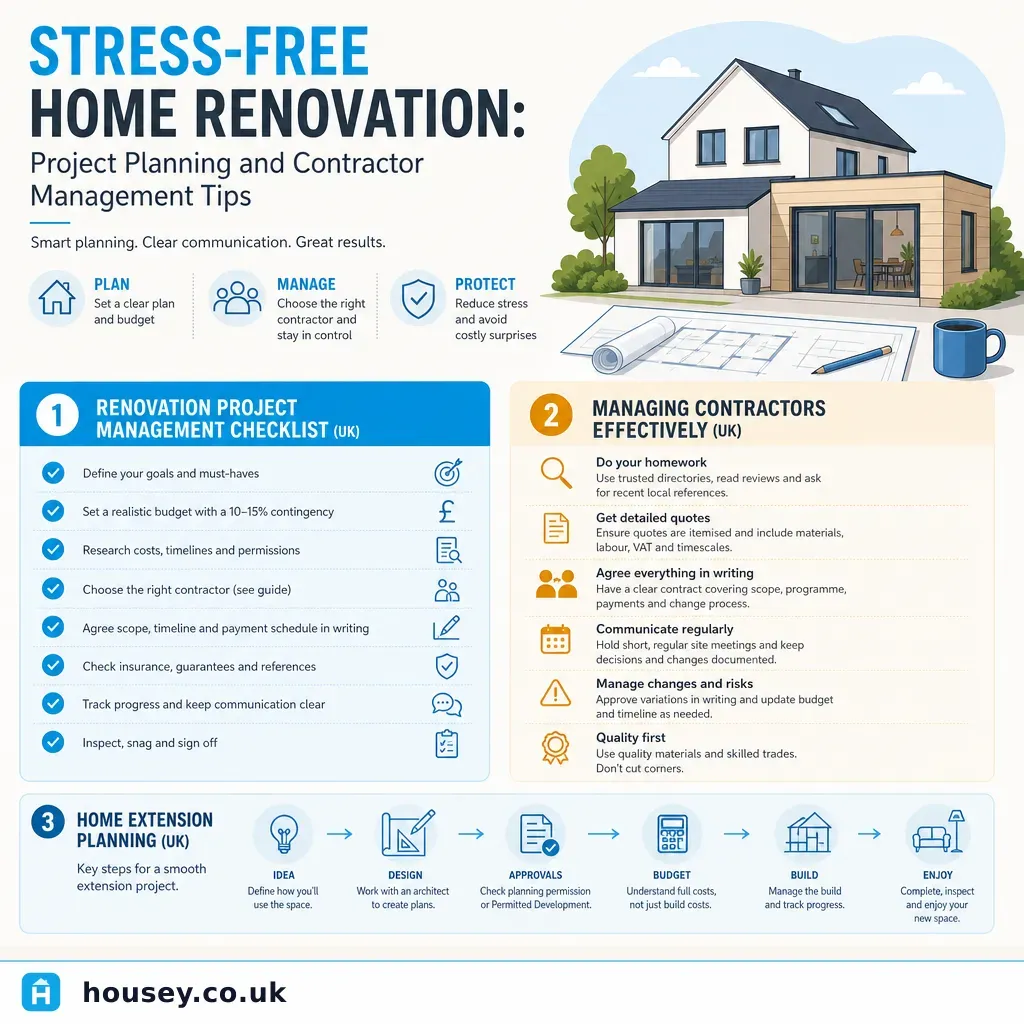
Stress-Free Home Renovation: Project Planning and Contractor Management Tips
The home renovations that stay on budget and on time share one characteristic: clear upfront planning.
 Improvement & Build
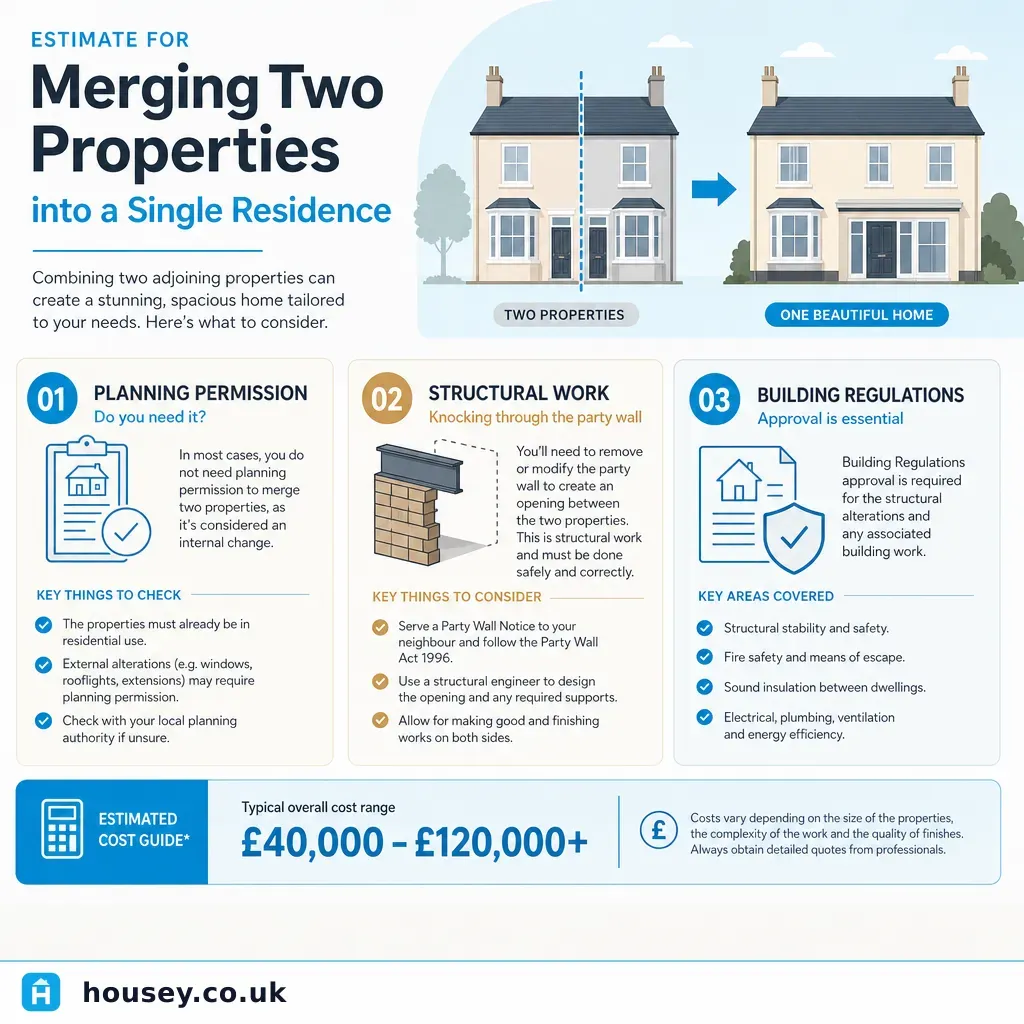
Estimate for Merging Two Properties into a Single Residence
Merging two properties into one typically costs £30,000–£120,000 or more, depending on property type, structural complexity, and professional fees.
 Improvement & Build
Utility Room Extension Construction Costs
A utility room extension in the UK typically costs £15,000–£40,000, depending on size, specification, and region.