How Solar Power Technology Works: Technical Fundamentals
By Housey · Last reviewed 30th of May 2026
How Solar Power Technology Works: Technical Fundamentals
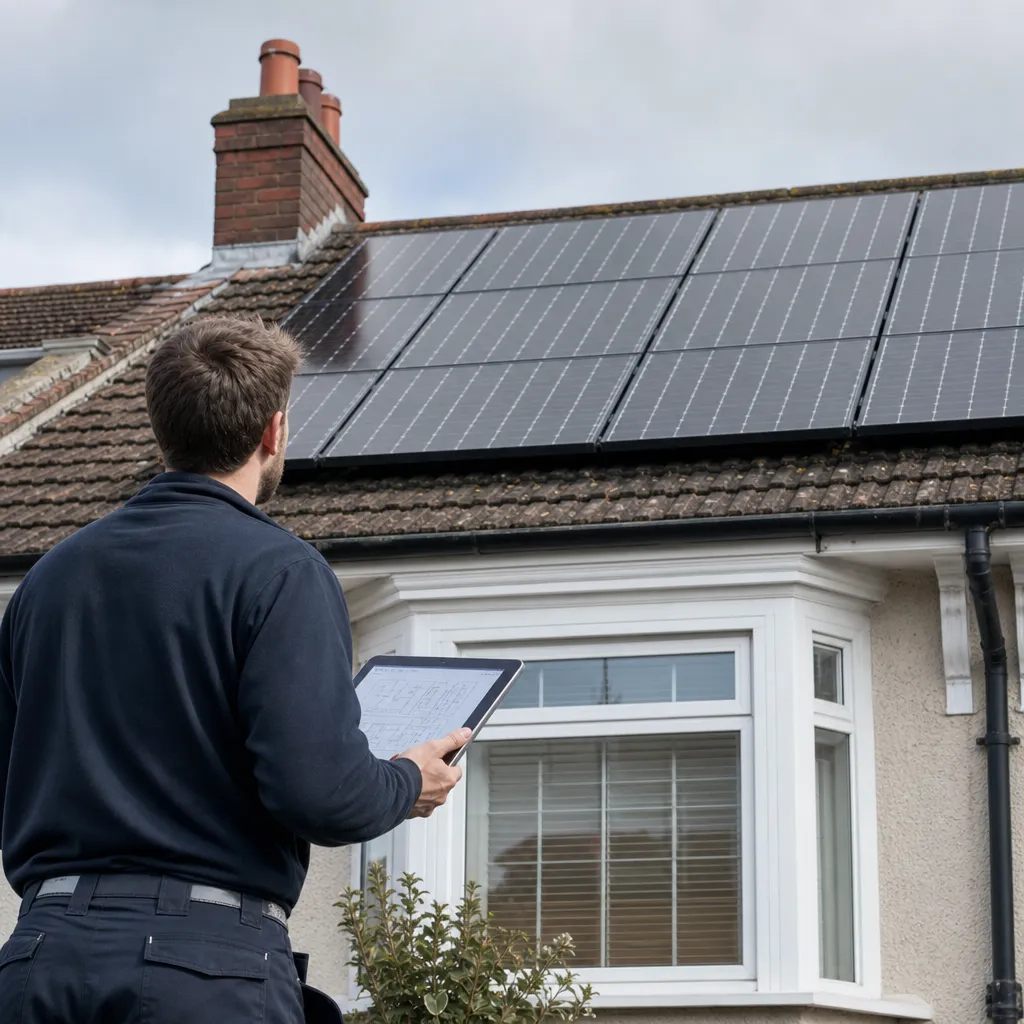
Solar photovoltaic systems are now found on more than a million UK homes, but the technical principles behind how they generate electricity are often poorly understood — which makes it harder to evaluate installer quotes, compare panel specifications, or assess performance claims. A working understanding of how solar electricity is generated, converted, and used helps homeowners ask better questions and make more confident decisions before committing to an installation.
Key points
- A photovoltaic cell converts light into DC electricity through the photovoltaic effect — no heat, combustion, or moving parts are involved in electricity generation.
- Commercial solar panel efficiency currently ranges from approximately 17% to 23%, meaning 17–23% of the solar energy striking the panel surface is converted to usable electricity.
- Panel output is rated in watts peak (Wp) under Standard Test Conditions (STC): 1,000 W/m² irradiance and 25°C cell temperature. Real-world UK output is typically 10–20% lower than the STC rating due to temperature, shading, and diffuse light.
- An inverter converts the DC electricity produced by the panels into 230V/50Hz AC electricity, compatible with UK household circuits and the distribution grid.
- Battery storage systems can increase household self-consumption of solar electricity from a typical 30–40% without storage to around 60–80% with appropriately sized storage, depending on household load profile.
How photovoltaic cells generate electricity
A photovoltaic cell is made primarily from silicon, a semiconductor material. When photons from sunlight strike the cell, they transfer energy to electrons in the silicon crystal lattice, causing them to move in a controlled direction and generate an electric current. This is the photovoltaic effect, first observed by Edmond Becquerel in 1839, and the physical basis of all solar PV technology.
Individual cells produce roughly 0.5–0.6V DC at low current. Cells are connected in series and encapsulated into a panel (or module), which typically contains 60, 72, or 96 cells. Multiple panels are then wired in strings to build up the voltage and current levels needed by the inverter.
The two dominant cell technologies in UK residential installations are:
- Monocrystalline silicon — cut from a single silicon crystal, producing a uniform dark appearance. Efficiency typically 19–23%, with good low-light performance. Currently the most common choice for UK residential rooftops.
- Polycrystalline silicon — made from multiple fused silicon crystals, giving a blue speckled appearance. Efficiency typically 15–18%; less common in new residential installations since monocrystalline production costs fell sharply.
A third technology — thin-film (amorphous silicon, cadmium telluride, or CIGS) — has lower efficiency but better high-temperature performance. Rarely used in UK residential rooftop applications but relevant for some commercial and flat-roof installations.
System components and their roles
A complete grid-connected solar PV system consists of several components working together.
Component | Function | Key specification |
|---|---|---|
PV panels | Convert sunlight to DC electricity | Power rating (Wp), efficiency (%), temperature coefficient |
Inverter | Converts DC to AC; controls grid connection | AC output (kW), number of MPPT inputs, conversion efficiency (%) |
Mounting system | Fixes panels to roof; maintains weathertightness | Load rating, corrosion resistance, roof compatibility |
Generation meter | Records total kWh generated | Required for Smart Export Guarantee registration |
AC isolator | Allows safe isolation of the AC circuit | Required by BS 7671 and Building Regulations Part P |
Monitoring system | Tracks output, faults, and export | Inverter app, web portal, or dedicated gateway device |
Battery storage adds two further components: a battery unit (lithium-ion or lithium iron phosphate, rated in usable kWh) and a battery inverter or charger that manages charging, discharging, and grid interaction.
How the inverter works
The inverter is the most technically complex component in a solar PV system. It performs three main functions:
- Maximum Power Point Tracking (MPPT): continuously adjusts the electrical load seen by the panels to extract the maximum available power as irradiance and cell temperature change throughout the day.
- DC-to-AC conversion: uses solid-state power electronics to synthesise a clean 230V/50Hz AC waveform from the variable DC input of the solar string.
- Grid interface and protection: synchronises with the grid, monitors grid voltage and frequency, and automatically disconnects if the grid fails — a safety function known as anti-islanding protection, required under Engineering Recommendation G98/G99.
String inverters connect all panels in a series string to one central unit. Microinverters are installed on each individual panel and convert DC to AC at roof level. Power optimisers are a hybrid: panel-level DC-to-DC optimisation feeding a central string inverter.
Which system configuration suits your property?
- Choose a string inverter if your roof has a single, largely unshaded orientation — south-, east-, or west-facing — and a straightforward panel layout. String inverters are lower cost and simpler to maintain.
- Choose microinverters or power optimisers if your roof has significant shading from chimneys, dormer windows, or trees, or if panels face multiple orientations. Each panel operates independently, so partial shading on one panel does not reduce the output of the entire string.
- Consider a hybrid inverter if you plan to add battery storage within the next five years — installing a hybrid inverter now avoids a second inverter installation later and typically reduces overall system cost.
- Ask an independent professional if your roof has a complex layout with multiple pitches, orientations, or heavy shading. A site-specific solar survey and shading analysis will give more reliable output estimates than general rules of thumb.
Understanding efficiency and real-world output
The wattage rating of a panel is measured under Standard Test Conditions — 1,000 W/m² irradiance with a cell temperature of exactly 25°C. In UK conditions, cell temperatures on sunny summer days regularly exceed 25°C, which reduces output: crystalline silicon panels typically lose 0.3–0.5% of output for each degree Celsius above the STC temperature.
Diffuse light, low-angle morning and afternoon irradiance, and surface soiling all reduce real-world output further. The Performance Ratio of a well-installed UK system is typically 0.75–0.85, meaning the system delivers 75–85% of the theoretical maximum for the irradiation received. A Performance Ratio consistently below 0.70 may indicate shading losses, soiling, inverter faults, or module mismatch and is worth investigating with your installer.
When to get professional help
If you are comparing quotes with significantly different predicted annual outputs for the same roof, or if an installer cannot explain their shading analysis methodology, an independent solar survey provides a technically grounded, site-specific assessment. Technical disputes about system performance after installation — for example, if actual generation is meaningfully below the predicted figure — should be referred to an MCS-certified professional or, if unresolved, to the Renewable Energy Consumer Code (RECC).
How Housey can help
A solar survey from an independent professional gives you a technically grounded assessment of your roof's solar potential, including shading analysis, system sizing options, and a realistic generation estimate — so you can evaluate installer proposals with confidence before committing.
Frequently asked questions
What does kWp mean on a solar panel quote?
kWp stands for kilowatts peak — the maximum rated power output of the system under Standard Test Conditions. A 4 kWp system consists of panels with a combined peak rating of 4,000 watts. Actual annual generation in kWh depends on location, roof orientation, shading losses, and real-world system performance, and is usually lower than the peak rating implies.
Do solar panels work with a north-facing roof?
North-facing roof slopes in the UK receive significantly less direct solar irradiance than south-, east-, or west-facing slopes and are generally not suitable for rooftop solar PV. However, flat or near-flat roofs can have panels mounted on angled frames to face south regardless of the building's underlying roof orientation.
What is the lifespan of a solar inverter?
Most string inverters are warranted for 5–10 years with an expected operational lifespan of 10–15 years. Extended warranties are available from most manufacturers at additional cost. Microinverters are typically warranted for 15–25 years. When planning system finances, budget for one inverter replacement over a 25-year system lifespan.
How does battery storage interact with the grid?
A home battery stores surplus solar electricity that would otherwise be exported. When solar output falls below household demand — in the evenings or on overcast days — the battery discharges to supply household loads, reducing grid imports. Most UK home battery systems can also be programmed to charge from the grid at off-peak tariff rates such as overnight Economy 7 or Agile tariffs.
Sources and further reading
- Solar panels advice and guidance — Energy Saving Trust
- PVGIS solar irradiance data tool — European Commission Joint Research Centre
- MCS Product Directory — Microgeneration Certification Scheme
- Smart Export Guarantee — Ofgem
- NAPIT Competent Person Scheme — NAPIT
Useful next reads
 Energy & Retrofit
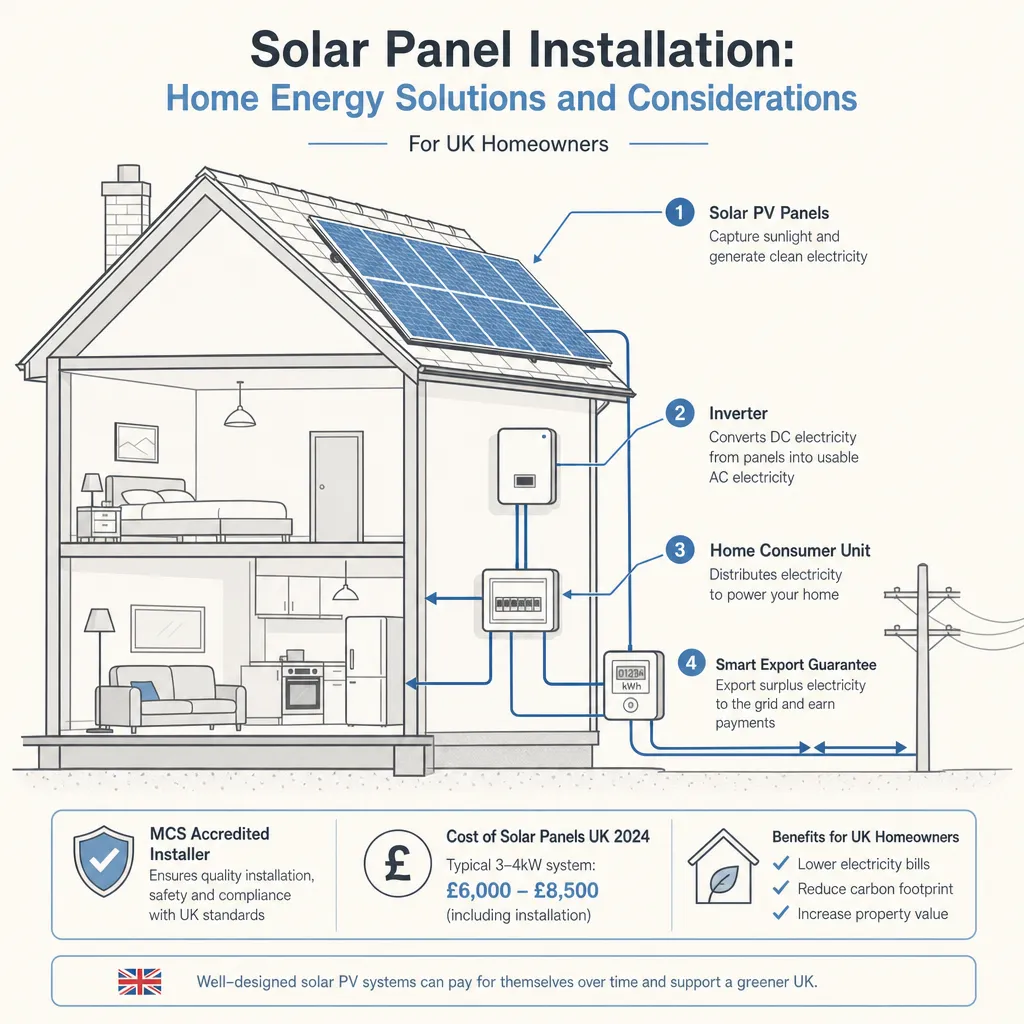
Solar Panel Installation: Home Energy Solutions and Considerations
A typical 4 kWp solar PV system costs £6,000–£9,000 installed and generates around 3,400–3,800 kWh per year on a south-facing roof in southern England.
 Energy & Retrofit
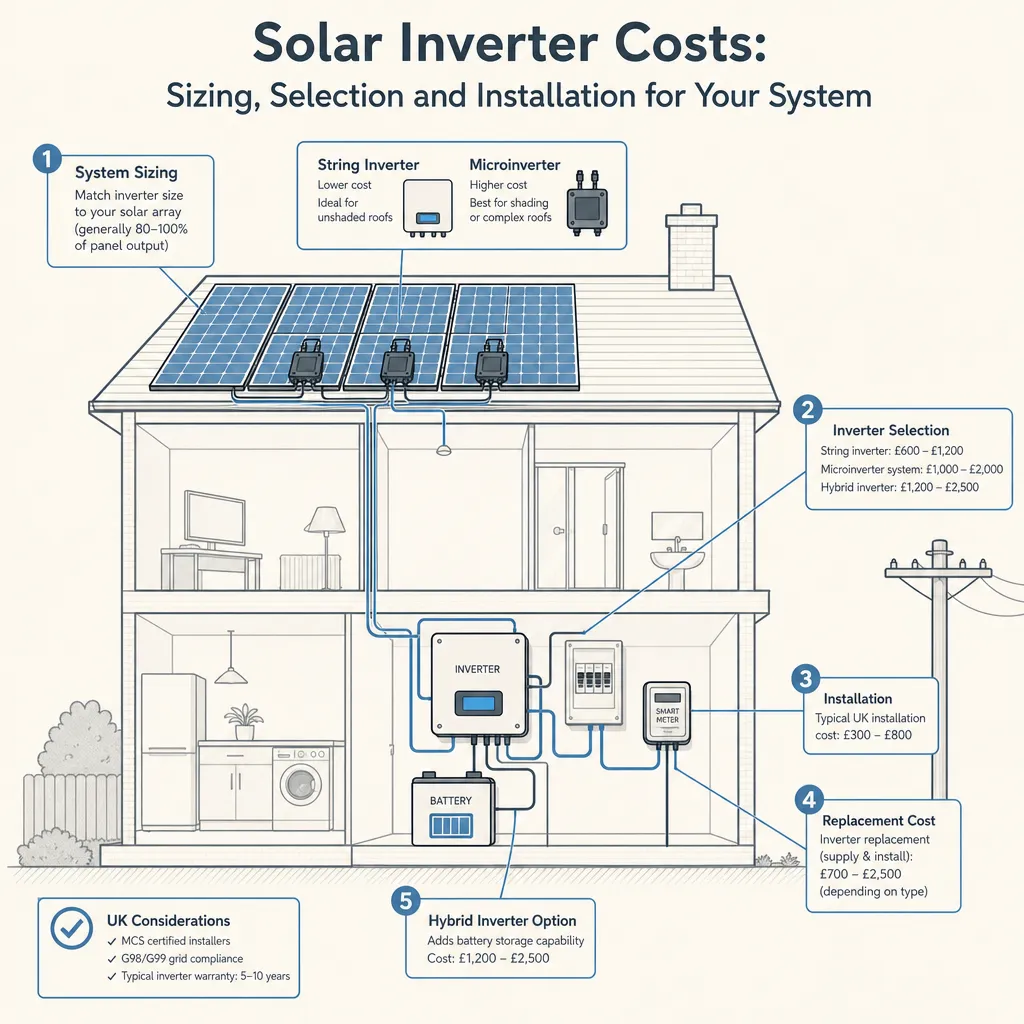
Solar Inverter Costs: Sizing, Selection and Installation for Your System
A solar inverter converts DC electricity from panels into AC power for home use.
 Energy & Retrofit
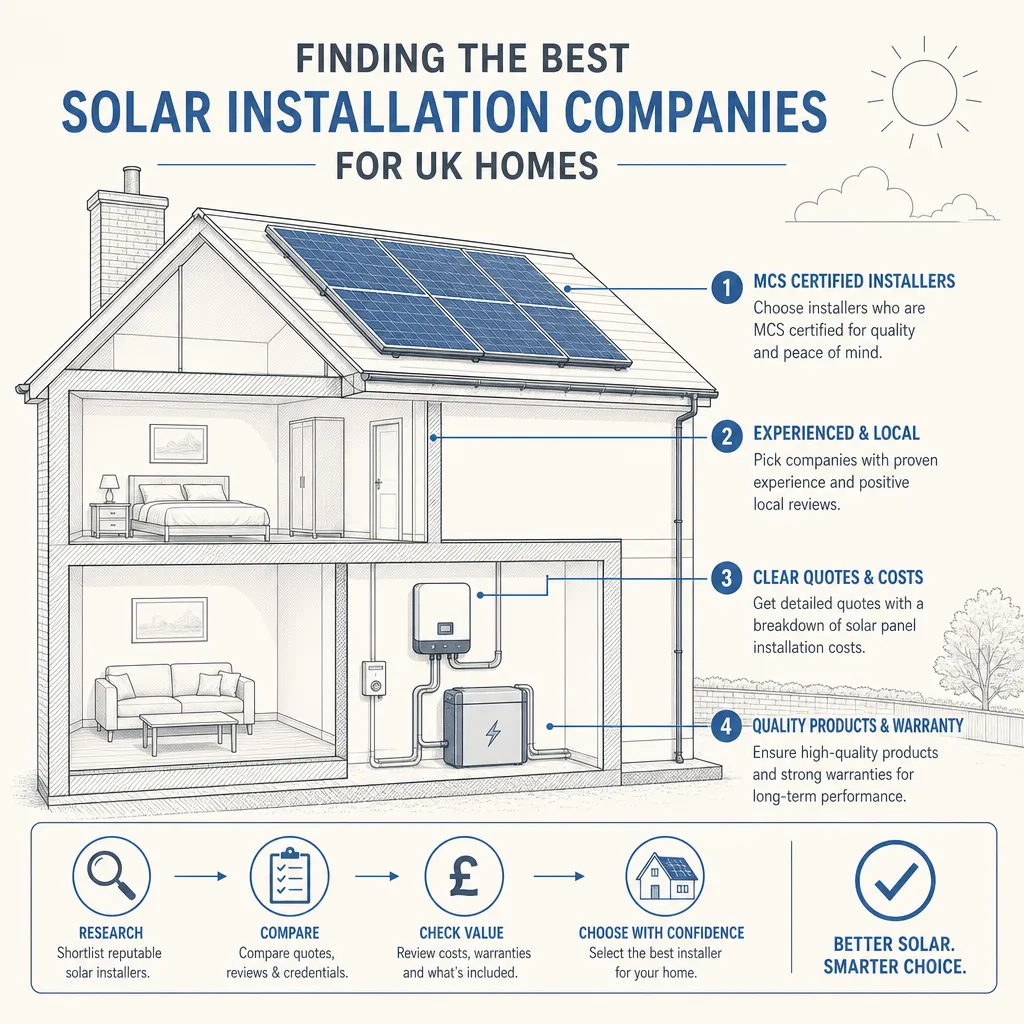
Finding the Best Solar Installation Companies for UK Homes
To find a reliable solar installation company in the UK, look for MCS (Microgeneration Certification Scheme) certification — required for Smart Export Guarantee eligibility — plus NICEIC or NAPIT electrical registration.
 Energy & Retrofit
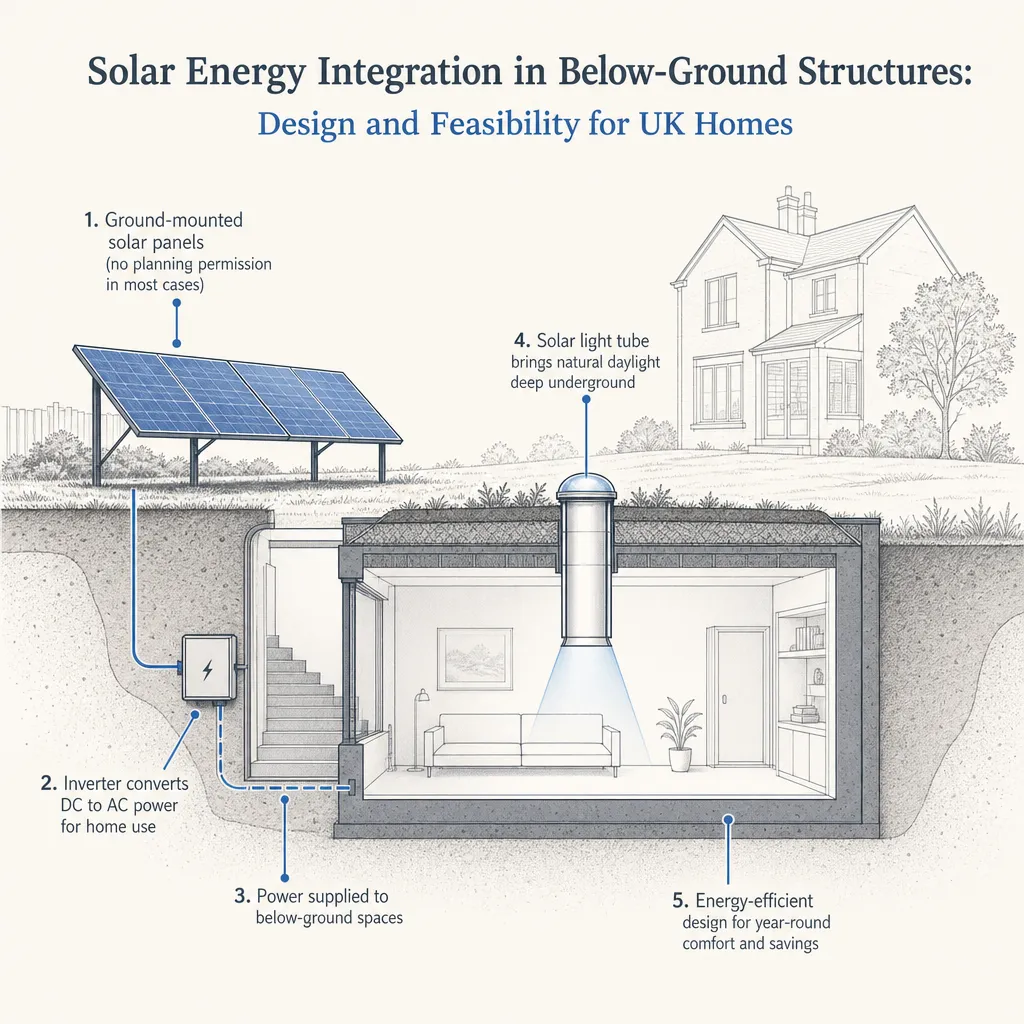
Solar Energy Integration in Below-Ground Structures: Design and Feasibility
Below-ground structures cannot host solar panels on their own roofs but can use surface-mounted panels connected via cable runs, solar light tubes for daylighting, and battery storage.
 Energy & Retrofit
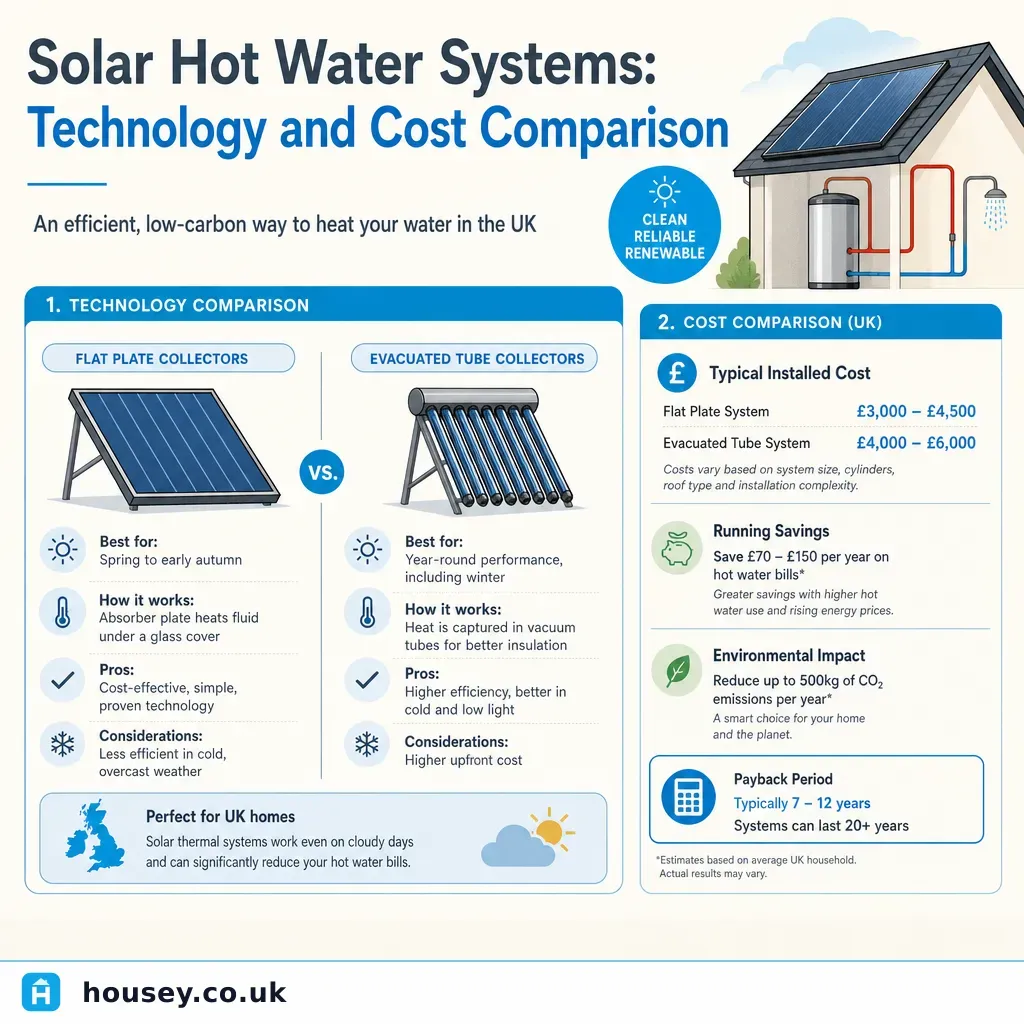
Solar Hot Water Systems: Technology and Cost Comparison
Solar thermal systems use roof-mounted collectors to heat domestic hot water via a glycol circuit and twin-coil cylinder.