Solar Inverter Costs: Sizing, Selection and Installation for Your System
By Housey · Last reviewed 31st of May 2026
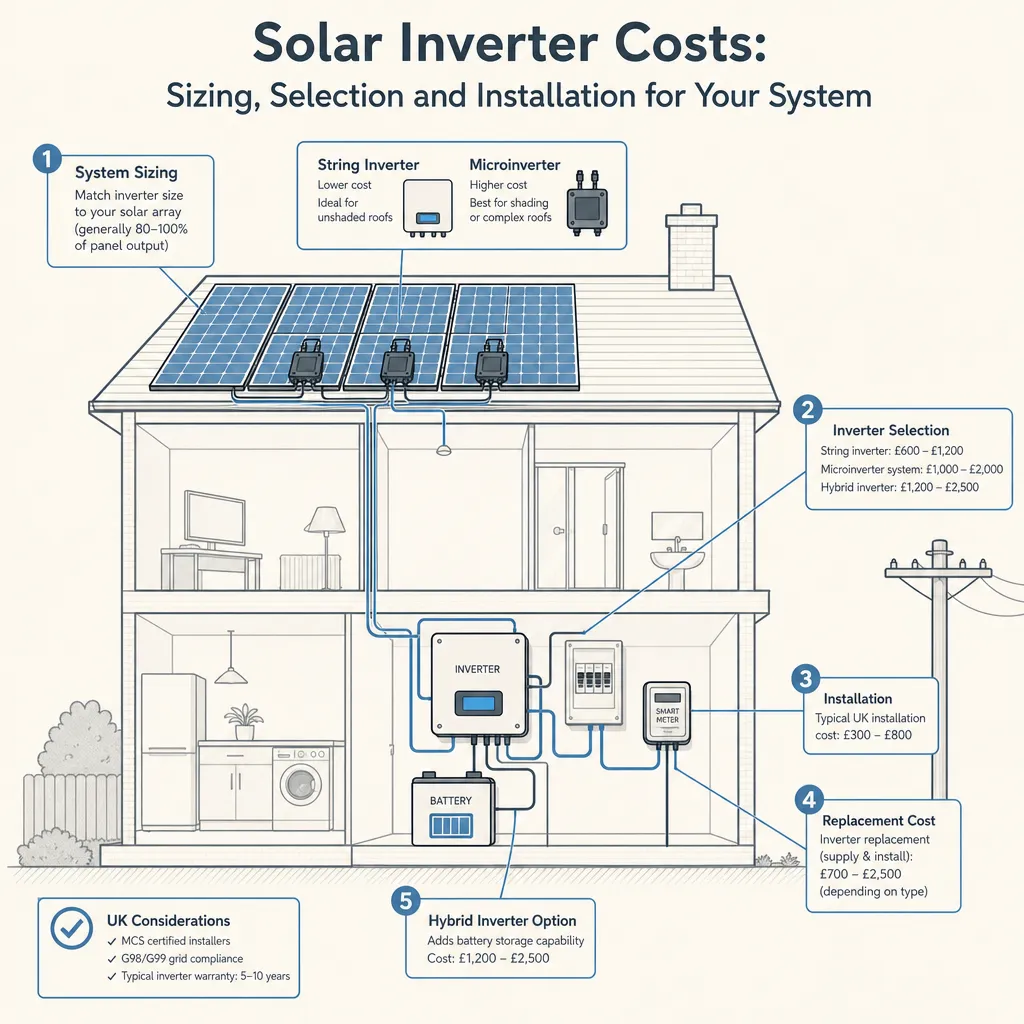
Solar Inverter Costs: Sizing, Selection and Installation for Your System
A solar inverter is the central component of any photovoltaic (PV) installation — it converts direct current (DC) electricity from the panels into alternating current (AC) that powers your home and, where exported, feeds the grid. It is also one of the more technically nuanced choices in a solar project: the wrong type can limit system performance, create compatibility problems with future battery storage, or fail prematurely if undersized. Most homeowners encounter inverter decisions either when specifying a new solar system or when an existing unit reaches the end of its working life.
Key points
- The three main inverter types for UK domestic solar are string inverters (one central unit per array), microinverters (one small unit per panel), and hybrid inverters (battery-ready string inverters)
- String inverters typically cost £500–£1,500 supplied and installed for a standard domestic array; microinverters cost £100–£200+ per panel; hybrid inverters range from £1,000–£2,500+ installed (Indicative UK costs, last reviewed 2026-05-31)
- Inverter capacity should be sized at approximately 80–120% of your array's total peak output in kilowatts (kWp) — an MCS-accredited installer performs this calculation based on your panel specification, orientation, and shading analysis
- String inverters are most sensitive to shading: if one panel in the string underperforms, output from the whole string can drop — microinverters and DC power optimisers address this at the panel level
- Replacing a failed solar inverter typically costs £700–£2,000+ including labour, and can take 2–4 weeks if parts must be ordered — a practical factor when calculating the total lifetime cost of any PV system
Types of solar inverter compared
Type | How it works | Best for | Not ideal for | Indicative cost (supply and install) |
|---|---|---|---|---|
String inverter | Converts DC from a series of panels in one central unit | Simple unshaded roofs facing one direction; most cost-effective setup | Roofs with shading, multiple orientations, or obstructions breaking the array | £500–£1,500 |
Microinverter | Each panel has its own small inverter mounted on the roof | Complex roofs, multiple orientations, or significant shading | Budget-conscious projects on simple unshaded roofs where the cost premium is hard to justify | £100–£200 per panel (£1,500–£4,000+ for a full system) |
Hybrid inverter | String inverter with a built-in DC battery interface | Anyone planning battery storage now or in future | Households with no battery plans and a tight initial budget | £1,000–£2,500+ |
String inverter + DC optimisers | Optimisers at each panel feed a central string inverter | Partially shaded arrays on otherwise simple roofs | Severe or complex shading — full microinverter installation may perform better | £800–£2,000 |
(Indicative UK costs, last reviewed 2026-05-31)
Which inverter type should you choose?
- Choose a string inverter if your roof faces a single direction — ideally south, or south-east to south-west — has no significant shading from chimneys, adjacent roofs, or trees, and you have no plans for battery storage.
- Choose a hybrid inverter if you plan to add battery storage at any point, even years from now. Retrofitting a battery to a non-hybrid system often requires an additional AC-coupled battery inverter, adding cost and complexity.
- Choose microinverters if your roof spans multiple orientations, is subject to shading for a meaningful portion of the day, or has a complex shape that a single string cannot efficiently serve.
- Choose DC optimisers with a string inverter if your roof has partial shading in one area but is otherwise straightforward — this is a cost-effective compromise between a string-only setup and a full microinverter installation.
- Ask your installer to model your specific roof using shading analysis software before committing. A quantified estimate of annual yield under each option is far more useful than a general recommendation.
Solar inverter costs in detail
Indicative UK costs, last reviewed 2026-05-31. Prices vary by brand, inverter capacity rating, installation complexity, and regional labour rates.
What drives cost variation:
- Type: microinverters carry a higher per-panel cost; string inverters have a lower unit cost for straightforward arrays
- Capacity (kW rating): a 3.6 kW string inverter costs less than an 8 kW model from the same manufacturer's range
- Brand and warranty support: recognised brands with UK service networks — SolarEdge, SMA, GivEnergy, Fronius, Huawei, Enphase — typically cost more than lesser-known alternatives but carry stronger long-term parts availability and support
- Replacement vs new installation: swapping a failed inverter involves decommissioning, testing, and re-commissioning, typically adding 1–2 hours of labour compared to a first-time installation
- Regional labour rates: installer day rates vary between London and the South East compared to other UK regions
Most string inverters carry a 5–12 year manufacturer warranty; extended warranties are available from some brands. Check whether the warranty offered by your installer includes on-site service or requires the unit to be returned to the manufacturer.
What affects inverter sizing?
Inverter sizing is a technical calculation, not an estimate. The main inputs are:
- Total panel peak output (kWp): the sum of all panel rated wattages under standard test conditions
- Orientation and tilt angle: affects peak simultaneous DC voltage and the generation profile throughout the day
- Temperature coefficient: inverter DC voltage limits must account for cold-weather peaks when string voltage rises above summer norms
- Grid connection limits: most domestic single-phase connections can export up to 3.68 kW without a formal G99 application to your Distribution Network Operator (DNO); systems with a larger proposed export capacity require DNO approval before connection
An undersized inverter clips peak generation on bright days, permanently wasting output. An oversized one is unnecessary expenditure. Engineering Recommendation G99, published by the Energy Networks Association, and the MCS Contractor standard govern how accredited installers approach this calculation.
When to get professional help
Solar inverter installation and replacement must be carried out by a qualified, MCS-accredited installer for any grid-connected system. MCS certification is required for Smart Export Guarantee (SEG) eligibility, and DNO notifications must be handled by a competent person.
Contact a professional specifically if:
- Your existing inverter has failed and you are considering a different type or brand — new cable runs or monitoring infrastructure may be needed
- You want to know whether your current system is compatible with battery storage and what coupling method would apply
- You suspect shading is reducing your system's output and want a technical assessment of whether optimisers or microinverters would recover meaningful generation
- Your proposed system exceeds 3.68 kW single-phase export and requires a G99 DNO application
Do not attempt to disconnect or replace a solar inverter yourself. PV panels generate DC voltage whenever daylight is present — even with the AC mains isolated, the DC side of the system remains live and presents a serious electrocution risk.
How Housey can help
If you are planning a new solar PV system and want to ensure the inverter type and capacity are right for your roof, future battery plans, and grid connection, a solar survey from an MCS-accredited professional will assess your roof's generation potential, identify shading constraints, and recommend the most appropriate inverter specification before any equipment is purchased.
Frequently asked questions
How long does a solar inverter last?
Most string inverters last 10–15 years — shorter than the 25-year performance warranty typical of solar panels. Microinverters are usually warranted for 25 years, matching panel lifespan. When budgeting for a solar PV system over its full life, allow for at least one string inverter replacement as part of your total cost of ownership planning.
Can I replace my solar inverter with a different brand?
Usually yes, provided the replacement is compatible with your panel voltage and current ratings and is commissioned by an MCS-accredited installer. Some brands — notably SolarEdge and Enphase — use proprietary optimiser and monitoring systems, so switching brand may mean losing monitoring capability or requiring additional component changes alongside the inverter swap.
Does a hybrid inverter cost more to run than a standard one?
No. A hybrid inverter operates at the same efficiency as a standard string inverter when no battery is connected. The additional cost is in the purchase price. If battery storage is added later, you avoid the cost of a separate AC-coupled battery inverter — which is one of the main financial arguments for choosing a hybrid inverter from the outset.
What is a G99 application and when is one needed?
A G99 is a formal notification to your Distribution Network Operator (DNO) required for solar PV systems with a single-phase inverter rated above 3.68 kW. Most standard domestic rooftop systems fall within this limit. Your installer will confirm whether a G99 is needed based on your proposed system size and will manage the application process with the DNO.
Sources and further reading
- MCS Solar PV standards and installer certification — Microgeneration Certification Scheme
- Smart Export Guarantee guidance — Ofgem
- Engineering Recommendation G99: connecting generation to the grid — Energy Networks Association
- Solar panels guidance for homeowners — Energy Saving Trust
- Approved Document P: electrical safety in dwellings — Ministry of Housing, Communities and Local Government
Useful next reads
 Energy & Retrofit
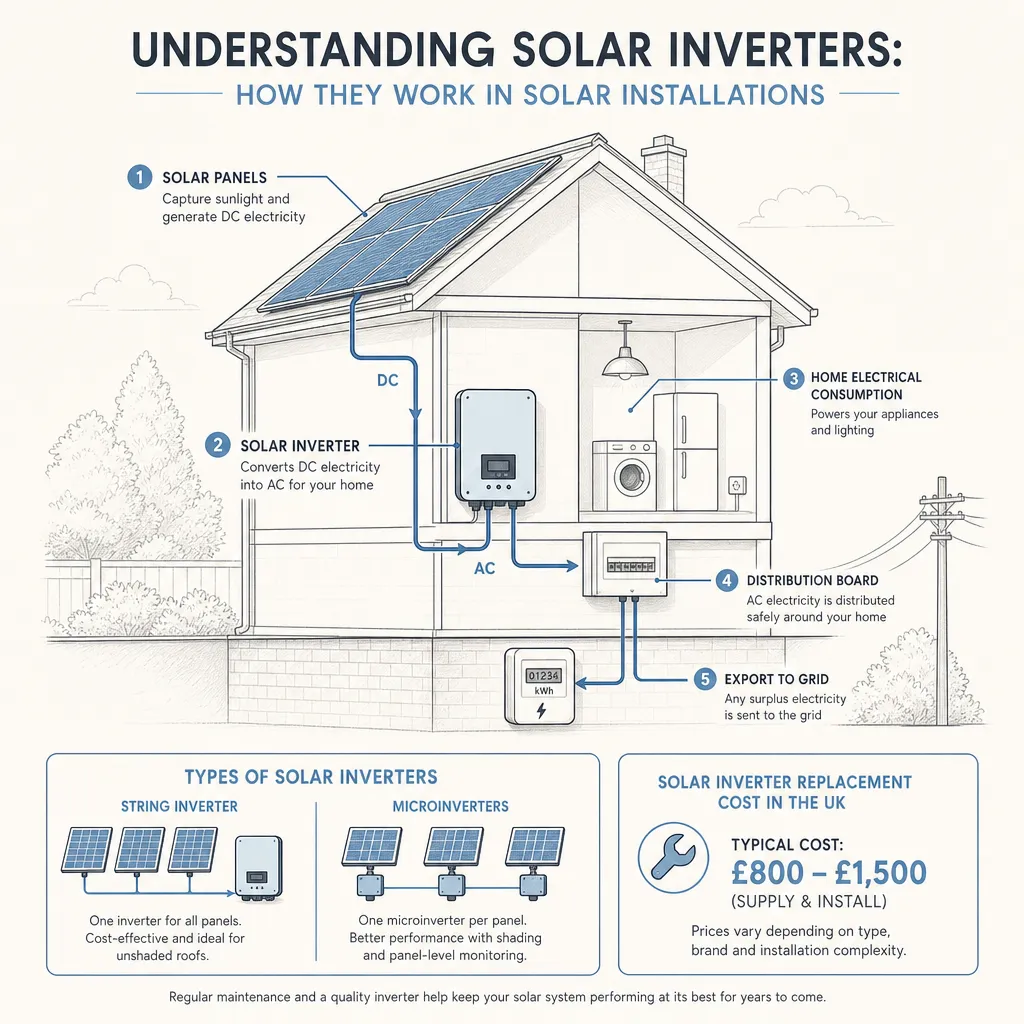
Understanding Solar Inverters: How They Work in Solar Installations
A solar inverter converts direct current (DC) electricity from solar panels into 230V alternating current (AC) that UK home appliances and the grid can use.
 Energy & Retrofit
How Solar Power Technology Works: Technical Fundamentals
Solar panels use photovoltaic cells to convert sunlight directly into DC electricity, which an inverter then converts to 230V AC for household use.
 Energy & Retrofit
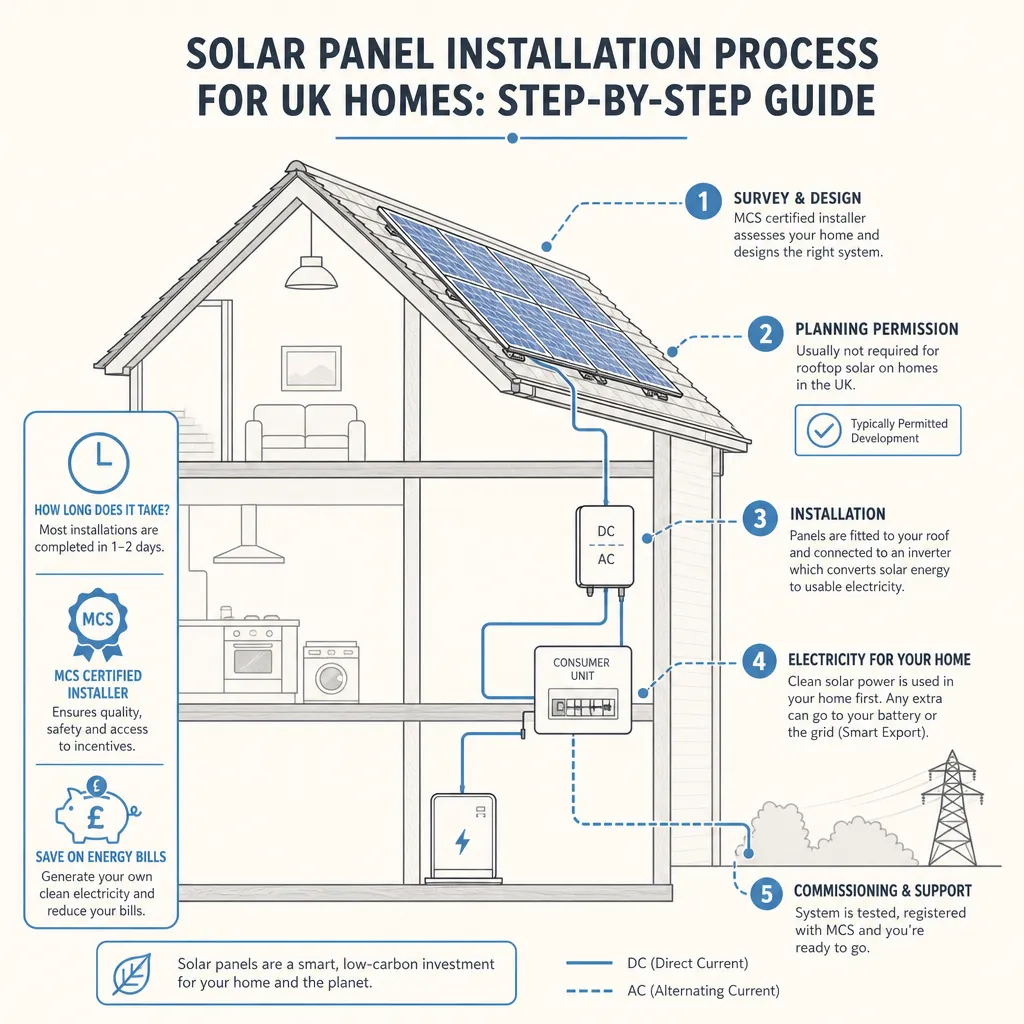
Solar Panel Installation Process for UK Homes: Step-by-Step Guide
Solar panel installation for a UK home usually takes 1–2 working days on-site, with the full process from initial survey to MCS certificate taking 2–6 weeks.
 Energy & Retrofit
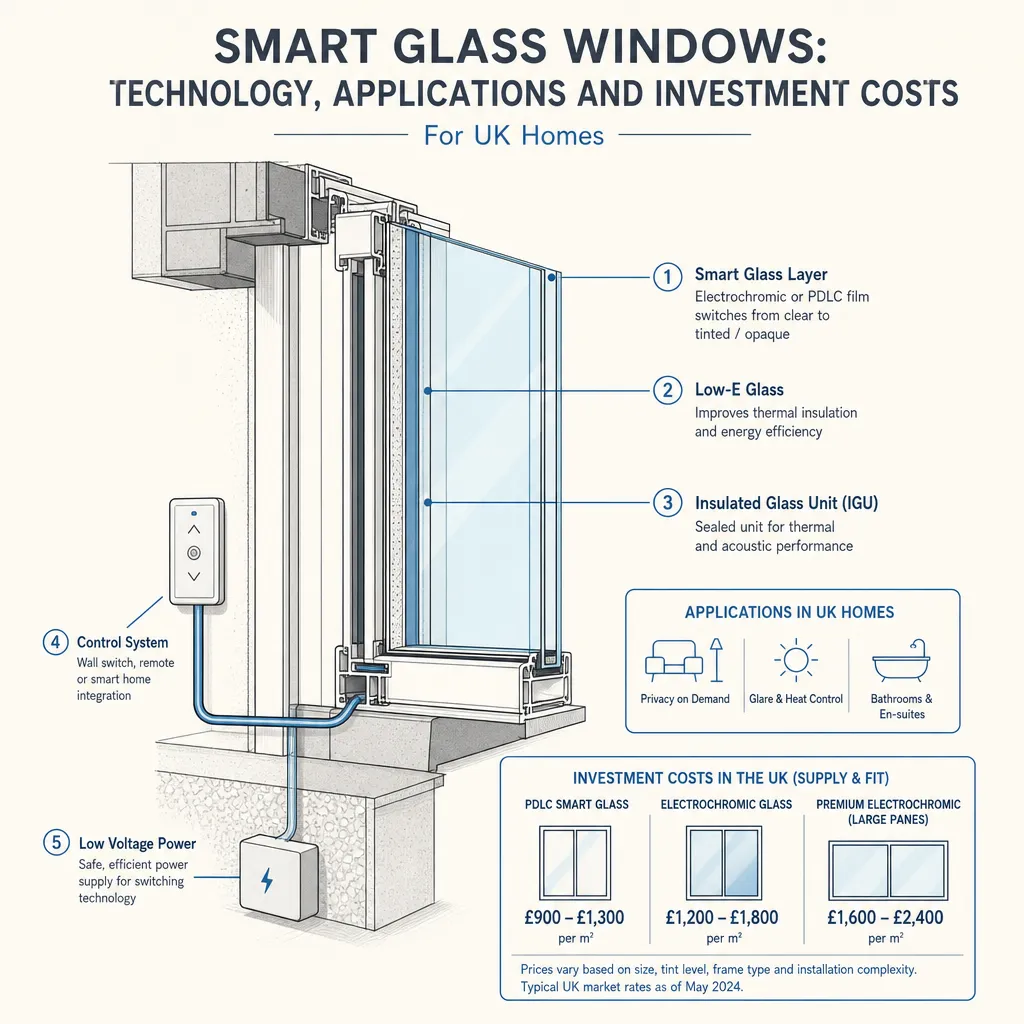
Smart Glass Windows: Technology, Applications and Investment Costs
Smart glass windows switch between transparent, tinted, or opaque states using electrical signals or heat.
 Energy & Retrofit
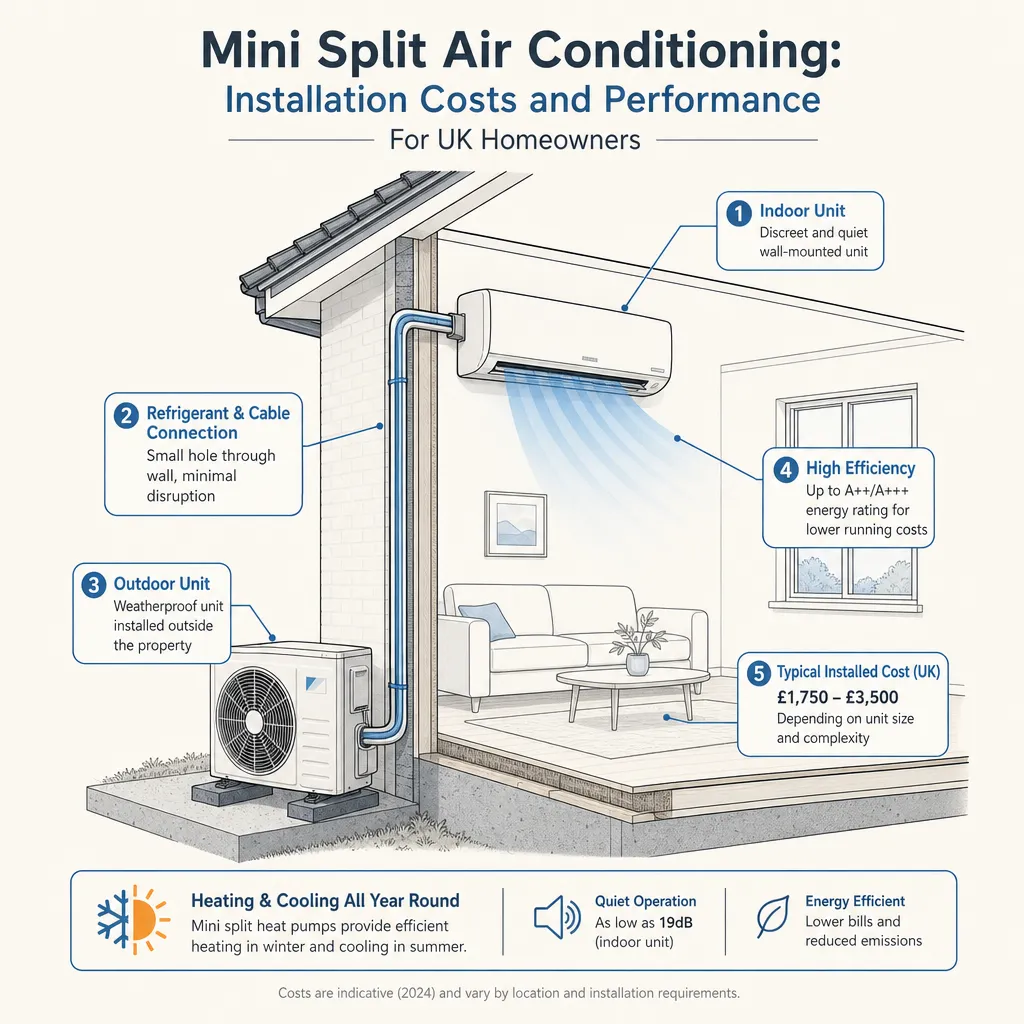
Mini Split Air Conditioning: Installation Costs and Performance
A mini-split (ductless) air conditioning unit costs roughly £1,500–£4,000 installed for a single room in the UK.