How to Facilitate a Successful House Move: Steps to Take
By Housey · Last reviewed 10th of May 2026

How to Facilitate a Successful House Move: Steps to Take
A house move involves dozens of interdependent tasks — legal, logistical, and administrative — running in parallel across the weeks surrounding completion day. The risks of poor planning are concrete: missed deadlines, damaged furniture, disputed deposits, and weeks of misdirected post failing to reach the right address. Whether you are buying, renting, or selling, the groundwork laid in the 6–8 weeks before moving day will largely determine how smoothly the day itself unfolds.
Key points
- Most removal companies recommend booking at least 4–6 weeks ahead, and earlier between March and September when demand peaks; late bookings can result in higher costs or unsuitable time slots.
- You are legally required to update your vehicle's V5C logbook with the DVLA after moving; failure to do so can result in a fine of up to £1,000 under the Road Vehicles (Registration and Licensing) Regulations 2002.
- Royal Mail redirection covers 3, 6, or 12 months (indicative cost from £39.30 as of 2026); it does not replace the need to notify each organisation individually.
- In England and Wales, completion day is the legal date of ownership transfer; keys are typically released once the conveyancer confirms funds have cleared, usually not before late morning.
- For rental moves, an inventory check-in report prepared by an AIIC-accredited clerk provides an independently documented baseline that carries more weight in tenancy deposit disputes.
Building your moving timeline: when to start
Eight weeks before your target moving date is the right point to begin systematic planning. Use this framework as your guide:
8 weeks out: Obtain removal quotes (at least three), begin decluttering, and decide what to sell, donate, or discard before packing starts. Notify current and new utility providers of the impending change.
6 weeks out: Confirm your removal firm and arrange storage if needed. Begin sourcing packing materials. Notify your bank, employer, HMRC, and DVLA of your new address.
4 weeks out: Begin packing non-essential items — books, seasonal clothing, decorative pieces. Set up Royal Mail redirection. Notify your GP, dentist, children's schools, and any regular delivery accounts.
2 weeks out: Pack the bulk of your belongings, leaving only daily essentials. Confirm the removal booking, access arrangements, and key handover procedure with your estate agent or solicitor.
Moving day: Take meter readings at both properties, photograph the condition of all rooms before and after loading, and keep important documents (contracts, IDs, keys, completion statement) to hand throughout.
Choosing a removal company
Which type of removal service do you need?
- Choose a full-service removal firm if you have a large volume of furniture, valuable or fragile items, or limited time for self-packing — full service covers packing, loading, transport, and unloading.
- Choose a man-and-van or part-load service if you are moving from a small flat with modest belongings and are confident to pack independently.
- Choose a specialist removal firm if you have grand pianos, fine art, antiques, or other high-value items requiring specialist care and appropriate insurance.
- Consider storage-in-transit if there is a gap between vacating your old property and gaining access to the new one — particularly common in complex chains.
What to ask a removal company before booking
- Are you a member of the British Association of Removers (BAR) or the National Guild of Removers and Storers (NGRS)?
- Does your quote include packing materials and boxes, or are these charged separately?
- What insurance does your quote include, and what is the claims process if items are damaged in transit?
- Are there items you will not transport (hazardous materials, certain plants, compressed gas canisters)?
- What happens if completion is delayed and we cannot vacate or access the property on the booked date?
- Is VAT included in the quoted price?
- Do you carry out a pre-move survey in person, or is the quote based on an online form or phone assessment?
You can compare quotes from vetted house removals companies through Housey.
Notifying organisations and updating your address
Address notifications take longer than most people anticipate. Begin as early as 6 weeks before moving day where possible.
Legal and financial
- HM Revenue & Customs (HMRC) — via your Personal Tax Account at gov.uk
- DVLA — driving licence and V5C vehicle registration logbook (online at gov.uk)
- Your bank and building society accounts
- Pension and investment providers
- Your employer (for payroll records and correspondence)
Services and utilities
- Gas and electricity suppliers at both properties — include meter readings on moving day
- Water supplier
- Broadband and TV providers (note installation lead times at the new address, which can be 1–2 weeks)
- Council Tax — notify both your current and new local authority
Health, personal, and civic
- GP and dentist
- DVLA organ donor registration
- Electoral roll — register at gov.uk/register-to-vote
- Royal Mail redirection service
Subscriptions and deliveries
- Online shopping accounts
- Magazine and newspaper subscriptions
- Home, contents, and vehicle insurance providers
Packing: a room-by-room checklist
Work through each area systematically, leaving high-use rooms until last. Label every box clearly with contents and destination room at the new property.
Pack first (4–6 weeks out):
Pack second (2–3 weeks out):
Pack last (final days):
Colour-coded labels by room help removal teams place boxes correctly at the new property without needing to read every label.
Inventory checks and condition reports
For renters moving into or out of a tenancy, an inventory check-in report prepared by an accredited inventory clerk documents the condition of every room and fixture at the start of the tenancy. An independent report carries more weight in deposit dispute resolution than one prepared by the landlord or letting agent, and is accepted by all three government-approved tenancy deposit protection schemes.
If you are moving into a newly purchased property, photographing the condition of every room on completion day — before your belongings are moved in — provides a useful baseline record for any future insurance or dispute purposes.
Housey can help you find a qualified independent inventory clerk for a check-in or check-out inspection.
The conveyancing process: key milestones
Your conveyancer (or licensed conveyancer) manages the legal transfer of ownership. Understanding the key milestones helps you plan the move timeline around the legal process:
- Instruction: Instruct as soon as your offer is accepted — delays in instructing a conveyancer often delay the entire chain.
- Searches: Local authority, environmental, and drainage searches typically take 2–6 weeks depending on the local authority.
- Exchange of contracts: The legally binding point; your completion date is agreed at exchange, and removal bookings should already be confirmed by this stage.
- Completion: The day funds transfer and keys are released. Have your removal vehicle ready, but avoid loading furniture and boxes until key release is confirmed — this is rarely before late morning.
Delays can affect your removal booking. Confirm a flexible cancellation or rescheduling policy with your removal firm before exchange. Housey can help you find a qualified conveyancer to manage the legal side of your purchase or sale.
When to get professional help
Most moving tasks can be managed independently, but professional input is valuable in a number of situations:
- If you have items of high value or specialist nature — fine art, antiques, a wine collection — instruct a specialist removal firm with appropriate transit insurance rather than a general carrier.
- If a tenancy deposit dispute arises, the Tenancy Deposit Scheme, MyDeposits, or Deposit Protection Service all offer dispute resolution; an independently prepared inventory report is your primary evidence.
- If completion is delayed and you are contractually committed to a vacate date at your old property, your solicitor can advise on your legal options and any entitlement to compensation.
- If your move involves a complex chain, ensure your conveyancer is actively chasing communication throughout — a single delay anywhere in the chain affects every buyer and seller linked to it.
How Housey can help
Housey connects homeowners, buyers, and renters with qualified professionals across the UK. For your move, you can compare quotes from vetted house removals companies, find a qualified conveyancer to handle the legal transfer of your property, or book an independent inventory clerk for a check-in or check-out report at the start or end of a tenancy.
Frequently asked questions
How far in advance should I book a removal company in the UK?
Ideally at least 4–6 weeks before your target moving date, and earlier during peak seasons (spring and early summer). Removal companies fill up quickly around school holiday periods and at the end of the month, which is a common completion date for property transactions in England and Wales.
What should I do if completion is delayed on moving day?
Contact your removal company as soon as possible. Most reputable firms have contingency arrangements for delays, though waiting fees may apply. Your conveyancer should advise on the legal and financial implications; in some cases, the buyer may be entitled to seek compensation from the seller for abortive removal costs.
Do I need to update my address with DVLA when I move?
Yes. You are legally required to notify DVLA of a change of address. Update your driving licence and your vehicle's V5C logbook online at gov.uk. Failure to update the V5C can result in a fine of up to £1,000 under the Road Vehicles (Registration and Licensing) Regulations 2002.
Does Royal Mail redirection replace the need to notify organisations individually?
No. Royal Mail redirection forwards post from your old address to your new one for up to 12 months, but it does not replace individual address updates with banks, HMRC, DVLA, and other organisations — particularly those that communicate digitally rather than by post. Set up both redirection and individual notifications for full coverage.
What is an inventory clerk and do I need one when moving into a rental property?
An inventory clerk prepares an independent, detailed report on the condition of a rental property at the start and end of a tenancy. An AIIC-accredited clerk's check-in report carries more weight in deposit dispute resolution than a landlord- or agent-prepared document. Requesting an independent check-in inventory when moving into a new tenancy is strongly advisable.
Sources and further reading
- Change your address on your driving licence — GOV.UK
- Road Vehicles (Registration and Licensing) Regulations 2002 — legislation.gov.uk
- Royal Mail address redirection service — Royal Mail
- British Association of Removers: find a member — British Association of Removers
- Tenancy Deposit Scheme: dispute resolution for tenants — Tenancy Deposit Scheme
- Register to vote after moving — GOV.UK
Useful next reads
 Buying & Moving
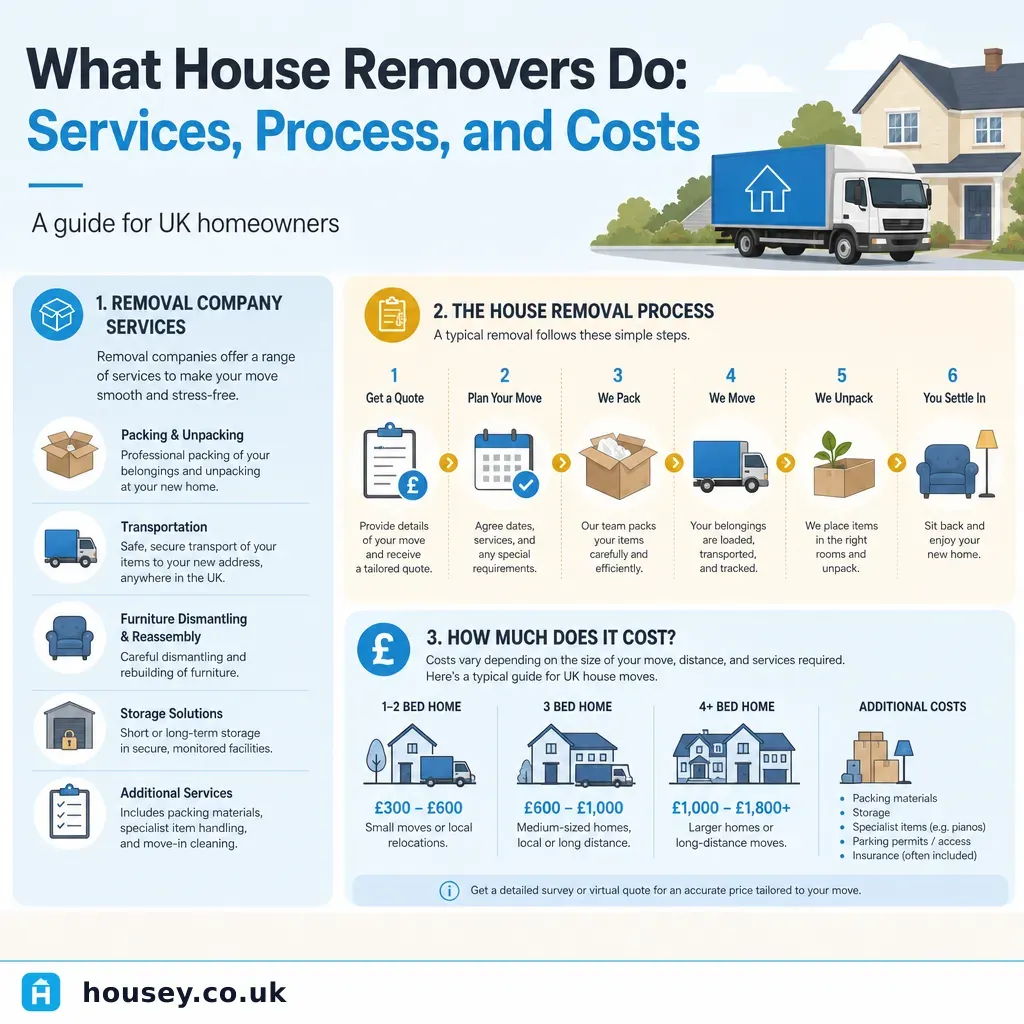
What House Removers Do: Services, Process, and Costs
House removers load, transport, and unload your belongings between properties.
 Buying & Moving
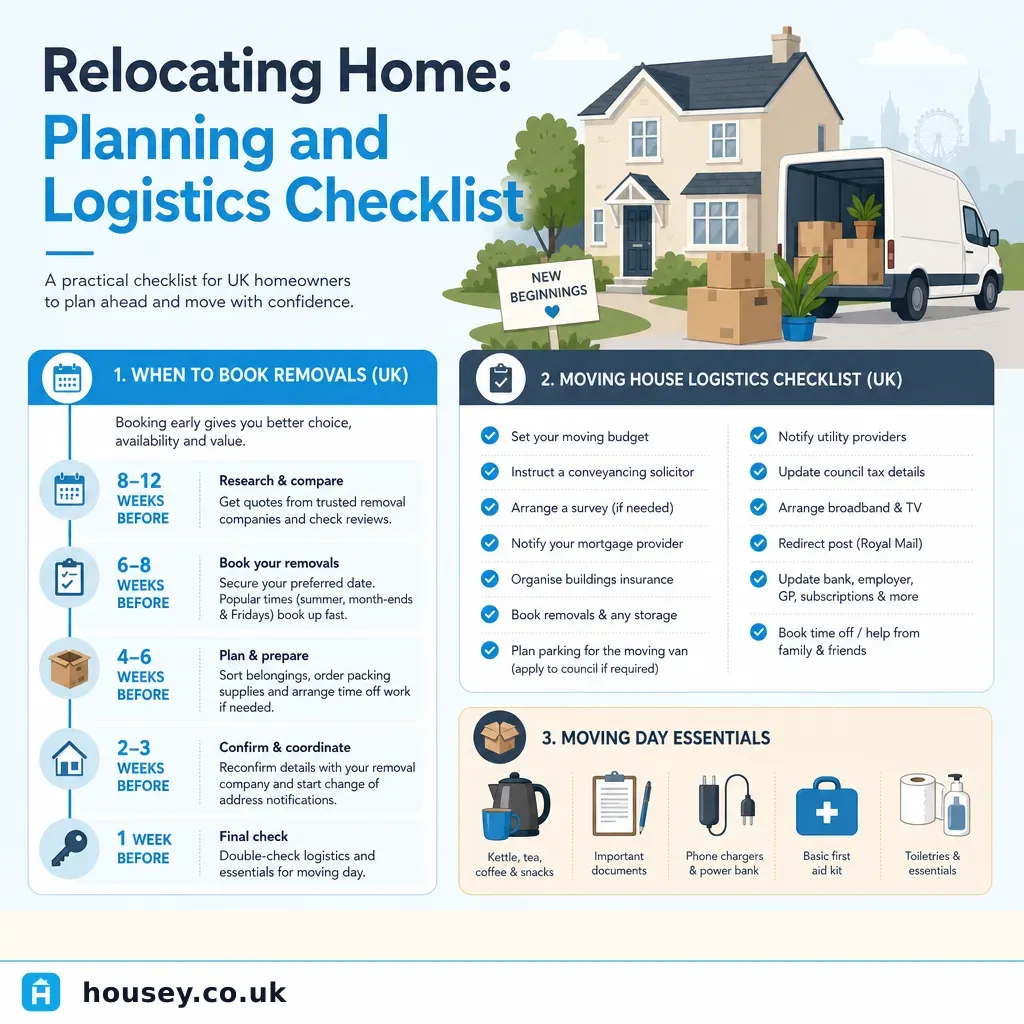
Relocating Home: Planning and Logistics Checklist
Successful home relocation in the UK typically requires 8–12 weeks of advance planning.
 Buying & Moving
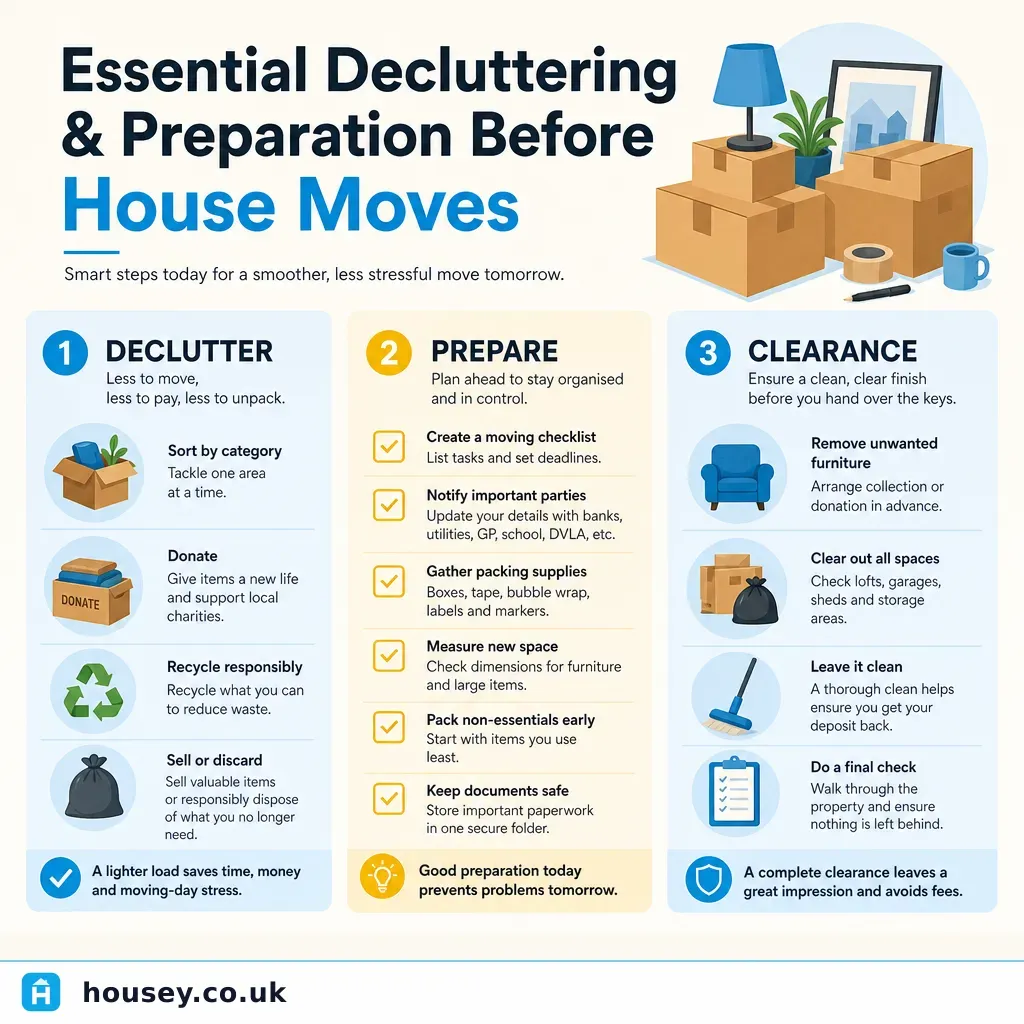
Essential decluttering and preparation before house moves
Decluttering before a house move reduces removal costs, improves property photographs, and simplifies unpacking.
 Buying & Moving
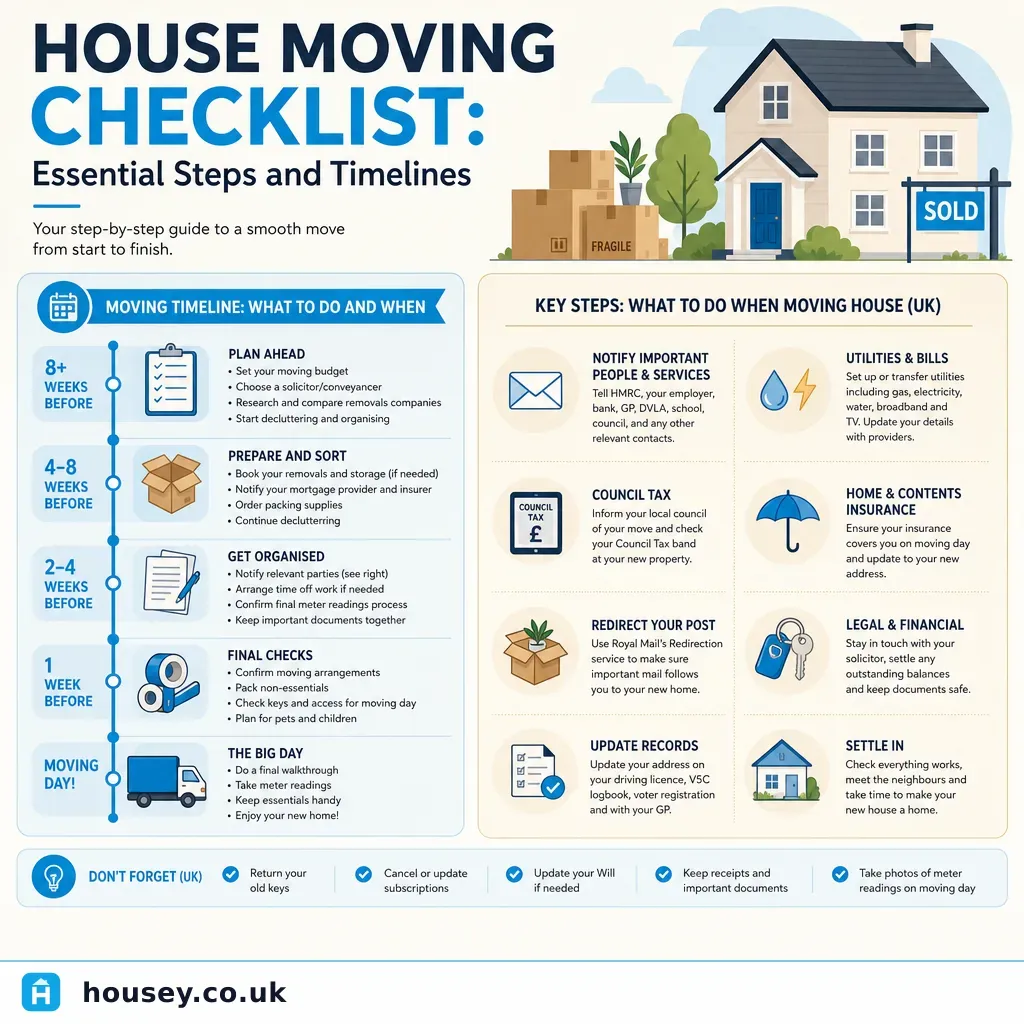
House Moving Checklist: Essential Steps and Timelines
A UK house move typically spans 8–12 weeks of preparation: book removals 4–6 weeks out, notify the DVLA, HMRC, and utilities as exchange approaches, take meter readings on moving day, and update Council Tax and the electoral register on arrival.
 Buying & Moving
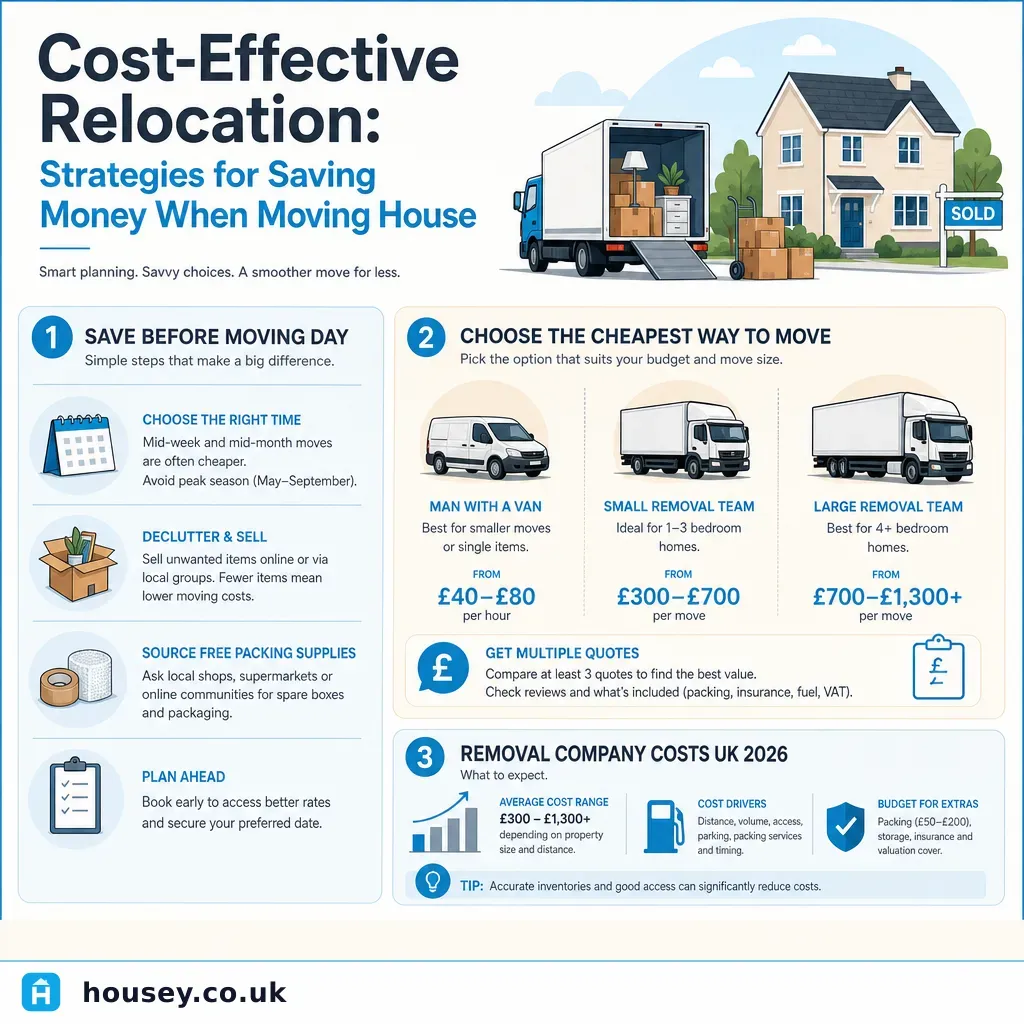
Cost-Effective Relocation: Strategies for Saving Money When Moving House
Moving house in the UK involves costs well beyond the removal van — stamp duty, conveyancing, surveys, and storage all add up.