How to fix a wired doorbell that isn't working
By Housey · Last reviewed 19th of May 2026
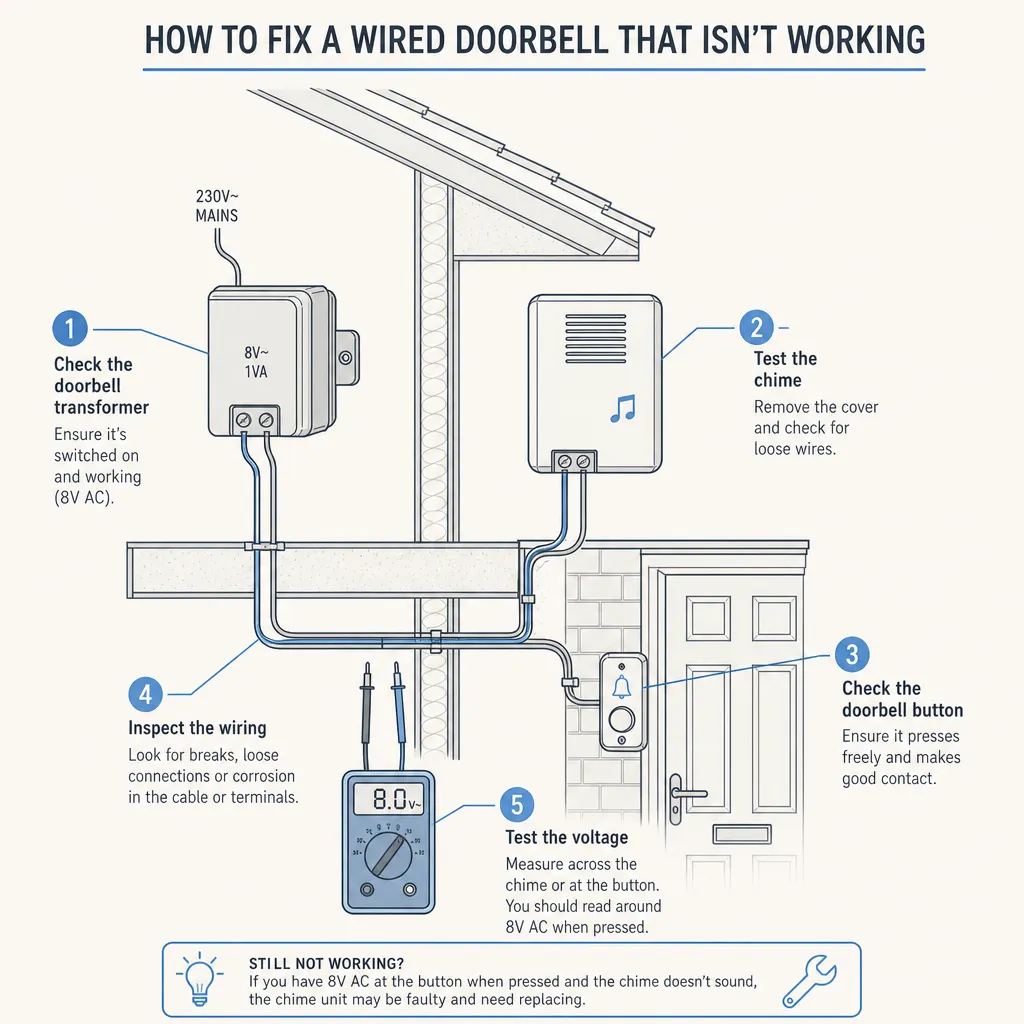
How to fix a wired doorbell that isn't working
A wired doorbell that falls silent is a small but frustrating problem, and the timing is rarely convenient — it often surfaces when a parcel fails to arrive or a visitor stands unnoticed on the doorstep. In older UK homes, particularly Victorian terraces and Edwardian semis, original bell-wire systems may have been in place for decades, making component failure more likely. Understanding how the circuit works — transformer, bell wire, push button, and chime unit — lets you isolate the fault quickly and decide whether to fix it yourself or call a qualified electrician.
Key points
- Most wired doorbells run on low-voltage AC supplied by a dedicated doorbell transformer (typically 8–24 V), not mains voltage — making basic troubleshooting safe for a competent homeowner.
- The push button is the most commonly failed component, due to weathering, corrosion, and mechanical wear at the front door.
- Bell wire is typically thin, two-core copper cable; corrosion at terminals or a broken conductor anywhere along the run will break the circuit entirely.
- Building Regulations Part P requires certain electrical work in dwellings to be carried out by a competent person and, where notifiable, reported to building control; replacing a transformer involves the mains side of the circuit.
- If you cannot locate your transformer, check inside the loft hatch frame, under the stairs, in an airing cupboard, or adjacent to the consumer unit — all common fitting positions.
How a wired doorbell circuit works
A standard wired doorbell circuit has four components: a mains-fed transformer (usually 8–16 VA rated) that steps mains voltage down to a safe bell voltage, two-core bell wire running from the transformer to the push button and back to the chime unit, a momentary-contact push button mounted at the front door, and an electromechanical or electronic chime unit indoors.
When the button is pressed, it closes the low-voltage circuit and energises the chime. A fault in any one of these four components will stop the doorbell working — so systematic testing from button inward is the most efficient approach.
Which component has failed? Decision tree
Work through these steps in order:
- Start at the push button. Remove the button cover and check whether the terminals are corroded or the wires have come loose. Temporarily bridge the two terminals with a short piece of wire — if the chime sounds, the button is faulty. Replace the button.
- Check the bell wire next. With the bridge removed, inspect the wire run for visible damage: pinched under a door frame, nicked by a screw, or corroded at any junction. A continuity tester or multimeter set to resistance mode will confirm an open or short circuit along the run.
- Test the transformer. Locate the transformer and check for a pilot light if fitted. With a multimeter set to AC voltage, measure across the low-voltage output terminals — you should see a reading close to the rated voltage (commonly 8, 12, or 16 V AC). A zero reading means the transformer has failed or its mains feed has tripped; check the fuse or MCB feeding it before replacing the transformer.
- Inspect the chime unit. Open the chime cover and check that the wires are firmly connected. On mechanical (solenoid) chimes, the striker may be stuck or the spring broken — clean the plunger and striker rods with a dry cloth. On electronic chimes, try a factory reset using the manufacturer's instructions.
- Still no sound? If all components test correctly individually but the doorbell remains silent, the likely cause is a high-resistance joint somewhere in the circuit. Re-terminate all connections using appropriate connectors.
Replacing a push button
Push buttons are the most common failure point and are inexpensive to replace — typically £5–£25 for a standard or decorative unit at a builders' merchant or online retailer. You may switch off the transformer at its fused connection unit before working on the wiring if you prefer a safety margin, though bell-wire voltages are safe to handle.
- Remove the existing button from its mounting (usually one or two small screws).
- Note which wire connects to which terminal — photograph the connections before disconnecting.
- Connect the wires to the new button. Polarity does not usually matter on a simple push-to-make switch.
- Refit and test.
Replacing a doorbell transformer
If the transformer has failed, replace it like-for-like with a unit of the same or compatible output voltage — check your chime unit's requirements, usually stated on its label or in its manual. Transformers are commonly rated 8 VA, 10 VA, or 12 VA.
Important: Replacing a transformer involves disconnecting from the mains supply. This work should be carried out by a competent person. If you are not confident working at the fused spur or junction box supplying the transformer, instruct a qualified electrician. Under Part P of the Building Regulations, work on mains circuits in a dwelling must be carried out by a competent person; where the work is notifiable, it must be reported to building control.
Homeowner pre-check checklist
Before calling a tradesperson, work through these checks:
When to get professional help
A wired doorbell is a low-voltage system and most faults are straightforward. However, contact a qualified electrician if:
- You cannot locate the transformer and suspect it may be wired into a lighting circuit or junction box inside a wall cavity.
- The fuse or MCB feeding the doorbell keeps tripping after replacement — this may indicate a fault beyond the doorbell circuit.
- You discover damaged, unsleeved, or otherwise non-standard wiring during the inspection.
- The house is older and you have reason to believe the wiring is aluminium-cored, rubber-insulated, or in otherwise deteriorated condition.
- You want a formal assessment of your home's electrical installation before or after any repair work.
How Housey can help
If your doorbell investigation raises concerns about the wider electrical installation in your home, Housey can connect you with a registered electrician to carry out an Electrical Installation Condition Report (EICR) — a formal, documented assessment of your wiring's condition and any remedial work recommended.
Frequently asked questions
Why has my wired doorbell suddenly stopped working?
The most common causes are a failed push button (due to weathering or corrosion), a loose or broken bell-wire connection, or a transformer that has reached end of life. Less commonly, the chime unit itself fails. Work through each component systematically before assuming the circuit needs a full replacement.
Can I replace a wired doorbell myself in the UK?
Low-voltage bell-wire work — replacing the push button, chime unit, or wire connections — is within the capability of a competent homeowner. Replacing the mains-side transformer connection involves mains voltage and should be carried out by a competent person under Part P of the Building Regulations. If in doubt, instruct a qualified electrician.
How do I find my doorbell transformer?
Common locations include the loft hatch frame, the airing cupboard, the area above or beside the consumer unit, inside a stair cupboard, or above a ceiling rose near the front door. It is a small box — usually with a mains terminal block and two low-voltage output terminals or screw connections — often fitted when the house was originally wired.
What voltage should a wired doorbell transformer output?
Most UK domestic doorbell transformers output 8–16 V AC. Check your chime unit's rated input voltage (printed on its label) and match the replacement transformer accordingly. Mismatched voltage can damage electronic chimes or fail to provide sufficient power to operate mechanical solenoid strikers.
My wired doorbell works intermittently — what is the likely cause?
Intermittent faults are usually caused by a loose terminal connection at the button, chime, or transformer, or by a corroded wire junction. A push button with a worn internal contact is also a common culprit. Check all connections and clean or re-terminate as needed. Intermittent transformer failure due to a thermal cutout is less common but possible.
Sources and further reading
- Building Regulations Approved Document P: Electrical Safety — GOV.UK
- DIY electrical work guidance for homeowners — Electrical Safety First
- Find a registered electrical contractor — NICEIC
Useful next reads
 Improvement & Build
How to Repair Window Tracks
Most window track problems — stiffness, grinding, or failure to slide — stem from debris build-up, worn rollers, or dried seals.
 Improvement & Build
Garage Door Spring Repair: When Springs Fail and What It Costs
A broken garage door spring usually makes the door heavy, lopsided, or completely inoperable.
 Improvement & Build
Common Window Problems and When to Call a Professional
The most common window problems in UK homes are condensation between panes (failed sealed unit), draughts from worn seals or warped frames, stiff or broken hardware, and rotting timber frames.
 Improvement & Build
Troubleshooting common sliding door issues and solutions
Most sliding door problems — stiff operation, draughts, misalignment, or a faulty lock — have straightforward fixes.
 Improvement & Build
Diagnosing and Fixing French Door Closure Issues
French doors that won't close are usually caused by hinge drop, a misaligned keep plate, or seasonal timber swelling.