How to plan a kitchen extension project
By Housey · Last reviewed 19th of May 2026
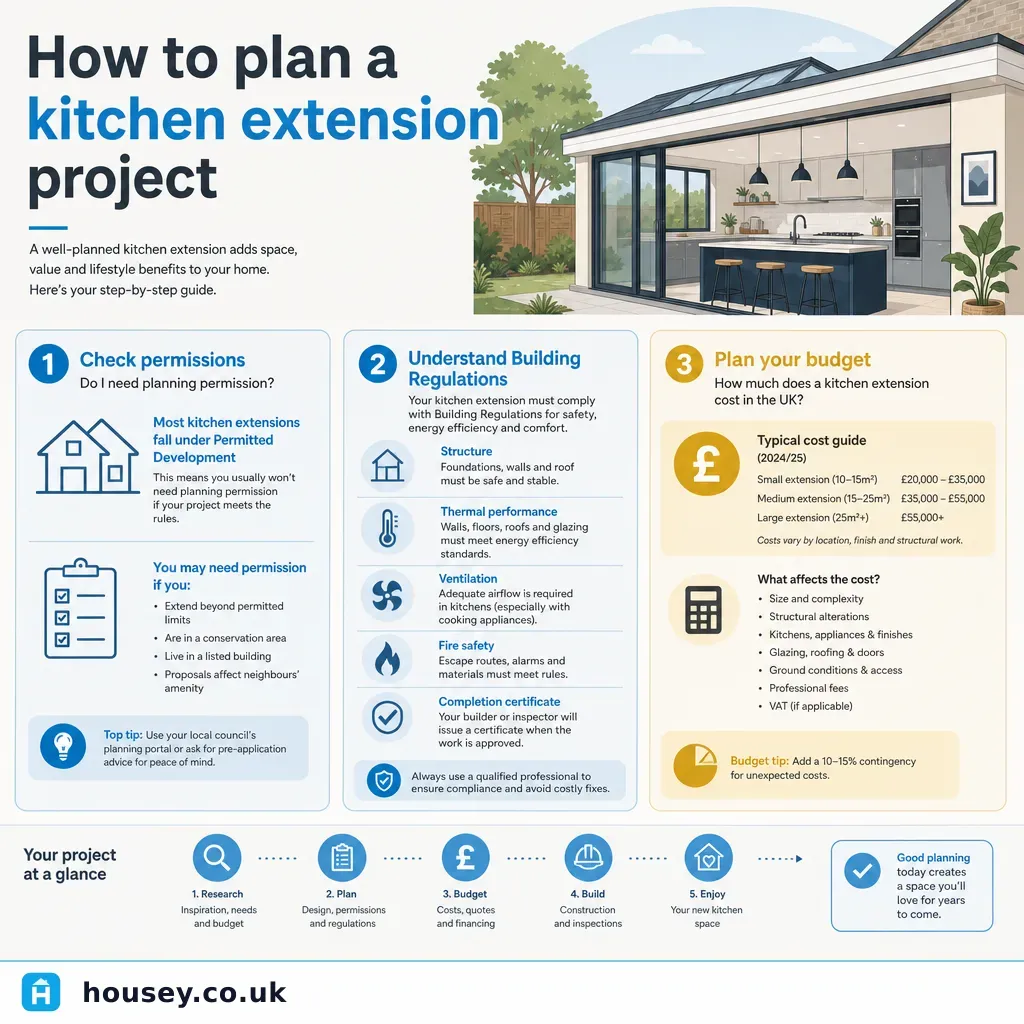
How to plan a kitchen extension project
Extending your kitchen is one of the most popular home improvement projects in the UK, yet it touches on planning law, structural engineering, and building control in ways that catch many homeowners off guard. Whether you are adding a modest rear extension to a 1930s semi or designing an open-plan kitchen-diner for a Victorian terrace, understanding the approval process before you appoint a builder will save time, money, and stress.
Key points
- Most single-storey rear extensions up to 6 m (detached houses) or 3 m (semi-detached and terraced) qualify for permitted development under Class A of the Town and Country Planning (General Permitted Development) (England) Order 2015.
- Extensions between 4–8 m deep (detached) or 3–6 m (semi/terraced) can use the Larger Home Extension Scheme, which requires prior approval from your Local Planning Authority (LPA) within a 42-day neighbour consultation window.
- All extensions must comply with the Building Regulations 2010 regardless of planning status, covering structure (Part A), fire safety (Part B), thermal performance (Part L), ventilation (Part F), and drainage (Part H).
- Removing or altering a load-bearing wall requires a structural engineer's calculations; building control will not approve structural work without them.
- VAT on residential extension work is charged at the standard rate of 20%; there is no reduced rate for homeowners extending an existing dwelling.
Do you need planning permission?
The answer depends on your property type, location, and the size of the proposed extension. Permitted development rights allow many standard rear extensions to proceed without a formal planning application — but these rights can be restricted or removed entirely.
Decision tree: planning permission for a kitchen extension
- Choose permitted development if the rear extension is single-storey, does not exceed 6 m depth (detached) or 3 m (semi-detached or terraced), is no higher than 4 m at its highest point, and the property is not listed, not in a designated area, and not subject to an Article 4 Direction.
- Use the Larger Home Extension Scheme (prior approval) if the single-storey rear extension is 4–8 m deep for a detached house, or 3–6 m for other house types. You must notify your LPA and allow 42 days for neighbour consultation before work begins.
- Apply for full planning permission if the property is in a conservation area, national park, Area of Outstanding Natural Beauty (AONB), or is listed; if the extension projects beyond the principal elevation; or if permitted development rights have been removed.
- Check with your LPA if you are unsure whether an Article 4 Direction applies to your street — these can remove permitted development rights in specific locations without individual notice to owners.
Scotland, Wales, and Northern Ireland have separate permitted development rules. Always verify the position with the relevant national planning authority before proceeding.
What Building Regulations cover
Planning permission and Building Regulations are entirely separate processes. Even a permitted development extension must comply with the Building Regulations 2010 (as amended). A Full Plans application — where drawings are checked by building control before work starts — is recommended over a Building Notice for extensions, as it gives much greater certainty before the build begins.
Approved Document | What it covers | Relevance to a kitchen extension |
|---|---|---|
Part A (Structure) | Loads, foundations, steelwork | New beams or wall removals require structural calculations |
Part B (Fire safety) | Escape routes, spread of flame | Open-plan layouts may affect fire escape route compliance |
Part F (Ventilation) | Air quality and extract fans | Kitchen extract ventilation must meet minimum flow rates |
Part L (Conservation of fuel and power) | U-values and airtightness | New walls, roof, and glazing must meet current thermal standards |
Part H (Drainage) | Foul and surface water | New sink or drain connections require compliant drainage |
Part J (Combustion appliances) | Boiler flues and air supply | Relevant if the boiler or flue is being relocated |
Assembling your project team
Most kitchen extension projects benefit from an architect or architectural technologist producing drawings, a structural engineer providing calculations, and an experienced contractor managing the build. On more complex projects, a planning consultant can add real value in navigating pre-application discussions with the LPA.
Role | When you need them | Typical output |
|---|---|---|
Architect or Architectural Technologist | Design, planning drawings, building regulation drawings | Planning application, specification, contract drawings |
Structural Engineer | Load-bearing wall removal, new steel beams, foundation design | Structural calculations for building control |
Planning Consultant | Listed buildings, conservation areas, appeals, pre-application advice | Planning statement, heritage assessment |
Building Control Inspector | All extensions requiring Building Regulations approval | Completion certificate |
Extension Builder | Construction phase | Finished, signed-off extension |
Typical project timeline
A straightforward single-storey rear extension in England typically follows this sequence. Timelines vary by project complexity and contractor availability.
- Appoint architect and agree brief — 1–3 weeks
- Concept design and planning drawings — 3–6 weeks
- Submit planning application or prior approval notice — 6–10 weeks for decision
- Structural engineering and building regulation drawings — 3–5 weeks (can run in parallel with planning)
- Tender to builders and appoint contractor — 4–6 weeks
- Construction — 10–16 weeks for a typical single-storey rear extension
- Building control sign-off and completion certificate — 1–2 weeks after practical completion
Allow 6–12 months from initial brief to moving in, depending on planning complexity and contractor availability.
Indicative costs
Indicative UK costs, last reviewed 2026-05-19. Figures are illustrative ranges only; always obtain detailed, itemised quotes.
Item | Indicative range |
|---|---|
Architect fees (design through to planning) | £2,000–£8,000+ |
Structural engineer (calculations and inspections) | £800–£2,500 |
Planning application fee (householder, England) | £258 |
Building regulations Full Plans application | £600–£1,200+ |
Construction cost per m² (single-storey rear) | £1,800–£3,500/m² |
Costs vary significantly by region, specification, and ground conditions. Obtain at least three itemised quotes before appointing a contractor.
What to ask before accepting a quote
- What is included and excluded from the build cost?
- Who will carry out structural and groundworks, and what qualifications do they hold?
- What drawings and specifications is the quote based on?
- What provisional sums are included, and what triggers a variation order?
- How will building control inspections be managed and who is responsible for notifications?
- Is VAT included, and at what rate?
- What is the programme of works and what are the key milestone dates?
- What happens if unforeseen ground conditions or hidden defects are found during the build?
Red flags during the project
Watch for these warning signs at any stage of the project:
- A builder who suggests starting structural work before building regulations approval is formally in place.
- No written contract specifying scope, price, programme, and payment stages.
- Requests for upfront deposits exceeding 10–15% of the contract value without a clear reason.
- Structural drawings produced by the builder rather than an independent structural engineer.
- No mention of Party Wall Act obligations when the extension is close to a shared boundary or adjoining structure.
Important limitations
This article provides general guidance only. Permitted development rules, planning policies, and Building Regulations requirements vary by property type, location, prior alterations, and local authority. Listed buildings require listed building consent for any internal or external alterations, in addition to any planning permission required. Scotland, Wales, and Northern Ireland operate separate regulatory frameworks. Always verify requirements with your Local Planning Authority and appoint qualified professionals before starting work.
When this becomes urgent
Stop work immediately and seek professional advice if any of the following arise:
- Suspected asbestos-containing materials are exposed during demolition — artex ceilings, floor tiles, soffit boards, pipe lagging, and certain insulation boards in properties built before 2000 may contain asbestos. Work must stop until a licensed asbestos surveyor has assessed the material.
- The existing structure shows unexpected signs of movement — recently widened cracks, a bowing or leaning wall, or structural timbers that are rotted or inadequately supported.
- Groundworks reveal underground drainage runs, contaminated fill, or soft ground that was not apparent before work began.
- The contractor starts structural work without confirmation from building control that the Full Plans application has been approved.
What to ask a qualified professional
Before appointing an architect, builder, or planning consultant, consider asking:
- Does this project require full planning permission, prior approval under the Larger Home Extension Scheme, or does it fall within permitted development?
- Are there any Article 4 Directions, conservation area constraints, or tree preservation orders affecting my plot?
- What are the Party Wall Act obligations given the position and depth of the proposed extension?
- What U-value and airtightness standard will the new construction need to meet under Part L?
- What are the drainage implications, and will new connections to the sewer require approval from the sewerage undertaker?
- What structural solution do you propose for any wall removals, and what will the structural engineer need to assess on site?
When to get professional help
A kitchen extension always requires qualified professionals for planning, structural design, and building control. Seek advice without delay if:
- You discover suspected asbestos when opening up the existing structure.
- There are signs of subsidence, significant cracking, or structural movement in the existing building.
- The extension is within 3 m of a shared boundary or adjoins a neighbour's structure — Party Wall Act notices may be required.
- The property is listed or in a conservation area and you have not yet obtained the required consents.
- A contractor has started structural work without building regulations approval being in place.
How Housey can help
Housey connects you with vetted extension builders, architects and architecture practices, and planning consultants who work in your area. For compliance submissions and inspections, our building control consultants can manage the Full Plans process from submission through to completion certificate. Submit a brief, compare quotes, and move forward with confidence.
Frequently asked questions
Does a kitchen extension always need planning permission?
Not always. Many single-storey rear extensions qualify as permitted development in England, meaning no formal planning application is required. Permitted development conditions on size, height, and materials must be met, and prior approval may be needed under the Larger Home Extension Scheme if the extension exceeds 4 m depth for detached houses or 3 m for other types. Permitted development does not apply to listed buildings or most designated areas.
How long does a kitchen extension take from start to finish?
Allow 6–12 months from initial design to completion for a typical single-storey rear extension. Planning and building control approvals alone can take 8–16 weeks. Construction typically adds 10–16 weeks. Projects involving listed buildings, conservation areas, or complex structural work will take longer.
Do I need a Party Wall Agreement for a kitchen extension?
You may need to serve Party Wall Act notices if the extension is within 3 m of a neighbour's building, if work is proposed on or near the shared boundary, or if excavation falls within 3–6 m of an adjoining structure. The Party Wall etc. Act 1996 sets out the notice requirements and agreement process. A party wall surveyor can advise on your specific circumstances.
Can I remove the back wall of my house without planning permission?
Removing a wall as part of a permitted development extension does not require planning permission, but it does require Building Regulations approval and a structural engineer's calculations. You cannot simply remove a load-bearing wall without formal building control approval, even if the extension itself qualifies as permitted development.
Sources and further reading
- Permitted development rights for householders — Planning Portal
- When is permission required? — GOV.UK
- Building Regulations Approved Documents — GOV.UK
- Party Wall etc. Act 1996 — an introduction — RICS
- Fees for planning applications — GOV.UK
Useful next reads
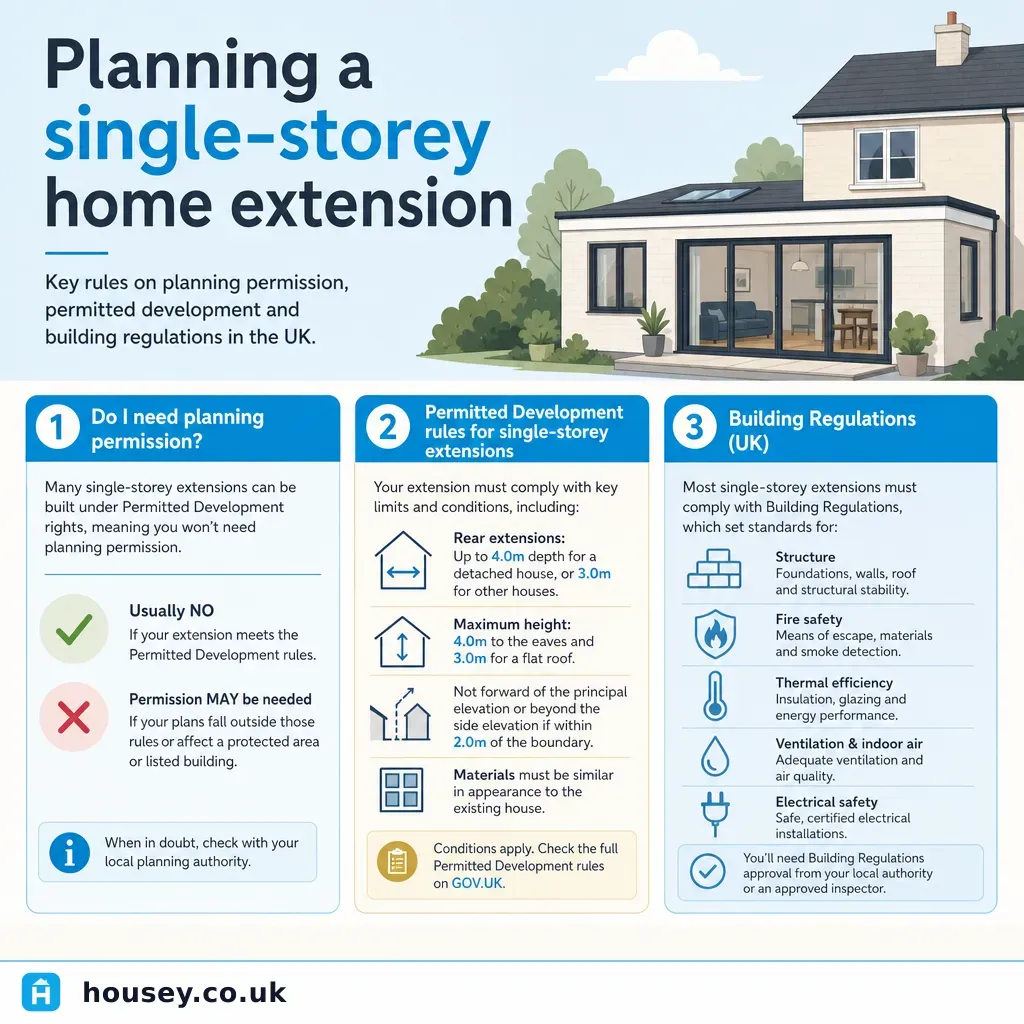 Improvement & Build
Planning a single-storey home extension
A single-storey extension may fall under permitted development rights, avoiding full planning permission, but only if it meets size, height, and boundary conditions simultaneously.
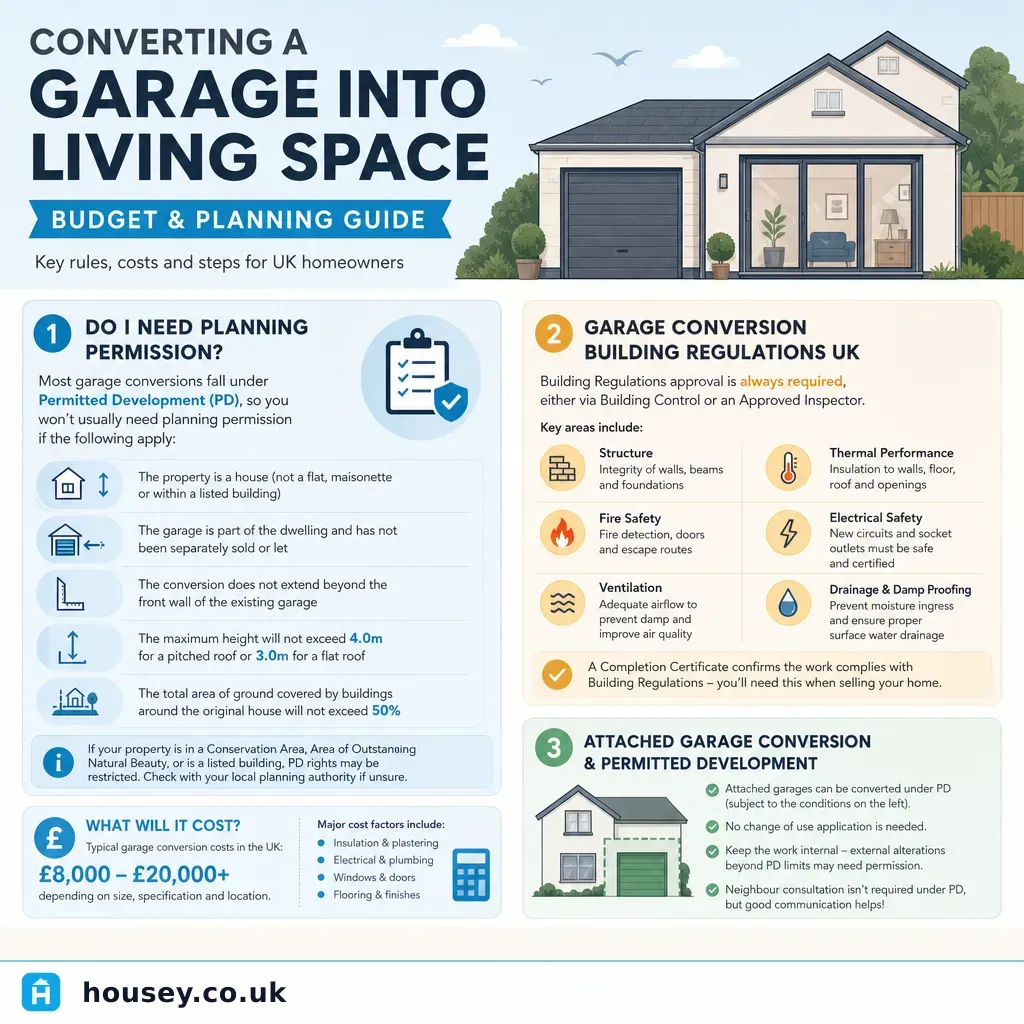 Improvement & Build
Converting a Garage into Living Space: Budget and Planning Guide
A single-garage conversion typically costs £8,000–£20,000 in the UK.
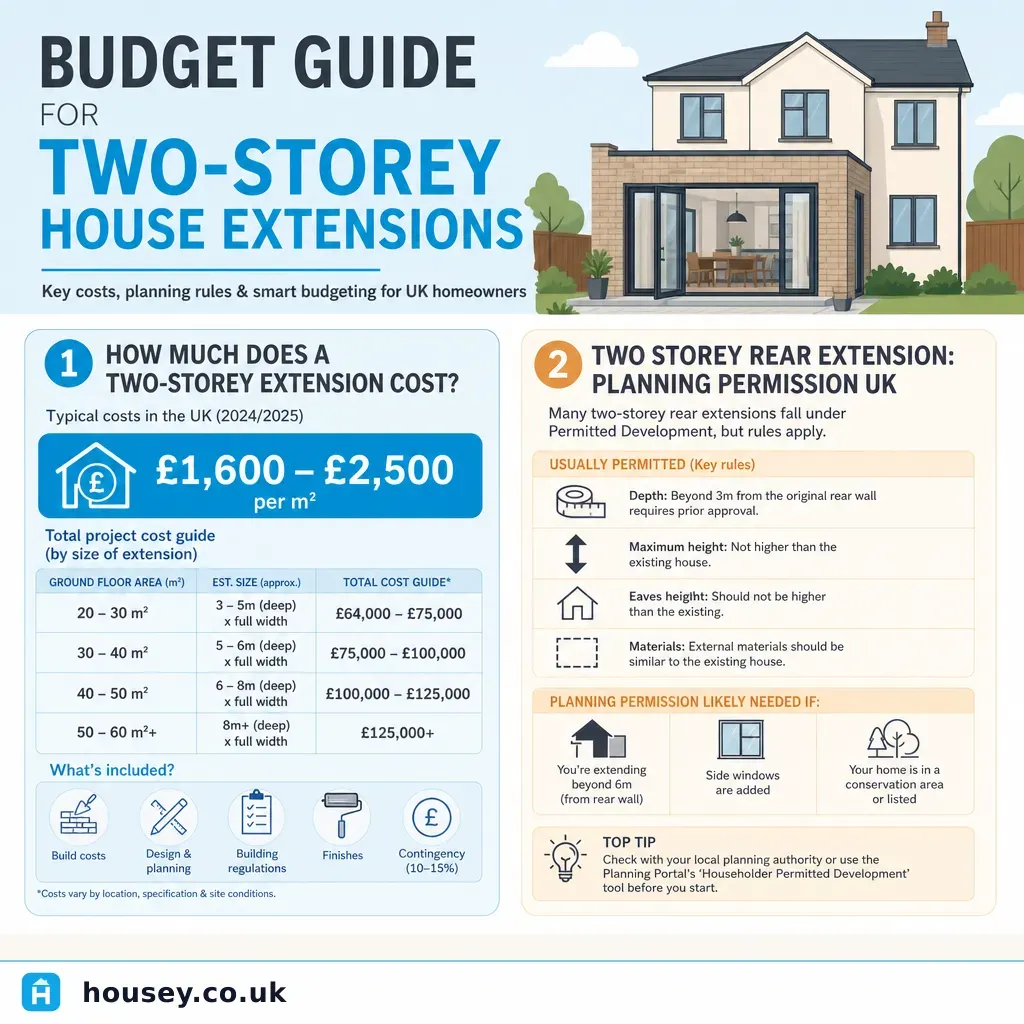 Improvement & Build
Budget Guide for Two-Storey House Extensions
A two-storey house extension in the UK typically costs £1,800–£3,000+ per square metre for the build alone.
 Improvement & Build
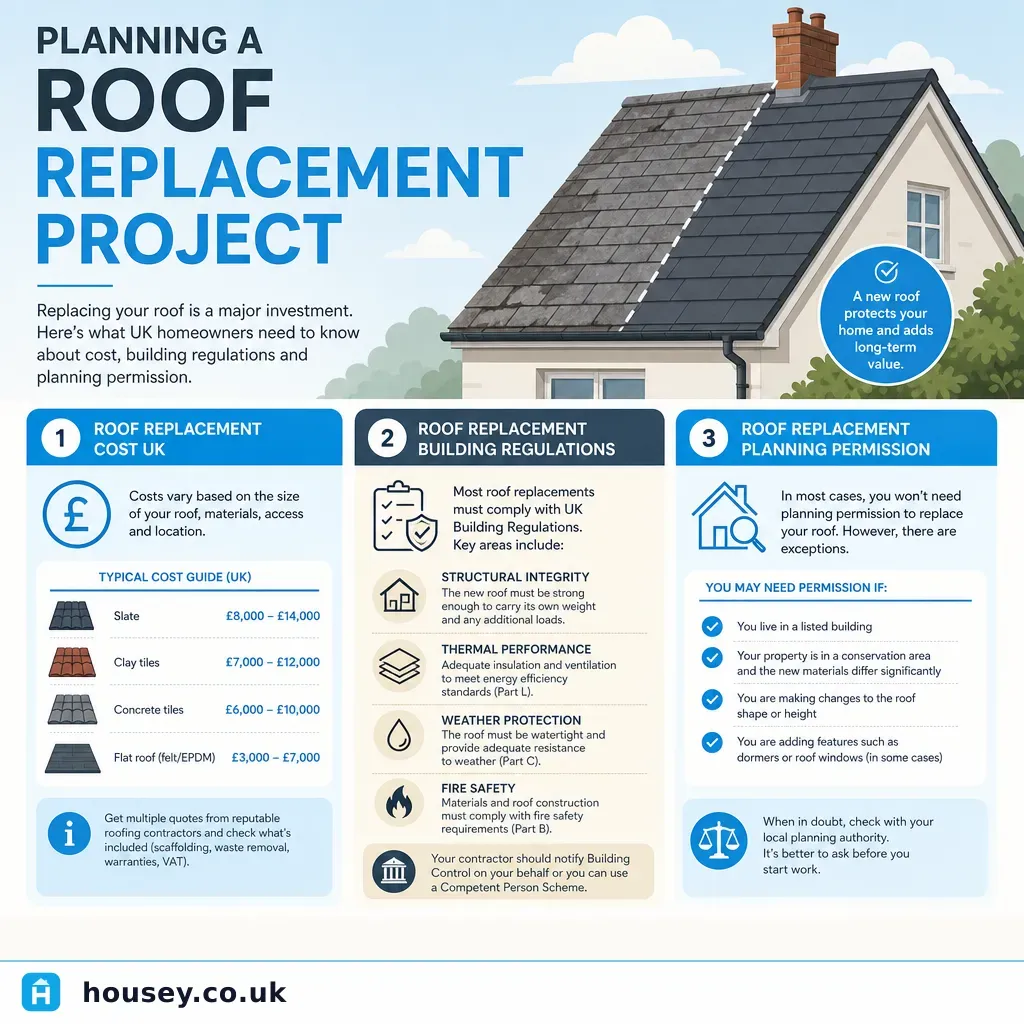
Planning a Roof Replacement Project
A roof replacement project involves stripping the existing covering, renewing the sarking felt and battens, and laying new tiles, slates, or a flat-roof membrane.
 Improvement & Build
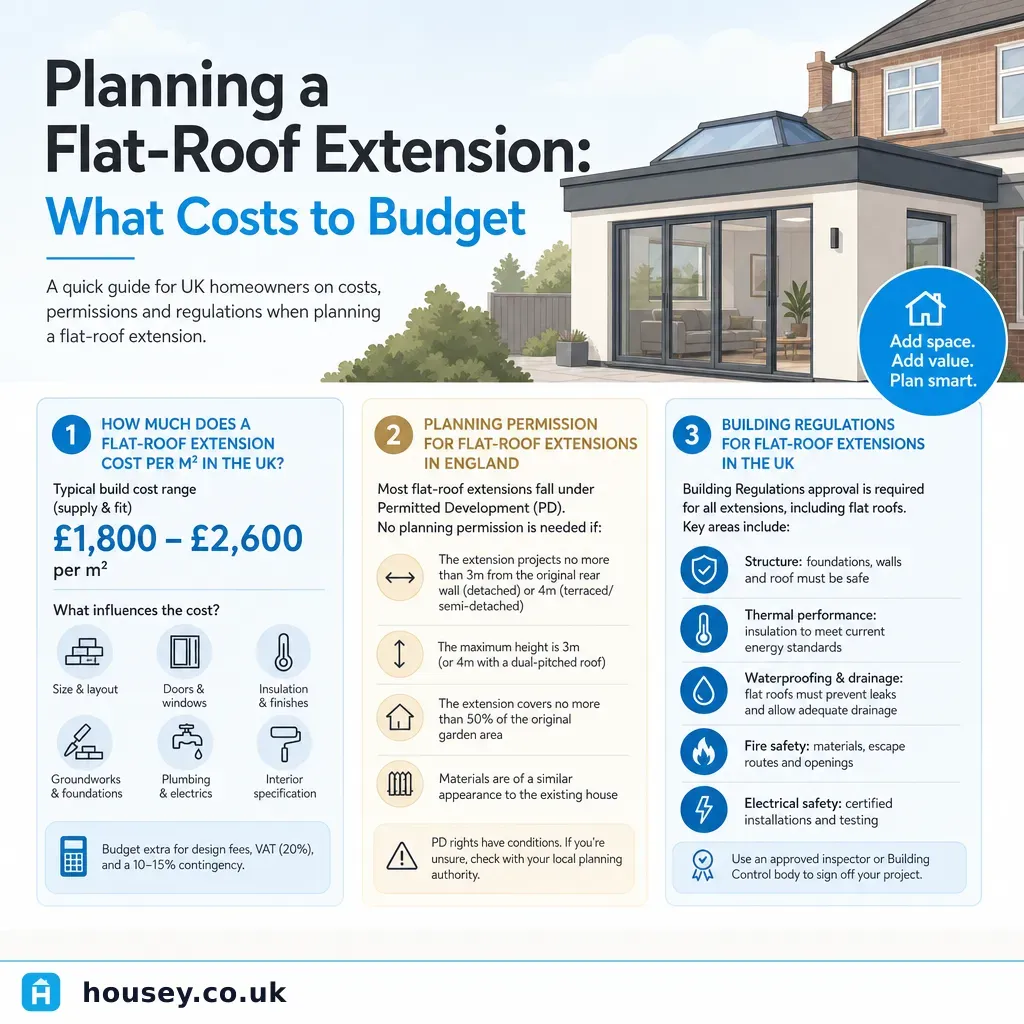
Planning a Flat-Roof Extension: What Costs to Budget
A flat-roof single-storey extension typically costs £1,500–£3,000 per m² in the UK, depending on size, specification, location, and roof membrane choice.