Tree Removal and Sustainable Uses for Timber
By Housey · Last reviewed 8th of May 2026
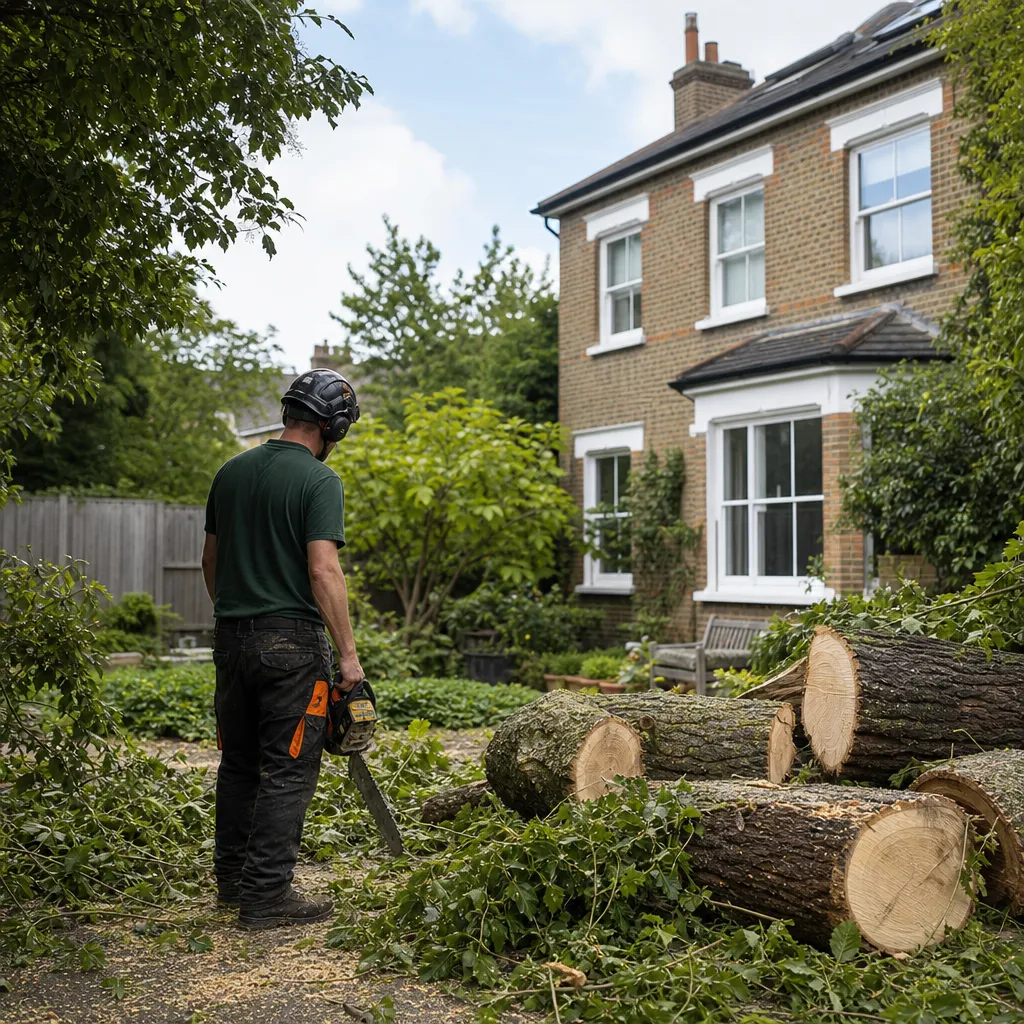
Tree Removal and Sustainable Uses for Timber
When a tree needs to come down — whether due to disease, storm damage, proximity to a building, or a garden redesign — the resulting timber rarely has to become skip fill or landfill. UK householders increasingly look to reuse, repurpose, or responsibly recycle wood from removed trees, and there are genuine practical and environmental reasons to do so. What is possible depends on the species, diameter, condition, and volume of the timber, as well as whether any disease-related restrictions apply to moving it.
Key points
- Green (freshly cut) hardwood typically contains 60–80% moisture and must season for 12–24 months to reach the sub-20% moisture level required by the Air Quality (Domestic Solid Fuels Standards) (England) Regulations 2020 before it can be sold or burned as Ready to Burn fuel.
- Trees with a Tree Preservation Order (TPO) or located in a Conservation Area require local planning authority consent before any felling — removing a protected tree without consent is a criminal offence under the Town and Country Planning Act 1990 and can attract a fine of up to £20,000 or an unlimited amount in some cases.
- Some diseased trees — including those affected by ash dieback (Hymenoscyphus fraxineus, formerly Chalara fraxinea) — may be subject to Forestry Commission guidance or regional movement restrictions; check GOV.UK before transporting logs off-site.
- Portable sawmill operators can visit your property and mill trunks into planks in situ, avoiding transport costs and retaining the most value from larger, straight-grained sections.
- NPTC/LANTRA-qualified arborists — and members of the Arboricultural Association — should carry out all felling; chainsaw operation and working at height above 2 m carry serious injury risk.
What can you do with timber after tree removal?
The most sustainable approach is to find a use on or near the site before arranging collection or disposal. Transporting timber adds cost and emissions; retaining useful material avoids both.
Firewood
Hardwoods — oak, ash, beech, hornbeam, cherry, and apple — make excellent firewood once seasoned. Softwoods such as pine, larch, and spruce burn faster and produce more resin deposits; they are usable but less prized for domestic heating appliances.
Green wood from a freshly felled tree contains up to 60–80% moisture by weight. For efficient combustion on a wood-burning stove or open fire, moisture content must be below 20% to meet the Ready to Burn standard under the Air Quality (Domestic Solid Fuels Standards) (England) Regulations 2020. That typically means 12–24 months of air-drying in a covered, well-ventilated log store. Softwoods dry faster — often 6–12 months — but are less energy-dense per kilogram.
If you do not have space or time to season the wood yourself, many firewood suppliers will collect and pay a small amount for suitable hardwood logs.
Woodchip mulch
A tree surgeon with an on-site chipper can reduce brash (smaller branches and twigs) to woodchip at the point of removal. Fresh woodchip makes effective garden mulch: it suppresses weeds, retains soil moisture, and gradually improves soil structure as it decomposes. Apply a 5–10 cm layer around trees and shrubs, keeping it clear of stems to avoid collar rot. Fresh woodchip temporarily draws down surface nitrogen as it decomposes, so avoid applying it thickly to vegetable growing beds.
Sawn timber and planks
Larger trunks and main limbs can be milled into planks suitable for furniture, shelving, flooring, or garden structures. A portable sawmill operator can visit your site to slice logs in situ, which significantly reduces transport effort and retains the most value from the timber. Operators are often listed through local trade directories or the Arboricultural Association's network.
Species vary considerably in workability and suitability for different end uses:
Species | Typical use | Notes |
|---|---|---|
Oak | Furniture, beams, flooring | Excellent durability; slow to season; splits if dried too quickly |
Ash | Tool handles, furniture, cladding | Light and strong; check ash dieback movement guidance before moving logs |
Beech | Indoor furniture, turning | Fine grain; not durable outdoors without treatment |
Cherry | Decorative furniture, cabinets | Beautiful figure; tends to smaller diameters |
Apple / pear | Turning, carving, smoking wood | Hard and dense; typically small diameter |
Pine / spruce | Structural framing, garden use | Less durable outdoors; treat if used externally |
Sycamore | Kitchenware, musical instruments | Food-safe when untreated; bright white wood |
Wood turning, carving, and craft uses
Bowl turners, sculptors, and craftspeople actively seek green wood from local trees — particularly fruit woods, burr sections, and unusual species. Community platforms such as Freecycle, Gumtree, or the British Woodturners' Association forum are good starting points for finding someone who will collect for free.
Habitat features
Sections of trunk and large branches can remain on site as habitat: log piles for invertebrates, hedgehogs, and fungi, or upright standing sections as nesting habitat for hole-nesting birds and insects. Natural England and the Woodland Trust both recommend retaining deadwood on site where feasible — it costs nothing and supports local biodiversity.
Community wood recycling
The Community Wood Recycling network operates across the UK, collecting timber from householders and businesses and reselling it to craftspeople or channelling it into social enterprises. Some local authorities also accept chipped wood at household waste recycling centres (HWRCs) — check your council's website for accepted materials.
Diseased timber: movement restrictions
Before transporting timber off your property, check whether any disease-related restrictions apply.
- Ash dieback (Hymenoscyphus fraxineus): No statutory movement restrictions on ash timber within Great Britain at the time of writing, but Forestry Commission guidance recommends moving ash logs only short distances and avoiding cross-border movement. Check the latest Forestry Commission plant health alerts.
- Phytophthora ramorum: Affects larch and some oaks. Movement restrictions may apply within designated Management Zones — check with the Forestry Commission before moving material.
- Oak Processionary Moth: Movement of oak material including logs is restricted within and from designated restricted zones in parts of England. Check GOV.UK for current zone boundaries.
If there is any doubt, contact the Forestry Commission's Tree Health service or consult GOV.UK's tree pests and diseases guidance before moving material off-site.
Homeowner checklist: making the most of felled timber
Red flags that mean you need professional involvement
- The tree is within falling distance of a building, vehicle, overhead power line, or neighbouring property
- Any limb is 10 cm or more in diameter and you are considering removing it yourself
- The tree has a Tree Preservation Order or is in a Conservation Area — confirm with your local planning authority before any work begins
- The tree shows signs of active structural decay: cavities, fungal fruiting bodies at the base, or large dead branches — a qualified arborist should assess safety before felling
- You are unsure whether disease movement restrictions apply to the species concerned
When to get professional help
Tree removal almost always requires a qualified arborist. Chainsaw operation and working at height above 2 m carry serious injury risk when attempted without proper training and equipment. Look for arborists who hold relevant NPTC/LANTRA qualifications and are members of the Arboricultural Association. Always check whether the tree has a TPO or sits in a Conservation Area before commissioning any work — your local planning authority's website or the Planning Portal can help you verify this.
If you want the timber processed for firewood or planks, discuss this with the arborist before the job starts. Some will arrange for a chipper or portable sawmill to attend on the same day, saving a separate booking.
How Housey can help
If you need a qualified tree surgeon to remove a tree and advise on the best use of the resulting timber, Housey can help you compare quotes from local, qualified professionals. Request quotes from local tree surgeons and note your timber preferences — logs, chips, or sawn sections — when you complete your request.
Frequently asked questions
Can I keep the wood when a tree surgeon removes a tree?
Usually yes — unless your contract specifies otherwise, timber from a tree on your property belongs to you. Discuss this with your arborist before the job starts; some will reduce their fee slightly if they can keep usable timber, while others will leave everything on site. Confirm the arrangement in writing before work begins.
How long does wood from a felled tree take to dry for burning?
Most hardwoods take 12–24 months to season below the 20% moisture threshold required for Ready to Burn certification. Softwoods typically dry in 6–12 months. Log diameter and stacking conditions affect drying time significantly. A cheap moisture meter lets you check readiness before burning.
Is it worth milling a garden tree into planks?
It depends on the species, size, and grain. A straight-grained oak, ash, or cherry trunk of 30 cm diameter or more can yield planks suitable for furniture, flooring, or shelving. Portable sawmill operators typically charge by the hour or board-foot; request a quote once you know the approximate dimensions.
Do I need permission to remove a tree in my garden?
Not usually for ordinary residential gardens, but you must check whether the tree has a Tree Preservation Order (TPO) or sits in a Conservation Area. If either applies, contact your local planning authority before any work begins. Felling a protected tree without consent is a criminal offence under the Town and Country Planning Act 1990 and can attract substantial fines.
What should I do with a very large volume of woodchip?
Contact local allotment associations, community gardens, schools, or parks departments — many welcome free deliveries. Horse-riding yards and farms also use large quantities of woodchip for paths and surfaces. Local councils often accept chipped wood at household waste recycling centres; check your council's accepted materials list.
Sources and further reading
- Ready to Burn — domestic solid fuel moisture standards — GOV.UK / DEFRA
- Tree Preservation Orders and protected trees — GOV.UK
- Tree pests and diseases — Forestry Commission / GOV.UK
- Community Wood Recycling — Community Wood Recycling network
- Find an Arborist — Arboricultural Association — Arboricultural Association
Useful next reads
 Improvement & Build
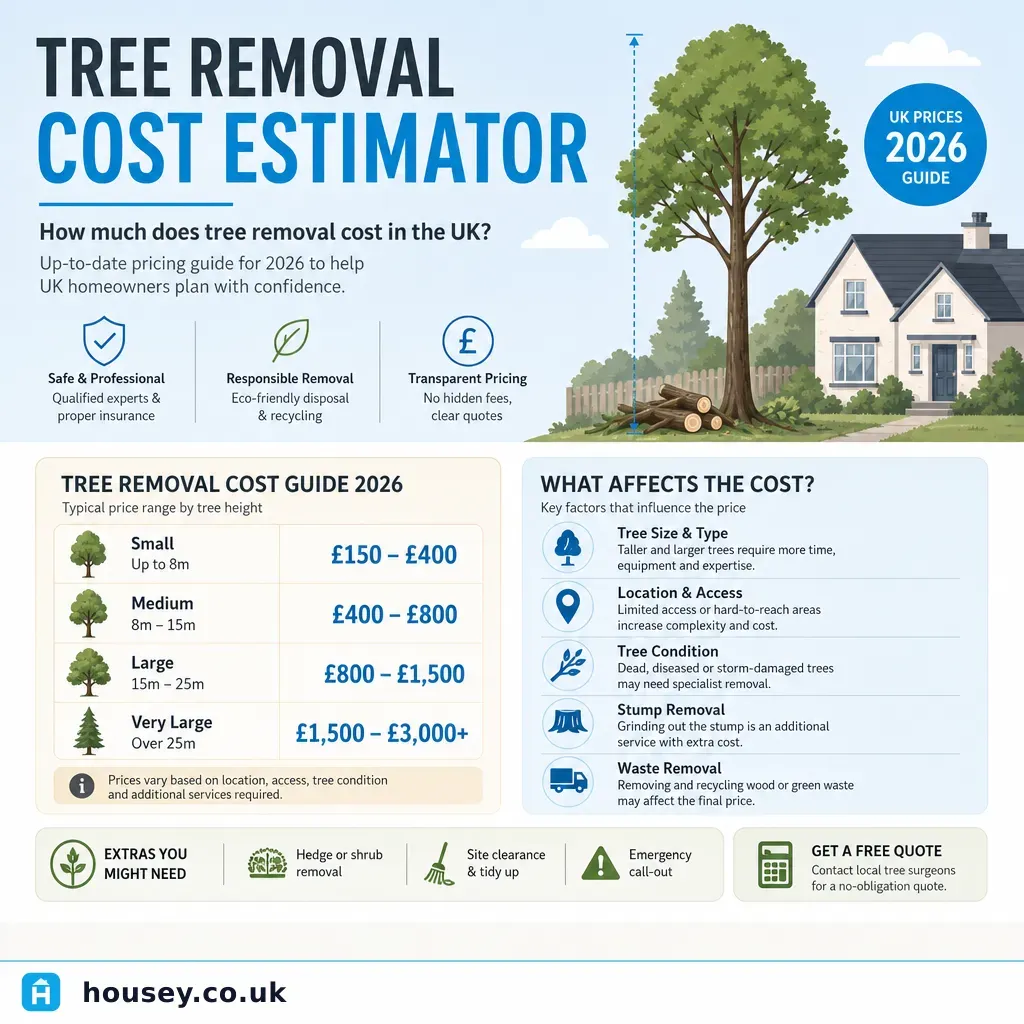
Tree Removal Cost Estimator
Tree removal in the UK costs roughly £150 to £5,000 or more, depending on the tree's height, species, access conditions, and whether stump removal is needed.
 Improvement & Build
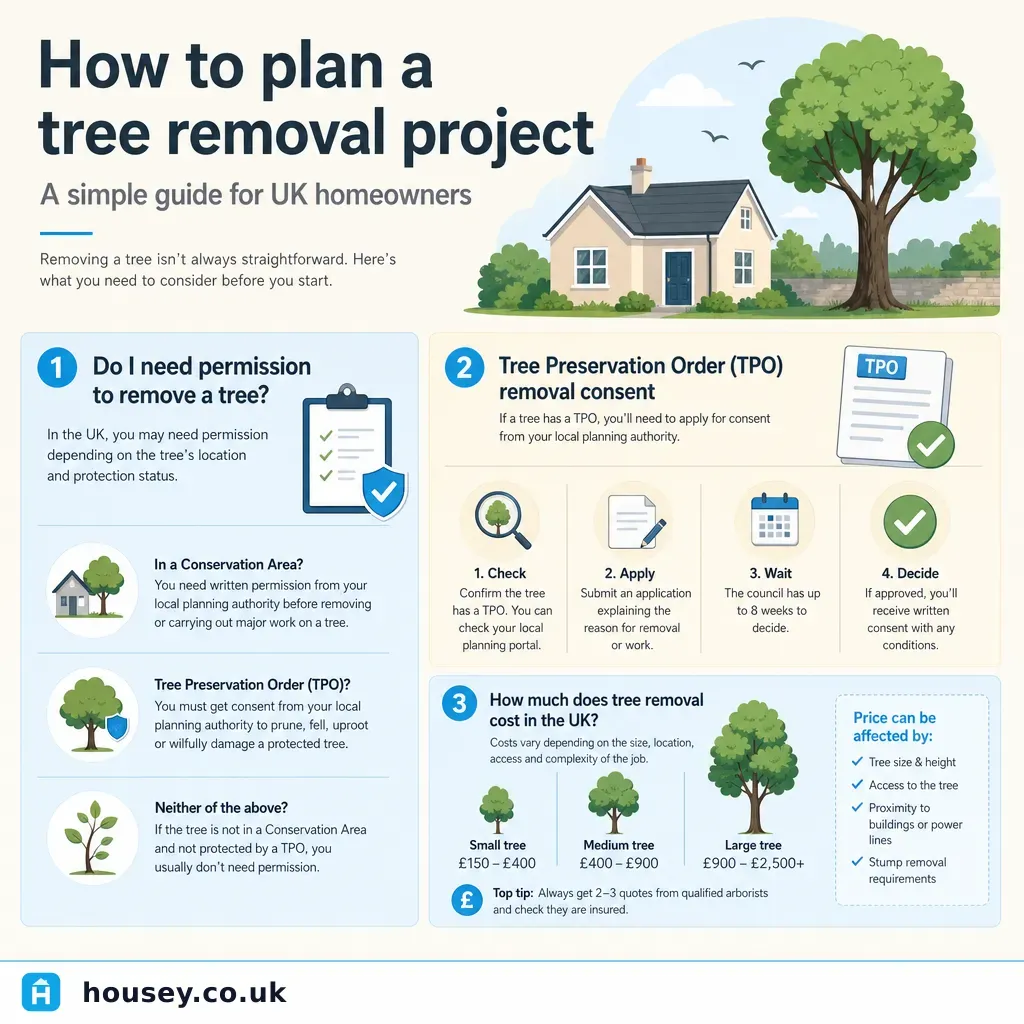
How to plan a tree removal project
Planning a tree removal project starts with checking whether the tree is protected by a Tree Preservation Order or sits in a conservation area, as both require council consent before any work begins.
 Improvement & Build
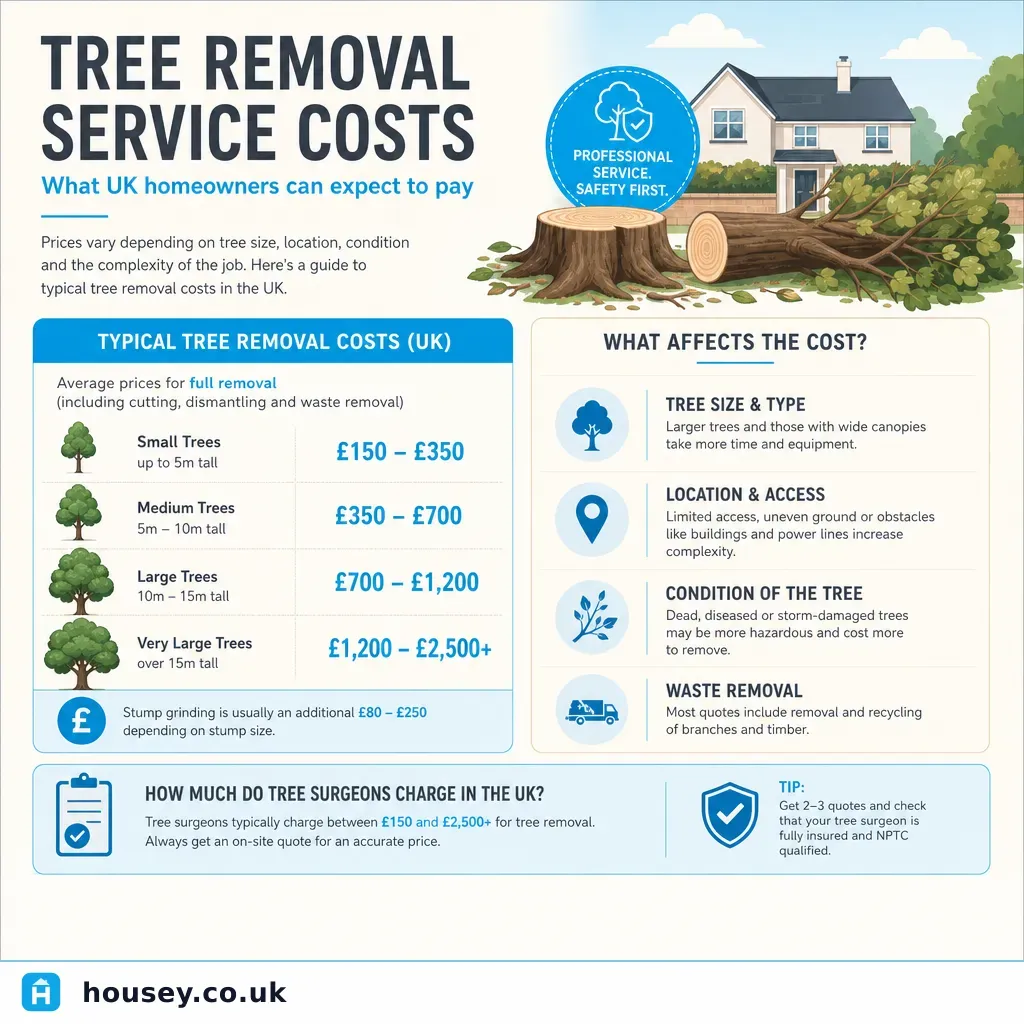
Tree Removal Service Costs
Professional tree removal costs in the UK depend on tree height, access, species, and the scope of work included.
 Improvement & Build
Disposing of Tree Waste from Felled Timber: Options and Removal Services
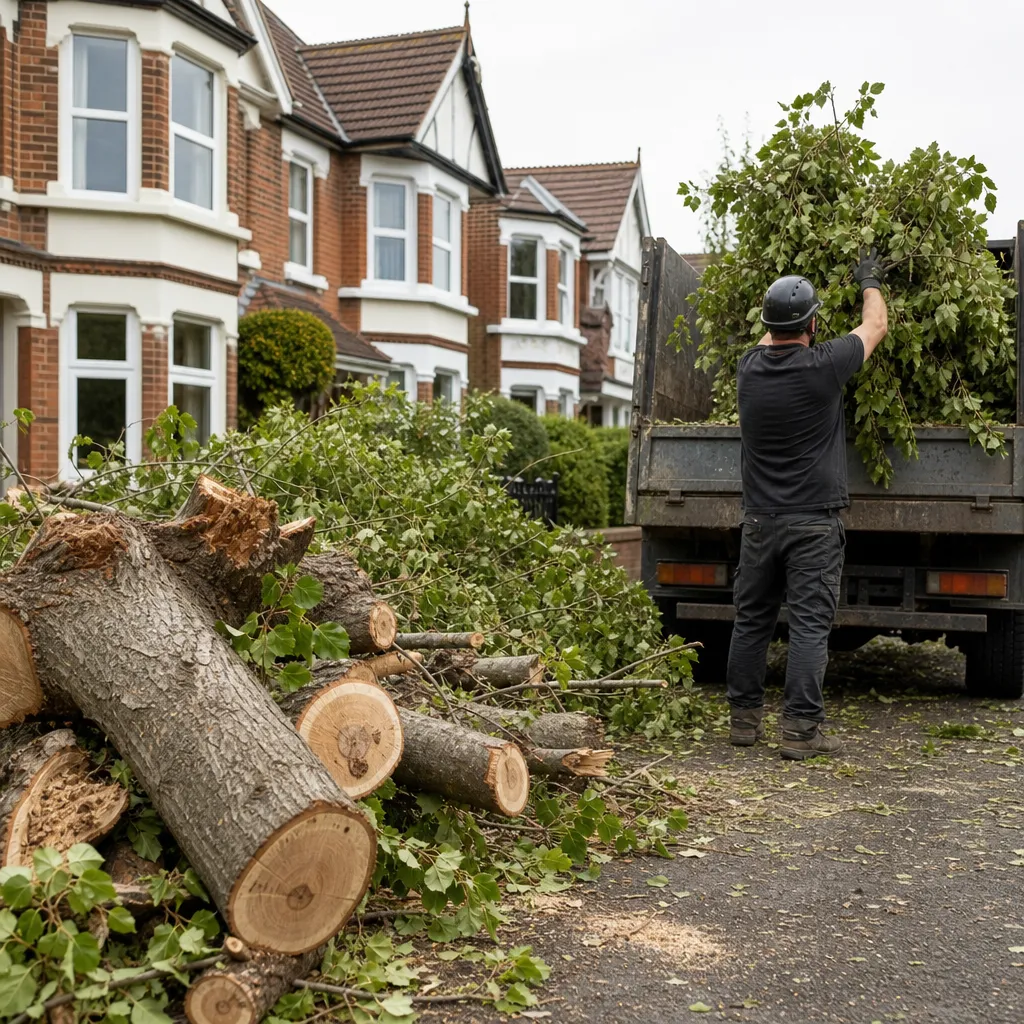
Tree waste from felled timber can be disposed of in several ways: a tree surgeon can chip or remove it as part of the job, you can hire a skip, take it to a household waste recycling centre, have logs split for firewood, or arrange a wood-chip delivery to a local composting site.
 Improvement & Build
Specialist Tree Removal and Extraction Costs
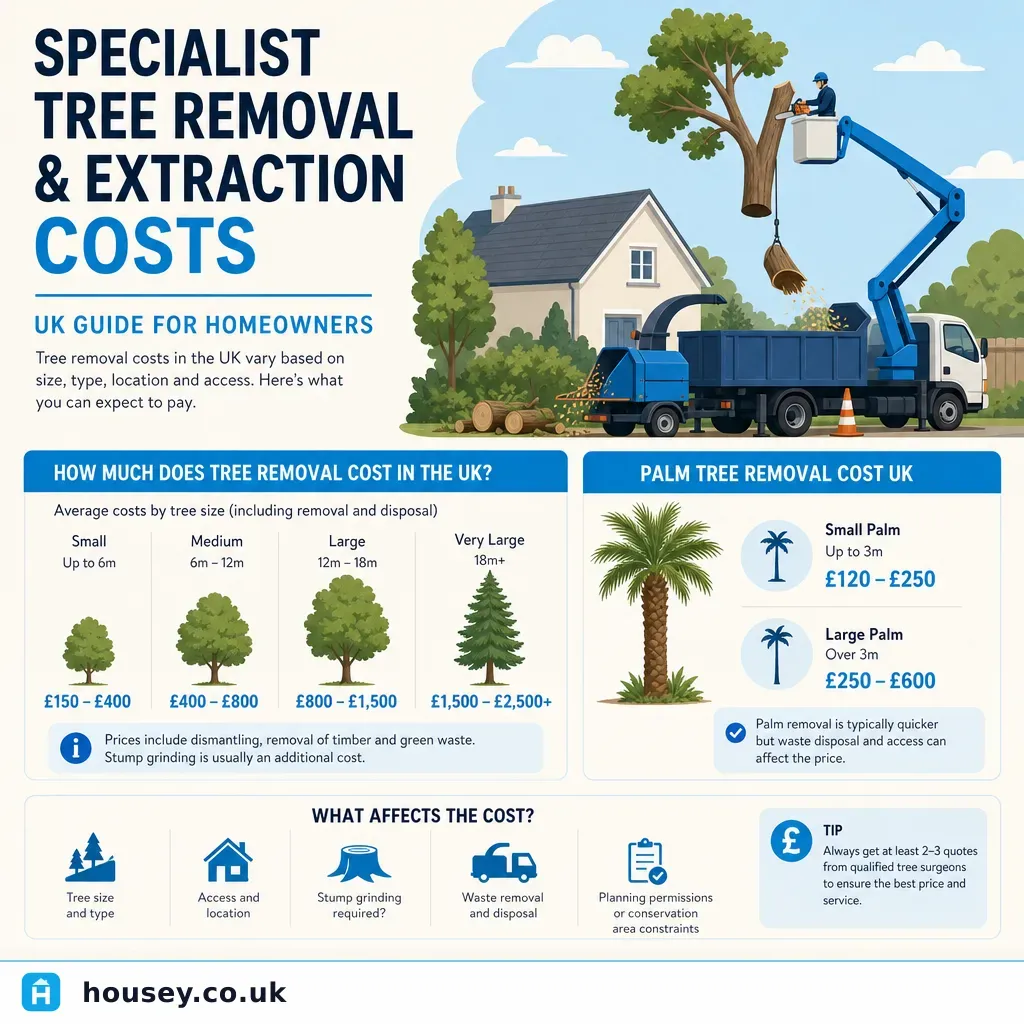
Specialist tree removal costs in the UK range from around £150 for small trees to £3,000 or more for large mature specimens, with palm trees typically costing more due to specialist technique.