When to Call a Tree Surgeon: Professional Assessment and Safety Standards
By Housey · Last reviewed 1st of June 2026
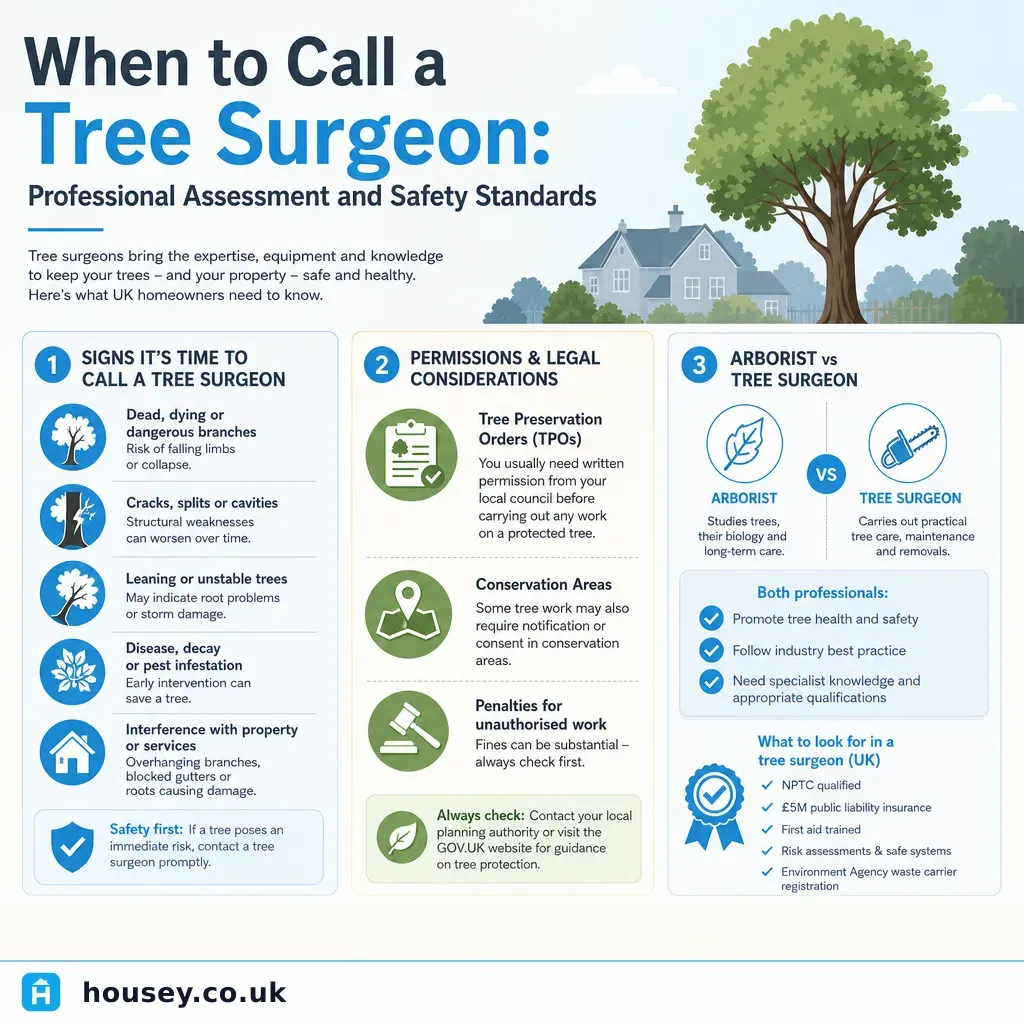
When to Call a Tree Surgeon: Professional Assessment and Safety Standards
Mature trees add character, shade, and ecological value to UK gardens, but they can also present serious hazards when they are diseased, structurally compromised, or growing close to buildings, boundaries, or overhead lines. For homeowners, the challenge is knowing when informal monitoring becomes insufficient and professional intervention is needed — particularly because tree work intersects with strict planning law through Tree Preservation Orders and conservation area designations, where acting without the correct permissions is a criminal offence.
Key points
- Tree surgeons should hold City & Guilds Level 3 in Arboriculture and relevant NPTC or LANTRA chainsaw certificates; the Arboricultural Association (AA) maintains a directory of Approved Contractors independently vetted for qualifications, insurance, and safe systems of work.
- Any works to a tree covered by a Tree Preservation Order (TPO) require prior written consent from the local planning authority under the Town and Country Planning Act 1990 — failure to comply is a criminal offence carrying an unlimited fine.
- Trees in conservation areas with a trunk diameter of 75 mm or more at 1.5 m above ground level require 6 weeks' prior notification to the local planning authority before most works begin.
- The Work at Height Regulations 2005 require that anyone carrying out tree climbing or aerial work is competent to do so; unqualified DIY tree work causes serious injuries and fatalities in the UK every year.
- A formal arboricultural assessment referencing British Standard BS 5837:2012 may be required by a local planning authority, mortgage lender, or insurer before development or significant tree works proceed.
What a tree surgeon does
A tree surgeon — also called an arborist — specialises in the care, maintenance, and removal of trees. Their work includes crown reduction, crown thinning, deadwood removal, pollarding, formative pruning, sectional dismantling, stump grinding, and root management. Qualified practitioners can also produce tree condition reports and arboricultural impact assessments, which are often required for planning applications, insurance claims, or pre-development surveys under BS 5837:2012.
The title "tree surgeon" is not legally protected, but commercial operations and professional contracting are expected to demonstrate verifiable qualifications, appropriate insurance, and documented safe working methods. A sole trader offering informal tree work without evidence of training, insurance, or method statements should be treated with caution — particularly for work involving climbing, chainsaws, or trees near structures or overhead lines.
When to call a tree surgeon
Signs requiring professional assessment
Symptom | What it may indicate | Recommended action |
|---|---|---|
Cracks or splits in the trunk | Internal decay or structural failure | Urgent assessment; keep people away from beneath the canopy |
Leaning that has noticeably changed angle | Root plate failure or soil movement | Clear the area; commission an assessment before approaching the tree |
Dead branches or significant dieback in the crown | Disease, pest activity, or drought stress | Schedule removal; falling deadwood is one of the most common tree hazards |
Fungal brackets at the base or on the trunk | Internal decay fungi such as Ganoderma or Meripilus | Qualified arboricultural assessment required as a priority |
Roots lifting paving or affecting building foundations | Root encroachment or heave | Professional assessment; possibly root barrier, directional pruning, or removal |
Overhanging branches above structures or vehicles | Risk of wind-throw or breakage damage to property | Assessment of branch attachment and structural condition |
Tree in contact with overhead power lines | Electrocution and fire risk | Contact the network operator (e.g., UK Power Networks) first; do not attempt to prune yourself |
Storm damage visible in crown or at root level | Structural compromise that may not be immediately obvious | Do not enter the area beneath the canopy; call a qualified arborist immediately |
Routine maintenance triggers
Even healthy, structurally sound trees may need scheduled professional attention for:
- Crown lifting to improve light levels, clear sightlines, or maintain safe clearance over paths and roads.
- Formative pruning of young trees to establish sound branch architecture before problems develop.
- Pollarding of species traditionally managed that way, such as willows, limes, and planes.
- Pre-development surveys required under BS 5837:2012 before construction, demolition, or significant groundworks begin.
Tree Preservation Orders and conservation areas
The legal framework is strict and non-compliance can result in prosecution and unlimited fines.
Tree Preservation Orders (TPOs): A TPO is made by a local planning authority under the Town and Country Planning Act 1990 to protect specific trees or groups whose removal would be to the public's detriment. To carry out any pruning, removal, or other works to a TPO tree, you must apply for prior written consent from your local planning authority before work begins. There is no application fee. Work must not begin until written consent is received or, in limited procedural circumstances, 8 weeks have elapsed. Emergency works to address an immediate safety risk may be carried out without prior consent, but the authority must be notified as soon as practicable, with photographic evidence of the danger.
Conservation areas: Under the same legislation, all trees within a conservation area with a trunk diameter of 75 mm or more at 1.5 m above ground require 6 weeks' prior notification to the local planning authority before works begin, unless the authority issues a no-objection notice sooner. Exemptions apply to dead, dying, or imminently dangerous trees, but the threshold for demonstrating danger is high and should be documented professionally.
How to check: Your local planning authority can confirm whether a tree has a TPO or falls within a conservation area. GOV.UK publishes detailed guidance on Tree Preservation Orders and trees in conservation areas, and the Planning Portal provides application guidance and templates.
Qualifications and accreditations to check
Before appointing a tree surgeon, verify the following:
Credential | What it confirms |
|---|---|
City & Guilds Level 3 Arboriculture | Core industry qualification covering tree work theory and practical application |
NPTC / LANTRA Chainsaw certificates | Competence for specific operations — cross-cutting, felling, processing, aerial chainsaw work |
Aerial rescue certificate | Required competence for any climbing or aerial tree operations |
Arboricultural Association Approved Contractor | Independently vetted for insurance, qualifications, method statements, and safe systems of work |
LANTRA Awards accreditation | Specialist arboriculture and chainsaw training provider |
Always ask for:
- Proof of public liability insurance (typically a minimum of £5 million for domestic work; more for larger or higher-risk operations).
- Certificates covering the specific chainsaw and aerial operations required for your job.
- A written method statement before any significant works begin.
- Confirmation that TPO and conservation area status has been checked for every tree on site before pricing the work.
Important limitations
This article provides general information about when tree surgery may be needed and the professional standards you should expect. It is not a substitute for an assessment by a qualified arborist, nor does it constitute legal advice on planning obligations. Tree risk is affected by species, age, root zone conditions, site history, soil type, and proximity to structures in ways that cannot be reliably assessed from a description alone. Planning obligations under the Town and Country Planning Act 1990 can also vary depending on individual tree designations, local authority policy, and property history. A qualified arborist should assess your trees in person, and your local planning authority should be consulted before any works that may be subject to legal restriction.
When to get professional help
Contact a qualified tree surgeon without delay if you observe any of the following:
- Any visible structural defect — cracks, splits, cavities, basal swelling, or significant lean that has changed since you last observed it.
- Fungal brackets, unusual growths, weeping wounds, or persistent dead patches on the trunk or major roots.
- A tree that has shifted, partially uprooted, or sustained storm damage affecting its structural integrity.
- Branches or whole trees that have fallen onto structures, vehicles, or are blocking access routes.
- Roots causing visible damage to buildings, drains, retaining walls, or hard surfaces.
- Any tree you believe may have a TPO or be in a conservation area on which you are considering works — check before you cut.
- Any work that requires a chainsaw, climbing equipment, or working above 2 m — do not attempt this without professional training, equipment, and insurance.
What to ask a qualified professional
Before instructing a tree surgeon, ask the following:
- What qualifications do you hold, and can you provide certificates for chainsaw operations and aerial rescue?
- Are you listed as an Arboricultural Association Approved Contractor?
- What level of public liability insurance do you carry, and can you provide a current certificate?
- Have you confirmed whether any tree on site has a TPO or is within a conservation area?
- Will you provide a written method statement before work begins?
- Will site arisings (timber, brash, and debris) be cleared, and is stump grinding included or separately priced?
- If a tree condition report or arboricultural assessment is required, is it referenced to BS 5837:2012?
- What happens if the work is more complex than anticipated — for example, due to hidden decay, restricted access, or proximity to buried services?
How Housey can help
Housey connects you with vetted, insured tree surgeons who can assess your trees, advise on TPO and conservation area obligations, and carry out safe, lawful works to British Standard. Submit a brief to receive quotes from up to four local professionals.
Frequently asked questions
Do I need permission to cut down a tree in my garden?
You may need permission if the tree is covered by a Tree Preservation Order (TPO) or is within a conservation area. For TPO trees, you must apply to your local planning authority before any works. In a conservation area, 6 weeks' prior notification is required. For unprotected trees not in either category, planning permission is not usually required — but confirm with your local authority if there is any doubt.
What qualifications should a tree surgeon have?
The industry standard is City & Guilds Level 3 in Arboriculture, along with relevant NPTC or LANTRA chainsaw certificates for the specific work type. For climbing and aerial operations, an aerial rescue certificate is also expected. Arboricultural Association Approved Contractors are independently vetted against qualifications, insurance levels, and safe systems of work before being listed in the directory.
Can I cut overhanging branches from my neighbour's tree?
Under common law you have the right to cut back branches overhanging your property to the boundary line, and must offer the cuttings to the tree owner. However, if the tree has a TPO or is in a conservation area, you must still notify or apply to the local planning authority before cutting — even if the branches are physically on your side of the boundary line.
How much does tree surgery cost in the UK?
Costs vary significantly by tree size, species, access, and work type. Indicative UK costs, last reviewed 2026-06-01: crown reduction on a medium-sized garden tree may range from £200 to £800; full removal of a large tree can range from £500 to £3,000 or more. Stump grinding is usually priced separately. Always obtain at least two written, itemised quotes and confirm that insurance and site clearance are included.
Sources and further reading
- Tree Preservation Orders and trees in conservation areas — GOV.UK
- Works to trees — Planning Portal — Planning Portal
- Find an Arboricultural Association Approved Contractor — Arboricultural Association
- Tree surgery safety — Health and Safety Executive
- Work at Height Regulations 2005 — legislation.gov.uk
- BS 5837:2012 Trees in relation to design, demolition and construction — BSI Group
Useful next reads
 Improvement & Build
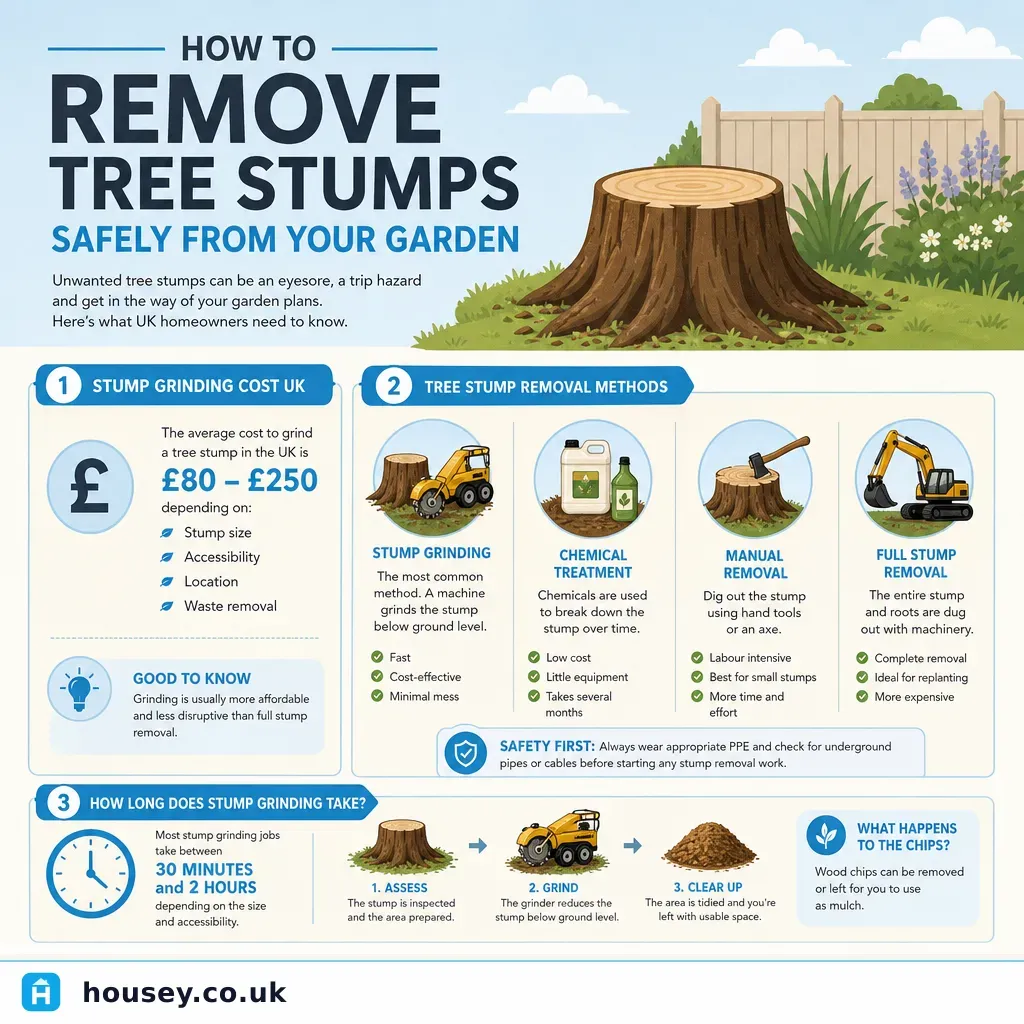
How to Remove Tree Stumps Safely from Your Garden
Tree stump removal in the UK typically involves stump grinding, chemical treatment, or manual excavation.
 Improvement & Build
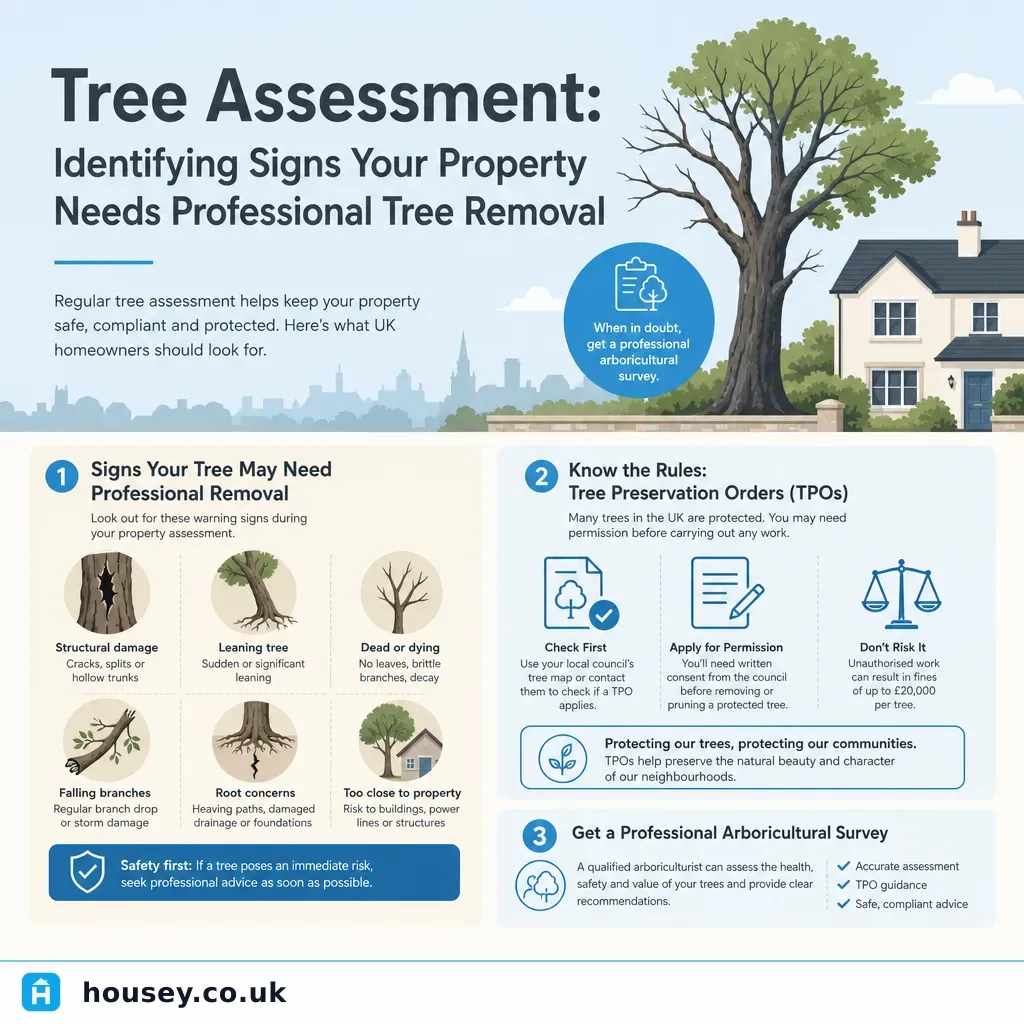
Tree Assessment: Identifying Signs Your Property Needs Professional Tree Removal
Key signs a tree may need professional removal include fungal brackets on the trunk, a sudden change in lean, dead or hanging branches, root heave, and visible cavities or decay.
 Improvement & Build
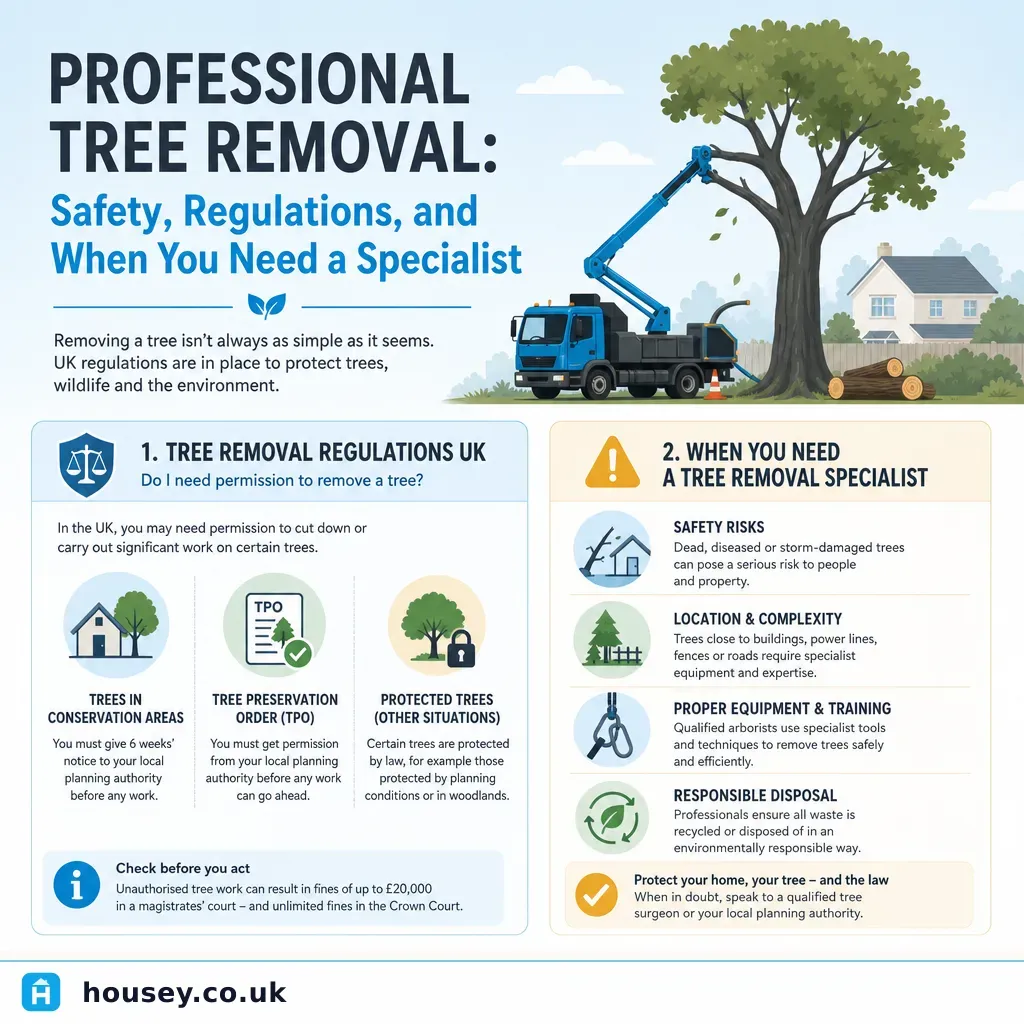
Professional Tree Removal: Safety, Regulations, and When You Need a Specialist
Professional tree removal in the UK often requires checking for Tree Preservation Orders or conservation area protections before any work begins.
 Improvement & Build
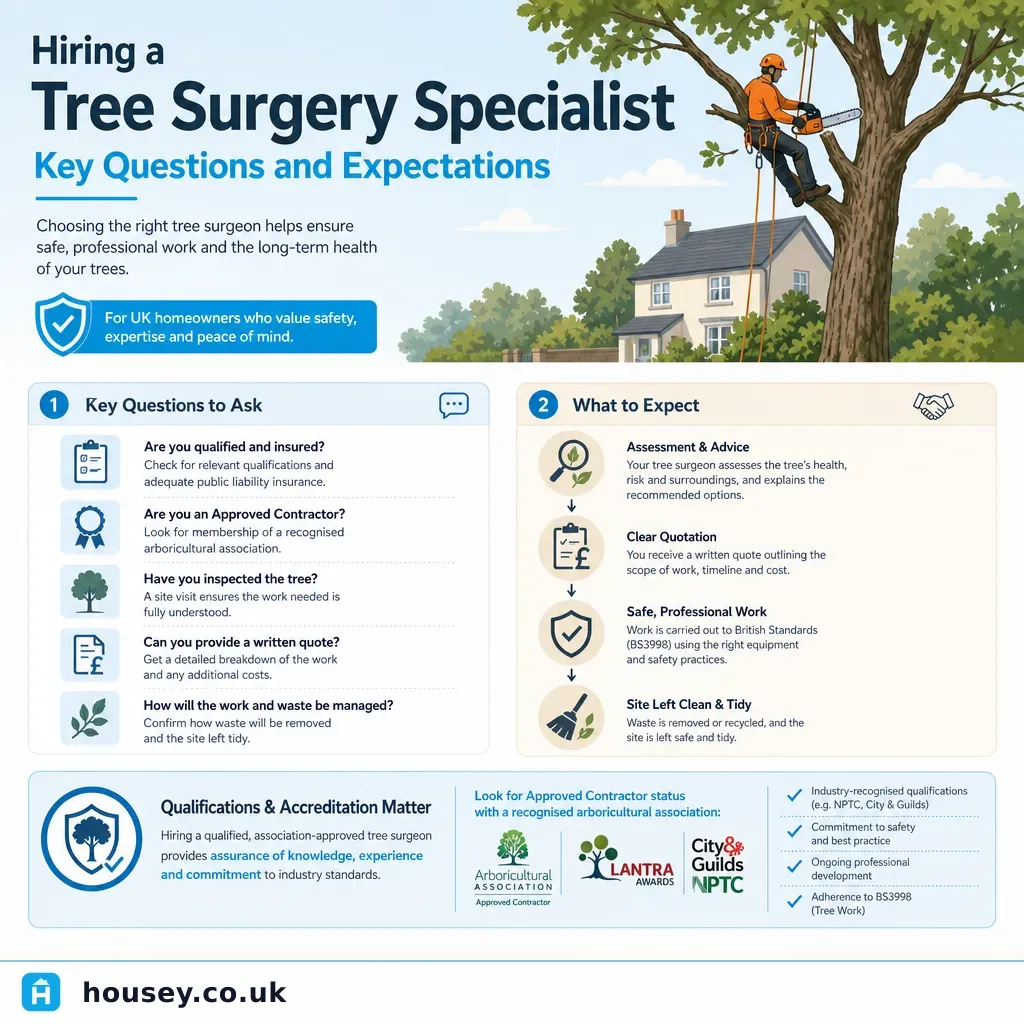
Hiring a Tree Surgery Specialist: Key Questions and Expectations
Before hiring a tree surgeon, check they hold NPTC (Lantra Awards) chainsaw certificates — CS30 and CS31 as a minimum — carry at least £5 million public liability insurance, and are listed in the Arboricultural Association's directory of approved contractors.
 Improvement & Build
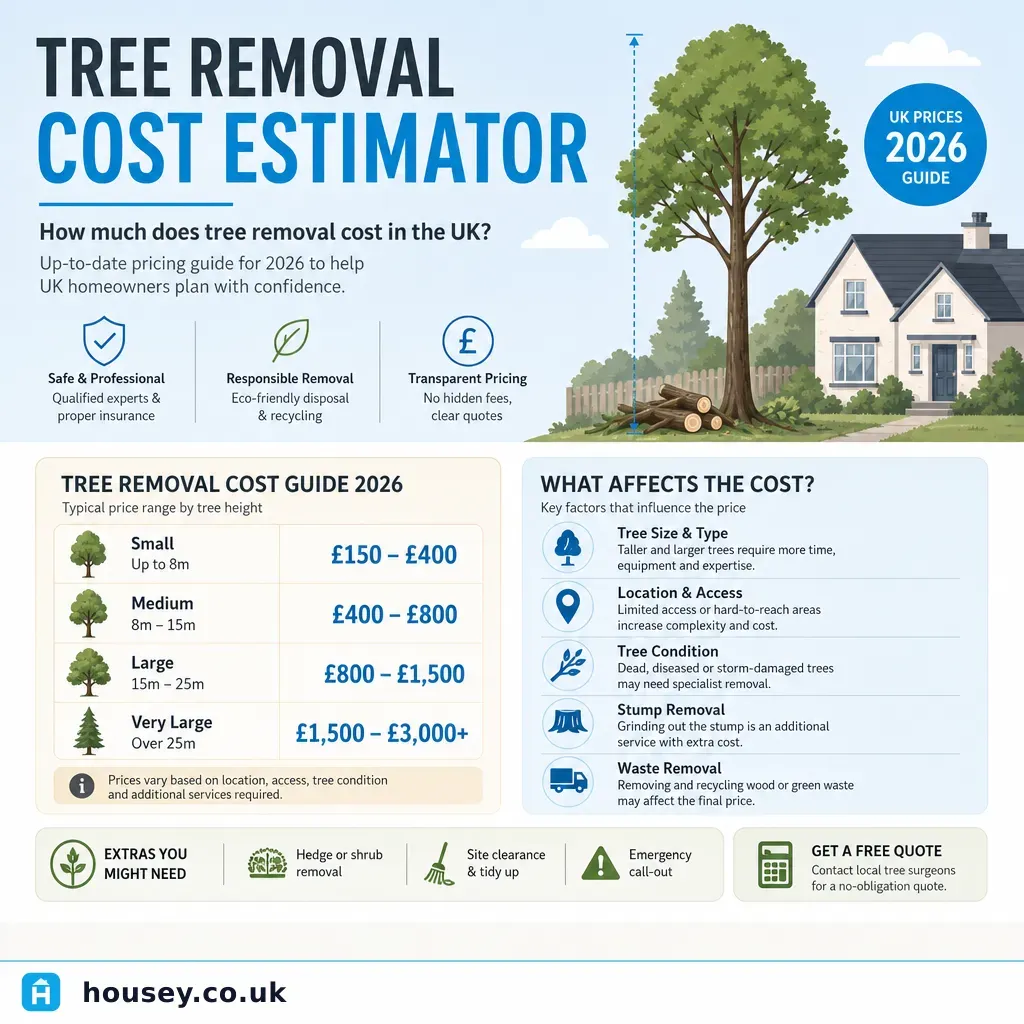
Tree Removal Cost Estimator
Tree removal in the UK costs roughly £150 to £5,000 or more, depending on the tree's height, species, access conditions, and whether stump removal is needed.