HVAC System Upgrades: Cost Savings for Older Properties
By Housey · Last reviewed 30th of May 2026
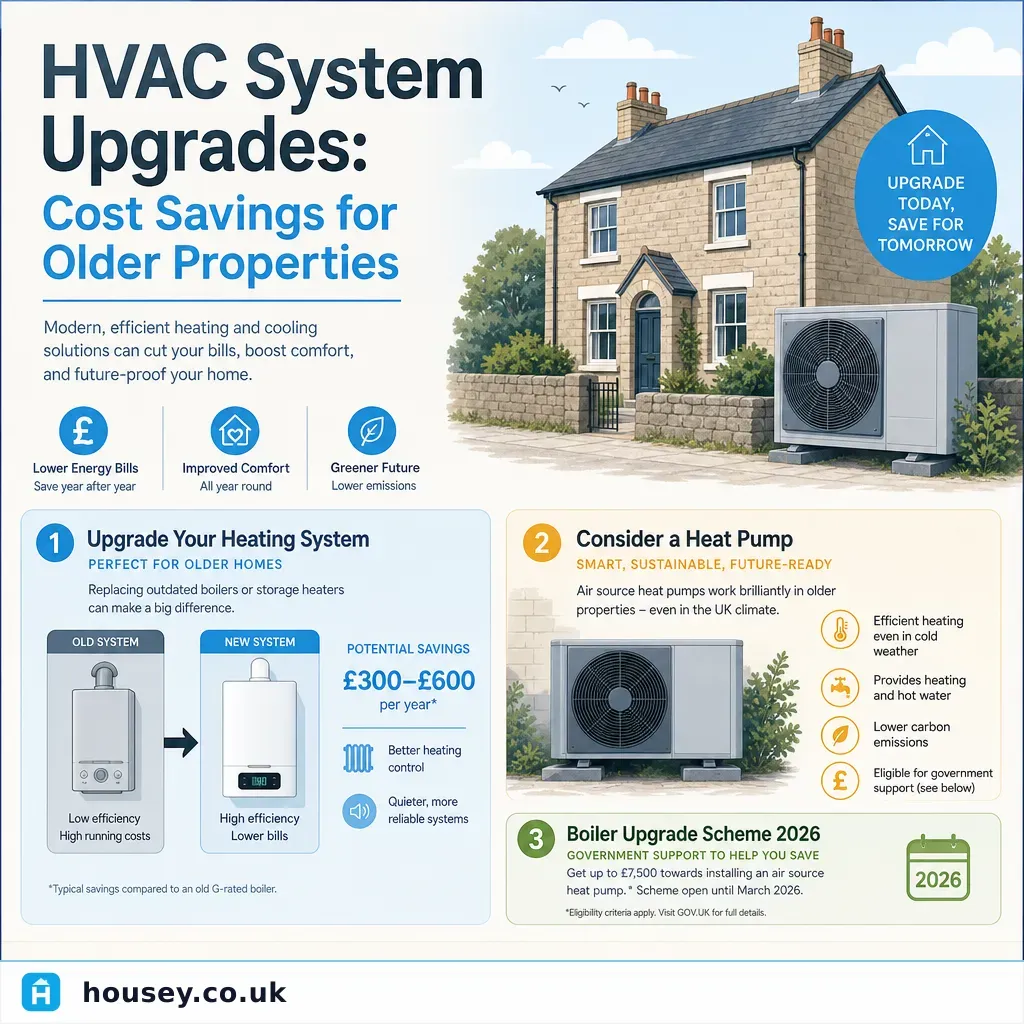
HVAC System Upgrades: Cost Savings for Older Properties
The heating, ventilation, and hot water infrastructure in older UK homes — whether a pre-war solid-wall terrace or a 1970s detached house — is often the single largest contributor to energy waste and high utility bills. Homeowners typically confront the question of upgrading when a boiler fails, when an Energy Performance Certificate (EPC) rating affects a remortgage or rental compliance, or simply when bills become difficult to manage. With UK building stock averaging some of the lowest energy efficiency ratings in Europe, decisions about heating system upgrades have long-term financial and comfort consequences, and increasingly regulatory ones.
Key points
- The UK Government's Boiler Upgrade Scheme (BUS) offers grants of up to £7,500 for air source heat pumps and up to £7,500 for ground source heat pumps in eligible properties in England and Wales (as of May 2026).
- Under Part L of the Building Regulations (England), replacement boilers must achieve at least 92% ErP efficiency; condensing boilers meeting this threshold are mandatory for like-for-like gas boiler replacements.
- PAS 2035 (Retrofitting dwellings for improved energy efficiency) governs whole-house retrofit projects funded under government schemes and requires a TrustMark-registered Retrofit Coordinator for scheme-funded work.
- Heat pump efficiency is measured as the Seasonal Coefficient of Performance (SCOP); a heat pump with an SCOP of 3.0 delivers 3 kWh of heat for every 1 kWh of electricity consumed.
- Solid-wall and poorly insulated homes typically need fabric improvements before a heat pump will perform cost-effectively; MCS-certified installers must carry out a heat loss calculation to BS EN 12831 before specification.
What does an HVAC upgrade mean for a UK home?
The term HVAC (Heating, Ventilation, and Air Conditioning) originates in commercial building services but is increasingly used by UK homeowners to describe the combined upgrade of central heating, hot water, and ventilation. In a domestic context, this typically means one or more of:
- Replacing an ageing gas or oil boiler with a high-efficiency condensing boiler or heat pump
- Adding mechanical ventilation with heat recovery (MVHR) or demand-controlled extract ventilation to improve air quality and reduce heat loss
- Upgrading radiators, underfloor heating (UFH), or hot water cylinders to suit a lower-flow-temperature heat pump system
- Installing smart controls, room thermostats, and thermostatic radiator valves (TRVs) to reduce wasted heat
The right combination depends on the property's age, construction, current EPC rating, and the homeowner's budget and plans.
Heating system options compared
System | Best suited to | Typical installed cost (indicative) | Key advantages | Key limitations |
|---|---|---|---|---|
High-efficiency condensing boiler | Properties with gas supply and an existing wet radiator system | £1,800–£3,500 | Lower upfront cost; existing radiators usually suitable; familiar technology | Gas prices remain volatile; no zero-carbon pathway; like-for-like replacement only |
Air source heat pump (ASHP) | Well-insulated homes (EPC C or above); properties with space for an external unit | £8,000–£15,000 before BUS grant | Lower running costs with good SCOP; eligible for BUS grant; significantly lower carbon | Requires insulation upgrades in older homes; flow temperature must be considered |
Ground source heat pump (GSHP) | Rural properties with sufficient land; high heat demand homes | £15,000–£30,000 before BUS grant | Higher SCOP than ASHP; stable ground temperature; eligible for BUS grant | High upfront cost; significant land requirements; longer payback period |
Hybrid heat pump | Solid-wall or hard-to-insulate homes where full electrification is not yet viable | £4,000–£8,000 (heat pump element) | Flexible; uses heat pump when efficient, gas boiler as back-up | Two fuel types; more complex servicing; BUS grant eligibility varies |
MVHR system | New builds and deep retrofits where good airtightness has been achieved or is planned | £3,000–£7,000 | Recovers heat from extract air; improves indoor air quality year-round | Only cost-effective in well-sealed homes; not appropriate as a standalone energy measure |
Indicative UK costs, last reviewed 2026-05-30. Costs vary considerably by property size, location, and specification. Always obtain at least three itemised quotes.
Worked example: upgrading a 1930s semi-detached in Manchester
A 1930s three-bedroom semi-detached home with cavity walls and an ageing gas boiler is typical of millions of UK properties. This worked example illustrates how a whole-house heating upgrade might be sequenced and costed.
Existing situation: 30-year-old gas boiler, single-zone controls, standard radiators, EPC rating D.
Retrofit assessment findings: Heat loss calculated at approximately 8 kW. Cavity walls already insulated. Loft insulation top-up to 270 mm recommended. No significant draught issues. EPC could reach B or C after measures.
Recommended upgrade pathway:
- Loft insulation top-up — indicative cost: £300–£600
- Smart controls and thermostatic radiator valves — indicative cost: £400–£700
- Air source heat pump with selective radiator upgrades — indicative net cost after BUS grant (£7,500): approximately £3,000–£6,500
Expected outcome: An illustrative running cost saving of 30–40% compared with the existing gas boiler, based on current tariff ratios. Payback period approximately 8–12 years before accounting for future energy price changes.
This example is illustrative only. Heat loss calculations, grant eligibility, and actual running costs must be assessed by a qualified professional for your specific property.
Important limitations
This article provides general information about heating and ventilation upgrade options for UK properties. System sizing, heat loss calculations, ventilation design, and grant eligibility must all be assessed for your specific property by a qualified professional. PAS 2035-funded work requires a TrustMark-registered Retrofit Coordinator. Heat pump sizing errors can result in underperformance, increased running costs, or moisture problems — never rely on a general article to specify or size a heat pump. Rules on grant eligibility and building regulations compliance can change; always check current guidance from GOV.UK or an accredited professional.
What to ask a qualified professional
Before commissioning a heating system upgrade, ask your installer or assessor:
- Have you carried out a heat loss calculation to BS EN 12831 for my property?
- Am I eligible for the Boiler Upgrade Scheme or any other current grant?
- What fabric improvements do I need before a heat pump will perform efficiently in my home?
- Are you MCS-certified (for heat pump installation) and TrustMark-registered?
- What will my expected running costs be at current energy tariffs, and what assumptions does that estimate use?
- Will I need to upgrade my radiators or hot water cylinder as part of this work?
- Does this work require building control notification, and will you handle that?
When to get professional help
Upgrading a heating system always benefits from independent professional advice, but it becomes particularly important if:
- Your current boiler is over 15 years old or failing frequently
- You are planning significant renovation work that affects the building fabric
- Your EPC rating is F or G and you are renting out or considering selling the property
- You are applying for any government-funded scheme (ECO4, BUS, or similar), which requires accredited assessors and registered contractors
- You have solid walls, a flat roof, or other hard-to-insulate construction elements that affect system suitability
A retrofit assessment by a qualified Retrofit Assessor is the recommended starting point for any whole-house approach.
How Housey can help
Housey connects you with MCS-certified installers, TrustMark-registered contractors, and independent energy-efficiency consultants who can assess your property and identify the most cost-effective upgrade pathway. You can also use Housey to find qualified professionals for heat pump surveys to establish whether your property is suitable before committing to installation.
Frequently asked questions
Is a heat pump suitable for my older property?
It depends on the property's insulation level and heat demand. Many older UK homes require fabric improvements — loft insulation, cavity wall insulation, double glazing, draught-proofing — before a heat pump will deliver running cost savings. A heat loss calculation to BS EN 12831, carried out by an MCS-certified assessor, will determine the required system size and whether existing radiators are adequate.
What is the Boiler Upgrade Scheme and am I eligible?
The Boiler Upgrade Scheme (BUS) is a government grant available in England and Wales for homeowners replacing fossil fuel heating with an air source heat pump (up to £7,500) or ground source heat pump (up to £7,500). The property must have a valid EPC with no outstanding loft or cavity wall insulation recommendations. Check eligibility at GOV.UK or with an MCS-certified installer.
How much can I save by upgrading my heating system?
Savings depend on the existing system's efficiency, the new system's SCOP, your current energy tariffs, and the property's heat loss. Switching from an old G-rated boiler to a modern condensing boiler can reduce fuel consumption by 20–30%. Upgrading to a well-specified heat pump in a suitably insulated home may cut heating running costs further. An independent energy assessment will model expected savings for your property.
Does a new heating system need building regulations approval?
Yes, in most cases. Replacing a boiler like-for-like is notifiable work and must be carried out by a Gas Safe registered engineer or notified to building control. Heat pump installations are notifiable under the Building Regulations and should be carried out by an MCS-certified installer. Competent person scheme registration covers the notification requirement in most circumstances.
Sources and further reading
- Boiler Upgrade Scheme: guidance for homeowners — GOV.UK
- PAS 2035:2023: Retrofitting dwellings for improved energy efficiency — BSI / TrustMark
- MCS: heat pump certification and standards — MCS (Microgeneration Certification Scheme)
- Approved Document L: Conservation of fuel and power — GOV.UK
- Air source heat pumps explained — Energy Saving Trust
Useful next reads
 Energy & Retrofit
Improving Home Energy Efficiency through Secondary Glazing Solutions
Secondary glazing fits an additional pane inside your existing window reveal, reducing heat loss and noise without replacing the original frame.
 Energy & Retrofit
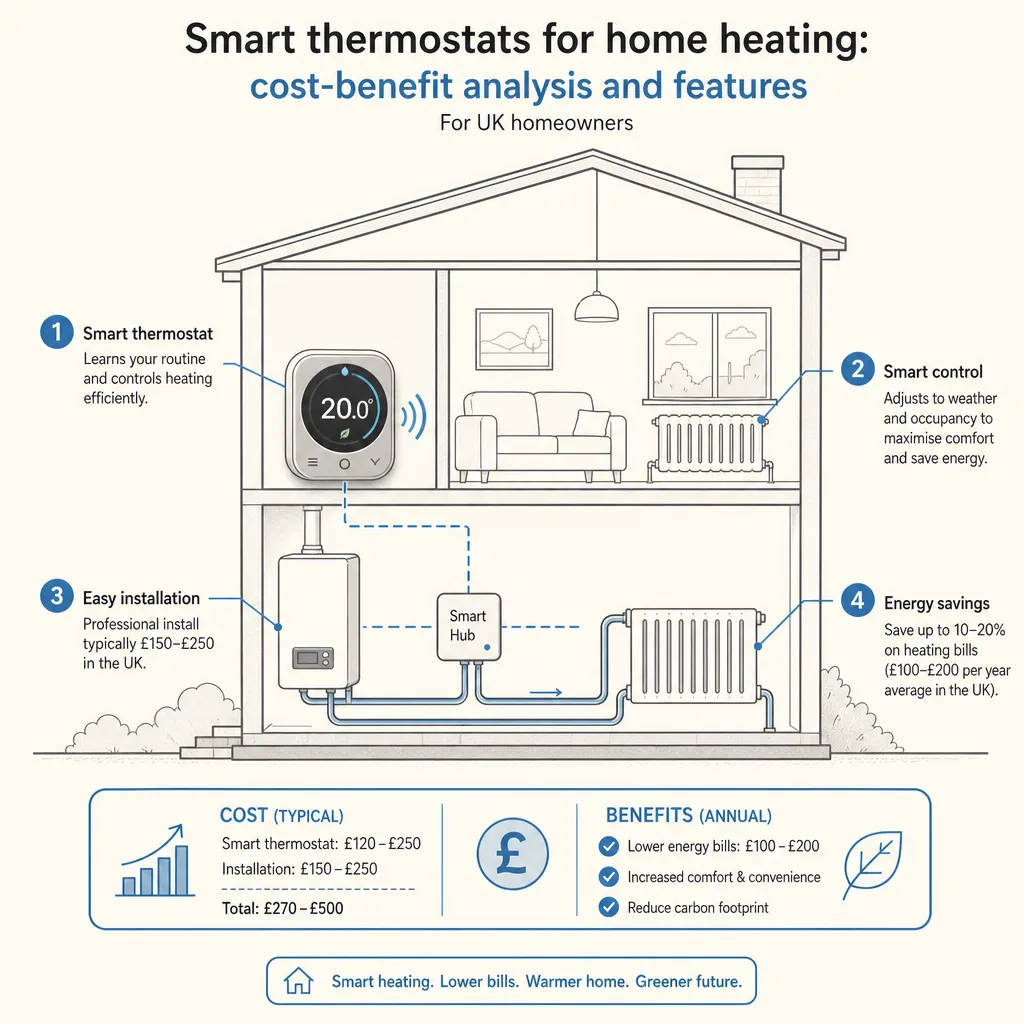
Smart thermostats for home heating: cost-benefit analysis and features
A smart thermostat typically costs £150–£350 installed and can reduce heating bills by 15–25% annually, according to the Energy Saving Trust.
 Energy & Retrofit
Are solar panels worth the investment for your property?
Solar panels can be a worthwhile investment for many UK homeowners, with typical payback periods of 10–15 years and ongoing income from the Smart Export Guarantee.
 Energy & Retrofit
Solar screens for windows: costs and energy-saving benefits
Solar screens for windows are shading systems — external mesh screens, solar control film, or fixed louvres — that reduce solar heat gain and glare.
 Energy & Retrofit
Selecting an Energy-Efficient Boiler for Your Home
For most UK homes, an A-rated condensing combi boiler is the most efficient and space-saving replacement.