Identifying common property defects that impact purchase decisions
By Housey · Last reviewed 31st of May 2026
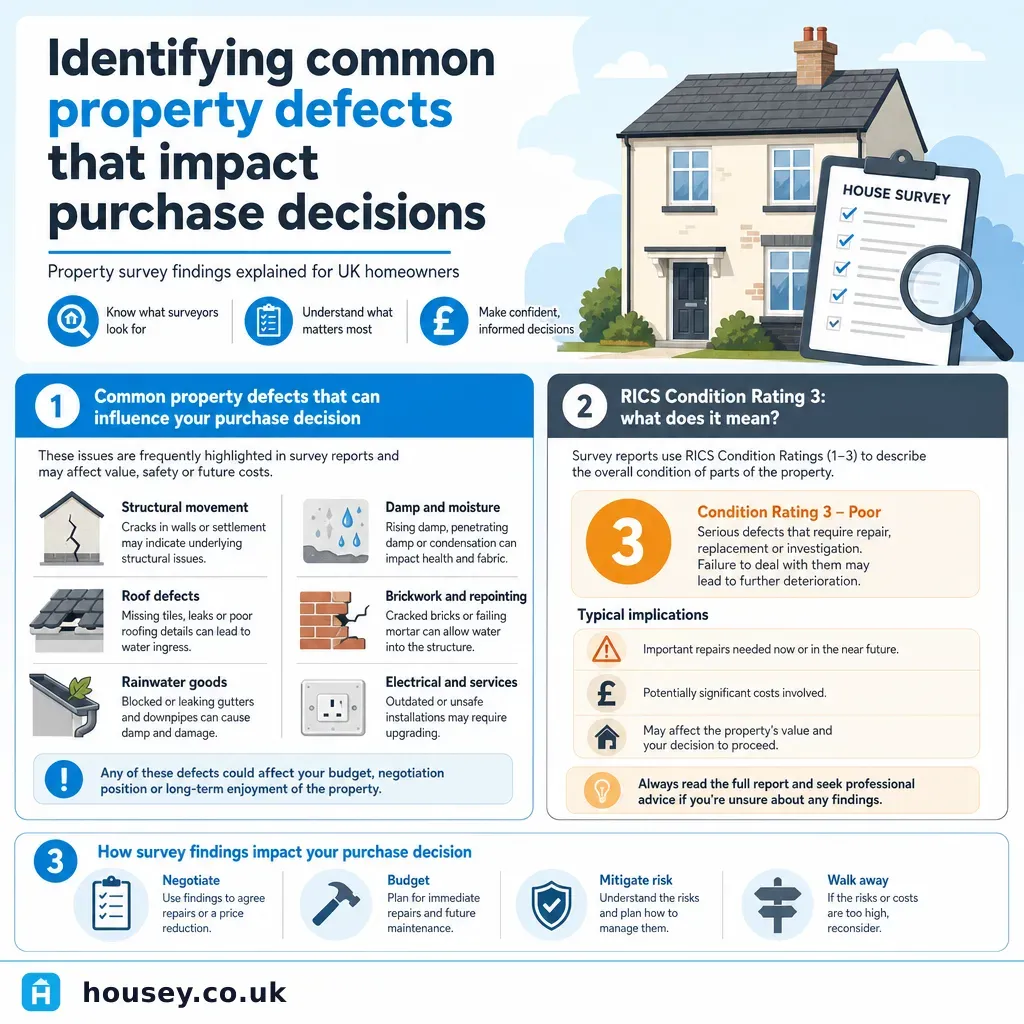
Identifying common property defects that impact purchase decisions
In England and Wales, sellers have no legal duty to volunteer information about known defects beyond responding truthfully to direct enquiries on the TA6 property information form. This places the burden of identifying defects almost entirely on the buyer and their surveyor before exchange. Survey findings can stop a purchase altogether, prompt a renegotiation, or — if ignored — result in repair bills that significantly exceed any saving made at the offer stage. Understanding which defects most commonly affect purchase decisions, what RICS condition ratings mean in practice, and how to respond when a surveyor raises a concern is among the most useful preparation a buyer can do before instructing a valuation.
Key points
- RICS condition ratings in a Home Survey run from 1 (no action currently needed) to 3 (urgent attention or investigation required) — Condition Rating 3 items are those most likely to affect a purchase decision, renegotiation, or mortgage offer.
- Structural movement is the defect most likely to affect mortgage insurability and resale value; crack width, pattern, and whether movement is active or historic all bear on severity — the RICS and BRE classification runs from Category 0 (negligible) to Category 5 (very severe).
- Damp is the most frequently reported defect in UK residential surveys and covers four distinct issues — rising damp, penetrating damp, interstitial condensation, and surface condensation — each requiring different diagnosis and treatment.
- Japanese knotweed within 7m of a structure must be disclosed on the TA6 property information form and can affect mortgage eligibility; lenders differ significantly in their acceptance criteria.
- A RICS Level 3 Building Survey (formerly Full Structural Survey) is generally more appropriate than a Level 2 for properties built before 1919, properties with evident defects, or those with unusual or altered construction.
Which defects most commonly affect UK property purchases?
Not all survey findings change purchase decisions. Many items in a survey report are maintenance issues the buyer is expected to manage over time. The defects that most commonly affect purchase decisions are those with implications for safety, structural integrity, mortgage insurability, or significant ongoing cost.
Common defects by impact on purchase
Defect | Typical RICS rating | Likely impact on purchase | Specialist needed? |
|---|---|---|---|
Active subsidence or significant structural movement | Condition 3 | May affect mortgage offer or insurance; significant remediation cost | Chartered structural engineer |
Rising or penetrating damp with failed or absent DPC | Condition 2–3 | Re-treatment and associated timber repairs may be needed | Damp and timber specialist |
Japanese knotweed within 7m of a structure | Condition 3 | Affects mortgage eligibility; management plan required | Accredited invasive species contractor |
Flat roof at or near end of life | Condition 2–3 | Replacement cost £50–£150/m² (indicative, 2026-05-31) | Roofing contractor |
Electrical installation over 25 years old, no EICR | Condition 2 | Full rewire may be needed (£3,000–£8,000, indicative 2026-05-31) | NICEIC or NAPIT-registered electrician |
Asbestos-containing materials in pre-2000 construction | Condition 2–3 | Depends on condition; management or licensed removal required | Licensed asbestos contractor |
Chimney movement or failed pointing | Condition 2–3 | Collapse risk if severe; repointing or partial rebuilding required | Structural engineer or experienced builder |
Cavity wall insulation failure | Condition 2 | Can cause penetrating damp through the wall; specialist removal may be needed | Specialist cavity wall contractor |
Significant roof covering deterioration | Condition 2–3 | From isolated re-tiling to full replacement depending on extent | Qualified roofing contractor |
Structural defects: what buyers need to know
Structural issues generate more anxiety among buyers than almost any other survey finding — and also the most misunderstanding. Not every crack indicates active movement; equally, not all movement described as historical is inconsequential.
Crack classification (based on RICS and BRE guidance)
Crack width | Category | Practical response |
|---|---|---|
Up to 0.1mm | Category 0 — negligible | Monitor only; no action usually needed |
0.1–1mm | Category 1 — very slight | Redecoration; no structural concern |
1–5mm | Category 2 — slight | Fill and monitor; external repointing may be needed |
5–15mm | Category 3 — moderate | Investigate cause; likely repairable |
15–25mm | Category 4 — severe | Significant repair required; engineering assessment essential |
Over 25mm | Category 5 — very severe | Urgent structural assessment; may require underpinning |
For any crack rated Category 3 or above, or where movement appears active — fresh cracking, sticking doors or windows, stepped cracking through brickwork — a structural survey by a chartered structural engineer (MIStructE or FIStructE) should be obtained before proceeding to exchange.
Important: a RICS Level 2 or Level 3 survey is a visual inspection. It identifies and rates defects but does not constitute a structural engineering assessment. If the surveyor recommends further investigation of structural movement, that means commissioning a separate structural engineer's report — not a second general survey.
What not to assume after a survey
Misreading a survey report is almost as risky as ignoring it. Several common assumptions lead buyers to underestimate or overestimate the significance of a finding.
- Do not assume that a Condition 2 rating is minor — it means the item needs attention, and the cost of that attention can range from £200 to many thousands of pounds.
- Do not assume that a previous damp-proof course treatment has resolved the underlying problem — failed DPC installations are common, and chemical injection does not fix penetrating damp caused by external defects such as failed pointing or overflowing gutters.
- Do not assume that diagonal cracking in brick or render indicates active subsidence — thermal movement, settlement, and shrinkage cracking are all more common causes; only an engineering assessment can confirm whether movement is active.
- Do not assume that a structural engineer's report is included in a RICS survey — it is not; a Level 3 Building Survey is a visual inspection, not a structural engineering analysis.
- Do not assume that the seller is obliged to fix defects before completion — in England and Wales, renegotiation of the purchase price is the usual approach; sellers frequently price in known defects rather than undertake remediation.
Damp: the most frequently flagged survey finding
Damp appears in more UK residential survey reports than any other defect, partly because the term encompasses four distinct problems — rising damp, penetrating damp, interstitial condensation, and surface condensation — each with different causes, costs, and remediation approaches.
Diagnosing the type and cause of damp is essential before any remediation is specified. The Property Care Association (PCA) recommends that buyers obtain an independent damp and timber survey before accepting any remediation quotation, particularly where the general survey has rated damp at Condition 2 or 3.
Steps to take when a survey flags damp:
- Request the surveyor's commentary on the likely cause, not just the location of the reading.
- Commission a specialist damp and timber survey if the finding is rated Condition 2 or 3.
- Obtain at least two remediation quotes; be cautious of quotes specifying chemical DPC injection without first ruling out penetrating damp from external defects.
- Check whether any existing damp-proof course guarantee is in place and whether the issuing company is still trading.
Homeowner checklist: before exchange on a property with survey defects
Important limitations
This article provides general guidance on common property defects in UK residential purchases. Defect severity, cause, and remediation cost vary considerably by property age, construction type, location, and condition. Nothing here constitutes structural, legal, or financial advice. RICS survey condition ratings are assigned by individual surveyors exercising professional judgement — if you disagree with a finding, ask the surveyor to explain their reasoning in writing before making purchase decisions. Rules and processes also differ between England and Wales, Scotland, and Northern Ireland.
When this becomes urgent
Get professional advice before proceeding to exchange when:
- Your survey includes a Condition 3 rating for structural movement, active subsidence, roof failure, or any safety-critical element.
- Your mortgage lender has applied a retention or a condition to the mortgage offer that refers to a specific defect.
- The seller is disputing survey findings without providing a counter-report from a qualified professional.
- Asbestos-containing materials are thought to be in a damaged or disturbed condition — do not instruct any works until a licensed asbestos surveyor has assessed the material in accordance with the Control of Asbestos Regulations 2012.
- Japanese knotweed is identified on or adjacent to the property — confirm your lender's specific acceptance policy before exchanging, as criteria differ significantly between lenders.
- Evidence of active water ingress is found during a revisit or second viewing after the survey was carried out.
What to ask a qualified professional
Before instructing a surveyor or specialist inspector:
- What level of survey do you recommend for this property given its age, construction type, and apparent condition?
- Will you inspect accessible roof spaces, subfloor voids, and outbuildings as part of the survey?
- If you rate an item Condition 3, will your report include guidance on the likely cause, indicative remediation cost, and which type of specialist to instruct?
- For a specific defect or structural survey: is your report in a format acceptable to mortgage lenders, and will it include estimated costs?
- Are you RICS-registered, and can you confirm your professional indemnity insurance is current?
- For damp and timber surveys: are you independent of any treatment company, and do you receive referral fees for recommending remediation contractors?
When to get professional help
A RICS Home Survey is the starting point for most residential purchases, but a general survey does not always provide sufficient detail for every situation. Consider a specialist survey when:
- The property is pre-1919 with solid-wall construction, original drainage infrastructure, or a history of significant alterations — a RICS Level 3 Building Survey is generally preferable to a Level 2 in these cases.
- The surveyor notes defects they cannot fully assess visually and explicitly recommends further investigation.
- You are purchasing at auction with limited time — a specific defect survey on the most concerning element is often more actionable than a full general survey in this context.
How Housey can help
Whether you need a RICS Home Survey before exchange, a structural survey to properly assess movement flagged in a Level 2 report, or a specialist damp and timber survey to diagnose a survey finding and obtain an independent remediation assessment, Housey connects buyers with qualified surveyors and inspectors across the UK.
Frequently asked questions
Should I pull out of a purchase if the survey finds damp?
Not automatically. Damp is very common in UK property and many cases result from straightforward maintenance failures — blocked gutters, failed pointing, inadequate sub-floor ventilation — rather than deep-seated structural defects. A specialist damp and timber survey will identify the cause and indicative remediation cost. Where remediation is genuinely needed, a price renegotiation is usually more practical than withdrawing, unless the cost is disproportionate to the property value.
What is the difference between a RICS Level 2 and Level 3 survey for identifying defects?
A RICS Level 2 Home Survey is a visual inspection of accessible areas that identifies and rates defects but does not investigate causes in depth. A RICS Level 3 Building Survey involves a more detailed inspection, greater commentary on construction and defect causes, and is generally more appropriate for older, significantly altered, or non-standard properties. Neither replaces a structural engineer's report for properties showing evidence of movement.
Can I use survey findings to renegotiate the purchase price?
Yes. Survey findings that reveal defects the seller did not disclose, or was unaware of, are routinely used to renegotiate the purchase price or ask the seller to carry out repairs before completion. There is no legal obligation on the seller to agree, but most sales involving significant defect findings result in some form of renegotiation. Your solicitor can advise on how to frame enquiries and any reduction request appropriately.
Does a mortgage valuation check for defects?
No. A mortgage valuation is carried out for the lender's purposes and assesses only whether the property provides adequate security for the loan amount. It will not systematically identify defects or comment on condition in the way a RICS survey does. You should always commission a separate RICS Home Survey for your own protection — the two are not interchangeable.
Sources and further reading
- RICS Home Survey Standard (2019) — RICS
- GOV.UK: Buying or selling your home — GOV.UK
- Property Care Association: Diagnosing damp — Property Care Association
- Electrical Safety First: Electrical safety in the home — Electrical Safety First
- Citizens Advice: Surveys when buying a home — Citizens Advice
Useful next reads
 Surveys & Inspections
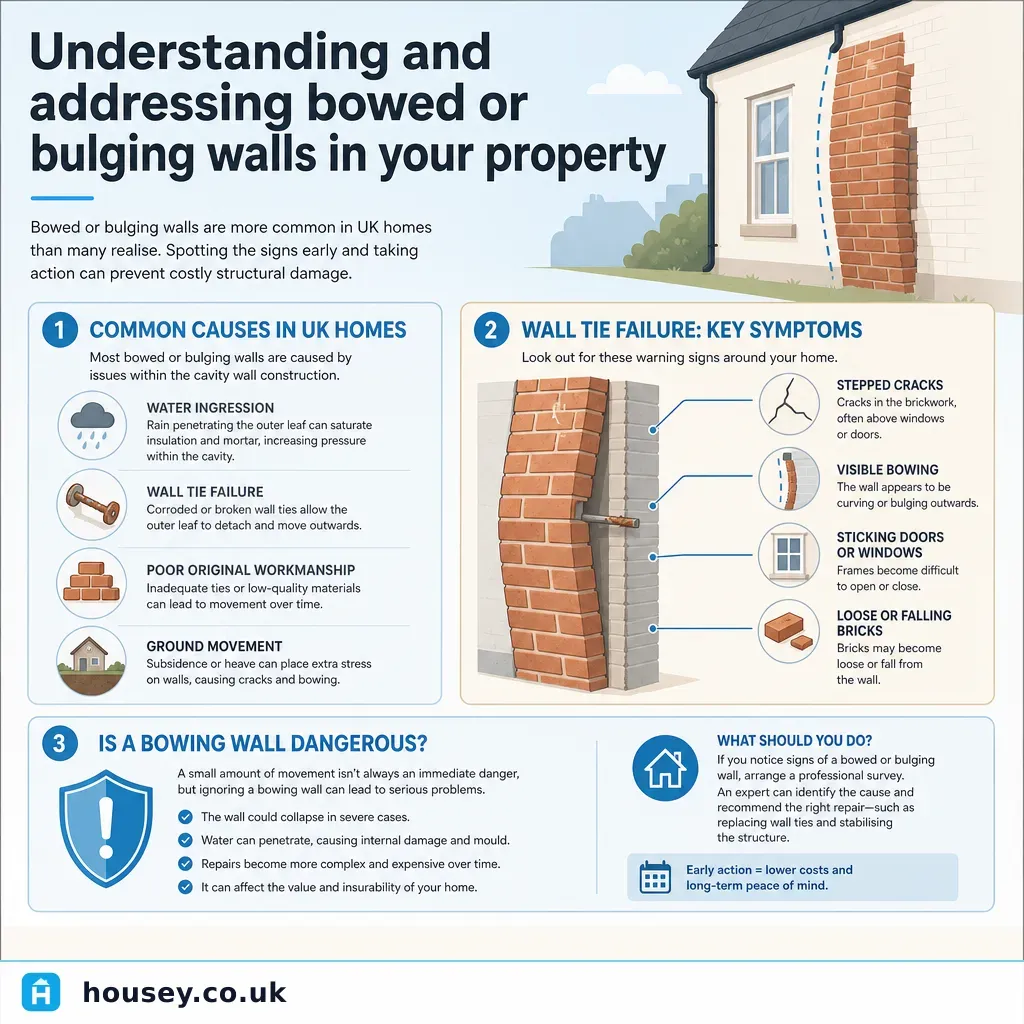
Understanding and addressing bowed or bulging walls in your property
A bowed or bulging wall may indicate wall tie failure, foundation movement, or overloading.
 Surveys & Inspections
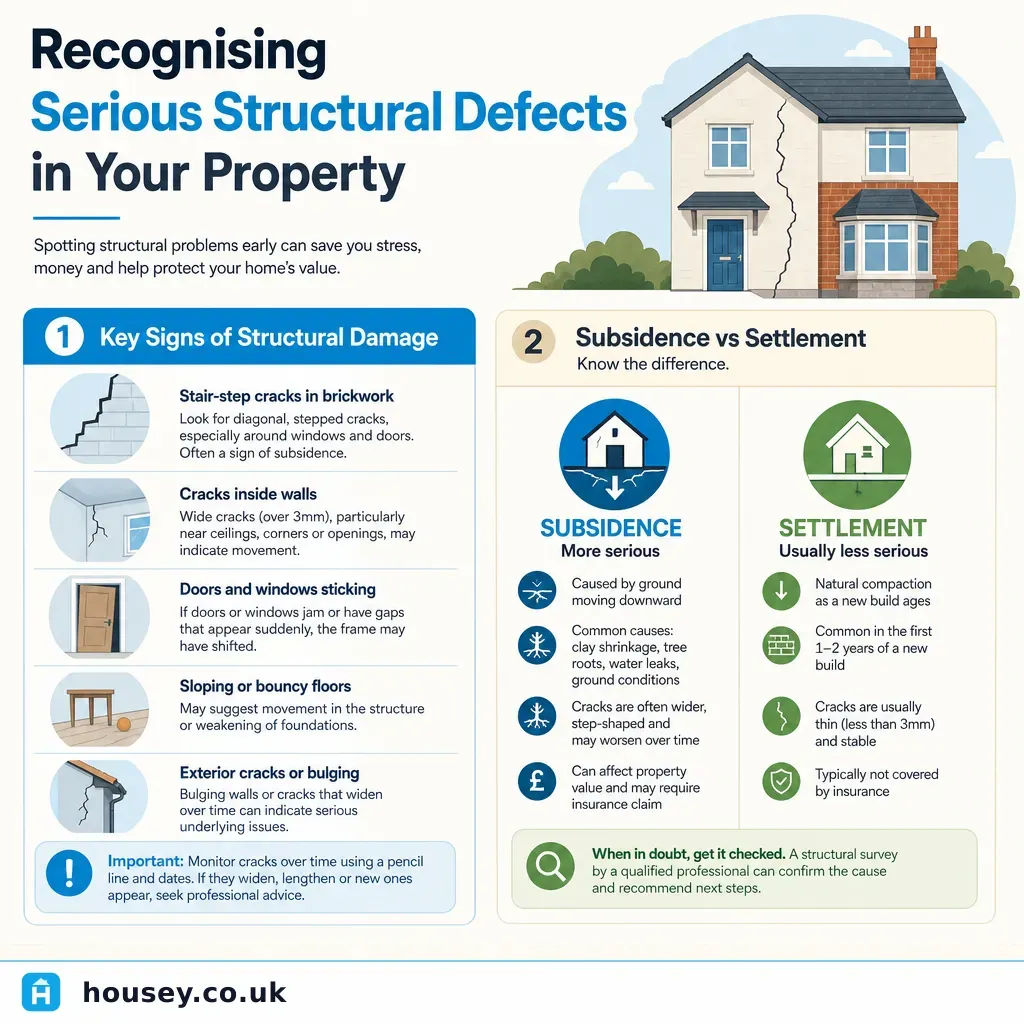
Recognising Serious Structural Defects in Your Property
Serious structural defects in UK homes include wide or diagonal cracks through brickwork, bowing or leaning walls, a sagging roof ridge, and floors or door frames notably out of level.
 Surveys & Inspections
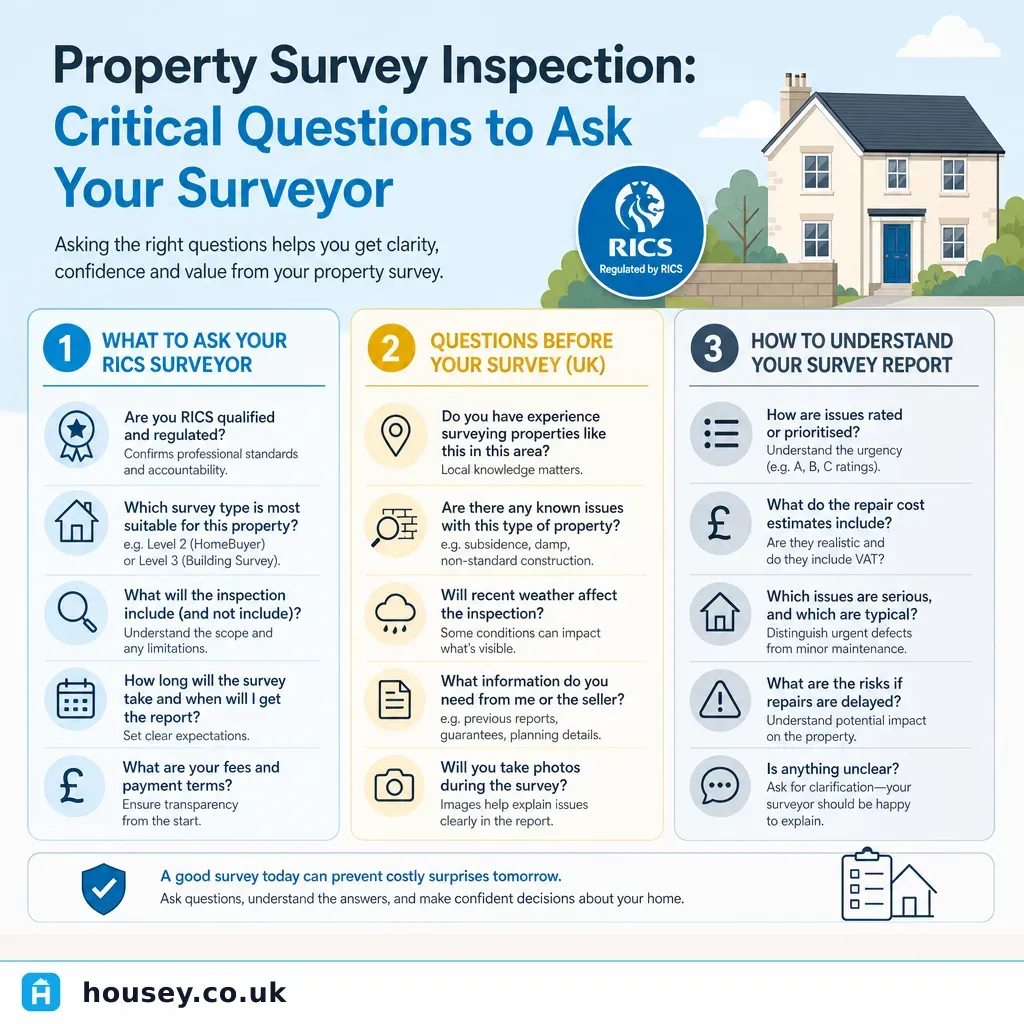
Property Survey Inspection: Critical Questions to Ask Your Surveyor
Before instructing a surveyor, ask which RICS level suits your property and what the report will and will not cover.
 Surveys & Inspections
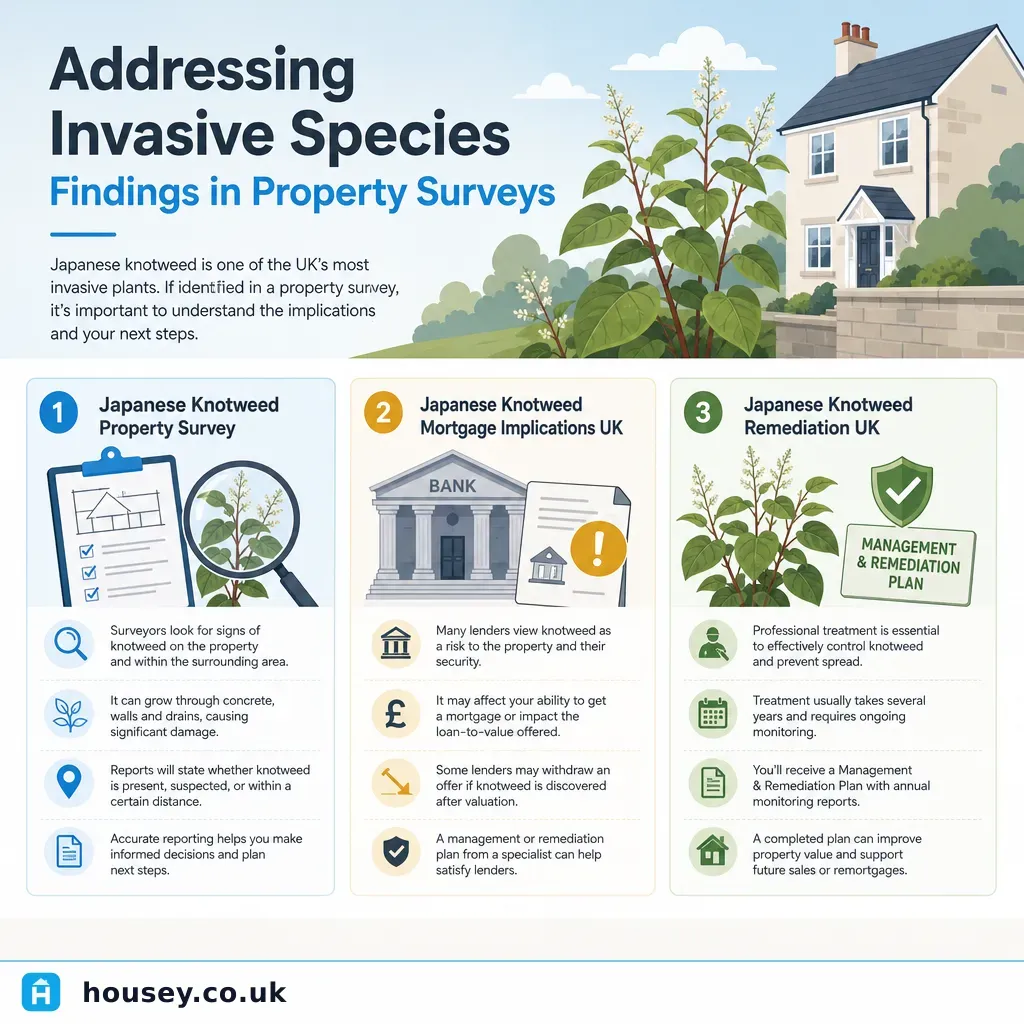
Addressing Invasive Species Findings in Property Surveys
If a property survey flags an invasive species such as Japanese knotweed, you should commission a specialist ecological or knotweed survey to confirm the extent and obtain a management plan.
 Surveys & Inspections
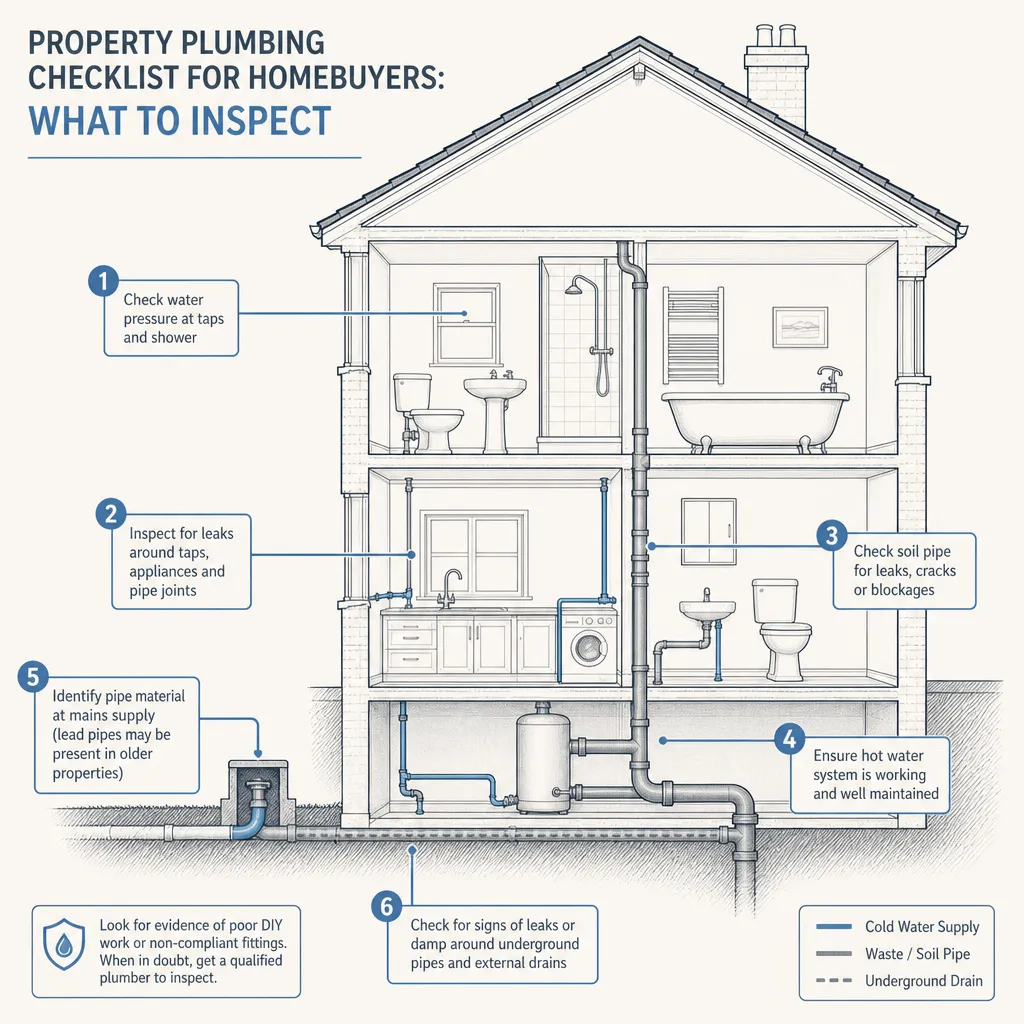
Property Plumbing Checklist for Homebuyers: What to Inspect
Before exchanging on a UK property, check water pressure at multiple outlets, look for signs of damp or staining around pipes, confirm whether any lead pipework remains, inspect the boiler age and service history, and ask your surveyor about drainage.