Identifying When Your House Needs Electrical Rewiring
By Housey · Last reviewed 11th of May 2026
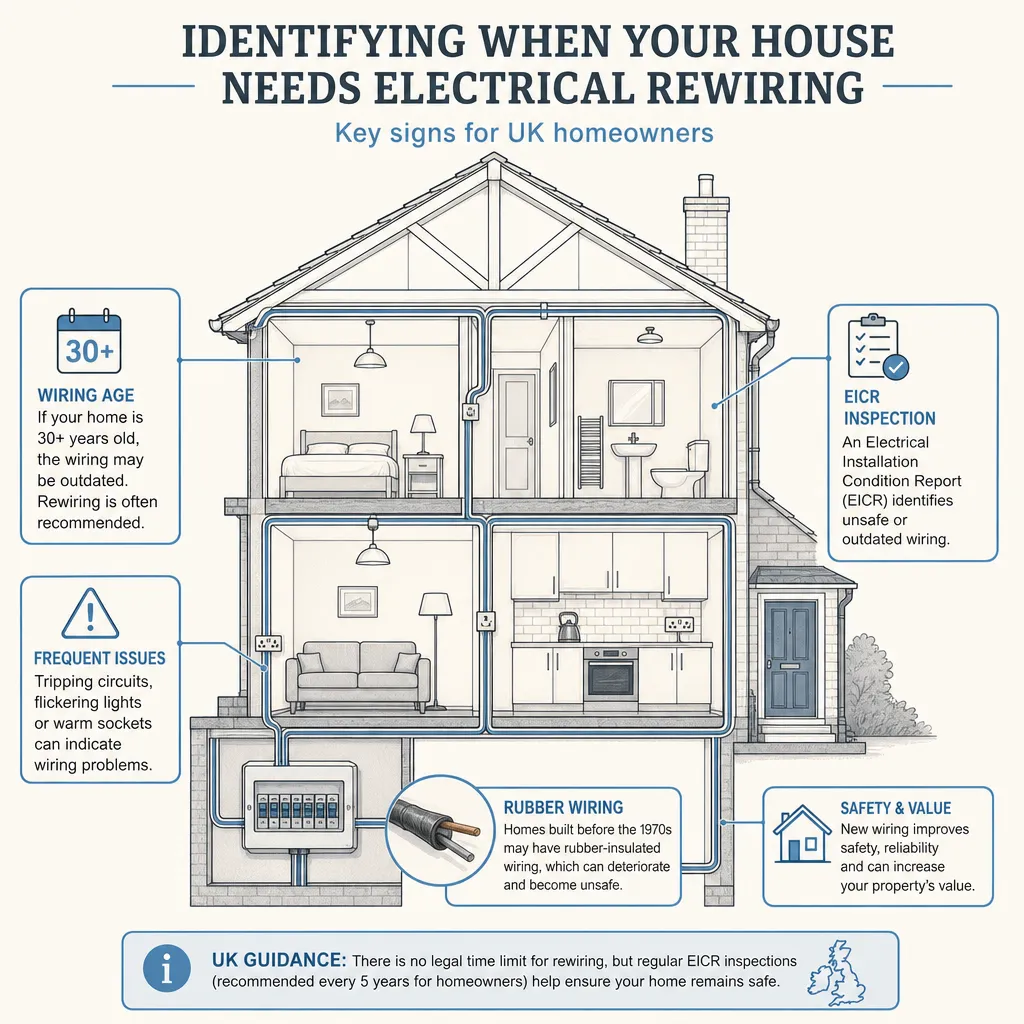
Identifying When Your House Needs Electrical Rewiring
UK homes built before the mid-1960s often carry wiring that was designed for a fraction of today's electrical demand — and age alone is not always visible to the untrained eye. Whether you are buying a Victorian terrace, renovating a 1950s semi, or noticing recurring faults in your current home, understanding the state of your electrical installation is a safety matter, not merely a convenience one. Electrical faults remain one of the leading causes of accidental domestic fires in the UK, and an ageing installation may give no obvious warning until a fault occurs.
Key points
- Wiring installed before approximately 1966 using rubber-insulated cables or aluminium conductors is likely at or beyond the end of its safe service life.
- An Electrical Installation Condition Report (EICR) is the formal mechanism for assessing an installation — codes C1 (immediate danger), C2 (potentially dangerous), and C3 (improvement recommended) guide the urgency of any remedial work.
- Under the Electrical Safety Standards in the Private Rented Sector (England) Regulations 2020, private landlords must have an EICR carried out every five years or at the start of each new tenancy.
- Building Regulations Part P requires that notifiable electrical work in dwellings is either carried out by a registered competent-person scheme member (NICEIC, NAPIT, ELECSA) or notified to the local authority building control.
- Round-pin sockets, Bakelite fittings, the absence of residual current devices (RCDs), and a fuse-board with rewirable fuses are each indicators of an ageing installation.
How old is too old? Understanding the age of your wiring
Electrical wiring does not carry a universal expiry date, but age and cable type are strong proxies for risk. The table below shows the main wiring generations found in UK homes and their associated risk profiles.
Wiring era | Cable type | Risk profile |
|---|---|---|
Pre-1966 | Rubber-insulated, often with a fabric outer sheath | Rubber degrades over time, becoming brittle and prone to cracking — high risk of arcing and fire |
1966–1977 | PVC-insulated; some aluminium conductors in flats | Generally safer if undisturbed, but may lack RCD protection and modern earthing arrangements |
1977–2004 | PVC-insulated copper with improved earthing | Often serviceable with targeted upgrades; check consumer unit type and RCD provision |
2004–present | Harmonised colours (brown/blue/green-yellow), modern consumer units | Likely compliant if professionally installed; verify condition with a periodic EICR |
A registered electrician conducting an EICR will identify which cable generation is present and assess its physical condition alongside the circuit design, earthing arrangements, and RCD protection.
Red flags: warning signs that warrant a professional inspection
The following signs each warrant a prompt EICR or assessment by a registered electrician. Any single one is sufficient reason to act without delay — professional diagnosis, not self-assessment, is the appropriate response.
- Discoloured, scorched, or cracked sockets and light switches
- A persistent burning smell with no obvious source
- Flickering or dimming lights unrelated to the mains supply
- Repeated tripping of circuit breakers or RCDs, especially on a single circuit
- Sparks when plugging in appliances
- Hot plugs, faceplates, or light fittings
- A fuse-board with ceramic rewirable fuses rather than modern MCBs and RCDs
- No RCD protection visible at the consumer unit
- Round-pin sockets (indicating pre-1970s wiring)
- Sockets or light fittings with a Bakelite or cast-iron appearance
- Mixed wiring visible in the loft — rubber-insulated cables running alongside newer PVC
Full rewire, partial rewire, or targeted repairs?
Not every ageing installation requires a complete rewire. An EICR will assign condition codes that indicate the urgency of any action required:
- C1 — Danger present: Requires immediate action; the inspector may recommend disconnecting the affected circuit.
- C2 — Potentially dangerous: Remedial work required before the installation can be formally certified as satisfactory.
- C3 — Improvement recommended: Not immediately dangerous, but should be addressed.
- FI — Further investigation required: The inspector cannot determine the full condition without additional testing.
Deciding which action is appropriate
- Choose targeted remedial work if: the installation is broadly post-1966 PVC-insulated copper, RCD protection can be added at the consumer unit, and the EICR codes are C3 only.
- Consider a partial rewire if: one or two circuits are degraded (such as the kitchen ring main or upstairs lighting) but the majority of the installation is sound.
- Plan a full rewire if: the installation contains rubber-insulated cables, there is no earthing at sockets, the fuse-board is a rewirable type with no MCBs, or multiple C1 or C2 codes are issued.
- Seek professional input before exchange if: you are buying a pre-war property and no EICR is available from the vendor — ask your conveyancer to request one.
What a rewire involves and what it costs
A full domestic rewire typically takes 5–10 days for a 3-bedroom house. All circuits are replaced from the consumer unit outward: lighting, ring mains, cooker, shower, and any outdoor circuits. Walls and ceilings may need to be chased or lifted to run new cables, and some decorative reinstatement should be included in the project budget.
Indicative UK costs, last reviewed 2026-05-11: a full rewire of a 3-bedroom semi typically ranges from £3,000 to £6,000 depending on property size, circuit count, and access difficulty. Costs vary significantly by region; always obtain at least three quotes from registered electricians. Source: NICEIC guidance; costs vary by region and scope.
After completion, the electrician must issue a Building Regulations Completion Certificate if work was notified to building control, or an Electrical Installation Certificate for works self-certified under a Part P competent-person scheme.
Important limitations
This article provides general information about electrical wiring age and condition indicators only. It is not a substitute for a formal Electrical Installation Condition Report (EICR) carried out by a qualified, registered electrician. The condition of any individual installation depends on its specific history, prior modifications, and maintenance — two homes of the same age can have very different risk profiles. Do not attempt to inspect, modify, or repair electrical wiring yourself. Electrical work in dwellings is subject to Building Regulations Part P and must be carried out or notified by a competent person.
What to ask a qualified professional
Before instructing an electrician or EICR inspector, ask:
- Are you registered with a Part P competent-person scheme (NICEIC, NAPIT, ELECSA, or equivalent)?
- Will the inspection cover the full installation, including the consumer unit, all circuits, earthing, and bonding?
- What will you do if you find a C1 code during the inspection?
- Will you provide a written EICR certificate with all condition codes clearly listed and explained?
- If remedial work is needed, will you quote separately for targeted repairs and for a full rewire?
- Is VAT included in your quote?
- Will a Building Regulations notification and completion certificate be issued for any remedial work carried out?
When to get professional help
Arrange a professional electrical inspection immediately if you notice a burning smell, experience a shock from a socket or switch, or observe scorch marks on any electrical fitting. Do not wait for a routine check — turn off the affected circuit at the consumer unit if you can safely identify it, and contact a registered electrician urgently.
For properties being bought or sold, request an EICR as part of the conveyancing process if one is not already available from the vendor.
How Housey can help
Housey can connect you with registered electricians in your area who carry out Electrical Installation Condition Reports (EICR). If your property requires remedial work or a full rewire that needs building control sign-off, our building regulations drawings service can help you prepare the necessary documentation.
Frequently asked questions
How often should a domestic EICR be carried out?
For owner-occupiers, RICS and electrical bodies recommend an EICR every 10 years or on change of occupancy. Private landlords in England must have one every five years or at the start of each tenancy under the Electrical Safety Standards in the Private Rented Sector (England) Regulations 2020. For homes with known ageing wiring, more frequent checks may be appropriate.
Can I sell a house with old wiring?
Yes — there is no legal requirement to rewire before selling. However, a buyer's survey or EICR may flag the condition, and some mortgage lenders may require remedial work before lending. Having an up-to-date EICR available to share with buyers can support the sale and reduce delays during conveyancing.
Does a rewire need building regulations approval?
Yes. A full rewire is notifiable under Building Regulations Part P. The electrician must be registered with a Part P competent-person scheme such as NICEIC or NAPIT, who can self-certify, or notify the local authority building control before works begin. An Electrical Installation Certificate must be issued on completion.
What is the difference between an EICR and a Periodic Inspection Report?
They refer to the same inspection. The current industry-standard term is Electrical Installation Condition Report (EICR); 'Periodic Inspection Report' was the older terminology used before BS 7671:2008. The EICR assesses the installation against the current IET Wiring Regulations (BS 7671:2018+A2:2022).
Sources and further reading
- Electrical Safety Standards in the Private Rented Sector (England) Regulations 2020 — legislation.gov.uk
- Building Regulations Approved Document P — Electrical safety in dwellings — GOV.UK
- NICEIC consumer guidance on EICRs — NICEIC
- IET Wiring Regulations BS 7671 — IET
- Electrical Safety First — homeowner guidance — Electrical Safety First
Useful next reads
 Surveys & Inspections
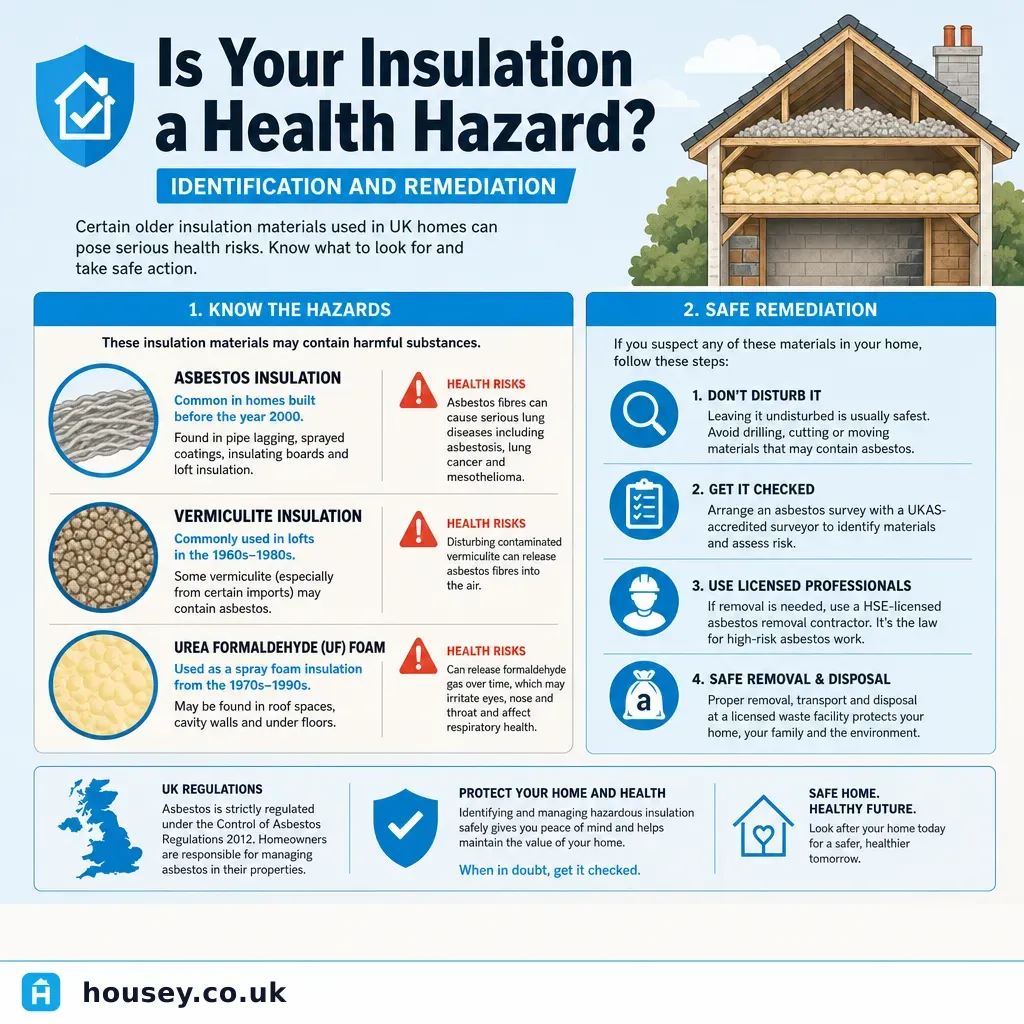
Is Your Insulation a Health Hazard? Identification and Remediation
Some insulation materials in pre-2000 UK homes may pose genuine health risks.
 Surveys & Inspections
Identifying Asbestos Insulation: What You Need to Know for Your Property
Asbestos insulation was widely used in UK properties built before 2000, commonly found in pipe lagging, ceiling tiles, loose-fill loft insulation, and around boilers.
 Surveys & Inspections
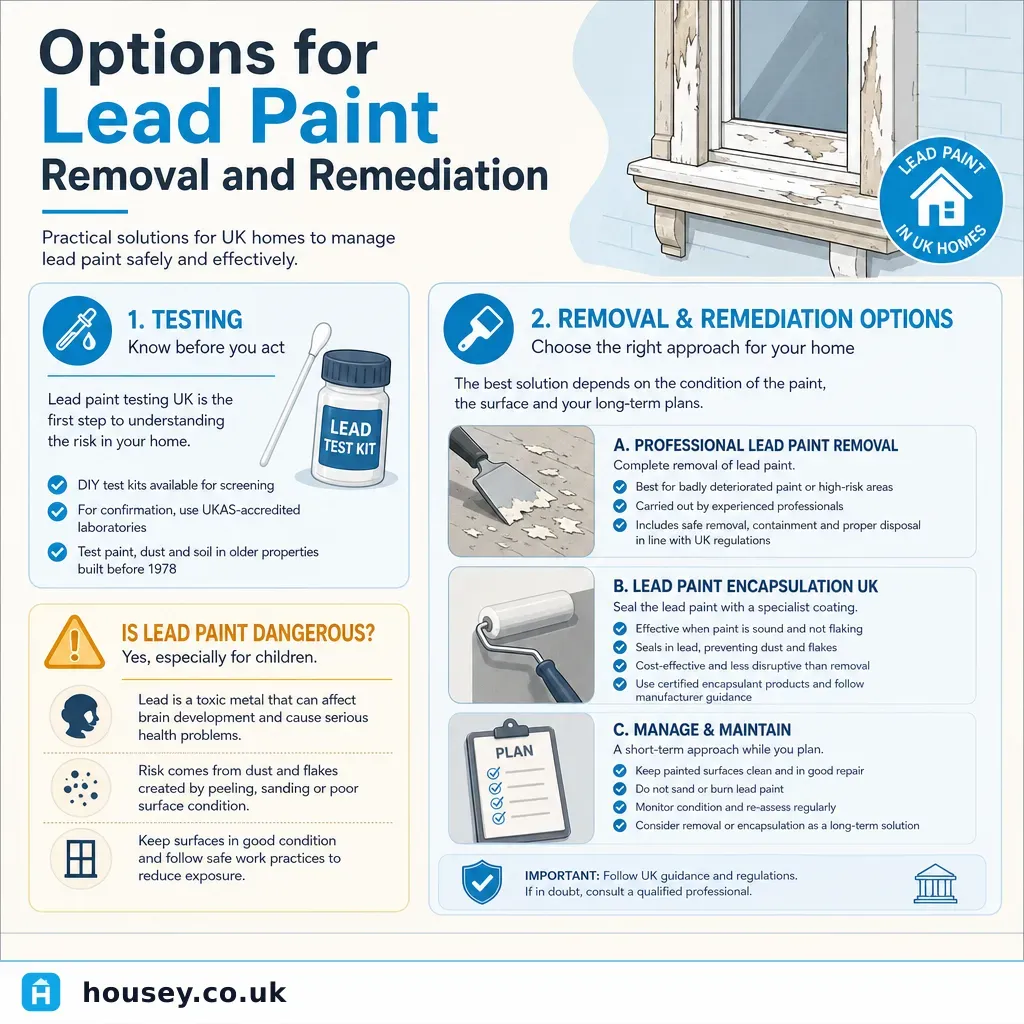
Options for Lead Paint Removal and Remediation
Lead paint in UK homes built before 1960 is common and not automatically hazardous if in good condition.
 Surveys & Inspections
House Survey Guide: Types and What to Expect
UK house surveys come in three RICS-standardised levels: Level 1 (Condition Report) for new or near-new homes, Level 2 (Home Survey) for conventional post-war properties, and Level 3 (Building Survey) for older, altered, or defective properties.
 Surveys & Inspections
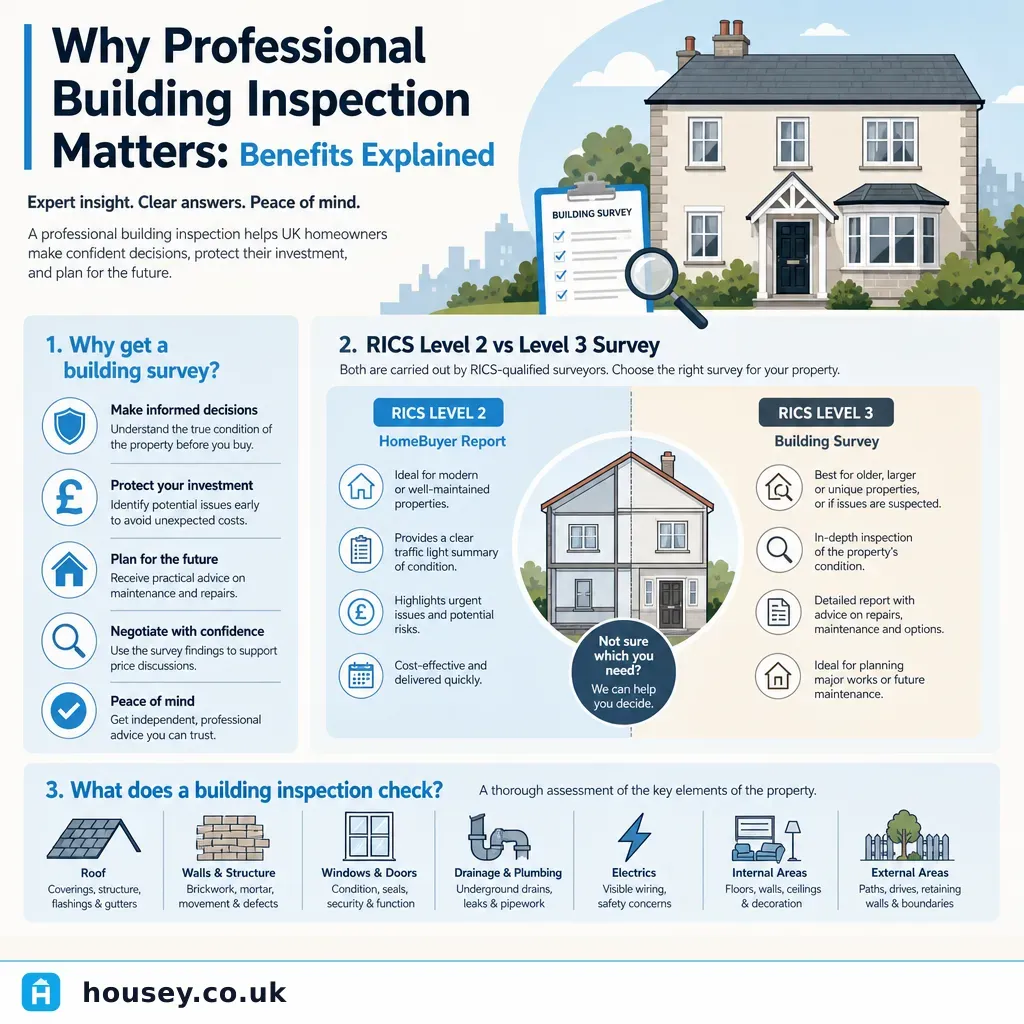
Why Professional Building Inspection Matters: Benefits Explained
Professional building inspection gives UK homeowners an independent, expert view of a property's condition and regulatory compliance.