Reducing Energy Consumption: Practical Thermal Efficiency Upgrades for Lower Bills
By Housey · Last reviewed 18th of May 2026
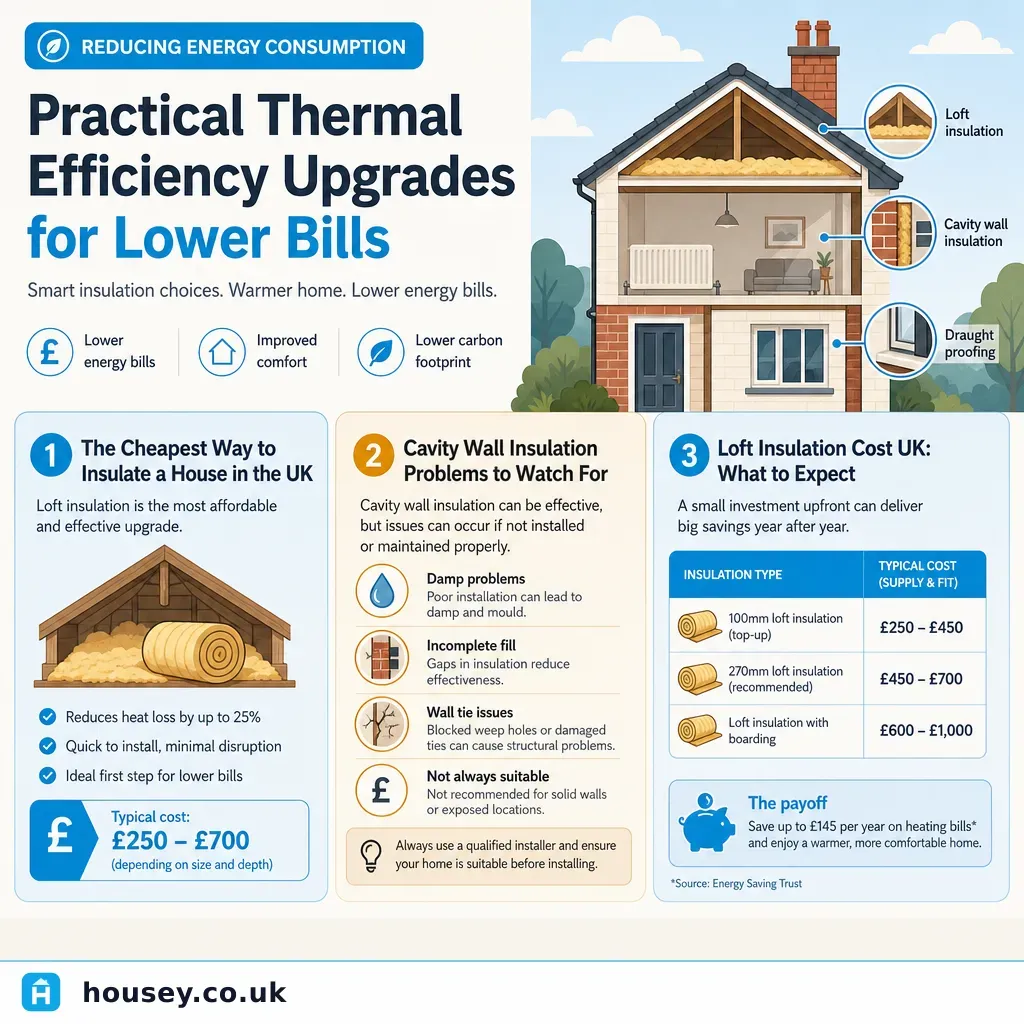
Reducing Energy Consumption: Practical Thermal Efficiency Upgrades for Lower Bills
Energy prices in Great Britain have remained volatile since 2021, and many homeowners are now revisiting what thermal improvements they can make to reduce long-term heating costs. Whether you own a 1930s semi with an uninsulated cavity wall or a Victorian terraced house with solid walls, the sequence in which you tackle thermal upgrades matters — addressing draughts before insulation, and understanding your wall type before specifying any measure, can mean the difference between a well-performing home and one that develops moisture problems. With government funding available through ECO4 and the Great British Insulation Scheme, and a range of measures available depending on your property type, knowing where to start and what to check before commissioning work can save both money and disruption.
Key points
- Loft insulation topped up to 270 mm is typically the most cost-effective single thermal upgrade, with payback periods of 2–4 years for homes with little or no existing insulation.
- Cavity wall insulation is unsuitable for some wall constructions and high-exposure zones — a professional assessment under PAS 2035:2023 is recommended before installation.
- Building Regulations Approved Document L sets minimum U-values for replacement elements: 1.2 W/m²K for windows, 0.18 for walls, 0.16 for roof elements, and 0.18 for ground floors.
- ECO4 and the Great British Insulation Scheme (GBIS) offer government-funded insulation measures for eligible households — eligibility depends on income, EPC rating, and property type.
- Draught-proofing all gaps at doors, windows, letterboxes, and suspended timber floors is the cheapest first step and carries no risk of moisture interaction with the building fabric.
Where does heat escape from a typical UK home?
Understanding where heat is lost helps prioritise spend. The Energy Saving Trust's heat-loss breakdown for an unimproved three-bedroom semi-detached house suggests approximately:
- 25–30% through the roof
- 25–35% through walls
- 15–20% through windows and doors
- 10–15% through the floor
- 10–20% through air leakage (draughts)
These figures vary substantially with property age, construction, and existing insulation. A 1970s cavity-wall house that already has original cavity fill may lose most heat through its windows and floor; a solid-wall Victorian terrace may lose the majority through its walls. An insulation assessment can identify the main loss areas before you commit to expenditure.
Which thermal upgrade should you tackle first?
Decision guide
- Start with draught-proofing if your home has obvious draughts at skirting boards, suspended timber floors, letterboxes, or around sash windows — this is low-cost, low-risk, and reduces heating demand before investing in insulation.
- Tackle loft insulation first if your loft has less than 100 mm of existing insulation or none at all — this offers the fastest payback and greatest comfort improvement in most property types.
- Assess cavity wall insulation if your home was built between approximately 1930 and 1995 and does not already have cavity fill — but always commission a professional assessment first.
- Consider solid wall insulation if your home has solid walls (likely pre-1930) and you are planning significant internal refurbishment or external render renewal — this is a more disruptive and costly measure with longer payback periods.
- Address windows and doors after the above — double glazing improves comfort but typically has a payback period of 20 or more years as a standalone measure.
- Consult a retrofit coordinator if you are planning multiple measures, applying for ECO4 or GBIS funding, or have a pre-1919 solid-wall property — PAS 2035:2023 requires a whole-house retrofit assessment before funded measures are installed.
Loft insulation: the first measure for most homes
For most homes with a pitched roof and accessible loft, insulating to 270 mm costs approximately £300–£500 for a typical three-bedroom house (Indicative UK costs, last reviewed 2026-05-18; quotes vary — contact installers for current pricing). Where less than 100 mm is already present, the Energy Saving Trust estimates savings of around £150–£300 per year on heating bills, though savings depend on property size, heating fuel type, and occupancy.
Key considerations:
- If your loft is used as habitable space (converted), insulation goes between and over the rafters rather than at joist level — costs and thermal performance differ.
- Ensure adequate roof ventilation is maintained when installing or topping up insulation to prevent condensation build-up at the eaves.
- Accessible loft insulation in eligible properties may be funded under ECO4 or GBIS. Check eligibility at GOV.UK: Great British Insulation Scheme.
Cavity wall insulation: assess before you install
Cavity wall insulation has transformed thermal performance in millions of UK homes since the 1980s, but it is not appropriate for every property. Incorrectly installed cavity fill in a high-exposure zone, or a wall with existing defects, can cause moisture to bridge across the wall, leading to damp and mould internally.
Before specifying cavity wall insulation:
- Confirm your cavity has not already been filled — a surveyor or thermal imaging survey can confirm this.
- Check wall exposure rating — properties in high-exposure wind-driven rain zones (much of western Britain, Scotland, and coastal areas) are more susceptible to moisture ingress after cavity fill.
- Inspect brickwork for cracks, spalled pointing, or signs of existing damp — these must be resolved before installation.
Under ECO4, all funded insulation measures must follow PAS 2035:2023 — the publicly available specification for retrofit — which requires a qualified Retrofit Assessor to evaluate the property before installation. This protects homeowners from poorly specified or inappropriate installs.
Insulation options comparison
Measure | Typical wall type | Indicative cost (3-bed semi) | Funding availability | Key risk |
|---|---|---|---|---|
Loft insulation | All | £300–£500 | ECO4, GBIS | Eaves ventilation blockage |
Cavity wall insulation | 1930–1995 cavity wall | £500–£1,500 | ECO4, GBIS | Moisture bridging if wall defective |
Internal wall insulation (IWI) | Pre-1920 solid wall | £8,000–£15,000 | ECO4 (limited) | Room size loss, cold bridging at junctions |
External wall insulation (EWI) | Pre-1920 solid wall | £10,000–£20,000 | ECO4 (limited) | Planning permission may be needed |
Underfloor insulation | Suspended timber floor | £500–£1,800 | Limited | Ventilation below floor must be maintained |
Double glazing | All | £400–£700 per window | Limited | Long payback as standalone measure |
Indicative UK costs, last reviewed 2026-05-18. Costs vary significantly by property size, access, and region. Obtain multiple quotes.
Government funding: ECO4 and the Great British Insulation Scheme
Two active government schemes can significantly reduce the cost of thermal upgrades for eligible households:
ECO4 (Energy Company Obligation 4): Delivered by major energy suppliers, ECO4 funds insulation and heating measures for households on qualifying income-related benefits, or low-income households in homes with an EPC rating of D, E, F, or G. Works must be designed and installed to PAS 2035. Apply through your energy supplier or a TrustMark-registered installer.
Great British Insulation Scheme (GBIS): Open to homes with EPC ratings of D or below (or D–G for lower-income households). GBIS funds a single primary insulation measure per property. Apply via GOV.UK: Great British Insulation Scheme.
Both schemes require TrustMark-registered installers. Ensure any installer you use holds the relevant accreditations before agreeing to funded work.
Draught-proofing: the overlooked first step
Draught-proofing is consistently underrated relative to its cost-effectiveness. The Energy Saving Trust estimates that professionally draught-proofing all windows, doors, and other gaps can save £45–£65 per year. For a suspended timber floor with significant gaps at the skirting, savings can be higher.
High-priority locations:
- Gaps around sash window pulleys and meeting rails
- Letterboxes (fit an internal brush plate or flap)
- Keyhole covers
- Gaps between floor and skirting board, particularly in pre-1960s properties with suspended timber floors
- Loft hatch — often uninsulated and a significant heat-loss point
- Unused fireplace openings (use a chimney balloon rather than a permanent seal, to maintain some ventilation)
When to get professional help
Draught-proofing and topping up accessible loft insulation are tasks many homeowners can carry out themselves. Everything else on the thermal upgrade list benefits from professional assessment and installation.
Seek professional help when:
- You are unsure of your wall construction type (cavity, solid, or previously filled).
- You have any existing damp, condensation, or mould — installing insulation over an existing moisture problem may trap it and worsen damage.
- You want to access ECO4 or GBIS funding — PAS 2035 compliance requires a qualified Retrofit Assessor before works begin.
- You are in a listed building or conservation area — solid wall insulation or window replacement may require listed building consent or prior approval.
- You have a pre-1919 solid-wall property — moisture management is more complex and requires specialist retrofit advice.
How Housey can help
Housey connects homeowners with accredited energy-efficiency consultants who can advise on the right sequencing of measures for your property, vetted insulation installers for cavity, loft, and wall insulation, and professionals offering insulation assessments to evaluate your home before any work starts.
Frequently asked questions
What is a U-value and why does it matter for insulation?
A U-value measures how quickly heat passes through a building element — the lower the number, the better the insulation. Building Regulations Part L sets target U-values for replacement elements: 1.2 W/m²K for windows, 0.18 for walls, 0.16 for roofs, and 0.18 for ground floors. Checking U-values when comparing insulation products or proposals allows a meaningful like-for-like comparison.
Is cavity wall insulation always suitable for older houses?
No. Cavity wall construction became common from the early 1930s and was standard by the 1960s. Properties with narrow cavities, defective masonry, or in high wind-driven rain exposure zones may not be suitable for cavity fill. A pre-installation survey by a qualified assessor is essential — under ECO4, this is mandatory before funded work can proceed.
Can I get a grant for solid wall insulation?
Solid wall insulation can be funded under ECO4 for eligible households, though it is less commonly available than loft or cavity wall funding. The GBIS does not typically cover solid wall measures. Contact a TrustMark-registered retrofit installer or assessor to check current eligibility for your property and location.
Will thermal upgrades improve my EPC rating?
Yes — loft insulation, cavity wall insulation, and other measures directly affect the modelled EPC score. Improving from an E to a C rating can make a property easier to let under current minimum EPC regulations, may improve resale value, and can affect mortgage rates from lenders offering green mortgage products.
Do I need planning permission for external wall insulation?
External wall insulation is usually permitted development for houses, but not for flats, listed buildings, or properties in conservation areas subject to Article 4 Directions. Always confirm with your local planning authority before instructing installation — enforcement notices can require removal at the owner's cost.
Sources and further reading
- Energy Saving Trust: insulation — Energy Saving Trust
- Great British Insulation Scheme — GOV.UK
- Energy Company Obligation (ECO4) — GOV.UK
- PAS 2035:2023 retrofitting dwellings — BSI Group
- Approved Document L: conservation of fuel and power — GOV.UK
- Draught-proofing — Energy Saving Trust
Useful next reads
 Energy & Retrofit
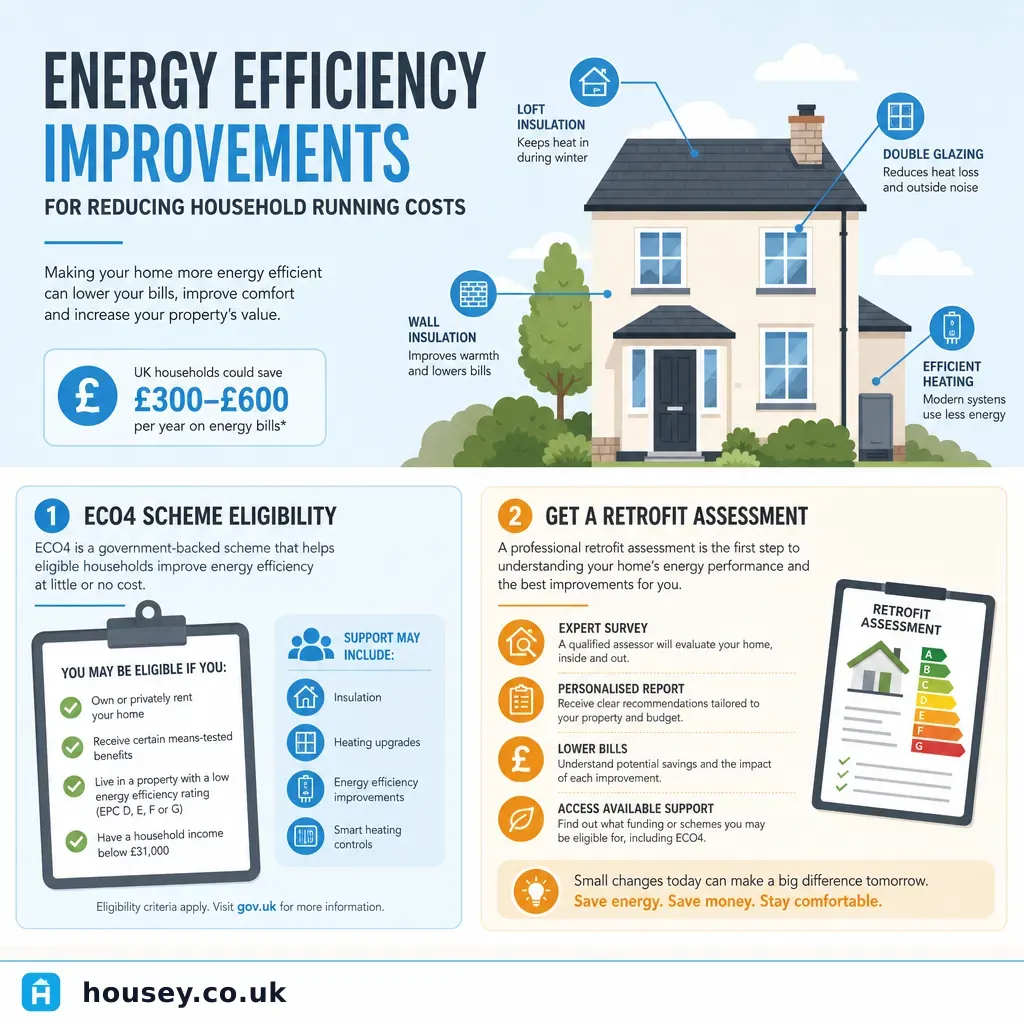
Energy Efficiency Improvements for Reducing Household Running Costs
Reducing household running costs usually starts with draught-proofing and loft insulation — the measures with the best savings-to-cost ratio.
 Energy & Retrofit
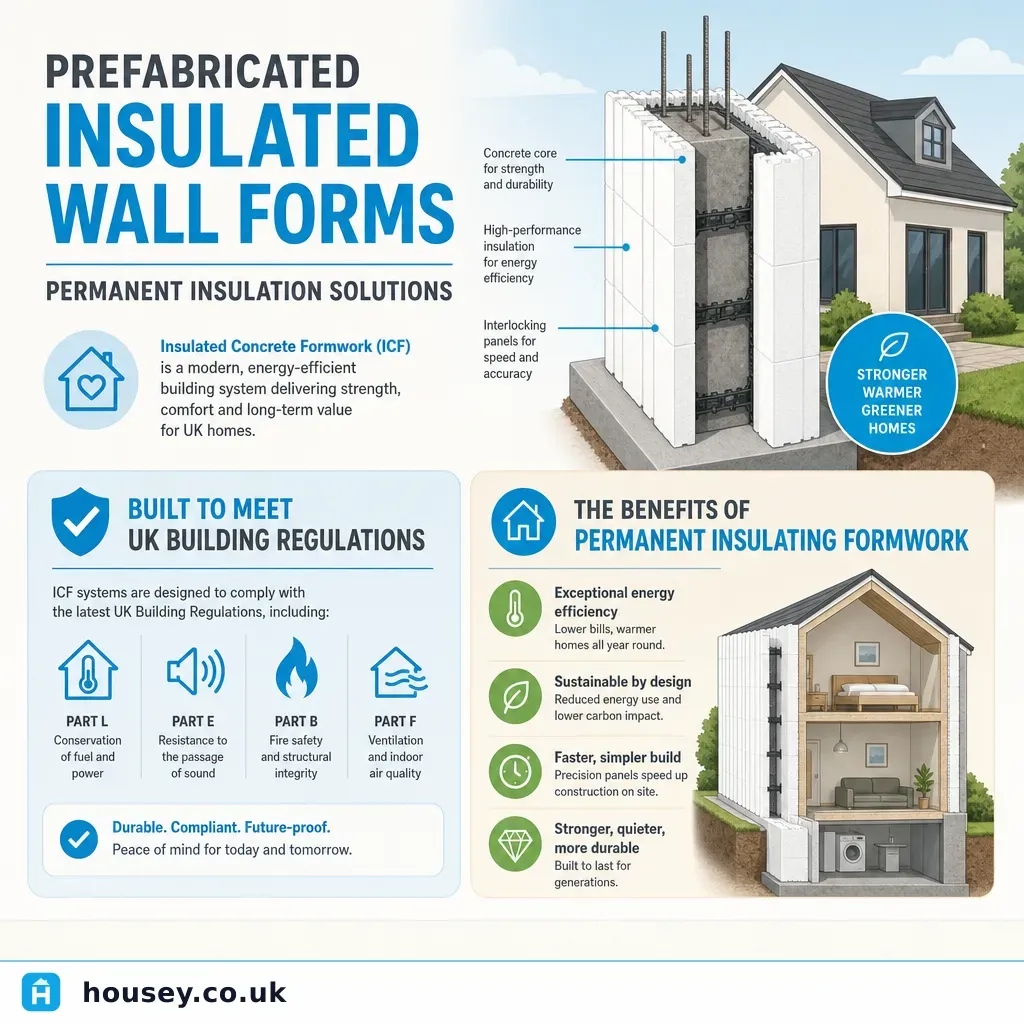
Prefabricated Insulated Wall Forms: Permanent Insulation Solutions
Prefabricated insulated wall forms — including ICF and SIPs systems — deliver high thermal performance by combining permanent insulation with structural concrete or timber in a single wall assembly.
 Energy & Retrofit
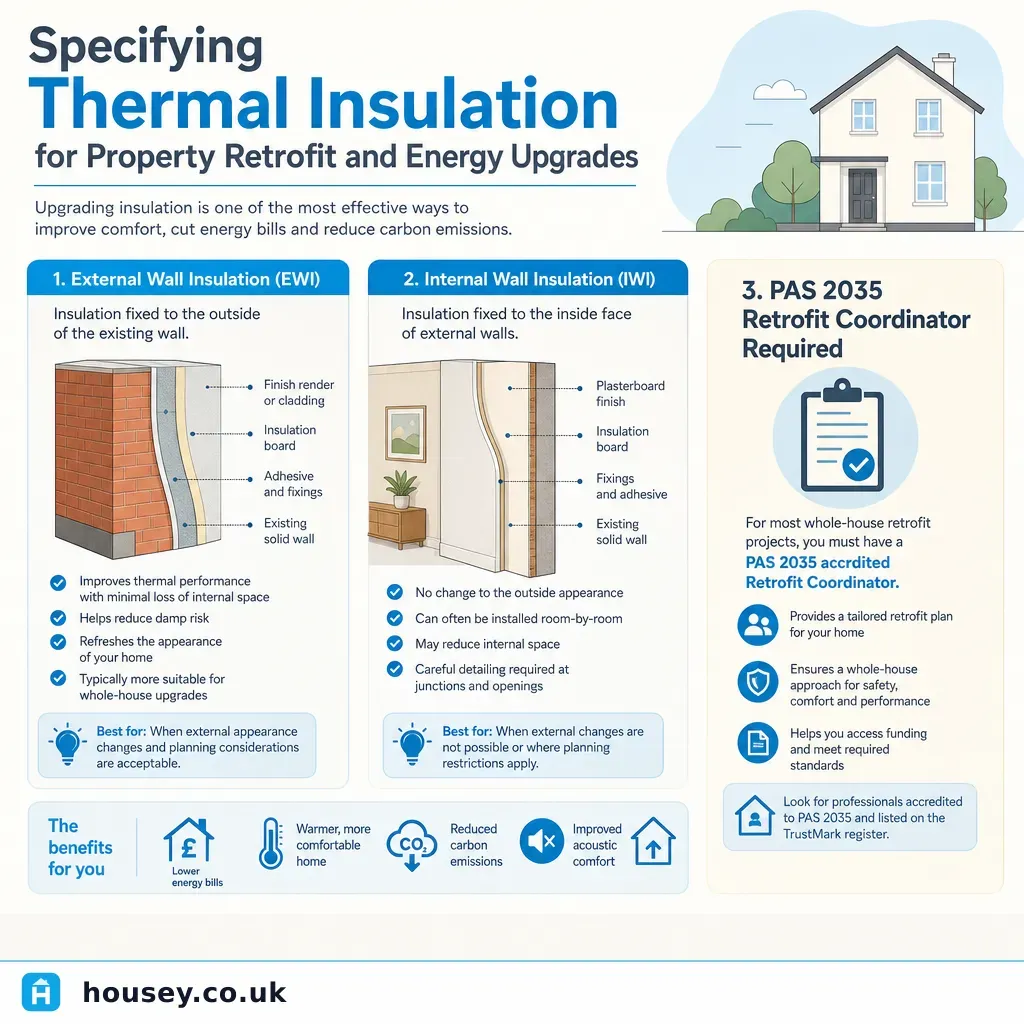
Specifying Thermal Insulation for Property Retrofit and Energy Upgrades
Specifying thermal insulation for UK retrofit requires matching the product to your property's construction, moisture conditions, and heating system.
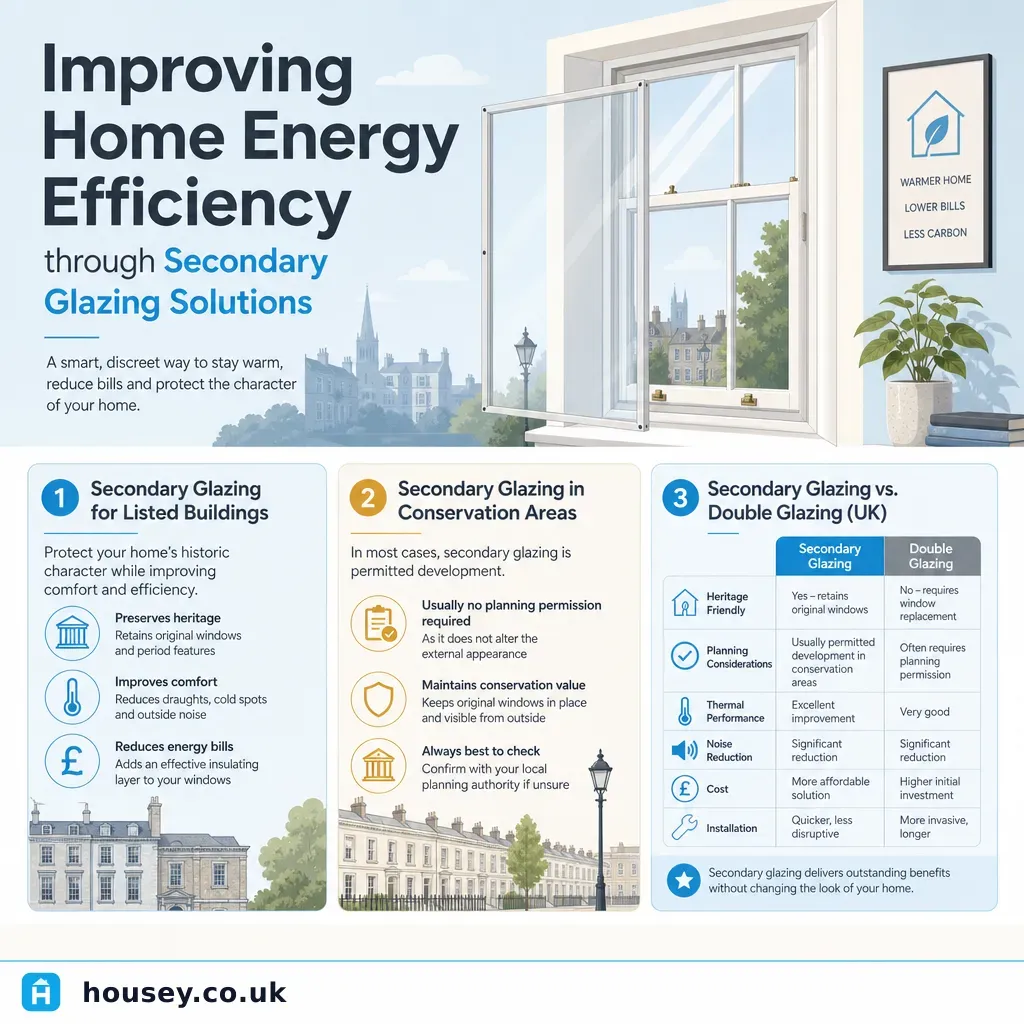 Energy & Retrofit
Improving Home Energy Efficiency through Secondary Glazing Solutions
Secondary glazing fits an additional pane inside your existing window reveal, reducing heat loss and noise without replacing the original frame.
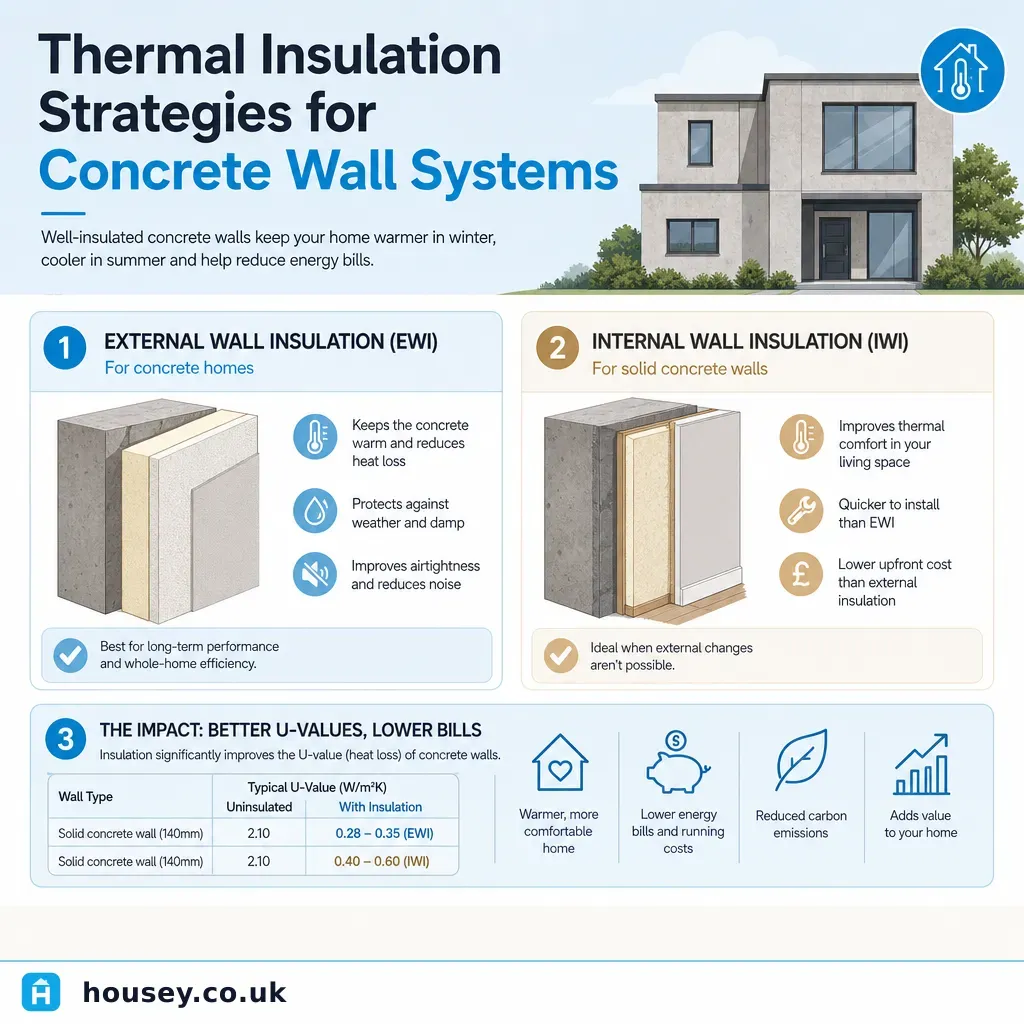 Energy & Retrofit
Thermal Insulation Strategies for Concrete Wall Systems
Concrete walls can be insulated using three main approaches: external wall insulation (EWI), internal wall insulation (IWI), or — where a cavity exists — cavity fill.