Installation Expenses for Recessed Ceiling Lights
By Housey · Last reviewed 6th of May 2026
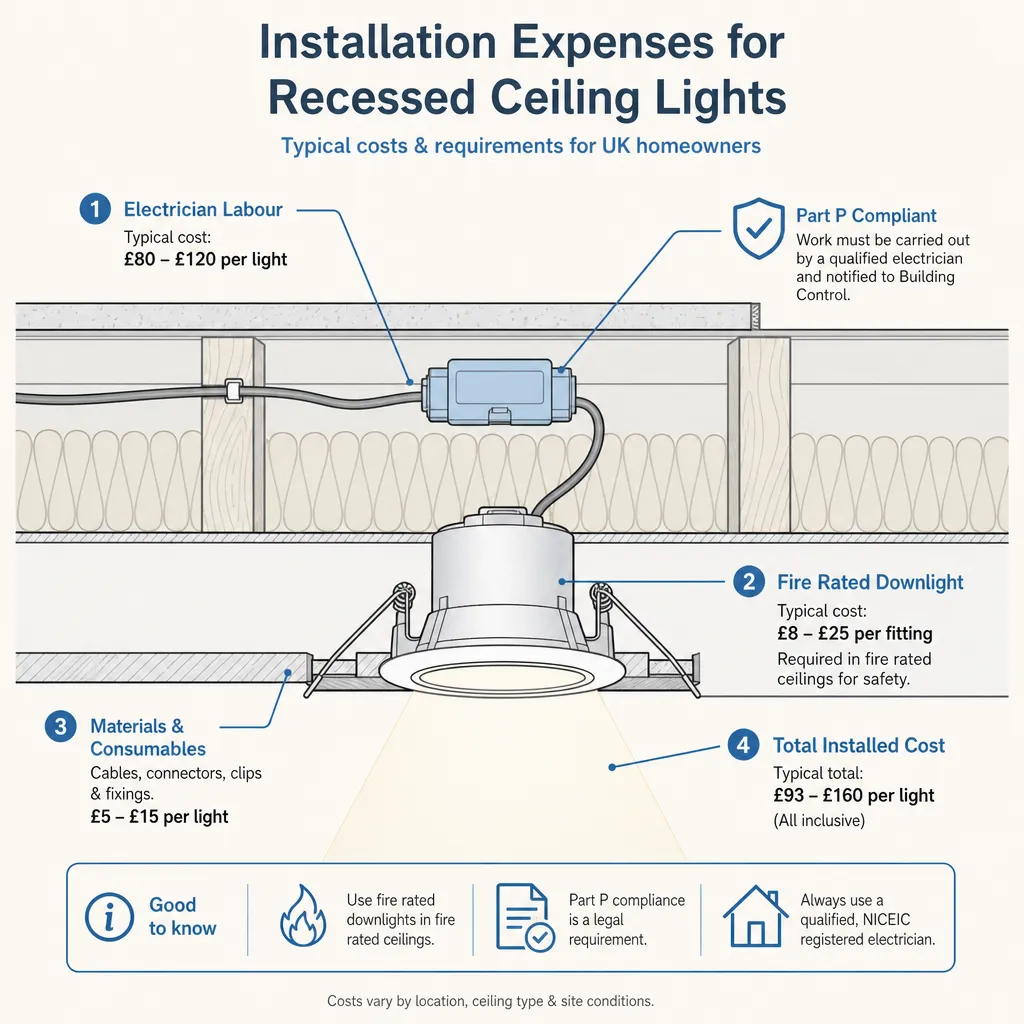
Installation Expenses for Recessed Ceiling Lights
Recessed ceiling lights — commonly called downlights or spotlights — come up regularly in kitchen renovations, open-plan refurbishments, and rewiring projects across the UK. Costs vary depending on ceiling construction, the number of fittings, whether fire-rated downlights are required, and whether a new circuit is needed from the consumer unit. Because this is notifiable electrical work under Part P of the Building Regulations, the electrician you choose directly affects both cost and compliance.
Key points
- Electricians in the UK typically charge £50–£150 per recessed downlight installed, with the per-unit cost falling when multiple lights are fitted in one visit.
- All work involving new or modified lighting circuits in a dwelling is notifiable under Part P of the Building Regulations in England; it must be carried out or certified by a registered competent person (NICEIC, NAPIT, ELECSA, or equivalent).
- Fire-rated downlights are required wherever a ceiling forms part of a fire-separating element — typically the ground-floor ceiling in a two-storey home — to maintain the fire-resistance rating of the assembly.
- In insulated ceilings, standard recessed lights create a thermal bypass; insulation hoods or IC-rated (insulation-contact) downlights are required to maintain Part L energy-performance compliance.
- Most halogen lamps have been restricted from sale in the UK since September 2021 under Ecodesign regulations; LED downlights are now standard and use roughly 75–80% less energy than halogen equivalents.
How much does it cost to install recessed ceiling lights?
Cost element | Typical range | Notes |
|---|---|---|
Standard LED downlight fitting | £10–£40 per unit | Quality and lumen output vary |
Fire-rated LED downlight fitting | £20–£60 per unit | Required in fire-separating ceilings |
Electrician labour | £30–£100 per light | Lower per fitting when doing several |
New circuit from consumer unit | £150–£500 (one-off) | Only if existing circuit capacity is insufficient |
Insulation hoods | £5–£15 per fitting | Needed above insulated ceilings |
Part P certification | Included if scheme-registered | Separate building control fee otherwise |
Indicative UK costs, last reviewed 2026-05-06. Prices vary by region, ceiling type, and specification. Obtain at least three quotes from scheme-registered electricians.
Typical project costs
Project | Indicative total |
|---|---|
6 downlights in a kitchen (new spur on existing circuit) | £400–£900 |
10 downlights across an open-plan ground floor | £700–£1,500 |
Single downlight replacement (like-for-like) | £60–£150 |
Full rewire with downlights throughout (3-bed semi) | £3,500–£7,000 |
Indicative UK costs, last reviewed 2026-05-06.
What drives the cost?
Number of lights and circuit capacity: Electricians typically quote a lower per-fitting rate when multiple lights are installed in a single visit. If the additional load exceeds existing circuit capacity, a new circuit must be run from the consumer unit — a one-off addition of roughly £150–£500.
Ceiling construction: Standard plasterboard is straightforward. Lath-and-plaster ceilings, common pre-1940s, are fragile and take more care. Concrete or beam-and-block ceilings may make traditional recessed fittings impractical without specialist fixings. Clear loft access simplifies cable runs; a fully boarded loft adds time and cost.
Fire-rated vs standard fittings: Ceilings separating habitable floors require fire-rated downlights rated to 30 or 60 minutes — these cost £20–£60 per unit versus £10–£40 for standard fittings and cannot be substituted in fire-separating locations.
Regional variation: Electrician day rates are typically 20–40% higher in London and the South East than in the Midlands, Wales, or northern England.
Homeowner checklist before installation
Red flags to watch for
- Electrician cannot confirm registration with a recognised competent-person scheme.
- No mention of Part P notification or certification in the quote.
- Standard (non-fire-rated) fittings proposed for a separating floor or ceiling without clear justification.
- No discussion of insulation provision for a top-floor or loft-adjacent ceiling.
- Quote significantly lower than all others with no explanation of the difference in scope or materials.
Important limitations
This article provides general cost and regulatory information for UK homeowners. All figures are indicative and are not a substitute for a written quote based on a site assessment by a registered electrician. Part P applies in England; Scotland, Wales, and Northern Ireland have equivalent regulations that may differ in detail. If you are uncertain whether your planned work is notifiable, check with your local authority building control team before work begins.
What to ask a qualified professional
- Are you registered with NICEIC, NAPIT, ELECSA, or another UKAS-accredited competent-person scheme?
- Will you notify the work, and what certificate will you issue on completion?
- Do any of the proposed ceiling locations require fire-rated fittings?
- Is the existing circuit adequate, or will a new circuit be needed from the consumer unit?
- What insulation provision do you recommend for my ceiling construction?
- What LED fittings are you supplying — lumen output, colour temperature, and IP rating?
- Is the quote inclusive of all cutting, cable runs, and making good?
- Is VAT included?
When to get professional help
All new circuit installation and significant electrical modification in a UK dwelling must involve a registered competent person under Part P. Do not attempt new circuits, consumer unit modifications, or new cabling as a DIY project — this affects your home's safety, building insurance, and saleability. Always use a registered electrician for lights near bathrooms (zone IP-rating requirements under BS 7671:2018 apply) and for any ceiling position where fire-rated fittings are required.
How Housey can help
Getting at least three quotes from scheme-registered electricians ensures both competitive pricing and compliant work. Housey helps UK homeowners describe their project and receive quotes from qualified local tradespeople registered with recognised competent-person schemes.
Frequently asked questions
Do I need a registered electrician to install recessed downlights?
For new circuits or extending existing circuits to add recessed lights, yes — this is notifiable work under Part P of the Building Regulations in England and must be carried out or certified by a registered competent person. Simple like-for-like replacement of an existing fitting on the same circuit may not require notification, but any new wiring or circuit modification requires a registered electrician.
Are fire-rated downlights required throughout the house?
No — fire-rated fittings are only required in ceilings that form part of a fire-separating element. In a typical two-storey house, this means the ground-floor ceiling. Top-floor ceilings with only a cold loft above may not require fire-rated fittings, but check with your electrician for your specific property type and ceiling construction.
How many recessed lights do I need per room?
A common starting point is one downlight per 1–1.5 m² of ceiling area, though this depends on lumen output, beam angle, and ceiling height. For a 20 m² kitchen, 12–16 lights is a typical range. Your electrician or a lighting designer can advise based on your specific room dimensions and the fittings specified.
Can I have recessed downlights in a bathroom?
Yes, but bathroom lighting must comply with zone classifications under BS 7671:2018 (the IET Wiring Regulations). Zones 0, 1, and 2 around baths and showers each require fittings with a minimum IP rating. Your electrician must specify fittings appropriate for each zone — non-compliance affects both safety and home insurance.
Will LED downlights reduce my energy bills?
LED downlights use roughly 75–80% less energy than equivalent halogen fittings. The total saving depends on the number of lights, daily usage hours, and your energy tariff. Proper insulation hoods or IC-rated fittings also prevent heat loss through ceiling penetrations, helping overall heating efficiency in the room above.
Sources and further reading
- Approved Document P: Electrical safety in dwellings — GOV.UK
- Find a registered electrician — NICEIC
- Electrical safety guidance for homeowners — Electrical Safety First
- Ecodesign regulation: halogen lamp restrictions — GOV.UK
Useful next reads
 General property advice
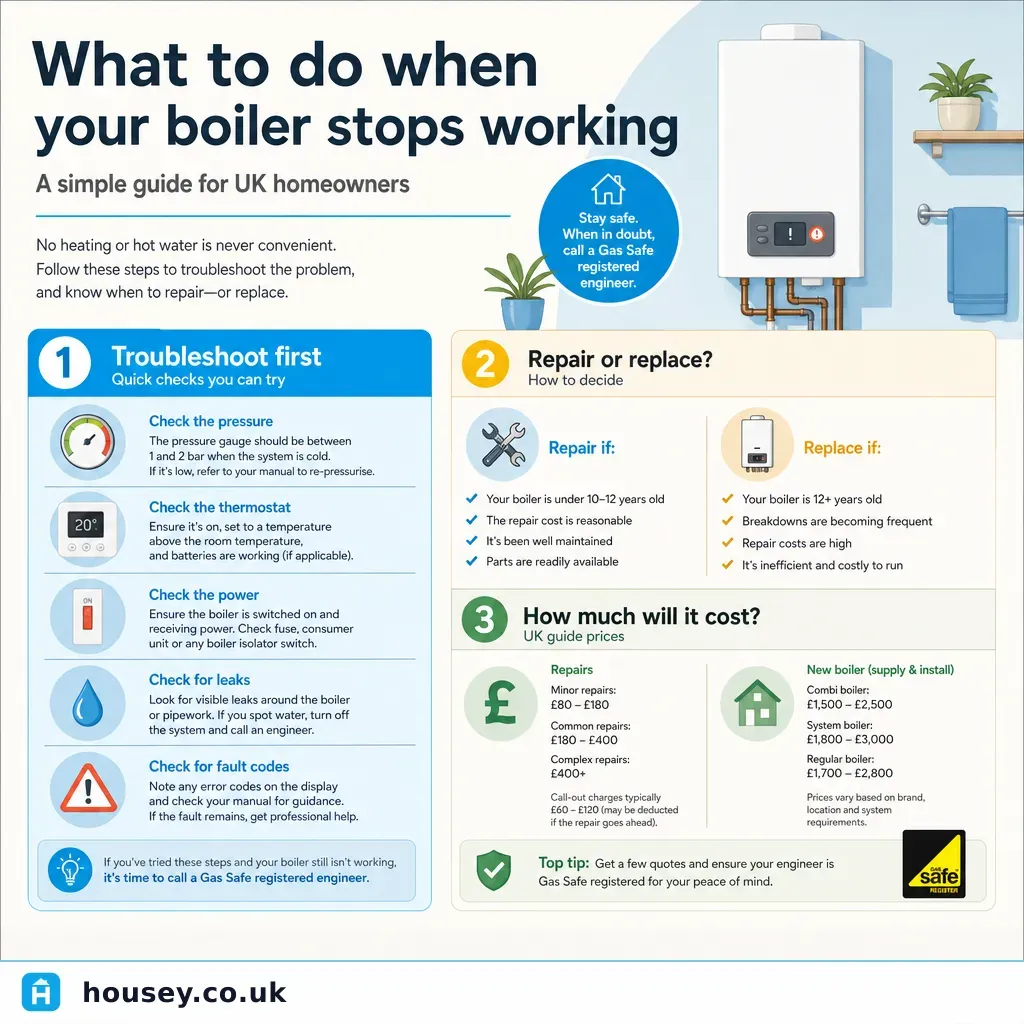
What to do when your boiler stops working
When your boiler stops working, check the pressure gauge (should read 1–1.
 General property advice
Property Market Trends: Activity Growth and Price Movements
UK property market activity is measured through completed sale registrations (HM Land Registry), lender mortgage data, and transaction volumes from HMRC.
 General property advice
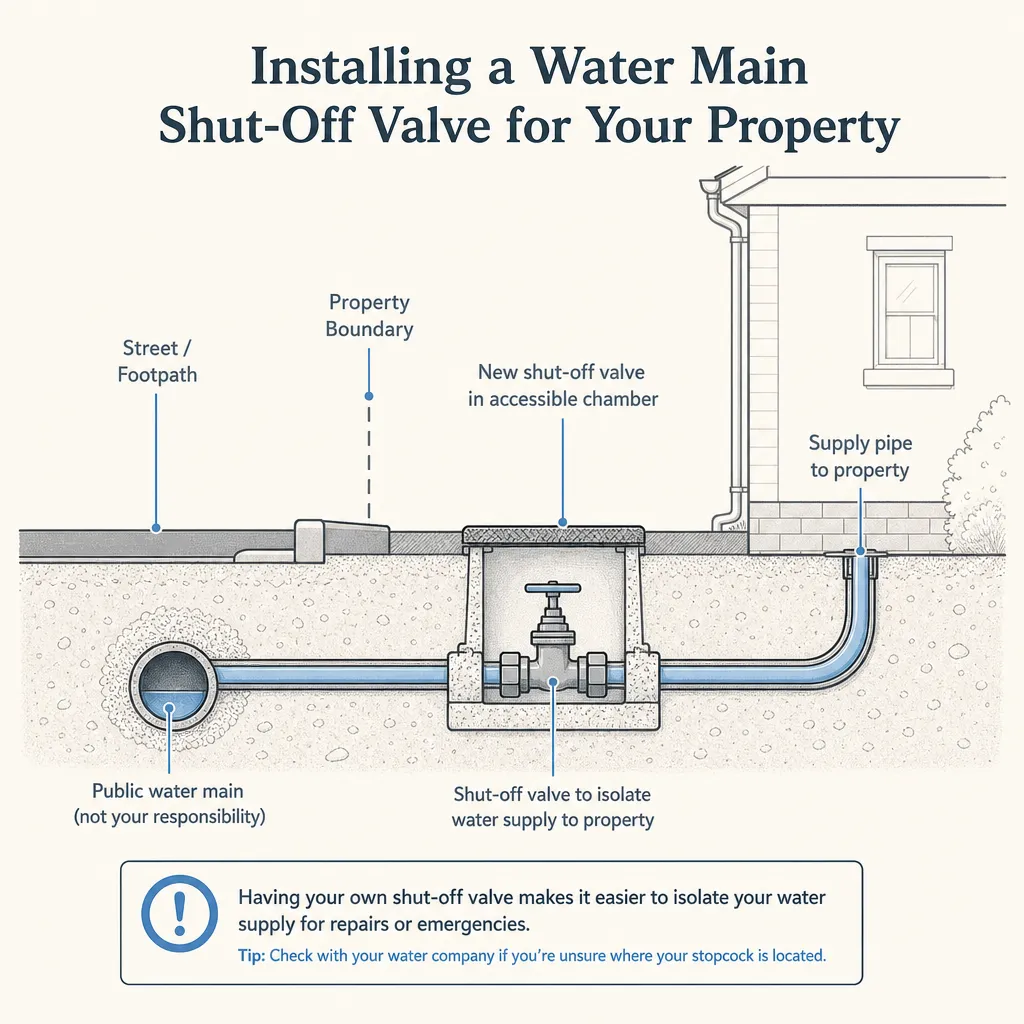
Installing a water main shut-off valve for your property
A water main shut-off valve — commonly called a stopcock — controls all water entering your home from the mains.
 General property advice
Monthly House Price Index: August Market Report and Analysis
The UK House Price Index is published monthly using completed Land Registry transaction data, meaning August figures typically reflect sales agreed months earlier.
 General property advice
Scottish Property Market: Activity and Regional Trends
Scotland's property market operates under distinct legal rules: sellers must provide a Home Report before marketing, transactions become legally binding at conclusion of missives rather than exchange of contracts, and Land and Buildings Transaction Tax replaces Stamp Duty.