Installing Bay Windows: Design, Planning and Building Regulations
By Housey · Last reviewed 19th of May 2026
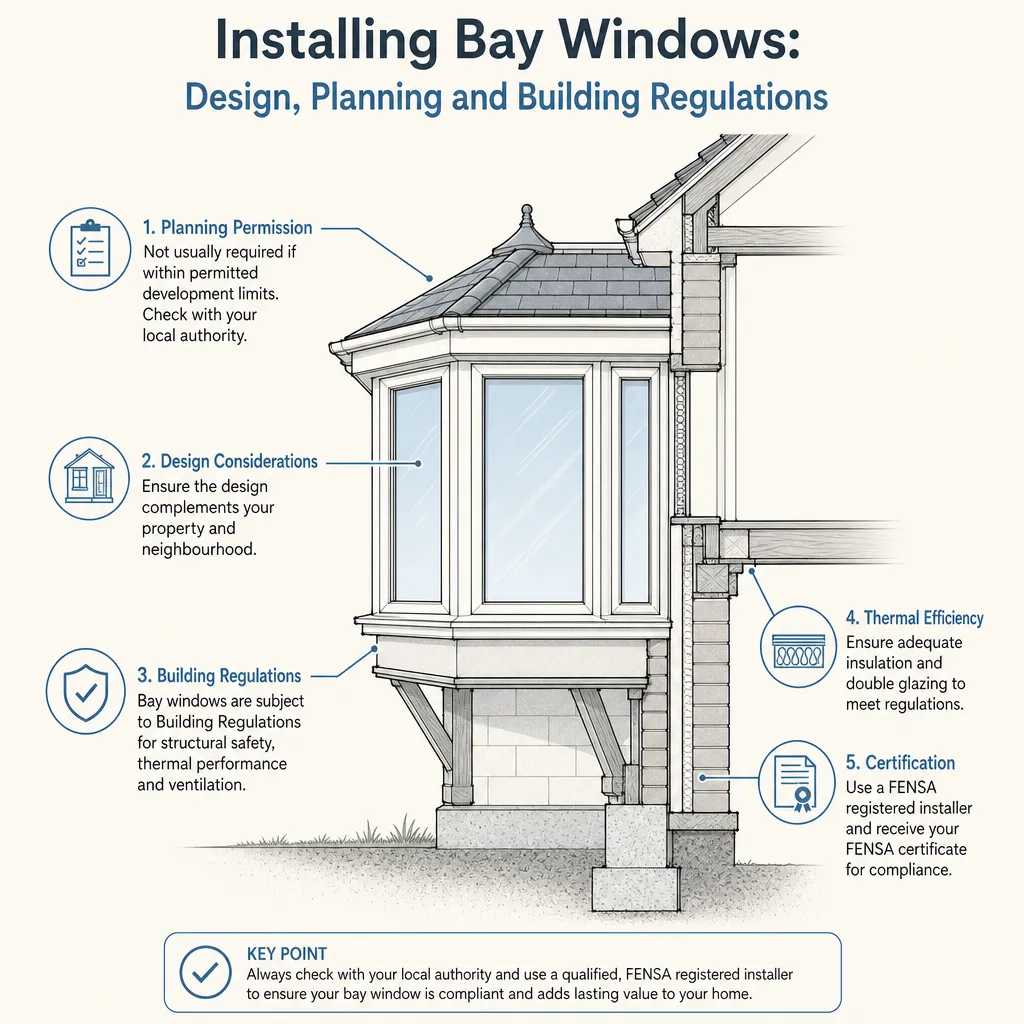
Installing Bay Windows: Design, Planning and Building Regulations
Bay windows are among the most recognisable features of UK residential property — standard on Victorian and Edwardian terraces, and frequently added to flat-fronted homes to borrow light and floor space. Whether you are replacing an existing bay that has seen better days or considering adding one to a previously plain elevation, the project involves more regulatory and structural complexity than a standard window replacement. Getting the planning and Building Regulations position right before work begins avoids enforcement problems and ensures you have the compliance documentation in place when you sell.
Key points
- Replacing an existing bay window on a like-for-like basis is usually permitted development — planning permission is not normally required unless the property is listed, in a conservation area, or a flat.
- New bay windows that extend beyond the original building line are treated as extensions and may need planning permission depending on their size, position, and location.
- Building Regulations approval is required for all new window installations in England under Approved Documents L (thermal performance), A (structure), and N (glazing safety).
- FENSA or CERTASS-registered installers can self-certify Building Regulations compliance for replacement windows — you receive a compliance certificate essential for future property sales.
- Current Approved Document L requires replacement windows in existing English dwellings to achieve a whole-window U-value of 1.4 W/m²K or better.
Replacement bay versus new bay addition: what changes?
These are quite different projects in terms of complexity, cost, and the permissions they require.
| Replacing existing bay | Adding a new bay window |
|---|---|---|
Planning permission | Usually not required (permitted development) | May be required if projecting beyond the building line |
Building Regulations | Yes — thermal, structural check, glazing safety | Yes — structural lintel, possible foundations, thermal, glazing |
Professionals typically needed | FENSA-registered installer | Architectural technologist or architect, structural engineer, window installer |
Structural works involved | Usually none | Wall removal, structural lintel, possibly new foundations |
Self-certification route | FENSA or CERTASS | Not available — full Building Control application required |
Risk if done without approval | Missing compliance certificate at sale | Building Control enforcement notice; potential sale complications |
Typical project duration | One to three days | Four to twelve weeks including design and approvals |
Do you need planning permission?
Replacing an existing bay window
Replacing an existing bay on a like-for-like basis — same size, similar materials and appearance — is generally permitted development under Schedule 2 of the Town and Country Planning (General Permitted Development) (England) Order 2015. No planning application is needed for most houses.
You will need planning permission if:
- Your property is a listed building of any grade
- Your property is in a conservation area and the bay faces or is visible from a public highway
- Your property is a flat or maisonette (permitted development rights do not apply to flats)
- Prior planning conditions on the property restrict window changes
Always confirm with your local planning authority if you are uncertain. The Planning Portal provides guidance on common projects including windows.
Adding a new bay window
A new bay addition that projects beyond the original building line is treated as an extension. Permitted development rules for single-storey rear extensions can sometimes encompass a modest rear bay, but front bays that project forward of the principal elevation almost always require planning permission in England. Scotland, Wales, and Northern Ireland apply different permitted development rules — check the relevant national planning guidance for your location.
Building Regulations: what applies and why
Even where planning permission is not required, Building Regulations approval is needed for all new and replacement window installations.
Approved Document L — thermal performance
To limit heat loss through glazing, replacement windows must meet minimum thermal performance standards. For existing dwellings in England, the current requirement under Approved Document L is a whole-window U-value of 1.4 W/m²K or better. Modern double-glazed units meet this comfortably; triple glazing typically achieves 0.7–1.0 W/m²K. Confirm the specification with your installer before ordering.
Approved Document A — structure
For a new bay addition, removing part of an external wall requires a structural lintel or beam of appropriate specification. The sizing should be determined by a structural engineer or an architectural technologist with structural competence. Inadequate support causes cracking, movement, and potentially serious long-term structural problems. New bays that project on a cantilevered or pad foundation — common in original Victorian bay designs — may require new or strengthened foundations depending on ground conditions.
Approved Document N — glazing safety
All glazing in positions that could be hazardous if broken must be safety glazing (toughened or laminated glass) under Approved Document N. This includes low-level glazing below 800 mm from floor level and any glazing in or adjacent to doors. Confirm safety glazing is specified for all relevant panes before accepting a quote.
Self-certification: FENSA and CERTASS
For replacement windows and doors — including like-for-like bay window replacements — installers registered with FENSA or CERTASS can self-certify Building Regulations compliance without a separate Local Authority Building Control application. This is the standard route for replacement installations.
What you receive: A compliance certificate issued within 30 days of completion, registered with your local authority. Solicitors ask for this when you sell — do not let it get lost.
Important: Self-certification covers replacement windows only. New bay additions involving structural works require a full Building Regulations application to Building Control. An architectural technologist can produce the required drawings and coordinate the application.
What to ask before accepting a quote
- Is your company FENSA or CERTASS registered? (For replacement bays)
- Will you handle the Building Regulations application, or do I need to submit one separately?
- What whole-window U-value will the finished installation achieve?
- Is safety glazing specified for all low-level panes and door-adjacent glazing?
- For a new bay addition: have you consulted a structural engineer for the lintel and foundation specification?
- What guarantees are provided on the sealed glazing units and the frame finish?
- Is VAT included in the quoted price?
- What happens if unforeseen issues are found behind the wall, such as damp, failing lintels, or existing structural problems?
Choosing a bay window style to suit your property
UK bay windows broadly fall into three profiles:
- Canted (angled) bay: the most common type, projecting at 45° or 30° angles; found on Victorian and Edwardian terraces across the country
- Square (box) bay: projects at 90° angles; more typical of 1930s and post-war properties
- Curved (bow) bay: a continuous curve; most common on Georgian and early Victorian properties
Matching your property's original profile matters both aesthetically and — in conservation areas — for planning. Replacing a canted Victorian bay with a square box bay on a terrace is likely to attract planning scrutiny even where the work would otherwise be permitted development.
Frame material choice affects maintenance and appearance:
- uPVC: low maintenance, cost-effective, widely available; may not suit period properties visually
- Timber: period-appropriate, paintable, higher maintenance; often required in conservation areas and for listed buildings
- Aluminium: slim sightlines, durable, suited to contemporary designs; generally acceptable in most planning contexts
When to get professional help
Seek professional input beyond your installer if:
- You are adding a new bay, not replacing an existing one — a structural engineer and/or architectural technologist should be involved from the outset
- Your property is listed or in a conservation area — get advice from your local planning authority before committing to any materials or design
- There is evidence of existing movement, cracking, or damp around the current bay before replacement works begin
- The existing bay structure appears to be pulling away from the main wall, bowing, or settling
- You need building regulations drawings and a formal specification for a new bay addition
How Housey can help
Housey can connect you with FENSA-registered window and door installers for replacement bay windows, architectural technologists who can produce drawings for new bay additions, and professionals providing building regulations drawings for more complex structural projects. Finding the right team before work starts protects your investment and ensures compliance documentation is in place for when you sell.
Frequently asked questions
Do I need a FENSA certificate when I sell my home?
Yes — your conveyancing solicitor will ask for evidence of Building Regulations compliance for any replacement windows or doors installed since April 2002. A FENSA or CERTASS certificate satisfies this requirement. If it has been lost, contact the installer or FENSA directly; FENSA maintains a searchable register of all certified installations.
How much does a bay window replacement cost in the UK?
Indicative UK costs, last reviewed 2026-05-19. A standard canted bay window replacement in uPVC typically costs £1,500–£3,500 depending on size, glazing specification, and location. Timber-frame equivalents often cost £3,000–£7,000 or more. Adding a new bay involves additional structural, groundworks, and Building Control costs and should be priced on a project-specific basis. Obtain at least three quotes and confirm VAT is included.
Does a bay window add value to my property?
Bay windows are among the most sought-after features for buyers of period properties in the UK. Replacing failing or single-glazed bays with quality double-glazed units generally improves saleability and EPC ratings. Adding a new bay can improve kerb appeal and usable floor area, though the value uplift depends heavily on location, property type, and quality of execution.
How long does a bay window installation take?
A like-for-like replacement typically takes one to three days. Adding a new bay window to an existing flat elevation is considerably more complex — structural works, possible groundworks, and roofline changes can extend the programme to several weeks, plus time for design and Building Regulations approval before work can start.
Sources and further reading
- Planning Portal: windows guidance — Planning Portal
- Approved Document L: conservation of fuel and power — GOV.UK / MHCLG
- Approved Document A: structure — GOV.UK / MHCLG
- Approved Document N: glazing safety — GOV.UK / MHCLG
- FENSA: competent person scheme for windows — FENSA
- Town and Country Planning (General Permitted Development) (England) Order 2015 — legislation.gov.uk
Useful next reads
 Improvement & Build
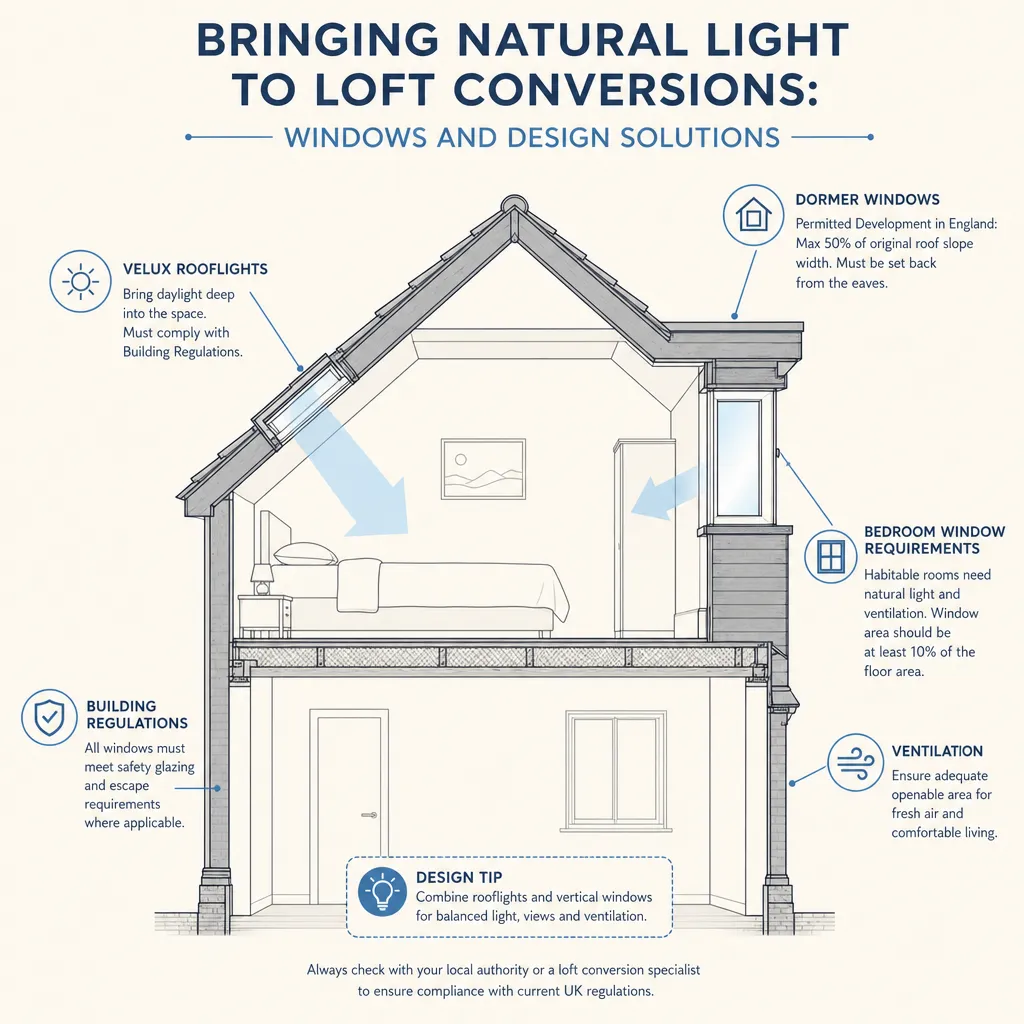
Bringing Natural Light to Loft Conversions: Windows and Design Solutions
Natural light in a loft conversion is usually achieved through roof lights, dormer windows, or gable-end glazing.
 Improvement & Build
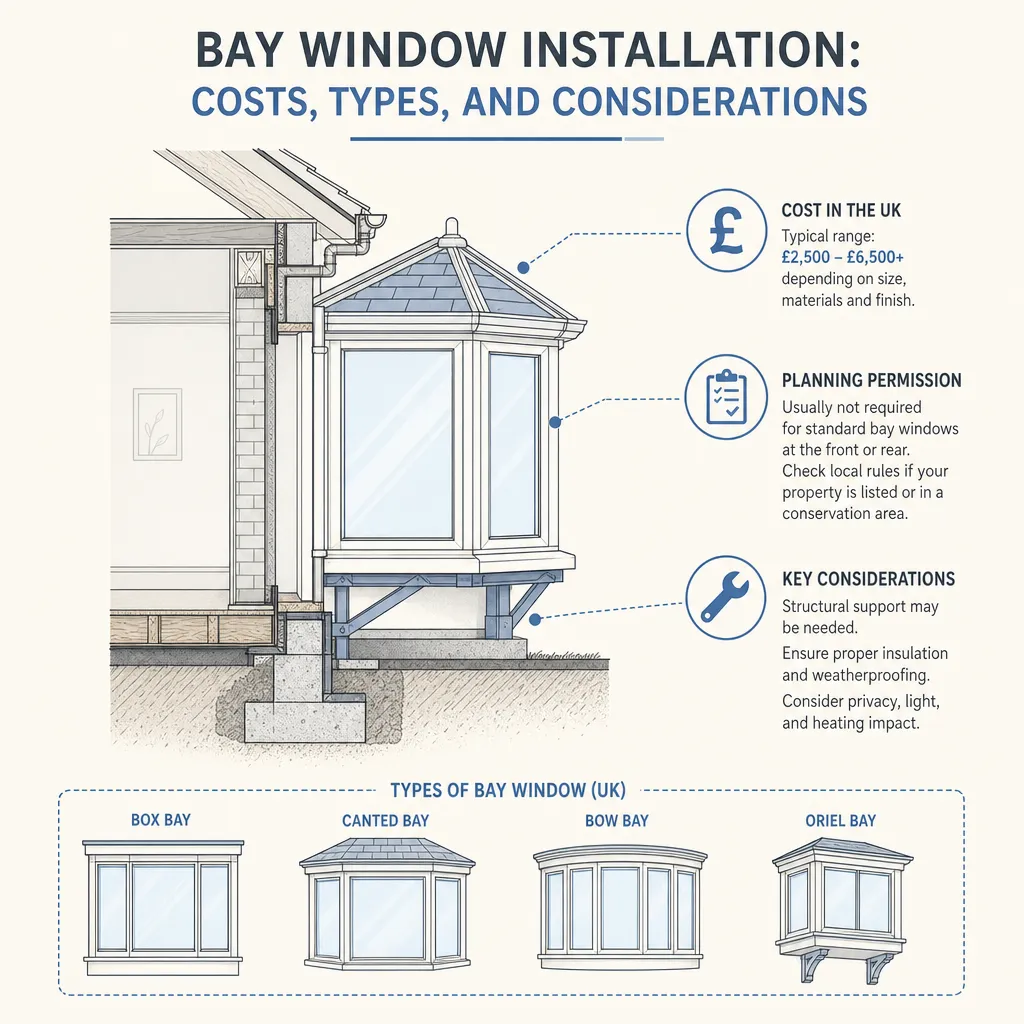
Bay Window Installation: Costs, Types, and Considerations
Bay window installation in the UK involves structural support, glazing to Part L energy standards, and — for new openings — a building control application.
 Improvement & Build
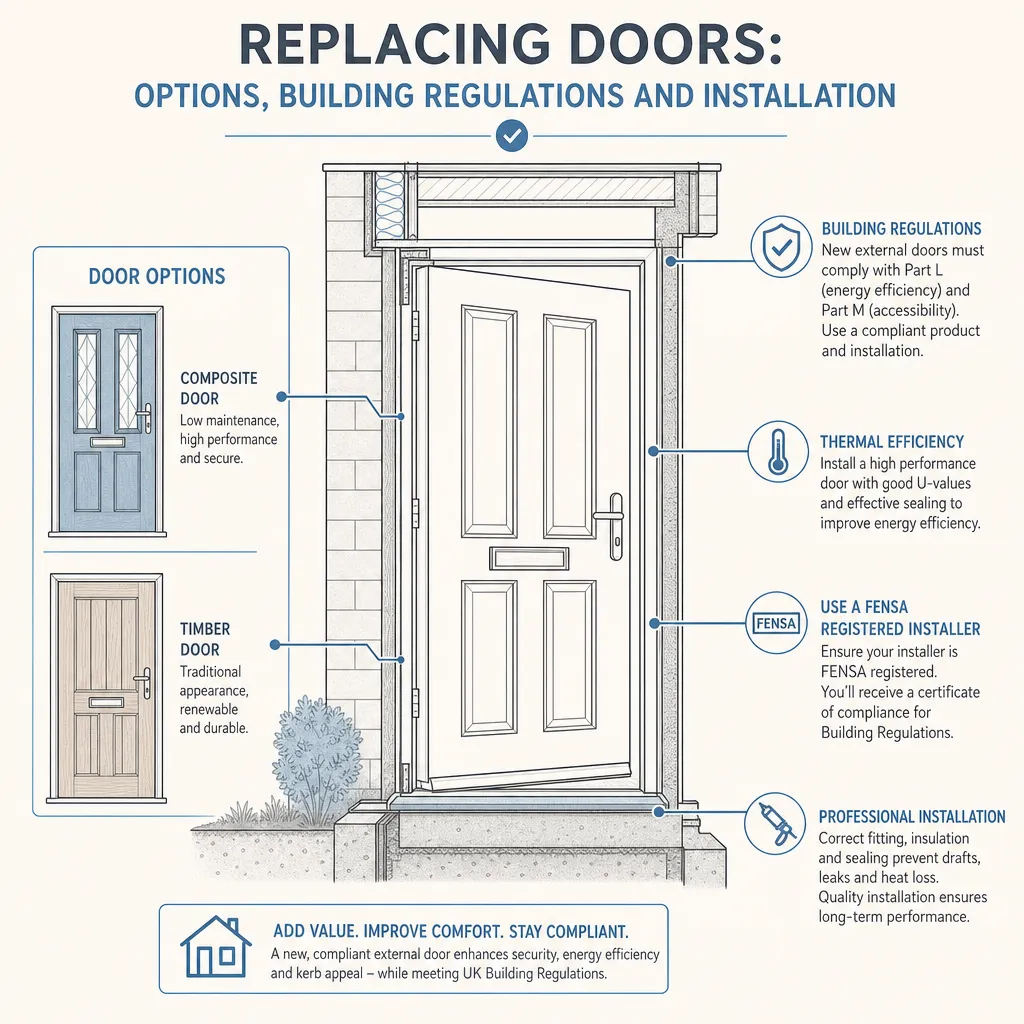
Replacing Doors: Options, Building Regulations and Installation
Replacing an external door in England requires compliance with Building Regulations Part L (minimum U-value 1.
 Improvement & Build
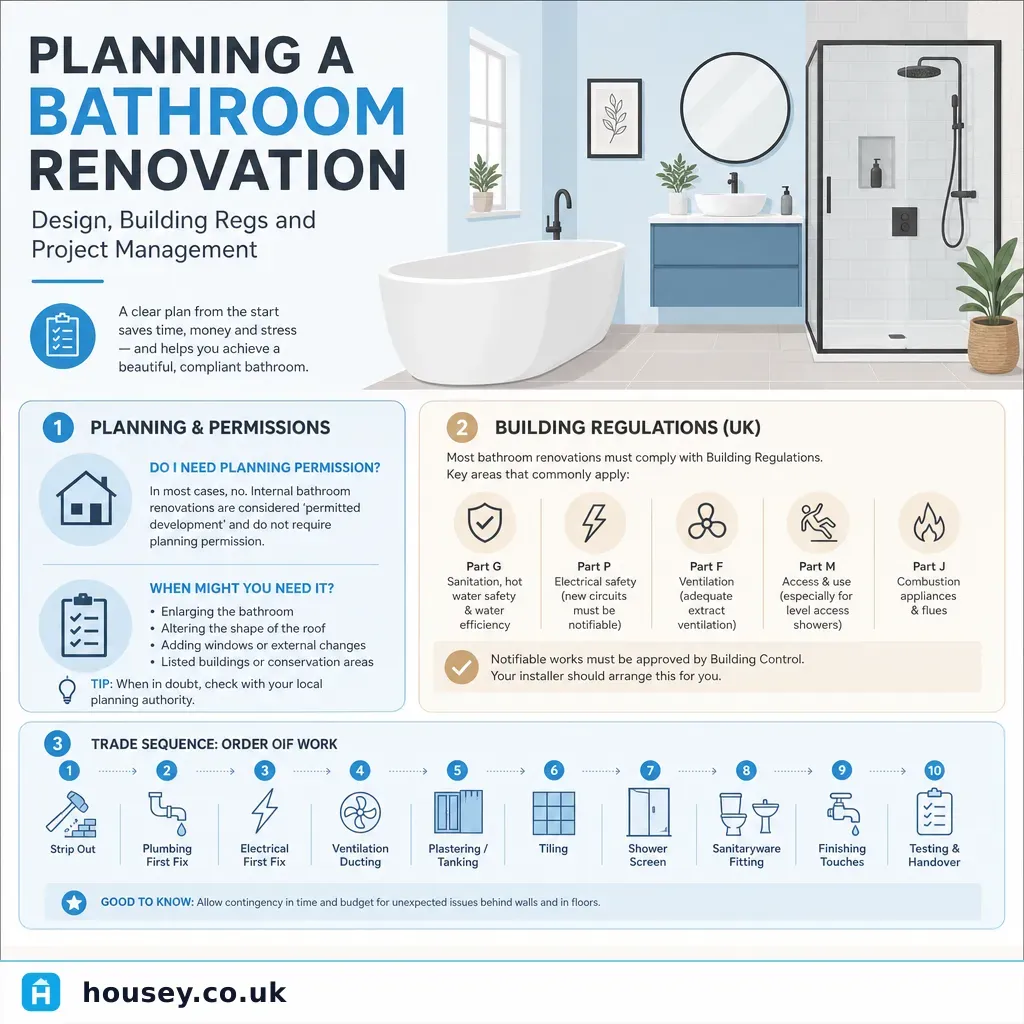
Planning a Bathroom Renovation: Design, Building Regs and Project Management
Most bathroom renovations replacing existing sanitaryware in the same location do not need building regs or planning permission.
 Improvement & Build
Maximising Property Value: Cost-Effective Home Expansion
A cost-effective home extension in the UK typically starts with a single-storey rear extension under permitted development, using an extension builder or design-and-build firm to control costs.