Smart Glass Windows: Technology, Applications and Investment Costs
By Housey · Last reviewed 31st of May 2026
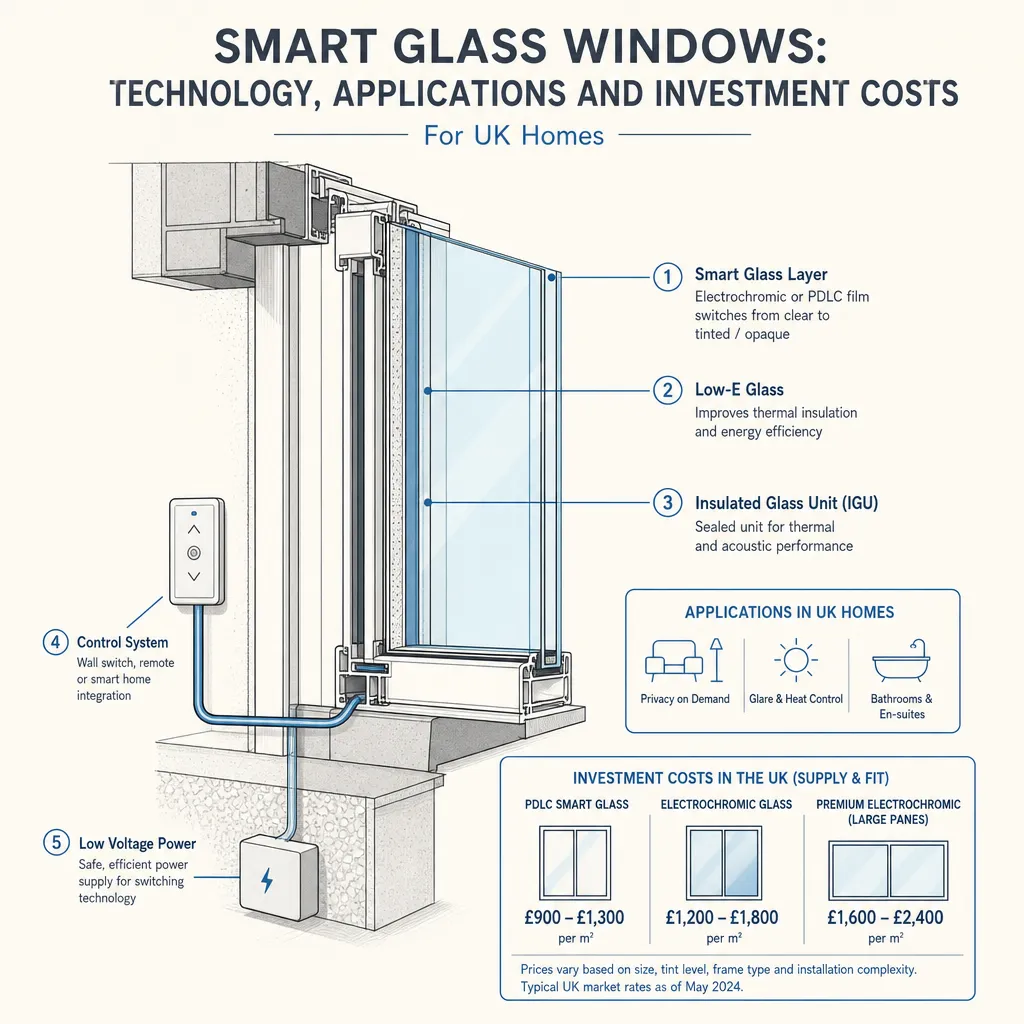
Smart Glass Windows: Technology, Applications and Investment Costs
Smart glass is transitioning from offices and commercial facades into UK residential projects, appearing in conservatory roofs, bathrooms, skylights, and large sliding door systems. The technology carries a significant price premium over standard glazing, which makes understanding what each type actually delivers — and what it realistically costs — essential before committing to a specification.
Key points
- Smart glass falls into four main types: electrochromic (EC), polymer dispersed liquid crystal (PDLC), suspended particle device (SPD), and thermochromic — each with different switching mechanisms, power requirements, and cost profiles.
- Replacement windows in England must meet a minimum U-value of 1.4 W/m²K under Building Regulations Part L (2021 edition, effective June 2022); confirm your chosen smart glass unit meets this before ordering.
- PDLC glass requires continuous AC mains power to remain transparent; disconnecting power returns it to the frosted or opaque state — the reverse of most buyers' expectations.
- Listed buildings and properties in conservation areas may require planning permission or listed building consent before any glazing change; check with your local planning authority before ordering.
- There are currently no UK government grant schemes specifically funding smart glass; the technology falls outside the scope of ECO4 and the Great British Insulation Scheme as of May 2026.
What types of smart glass are available for UK homes?
Four technologies are commonly available for residential projects in the UK. Each switches between states differently and suits different applications.
Technology | Switching trigger | Power when transparent | Fully opaque? | Best residential use |
|---|---|---|---|---|
Electrochromic (EC) | Low-voltage DC | Near-zero (state holds) | No — gradual tint | South/west skylights, solar control |
PDLC | AC mains | Continuous | Yes | Bathrooms, internal partitions |
SPD | Low-voltage DC | Continuous | No — variable tint | Conservatories, roof glazing |
Thermochromic | Heat (passive) | None required | No — passive tint | Conservatory roofs, south elevations |
Important distinction: EC and thermochromic glass hold their state once set without ongoing power. PDLC and SPD require continuous power to remain clear — factor ongoing running costs into your assessment.
Where is smart glass used in UK residential properties?
The most common residential applications are:
- Bathroom windows — PDLC is popular as a replacement for traditional obscured glazing, allowing natural light while providing instant privacy without permanent frosted film.
- Conservatory and orangery roofs — EC and SPD glazing reduces solar heat gain in summer, making spaces more comfortable without portable fans or air conditioning.
- Skylights and rooflights — particularly useful where blinds would be difficult to install, maintain, or operate.
- Bifold and sliding door systems — the full glass panel can act as a privacy screen when required without a separate blind track.
- Internal partitions — in open-plan living spaces where occasional visual separation is wanted without a permanent wall.
Worked UK property scenario: rear extension rooflight
A homeowner in Leeds fits a single-storey rear extension with a 2.16 m² rooflight over a kitchen-diner. Standard solar-control glass is specified, but the space overheats on sunny days. Retrofitting with an SPD rooflight unit at indicative costs of £700–£1,100/m² would cost £1,500–£2,400 for that panel alone. An energy-efficiency consultant can model whether the improvement to thermal comfort and reduced cooling load justifies that premium over a high-performance solar-control coating. (Indicative UK costs, last reviewed 2026-05-31; individual quotes vary by supplier and project.)
How much does smart glass cost in the UK?
Smart glass carries a significant premium over standard and high-performance conventional glazing. Costs depend on technology, panel dimensions, frame specification, and glazing unit build-up.
Indicative UK supply-and-install cost ranges per m² (last reviewed 2026-05-31):
Technology | Indicative cost/m² | Standard low-E double glazing (comparison) |
|---|---|---|
Thermochromic | £300–£700 | £150–£400/m² |
PDLC | £400–£900 | — |
SPD | £600–£1,200 | — |
Electrochromic | £800–£1,500+ | — |
Always obtain at least three quotes. Figures above are indicative; supplier pricing, project complexity, and specification vary considerably.
Main cost drivers:
- Panel size — large-format glass does not scale linearly in price; manufacturing complexity increases with area.
- Frame material — aluminium, timber, and uPVC interact differently with the electrical connections required for active glass.
- Wiring and controls — active glass needs a transformer and switch or smart-home relay; this adds labour costs and may require a separate Part P-certified electrician.
- Glazing unit build-up — smart glass is typically laminated; additional low-E coatings or argon fill add to cost and affect the overall U-value.
- Access — rooflights at height require scaffolding or a mobile elevated work platform, adding to overall project cost.
What to check before accepting a quote
- What is the certified U-value of the completed glazing unit — does it meet Part L (≤ 1.4 W/m²K for replacement windows in England)?
- Who is responsible for the electrical connection — the glazing contractor or a separately appointed Part P-certified electrician?
- What is the default state if mains power fails — clear or frosted?
- Is the control system compatible with your existing smart-home setup?
- Is the unit CE-marked, and does it carry a manufacturer warranty (typically 5–10 years for the switching mechanism)?
- Is VAT at 20% included in the quote, or does the project qualify for a reduced rate?
Is smart glass eligible for UK energy-efficiency grants?
As of May 2026, no government scheme specifically funds smart glass. ECO4 (the Energy Company Obligation) and the Great British Insulation Scheme focus on insulation and low-carbon heating rather than premium glazing technology. Some local authority whole-house retrofit programmes may consider high-performance glazing as part of a broader package, but smart glass alone is unlikely to qualify.
Zero VAT on energy-saving materials does not currently extend to smart glazing. Check GOV.UK's energy-saving materials VAT guidance for up-to-date eligibility, and confirm with your contractor whether any reduced-rate VAT applies to the installation services element.
When to get professional help
Smart glass installation spans glazing, electrical, and building regulations disciplines. Seek professional input when:
- The project involves a listed building or conservation area — planning or listed building consent may be needed before any glazing change.
- Rooflights are to be installed at height — insist on a contractor with a working-at-height risk assessment and appropriate access equipment.
- You want to verify the thermal performance impact on your EPC before specifying — an independent assessment is more reliable than manufacturer data alone.
- Building control flags the glazing specification as potentially non-compliant with Part L — your installer should provide manufacturer U-value certification to resolve this.
How Housey can help
Housey connects you with vetted window and door installers who have experience specifying and fitting smart glazing in residential projects across the UK. If you want an independent view of how smart glass fits your property's energy-performance goals before committing to the cost, our energy-efficiency consultants can model the options without the bias of a product sale.
Frequently asked questions
Does smart glass actually reduce energy bills?
It can — particularly for south- or west-facing glazing where electrochromic or SPD glass limits summer solar heat gain and reduces reliance on portable cooling. However, PDLC and SPD consume continuous power when transparent (around 5–15 W/m²), which may partially offset passive gains. Independent thermal modelling for your specific property and orientation gives the most reliable answer before committing.
Can smart glass be installed into an existing window frame?
Sometimes. A replacement smart glass unit can be fitted into a structurally sound existing frame, but the frame must accommodate the additional laminate thickness and the wiring conduits needed for active glass. Standard frames may not be suitable. A glazing specialist should assess the existing frame before you place an order.
Does replacing windows with smart glass require building regulations approval?
In England, window replacement requires either notification to the local building control body or use of a FENSA-registered installer who self-certifies Part L compliance. Smart glass does not automatically satisfy Part L — confirm the declared U-value with the manufacturer before installation. Your installer should handle this as a routine part of the job.
How long does the switching mechanism last?
Manufacturer warranties typically cover the switching mechanism for 5–10 years. The laminated glass itself, if not physically damaged, can last as long as conventional laminated glazing. Electrochromic coatings may degrade if exposed to UV conditions beyond the manufacturer's specified limits — check the product data sheet for south-facing installations.
Sources and further reading
- Conservation of fuel and power: Approved Document L (2021) — GOV.UK
- FENSA self-certification scheme for windows and doors — FENSA
- Energy-saving materials: VAT relief guidance — GOV.UK
- Glass and Glazing Federation technical guidance — Glass and Glazing Federation
- ECO4 scheme overview — GOV.UK
Useful next reads
 Energy & Retrofit
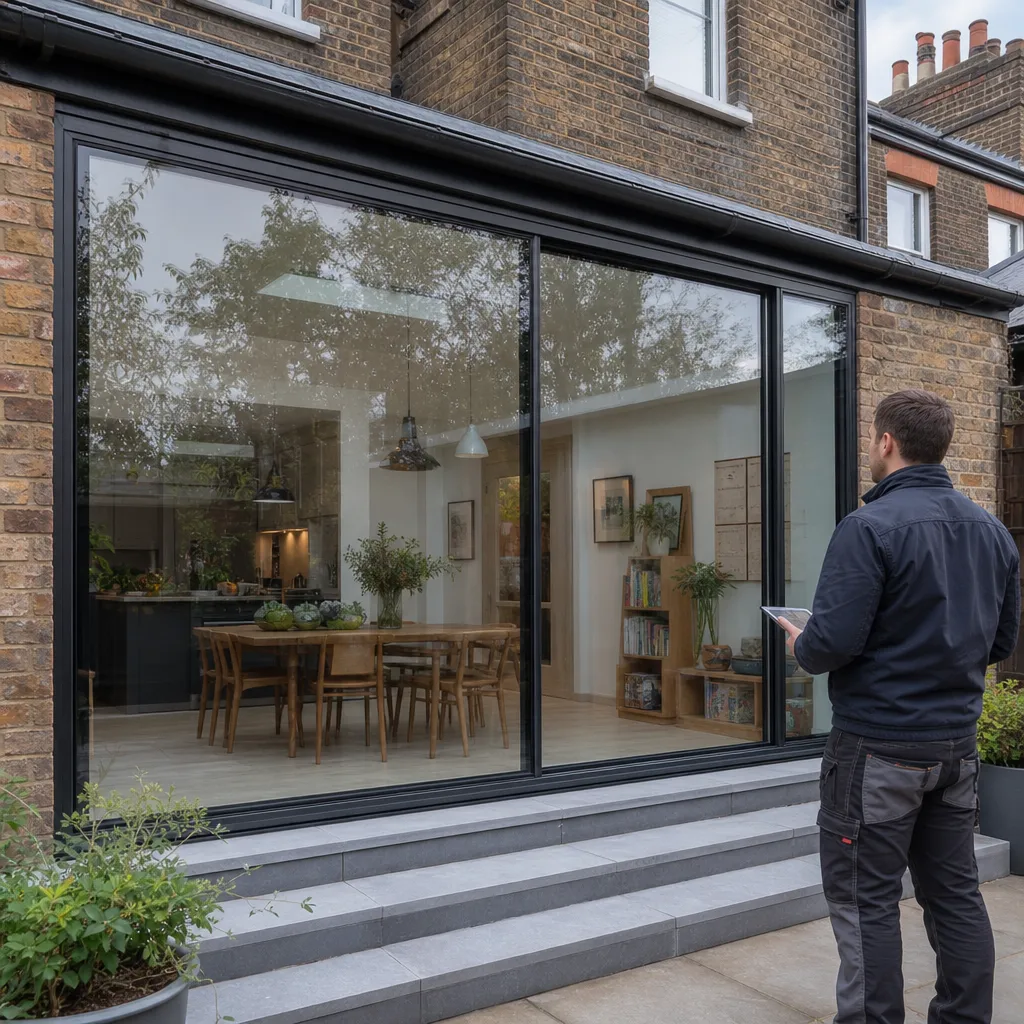
Smart Glass Windows: How Dynamic Glazing Works and Its Benefits
Smart glass changes its optical properties through one of four physical mechanisms: electrochromic glass tints gradually when a small voltage is applied and holds that state without continuous power; PDLC glass aligns liquid crystals to become transparent when mains voltage is applied; SPD glass aligns particles under voltage; and thermochromic glass responds passively to heat.
 Energy & Retrofit
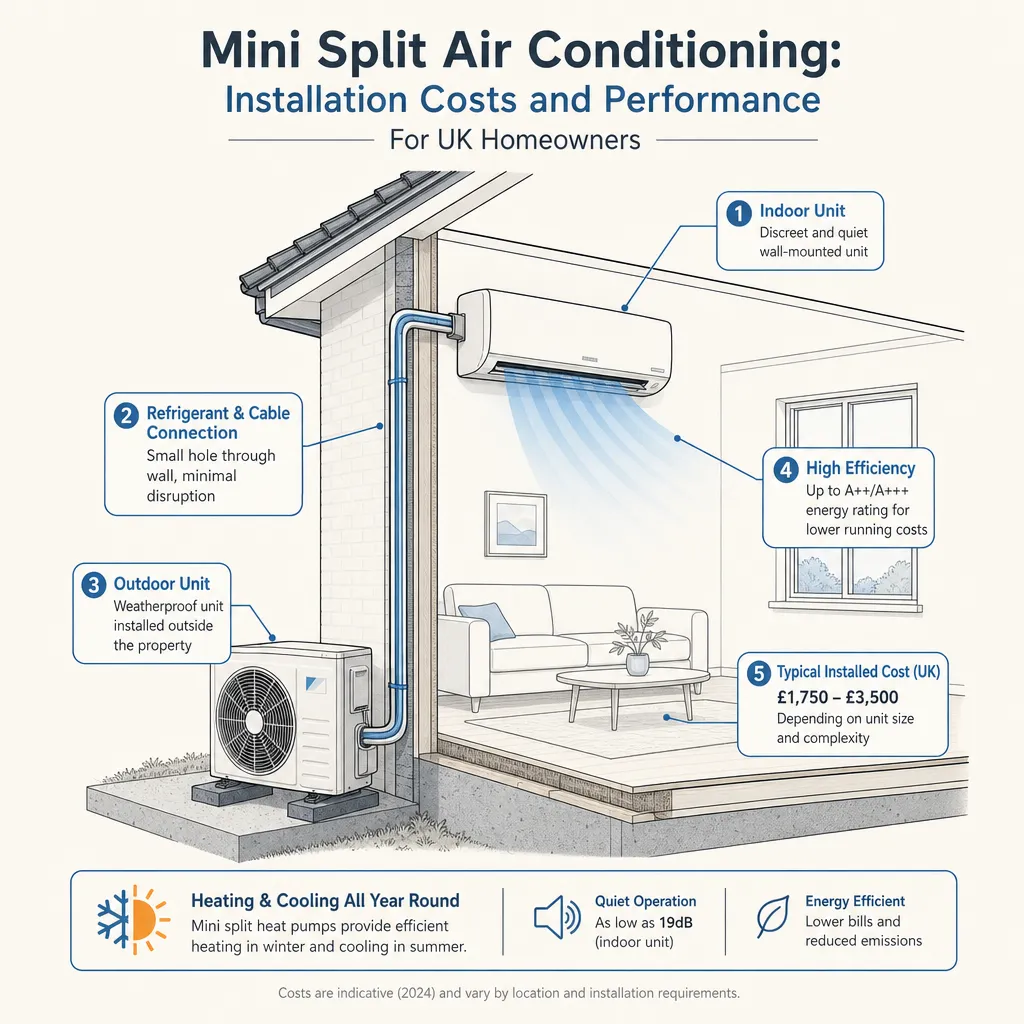
Mini Split Air Conditioning: Installation Costs and Performance
A mini-split (ductless) air conditioning unit costs roughly £1,500–£4,000 installed for a single room in the UK.
 Energy & Retrofit
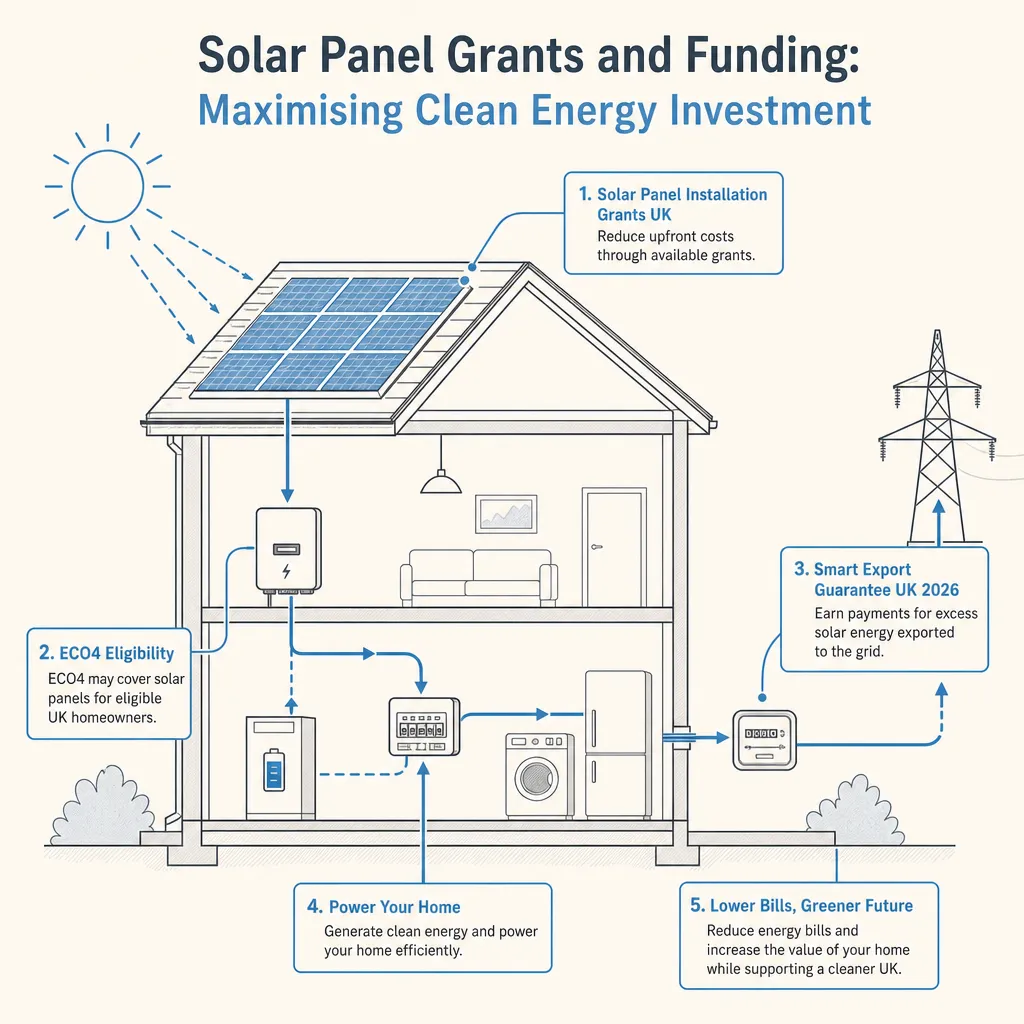
Solar Panel Grants and Funding: Maximising Clean Energy Investment
Several UK solar funding schemes are currently open: the Smart Export Guarantee pays homeowners for surplus electricity exported to the grid, ECO4 can fund free or subsidised panels for eligible low-income households, and 0% VAT on installation applies until at least March 2027.
 Energy & Retrofit
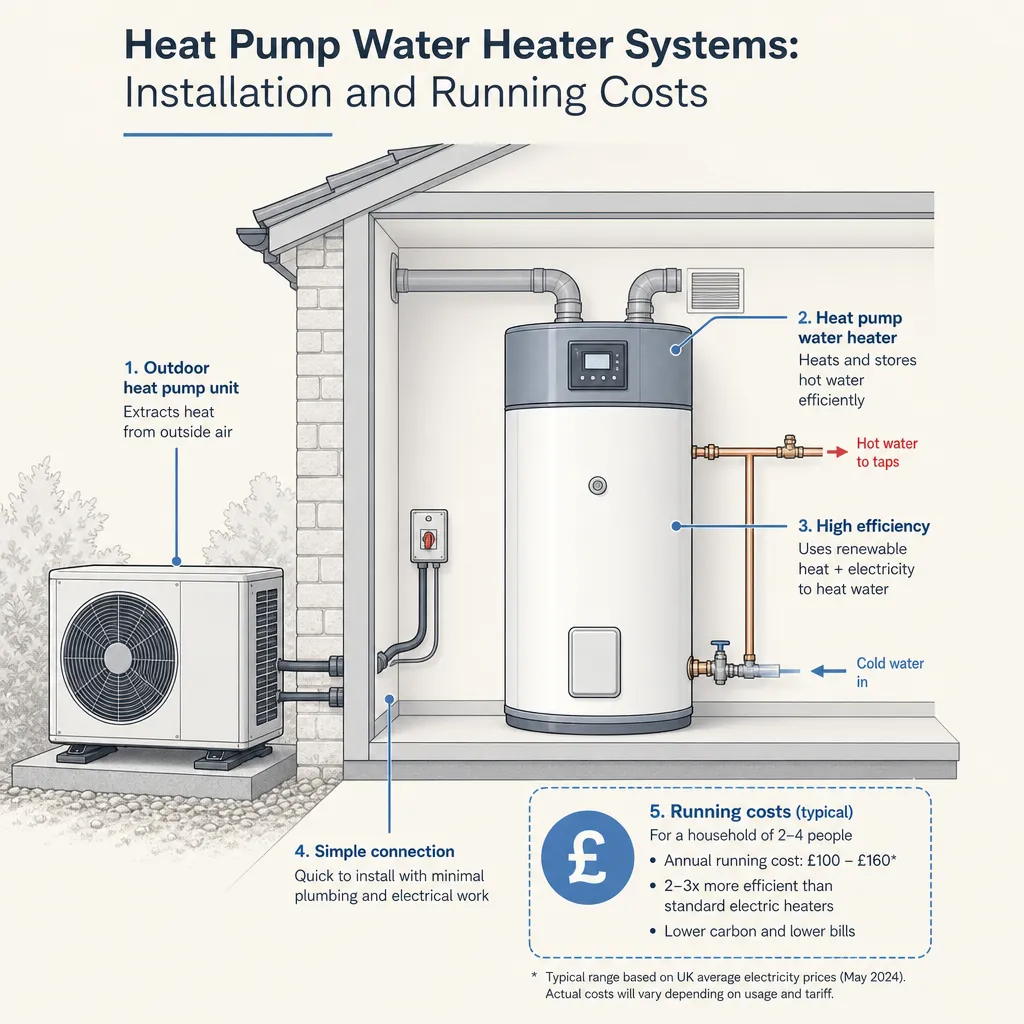
Heat Pump Water Heater Systems: Installation and Running Costs
A heat pump water heater extracts heat from surrounding air to warm your domestic hot water cylinder, achieving a Coefficient of Performance of 2.
 Energy & Retrofit
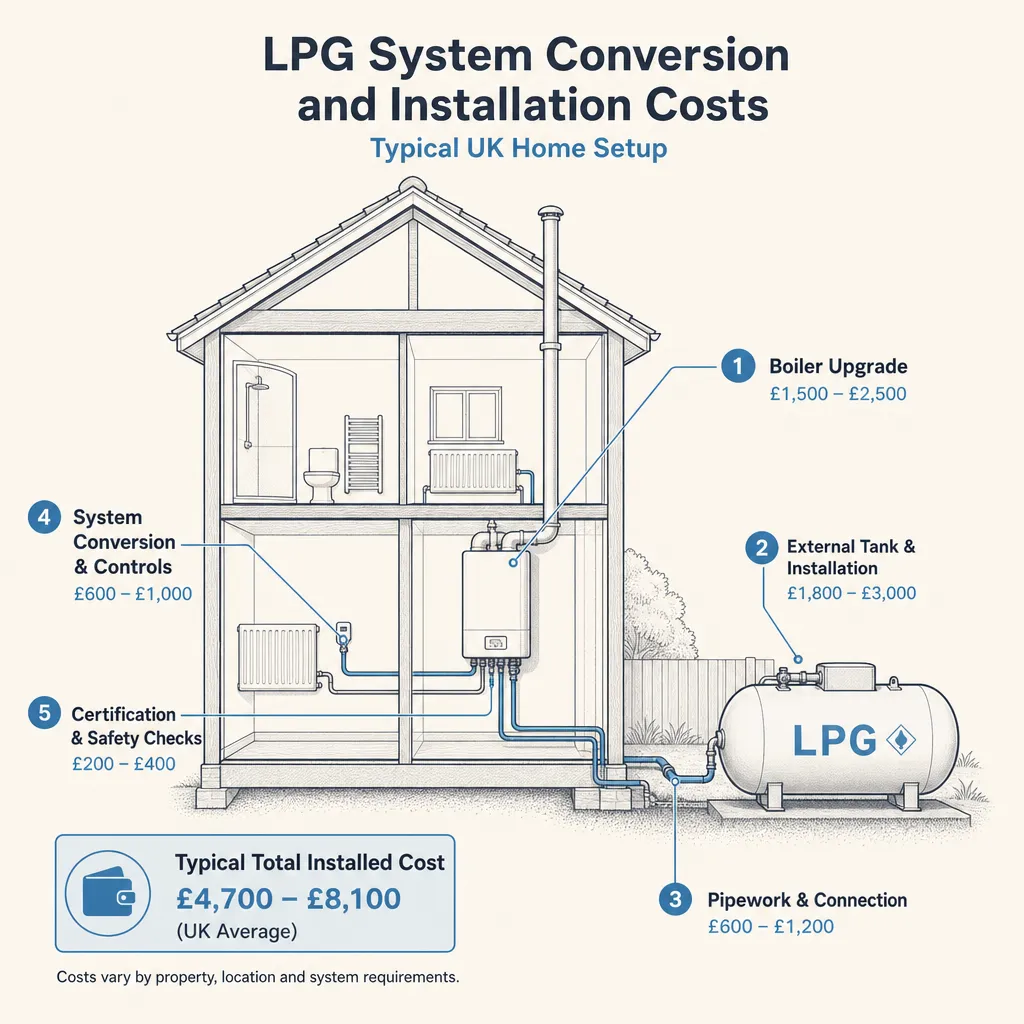
LPG System Conversion and Installation Costs
Converting a UK property to LPG typically costs £3,500–£10,000, covering a new LPG-compatible boiler, pipework, and tank installation.