Installing Soffit Vents: Ventilation, Costs, and Building Regulations
By Housey · Last reviewed 5th of May 2026
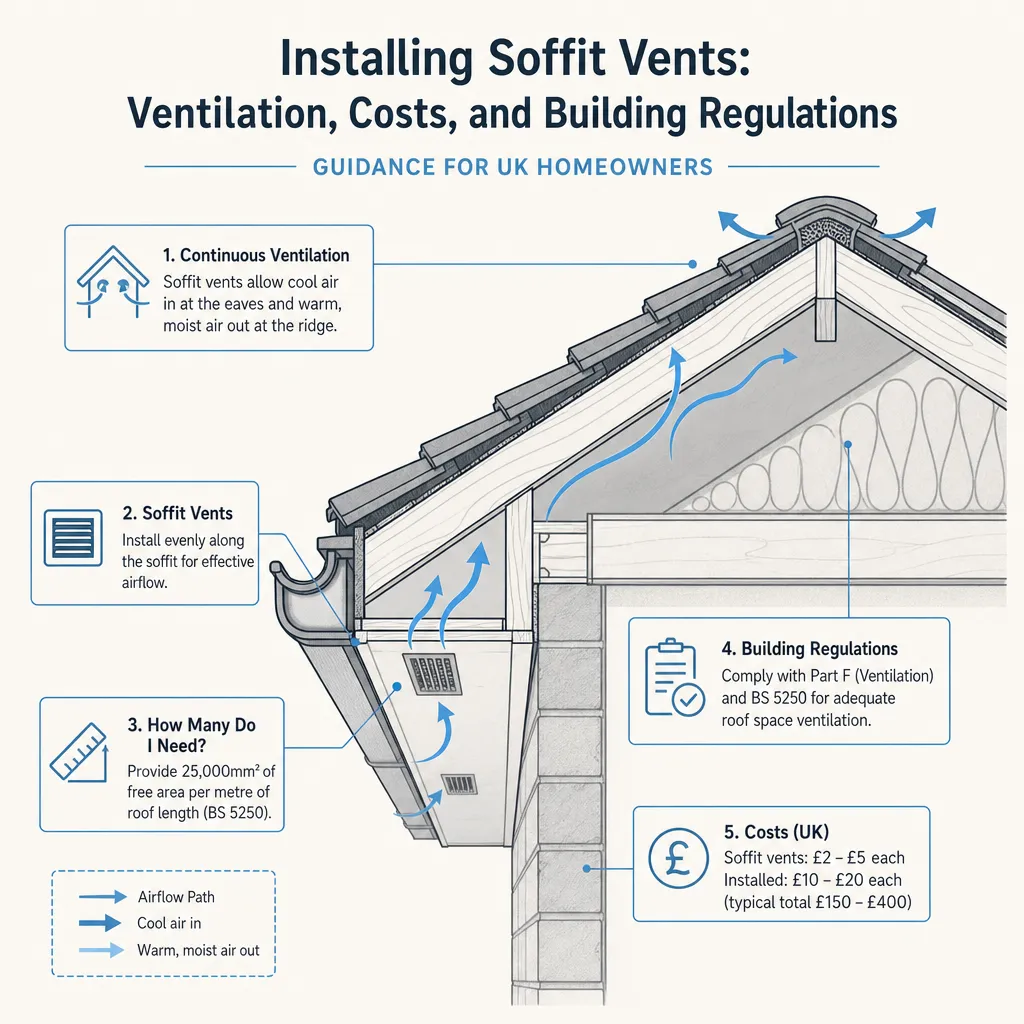
Installing Soffit Vents: Ventilation, Costs, and Building Regulations
Soffit vents are one of the primary means by which fresh air enters a cold roof space in UK homes, and their correct installation directly affects how well a roof structure is protected from condensation and moisture damage. The need to fit, replace, or upgrade soffit vents typically arises during re-roofing work, a loft insulation project, or when a surveyor or roofer identifies inadequate eaves ventilation as a cause of timber decay or interstitial condensation.
Key points
- Approved Document C (Site preparation and resistance to contaminants and moisture) and Approved Document F (Ventilation) under the Building Regulations set out ventilation requirements for roof spaces in England and Wales.
- Cold roofs — where insulation sits at ceiling level rather than at rafter level — require a minimum 50mm air gap between the top of the insulation and the underside of the roof deck, with cross-ventilation at eaves on opposing sides.
- BS 5250:2011 (Code of practice for control of condensation in buildings) specifies the 1/300 rule: a ventilation opening equivalent to at least 1/300 of the roof plan area, split between opposing eaves.
- Approved Document C requires a 25mm minimum clear airway to be maintained at the eaves after insulation is installed — soffit vents must not be blocked by insulation pushed into the eaves void.
- Re-roofing work that also involves changes to insulation or roof structure is likely to trigger building regulations compliance and building control notification requirements.
What are soffit vents and why do they matter?
Soffits are the boards or panels fixed to the underside of the roof overhang at the eaves. Soffit vents are openings — either continuous slotted strips or individual disc or louvred grilles — installed in the soffit to allow outside air into the roof space.
In a cold roof, this airflow travels from the eaves upward across the underside of the roof deck and exits via ridge vents, tile vents, or gable vents. This cross-ventilation carries moisture vapour away before it can condense on cold timber surfaces, preventing rot and mould in the roof structure.
In a warm roof — where insulation fills the full rafter depth — the approach differs and eaves-level ventilation requirements vary by construction method. Confirm with a qualified roofer or building control officer if you are unsure which roof type your property has.
Types of soffit vent
Vent type | Description | Best for | Notes |
|---|---|---|---|
Continuous soffit strip vent | Long slotted strip running the full eaves length | New builds and full soffit replacement | Provides consistent airflow; most commonly specified |
Individual disc or circular vents | Round vents cut or drilled at intervals | Existing soffits where full replacement is impractical | Easier to retrofit; check total EQA against 1/300 rule |
Fascia vents | Slotted vents fitted to the fascia board | Where soffit is narrow or absent | Used where the eaves overhang is limited |
Pre-ventilated uPVC soffit board | Integrated ventilation slots within the full board | Full re-roofing or eaves replacement | Requires replacing the complete fascia and soffit run |
uPVC soffit boards with integrated ventilation are now standard in UK housing due to low maintenance requirements. Always check the free-air equivalent area (EQA) of any product against the 1/300 figure required for your roof plan area before ordering.
How many soffit vents do you need?
The calculation follows the 1/300 rule from BS 5250:2011:
Required ventilation area = Roof plan area (m²) ÷ 300
For a typical 3-bedroom semi-detached with a roof plan area of 50m²:
50 ÷ 300 = 0.167m² (1,670cm²) of equivalent ventilation opening, split evenly between both eaves.
Manufacturers publish the EQA of each product in their technical datasheets. Total your installed EQA and confirm it meets or exceeds the required figure.
Note: where a vapour control layer is absent from the ceiling, some guidance recommends a more generous 1/150 ratio. Discuss with your roofer or building control officer for your specific property.
Worked example: 1930s semi-detached, re-roofing with new soffits
A homeowner in the East Midlands is having their 1930s semi-detached re-roofed. The existing timber soffits are partly rotten and the roofer proposes replacing them with uPVC soffit boards.
- Roof plan area: approximately 48m²
- Required ventilation: 48 ÷ 300 = 0.16m² (1,600cm²) EQA minimum
- Chosen product: continuous uPVC ventilated soffit strip with 10,000mm² EQA per linear metre
- Eaves length (both sides combined): 2 × 8m = 16m
- Total EQA: 16m × 10,000mm² = 160,000mm² = 1,600cm² ✓
The roofer also installs eaves comb fillers to maintain the 25mm clear airway required by Approved Document C, and cross-flow is confirmed via existing ridge tiles. The homeowner notifies the local authority building control as the works involve changes to the external envelope alongside loft insulation.
Soffit vent installation: the process
- Assess existing ventilation — a roofer or building control officer checks whether current provision meets the 1/300 standard.
- Calculate required ventilation area — roof plan area divided by 300, per BS 5250:2011.
- Choose vent type — continuous strip for full soffit replacement; disc vents for retrofitting. Verify EQA.
- Remove old soffits and fascias if replacing, or cut openings into existing soffits for disc vents.
- Fit eaves comb fillers or ventilation baffles — maintain the 25mm minimum clear airway at the eaves.
- Install soffit vents or ventilated soffit boards.
- Check the cross-ventilation path — confirm air flows from eaves to opposing eaves or exits via ridge or tile vents.
- Notify building control if required — particularly for re-roofing, loft insulation upgrades, or structural changes.
Do not allow insulation to be pushed into the eaves void after installation — blocking newly fitted vents is one of the most common causes of failed roof ventilation following loft insulation work.
Indicative costs
Indicative UK costs, last reviewed 2026-05-05. Costs vary by property size, access difficulty, existing soffit condition, and whether full soffit and fascia replacement is included.
Scope | Indicative cost range |
|---|---|
Retrofitting disc vents to existing soffits (DIY materials only) | £1–£3 per vent |
Retrofitting disc vents with labour (full semi-detached) | £150–£400 |
Full uPVC soffit and fascia replacement with strip vents (semi-detached) | £800–£2,000+ |
Full re-roofing including soffits and ventilation upgrade (3-bed semi) | £5,000–£12,000+ |
Always obtain at least three quotes from qualified roofers. Ask each to specify the EQA of the ventilation products they propose and confirm compliance with BS 5250:2011 and Approved Document C.
Do soffit vents require building regulations approval?
Like-for-like soffit board replacement with ventilated equivalents: building regulations approval is not usually required as this is routine maintenance. Check with your local authority building control if uncertain.
Re-roofing, loft insulation changes, or structural roof work: building regulations are likely to apply under Approved Document C and Approved Document F. A building control consultant can advise whether a full application, a building notice, or a regularisation certificate is appropriate for your project.
Working at height on soffits and fascias carries significant risk. This work should be carried out by a competent roofer with appropriate access equipment. Do not attempt to access or replace fascia and soffit boards from a domestic ladder above 2m, in line with HSE guidance on working at height.
What to ask before accepting a quote
- What EQA does the proposed product provide per metre or per unit?
- Does the specification meet the 1/300 ventilation requirement for this roof plan area?
- How will eaves baffles or comb fillers be installed to maintain the 25mm clear airway?
- Is building regulations notification included in the scope, and who handles it?
- What guarantees apply to the uPVC fascia and soffit products?
- Is VAT included in the quoted price?
- What happens if the existing soffit structure or underlying timber is found to be more damaged than expected?
When to get professional help
If a surveyor or energy assessor has flagged inadequate roof ventilation, or if you can see condensation, dark staining, or mould in the loft, do not simply add more vents without understanding the root cause. A qualified roofer should assess whether the issue relates to ventilation quantity, blocked airflow paths, absence of a vapour control layer, or poor insulation installation.
For re-roofing, loft conversion, or insulation upgrade projects, engage building control from the outset to ensure the completed works comply with Approved Document C and Approved Document F.
How Housey can help
Housey can connect you with qualified roofers experienced in UK soffit and ventilation work, and with building control consultants who can advise on whether your project requires formal building regulations notification and help ensure compliance from the start.
Frequently asked questions
Can I install soffit vents myself?
Fitting individual disc vents to accessible soffits at low level is within DIY capability if safe access exists. Working at height above 2m on a ladder or scaffolding is a significant safety risk and should be left to qualified roofers with proper access equipment. Always verify the required equivalent ventilation area and confirm compliance with BS 5250:2011 before purchasing materials.
How do I know if my roof has enough ventilation?
Signs of inadequate roof ventilation include condensation on the underside of the roof deck, dark staining on rafters or sarking boards, mould growth on insulation or timbers, and frost inside the loft in winter. A roofer or RICS surveyor can assess whether current provision meets the 1/300 standard set out in BS 5250:2011.
Do modern houses need soffit vents?
Most UK new-build homes with cold roofs use continuous ventilated soffit strip or equivalent eaves ventilation to comply with Approved Document C and Approved Document F. Some modern constructions use warm roof or hybrid approaches where eaves-level ventilation is handled differently. If you are unsure about your property's roof type, ask a qualified roofer or your local building control officer.
Are uPVC soffits better than timber for ventilation?
uPVC soffit boards with integrated ventilation are low maintenance and come in a range of equivalent ventilation area ratings. Timber soffits can also be ventilated but require regular painting and are more vulnerable to rot if moisture enters. For most UK domestic properties, uPVC is now the standard choice for fascia and soffit replacement due to its durability and ease of maintenance.
Sources and further reading
- Approved Document C: Site preparation and resistance to contaminants and moisture — HM Government
- Approved Document F: Ventilation — HM Government
- BS 5250:2011 Code of practice for control of condensation in buildings — BSI (British Standards Institution)
- Working at height: a brief guide — Health and Safety Executive (HSE)
- Condensation and ventilation guidance — BRE (Building Research Establishment)
Useful next reads
 Improvement & Build
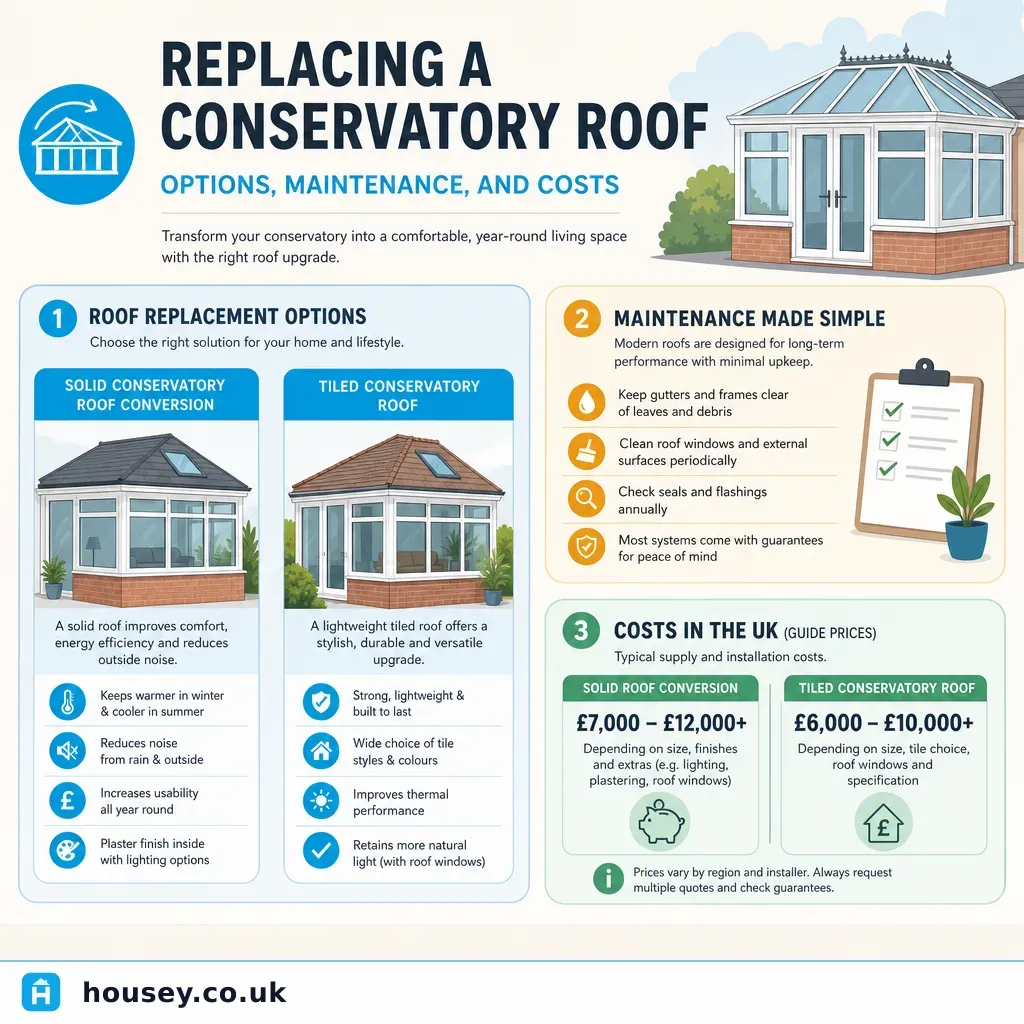
Replacing a Conservatory Roof: Options, Maintenance, and Costs
Conservatory roofs can be replaced with polycarbonate, glass, or solid tiled systems.
 Improvement & Build
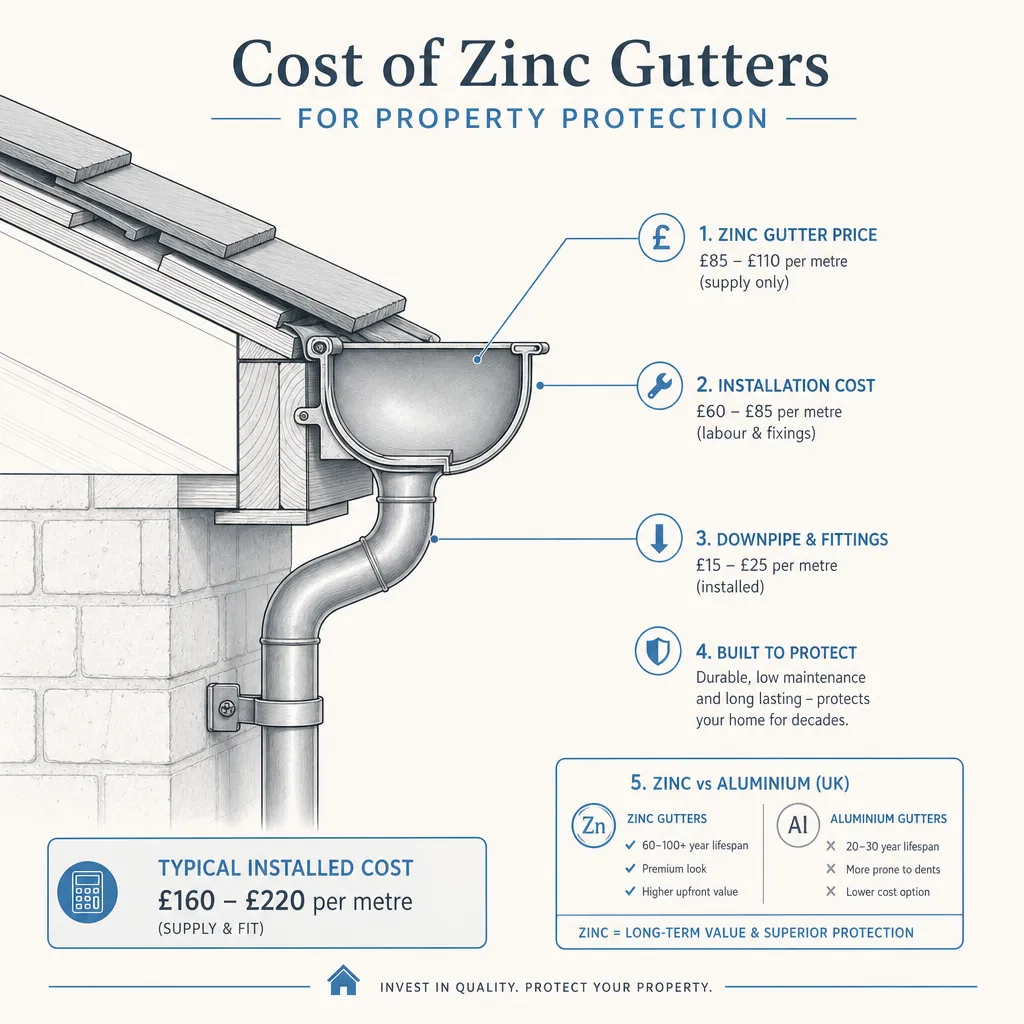
Cost of Zinc Gutters for Property Protection
Zinc gutters cost around £60–£120 per metre installed in the UK, depending on profile complexity, property type, and scaffolding requirements.
 Improvement & Build
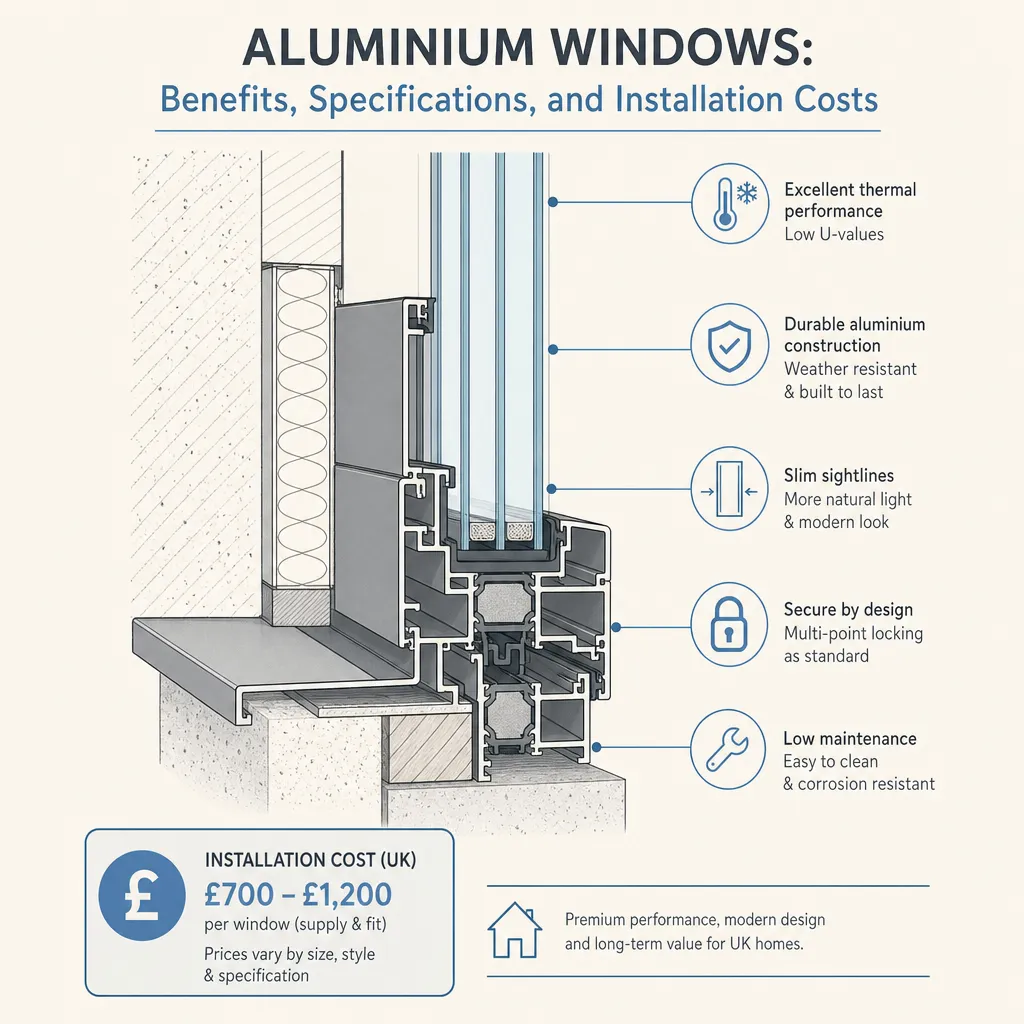
Aluminium Windows: Benefits, Specifications, and Installation Costs
Aluminium windows typically cost £600–£1,800 per window installed in the UK, depending on size and specification.
 Improvement & Build
Building an Outdoor Kitchen: Design, Materials, and Investment
Building an outdoor kitchen in the UK costs roughly £3,000–£25,000 depending on size and materials.
 Improvement & Build
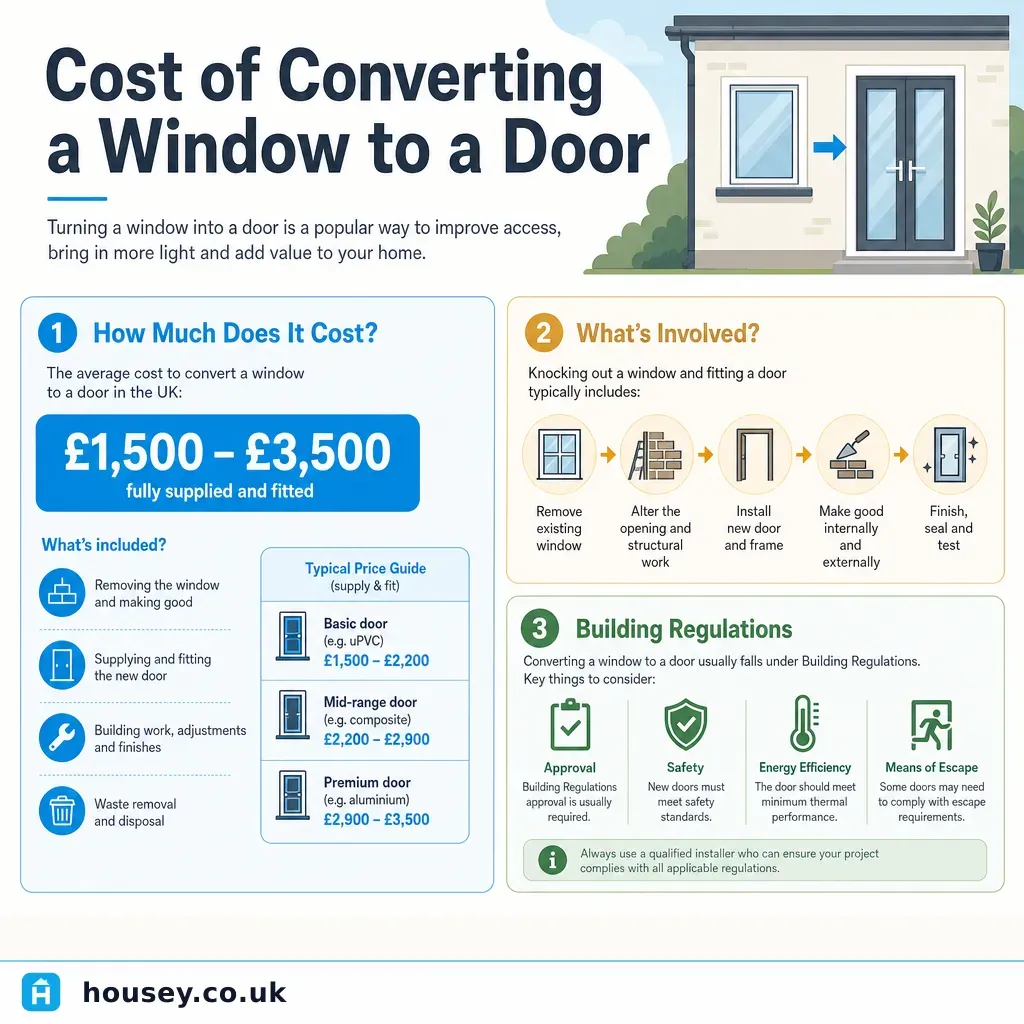
Cost of converting a window to a door
Converting a window to a door in the UK typically costs £1,500–£5,000 or more, depending on wall construction (cavity, solid, or timber frame), the type of door fitted, and whether a new or enlarged lintel is required.