Installing a TV in Your Bathroom: Zones, Regulations and What UK Homeowners Need to Know
By Housey · Last reviewed 6th of May 2026
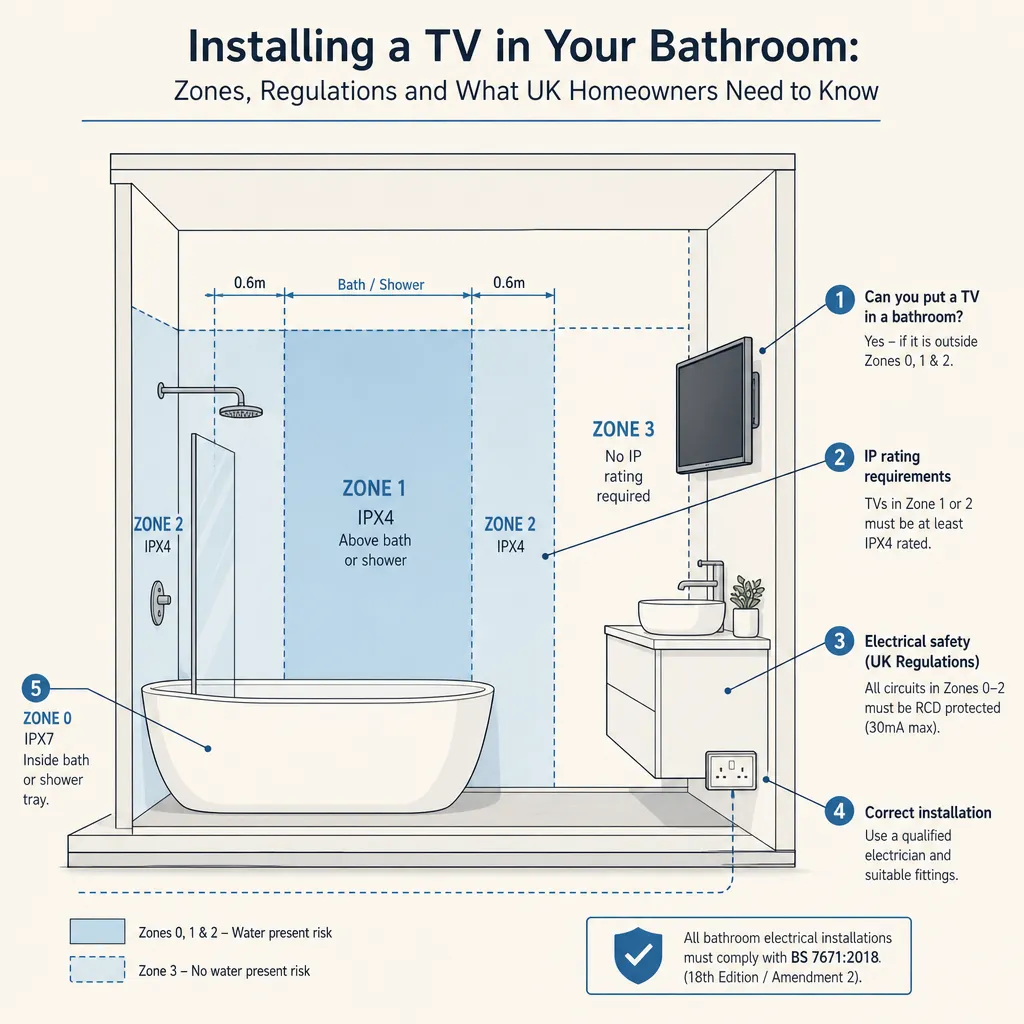
Installing a TV in Your Bathroom: Zones, Regulations and What UK Homeowners Need to Know
Bathroom televisions have moved from hotel luxury to a realistic home upgrade, with IP-rated screens and purpose-built waterproof enclosures now widely available at a range of price points. However, UK bathrooms are subject to strict electrical zone regulations under BS 7671 (IET Wiring Regulations), and the consequences of getting installation wrong range from a voided manufacturer warranty to genuine electrocution risk. Understanding the rules before you buy — and choosing the right electrician to install — is what separates a safe, legally compliant setup from a costly problem.
Key points
- UK bathroom electrical installations are governed by BS 7671:2018+A2:2022 (IET Wiring Regulations 18th Edition) Section 701, which divides the room into Zones 0, 1, and 2 based on proximity to water.
- A TV may be installed in Zone 2 (minimum IP44 rating) or outside all zones — it must not be placed in Zone 0 or Zone 1 under any circumstances.
- All fixed electrical work in bathrooms is notifiable under Building Regulations Part P and must be carried out or certified by a registered competent person, typically a Part P registered electrician.
- A suitably rated residual current device (RCD) must protect all circuits serving bathroom zones; standard 13-amp sockets must be sited at least 3 metres from the bath or shower.
- Non-compliant electrical work in a bathroom can affect your home insurance and will be flagged on an Electrical Installation Condition Report (EICR) at the point of sale.
What are the bathroom electrical zones?
BS 7671 Section 701 sets out the UK electrical zone framework for bathrooms and shower rooms. The zones define what equipment can be installed where, based on the risk of water contact.
Zone | Location | Minimum IP rating | What is permitted |
|---|---|---|---|
Zone 0 | Inside the bath or shower tray | IPX7 | Equipment designed for immersion only; SELV 12V maximum |
Zone 1 | Above the bath or shower to 2.25 m height | IPX4 (IPX5 if water jets likely) | SELV equipment only; shower units and extract fans at IPX5 |
Zone 2 | 0.6 m horizontally from edge of bath or shower, up to 2.25 m height | IPX4 (IP44) | Fixed equipment meeting minimum IP; sealed TVs, certain luminaires and fans |
Outside zones | Beyond Zone 2 | Standard equipment ratings | Most electrical equipment, including standard sockets (minimum 3 m from bath) |
Source: IET Wiring Regulations BS 7671:2018+A2:2022, Section 701.
A television may be legally positioned in Zone 2 with at least an IP44 rating, or outside all zones entirely. Most purpose-built bathroom TVs carry an IP44 or IP65 rating. Always verify the IP specification on the manufacturer's data sheet before purchasing, as zone suitability cannot be assumed from price or appearance alone.
What IP rating does a bathroom TV need?
IP ratings use two digits: the first indicates protection against solid particles, the second against water ingress.
- IP44 — protected against solid objects larger than 1 mm and water splashing from any direction. The minimum requirement for Zone 2.
- IP55 — protected against dust ingress and low-pressure water jets. Suitable for Zone 1 situations such as steam rooms, and for more demanding Zone 2 use.
- IP65 — fully dust-tight and protected against low-pressure water jets. Common on premium bathroom TVs and appropriate across Zone 2.
- IP67 / IP68 — dust-tight and immersion-rated. Required for Zone 0 use; rarely applicable to a TV installation.
A standard household television carries no IP rating and must not be used in bathroom zones under any circumstances, including inside mirrored cabinets or behind glass panels, unless the enclosure itself is IP-rated as a complete certified unit.
What does a bathroom TV installation involve?
A typical installation includes the following steps:
- Site assessment — the electrician confirms zone classification, checks existing circuits and RCD protection, and assesses ventilation and cable routes.
- Circuit design — a dedicated circuit or addition to the existing RCD-protected bathroom circuit, designed to comply with BS 7671 Section 701.
- Mounting — flush or surface-mounted back-box or bracket, sealed where the IP rating of the installation requires it.
- Cable routing — cables must be enclosed or protected against mechanical damage, particularly where run through walls.
- Connection and testing — including insulation resistance testing and RCD functional testing.
- Part P certification — your electrician issues a BS 7671 Minor Works Certificate or Electrical Installation Certificate and notifies the local authority, or self-certifies if registered with a competent persons scheme such as NICEIC or NAPIT.
How much does a bathroom TV installation cost?
Indicative UK costs, last reviewed 2026-05-06.
- Purpose-built IP-rated bathroom TV (15–24 inch): £300–£1,500 depending on size, IP rating, and specification. Mirror TVs — where the screen is concealed behind a reflective panel — typically cost more.
- Electrician's installation fee: £150–£400 depending on complexity, circuit work required, and region.
- Additional circuit work if required: £100–£300+.
- Part P building control notification fee: £100–£200 if notifying the local authority directly; most Part P registered electricians self-certify at no additional cost to the homeowner.
Always request itemised quotes and confirm that VAT is shown separately.
What to ask before accepting a quote
Before instructing an electrician for a bathroom TV installation, ask:
- Are you registered with a Part P competent persons scheme — NICEIC, NAPIT, ELECSA, or equivalent?
- Will you issue a BS 7671 Electrical Installation Certificate on completion?
- How will Part P notification be handled — do you self-certify, or will I need to notify my local building control separately?
- Have you confirmed which zone the proposed TV location falls into, and what IP rating is required for that position?
- What RCD protection is currently in place, and will the new circuit be fully covered?
- Does the quote include all cable routing, fixings, testing, and certification?
- Is VAT included in the quoted price?
Important limitations
This article provides general information about UK bathroom TV installation regulations as of May 2026. Electrical zone requirements and Part P obligations are governed by BS 7671 (subject to periodic amendment) and Building Regulations Part P. Requirements may vary for specific property types including licensed HMOs, listed buildings, and social housing. This article is not a substitute for a qualified electrician assessing your specific installation. Do not attempt DIY electrical work in a bathroom — this is specialist work where errors can cause electrocution, fire, or invalidate your home insurance.
What to ask a qualified professional
Before instructing an electrician, ask:
- Which zone does my planned TV position fall into under BS 7671 Section 701, and what IP rating does the TV need to carry?
- Is a dedicated circuit required, or can my existing RCD-protected bathroom circuit support the additional load safely?
- What IP-rated screen would you recommend for this location, and do you supply as well as install?
- Are there any listed building consent or planning implications for surface cable routing in my property?
- Will you handle the Part P competent person notification, and can I receive a copy of the installation certificate?
When to get professional help
For bathroom electrical installations, professional help is not optional — it is a legal requirement under Building Regulations Part P.
- All fixed electrical work in bathrooms is notifiable; unregistered work will be flagged on an EICR and can create problems at point of sale.
- Insurance claims arising from non-compliant electrical work may be reduced or rejected by your insurer.
- A bathroom TV installation is not a suitable DIY task regardless of general electrical experience.
Red flags to watch for in a quote or during initial discussions with a contractor:
- The electrician does not mention Part P, certification, or a competent persons scheme registration.
- No Electrical Installation Certificate is offered on completion.
- The contractor proposes fitting a standard, non-IP-rated consumer TV into Zone 2 or Zone 1.
- No RCD check or circuit assessment is mentioned before quotation.
- The quote contains no reference to testing or inspection.
How Housey can help
If you need a qualified electrician to install a bathroom TV safely and in compliance with BS 7671 and Building Regulations Part P, Housey can help you find and compare local registered professionals. Use Housey to request quotes, verify scheme registrations, and review credentials before committing to any electrical work in your home.
Frequently asked questions
Can I install a regular TV in my bathroom if it is inside a sealed cabinet?
Generally, no. BS 7671 requires fixed equipment in bathroom zones to meet the minimum IP rating for that zone as a complete unit. A standard TV inside a sealed cabinet does not carry the required IP rating. Only purpose-built IP-rated bathroom TVs or properly certified sealed enclosures designed for that application are appropriate in Zone 2 or Zone 1.
Does a bathroom TV need its own dedicated circuit?
Not always, but it may be necessary depending on the existing circuit design and load. Your electrician will assess whether the existing RCD-protected bathroom circuit has sufficient capacity and whether adding a TV is compliant with BS 7671 Section 701. A dedicated circuit is sometimes the cleaner solution and makes future fault-finding more straightforward.
Do I need planning permission to install a TV in my bathroom?
In most cases, no. Installing a TV in a bathroom does not require planning permission. However, if your property is listed, you may need listed building consent for any structural alterations made during installation — for example, channelling cables into historic fabric. Check with your local planning authority if your property is listed or in a conservation area.
Will a non-compliant bathroom TV installation affect my home insurance?
Potentially yes. Many home insurers require electrical work to comply with Building Regulations and BS 7671. If a claim arises following a fire or electrical fault and non-compliant work is identified, insurers may reduce or reject the claim. Always use a registered electrician and keep your installation certificate as proof of compliance.
Can I use a streaming stick or Chromecast with a bathroom TV?
Most purpose-built bathroom TVs are smart TVs with built-in streaming apps. Some also accept HDMI input. A streaming stick can be connected via HDMI if the TV supports it, but the device carries no water-resistance rating and should not be placed directly in Zones 0–2. Confirm the arrangement with your electrician before the installation is finalised.
Sources and further reading
- Building Regulations Approved Document P: electrical safety in dwellings — GOV.UK
- IET Wiring Regulations BS 7671 (18th Edition) — Institution of Engineering and Technology
- Electrical safety in bathrooms — Electrical Safety First
- NICEIC registered electricians — NICEIC
- NAPIT registered contractors — NAPIT
Useful next reads
 General property advice
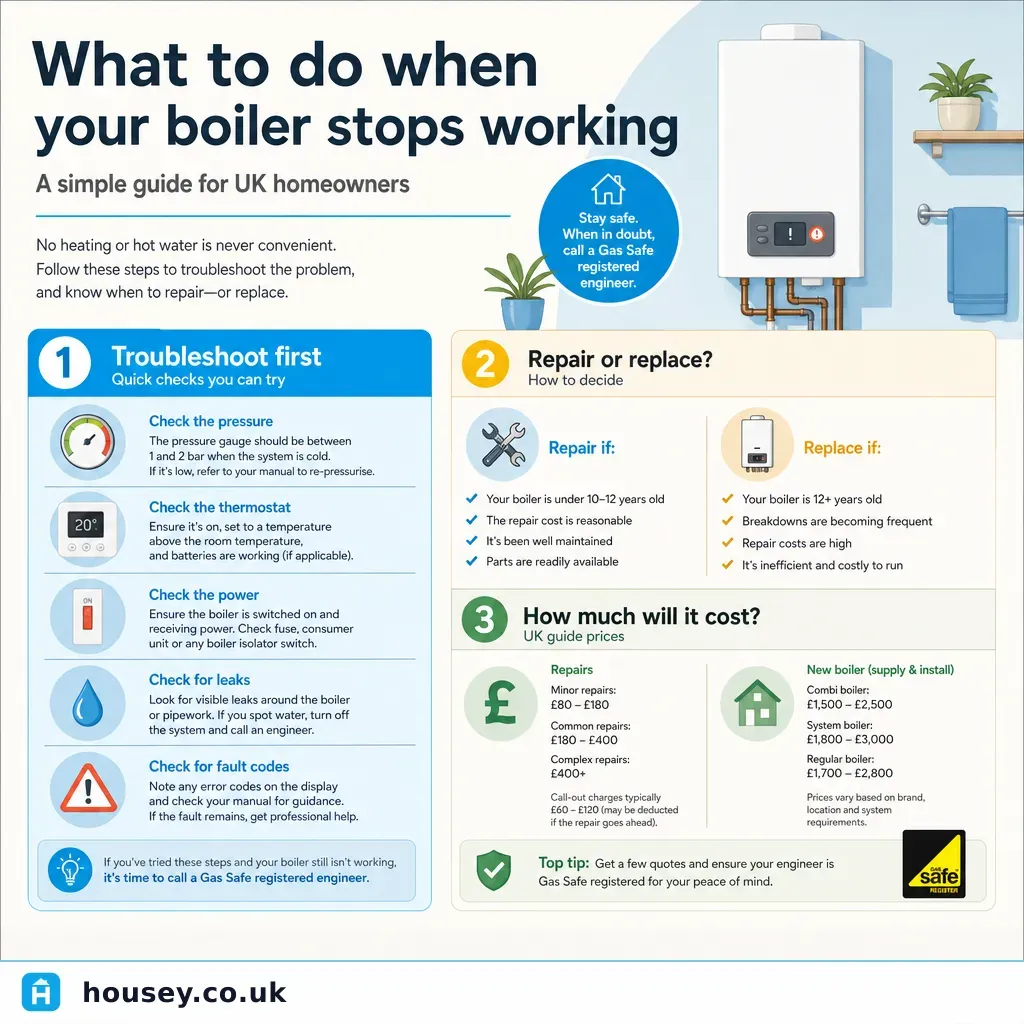
What to do when your boiler stops working
When your boiler stops working, check the pressure gauge (should read 1–1.
 General property advice
Property Market Trends: Activity Growth and Price Movements
UK property market activity is measured through completed sale registrations (HM Land Registry), lender mortgage data, and transaction volumes from HMRC.
 General property advice
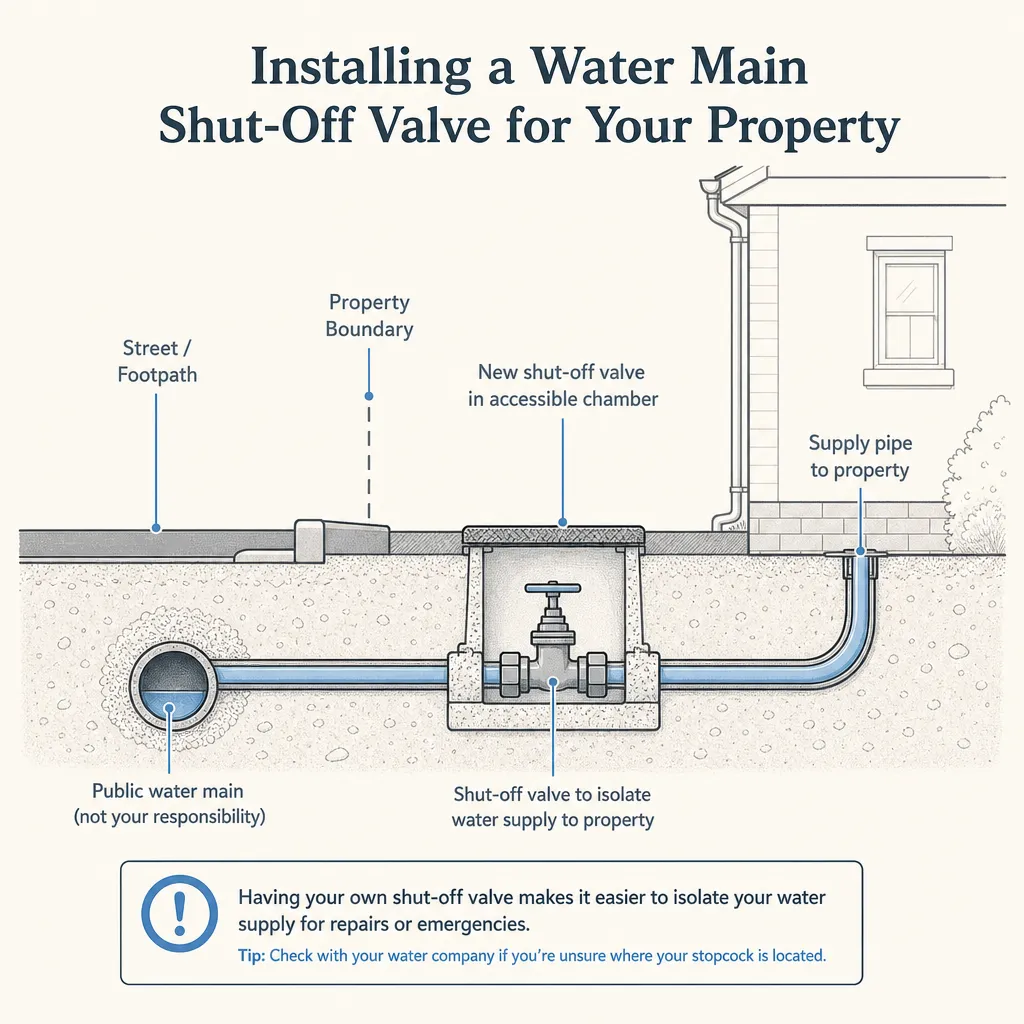
Installing a water main shut-off valve for your property
A water main shut-off valve — commonly called a stopcock — controls all water entering your home from the mains.
 General property advice
Monthly House Price Index: August Market Report and Analysis
The UK House Price Index is published monthly using completed Land Registry transaction data, meaning August figures typically reflect sales agreed months earlier.
 General property advice
Scottish Property Market: Activity and Regional Trends
Scotland's property market operates under distinct legal rules: sellers must provide a Home Report before marketing, transactions become legally binding at conclusion of missives rather than exchange of contracts, and Land and Buildings Transaction Tax replaces Stamp Duty.